
There is no single, trustworthy national number for DUI lawyer cost. Fees are set lawyer by lawyer and court by court, and they usually take the form of a flat fee, an hourly retainer, or a phased fee that grows if the case goes to a contested hearing or trial. Under the American Bar Association’s Model Rules, a fee must be reasonable, and the basis for it should be communicated to you, preferably in writing. The only price that counts is the one in the lawyer’s written fee agreement.
This national guide explains what you are paying for, why quotes differ, which costs sit outside the attorney’s fee (fines, court costs, license fees, classes, interlock devices), and how five states compare on verified penalty rules. It also covers public defenders, payment plans and fee disputes. Everything here is general information, not legal advice.
DUI Lawyer Cost: How Fees Are Set and What They Cover
A DUI lawyer’s fee is a negotiated price for a defined set of tasks, not a posted rate. It is shaped by the court, the facts of the arrest, the stage the case reaches and how the lawyer structures billing. This section explains the ground rules before any dollar figure comes into play.
Why no honest national price exists
Search results are full of “average DUI lawyer cost” figures, and most of them trace back to marketing pages rather than to any court, bar association or government agency. We have not found an official source that publishes a national fee average for DUI defense, so this guide does not print one. What follows is what can be verified: the rules that govern fees, the structures lawyers use and the factors that move the price.
What the ethics rules say about fees
ABA Model Rule 1.5(a) says a lawyer may not charge an unreasonable fee or unreasonable expenses. The rule lists factors for judging reasonableness, including the time and labor required, the difficulty of the questions, the fee customarily charged locally for similar services, the time limits the circumstances impose, the lawyer’s experience and ability, and whether the fee is fixed or contingent. Each state adopts its own version of the rule, so the wording of your state’s rule controls.
Rule 1.5(b) adds that the scope of the representation and the basis of the fee, along with the expenses you must pay, should be communicated to you, preferably in writing, before or soon after the work begins. That is why a written fee agreement is the most useful document you will receive from any lawyer.
Why published “averages” are unreliable
A cost average blends very different cases: a first-time arrest with a low breath result and no crash, and a repeat arrest with a blood test, a collision and a possible felony charge. It also blends rural courts with major metropolitan courts. A single number from that mix tells you little about the quote you will actually receive.
Treat any average you see online as a rough prompt for questions, not a budget. If a page cites no official source and no date, assume it is advertising copy.
Ask every lawyer you speak with for the fee in writing, with the scope spelled out. Then compare scopes, not just totals. A lower quote that excludes the DMV hearing, a suppression motion and trial may cost more in the end than a higher quote that includes them.

Text version of this graphic
- Arrest and release. Police arrest, test or request a test, and release you with paperwork.
- License notice. The arrest paperwork often starts a separate, short DMV deadline.
- Arraignment. You appear, hear the charge and enter an initial plea.
- Evidence review. Your lawyer requests reports, video, test records and calibration data.
- Motions and negotiation. Challenges to the stop or test; talks with the prosecutor.
- Plea or trial. You resolve the case by agreement or contest it before a judge or jury.
- Sentence and compliance. Fines, classes, probation terms and any device requirements.
- License reinstatement. Fees and paperwork restore driving privileges.
The fee structures you are likely to see
Most DUI defense is billed in one of three ways, sometimes blended. Knowing the structure helps you read a quote and spot what is left out.
Flat fees
A flat fee is a set price for a defined scope, such as handling the case through a plea or through a pretrial hearing. Its appeal is predictability. Its weakness is the scope: flat fees often exclude trial, the separate license hearing, expert witnesses or appeals, so ask exactly where the flat fee stops.
Many lawyers use a flat fee only up to a milestone and quote a new figure if the case is set for trial. That is not necessarily unfair, but it should be written down before you sign.
Hourly rates with a retainer
Under an hourly arrangement, you pay a retainer (an upfront deposit held in trust) and the lawyer bills time against it. This model can cost less when a case resolves early, and more when the prosecution contests everything. Ask for the hourly rate, who else bills time (associates, paralegals, investigators), the billing increments and how often you receive an itemized statement.
ABA Model Rule 1.15(c) says a lawyer must deposit fees and expenses paid in advance into a client trust account and withdraw them only as fees are earned or expenses incurred. If you pay an advance deposit, ask how it is held and when portions move out of trust.
Phased or milestone fees
A phased fee splits the work into stages with a separate price for each, for example the initial investigation, pretrial motions and trial. The structure ties payment to work actually done and gives you decision points: you can see the next price before you commit to the next stage.
The trade-off is that the total depends on how far the case goes, and you may not control that. A prosecutor’s refusal to offer a reasonable plea, for instance, can push the case into a costlier stage.
What a lawyer may not charge or label
Some fee practices are barred or restricted by the ethics rules, and others are common but widely misunderstood. A few minutes on these points can prevent a dispute later.
Why contingency fees are off the table
In civil injury cases, many lawyers take a percentage of a recovery. DUI defense is different: ABA Model Rule 1.5(d)(2) prohibits a lawyer from charging or collecting a contingent fee for representing a criminal defendant. A lawyer who offers to be paid only if you “win” a DUI case is offering something the model rule forbids, and your state’s rule will likely say the same. See our guide to wrongful death lawyer cost for how contingency fees work in a civil case, which is the opposite arrangement.
Check your state’s version of Rule 1.5 or ask the state bar if you are unsure. Where a rule is a model rather than binding law, the state’s adopted text governs.
Understanding “nonrefundable” and “earned on receipt” labels
Some fee agreements call a payment nonrefundable or earned the moment it is paid. A 2024 Criminal Justice magazine article discussing ABA Formal Opinion 505 (2023) explains that, under the Model Rules, calling a fee nonrefundable does not by itself make it so. A minority of jurisdictions differ by rule or advisory opinion, so state law matters.
ABA Model Rule 1.16(d) requires a lawyer, on ending the representation, to take steps to protect the client’s interests, including refunding any advance payment of fee or expense that has not been earned or incurred. If a lawyer is discharged or withdraws early, ask in advance how the agreement treats the refund.
Be cautious about any fee agreement that calls your payment nonrefundable but does not explain what work it covers, when that work is considered finished, or what happens if the representation ends early.
What Moves a DUI Lawyer’s Fee Up or Down
Quotes for what looks like the same charge can differ because the cases are not the same. The factors below explain most of the gap, and they are the same ones the ethics rules point to when they ask whether a fee is reasonable.
Factors tied to your case
Your facts and the charges you face drive the amount of work. More contested evidence, more serious allegations and more hearings usually mean a higher fee, whatever structure the lawyer uses.
Test type, result and charge level
A breath test, a blood draw and a refusal each raise different legal questions. A blood result may involve a laboratory, chain-of-custody records and sometimes a toxicology expert. A refusal can trigger separate license consequences and, in some states, different sentencing rules. Higher alcohol concentrations are also treated more severely in several states, as the state comparison later in this guide shows.
Charge level matters too. A first-offense misdemeanor, a charge with an aggravating factor and a felony are different workloads. Your lawyer cannot tell you the real scope until they have read the police report and the charging document.
Prior record, crash or injury
A prior DUI conviction within a state’s look-back period can raise the charge and the penalties. A collision, an injury or a child in the vehicle can add counts, a victim’s insurer or a civil claim. Each of these can lengthen the case and widen the lawyer’s tasks.
If anyone was hurt, tell the lawyer at the first meeting. A DUI defense lawyer and a civil injury lawyer do different work, and your criminal exposure and civil exposure can affect each other.
Evidence and expert needs
Body-camera and dash-camera video, field sobriety test instructions, breath instrument maintenance records and blood-draw procedures can all be reviewed. Some cases need an outside investigator or a toxicologist, and expert time is billed separately in many fee agreements. A lawyer who tells you early which of these are likely in your case is giving you cost information you can use.
Ask whether expert and investigator fees are included in the quote or billed on top. Under ABA Model Rule 1.5(a), unreasonable expenses are barred along with unreasonable fees, so costs deserve the same scrutiny as the headline number.
Plea or trial
Cases that resolve by plea generally take less lawyer time than cases set for a contested hearing or a jury trial. Whether the prosecutor offers a resolution you would accept is partly outside everyone’s control. That uncertainty is why many agreements treat trial as a separate, higher-cost stage.
Do not assume that a lower upfront fee means a lower final cost. Ask what the agreement says will change if the case does not settle.
Factors tied to the lawyer and the court
The second group of factors has nothing to do with whether you are guilty or innocent. They are about where the case is, who is handling it and what is bundled into the price.
Local court practices and market
Under Rule 1.5(a), the fee customarily charged locally for similar services is one of the reasonableness factors. A busy metropolitan court with long dockets and multiple hearing dates can cost more in lawyer time than a small court that moves quickly. Distance matters as well: a lawyer who must travel to a distant courthouse may price that in.
This is why a quote from a lawyer in one county is a poor guide to a quote from another county, and why a national figure says little about your local court.
Experience and staffing
Rule 1.5(a) also lists the experience, reputation and ability of the lawyer as a factor, and that is a legitimate reason for fees to differ. It also explains why a solo lawyer, a small firm and a large firm may quote differently. We do not rank lawyers, and no price tells you how a case will end.
Ask who will actually handle your case day to day, which tasks go to staff, and whether the person you meet at the consultation is the person who will appear in court.
What the fee covers and what it leaves out
Scope is the single most important variable in a quote. The same total can cover very different bundles, so compare the scope line by line using the table below.
| Factor | How it can affect the fee | What to ask the lawyer |
|---|---|---|
| Test type and result | Blood or contested breath results can add records review and possible expert work. | Will an expert or lab review be needed, and who pays? |
| Charge level and priors | Aggravated, repeat or felony-level charges add procedures and hearings. | Which charge am I facing, and what changes if it is amended? |
| Crash or injury | More parties, more evidence and possible civil exposure. | Do you also handle related civil matters, or should I speak to a separate lawyer? |
| Video and records | Hours of recordings and instrument records take time to review. | Is video review included in the stated fee? |
| Contested motions | Motions to challenge the stop, arrest or test add drafting and hearing time. | Are pretrial motions included or billed as a separate stage? |
| Plea vs. trial | Trial is typically the costliest stage. | What is the fee if the case is set for trial, in writing? |
| License (DMV) hearing | A separate proceeding with its own deadline, and sometimes its own agency fee. | Is the license hearing included, and who pays any agency hearing fee? |
| Local court and travel | Court congestion, distance and hearing frequency affect lawyer time. | Are travel and filing costs billed separately? |
| Staffing | Associates and paralegals may lower hourly cost but change who does the work. | Who will appear at each hearing? |
A fee is not “reasonable” simply because a client agreed to it. Under ABA Model Rule 1.5(a), the fee must still meet the reasonableness test, and you may raise a fee concern with your state bar. A later section explains how fee disputes are handled.
How to Compare DUI Lawyers and Read a Fee Agreement
You can compare DUI lawyers fairly by asking each one the same questions and laying the written answers side by side. Price is one column in that comparison, not the whole sheet. This directory does not rank or recommend lawyers, so the method matters more than any name.
Questions that make quotes comparable
If you speak with three lawyers and ask three different sets of questions, you will not be able to compare the answers. Use one list for every call. Our guide to what to ask before hiring a criminal defense lawyer covers consultation questions that apply to any criminal case, and the DUI-specific ones follow here.
Experience in your court and with your facts
Ask how often the lawyer handles DUI cases in the specific court where yours is pending, and whether they have handled cases involving your kind of evidence, such as a blood test, a refusal or a crash. Experience is a legitimate fee factor under Rule 1.5(a), but ask for descriptions of the work rather than claims of titles. Be wary of any claim of formal certification or specialization unless your state actually offers a recognized program and the lawyer can name it.
Lawyer advertising is regulated. ABA Model Rule 7.1 says a lawyer may not make a false or misleading communication about the lawyer or the lawyer’s services, and many states add stricter advertising rules.
Scope, staffing and communication
Ask exactly what the quoted fee covers: the criminal case, the license hearing, motions, trial, any appeal. Ask who will handle each task and how you will be updated. A clear answer to “what happens next and when” is a good sign of an organized practice.
Ask how quickly the lawyer returns calls only as a description of their routine; do not treat a promised response time as a measure of quality. We do not rate or vouch for any lawyer’s responsiveness.
Honesty about outcomes
A careful lawyer will talk about possible outcomes, risks and what depends on evidence you have not yet seen. A lawyer who promises a dismissal, a specific sentence or a license outcome before reviewing the file is not describing the process accurately. No lawyer controls a prosecutor’s decision, a judge’s ruling or a lab result.

Text version of this graphic
| Criterion | Question to ask | Weight |
|---|---|---|
| Scope of fee | What exactly does the quoted fee include and exclude? | High |
| Fee structure | Is it flat, hourly or phased, and what triggers a new charge? | High |
| License hearing | Is the DMV hearing included, and who pays its agency fee? | High |
| Local court experience | How often do you handle DUI cases in this court? | High |
| Costs and experts | Which expenses are billed separately from the fee? | Medium |
| Staffing | Who handles my case and who appears at hearings? | Medium |
| Communication | How will I receive updates and itemized statements? | Medium |
| Refunds | What happens to unearned fees if the case ends early? | High |
Reading the fee agreement line by line
The fee agreement is the contract that turns a conversation into a price. Read it before signing and ask for changes in writing. If a promise matters to you, it should appear on the page.
Scope and stages
Look for a clear list of what the representation includes: the arraignment, pretrial motions, negotiations, hearings, trial and the license proceeding. Then look for what is excluded. Anything listed as “additional” or “outside the scope” will cost extra, and the agreement should say how that price is set.
Check the end point as well. An agreement that ends at sentencing may not cover a later violation of probation or a request to modify conditions.
Payments, trust accounts and refunds
Look at how much is due, when it is due and what happens if you miss a payment. Ask whether advance money goes into a client trust account, consistent with Model Rule 1.15(c), and when portions are treated as earned. Look for the refund clause, because Rule 1.16(d) requires refunding advance fees that have not been earned or incurred when a representation ends.
The Criminal Justice magazine article on Formal Opinion 505 notes that a few jurisdictions allow small flat fees to be handled differently from the Model Rule, so ask the lawyer how your state treats the arrangement and confirm with your state bar if something looks unusual.
Costs, expenses and who decides
Find the section on costs. Typical items include filing or records fees, process servers, investigators, experts and transcript charges. The agreement should say whether the lawyer needs your approval before incurring a major expense. It should also say how costs are billed: advanced from your deposit, charged as they arise, or added to the final statement.
Keep a signed copy of the agreement and every invoice. If a disagreement arises, those papers are your evidence.
Do not let a fee negotiation run past a license-hearing deadline. In some states the request for a DMV hearing is due within 7 to 15 days of the arrest or notice. Ask any lawyer you are considering whether they can act on the license deadline right away, and look up the deadline on your own paperwork as a backstop.
Preparing for the first consultation
A prepared client gets a more specific answer and a more accurate quote. Gathering documents before the call also shortens the time a lawyer spends on intake, which is time you might otherwise pay for.
Documents to gather
Collect the citation or complaint, any bail or release paperwork, the notice of license suspension if you received one, the property or vehicle impound receipt, and the court notice that shows your next date. Note the date, time and place of every deadline printed on those papers. If you have a prior record, write down the dates and courts as best you can.
Notes to write down while memory is fresh
Write a short timeline of the evening in your own words: where you were, what you ate or drank and when, when you were stopped, what the officer said and asked, and what tests were offered. Keep it for your lawyer only and do not post it online or share it with others. Conversations with a lawyer you are considering hiring are generally treated as confidential, but ask about confidentiality at the start of the call.

Text version of this graphic
- Charging papers. The citation, complaint or release paperwork.
- License notice. Any suspension notice and its printed deadline.
- Court dates. Your next hearing date, time and courtroom.
- Your timeline. A private, written account of the evening.
- Test paperwork. Breath, blood or refusal forms you received.
- Prior record. Dates, courts and outcomes of earlier cases.
- Insurance and vehicle details. Policy papers and impound receipts.
- Questions list. The same questions to ask every lawyer.
Bring a notebook and write the lawyer’s answers next to each question. Afterward, fill in one line per lawyer: scope, fee structure, what is billed separately and what the refund terms say. A side-by-side sheet makes the cheapest-looking quote easy to test.
If you are in a particular state, a state guide can add local detail. For one example of how a state-level guide is organized, see our Idaho criminal defense lawyer guide.
Beyond Attorney Fees: Court Costs, Fines and Penalty Add-Ons by State
The attorney’s fee is only one line in the total cost of a DUI case. Fines, court assessments, program fees, monitoring, license fees and insurance changes are set by state law and local courts, and they vary a great deal from state to state. This section compares five states using the statutes themselves, so the figures below are sourced, not estimated.
Fines, court costs and assessments are not the same thing
People often use “court costs” for everything the court charges. The terms have different legal meanings, and the difference affects what a plea or a sentence actually costs you.
Three kinds of charges on one bill
A fine is the monetary punishment the judge imposes within a statutory range. Court costs are charges that fund court operations or other government programs. Assessments and surcharges are add-ons set by statute that attach to the conviction, such as a victim-assistance fee. Some are fixed, some are percentages and some change with legislation, so ask the clerk for the current figure rather than trusting an old internet post.
New York is one example. Penal Law § 60.35 sets mandatory surcharges and a crime victim assistance fee that depend on the class of offense, and it makes an exception tied to Vehicle and Traffic Law § 1809 for certain traffic-law convictions. That is why the amount you owe on a New York conviction depends on the exact offense and statute.
Maximum exposure is not a typical outcome
A statute lists what a judge may impose. It does not tell you what usually happens, and we do not publish “typical” sentences because we have no verified source for them. Minimums, such as a mandatory jail floor or a minimum fine, are more informative about cost than maximums, because a judge cannot go below them (except where the statute allows an alternative).
Plea terms also matter. A negotiated plea can change the offense of conviction, and with it the fine range, the assessments and the license consequences.
Be skeptical of any page or caller that gives you an exact total “cost of a DUI” without knowing the state, the court, the test result and the charge. The statutes below show why: the same offense can carry very different mandatory amounts in neighboring states.
Five states compared on verified first-offense rules
The table shows the baseline criminal exposure for a first DUI conviction in five states, based on each state’s statute as we read it in October 2026. It is a comparison tool, not a prediction. Your charge, test result, prior record and the court’s rules may change every entry.
| State and statute | Baseline first offense | Higher-test tier | Fixed items the text lists |
|---|---|---|---|
| Texas, Penal Code § 49.04 | Class B misdemeanor; minimum 72 hours confinement; up to 180 days and a fine up to $2,000 (§ 12.22) | Alcohol concentration of 0.15 or more is a Class A misdemeanor: up to one year and a fine up to $4,000 (§ 12.21) | Minimum confinement is fixed; fine is a ceiling. |
| Florida, Stat. § 316.193 | Fine of $500 to $1,000; up to 6 months imprisonment; monthly-reporting probation; DUI school | 0.15 or more, or a minor in the vehicle: fine of $1,000 to $2,000; up to 9 months; ignition interlock at least 6 months | At least 50 hours of community service (or $10 per hour alternative); 10-day vehicle impoundment; offender pays program costs |
| New York, Vehicle & Traffic Law § 1193 | DWI misdemeanor: fine of $500 to $1,000, up to one year in jail, or both | Aggravated tier (§ 1192(2-a)(a)): fine of $1,000 to $2,500; one-year minimum revocation | Court must impose probation or conditional discharge with an ignition interlock for at least 12 months; revocation of at least 6 months |
| Arizona, A.R.S. § 28-1381 | Class 1 misdemeanor; 10 consecutive days in jail (court may suspend all but 1 day after required screening and education); fine of at least $250 | Higher-concentration and aggravated tiers are addressed in other provisions not summarized here | $500 prison-construction assessment and $500 public-safety-equipment assessment; certified interlock required in some cases |
| Washington, RCW 46.61.5055 | BAC under 0.15: 24 hours to 364 days in jail; fine of $350 to $5,000, with $350 not suspendable unless indigent | BAC of 0.15 or more, or test refusal: 48 hours to 364 days; fine of $500 to $5,000, with $500 not suspendable | Court may order electronic home monitoring (offender pays) or 24/7 sobriety program; ignition interlock rules apply |
Texas and Florida
Texas classifies a first DWI as a Class B misdemeanor with a 72-hour minimum, and a concentration of 0.15 or more raises it to a Class A misdemeanor. We could read the Texas Penal Code text only through a legal-text mirror, not the state’s own statute site, so the Texas row is flagged for confirmation. Florida’s statute (Fla. Stat. § 316.193) is more granular on money: it sets a fine range for each conviction number and ties higher penalties to a 0.15 result or a minor in the vehicle, and it makes the offender responsible for the reasonable cost of the DUI program’s education, evaluation and treatment.
Florida also lets the court replace community service hours with a per-hour payment if it finds undue hardship, and it allows the court to dismiss an impoundment order if the defendant installs a certified ignition interlock on regularly driven vehicles. These are options a lawyer may raise, not entitlements.
New York, Arizona and Washington
New York separates impaired driving by degree: a lower-level DWAI is a traffic infraction with a fine of $300 to $500 and up to 15 days in jail under § 1193(1)(a), while DWI is a misdemeanor. The statute also requires an interlock condition for at least 12 months on the misdemeanor DWI sentence, with early termination possible after proof of installation. Arizona’s text gives unusually specific fixed numbers: a 10-day minimum jail term, a minimum $250 fine and two $500 assessments, which together add $1,250 in the items the statute names, before any program, screening or interlock costs.
Washington sets a minimum fine in each tier and makes part of it non-suspendable unless the defendant is indigent. The court may also order electronic monitoring or a 24/7 sobriety program, which the offender pays for at rates set by the local government.
How to use the comparison
Use the table to see what categories of cost exist in your state, then ask your lawyer or the court clerk for current figures. Do not use a neighboring state’s numbers. If your arrest happened out of state, ask whether the home state of your license will treat the out-of-state conviction as a conviction under its own law, because that can bring separate license consequences.
Two drivers each face a first-offense charge at the base tier, with no prior record and no crash. One is stopped in Arizona, where the statute lists a 10-day jail minimum (with a path to reduce it after screening and education) and two $500 assessments. The other is stopped in Washington, where the statute sets a fine range of $350 to $5,000 and a 24-hour jail minimum with monitoring alternatives. The base statutes are structured differently, and a lawyer in each state would explain which options apply, if any, to a specific case.
Costs that arrive after sentencing
Many of the largest expenses in a DUI case are not attorney fees or fines. They are conditions you must meet, usually at your own expense, to complete probation and get your license back.
Classes, evaluations and treatment
Florida’s statute requires completion of a substance abuse course at a state-licensed DUI program, including a psychosocial evaluation, and makes the offender pay the reasonable costs of education, evaluation and treatment. Arizona’s statute refers to court-ordered screening, education or treatment and requires approved traffic survival school, though it states no price. Other states have comparable requirements under different names, with fees set by the provider, the court or the state.
Ignition interlocks and monitoring
An ignition interlock device is a breath-testing device wired into a vehicle that prevents it from starting if it detects alcohol. Florida’s statute, for example, requires an interlock for a second conviction at the offender’s expense. Washington and Florida also allow sobriety or electronic monitoring programs, with the offender bearing the cost. None of the statutes we read states a monthly rate, so ask the vendor or the court for current charges.
Insurance filings and reinstatement fees
After a DUI conviction or license action, a state may require proof of higher liability insurance on a special form. Florida’s DHSMV describes an FR-44 form for convictions after October 1, 2007, and California requires proof of financial responsibility with its reissue fee. We did not find official figures for what these filings add to premiums, so do not rely on online estimates; ask an insurance agent for a quote after the case is resolved.
Reinstatement fees are easier to verify. California’s DMV lists a $125 reissue fee ($100 for a driver under 21 suspended under zero tolerance), and Texas DPS lists a $125 reinstatement fee on its administrative license revocation page. Fees change, so confirm with the agency.
The License Case: Short DMV Deadlines and Hearing Costs
In many states, a DUI arrest starts two separate cases: the criminal case in court and an administrative case about your driver’s license. The license case has its own agency, its own rules and, often, a deadline of only days. Missing it can cost you the chance to contest a suspension, whatever happens in criminal court.
Why the DMV case runs on its own clock
The administrative process is about driving privileges, not guilt. Different standards apply, a different decision-maker hears it and the deadlines are usually far shorter than anything in the criminal case.
Two proceedings, two outcomes
The criminal court decides whether you are convicted of a DUI offense and imposes the sentence. The licensing agency decides whether to suspend or revoke your driving privilege based on a failed or refused chemical test. Texas DPS states the point directly: the administrative license revocation (ALR) suspension is separate from the criminal court proceedings for DWI.
That separation means you can face a suspension even if the criminal charge is later reduced or dismissed, and you can sometimes defeat the suspension and still face the criminal charge. Each track needs its own attention.
Deadlines that arrive before you may have hired anyone
The paperwork the officer hands you at arrest often starts the clock. In California, for example, the DMV says you have 10 days from receipt of the suspension order to request a hearing. If you are still weighing quotes on day six, you are using up the window.
Read the notice you were given the day you were arrested and find the hearing deadline printed on it. The deadline is counted from the arrest or from the notice, depending on the state, and a late request may be denied. If you cannot find the notice, contact the licensing agency directly or ask a lawyer in your state the same day.
Four states compared on license-hearing rules
The next table shows four states where we could verify the agency’s rules, as of October 2026. These are first-offense, adult, noncommercial-license rules. Commercial drivers, drivers under 21 and repeat offenders face different rules.
| State and agency | Deadline to request a hearing | First-offense suspension (test over limit) | Refusal | Fees the agency lists |
|---|---|---|---|---|
| California, DMV | 10 days from receipt of the order | 4 months (after a 30-day temporary license period) | 1 year | $125 reissue fee |
| Texas, DPS (SOAH hearing) | 15 days from service of notice (20 days from mailing if you consented to a blood test) | Length shown in a DPS chart, not summarized here | Length shown in a DPS chart, not summarized here | $125 reinstatement fee listed on the DPS page |
| Florida, DHSMV | 10 days from the notice of suspension (formal or informal review) | 6 months | 1 year for a first refusal | Review fee not stated in the statute text we reviewed |
| Washington, DOL | 7 days from arrest or notice (postmarked) | At least 90 days | At least 1 year | $375 non-refundable hearing fee; waiver available if indigent |
California and Texas
California’s DMV page gives a four-month suspension for a first offense at 0.08 percent or more for a driver 21 or older, and a one-year suspension for a refused or uncompleted test. The DMV’s fact sheet says the suspension takes effect after a 30-day temporary license period. Texas lets you request an ALR hearing within 15 days of service of the notice, or within 20 days of mailing if you consented to a blood test, and a suspension takes effect on the 40th day after notice if you do not request a hearing.
In Texas the hearing is conducted by the State Office of Administrative Hearings, not a criminal court, and an administrative law judge decides whether the suspension is upheld. The decision can be appealed.
Florida and Washington
Florida’s statute gives a driver 10 days to request a formal or informal review, with a 10-day temporary permit issued at the time of the notice. A first suspension for a result at or over 0.08 is six months, and a first refusal is one year. Washington’s deadline is the shortest in this set: its notice says the request must be postmarked within 7 days of the date of arrest, with a non-refundable $375 fee unless the person qualifies for a waiver.
Washington’s statute sets the minimum for a test result at or above 0.08 at 90 days and for a refusal at one year. A minimum is a floor, and the actual period can differ by facts and by what the person has previously done.
What a lawyer does at a license hearing and what it adds
Whether a lawyer attends the license hearing, and whether it is part of the quoted DUI fee, are cost decisions you can make with eyes open. You are not required to hire a lawyer for the administrative hearing, but the stakes may justify asking about it.
Confirm whether the hearing is in the quote
Some lawyers fold the license hearing into the overall fee and others price it separately. Ask for the answer in writing and ask whether the lawyer can meet the deadline in your state. A hearing request can be filed by you or by a lawyer, but it must reach the agency on time.
Agency fees and fee waivers
Washington’s $375 fee is paid to the agency, not to the lawyer, and it is separate from any attorney fee. The statute lets the department waive it for an indigent person as defined in RCW 10.101.010. Not every state charges a hearing fee, so check your notice.
Hardship and occupational licenses
Many states allow a restricted license so a suspended driver can drive to work, school or treatment. Texas DPS says you may be eligible to apply for an occupational license to drive a non-commercial vehicle while suspended, and Florida’s DHSMV describes a hardship license that requires proof of DUI program completion. These licenses usually carry their own application steps and fees, so ask whether the lawyer’s quote includes the petition.
Make a one-page calendar the day you are arrested: the license-hearing deadline, the arraignment date, and any date to enroll in a required class. Put the deadlines in two places, such as a phone calendar and a paper copy, and share them with the lawyer you hire.
Paying for a DUI Defense: Public Defenders, Payment Plans and Fee Disputes
If a private lawyer’s fee is out of reach, you have options, and you also have protections if a fee turns out to be a problem. This section covers court-appointed counsel, ways to spread or contain cost, what to do about a fee dispute and the key decision points as a case moves along.
Court-appointed counsel and public defenders
The Constitution sets a floor for when the government must provide a lawyer, and states may go further. Whether you qualify in practice depends on your income, the charge, the possible penalty and your state’s procedures.
The constitutional floor
In Gideon v. Wainwright, 372 U.S. 335 (1963), the Supreme Court held that states must provide counsel to indigent defendants in criminal trials. In Scott v. Illinois, 440 U.S. 367 (1979), the Court held that the Sixth and Fourteenth Amendments bar a jail or prison sentence for an indigent defendant unless the State provided appointed counsel, and do not require appointed counsel where the sentence does not include imprisonment. DUI statutes commonly authorize jail time, so many first-offense defendants who are indigent are eligible for appointed counsel, but that depends on your state and the judge, and some courts decide before the arraignment whether jail is on the table.
How states decide who is indigent
Each state sets its own test. Florida’s statute treats an applicant as indigent if income is at or below 200 percent of the federal poverty guidelines for the household size, and it also counts receipt of certain benefits. The clerk of court makes the initial determination, and a person found not indigent may seek court review. Washington’s statute defines indigent in several ways, including an after-tax income at or below 125 percent of the federal poverty level, and separately defines “indigent and able to contribute” for people who can pay part of the cost.
Appointed counsel can still carry costs
Florida charges a $50 application fee for court-appointed counsel, and after a conviction or plea the court may order the state-paid costs recorded as a lien against the defendant. Washington’s category of “indigent and able to contribute” means part of the cost may fall on you. Ask the clerk or the public defender’s office exactly what you might owe afterward.
Using a public defender is not a lesser defense in law. Public defenders are often assigned many cases at once, so ask about contact and timelines at the first meeting, and make sure you know the dates of every hearing and the license-hearing deadline.
Containing and spreading the cost
A lower price should never come at the cost of a poorly defined scope. These approaches help you control the total without trading away important protections.
Phased payment and written payment plans
Many lawyers will accept installments or phase the fee by stage. If you are offered a payment plan, get it in the fee agreement, including what happens if a payment is late. Ask whether work stops if a payment is missed, and whether the plan changes the refund terms.
Court payment arrangements
Ask the clerk of the court whether fines and assessments can be paid in installments and what happens if you miss a payment. Florida’s DUI statute allows replacement of community service hours by a $10 per hour payment on a finding of undue hardship, and many courts have other mechanisms. Rules vary and we did not verify payment-plan policies for every state, so ask the court directly.
Referral programs and legal aid
State and county bar associations often run lawyer referral services that connect people with lawyers who have agreed to its terms. Legal aid organizations often focus on civil cases and may not defend criminal charges, so a legal aid office may not help with a DUI itself, though some can point you to other resources. Check your state bar’s website for current programs.
If you think a fee is wrong
Fee disagreements are common enough that most states provide a path for them. Start with the lawyer, put your concern in writing, and escalate only if it is not resolved.
Raise it with the lawyer in writing
Write a short, specific message that cites the fee agreement and states what you believe is wrong, for example a charge outside the scope or an unearned balance after the lawyer withdrew. Keep a copy. Many disputes end here, because the lawyer must justify the charge under the reasonableness rule.
State bar fee-dispute programs
Programs differ by state. The State Bar of California, for example, runs a Mandatory Fee Arbitration program in which, once a client requests arbitration, the attorney is required to take part, and the client does not need a lawyer to use it. Most arbitrations go through local county bar programs. Check your own state bar’s website for how fee disputes are handled where you live.
Unearned fees and client protection
The Criminal Justice magazine article on Formal Opinion 505 notes that unearned fees are the largest category of claims against client protection funds, which are state-run funds that reimburse clients in some circumstances. Ask your state bar whether such a fund exists and what it covers. A fund is a last resort, not a plan.
Costs, deadlines and decision points on one timeline
Most people face the same sequence of choices, and each has a cost consequence. Seeing them in order helps you ask the right question at the right time.
The first days
In the first week, the questions are the license deadline, whether to hire a lawyer and whether you qualify for appointed counsel. Find the date on your notice, gather your papers and speak with more than one lawyer if time allows.
The pretrial period
Once your lawyer has the evidence, the questions become whether to file motions, what the prosecutor is offering and whether to accept a plea. This is where the fee structure matters, because a phased agreement will show the price of the next stage.
After the case resolves
After a plea or verdict, the costs are compliance costs: fines, classes, probation, devices and license reinstatement. Your sentence may also affect later questions about record clearing, which is covered in our expungement lawyer guide. Eligibility for that depends entirely on state law.
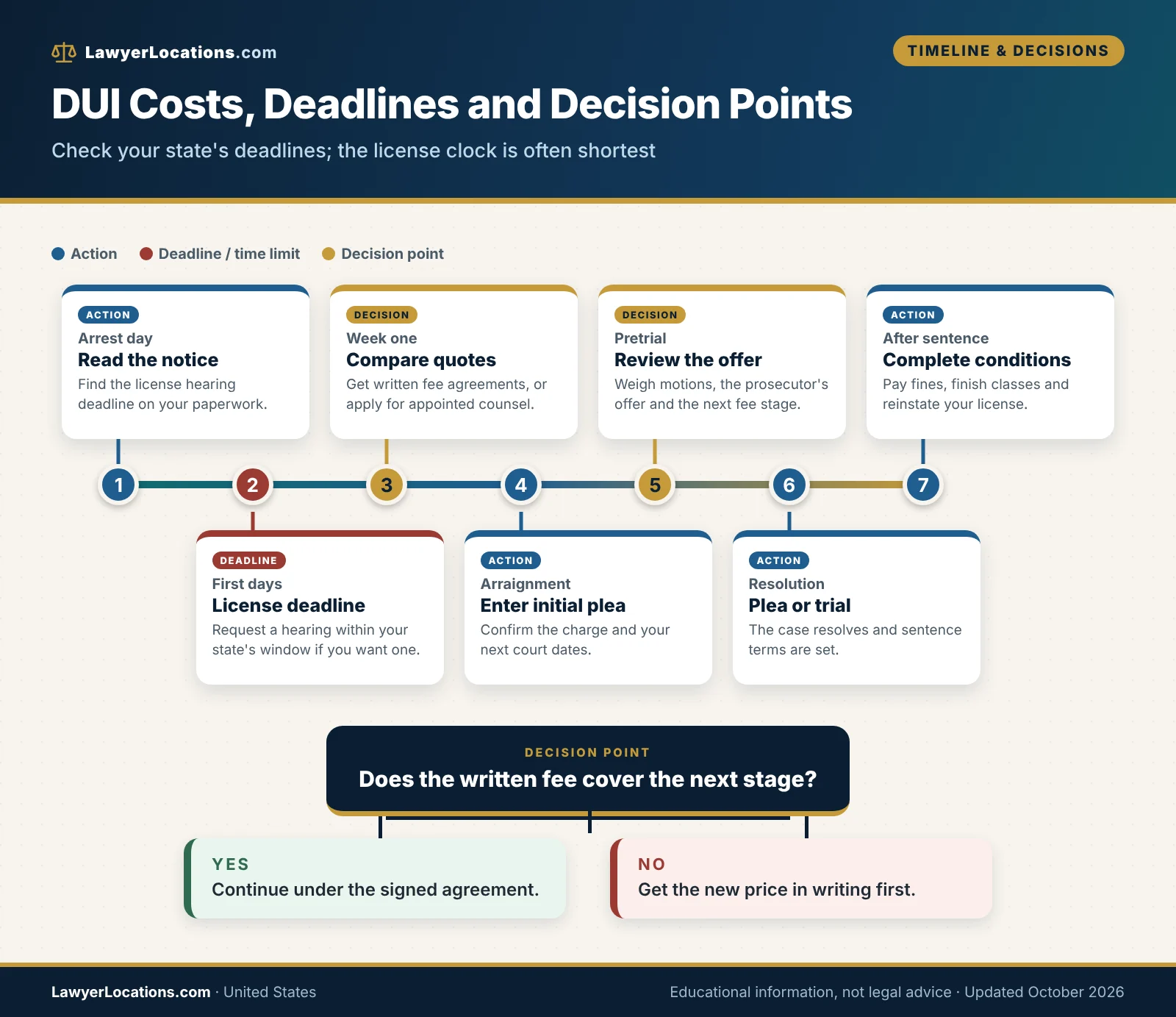
Text version of this graphic
- Arrest day (action). Read the license notice and note its deadline.
- First days (deadline). Request the license hearing if you want one, within your state’s window.
- Week one (decision). Compare written quotes or apply for appointed counsel.
- Arraignment (action). Enter an initial plea and confirm your next dates.
- Pretrial (decision). Review evidence, motions and the prosecutor’s offer.
- Resolution (action). Plea, hearing or trial; then sentence terms.
- After sentencing (action). Pay fines, finish classes and reinstate your license.
Decision point: Does the written fee cover the next stage? If yes, continue under the agreement. If no, get the new price in writing before authorizing more work.
Common Mistakes, Red Flags and Next Steps
Most avoidable DUI costs come from a handful of mistakes: missed deadlines, unclear agreements and decisions made in a panic. Most of the red flags below are also checkable in a few minutes, using documents you already have.
Mistakes that raise the total cost
These are patterns, not predictions. They explain why a calm first week often saves more money than a quick signature.
Missing the license-hearing deadline
The most expensive mistake can be the earliest one. A missed administrative deadline can mean losing the right to contest a suspension, and the suspension can interfere with work, school and family obligations. The deadlines in this guide run from 7 to 15 days depending on the state, so treat the printed notice as urgent.
Signing before you understand the scope
A fee agreement that says “DUI defense” without a scope list leaves room for later add-ons. Ask the lawyer to list what is included and excluded, and keep the signed copy. If you are told “we’ll figure it out later,” ask for that sentence in the agreement.
Paying without a receipt or a written agreement
Any payment, including a cash deposit, should come with a receipt and a fee agreement that states how the money will be held and applied. Without that paper trail, a refund dispute becomes your word against theirs. Keep copies of every statement.
Discussing the case with others
Statements you make to friends, on social media or to insurers may not be protected by confidentiality. Share the timeline only with your lawyer, and ask your lawyer before you speak with an insurance adjuster or a prosecutor. If drugs rather than alcohol were involved, see our guide to finding a drug crime lawyer in Atlanta, GA for how that charge differs.
Red flags in quotes and advertising
Lawyer advertising is regulated, and ABA Model Rule 7.1 bars false or misleading communications about a lawyer or the lawyer’s services. If a claim sounds too good to check, it probably is.
Promises about results
Be cautious about any lawyer or website that promises a dismissal, a reduced charge or an unaffected license before reviewing your file. No one controls the prosecutor, the judge or the lab. A careful lawyer will describe possible outcomes and the facts they depend on.
Pressure to pay immediately
Urgency around a license deadline is real, but urgency around a fee is a sales tactic. A lawyer can act on a deadline and still give you time to read an agreement. If you are told the “price goes up” in an hour, ask for the policy in writing.
Refusal to put terms in writing
Model Rule 1.5(b) says the basis of the fee should be communicated, preferably in writing. A lawyer who is reluctant to write down the scope, the price and the refund terms is giving you information about how disputes will go.
- A quote with no list of what is included or excluded.
- A “nonrefundable” label with no explanation of what work it covers.
- A promise of a specific result before the lawyer has seen the evidence.
- No answer to the question “Is the license hearing included?”
- Pressure to sign or pay before you have read the agreement.
Your next steps
You do not need to decide everything at once. Work through the steps below in order, and treat the license deadline as the first item.
This week
- Find the license deadline. Locate the notice you received and note the date and the agency.
- Write down your court dates. Note the arraignment date and the court’s address.
- Contact two or three lawyers. Use the same questions and ask for the fee agreement in writing.
- Check whether you qualify for appointed counsel. Ask the clerk of the court about the application.
Before you sign
Compare the scope, the fee structure, what is billed separately, who handles the case and how refunds work. If something is unclear, ask for a revised version. If you are unsure about a clause, you can ask your state bar whether the term is permitted.
Questions people ask about DUI lawyer cost
The short answers below follow the points covered in this guide. Details depend on your state, so use them as a starting point for questions to your own lawyer.
Fee and lawyer questions
How much does a DUI lawyer cost?
There is no verified national figure. Fees are set by each lawyer and depend on the court, the charge, the evidence and the structure (flat, hourly or phased). The number that matters is the one in the written fee agreement.
Do DUI lawyers charge a flat fee or by the hour?
Both are common, and some mix them. A flat fee covers a defined scope and often excludes trial; hourly work is billed against a retainer. Ask which applies and what happens if the case goes beyond the scope.
Can a DUI lawyer work on contingency?
Under ABA Model Rule 1.5(d)(2), a lawyer may not charge a contingent fee for representing a criminal defendant. Your state’s version of the rule controls, so confirm it with your state bar.
Is a “nonrefundable” retainer really nonrefundable?
Not necessarily. Under the Model Rules, labeling a fee nonrefundable does not by itself make it so, and Rule 1.16(d) requires refunding unearned advance fees when a representation ends. A few jurisdictions take different approaches, so state rules matter.
Does the quoted fee include the DMV or license hearing?
Sometimes, but not always. Ask for the answer in writing, and ask who pays any agency fee, such as Washington’s $375 hearing fee.
Why do two lawyers quote very different prices?
The scope, the staffing, the court and the expected experts and stages can all differ. Compare what is included, not just the total.
Will I pay extra if my case goes to trial?
Many agreements do charge more for trial, often as a separate stage or at hourly rates. Ask for the trial fee in writing before you sign.
Court, license and eligibility questions
What costs come on top of the lawyer’s fee?
Fines, court assessments, program or class fees, monitoring, ignition interlocks, license reinstatement and insurance filings can all apply. Which ones apply depends on your state and sentence.
How long do I have to request a DMV hearing after a DUI arrest?
It depends on the state. In the states we verified it is 7 days in Washington, 10 days in California and Florida, and 15 days in Texas (20 days if you consented to a blood test). Check the notice you received.
Can I get a public defender for a DUI?
Possibly. Courts must provide counsel to indigent defendants who face a jail sentence under Scott v. Illinois, and states set their own income tests. Ask the clerk of the court about the application and any fees.
Do I have to pay back a public defender?
It depends on the state. Florida, for example, charges a $50 application fee and allows a lien for state-paid costs after a conviction or plea. Ask what applies in your court.
What is the legal alcohol limit for driving?
NHTSA’s Countermeasures That Work states that all states have a 0.08 per se limit except Utah, which has a 0.05 limit. A person can be charged with impaired driving below those levels in some states, so rely on your state’s statute.
Can I get my driver’s license back during a suspension?
Some states allow a restricted, hardship or occupational license. Texas DPS and Florida DHSMV both describe versions of this. Each has its own conditions and fees.
What can I do if I think my lawyer overcharged me?
Raise it in writing first. Then ask your state bar about fee-dispute or arbitration programs. California, for example, has a mandatory fee arbitration program once a client requests it.
Ready to compare your options?
Start with the license deadline, then collect two or three written fee agreements and compare scope line by line. For questions that apply to any criminal case, read our guide on what to ask before hiring a criminal defense lawyer. A lawyer licensed in your state can tell you what applies to your facts.
Sources & References
Show all 27 sources
- Model Rule 1.5: Fees — American Bar Association — americanbar.org — accessed October 2026.
- Model Rule 1.15: Safekeeping Property — American Bar Association — americanbar.org — accessed October 2026.
- Model Rule 1.16: Declining or Terminating Representation — American Bar Association — americanbar.org — accessed October 2026.
- Model Rule 7.1: Communications Concerning a Lawyer’s Services — American Bar Association — americanbar.org — accessed October 2026.
- Joy & McMunigal, “Obligations When Receiving Flat Fees and Other Fees Paid in Advance,” Criminal Justice magazine, Winter 2024 (discussing ABA Formal Opinion 505) — American Bar Association — americanbar.org — accessed October 2026.
- Administrative License Revocation (ALR) Program — Texas Department of Public Safety — dps.texas.gov — accessed October 2026.
- Tex. Penal Code § 49.04, Driving While Intoxicated (text as reproduced by Public.Law; confirm against the state’s statute site) — Public.Law — texas.public.law — accessed October 2026.
- Tex. Penal Code § 12.22, Class B Misdemeanor (Public.Law reproduction) — Public.Law — texas.public.law — accessed October 2026.
- Tex. Penal Code § 12.21, Class A Misdemeanor (Public.Law reproduction) — Public.Law — texas.public.law — accessed October 2026.
- Fla. Stat. § 316.193, Driving under the influence; penalties — Florida Legislature — leg.state.fl.us — accessed October 2026.
- Fla. Stat. § 322.2615, Suspension of license; right to review — Florida Legislature — leg.state.fl.us — accessed October 2026.
- Fla. Stat. § 27.52, Determination of indigent status — Florida Legislature — leg.state.fl.us — accessed October 2026.
- DUI Frequently Asked Questions — Florida Department of Highway Safety and Motor Vehicles — flhsmv.gov — accessed October 2026.
- N.Y. Vehicle and Traffic Law § 1193, Sanctions — New York State Senate (Open Legislation) — nysenate.gov — accessed October 2026.
- N.Y. Penal Law § 60.35, Mandatory surcharge and crime victim assistance fee — New York State Senate (Open Legislation) — nysenate.gov — accessed October 2026.
- A.R.S. § 28-1381, Driving or actual physical control while under the influence — Arizona Legislature — azleg.gov — accessed October 2026.
- RCW 46.61.5055, Alcohol violators — penalties — Washington State Legislature — app.leg.wa.gov — accessed October 2026.
- RCW 46.20.308, Implied consent — Washington State Legislature — app.leg.wa.gov — accessed October 2026.
- RCW 10.101.010, Definitions (indigent) — Washington State Legislature — app.leg.wa.gov — accessed October 2026.
- DUI hearing request notice — Washington Department of Licensing — dol.wa.gov — accessed October 2026.
- DUI hearing information page — Washington Department of Licensing — dol.wa.gov — accessed October 2026.
- Driving Under the Influence (administrative per se) — California Department of Motor Vehicles — dmv.ca.gov — accessed October 2026.
- Administrative Per Se (APS) fact sheet — California Department of Motor Vehicles — dmv.ca.gov — accessed October 2026.
- Fee Disputes — The State Bar of California — calbar.ca.gov — accessed October 2026.
- Gideon v. Wainwright, 372 U.S. 335 (1963) — Justia U.S. Supreme Court Center — supreme.justia.com — accessed October 2026.
- Scott v. Illinois, 440 U.S. 367 (1979) — Justia U.S. Supreme Court Center — supreme.justia.com — accessed October 2026.
- Countermeasures That Work: Lower BAC Limits — National Highway Traffic Safety Administration — nhtsa.gov — accessed October 2026.
General information only. LawyerLocations.com is a legal-education and lawyer-discovery resource, not a law firm, and nothing here is legal advice or creates an attorney-client relationship. Laws, court fees, agency deadlines and procedures change and differ by state and court, so verify current rules with the court, the licensing agency or your state bar. Consult a lawyer licensed in the relevant jurisdiction about your situation. Fee information in this guide is general; the only binding price is the one in a lawyer’s written fee agreement.
Legal Disclaimer and Limitation of Liability
Informational and illustrative purposes only. This article was prepared by LawyerLocations.com solely on the basis of the information available to us at the time of writing. It is an illustrative, general overview. It is not a complete or authoritative statement of the law, and it has not been reviewed by a lawyer licensed in your state or county.
Not legal advice. Nothing in this article is legal, financial, tax or immigration advice, and reading it does not create an attorney-client relationship between you and LawyerLocations.com or any author, lawyer or firm mentioned. Laws, court rules, fees, filing deadlines and agency procedures differ by state, county and court, and they change often. Some details here may be simplified, incomplete or out of date, and time limits for legal claims can be short.
No warranty. We make no representation or warranty, express or implied, about the accuracy, completeness, timeliness or suitability of this content for your situation. Please do not rely on it to make, delay or skip any legal decision. Check the facts against official sources and speak with a licensed attorney in the relevant jurisdiction before you act.
Limitation of liability. To the fullest extent permitted by law, LawyerLocations.com and its owners, authors and contributors disclaim all liability for any loss, damage, cost or other consequence arising from the use of, or reliance on, this article, including any content on third-party websites we link to. Mentioning a lawyer, firm, organization or service is not an endorsement and is not a promise of any result. If you are in immediate danger, contact your local emergency number.