People who search for an “asylum lawyer virginia” are usually trying to do three things at once: understand how asylum works, find a trustworthy person to help, and avoid an expensive mistake. Asylum is a federal protection created by section 208 of the Immigration and Nationality Act, 8 U.S.C. 1158, so the substantive rules are the same in Virginia as anywhere else in the country. What is local is the immigration court, the USCIS asylum office, the lawyers licensed by the Virginia State Bar, and the free-help networks.
The general rule is that an application must be filed within one year of your last arrival in the United States, unless an exception applies. Fees and procedures changed a great deal in 2025 and 2026, so this guide describes them “as of October 2026” and flags what to confirm. It is general information, not advice about any person’s case.
Asylum Is Federal Law: What Virginia Does and Does Not Change
Asylum is decided under federal law by federal agencies, so a Virginia address does not give you a different set of rights than a Texas or California address. What changes is where you go, who you can hire, and which local rules protect you when you hire them. This section separates the two.
The federal rule behind every asylum case
Congress wrote the asylum statute as section 208 of the Immigration and Nationality Act, codified at 8 U.S.C. 1158. Every asylum request in Virginia, whether filed with USCIS or raised in front of an immigration judge, is measured against that statute and the federal regulations that implement it.
Who may apply
Under 8 U.S.C. 1158(a)(1), a person who is physically present in the United States, or who arrives here, may apply for asylum “irrespective of such alien’s status.” That includes people who did not enter at a designated port of arrival.
Three situations can block an application: a safe-third-country agreement, a missed one-year deadline without an exception, and a previously denied asylum application without changed circumstances (1158(a)(2)). The one-year rule is the one most people run into, and section 3 covers it in detail.
What an applicant has to show
The statute lets the Secretary of Homeland Security or the Attorney General grant asylum to a person who is a “refugee” as defined in 8 U.S.C. 1101(a)(42)(A) (1158(b)(1)(A)). The same statute names the protected grounds: race, religion, nationality, membership in a particular social group, and political opinion. In practice, a lawyer looks at whether the harm someone suffered or fears is serious enough to count as persecution and whether it is connected to one of those grounds.
Asylum is discretionary (“may”), and the law lists bars that can defeat a claim even when the facts are sympathetic. Examples in 1158(b)(2)(A) include persecuting others, a conviction for a particularly serious crime, and firm resettlement in another country. Whether a bar might apply to a particular person is a question for a licensed lawyer, not a website.
Asylum is a form of protection that lets a person who qualifies as a refugee stay in the United States instead of being sent back to the country they fear. It is different from a visa, a green card, or temporary status, although it can lead toward permanent residence later.
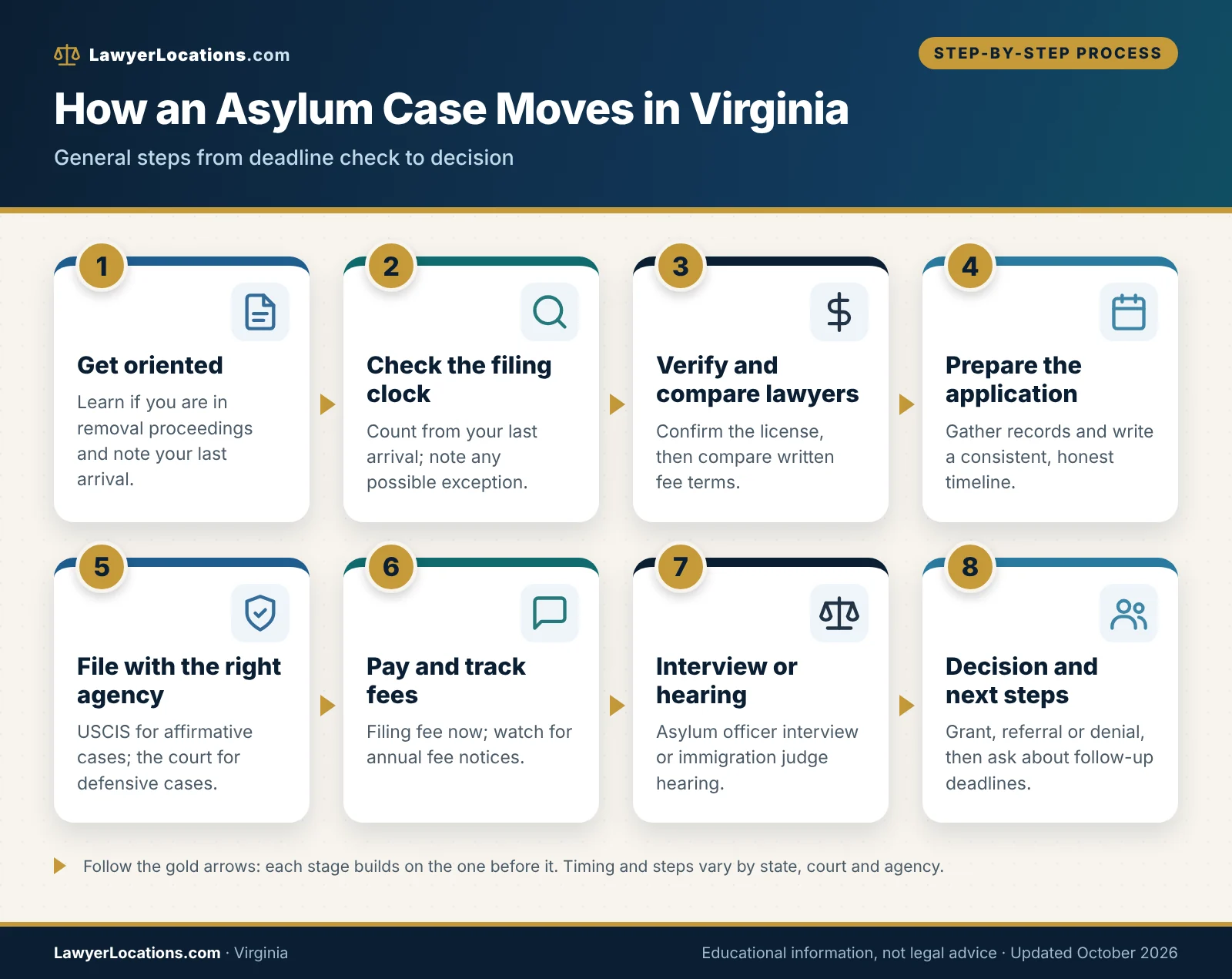
Text version of this graphic
- Get oriented: are you in removal proceedings, and when did you last arrive?
- Check the one-year clock and any possible exception.
- Verify the license, then compare lawyers and fee terms.
- Prepare the application and a consistent timeline.
- File with USCIS (affirmative) or the court (defensive).
- Pay the filing fee and track annual fee notices.
- Attend the interview or hearing.
- Decision and next steps: grant, referral or denial, and follow-up deadlines.
What asylum is not: related protections to know about
Asylum is one of several protections in the immigration system. Knowing the neighbors helps you ask better questions, because a lawyer may recommend asking for more than one form of protection at the same time.
Withholding of removal and Convention Against Torture protection
Withholding of removal and protection under the Convention Against Torture (CAT) are separate forms of relief, governed by 8 CFR 208.16. For withholding, the applicant must show a life or freedom threat tied to the same five grounds, and without past persecution the regulation uses a “more likely than not” standard. For CAT, the applicant must show it is more likely than not that they would be tortured.
One practical point: under 8 CFR 208.16(a), an asylum officer cannot grant withholding or deferral, so those requests are decided by an immigration judge. The one-year deadline is written into the asylum statute itself, 1158(a)(2)(B), and the withholding regulation text reviewed for this guide does not mention it. Ask any lawyer you meet how these protections fit together for your situation.
Credible fear and border-related cases
Some people ask for protection at the border and are placed in expedited removal. USCIS describes a route where a positive credible fear finding leads into the immigration court, where the person asks for asylum as a defense against removal. If your case began at the border or in detention, tell every lawyer or legal-aid program that first, because it changes which deadlines and forms matter.
Where Virginia enters the picture
Virginia does not write asylum law, but several Virginia-based institutions shape your day-to-day experience. The table lists them, and the paragraphs after it add detail.
| Place or office | What it does | Listed address or contact |
|---|---|---|
| Annandale Immigration Court (EOIR) | Immigration judge hearings, including defensive asylum | 7619 Little River Turnpike, Suite 400, Annandale, VA 22003; 703-343-4000 |
| Sterling Immigration Court (EOIR) | Immigration judge hearings, including defensive asylum | 21400 Ridgetop Circle, Suite 200, Sterling, VA 20166; 703-674-4600 |
| Arlington Immigration Court (EOIR page) | Listed on an EOIR court page; status needs confirmation | 1901 South Bell Street, Suite 200, Arlington, VA 22202; 703-603-1300 |
| Arlington Asylum Office (USCIS) | Interviews for affirmative asylum applications | 1525 Wilson Boulevard, Suite 300, Arlington, VA 22209 |
| Virginia Lawyer Referral Service (VSB) | Connects callers with Virginia State Bar members | (800) 552-7977, Monday to Friday, 9am to 5pm |
Immigration courts in Virginia
EOIR, the Justice Department’s Executive Office for Immigration Review, runs the nation’s immigration courts. Its operational-status page lists Annandale and Sterling as the open Virginia courts, and each court’s page gives public hours of 8:00 a.m. to 4:30 p.m. on weekdays, with window filing closing earlier in the afternoon. Both courts say they do not accept faxes or other electronic submissions unless court staff or the judge asks for them.
EOIR also still publishes a page for an Arlington Immigration Court at 1901 South Bell Street, but Arlington did not appear on the operational-status listing checked for this guide. Your hearing notice is the controlling document: it names the court, the date and the address, so rely on it and call the court if anything looks unclear.
The Arlington Asylum Office
People who apply affirmatively are interviewed by USCIS, and for Virginia that is generally the Arlington Asylum Office at 1525 Wilson Boulevard, Suite 300, Arlington, VA 22209. A Human Rights First guide to asylum office practice confirms that address, and a secondary source lists Virginia among the states the office covers. Your interview notice will name the office; use the USCIS office locator or the Contact Center if you are unsure.
How an Asylum Case Moves: Affirmative and Defensive Paths
There are two doors into the asylum process, and which one you use depends mostly on whether you are already in removal proceedings. USCIS describes them as affirmative asylum, handled by an asylum officer, and defensive asylum, handled by an immigration judge. Understanding the difference early helps you ask lawyers the right questions.
Affirmative asylum with USCIS
Affirmative asylum is for people who are not in removal proceedings. You file Form I-589, Application for Asylum and for Withholding of Removal, with USCIS and later attend an interview. Follow the current Form I-589 instructions for where to file, because filing locations and procedures can change.
Filing and the interview
After you file, USCIS schedules an interview with an asylum officer. USCIS describes this interview as non-adversarial, meaning no government lawyer argues against you in the room. For Virginia residents, the interview usually takes place at the Arlington Asylum Office.
The statute sets goals: an initial interview within 45 days of filing and a final decision within 180 days, “in the absence of exceptional circumstances” (8 U.S.C. 1158(d)(5)(A)). Those are targets, not promises, and actual timing varies, so ask any lawyer what they are seeing now.
If USCIS does not approve the application
If USCIS does not approve the case and the applicant does not have legal immigration status, USCIS issues a Notice to Appear and refers the case to an immigration judge, who hears it fresh. That is a central reason to talk with a lawyer before you file rather than after. A person filing affirmatively should understand that a denial can start court proceedings.
Filing an affirmative application can end in a referral to immigration court if the application is not approved and you have no other lawful status. This is not a reason to avoid filing when you have a real fear of return; it is a reason to understand the risk and plan for it with a licensed lawyer first.
Defensive asylum in a Virginia immigration court
Defensive asylum means asking for protection as a defense to removal. It is the path for anyone already placed in removal proceedings, and it happens in front of an immigration judge at a court such as Annandale or Sterling.
How a person ends up in this path
USCIS lists two common routes: a referral from an asylum office after an unsuccessful affirmative case, or an enforcement action such as an apprehension at the border or in the interior, or expedited removal after a positive credible fear finding. Either way, the hearing is adversarial: the person seeking asylum presents the case, and a government attorney from ICE can contest it.
The one-year requirement still matters here. The regulation counts an application in an immigration court case as filed when the court receives it (8 CFR 208.4(a)(2)), so the date the court stamps is what counts.
Hearings, forms and addresses
Cases in immigration court generally move through a preliminary hearing before a full hearing where the applicant testifies. A lawyer who represents you in court files Form EOIR-28, the Notice of Entry of Appearance as Attorney or Representative Before the Immigration Court. If your address changes, you must report it on Form EOIR-33/IC, the Change of Address/Contact Form for the Immigration Court.
The statute warns that an applicant who fails to appear for an interview or hearing without prior authorization or exceptional circumstances may have the application dismissed or otherwise sanctioned (1158(d)(5)(A)(v)). Read every notice, calendar every date, and never assume a hearing was cancelled without checking.
Comparing the two paths
The table gives a quick side-by-side so you can see which questions apply to you. Use it as a vocabulary guide for your first consultation, not as a way to pick a path yourself.
Side by side
The comparison below follows USCIS’s description of the two paths.
| Feature | Affirmative asylum | Defensive asylum |
|---|---|---|
| Who it is for | People not in removal proceedings | People already in removal proceedings |
| Decision-maker | USCIS asylum officer | Immigration judge (EOIR) |
| Setting | Non-adversarial interview | Adversarial hearing; ICE attorney represents the government |
| Virginia location | Arlington Asylum Office | Annandale or Sterling Immigration Court (per hearing notice) |
| If not granted | May be referred to an immigration judge if no legal status | Appeal rights may exist; ask a lawyer about deadlines |
| Lawyer’s filing form | USCIS representation form (check current instructions) | Form EOIR-28 |
Why the path matters when you choose a lawyer
Some lawyers focus on USCIS filings and rarely go to court; others spend most of their time in front of immigration judges. If your case is defensive, the lawyer needs to be comfortable with hearings, evidence rules and cross-examination. If your case is affirmative, you may want a lawyer who also understands what happens if the case is referred to court.
Deadlines, Fees and 2025–2026 Changes: What to Check Before You File
The three things most likely to shape an asylum case this fall are the one-year deadline, the government’s new asylum fees, and a moving set of work-permit and processing rules. All of them are federal, none of them is specific to Virginia, and several are in active litigation. The facts below are described “as of October 2026.”
The one-year filing deadline and its exceptions
The statute requires an applicant to show “by clear and convincing evidence” that the application was filed within one year after arrival (8 U.S.C. 1158(a)(2)(B)). The statute also allows an application to be considered later if the applicant shows changed or extraordinary circumstances (1158(a)(2)(D)).
How the clock works
The implementing regulation, 8 CFR 208.4(a)(2), measures the year from the date of the person’s last arrival in the United States, or April 1, 1997, whichever is later. If the last day falls on a weekend or legal holiday, the deadline moves to the next business day. An application counts as filed when the agency receives it, although proof of timely mailing can sometimes fix the filing date if the application was never received.
Because the clock runs from the last arrival, the right date is not always obvious. The statute also bars court review of the government’s determination on the deadline (1158(a)(3)), which makes the first filing important.
If you arrived in the United States within the last year and are thinking about asylum, treat the filing date as urgent and speak with a licensed lawyer or accredited representative as soon as you can. If you have been here longer than a year, do not assume you are shut out; exceptions exist, and a lawyer can assess whether any might apply.
Changed and extraordinary circumstances
The regulation gives examples. Changed circumstances can include worsening conditions in the home country, changes in U.S. law, and activities abroad that create new risk. Extraordinary circumstances are events directly related to the late filing, such as serious illness or disability, legal disability (for example, being an unaccompanied minor), ineffective assistance of counsel, or maintaining lawful status, TPS or parole until a reasonable time before filing (8 CFR 208.4(a)(4)–(5)).
In every exception, the application has to be filed within a “reasonable period” after the circumstance, and the regulation does not fix a number of days. The applicant carries the burden of proof. The statute exempts unaccompanied alien children from the one-year rule (1158(a)(2)(E)).
Government fees: what the agencies charge
In July 2025, Congress created new asylum-related fees in Public Law 119-21 (known as H.R. 1 or the “One Big Beautiful Bill Act”). USCIS and EOIR have since implemented them, and several parts have been challenged in court. This section describes the fee structure, then the legal uncertainty.
The $100 filing fee and the annual asylum fee
USCIS’s November 2025 Federal Register notice (90 FR 52693) states that the initial asylum application fee is $100 and that the annual asylum fee for an application that remains pending was adjusted for inflation from $100 to $102 for fiscal year 2026. A later interim final rule, 91 FR 22952 (published April 29, 2026, effective May 29, 2026), describes payment after an individualized notice with a 30-day window to pay online, and says these H.R. 1 fees cannot be waived or reduced.
Secondary sources report that the annual fee rises to $105 for fiscal year 2027, collected by immigration courts from October 1, 2026 and by USCIS from October 16, 2026. Always pay the amount shown on the official payment page rather than an amount from a website or a friend.
Immigration court fees and unsettled litigation
EOIR applied the same fees in immigration court through Policy Memorandum 25-36, effective July 17, 2025, which says the fees cannot be waived and that filings without the required fee must be rejected. Federal courts have since weighed in. In Asylum Seeker Advocacy Project v. USCIS (D. Md.), an October 2025 pause was lifted in February 2026, and a September 22, 2026 ruling reportedly found the way immigration courts charged the fee unlawful without stopping collection. In a Massachusetts case, Venezuelan Association of Massachusetts v. USCIS, an August 2026 preliminary injunction reportedly limits USCIS from rejecting applications, ending work permits, or starting removal proceedings solely over nonpayment.
These summaries come from advocacy and law-firm sources, not the court dockets. What is safe to say is that the fee exists, that court orders may limit penalties, and that ignoring a payment notice is risky. Keep every notice and give copies to your lawyer.
| Item | Amount reported | Notes and source |
|---|---|---|
| Form I-589 filing fee | $100 | Set by H.R. 1; unchanged for FY 2026; no fee waiver (90 FR 52693; 91 FR 22952) |
| Annual asylum fee, FY 2026 | $102 | Each calendar year an application remains pending (90 FR 52693) |
| Annual asylum fee, FY 2027 | $105 | Reported by secondary sources; confirm on the official payment page |
| Fee waiver | Not available | H.R. 1 fees cannot be waived or reduced (EOIR PM 25-36; 91 FR 22952) |
| Penalties for non-payment | Rule exists; court orders may limit it | Interim final rule describes rejection and work-permit effects; litigation ongoing |
Work permits and processing changes
Two other areas moved fast in the past year: work authorization for people with pending asylum applications, and USCIS’s handling of affirmative cases. Both can affect how long you wait and what you can do while you wait.
Work authorization while the case is pending
By statute, an asylum applicant is not entitled to employment authorization, and cannot receive it before 180 days after filing unless otherwise eligible (1158(d)(2)). In practice that has meant a waiting period tracked by an “asylum clock.” Annandale and Sterling each list a dedicated email address for clock correction requests, which a lawyer can use if the count looks wrong.
In February 2026, DHS proposed a rule (91 FR 8616, published February 23, 2026) that would extend the wait to 365 days, allow USCIS to stop accepting initial applications when affirmative processing times exceed a threshold, and limit eligibility for some people who entered without inspection. The comment period closed April 24, 2026. No final rule appeared in the sources reviewed for this guide, so treat it as a proposal. Initial work-permit fees for asylum applicants were reported at $560 for fiscal year 2026.
Processing pauses and policy shifts
In late 2025 USCIS announced a hold on affirmative asylum decisions, followed by a December 2, 2025 policy memorandum. Reports say USCIS signaled in March 2026 that it would resume decisions on some applications, and on June 5, 2026 a federal court in Rhode Island (Dorcas International Institute of Rhode Island v. USCIS) vacated the memorandum and found the indefinite pause unlawful. The government has appealed, and sources disagree about how far the order reaches.
The USCIS hold did not apply to immigration courts, which are run by a different agency. Ask your lawyer what they are currently seeing at the Arlington Asylum Office and at Annandale or Sterling, rather than relying on old wait-time stories.
Who Can Represent You in Virginia, and How to Compare Lawyers
The Virginia State Bar says only two kinds of people are authorized to give immigration legal advice: licensed attorneys, and accredited representatives who work for recognized nonprofit organizations. Everyone else, including anyone who calls themselves a “notario,” “visa consultant” or “immigration consultant,” is not. The rest of this section shows how to confirm that and how to compare the people who are allowed to help.
Start your asylum lawyer Virginia search with a license check
Before you compare personalities, price or office locations, confirm that the person is who they say they are. This takes a few minutes and filters out most of the serious risks.
Verify the license and the record
The Virginia State Bar suggests using its VSB Lawyer Look Up to confirm a lawyer’s license and asking the lawyer to show a bar license. If the lawyer is licensed in another state or in Washington, D.C., check that jurisdiction’s bar records for current status and any public discipline.
Some lawyers who take Virginia cases work from offices in other jurisdictions, so ask every lawyer plainly: where are you licensed, are you in good standing, and which Virginia courts and the Arlington Asylum Office have you appeared before?
Attorneys, accredited representatives and nonprofits
Accredited representatives are non-lawyers authorized by the Board of Immigration Appeals to work for recognized nonprofit organizations. The Justice Department keeps a roster of recognized organizations and accredited representatives. Ask to see the accreditation certificate, as the Virginia State Bar suggests, and confirm it against the EOIR roster. The roster page opened for this guide showed a 2021 update date, so check EOIR for the current version.
| Type of helper | May give immigration legal advice? | How to check |
|---|---|---|
| Licensed attorney | Yes, within the license and the agencies’ rules | VSB Lawyer Look Up, or the bar of the state where licensed |
| DOJ-accredited representative | Yes, when working for a recognized organization | EOIR roster of recognized organizations and accredited representatives |
| Nonprofit or law-school clinic staffed by lawyers | Yes, through licensed supervising attorneys | EOIR pro bono list; ask who the lawyer is |
| “Notario,” visa consultant, immigration consultant | No | Notaries are barred from immigration advice and from “notario” advertising |
A comparison framework you can use on every consultation
Treat each first call as an interview, not a favor. Ask the same questions each time and write the answers down, then compare. The scorecard below turns those questions into a repeatable checklist.
Experience and approach
Ask which kinds of asylum cases the lawyer handles, how many are affirmative and how many are in court, and which Virginia court or the Arlington Asylum Office they use most. Ask who will prepare the declaration and who will attend interviews or hearings with you.
You are not looking for a lawyer who promises a result, because no one honest can. Look for one who can explain, in plain words, what problems your situation may face, what evidence matters, and what the next 30 days would involve.
Communication, language and logistics
Ask in what language the office communicates, who your day-to-day contact will be, and what happens if the lawyer is unavailable on a hearing date. If you need an interpreter, ask whether one is provided and who pays for it. Ask where meetings happen and whether video calls are available, which matters if you live far from Northern Virginia.
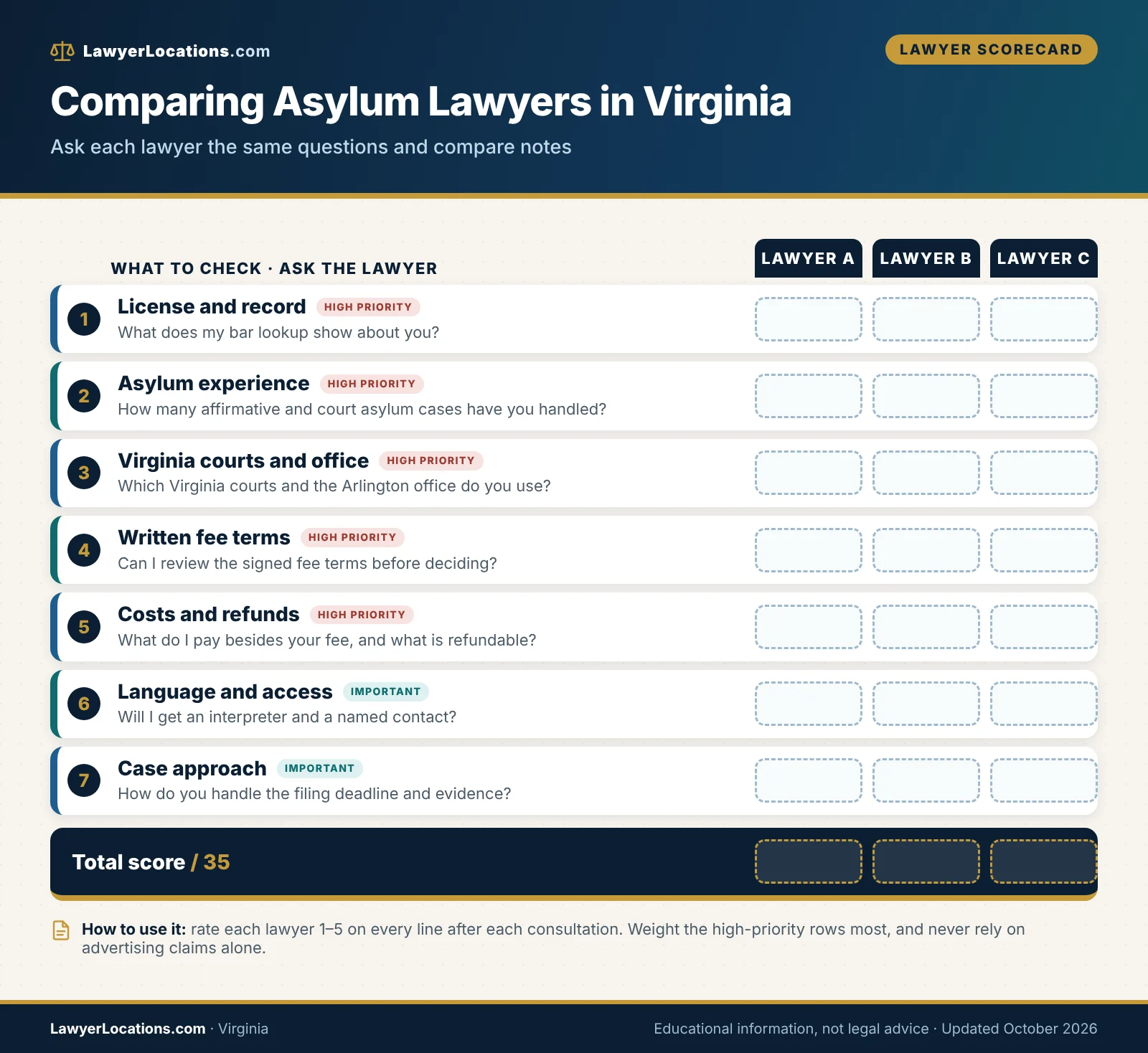
Text version of this graphic
| Criterion | Question to ask | Weight |
|---|---|---|
| License and record | What does my VSB or bar lookup show about you? | High |
| Asylum experience | How many affirmative and court asylum cases have you handled? | High |
| Virginia courts and office | Which Virginia courts and the Arlington office do you use? | High |
| Written fee terms | Can I review the signed fee terms before deciding? | High |
| Costs and refunds | What do I pay besides your fee, and what is refundable? | High |
| Language and access | Will I get an interpreter and a named contact? | Medium |
| Case approach | How do you handle the one-year deadline and evidence? | Medium |
Advertising and red flags
Virginia limits what lawyers can say about themselves, and those limits are a helpful screen. If an ad or website breaks them, that tells you something about the office.
Virginia’s advertising and solicitation rules
Under Virginia Rule of Professional Conduct 7.1, a lawyer shall not make a false or misleading communication about the lawyer or the lawyer’s services, and the rule’s comments warn that reporting past wins can create an unjustified expectation of the same results. Rule 7.3 covers direct solicitation and requires “ADVERTISING MATERIAL” labels on many written solicitations. This summary relies on a Supreme Court of Virginia order from 2017; confirm the current text on the Virginia State Bar site.
Be wary of any lawyer who claims to be the “best” or “top” in asylum work. Those words say nothing verifiable, so ask about experience and process instead.
Red flags to take seriously
- A promise that you will win, or a claim of a sure approval, a “special relationship” with officers or a shortcut around the line.
- Pressure to sign immediately, or a request to sign blank or incomplete forms.
- No written agreement, no receipts, or a refusal to give you copies of what is filed.
- A request to exaggerate, change or invent facts. A false asylum claim can create serious, lasting problems.
- Holding on to your original passport, birth certificate or other documents.
What Asylum Lawyers Charge and How Fee Agreements Work in Virginia
There is no official published average for what asylum lawyers charge in Virginia, and this guide does not give one. Fees vary with the lawyer, the office, the complexity of the evidence and whether the case is affirmative or in court. What you can control is how clear the agreement is, and Virginia’s ethics rules set some firm limits.
Common fee structures
Asylum lawyers commonly use flat fees for defined stages, hourly billing, or some mix of the two. Nonprofit programs may offer free or sliding-scale services. The point of comparing structures is to understand what happens to your money if the case takes longer than expected or ends early.
Flat fees by stage
A flat fee might cover preparing and filing an application, or an interview, and not the rest. Ask exactly what is included: drafting your declaration, gathering evidence, attending the interview or hearings, responding to government requests, appeals, and any work-permit filings. Ask what happens if the case is referred from USCIS to an immigration judge, since that often means new work.
Hourly billing and separate costs
Hourly arrangements usually involve a deposit the lawyer draws against, so ask for itemized statements. Expect out-of-pocket costs on top of attorney time, such as certified translations, medical or psychological evaluations, expert reports and copies. The government’s $100 filing fee and the annual asylum fee, discussed in section 3, are separate from what you pay the lawyer.
Virginia rules that protect you
Virginia is unusually specific about fees. These protections come from the Virginia State Bar’s Rules of Professional Conduct, which apply to Virginia-licensed lawyers wherever they practice.
Fees must be explained and, preferably, written
Under Rule 1.5(b), a lawyer’s fee “shall be adequately explained to the client,” and for a new client the amount, basis or rate should be communicated, preferably in writing, before or soon after the work starts. Rule 1.5(c) requires a contingent fee agreement to be in writing. Rule 1.5(d) bars contingent fees in domestic-relations matters (except in rare instances) and in criminal defense, and it does not mention immigration, so if a lawyer proposes one in an asylum case, ask why and get the details in writing.
No nonrefundable advance fees
Virginia prohibits nonrefundable advanced legal fees (Rule 1.5(g)). The rule’s comments also say an unearned fee is per se unreasonable, and that a lawyer who takes an advance payment must return any unearned portion. In plain terms, if you pay in advance and the case ends or the lawyer withdraws early, you are entitled to a fair accounting of what was earned.
Ask the lawyer to explain, in writing, what happens to unused advance money if you change your mind, if the case ends early, or if the lawyer cannot continue. Keep a copy of the signed agreement and every receipt.
Putting dollars and dates on a calendar
Costs and deadlines are easier to manage when you see them together.
The money and deadline sequence
First comes the one-year check, then the lawyer comparison and fee agreement, then filing with the government fee, then the interview or hearing, and the annual fee for each calendar year the case stays pending.
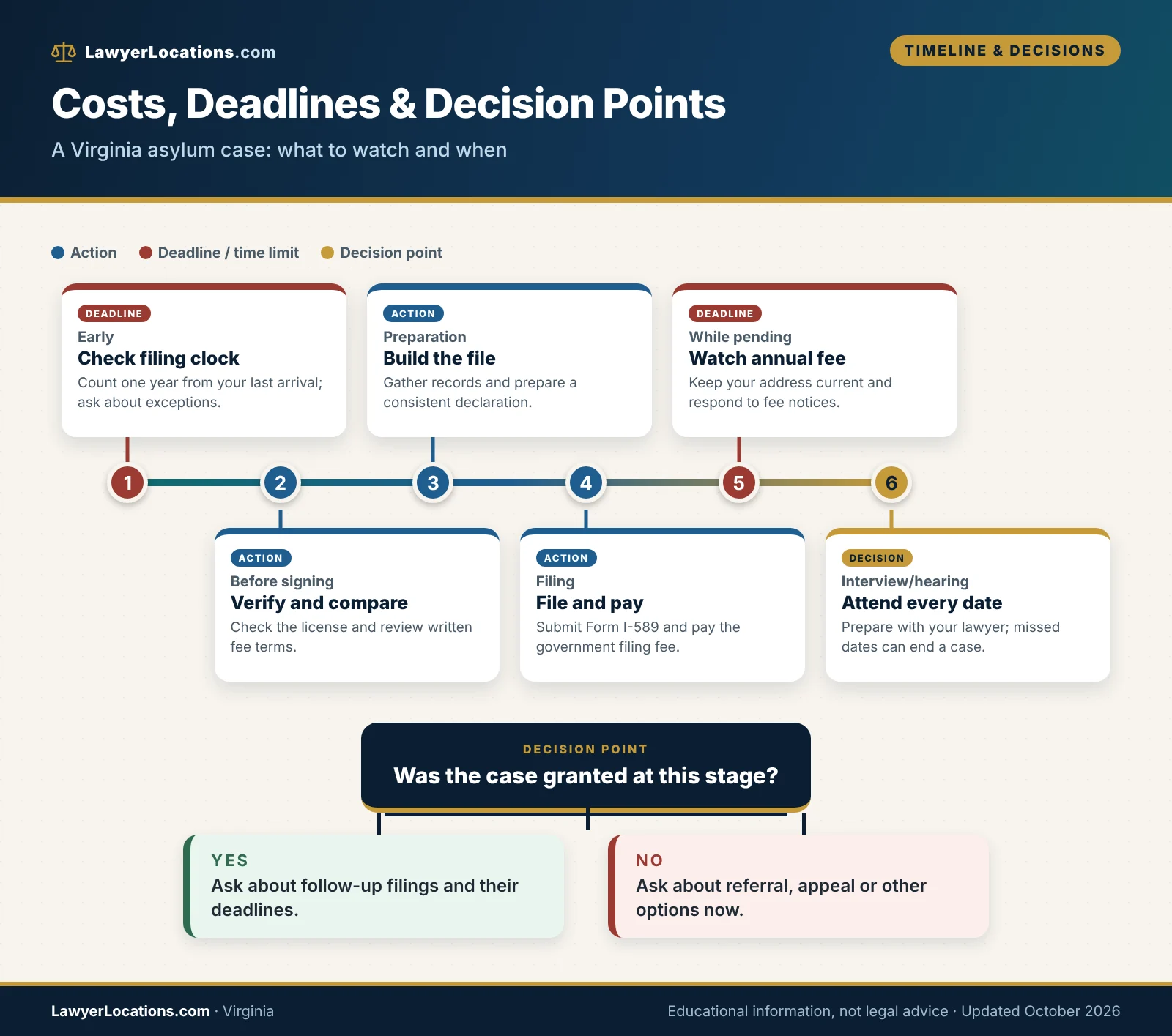
Text version of this graphic
- First weeks after arrival (deadline): Count the one-year filing period from your last arrival.
- Before signing (action): Verify the license and compare written fee terms.
- Preparation (action): Gather records and prepare a consistent declaration.
- Filing (action): File Form I-589 with the correct agency and pay the filing fee.
- While pending (deadline): Watch for annual fee notices and keep your address current.
- Interview or hearing (decision): Prepare with your lawyer and attend every date.
- Decision point: If the case is not granted, ask about referral, appeal or other options and their deadlines.
Building your own budget
- Attorney or representative fees, and what each fee covers.
- Government filing fee and the annual asylum fee for each calendar year pending.
- Translations, evaluations, expert reports and document copies.
- Travel and time off work for interviews, hearings and appointments.
- A reserve for later steps, such as a work-permit filing or appeal, which have their own fees and deadlines.
Free and Low-Cost Help in Virginia, and How to Avoid Scams
You do not need to pay a large private fee to get legitimate help, but you do need to look in the right places. EOIR’s pro bono list, Virginia nonprofits, and the Virginia Lawyer Referral Service are the main starting points, and a handful of scam patterns are worth knowing before you hand anyone money or documents.
Free and reduced-cost routes
Demand for free immigration help is high and capacity is limited, so expect waiting lists and be ready to try more than one door. A call that does not work out is not a verdict on your case.
EOIR’s list of pro bono legal service providers
Anyone in removal proceedings can use EOIR’s List of Pro Bono Legal Service Providers. EOIR describes it as a tool for people in immigration proceedings, listing nonprofits and attorneys who commit to at least 50 hours a year of pro bono service before the court where they appear. EOIR updates the list quarterly. The October 2026 index shows three Virginia entries: Annandale Immigration Court, the Annandale juvenile docket, and Sterling Immigration Court.
Contact each provider directly. A listing is not an endorsement or a promise of space for your case, and EOIR says the list is not for soliciting paid services.
Virginia nonprofits and clinics
EOIR’s Virginia pro bono sheet, last dated July 2024, named organizations that serve people with cases at Annandale and Sterling. Confirm each one against the current list before relying on this summary, because eligibility and capacity change.
- Northern Virginia Family Service / Ayuda: non-detained clients; serves people in any language, with Spanish and interpretation; call for intake.
- Human Rights First: serves low-income asylum seekers; no walk-ins.
- Kids In Need of Defense (KIND): only minors and unaccompanied children.
- Georgetown and George Washington law school clinics: appointment or call-ahead intake; some listings limit intake to academic semesters.
- Amica Center for Immigrant Rights: detained adults and children in D.C., Maryland and Virginia.
For general civil legal aid, Virginia Law Help, run by the Virginia Poverty Law Center, lists a statewide number, 866-LEGLAID (866-534-5243), for connecting with a local legal aid office. Ask whether that office handles immigration matters, because many legal aid programs focus on other civil problems.
Virginia Lawyer Referral Service
The Virginia Lawyer Referral Service, run by the Virginia State Bar since 1977, matches callers with Bar members who signed up for specific practice areas they feel competent to handle. The service says its fee is a $35.00 non-refundable referral fee for up to a half-hour consultation, and that neither side is obligated to continue afterward. Call (800) 552-7977 on weekdays between 9am and 5pm.
A referral is a starting point, not a recommendation. Use the comparison questions from section 4 on any referred lawyer.
If a lawyer or program cannot take your case, ask whether they can recommend another legitimate provider or tell you what deadline to protect while you look. A short, honest referral can be worth more than a rushed engagement.
Immigration scams and notario fraud in Virginia
People new to the U.S. legal system are targeted by scams because they are often afraid of authorities and unsure who is allowed to help. Virginia has specific protections, and they were strengthened in July 2026.
Who is not allowed to help
Under Va. Code § 47.1-15.1, a notary may not offer or provide legal advice on immigration or other legal matters or represent anyone in immigration proceedings, unless the notary is licensed to practice law in Virginia or accredited under 8 CFR 292.2. The statute also bars notaries from using “notario,” “notario publico,” “licenciado” or similar non-English titles that suggest they can practice law.
Since July 1, 2026, the Virginia Attorney General has additional tools under House Bill 1262, including civil investigative demands, injunctions and restitution, and the civil penalties for the advertising violation rose to up to $2,500 for a first violation and $5,000 for a later one.
A person who is not a lawyer or accredited representative cannot lawfully advise you on asylum. Errors on an asylum form can affect your claim for years, and unlike a fee, a missed deadline cannot be refunded.
Where to report
The Virginia State Bar’s immigration-fraud page lists these contacts. Report unauthorized practice of law to the Virginia State Bar Ethics Department at (804) 775-0557 and ask for a complaint form. The Federal Trade Commission takes reports at 1-877-FTC-HELP. The Virginia Attorney General’s Consumer Protection Hotline is 804-786-2042.
The Bar’s page also notes that victims may have rights under the Virginia Consumer Protection Act, Va. Code § 59.1-196 and following, and suggests consulting a lawyer about them. If you worry how reporting might affect your own situation, talk with a licensed lawyer first.
Preparing for a Consultation and Next Steps
A first consultation goes better when you arrive with your records, a written timeline and a short list of questions. That preparation helps the lawyer give you a more useful read of your situation, and it helps you compare more than one lawyer fairly.
Before you call
You do not need a perfect file. If you are missing documents, say so, and the lawyer can tell you which are essential and how to request them. Do not wait to call until everything is collected, especially if the one-year deadline may be close.
Documents and records to gather
- Passport, travel documents and any government identification, plus your I-94 or other entry record if you have it.
- Every notice from USCIS or the immigration court, including hearing notices, receipts, interview notices and any annual fee notice.
- Dates of every entry and departure from the United States, as exactly as you can recall them.
- Evidence of what happened or what you fear: medical records, police reports, threats, photos, news articles, and statements from people who know.
- Records of past applications or filings, including those prepared by someone else.
- Your addresses since arriving, and the names of anyone who has given you legal-sounding advice.
Bring copies and keep originals safe. Never alter a document.
Your timeline and your questions
Write a simple timeline: when you left, when you arrived, and key events. Mark dates you are unsure about. If some events are hard to discuss, you can share at your own pace and ask for breaks.
Conversations with a lawyer you hire are generally confidential, and the lawyer can explain how that works. Bring the comparison questions from section 4 and a way to take notes.
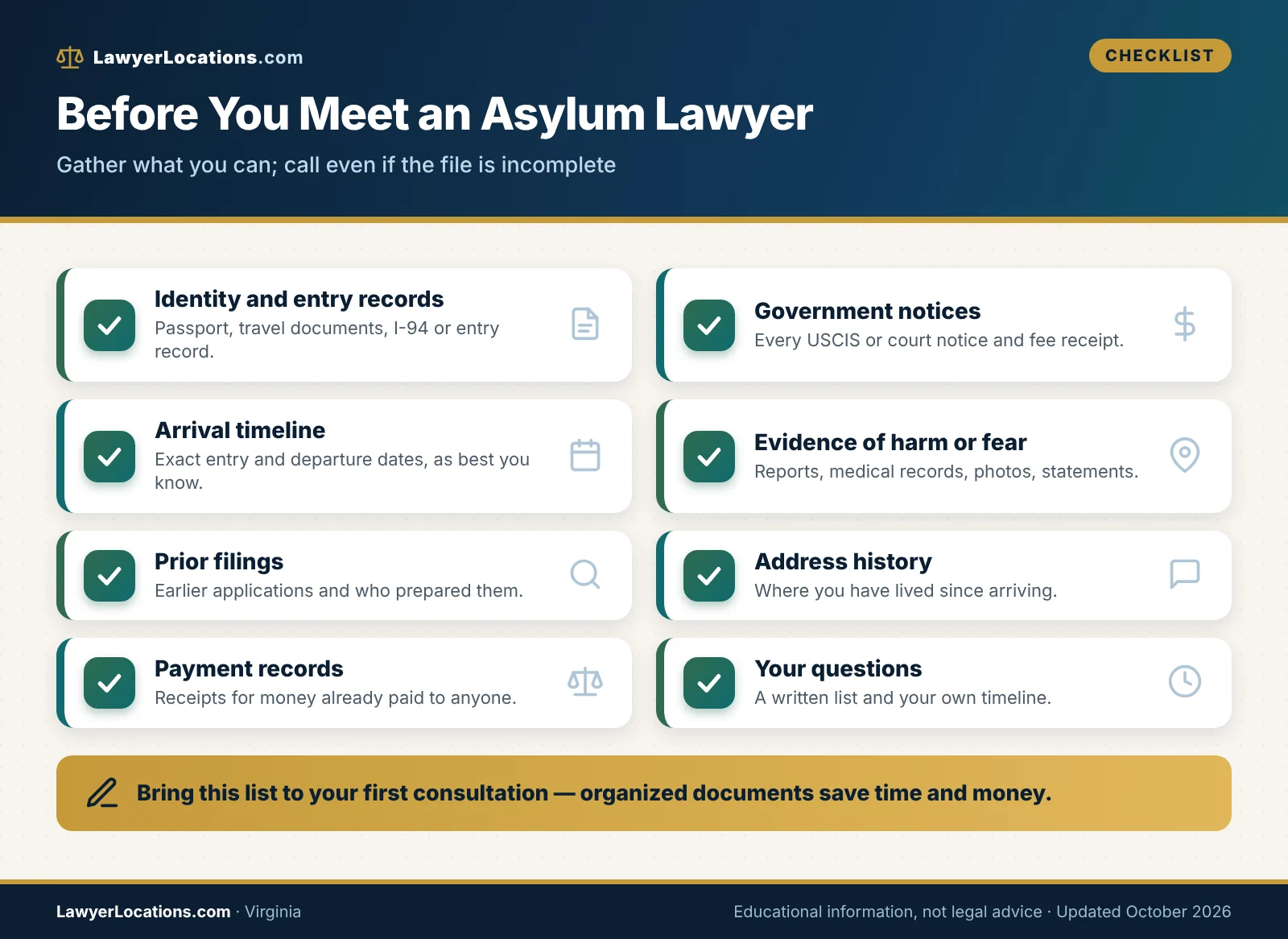
Text version of this graphic
- Identity and entry records, including I-94.
- Every government notice and fee receipt.
- Exact entry and departure dates.
- Evidence of harm or fear.
- Prior filings and who prepared them.
- Address history and payment receipts.
- Your questions and a written timeline.
Common mistakes to avoid
Most avoidable problems in asylum cases are about timing, paperwork and trust. Naming them in advance makes them easier to avoid.
Mistakes with timing and paperwork
- Waiting past one year without getting advice about exceptions.
- Ignoring an annual asylum fee notice, or assuming a rumor about court orders means you do not have to pay.
- Failing to update your address with USCIS or the immigration court.
- Missing a hearing, interview or biometrics appointment.
- Signing documents you cannot read or that contain facts you do not agree with.
An application with inconsistent dates or details can raise doubts about credibility. Go through every form with your lawyer, in a language you understand, before it is filed.
Mistakes with who you trust
Using a notario, a “consultant” or a friend of a friend who “knows how it works” is one of the most common and most costly choices. So is paying large cash amounts without receipts.
Do not copy another person’s story from a form, a website or a social media post. Every claim must be your own. Tell your lawyer the truth, including the parts that worry you.
Frequently asked questions and next steps
These short answers cover common questions and point back to the section that explains each rule.
Costs, eligibility and deadlines
How much does an asylum lawyer cost in Virginia?
There is no official average. Fees depend on the lawyer and the stage, and Virginia requires fees to be explained and prohibits nonrefundable advance fees. Government fees of $100, plus the annual asylum fee while your case is pending, are separate (sections 3 and 5).
What is the deadline to apply for asylum?
Generally one year after your last arrival in the United States, with exceptions for changed or extraordinary circumstances (8 U.S.C. 1158(a)(2)). A lawyer can look at whether an exception might apply (section 3).
Can I work while my asylum case is pending?
By statute, not before 180 days after filing, and then only if you are otherwise eligible. DHS has proposed a longer wait, so ask your lawyer what applies when you file (section 3).
Process and local questions
Which immigration courts are in Virginia?
EOIR lists Annandale and Sterling as open Virginia courts. EOIR also keeps an Arlington court page; rely on your hearing notice for the court that has your case.
Can a notary or consultant file my asylum application?
Not as a legal adviser. Virginia law bars notaries from giving immigration advice, and the Virginia State Bar says only lawyers and accredited representatives may do so (section 6).
What happens if I miss my hearing?
The statute says an application may be dismissed or the applicant otherwise sanctioned for failing to appear without authorization or exceptional circumstances. Call the court or your lawyer immediately if a problem arises.
What if I have been in the United States longer than a year?
You may still be able to apply if an exception applies, and other protections such as withholding or CAT may be available. A lawyer can explain what fits your timeline (sections 1 and 3).
If you are ready to look for an asylum lawyer Virginia families and individuals can rely on, the sequence in this guide is a sound one: check the filing date first, verify licenses, compare written fee terms, ask about free help in parallel, and keep every notice and receipt. Asylum can lead to other filings later, and our guides to a green card lawyer and to citizenship lawyers in Harris County, Texas show how those steps work elsewhere. Criminal charges and immigration cases can affect each other, so see our guide to criminal defense consultations if that applies. If you move, finding an immigration attorney in Oklahoma City shows how the same federal rules meet different local courts.
Ready to compare your options?
Start with your arrival date, then use the scorecard questions with at least two licensed attorneys or accredited representatives. This site does not endorse or recommend any lawyer. If you are in removal proceedings, also ask the providers on EOIR’s pro bono list whether they have capacity.
Sources & References
Show all 31 sources
- 8 U.S.C. 1158, Asylum — Legal Information Institute, Cornell Law School — law.cornell.edu/uscode/text/8/1158 — accessed October 2026.
- 8 CFR 208.4, Filing the application — Legal Information Institute, Cornell Law School — law.cornell.edu/cfr/text/8/208.4 — accessed October 2026.
- 8 CFR 208.16, Withholding of removal under section 241(b)(3) and CAT — Legal Information Institute, Cornell Law School — law.cornell.edu/cfr/text/8/208.16 — accessed October 2026.
- Obtaining Asylum in the United States — U.S. Citizenship and Immigration Services — uscis.gov — accessed October 2026.
- Annandale Immigration Court — Executive Office for Immigration Review, U.S. Department of Justice — justice.gov/eoir/annandale-immigration-court — accessed October 2026.
- Sterling Immigration Court — Executive Office for Immigration Review — justice.gov/eoir/sterling-immigration-court — accessed October 2026.
- Arlington Immigration Court — Executive Office for Immigration Review — justice.gov/eoir/arlington-immigration-court — accessed October 2026.
- Immigration Court Operational Status — Executive Office for Immigration Review — justice.gov/eoir/immigration-court-operational-status — accessed October 2026.
- List of Pro Bono Legal Service Providers — Executive Office for Immigration Review — justice.gov/eoir/list-pro-bono-legal-service-providers — accessed October 2026.
- List of Pro Bono Legal Service Providers, Virginia (July 2024) — Executive Office for Immigration Review — justice.gov/eoir/file/ProBonoVA/dl — accessed October 2026.
- List of Pro Bono Legal Service Providers, full list (October 2026 edition) — Executive Office for Immigration Review — justice.gov/eoir/file/probonofulllist/download — accessed October 2026.
- Recognized Organizations and Accredited Representatives Roster by State and City — Executive Office for Immigration Review — justice.gov/eoir — accessed October 2026.
- EOIR forms list (EOIR-28, EOIR-33/IC, EOIR-61, EOIR-26) — Executive Office for Immigration Review — justice.gov/eoir/list-downloadable-eoir-forms — accessed October 2026.
- Policy Memorandum 25-36 (Amended), Statutory Fees Under the One Big Beautiful Bill Act — Executive Office for Immigration Review — justice.gov/eoir/media/1408356/dl — accessed October 2026.
- Inflation Adjustment to H.R. 1 Immigration Fees, 90 FR 52693 (Nov. 21, 2025) — U.S. Citizenship and Immigration Services via GovInfo — govinfo.gov — accessed October 2026.
- USCIS Immigration Fees and Related Procedures Required by H.R.1 Reconciliation Bill (interim final rule), 91 FR 22952 (Apr. 29, 2026) — USCIS via GovInfo — govinfo.gov — accessed October 2026.
- Employment Authorization Reform for Asylum Applicants (proposed rule), 91 FR 8616 (Feb. 23, 2026) — USCIS via GovInfo — govinfo.gov — accessed October 2026.
- Annual Asylum Fees (litigation and payment status) — Asylum Seeker Advocacy Project — asaptogether.org/en/annual-asylum-fees — secondary source, accessed October 2026.
- Asylum Annual Fee Rule Tracker (2026 update) — asylumtracker.com — asylumtracker.com/rules/annual-asylum-fee — secondary source, accessed October 2026.
- USCIS Announces FY 2027 Inflation Adjustments to H.R. 1 Immigration Fees — EIG Law — eiglaw.com — secondary source, accessed October 2026.
- Asylum Update (status of USCIS asylum hold and Dorcas ruling, June 18, 2026) — U.S. Conference of Catholic Bishops — usccb.org — secondary source, accessed October 2026.
- Arlington Asylum Office practice information — Human Rights First, Asylum Office Best Practice Guide 2024 — resources.humanrightsfirst.org — secondary source, accessed October 2026.
- Arlington Asylum Office jurisdiction listing — VisaVerge — visaverge.com/asylum-offices/arlington — secondary source, accessed October 2026.
- Immigration Fraud — Virginia State Bar — vsb.org/Site/legal-help/immigration-fraud.aspx — accessed October 2026.
- Virginia Lawyer Referral Service — Virginia State Bar — vsb.org/Site/Legal-Help/VLRS.aspx — accessed October 2026.
- Virginia Rules of Professional Conduct (Rule 1.5, fees) — Virginia State Bar — vsb.org — accessed October 2026.
- Order amending Rules 7.1 through 7.5 of the Virginia Rules of Professional Conduct (effective July 1, 2017) — Supreme Court of Virginia — vacourts.gov — accessed October 2026.
- Va. Code § 47.1-15.1, Notaries and immigration matters — Virginia Legislative Information System — law.lis.virginia.gov — accessed October 2026.
- Attorney General Jay Jones announces new tools to combat notario fraud — Office of the Attorney General of Virginia — oag.state.va.us — accessed October 2026.
- Virginia House Bill 1262 (2026) summary — National Notary Association — nationalnotary.org — accessed October 2026.
- Virginia Law Help — Virginia Poverty Law Center — virginialawhelp.org — accessed October 2026.
General information only. This page is a legal-education resource from LawyerLocations.com, which is not a law firm and does not give legal advice or recommend, rate or refer you to any lawyer. Reading this guide does not create an attorney-client relationship. Immigration laws, fees, court orders and local procedures change often, and the facts here are described as of October 2026. For advice about your situation, consult a lawyer licensed in the relevant jurisdiction or a Department of Justice-accredited representative.
Legal Disclaimer and Limitation of Liability
Informational and illustrative purposes only. This article was prepared by LawyerLocations.com solely on the basis of the information available to us at the time of writing. It is an illustrative, general overview. It is not a complete or authoritative statement of the law, and it has not been reviewed by a lawyer licensed in your state or county.
Not legal advice. Nothing in this article is legal, financial, tax or immigration advice, and reading it does not create an attorney-client relationship between you and LawyerLocations.com or any author, lawyer or firm mentioned. Laws, court rules, fees, filing deadlines and agency procedures differ by state, county and court, and they change often. Some details here may be simplified, incomplete or out of date, and time limits for legal claims can be short.
No warranty. We make no representation or warranty, express or implied, about the accuracy, completeness, timeliness or suitability of this content for your situation. Please do not rely on it to make, delay or skip any legal decision. Check the facts against official sources and speak with a licensed attorney in the relevant jurisdiction before you act.
Limitation of liability. To the fullest extent permitted by law, LawyerLocations.com and its owners, authors and contributors disclaim all liability for any loss, damage, cost or other consequence arising from the use of, or reliance on, this article, including any content on third-party websites we link to. Mentioning a lawyer, firm, organization or service is not an endorsement and is not a promise of any result. If you are in immediate danger, contact your local emergency number.