If you are starting a personal injury lawyer Washington search, three state rules shape almost everything that follows: the general deadline to sue is three years under RCW 4.16.080, a claim against a city, county, school district or the state itself needs a written claim filed and a 60-day wait before a lawsuit, and injury lawyers in Washington usually work on a contingent fee that must be set out in a signed writing under RPC 1.5(c).
This guide explains how Washington injury claims work, where to look for a lawyer, what the fee paperwork should say, how to compare attorneys, and how a case moves through Washington courts. It is general information for readers anywhere in the state, not advice about your own claim.
What a Washington Injury Lawyer Does and How State Law Frames Your Claim
A personal injury lawyer in Washington helps people hurt by someone else’s carelessness pursue compensation from the responsible person or the insurer standing behind them. Washington is a fault-based state, so most claims turn on who caused the harm, how much each person contributed, and what the injured person can prove. The rules in this section apply the same way in Seattle, Spokane, Tacoma, Vancouver, Yakima and every smaller town in between.
What a personal injury lawyer actually handles
People often picture a courtroom, but most of a lawyer’s work happens well before one. Understanding the range of tasks helps you judge whether the person you are interviewing has the time and structure to do them.
The types of claims that fall under “personal injury”
The label covers car and truck crashes, motorcycle and bicycle collisions, pedestrian injuries, falls on unsafe property, dog bites, defective products, medical negligence and wrongful death. Each area has its own evidence, its own insurers and, sometimes, its own deadlines. If your situation is a specific one, our guides on bicycle accidents in Washington and how truck and car cases differ go further than a general overview can.
Workplace injuries are a different track. Most Washington employees hurt on the job go through the state workers’ compensation system rather than a lawsuit against the employer, and that system has its own agencies and appeal steps. If a third party outside your employer, such as a negligent driver, also contributed, you may have a separate injury claim alongside it.
The work that happens before any lawsuit
A typical engagement starts with gathering records: crash or incident reports, photographs, medical charts, billing statements and wage proof. The lawyer then identifies every insurance policy that might apply, including your own, and communicates with adjusters so you are not giving recorded statements on your own.
Once your treatment reaches a stable point, the lawyer usually assembles a demand package that explains fault, lays out your medical history and puts a number on both economic and noneconomic losses. Most claims resolve through negotiation rather than trial, but a lawyer who prepares each file as if it may be filed in court generally negotiates from a stronger position.
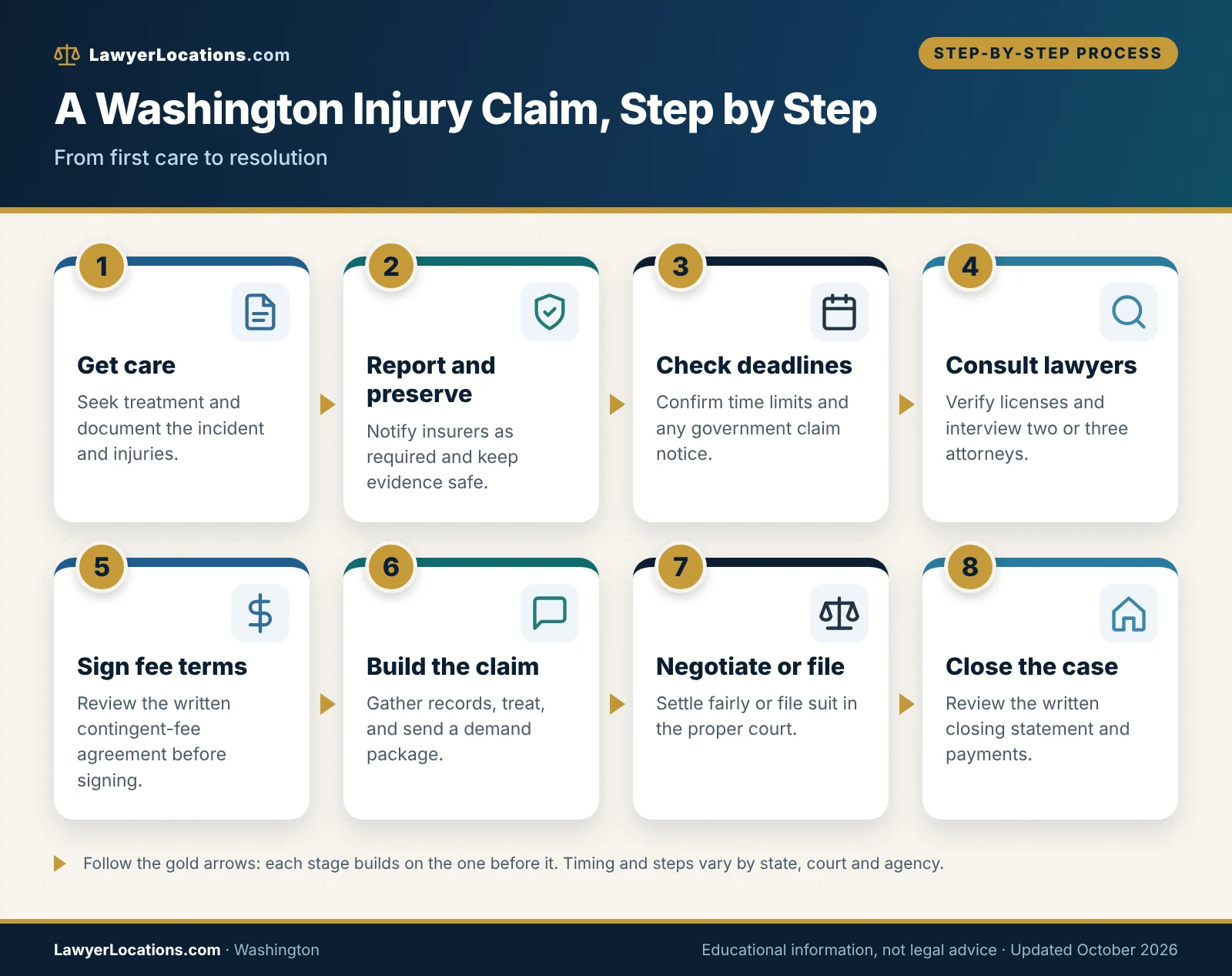
Text version of this graphic
- Get medical care and document the incident.
- Report to insurers and preserve evidence.
- Check deadlines, including any government claim notice.
- Consult one or more Washington lawyers.
- Sign a written contingent-fee agreement.
- Investigate, treat and send a demand.
- Negotiate, or file suit in the right Washington court.
- Resolve the case and review the closing statement.
LawyerLocations.com is a legal-education and lawyer-discovery resource, not a law firm. Nothing here creates an attorney-client relationship, and we do not rank or recommend individual lawyers. The goal is to help you ask better questions, whoever you end up talking to.
How Washington law frames who pays and how much
Two statutes in chapter 4.22 RCW do most of the work in setting how fault is divided and who owes what. Reading them in plain English explains why a lawyer will ask about your own conduct and about everyone else who might share responsibility.
Pure comparative fault under RCW 4.22.005
Under RCW 4.22.005, any contributory fault chargeable to the injured person diminishes proportionately the amount awarded but does not bar recovery altogether. The system is called pure comparative fault: a person found partly responsible for their own injury can still recover the remaining share.
That has a practical consequence when you meet a lawyer. If someone tells you that you have “no case” simply because you were partly to blame, ask them to explain how the percentage rule applies. A reduction for your share of fault is normal; a flat denial for that reason alone is not how the statute reads.
Several liability, with a key exception under RCW 4.22.070
Under RCW 4.22.070, when more than one party is at fault the jury assigns each a percentage that totals 100%, and each defendant’s liability is generally several only, meaning each pays its own share rather than the whole judgment. Joint and several liability, where one defendant can be made to cover everything, survives in limited situations, including when defendants acted in concert or as agents of one another, and when the injured person is found to have no fault at all.
That second exception matters in practice. A passenger or pedestrian with no share of the blame may be able to collect the combined shares of the defendants against whom judgment is entered, while a driver who carries some fault may not. A lawyer who knows these rules will think about who else could be named early, because fault assigned to an empty chair can shrink what you collect.
A jury finds one driver 70% at fault, a delivery company 20% at fault for putting an unsafe vehicle on the road, and a bicyclist 10% at fault for riding without a light at dusk. The bicyclist’s damages are reduced by 10%, and because the bicyclist carries some fault, each defendant generally answers only for its own percentage. Had the bicyclist been found free of fault, the exception for no-fault claimants could have applied. The numbers here are illustrative, not predictions.
When you can reasonably start on your own and when to call a lawyer
Not every injury needs a lawyer, and honest lawyers will say so. The question is whether the stakes, the complexity and the other side’s behavior make professional help worth the cost of a fee.
Situations where handling it yourself may be reasonable
If the injury was minor, you finished treatment quickly, the other driver’s fault is undisputed and the insurer is paying fairly, you may be able to resolve the claim directly. Property-damage-only claims usually fall in this group. Even then, avoid signing a release until you are sure all treatment is complete, because a release usually ends the claim for good.
Many lawyers offer an initial consultation to tell you whether your case justifies hiring one. If you only need a quick reality check, that conversation may be all you need. Our guide on whether you need a lawyer after a car accident lays out the decision more fully.
Signals that point toward hiring a lawyer
Consider professional help when injuries are serious or ongoing, when fault is disputed, when more than one party or insurer is involved, when the insurer is slow-walking or denying, or when a government body or a medical provider may be responsible. A death or an injury to a child almost always warrants a conversation with a lawyer, because the rules and court approvals are more involved.
- You are being pressed to give a recorded statement or sign a release before treatment is complete.
- The other side’s insurance limits look too low for your medical bills.
- A public agency, school or the state may share responsibility.
- You have missed work or may not be able to return to your old job.
Deadlines and Notice Rules That Can End a Washington Claim
The general Washington deadline to file an injury lawsuit is three years, but claims against public bodies and some other categories have extra steps. Missing a deadline can end a claim no matter how strong the facts are, which is why timing is the first thing a careful lawyer checks. Treat the rules below as a map, not a calculator for your own date.
The three-year general deadline
Most ordinary injury claims against private people and businesses fall under one statute. Knowing what it covers, and when the clock can pause, helps you understand why a lawyer may ask for dates before anything else.
What RCW 4.16.080 says in plain language
The lead-in to RCW 4.16.080 says certain actions “shall be commenced within three years.” Subsection (2) of that section covers injury to the person or rights of another not otherwise listed, which is where a typical car crash, fall or dog bite claim lands. The practical result is a 3-year general window to file a lawsuit in court.
Filing a claim with an insurer does not stop the clock. The deadline refers to filing in court, so a negotiation that drags on can run out the time if no lawsuit is started. For more on how deadlines work across the country, see our guide on how long you have to file a personal injury claim.
When the clock may pause for minors, disability or other reasons
Under RCW 4.16.190, if the person entitled to sue was under age eighteen, or incompetent or disabled to the degree that they cannot understand the nature of the proceedings, or imprisoned on a criminal charge before sentencing when the claim arose, the time of that disability is not counted toward the deadline. The statute, however, has exceptions and its own interplay with other rules, so a parent or guardian should not assume a child’s claim can wait.
The discovery of an injury can also matter in some categories, particularly medical claims. Because tolling and discovery arguments are fact-heavy and often contested, ask any lawyer you interview to state in writing which deadline they believe applies and why.
Do not wait for a lawyer to start the paperwork if a government body may be involved. The pre-suit claim rules below can need to be satisfied before the three-year period ends, and the 60-day waiting period is added on top of your preparation time.
Claims against local governments and the state
Injuries on a cracked sidewalk, in a city vehicle crash or at a public school raise a separate set of rules. Washington requires a written claim first, and the details differ slightly depending on whether the defendant is local or state government.
Local entities: RCW 4.96.020
For cities, counties, school districts and other local bodies, RCW 4.96.020 requires a claim for damages to be presented to the entity’s designated claims agent before you sue. The statute requires claimants to use the standard tort claim form from the Department of Enterprise Services Office of Risk Management unless the entity supplies its own, and the form asks for the claimant’s details, a description of the conduct and injury, the time and place, the people involved and the amount of damages claimed.
A lawsuit cannot begin until 60 calendar days have passed after presentation, and the limitations period is paused during those 60 days. Each governing body must name its agent and record the agent’s identity and address with the county auditor, so you can find the right recipient with a records request or a call to the clerk.
The state itself: RCW 4.92.110
For claims against the state and its employees acting in that role, RCW 4.92.110 sets a similar 60-day waiting period after the claim is presented to the Office of Risk Management in the Department of Enterprise Services. The limitations period is paused while you wait, and a suit filed within five court days after the waiting period ends is treated as presented on the first day after it ended.
Both statutes encourage a practical reading of procedure, and the local-entity statute states that its content and procedural requirements are to be construed liberally so that substantial compliance is enough. Do not rely on that leniency. Use the official form, deliver it by a method you can prove and keep a copy.
Medical negligence and wrongful death
Two categories behave differently enough that they deserve their own subsection. Both involve high stakes, and both reward early advice.
Health care claims: RCW 4.16.350
For injuries from health care, RCW 4.16.350 sets a deadline of the later of 3 years from the act or omission or 1 year from when you discovered, or reasonably should have discovered, that the injury was caused by it. There is also an eight-year outer limit measured from the act or omission, with narrow tolling for fraud, intentional concealment or a foreign body left in the patient.
The statute also addresses children: a custodial parent’s or guardian’s knowledge can be imputed to a child, which can cut off the child’s claim in the same way it would an adult’s. If you suspect a medical error, speak with a lawyer promptly rather than waiting for symptoms to settle.
Wrongful death: who sues and for whom
Under RCW 4.20.010, a wrongful death action is brought by the decedent’s personal representative against the person whose wrongful act, neglect or default caused the death. Under RCW 4.20.020, it is for the benefit of the surviving spouse, state-registered domestic partner or children, and if there are none, the statute allows an action for certain parents or siblings.
The wrongful death statute itself does not spell out a time limit, so timing in these cases is usually analyzed under the general limitation rules and any special claim requirements that apply to the defendant. Families should not guess. For a look at costs in these cases, see our guide to wrongful death lawyer costs.
| Situation | Authority | Time rule | Practical note |
|---|---|---|---|
| Typical injury claim against a private person or business | RCW 4.16.080 | 3 years to file suit | Insurer negotiations do not pause the clock. |
| Injured person is a minor, or disabled to a degree that prevents understanding the proceedings | RCW 4.16.190 | Period of disability not counted | Do not assume; exceptions exist and facts matter. |
| Claim against a city, county, school district or other local body | RCW 4.96.020 | Claim first; 60 calendar days before suing | Use the standard claim form; deliver to the entity’s claims agent. |
| Claim against the State of Washington | RCW 4.92.110 | Claim first; 60 calendar days before suing | Claim goes to the Office of Risk Management. |
| Health care injury | RCW 4.16.350 | Later of 3 years from act or 1 year from discovery; 8-year outer limit | Narrow exceptions for concealment and foreign objects. |
| Wrongful death | RCW 4.20.010 and 4.20.020 | Statute names who sues, not a time limit | Ask a lawyer how timing applies to your facts. |
How to Find and Compare Personal Injury Lawyers in Washington
Start with official, verifiable sources, then interview more than one lawyer before you sign anything. Washington’s state bar does not refer members of the public to private lawyers, so the useful tools are its license directory, county bar referral services where they exist, and your own list of questions. Nothing on this page ranks or endorses any attorney.
Where to look for a lawyer in Washington
No single list is complete, and each source answers a different question. Used together, they give you names to check and a way to check them.
The WSBA Legal Directory as a verification tool
The Washington State Bar Association (WSBA) publishes a Legal Directory that lists members’ contact details, license information, discipline history and practice areas. Its Advanced Search lets you filter by practice area, eligibility to practice, license type, county, city and languages other than English, which makes it useful for narrowing a list and for double-checking someone you already heard about.
Treat the directory as a place to confirm status, not as a measure of skill. A clean record means no public discipline is shown; it does not say how a lawyer will handle your case. Look at license status, any listed discipline and the practice areas the lawyer reports.
County bar referral services and legal aid
WSBA’s own public-help page says county bar associations run referral services in Clark, King, San Juan, Snohomish and Tacoma-Pierce counties, with San Juan County requiring an email request. Outside those areas, a search of the directory by county and practice area is the usual route, and a local legal-aid office may know who handles what.
If your income is low, civil legal aid may help with some problems. The Northwest Justice Project’s CLEAR service assists low-income Washington residents with civil legal problems; WSBA lists an online application and a toll-free line, and callers inside King County use the 211 legal referral hotline. Legal aid programs set their own priorities and eligibility rules, so ask whether your problem is covered; they can often point you toward other resources and may help with related issues such as housing or benefits. WSBA’s Moderate Means program has been described as covering family, housing, consumer and employment matters, so confirm its current scope before counting on it for an injury claim.
| Source | What it is good for | What it cannot tell you | Next step |
|---|---|---|---|
| WSBA Legal Directory | Confirming license status, discipline history and practice areas; filtering by county, city and language | Quality of work, fees or availability | Look up every lawyer on your shortlist. |
| County bar referral service (Clark, King, San Juan, Snohomish, Tacoma-Pierce) | Getting names in a local area from a bar-run program | Whether a particular lawyer is right for your claim | Ask how the service screens and what it charges, if anything. |
| Northwest Justice Project / CLEAR | Free civil legal help for eligible low-income residents on covered problems | Contingent-fee injury representation | Check eligibility online or by phone. |
| Friends, coworkers, other professionals | Candid accounts of communication and responsiveness | Whether the lawyer handles your type of claim | Verify the lawyer in the WSBA directory first. |
| Online search and advertising | Finding firms near you and reading how they describe their work | Anything verified; ads are marketing | Read claims skeptically and confirm credentials. |
What to check before you meet anyone
A few minutes of homework saves you from wasting consultations on firms that do not handle your kind of case, and it makes your own questions sharper.
License, discipline and who actually works your file
Confirm that the person is actively licensed in Washington and read any discipline shown. Then ask who will do the day-to-day work. Some firms assign a lawyer for strategy and a case manager or paralegal for routine contact, which can be fine as long as you know whom to call and the lawyer remains reachable on key decisions.
Ask whether the same lawyer who meets you at the consultation will handle negotiation and, if needed, litigation. The answer tells you how the firm is staffed, and staffing is often a better predictor of your experience than any slogan.
Experience with your kind of claim and with Washington courts
A motorcycle crash, a fall at a store, a school injury and a surgical error call for different evidence and sometimes different experts. Ask how many matters like yours the lawyer has handled recently, what stage most of them reached, and whether the firm is comfortable taking a case to trial if negotiations fail.
Also ask about the court where your case would likely be filed. Washington trial-level civil cases are heard by superior courts in each county, and local practices differ on scheduling and on mandatory arbitration for smaller claims. A lawyer who regularly appears in your county will know those habits; one who does not may need to learn them on your time.
Bring a one-page timeline to every consultation. Dates of the incident, first treatment, major test results, missed work and each insurer contact let a lawyer assess your case quickly and let you compare how different lawyers react to the same facts.
How to run consultations and compare lawyers
Plan to speak with at least two or three lawyers. Many injury lawyers offer an initial consultation; ask each one whether there is any charge before you book, and what you should bring.
Questions worth asking in every consultation
Good questions are specific and require a real answer. They also reveal how clearly a lawyer explains things, which matters over a case that can last months or years.
- Who will handle my case day to day, and how do I reach that person?
- Which deadlines or notice rules do you think apply to me, and what is the date?
- What is your fee percentage at each stage, and are costs deducted before or after the fee is calculated?
- Which costs would I owe even if there is no recovery?
- What are the main risks to my claim, including any share of fault that might be assigned to me?
- How often will you update me, and how will I be told about settlement offers?
- Do you handle cases like mine regularly, and would you file suit if the insurer will not be reasonable?
Scoring what you hear
After each meeting, write down answers while they are fresh and score each lawyer on the same criteria. A simple scorecard keeps a confident personality from outweighing a thin answer on deadlines or fees.
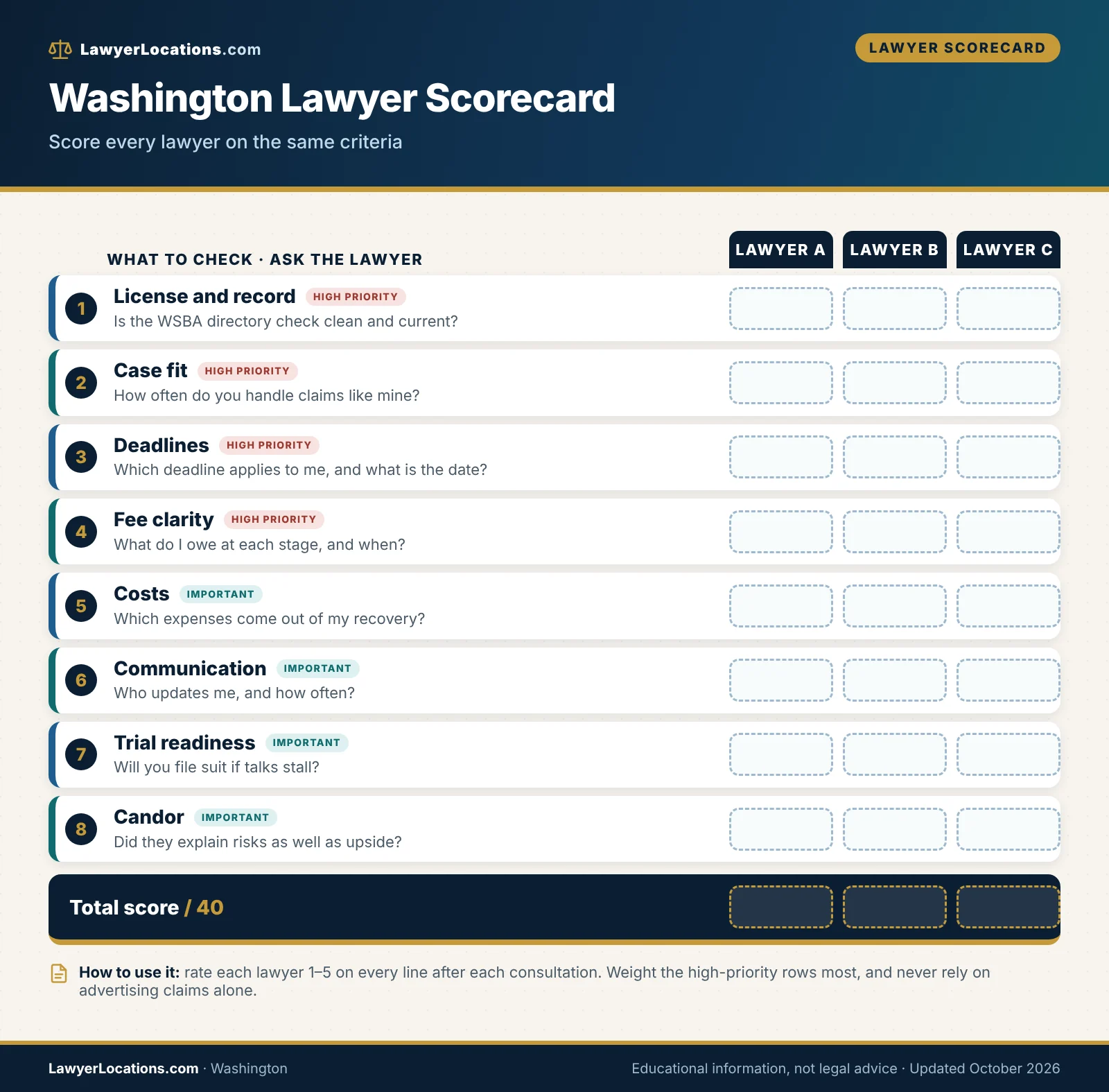
Text version of this graphic
| Criterion | Question to ask |
|---|---|
| License and record | Is my WSBA directory check clean and current? |
| Case fit | How often do you handle claims like mine? |
| Deadlines | Which deadline applies, and what is the date? |
| Fee clarity | What do I owe at each stage, and when? |
| Costs | Which expenses come out of my recovery? |
| Communication | Who will update me, and how often? |
| Trial readiness | Will you file suit if negotiation stalls? |
| Candor | Did they explain the risks, not just the upside? |
Red flags when choosing a lawyer
Most lawyers behave professionally. A few patterns, though, deserve a pause, and spotting them early is easier than leaving later.
Pressure and promises at the first contact
Be wary of anyone who promises a result or a dollar figure before reviewing your records, urges you to sign the same day, or contacts you uninvited right after an incident. A responsible lawyer can explain what they know and what they do not, and will let you take a fee agreement home to read.
- A promised outcome or a specific payout quoted at the first call.
- Pressure to sign immediately or to skip reading the agreement.
- Vague answers about who will handle your file.
- Reluctance to put the fee terms in writing.
Fee and communication warning signs
Watch for fee terms that are unclear about costs, a lawyer who cannot explain what happens if there is no recovery, or a firm that is hard to reach before you even sign. If it is difficult to get a call returned during the consultation phase, it rarely gets easier later.
If a problem arises after you hire a lawyer, the WSBA directory and the bar’s disciplinary process are the official channels for conduct concerns, while a fee disagreement usually starts with a direct conversation and a review of the signed agreement.
Never pay an upfront “case evaluation” or “filing” fee to someone who is not clearly a licensed Washington lawyer. Verify the person in the WSBA Legal Directory before you hand over documents or money.
What Washington Injury Lawyers Charge: Contingent Fees, Costs and Liens
Most Washington injury lawyers are paid a percentage of what they recover, and no recovery generally means no fee, though you may still owe certain expenses depending on the agreement. Washington’s ethics rules require the arrangement to be in a signed writing and set out specific terms. We do not publish an “average” percentage because rates vary by firm, stage and case type; ask each lawyer for theirs in writing.
How a contingent fee works under Washington’s ethics rules
The governing rule is Washington Rule of Professional Conduct 1.5, which the Washington Supreme Court issues for all lawyers licensed in the state. Its paragraph (c) is the one most people need.
What RPC 1.5(c) requires in the written agreement
A contingent fee agreement must be in a writing the client signs, and it must state RPC 1.5(c) items: how the fee is calculated, including the percentage for settlement, trial or appeal; which litigation and other expenses will be deducted from the recovery; whether those expenses come out before or after the fee is calculated; and which expenses the client must pay regardless of outcome. The rule says the agreement must clearly notify the client of any expenses for which the client will be liable.
The rule sets no numeric cap on the percentage. Instead, paragraph (a) requires every fee to be reasonable under factors that include the time and skill required, the customary fee in the locality for similar services, the amount involved and results obtained, and whether the fee is fixed or contingent. In other words, the market and the reasonableness standard, not a statute, set the range.
The closing statement and payments over time
When the matter ends, the lawyer must give you a written statement of the outcome. If there is a recovery, that statement must show the amount sent to you and how it was calculated, so you can see the gross figure, the fee, the expenses and any payments to lienholders in one place.
If a recovery is paid over time, the rule allows the percentage to be applied only to amounts as you actually receive them, or to the actual cost of the settlement or award to the defendant. That matters in structured settlements, where the headline number and the present cost can differ.
Contingent fee means the lawyer’s payment depends on the result. If the case is lost, the lawyer ordinarily takes no fee, but the agreement may still make you responsible for case expenses, so read that section closely.
Costs, expenses and liens that affect what you keep
The fee percentage is only one line of the math. Expenses and repayment claims can move your net recovery as much as the fee does.
Case expenses and the order of deduction
Typical expenses include court filing fees, records and imaging charges, expert witness fees, deposition costs, mediation fees and investigators. Whether those costs are subtracted before or after the percentage is calculated changes your take-home amount, which is exactly why RPC 1.5(c) requires the agreement to say so.
Ask for a rough budget at the start and for periodic updates on spending. Also ask whether the firm advances costs and what happens to them if there is no recovery. Put the answer in the signed agreement, not in a phone call.
The attorney’s lien and repayment claims from insurers and providers
Washington law gives a lawyer a lien for compensation. Under RCW 60.40.010, the lien can attach to the action and its proceeds, and to a judgment once notice is filed, and the lien on an action or its proceeds is described as superior to other liens. The lien protects the lawyer’s agreed or reasonable fee if the client and lawyer part ways or if the case settles.
Separate from the lawyer’s lien, health insurers, public benefit programs and medical providers may assert claims for repayment from a settlement. These rules depend on the type of plan, and some federal programs have their own requirements. Ask any lawyer you are considering how they handle those claims, because negotiating them can affect your net recovery. For a deeper look, see our guide to handling medical bills after a car accident.
| Term to confirm | Question to ask | Why it matters |
|---|---|---|
| Fee percentage by stage | Does the percentage change if a lawsuit is filed or the case goes to trial or appeal? | The rule requires the percentages for settlement, trial and appeal to be stated. |
| Expense deduction order | Are expenses subtracted before or after the fee is calculated? | Changes your net amount even when the percentage is identical. |
| Expenses owed if no recovery | Which costs, if any, would I still owe? | The agreement must clearly notify you of any such expenses. |
| Scope of the engagement | Does the agreement cover only the injury claim, or also related insurance disputes? | Prevents surprises about what the fee covers. |
| Ending the relationship | What happens to the fee and costs if I change lawyers? | Connects to the lawyer’s lien under RCW 60.40.010. |
| Closing statement | Will I receive a written accounting of the recovery and each deduction? | Required when the matter ends with a recovery. |
Comparing fee offers fairly
A lower percentage is not automatically a better deal. What counts is what you keep after fees, costs and repayment claims, and the service you receive for it.
Percentages, tiers and what a fair comparison looks like
Some agreements use one flat percentage; others step up after a lawsuit is filed or a trial date is set. When you compare offers, ask each firm to run the same hypothetical settlement figure through its agreement and show you the net result after fees, costs and a placeholder for lien repayment. That turns a confusing set of terms into a single comparable number.
Avoid choosing solely on the percentage. A firm charging slightly more that prepares files thoroughly may leave you better off than a cheaper one that routinely settles early. The reverse can also be true, which is why the net-to-client exercise is worth the effort.
Other fee structures and when they appear
Hourly billing and hybrid arrangements are less common in ordinary injury work but may appear in unusual disputes, such as a complex insurance coverage fight or a business claim. If a lawyer proposes anything other than a straightforward contingent fee, ask why, and ask for an estimate of total cost and a cap on hours if you are asked to pay by the hour.
Limited-scope arrangements, where a lawyer handles one defined task such as reviewing a settlement offer, can be a lower-cost option for smaller claims. Make sure the scope, the price and what is excluded are written down. See also our guide to how long a car accident settlement takes to understand how timing interacts with cost.
- The agreement states percentages for settlement, trial and appeal.
- You receive a plain explanation of expenses and their order of deduction.
- The lawyer invites you to read the agreement at home.
- The lawyer will not explain which costs you owe if there is no recovery.
- Terms exist only in conversation or marketing materials.
- You are asked to sign before knowing who will work on your case.
Insurance, Damages and Courts: How a Washington Case Moves
A Washington injury claim usually moves from insurance claim to negotiation, and only some cases reach a lawsuit. The coverage available, the way damages are measured and the court that would hear the case all influence the decisions you and your lawyer make along the way. This section covers the state-specific rules that matter most.
Insurance that may pay
Washington cases often turn on whose policy applies and how much it covers. Knowing the baseline rules helps you ask the right questions about your own coverage as well as the other side’s.
Liability minimums and how insurers must respond
Under RCW 46.29.090, the minimum limits for a motor vehicle liability policy are $25,000 for bodily injury or death to one person, $50,000 for two or more persons in one accident, and $10,000 for property damage. These are floors, not what your injuries are worth; a serious injury can exceed a minimum policy quickly, which is why your own underinsured coverage matters.
Washington’s insurance regulations also set response times. Under WAC 284-30-360, an insurer must acknowledge notice of a claim within 10 working days for individual policies (15 for group contracts), and must reply to other claimant communications that reasonably call for a response within the same period. If an insurer is not meeting those basics, a lawyer or the Office of the Insurance Commissioner can be a next step.
Underinsured motorist and personal injury protection coverage
Under RCW 48.22.030, auto policies issued for vehicles registered or principally garaged in Washington must include underinsured motorist coverage unless the named insured rejects it in writing, and bodily injury limits are generally tied to the insured’s own liability limits. A vehicle counts as underinsured when total applicable liability limits are less than the damages the covered person is legally entitled to recover. As the statute is written, its requirement does not extend to motorcycle policies, so motorcyclists should check their own policy language.
Under RCW 48.22.085, insurers must offer personal injury protection (PIP) as optional coverage, and a named insured may decline it in writing. Whether you have it, and what it pays, depends on your policy, so look at your declarations page. For the claims process in these cases, see our guide to uninsured motorist claims and lawyers.
| Coverage | What the statute says | Authority | What to check |
|---|---|---|---|
| Liability (other driver) | Minimums of $25,000 per person, $50,000 per accident for bodily injury, $10,000 property damage | RCW 46.29.090 | Ask early what limits apply; minimums can fall short of serious injuries. |
| Underinsured motorist (your policy) | Must be included unless rejected in writing; limits generally match your liability limits | RCW 48.22.030 | Look for a written rejection and confirm your limits. |
| Personal injury protection (your policy) | Insurer must offer it as optional coverage; insured may decline in writing | RCW 48.22.085 | Read the declarations page to see if you have it. |
| Insurer response times | Acknowledge notice of claim within 10 working days (individual policies) | WAC 284-30-360 | Keep dates of every call and letter. |
How damages are measured in Washington
Damages are the money the law allows an injured person to seek. Understanding the categories helps you read a demand letter and judge a settlement offer.
Economic and noneconomic losses in plain English
Economic damages are measurable costs such as medical bills, rehabilitation, lost wages and reduced earning capacity. Noneconomic damages compensate for harms with no receipt, such as pain, loss of enjoyment of life and emotional distress. A well-prepared claim documents both with records, not just a number.
In wrongful death cases, RCW 4.20.010 provides that recovery covers economic and noneconomic damages sustained by the statutory beneficiaries because of the death, in amounts the jury finds just. That is a different set of questions than an ordinary injury claim, and a lawyer will explain who can recover what.
No general statutory cap on noneconomic damages
In Sofie v. Fibreboard Corp., 112 Wn.2d 636 (1989), the Washington Supreme Court declared the state’s statutory limit on noneconomic damages unconstitutional because it violated the right to a jury trial under the state constitution. As of October 2026, we are not aware of a general statutory cap on noneconomic damages in ordinary injury cases, though some claim types carry special rules, so ask a lawyer whether any apply to yours.
For you, the practical lesson is that a lawyer should not tell you your pain and suffering claim is capped by a formula. The value turns on the evidence: how serious the injury was, how long it lasted, how it changed your life and how credible the documentation is. Our guide to motorcycle accident settlements shows how one type of claim is valued without relying on averages.
We do not publish average settlements or typical payouts for Washington. Outcomes depend heavily on the facts, the insurance available and the strength of the evidence, and a number from someone else’s case says little about yours.
Courts and how a case is filed
If negotiation fails, the lawsuit is filed in a Washington trial court. Knowing which one, and what extra steps may apply, helps you ask lawyers about their local experience.
Superior courts, district courts and mandatory arbitration
Washington’s trial courts of general jurisdiction are the superior courts, with a county-by-county directory published by the state court system at courts.wa.gov. District courts hear smaller civil matters; under RCW 3.66.020, their civil jurisdiction reaches claims up to $100,000, exclusive of interest, costs and attorneys’ fees. Most significant injury cases are filed in superior court in the county where the defendant lives or where the incident happened, subject to the venue rules a lawyer will apply.
Chapter 7.06 RCW authorizes mandatory arbitration of certain civil actions, implemented through the Superior Court Mandatory Arbitration Rules. Whether your claim goes to arbitration first, and at what dollar level, depends on the county’s local rules and the amount in controversy, so ask your lawyer what the county requires and what the next step is if you disagree with an award.
Court approval for settlements involving children or incapacitated people
Under SPR 98.16W, a settlement involving the beneficial interest of an unemancipated minor or a person determined to be incapacitated requires court approval, whether or not a lawsuit has been filed. The court must find the settlement adequate, and the petition must list liens, fees, costs and expenses so the net amount to the affected person is clear.
The rule also calls for a settlement guardian ad litem in most cases, an attorney who investigates and reports to the court, unless an exception applies. For families, this means a child’s settlement is not final until the judge approves it, and the court decides on fees and costs at the hearing.
Key decision points and the timeline of a typical case
No two cases run on the same calendar, but most pass through recognizable stages. Identifying where decisions occur helps you stay in control rather than reacting to the other side’s schedule.
When to settle and when to file suit
Your lawyer will usually recommend settling when an offer fairly covers your documented losses and the risks of trial, and filing suit when the insurer will not move or a deadline approaches. The decision to accept or reject a settlement offer belongs to you, and a good lawyer explains the trade-offs in plain language before asking for it.
A key timing rule: do not let negotiations run toward the deadline. If the three-year period (or the 60-day waiting period for government claims) is close, filing a lawsuit protects your rights while talks continue.
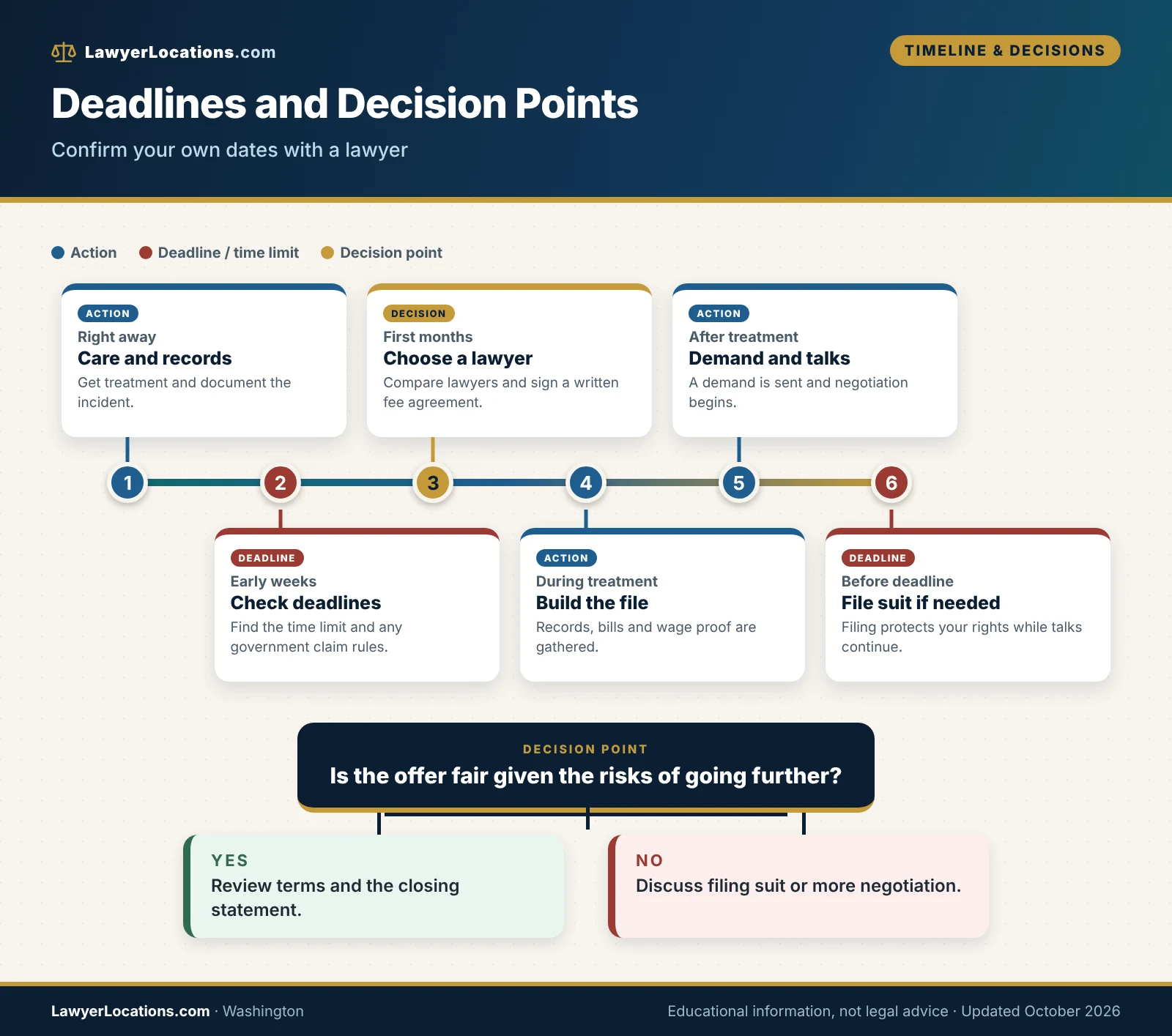
Text version of this graphic
- Right away: Get care, document, and report as required. (action)
- Early weeks: Check deadlines, including any government claim notice. (deadline)
- First months: Interview lawyers and sign a written fee agreement. (decision)
- During treatment: Lawyer gathers records and tracks costs. (action)
- After treatment stabilizes: Demand sent and negotiation begins. (action)
- Before the deadline: File suit if no fair resolution. (deadline)
- Decision point: Is the offer fair given the risks of going further? Yes: review the closing statement. No: consider filing or continuing negotiation.
What happens after a lawsuit is filed
After filing, the defendant responds, both sides exchange information through discovery, and the court sets deadlines and a trial date. Mediation or arbitration often happens along the way, and many cases settle before a jury ever hears them.
Litigation takes longer and costs more than a pre-suit settlement, which is why fee agreements often treat the filing stage differently. Ask your lawyer to explain the expected steps, the likely expenses at each one and how that affects your net recovery.
Write down three dates the day you hire a lawyer: the date your lawyer believes the lawsuit deadline falls, the date of any government claim filing and the date you expect your treatment to reach a stable point. Revisit them every month.
Before You Call: Documents, Mistakes to Avoid and Next Steps
Preparation makes the first conversation with a lawyer more productive and protects your claim in the meantime. Gather what you have, avoid a few common missteps, and then compare at least two lawyers using the questions and scorecard above. This section pulls the practical pieces together.
Documents and evidence to gather
You do not need a perfect file to call a lawyer, but the more you can bring, the faster the review. Start with what you already have and add as you go.
The core records to collect now
Collect the crash or incident report number, photographs of the scene and injuries, contact details for witnesses, insurance information for everyone involved, and your own policy. Add medical records and bills, proof of lost income and a short written timeline while memories are fresh.
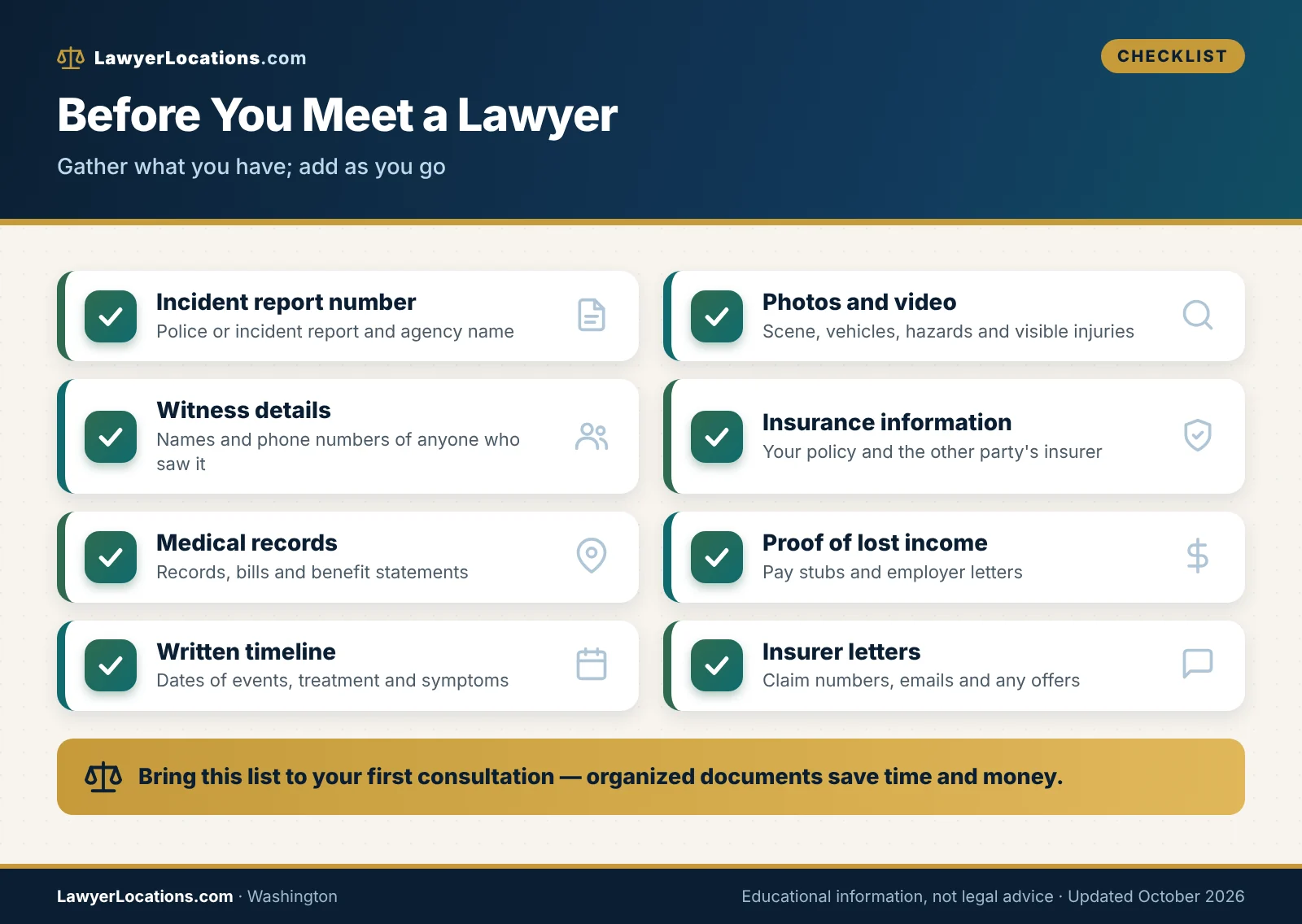
Text version of this graphic
- Incident or crash report number
- Photos and video of the scene and injuries
- Witness names and contact details
- All insurance information, including your own policy
- Medical records and bills
- Proof of missed work and lost income
- Written timeline of events and symptoms
- Any letters, emails or claim numbers from insurers
- Photographs and video of the scene, vehicles, hazards and injuries
- Police or incident report number and responding agency
- Names and phone numbers of witnesses
- Your insurance policy and the other party’s insurer and claim numbers
- Medical records, bills and explanation-of-benefits statements
- Pay stubs and employer letters showing missed time
- A daily symptom and activity journal
Preserving evidence that can disappear
Some evidence vanishes quickly: surveillance video is overwritten, vehicles are repaired or salvaged, and hazards are fixed. Ask a lawyer promptly about preservation letters if a business or agency may hold important footage or records.
Keep damaged items, clothing and devices in their current condition until a lawyer has had a chance to look, and avoid posting about the incident or your recovery on social media. Insurers and defense lawyers read public posts, and a casual comment can be quoted back out of context.
Mistakes that can cost you
Most mistakes come from trying to be helpful or from moving too fast. Knowing them in advance is a cheap form of protection.
Mistakes when dealing with insurers
Giving a recorded statement to the other side’s insurer before understanding your options, accepting an early offer before treatment is complete, and signing a broad medical authorization are common examples. Insurers are not required to look out for your interests, and an early offer may not account for future care.
- Signing a release before you know the full extent of your injuries.
- Downplaying symptoms in a recorded statement.
- Skipping medical appointments, which can look like your injuries improved.
- Posting activity on social media that seems inconsistent with your injuries.
Mistakes about timing and hiring
Waiting too long, assuming a government claim works like a private one, or hiring the first lawyer who calls can limit your options. Take the time to verify, compare and read the fee agreement before you sign.
Also avoid assuming that a lawyer in a different state can handle a Washington case by default. Courts have admission rules, and a lawyer licensed elsewhere may need local counsel. Check the WSBA directory and ask directly.
Your next steps
You do not need to decide everything today. A short, ordered plan can keep a stressful situation manageable.
A simple plan for the next two weeks
- Protect your health. Follow your providers’ instructions and keep every appointment.
- Write down your key dates. Include the incident date and any government claim requirements.
- Collect the core documents listed above and keep them in one folder.
- Check two or three lawyers in the WSBA Legal Directory and book consultations.
- Compare in writing. Use the scorecard and ask each firm for fee terms before you sign.
Where to find official help
The WSBA Legal Directory is the place to verify a lawyer’s license and discipline history, and the court directory at courts.wa.gov helps you find the right county court. If you qualify for civil legal aid, the Northwest Justice Project’s CLEAR service is a starting point for covered problems. For what to do right after a crash, see our guide on what to do after a car accident.
When you are ready, a personal injury lawyer in Washington can review your records, identify the deadlines that apply and explain your options. The decision to hire, and whom to hire, stays with you.
How long do I have to file a personal injury lawsuit in Washington?
For most ordinary injury claims against private parties, the general deadline is three years under RCW 4.16.080. Claims against governments, medical providers and some other defendants have extra steps or different timing, so confirm which rule applies to you.
Can I still recover if I was partly at fault?
Generally yes. Under RCW 4.22.005, your share of fault reduces your damages proportionally rather than barring them.
What do I have to do before suing a city or the state?
You generally must present a written claim first and wait 60 calendar days before filing suit, under RCW 4.96.020 for local entities and RCW 4.92.110 for the state. Use the official claim form and keep proof of delivery.
Do Washington injury lawyers charge upfront?
Many work on a contingent fee, which means their payment depends on the result. You may still owe certain case expenses, and RPC 1.5(c) requires the agreement to state them clearly in a signed writing.
Is there a cap on what I can recover for pain and suffering?
The Washington Supreme Court struck down the old statutory cap on noneconomic damages in 1989, and we are not aware of a general cap in ordinary injury cases as of October 2026. Some claim types have their own rules, so ask a lawyer about yours.
How do I check whether a lawyer is licensed in Washington?
Use the WSBA Legal Directory, which shows license information and discipline history. The WSBA does not refer members of the public to specific lawyers.
Where can I find a lawyer if I live outside Seattle?
The directory’s Advanced Search lets you filter by county, city and practice area. County bar referral services operate in Clark, King, San Juan, Snohomish and Tacoma-Pierce counties.
Does my child’s settlement need a judge’s approval?
Yes. SPR 98.16W requires court approval of settlements involving unemancipated minors or people determined to be incapacitated, and the court reviews fees, costs and liens.
What insurance does Washington require drivers to carry?
Minimum liability limits under RCW 46.29.090 are $25,000 per person and $50,000 per accident for bodily injury, and $10,000 for property damage. Those minimums may be far less than a serious injury costs.
Can I switch lawyers if I am unhappy?
Generally you may, but the first lawyer may have a lien for their agreed or reasonable fee under RCW 60.40.010. Read your fee agreement and talk with the new lawyer about how fees and costs would be handled.
Ready to compare your options?
Pick two or three Washington lawyers, verify each one in the WSBA Legal Directory, and take the scorecard questions to the consultations. If you want to understand the timing first, start with our guide on how long you have to file a personal injury claim.
General information only. This page is a legal-education resource and not legal advice. Reading it does not create an attorney-client relationship, and LawyerLocations.com is not a law firm or a lawyer referral service. Laws, court rules and agency procedures change; consult a lawyer licensed in Washington about your situation and confirm current deadlines with the official sources.
Sources & References
Show all 21 sources
- RCW 4.16.080, Actions limited to three years — Washington State Legislature — app.leg.wa.gov — accessed October 2026
- RCW 4.16.190, Statute tolled by personal disability — Washington State Legislature — app.leg.wa.gov — accessed October 2026
- RCW 4.16.350, Health care actions — Washington State Legislature — app.leg.wa.gov — accessed October 2026
- RCW 4.22.005, Effect of contributory fault — Washington State Legislature — app.leg.wa.gov — accessed October 2026
- RCW 4.22.070, Percentage of fault; several liability — Washington State Legislature — app.leg.wa.gov — accessed October 2026
- RCW 4.96.020, Tortious conduct of local governmental entities — claim filing — Washington State Legislature — app.leg.wa.gov — accessed October 2026
- RCW 4.92.110, Claims against the state — waiting period — Washington State Legislature — app.leg.wa.gov — accessed October 2026
- RCW 4.20.010 and 4.20.020, Wrongful death — Washington State Legislature — app.leg.wa.gov — accessed October 2026
- RCW 60.40.010, Lien for compensation — Washington State Legislature — app.leg.wa.gov — accessed October 2026
- RCW 46.29.090, Minimum liability limits — Washington State Legislature — app.leg.wa.gov — accessed October 2026
- RCW 48.22.030, Underinsured coverage — Washington State Legislature — app.leg.wa.gov — accessed October 2026
- RCW 48.22.085, Personal injury protection — Washington State Legislature — app.leg.wa.gov — accessed October 2026
- RCW 3.66.020, District court civil jurisdiction — Washington State Legislature — app.leg.wa.gov — accessed October 2026
- Chapter 7.06 RCW, Civil arbitration — Washington State Legislature — app.leg.wa.gov — accessed October 2026
- WAC 284-30-360, Standards for prompt, fair and equitable settlements — Washington Office of the Insurance Commissioner rules — app.leg.wa.gov — accessed October 2026
- RPC 1.5, Fees — Washington Supreme Court, court rules — courts.wa.gov — accessed October 2026
- SPR 98.16W, Settlement of claims of minors and incapacitated persons — Washington Courts — courts.wa.gov — accessed October 2026
- Washington court directory — Washington Courts — courts.wa.gov — accessed October 2026
- How to Find a Lawyer Using WSBA’s Legal Directory — Washington State Bar Association (NWSidebar) — nwsidebar.wsba.org — accessed October 2026
- Find Legal Help — Washington State Bar Association — wsba.org — accessed October 2026
- House Bill Report on HB 1034 (discussing Sofie v. Fibreboard Corp., 112 Wn.2d 636 (1989)) — Washington State Legislature — lawfilesext.leg.wa.gov — accessed October 2026
Legal Disclaimer and Limitation of Liability
Informational and illustrative purposes only. This article was prepared by LawyerLocations.com solely on the basis of the information available to us at the time of writing. It is an illustrative, general overview. It is not a complete or authoritative statement of the law, and it has not been reviewed by a lawyer licensed in your state or county.
Not legal advice. Nothing in this article is legal, financial, tax or immigration advice, and reading it does not create an attorney-client relationship between you and LawyerLocations.com or any author, lawyer or firm mentioned. Laws, court rules, fees, filing deadlines and agency procedures differ by state, county and court, and they change often. Some details here may be simplified, incomplete or out of date, and time limits for legal claims can be short.
No warranty. We make no representation or warranty, express or implied, about the accuracy, completeness, timeliness or suitability of this content for your situation. Please do not rely on it to make, delay or skip any legal decision. Check the facts against official sources and speak with a licensed attorney in the relevant jurisdiction before you act.
Limitation of liability. To the fullest extent permitted by law, LawyerLocations.com and its owners, authors and contributors disclaim all liability for any loss, damage, cost or other consequence arising from the use of, or reliance on, this article, including any content on third-party websites we link to. Mentioning a lawyer, firm, organization or service is not an endorsement and is not a promise of any result. If you are in immediate danger, contact your local emergency number.