
If you were hurt in a fall on someone else’s property and are weighing a slip and fall lawyer Houston TX option, the lawyer can help you work out whether the property owner or occupier can be held responsible under Texas premises liability law. Most private-property injury lawsuits in Texas must be filed within 2 years under Tex. Civ. Prac. & Rem. Code § 16.003, and claims against the City of Houston can require written notice within 90 days.
This guide explains how those rules work, which Harris County courts may hear a case, how contingent-fee agreements are regulated, and how to compare attorneys before you sign anything. It is general information, not legal advice.
How Slip and Fall Claims Work Under Texas Law
A slip and fall claim in Houston is a premises liability case: you argue that a property owner or occupier failed to deal with a dangerous condition and that the failure caused your injury. Texas law, not a Houston ordinance, supplies the main rules, and local courts apply them.
Premises liability basics
Texas courts treat a fall injury differently from a car crash. Nobody is liable just because you fell on their property. The question is whether the owner or occupier did something wrong, or failed to do something reasonable, about a hazard they knew or should have known about.
Your status on the property comes first
The duty a property owner owes depends on why you were there. An invitee is someone on the property for the owner’s business benefit, such as a shopper in a grocery store or a diner in a restaurant. A licensee is generally a social guest or someone present with permission but without a business purpose. A trespasser is owed the least.
Most people hurt in Houston stores, restaurants, office lobbies and apartment common areas are invitees, which is the category that carries the strongest duty. Your lawyer will want to pin down your status early because it frames every other argument.
Knowledge of the hazard is the element that decides many cases
In a typical Texas slip and fall claim, you must show the owner or occupier knew, or reasonably should have known, about the dangerous condition. Knowledge can be actual (an employee saw the spill) or constructive (the hazard sat there long enough that a reasonable inspection would have found it).
The Supreme Court of Texas addressed this in Keetch v. Kroger Co. (1992), where a shopper slipped on a slick spot in a grocery store floral department. The court held that evidence that the store created the hazard did not by itself establish, as a matter of law, that the store knew about it. That is why photos, timing evidence and store records matter so much.
Ask any lawyer you interview how they would prove how long the hazard was there. Surveillance video, cleaning logs, inspection schedules and employee statements are the usual building blocks, and they are often kept for a limited time.
Hazard on the ground versus a negligent activity
Texas courts also separate claims about a dangerous condition (a wet floor, a broken step) from claims about a negligent activity (a crew mopping without warning signs). The legal theory affects what you must prove, so a case pleaded the wrong way can run into trouble.
A careful lawyer will look at both possibilities before filing, because the facts of how the hazard appeared often point toward one theory or the other.
Where Houston slip and fall injuries happen
Premises cases arise anywhere people walk. The setting matters because it tells you who the likely defendants are, who carries insurance, and what records exist.
Stores, restaurants and big-box retail
Retail and restaurant falls usually involve a spill, a freshly mopped floor, a tracked-in puddle or a cluttered aisle. Stores often have cameras, incident-report forms and written inspection routines, so a lawyer may ask early on that the company preserve those records.
The defendant may be a national chain, a franchisee, a landlord who owns the building, or more than one of them. Sorting out who controlled the area where you fell is part of the groundwork.
Apartments, offices and parking structures
Falls on stairs, in lobbies, in parking garages and along walkways often turn on maintenance duties: lighting, handrails, drainage, uneven pavement and cracked concrete. A property manager, a management company and an owner may each have written responsibilities in their contracts.
If you were hurt in a place that is not private, such as a public sidewalk or a government building, a different set of notice rules can apply, covered in section 3 below.
Wet-weather and outdoor hazards
Rain brought indoors, standing water in entrances and slippery walkways are common fact patterns in a rainy Gulf Coast city. The legal question stays the same: did the owner know or should the owner have known, and did they take reasonable steps such as mats, warning signs or prompt cleanup?
Weather alone rarely settles a case. Defendants will point to it as an obvious risk, and your lawyer will look at what a reasonable owner would have done about it.
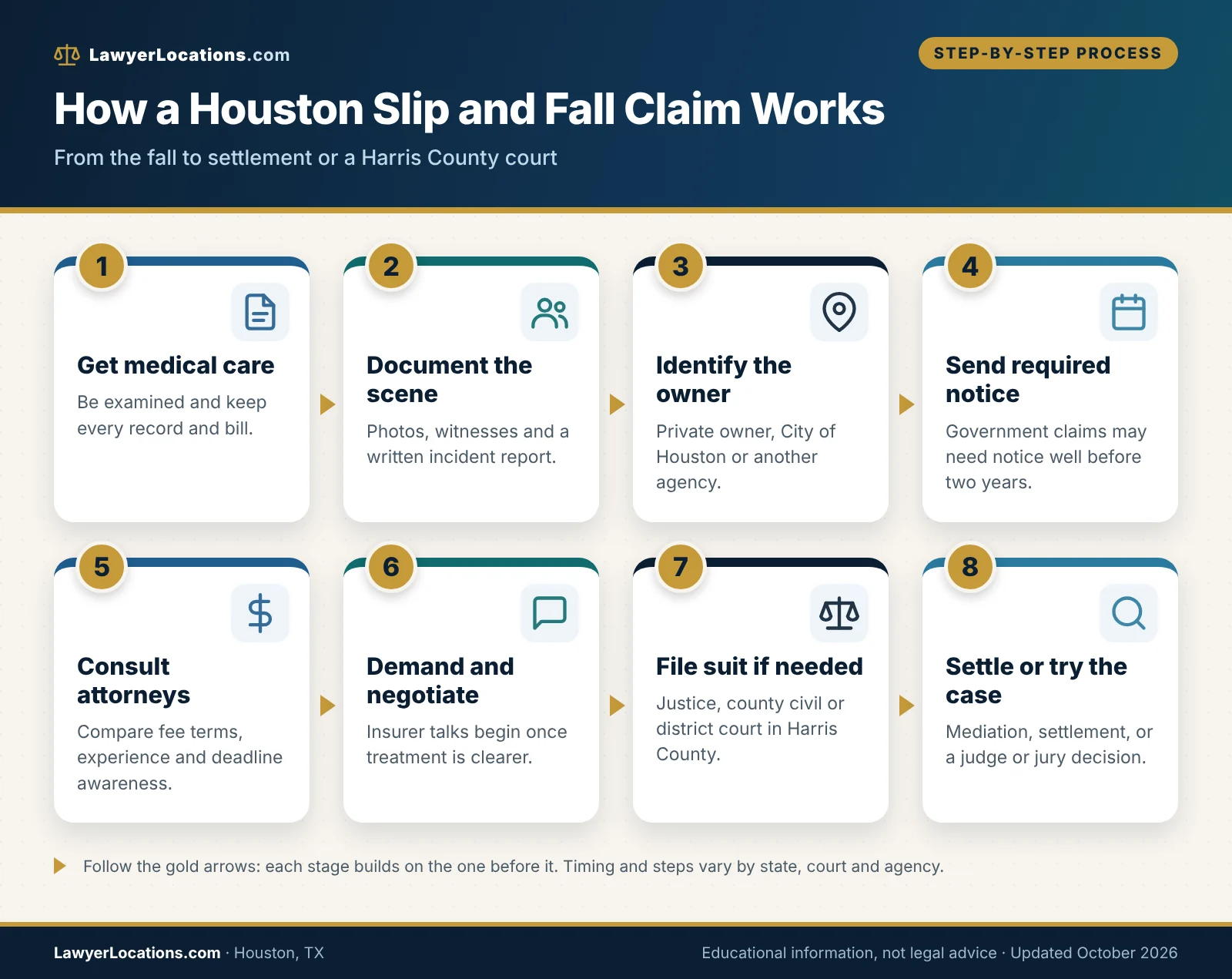
Text version of this graphic
- Get medical care and document the fall scene.
- Report the incident to the property owner or manager in writing.
- Preserve evidence: photos, shoes, witness names, receipts and records.
- Consult one or more Houston attorneys about the facts and deadlines.
- Send required notices, especially for claims against government entities.
- Negotiate with the insurer, or file suit in the correct Harris County court.
- Exchange evidence, attend mediation if ordered, then settle or go to trial.
What a Houston slip and fall case usually looks like from start to finish
Every file is different, but most follow a recognizable path. Understanding the path helps you judge a lawyer’s explanation of it.
Investigation and demand
The first phase is gathering facts: the incident report, photos, medical records, bills and any video. Your lawyer may send preservation letters and, once medical treatment has stabilized, a demand package to the insurer.
Many people are tempted to settle quickly. The risk is that you may not yet know the full extent of the injury, and a signed release usually ends the claim for good.
Lawsuit and discovery
If negotiation does not resolve the claim, a lawsuit must be filed before the deadline in section 2. After that, both sides exchange documents, answer written questions and give sworn testimony in depositions.
A court may refer the parties to mediation, a confidential meeting with a neutral mediator, before a trial date is reached, and parties can also agree to mediate on their own.
Resolution
Most civil claims end in a negotiated settlement, but some go to a judge or jury. A good attorney explains the realistic range of outcomes without promising any of them.
Whatever route your case takes, a Texas lawyer working on contingency must give you a written closing statement when the matter ends, as covered in section 5.
Texas Deadlines and Fault Rules That Shape Your Claim
Three rules do most of the work in a Texas fall case: the filing deadline, the fault-sharing rule, and the limit on recovering medical expenses. Each comes from the Texas Civil Practice and Remedies Code and applies statewide, including in Harris County.
The two-year filing deadline
A lawsuit over a personal injury generally has to be filed within two years. Missing that date usually means the court will dismiss the case no matter how strong the facts are.
The general rule in Section 16.003
Tex. Civ. Prac. & Rem. Code § 16.003(a) sets a two-year limit for suing over personal injury, running from the day the claim arises, subject to the exceptions listed in the statute. For most falls, that means two years from the date you were hurt.
The two-year period is the outer limit for filing a lawsuit, not a target date for starting. Evidence such as video can disappear within weeks, and notice rules for government property can expire much sooner. For a broader look at state limits, see our guide on how long you have to file a personal injury claim.
Special situations that can change the clock
Texas law contains exceptions that may extend or alter the deadline, such as special rules for injured children and certain situations in which an injury could not reasonably have been discovered. The exceptions are narrow and fact-specific.
If your situation involves a child, a death, or a delayed diagnosis, do not assume the two-year rule applies the way it does for an adult with an obvious injury. Ask a Texas attorney to calculate the date from the actual facts. A fall that ended in a death raises separate wrongful death rules, which we compare in our wrongful death lawyer cost guide.
Shared fault under Texas proportionate responsibility
Defendants in fall cases almost always argue that you share the blame: you were distracted, wore unsafe shoes, or ignored a warning sign. Texas has a statutory system for dividing blame.
The more-than-50-percent bar
Under Tex. Civ. Prac. & Rem. Code § 33.001, a claimant may not recover damages if his or her percentage of responsibility is greater than 50 percent. A jury that finds you 50 percent responsible or less does not shut you out, but one that finds you 51 percent responsible does.
That single percentage point is why defendants focus on your own conduct, and why your lawyer should anticipate those arguments before you give any recorded statement.
How the percentage reduces your recovery
If you are not barred, § 33.012 directs the court to reduce your damages by your percentage of responsibility. Section 33.012 also provides for a further reduction by the amount of any settlements you reached with other persons in the same claim.
Suppose, purely as a hypothetical, a jury found $100,000 in damages and decided you were 20 percent responsible. The court would reduce the award by 20 percent, to $80,000. If you had also settled with another party for $10,000, § 33.012(b) would call for a further reduction by that settlement amount. The numbers are illustrative only, not a prediction of any real case.
Medical expenses: what you can claim
Medical bills are usually the backbone of a premises injury claim, but Texas limits how they are measured.
Paid or incurred, not just billed
Tex. Civ. Prac. & Rem. Code § 41.0105 says that recovery of medical or health care expenses incurred is limited to the amount actually paid or incurred by or on behalf of the claimant. The number on a hospital’s original bill is therefore not always the number a jury can consider.
This rule is one reason an insurer’s valuation can look lower than the total on your billing statements. A lawyer can explain how insurance write-offs and adjustments affect your case. We cover bill handling in more detail in our guide to medical bills after an accident, which is written for car crashes but explains many of the same payment mechanics.
Other categories of damages
Beyond medical costs, injured people may seek compensation for lost income, reduced earning ability, pain, physical impairment and similar harms, depending on the evidence. Each category needs proof, such as employer letters, tax records, and doctor opinions about long-term limits.
No lawyer can honestly tell you in advance what a fall case is worth. Be cautious about any online calculator or advertisement that does.
| Issue | Texas rule | What it means for you |
|---|---|---|
| Filing deadline | Two years for personal injury, Tex. Civ. Prac. & Rem. Code § 16.003(a) | File suit, or resolve the claim, before the date arrives; ask a lawyer to confirm the exact date. |
| Shared fault | No recovery if your responsibility is greater than 50 percent, § 33.001 | Your own conduct is examined; avoid guessing about blame in statements. |
| Reduction for fault | Damages reduced by your percentage of responsibility, § 33.012 | Even a modest share of blame lowers the final amount. |
| Medical expenses | Limited to amounts actually paid or incurred, § 41.0105 | Gather both billed amounts and insurance payment records. |
| City of Houston | Written notice within 90 days under the City Charter | Start the notice early, even if you have not hired a lawyer. |
| Other governmental units | Notice generally within six months, § 101.101, unless a charter or ordinance sets another period | Identify the owner of the property quickly. |
Statutes can be amended. The Texas Legislature publishes the current text of every code at statutes.capitol.texas.gov, and a lawyer should confirm the version in force on the date of your injury.
Claims Involving City of Houston and Other Government Property
If your fall happened on a city sidewalk, in a municipal building or on another government-owned property, a separate set of rules applies. These rules can shorten your notice period dramatically, so identify the owner of the property first.
The City of Houston 90-day notice
The City of Houston Legal Department states that the City Charter requires notice of a claim within 90 days after the injury or damage was sustained, and that failure to notify within that time and manner exempts the city from liability.
What the notice must contain
According to the City’s claims page, the written notice must state when, where and how the injury occurred, the apparent extent of the injury and the amount of damage, and the amount for which the claimant will settle. It must also give your street address when the claim is presented, your residence for the six months before the incident, and the names and addresses of the witnesses you rely on.
Because the notice asks for a settlement figure early in the process, many people want a lawyer to review it before it is sent. Once a number is on paper, it can be hard to walk back.
A late notice can end a city claim before it begins. If you suspect the hazard was on city property, treat the 90-day period as an urgent deadline and keep proof of when and how you sent your notice.
How and where to send it
The City states that the claim information should be put in writing and the letter signed before a notary public. It lists attachments to include, such as photos of any damage, an accident report if available, and photocopies of medical bills and a doctor’s narrative.
The City’s page directs the primary notice to the City Secretary’s Office and a copy to the City Attorney’s Office, Claims/Subrogation Section, and it lists mailing addresses and fax numbers. Always use the current addresses published at houstontx.gov/legal/fileclaim.html, since contact details change.
Other government entities in the Houston area
Houston-area property is owned by many public bodies: Harris County, school districts, transit authorities, flood-control and special districts, and state agencies. Each can have its own notice rules.
The six-month notice rule under Chapter 101
Under the Texas Tort Claims Act, § 101.101(a) says a governmental unit is entitled to receive notice of a claim within six months after the incident, describing the damage or injury claimed, the time and place, and the incident. Subsection (b) ratifies charter or ordinance provisions that set a notice period within the limits allowed by law, which is how the City of Houston’s shorter period fits in.
Subsection (c) provides that the notice requirements do not apply where the governmental unit has actual notice of a death, an injury or property damage. Do not rely on that exception without legal advice; written notice remains the safer course.
A narrower duty on public premises
For premises defects, § 101.022(a) says the governmental unit owes only the duty that a private person owes to a licensee on private property, though that limit does not apply to a claimant who pays to use the premises. Special defects, such as excavations or obstructions on roads, have different treatment under subsection (b).
The practical effect is that proving a government-premises fall is typically harder than proving a store fall. The Act also contains limits on the amounts that can be recovered, so a lawyer should explain how those limits apply to your claim.
| Factor | Private owner (store, apartment, office) | City of Houston | Other governmental units |
|---|---|---|---|
| Pre-suit notice | No statutory notice to the owner, though prompt reporting helps | Written notice within 90 days under the City Charter | Generally within six months under § 101.101, unless a charter or ordinance sets a different period |
| Standard for premises defects | Depends on whether you were an invitee, licensee or trespasser | Licensee-level duty unless an exception applies, § 101.022 | Licensee-level duty unless an exception applies, § 101.022 |
| Lawsuit deadline | Two years, § 16.003 | Two years in general, but only if the notice requirement was met | Two years in general, but only if the notice requirement was met |
| Key documents | Incident report, video, inspection logs | Notarized notice letter, photos, medical records | Notice letter and records from the specific agency |
Houston and Harris County Courts, Step by Step
Houston is the largest city in Harris County, and most city-limit incidents are litigated in Harris County courts. Which court hears a case depends mainly on the amount in controversy and the type of claim.
Confirm the county where the property sits. Some properties with a Houston mailing address lie in a neighboring county, and the right venue follows the facts of the case, so your lawyer should check the location before filing.
Which court can hear a slip and fall case
Texas divides civil cases among several trial courts. In the Houston area, the three you are most likely to hear about are the justice courts, the county civil courts at law and the district courts.
Justice courts for smaller claims
Under Tex. Gov’t Code § 27.031, a justice court has civil jurisdiction over matters where the amount in controversy is not more than $20,000, exclusive of interest, when exclusive jurisdiction does not lie in another court. Most injury claims with significant medical treatment exceed that range, but a minor injury with modest bills could fit.
Because these courts are designed for simpler disputes, parties often represent themselves there. Consider whether the possibility of future medical needs makes a small-claims route too risky before choosing it.
Harris County civil courts at law
Harris County’s county civil courts at law, which list their address as 201 Caroline in downtown Houston, describe civil jurisdiction for matters with an amount in controversy up to $250,000, along with appeals of civil cases from Harris County justice courts. Their authority comes from Tex. Gov’t Code § 25.1032 and the general statutory county court provisions.
A moderate-value fall case can land here. These limits are set by statute and can change, so your lawyer should verify the current ceiling when choosing where to file.
District courts for larger cases
Claims above the county court ceiling, or cases a lawyer prefers to file in a district court, go to a Harris County district court, with filings handled through the Harris County District Clerk. Texas district courts are the state’s general-jurisdiction trial courts.
Which court is better depends on strategy, the amount at stake and the facts. This is a decision to make with your lawyer, not a form field to guess at.
| Court | Amount in controversy | Typical use | Official source |
|---|---|---|---|
| Harris County justice courts | Up to $20,000, exclusive of interest | Smaller claims, often with fewer procedural formalities | Tex. Gov’t Code § 27.031 |
| Harris County civil courts at law | Up to $250,000 as described by the courts | Mid-sized injury claims; appeals from justice courts | Tex. Gov’t Code § 25.1032; ccl.hctx.net |
| Harris County district courts | Above county court limits, and other general-jurisdiction cases | Larger or more complex claims | Harris County District Clerk |
How a lawsuit moves through Harris County
Once a petition is filed, the case follows the Texas Rules of Civil Procedure. Local administration, such as docket access, records and fee schedules, comes from Harris County offices.
Filing and the district clerk
The Harris County District Clerk’s website offers civil sections for courts, intake and post-trial matters, plus links for docket searches, mandated e-filing information and civil fee schedules. Use the clerk’s current fee schedule to see the filing cost for your court rather than relying on an old figure.
The clerk publishes mandated e-filing information for civil cases, and lawyers generally file electronically, so your attorney will normally handle the filing. If you ever file without a lawyer, read the clerk’s e-filing guidance first. If cost is a barrier, ask the clerk about the process for requesting a fee waiver.
Expedited actions under Rule 169
Texas Rule of Civil Procedure 169 creates an expedited process for suits where every claimant affirmatively pleads that they seek only monetary relief up to a dollar ceiling stated in the rule, excluding items such as interest, penalties and attorney fees. The rule limits the recovery, restricts trial time for each side and allows a party to request a trial setting within a set period after discovery closes.
Expedited treatment can speed things up, but it also caps what you can recover. Ask any lawyer whether your claim fits within Rule 169 and how that choice affects the value of your case.
Discovery, mediation and trial
During discovery, each side requests documents, answers written questions and sits for depositions. For a fall case, expect requests about the incident report, video, maintenance logs, prior similar falls and your own medical history, including prior injuries to the same body part.
A court may refer a case to mediation, and many parties choose it voluntarily. If the case does not settle, it proceeds to a judge or jury trial.
How to Compare Slip and Fall Lawyers in Houston
Choosing a lawyer is a decision about fit, communication and fees. LawyerLocations.com does not rank or recommend firms; this section shows you how to run your own comparison.
Where to find and vet Houston attorneys
You can start with referral services, a directory, or a recommendation from someone you trust. Whatever route you use, verify the basics yourself.
Bar-run referral services
The Houston Lawyer Referral Service (HLRS) describes itself as a public service of the Houston Bar Association and eight other local bar associations, certified by the State Bar of Texas. It states that the referral itself costs nothing, and that the first 30 minutes of a consultation with a referred attorney carry a $20 nominal fee.
HLRS lists a phone number of (713) 237-9429 on weekdays and an online referral form at hlrs.org. Terms can change, so confirm current details when you call. Referral services help you reach a lawyer who handles your type of case, but they do not evaluate your claim for you.
Directories and advertising
Online directories, search results and billboards are marketing, not a ranking of quality. A professional-looking page does not prove a lawyer’s experience with premises claims.
Treat claims such as “millions recovered” with caution. Past results do not predict your outcome, and a number without context (the type of case, the date, the facts) tells you little.
Checking license status
Before you sign anything, confirm through the State Bar of Texas’s public attorney lookup that the lawyer is licensed and in good standing, and look at any public disciplinary history. HLRS likewise says its referred attorneys are in good standing with the State Bar.
Also ask who will actually work on your file. In some firms, a senior lawyer signs you up and a junior lawyer or case manager handles the day-to-day work.
Fees and costs in a Texas injury case
Most premises injury lawyers work on contingency, meaning the fee is a percentage of any recovery rather than an hourly bill. The arrangement is regulated by the Texas Disciplinary Rules of Professional Conduct.
What Rule 1.04 requires
Under Rule 1.04(d), a contingent fee agreement must be in writing and must state the method by which the fee will be determined. If the percentage changes for settlement, trial or appeal, each rate has to be stated, and the agreement must list the expenses to be deducted from the recovery and whether they come out before or after the fee is calculated.
Read the whole agreement before you sign. The percentage is only one piece; how costs are handled can change what you actually take home.
Case expenses and the closing statement
Expenses are separate from the lawyer’s fee. They can include court filing fees, records charges, deposition costs and fees for medical or other experts. Ask whether you owe expenses if the case does not produce a recovery, and get the answer in writing.
When the matter ends, Rule 1.04(d) calls for a written statement of the outcome that, if there was a recovery, shows the amount remitted to you and how it was calculated. Keep it with your records.
Unpaid medical bills and repayment claims
A recovery may have to repay certain medical providers or health plans that paid your bills. Ask the lawyer how those claims are identified and negotiated, and whether the agreement explains who handles them.
No honest attorney can tell you what you will net before the facts are known. Look for plain explanations, not promises. For a related discussion of whether a lawyer is worth it in the first place, see do I need a lawyer after a car accident, which covers similar cost-benefit questions.
Questions to ask at a consultation
Be wary of anyone who pressures you to sign immediately, promises a dollar amount, or tells you to skip medical care. A reputable attorney can explain the agreement and give you time to read it.
A first meeting is a two-way interview. Bring your documents, ask the same questions of each lawyer and compare the answers.
Experience with premises claims
Ask how many premises liability cases the lawyer has handled in Texas courts and whether any went to trial. A lawyer who regularly tries cases may negotiate differently from one who refers every case out.
Ask about experience with the type of defendant in your case, whether a national retailer, an apartment owner or a governmental unit, since each calls for different strategy.
Who does the work and how you will be updated
Find out who answers calls, how often you will receive updates and how decisions about settlement are made. Under Texas professional conduct rules, the decision whether to accept a settlement offer generally belongs to the client, so a lawyer should explain offers rather than simply accept them.
Ask about their plan for the first 30 days: preservation letters, medical records requests and notice deadlines.
Honest case assessment
Pay attention to whether the lawyer explains weaknesses, such as the knowledge element or shared fault. A lawyer who identifies the hard parts of your case is usually giving you a more useful assessment than one who only talks about big numbers.
It is also reasonable for a lawyer to decline a case. Ask for the reason and whether they are aware of a deadline you need to protect.
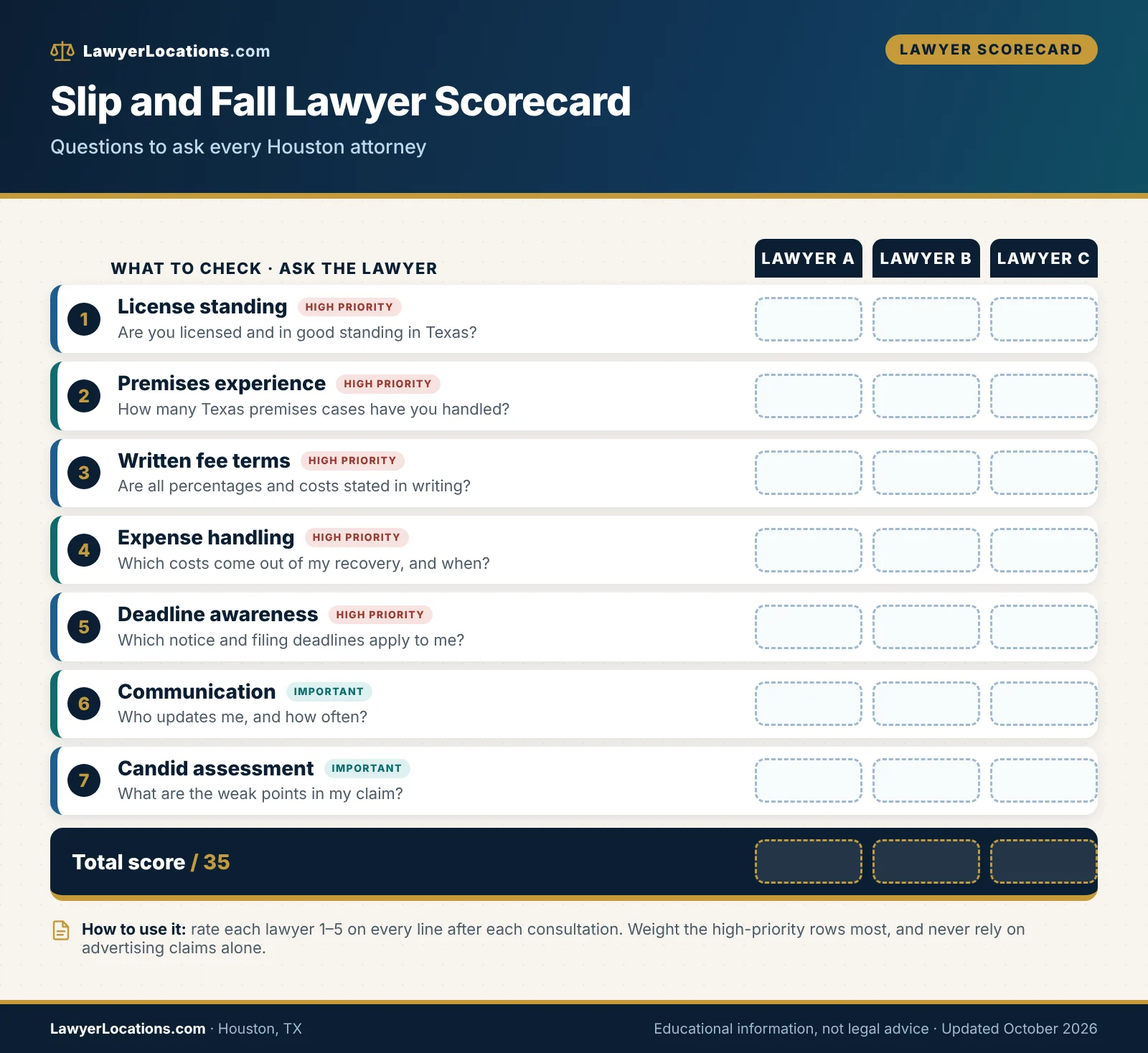
Text version of this graphic
| Criterion | Question to ask |
|---|---|
| License standing | Are you licensed in Texas and in good standing? |
| Premises experience | How many premises liability cases have you handled in Texas? |
| Fee clarity | Is the contingent fee in writing, with each percentage stated? |
| Expenses | Which costs come out of my recovery, and when? |
| Deadlines | What notice and filing deadlines apply to my claim? |
| Communication | Who will update me, and how often? |
| Case assessment | What are the main weaknesses in my claim? |
| What to compare | Why it matters | Green flag | Red flag |
|---|---|---|---|
| Fee agreement | Rule 1.04 requires a written contingent fee agreement | Clear percentages and cost handling in writing | Vague terms or pressure to sign immediately |
| Experience | Premises cases turn on knowledge and notice | Specific examples of the work, without confidential details | Only general claims about winning |
| Communication | Cases can run for a long time | A named contact and a set update routine | Hard to reach before you sign |
| Case assessment | You need realistic expectations | Discusses risks and shared fault | Promises a result or a dollar amount |
| Deadline awareness | City and county notice can expire early | Raises notice rules and the two-year date unprompted | Never mentions deadlines |
- The lawyer puts the fee, percentages and expense terms in writing before you sign.
- You get a candid discussion of risks as well as strengths.
- You know who your day-to-day contact will be.
- Someone promises a specific result or dollar figure.
- You are pressured to sign at the first meeting or accept an early offer.
- You are told not to see a doctor, or to skip a deadline.
Evidence, Timeline, Mistakes and Next Steps
What you do in the first days and weeks after a fall often determines how strong the claim is. The steps below are general; a lawyer can tailor them to your facts.
Evidence and records to gather
Premises cases are won or lost on proof of the hazard, the owner’s knowledge and the injury.
At the scene
If you can do so safely, take photos of the hazard, the surrounding area, lighting, signs, and the shoes you were wearing. Get names and contact details for witnesses, and ask that the property owner or manager prepare an incident report.
Ask for a copy of any report, or at least note the name of the person who took it. Avoid arguing about blame at the scene, and be careful about informal apologies or guesses about what happened.
Medical care and records
Get examined promptly, even if you feel only sore, since some injuries show up later. Follow the treatment plan and keep appointments, because gaps in care are commonly used to dispute the severity of an injury.
Keep every bill, explanation of benefits and pharmacy receipt. A simple journal of pain, missed work and daily limits can help you remember details months later.
Preserving evidence that can disappear
Video, maintenance logs and cleaning schedules may be overwritten on a routine cycle. A lawyer can send a written preservation request quickly, which is one of the strongest reasons not to wait.
Keep your shoes in the condition they were in at the time of the fall, and do not post about the incident on social media. Insurers and defense lawyers do review public posts.
- Photos and video of the hazard and the scene
- Names and contact details of witnesses
- Incident report or the manager’s name
- Medical records, bills and insurance statements
- Proof of missed work and lost income
- Shoes and clothing worn during the fall
- Any written notice sent to a government entity, with proof of mailing
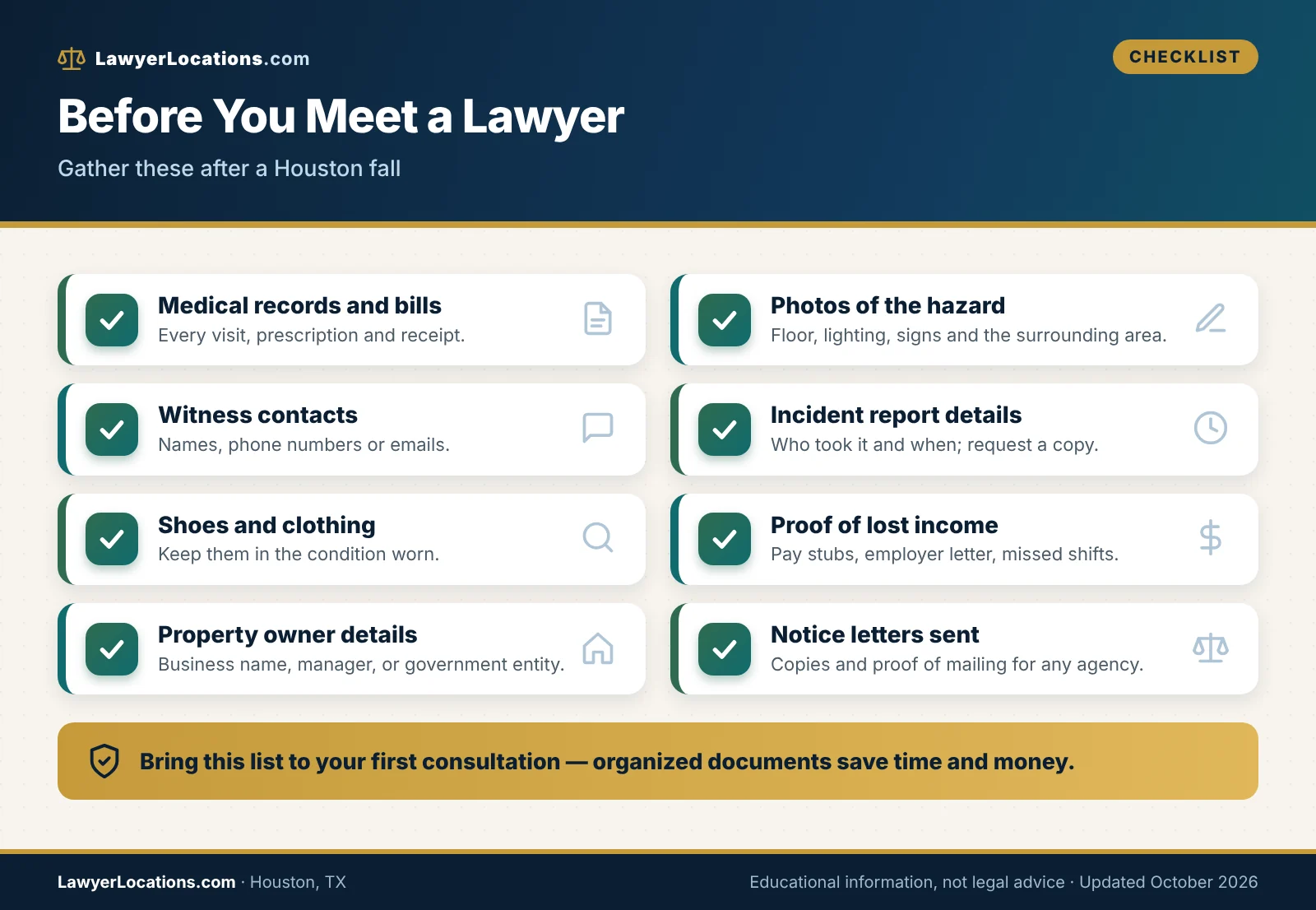
Text version of this graphic
- Get medical care and keep every record.
- Photograph the hazard, the scene and your injuries.
- Collect witness names and contact details.
- Report the fall in writing to the owner or manager.
- Keep the shoes and clothing you wore.
- Do not post about the fall online.
- Identify who owns the property, private or government.
- Write down questions for your consultation.
Costs, deadlines and decision points
The path from injury to resolution has a few points where you have to make decisions or act quickly.
A practical timeline
In the first days, focus on medical care and evidence. Within weeks, identify the property owner and, if it is a government entity, send the required notice, remembering the 90-day City of Houston charter period. Within months, gather medical records and begin settlement talks only when your treatment picture is clear. Before two years pass, a lawsuit must be filed if the claim has not resolved.
These stages overlap, and a lawyer can set a calendar with the actual dates for your fall.
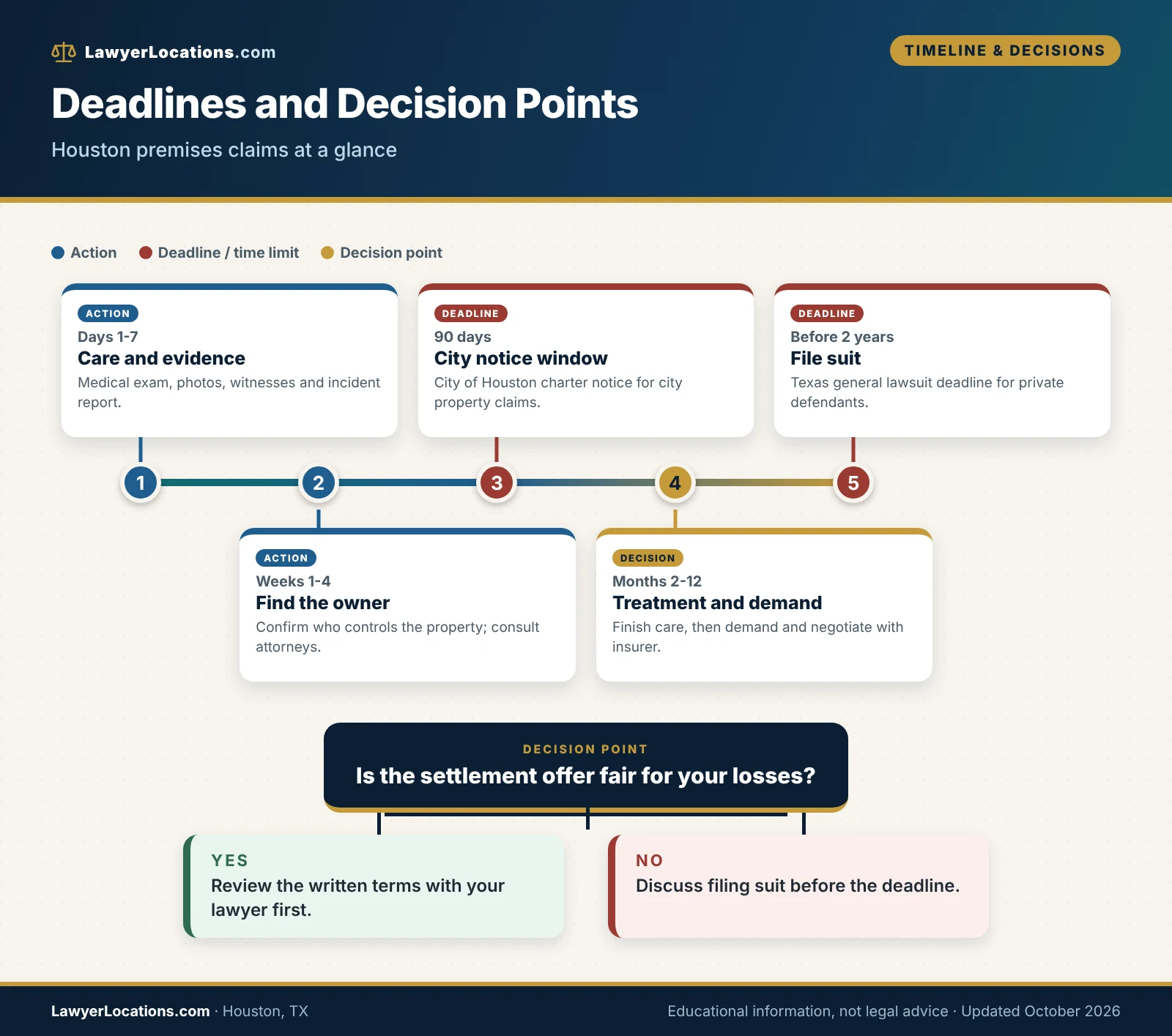
Text version of this graphic
- Days 1-7: Get care, document the scene, report the fall.
- Weeks 1-4: Identify the owner; consult lawyers; send preservation requests.
- Within 90 days (City of Houston property): Deliver the charter notice.
- Within about six months (other government units): Deliver notice unless a charter sets another period.
- Months 2-12: Finish treatment; demand and negotiation.
- Before two years: File suit if the claim is unresolved.
Decision point: Do you accept the offer, or file suit and continue? Weigh the offer against your total losses, shared-fault risk and your lawyer’s advice.
Deciding whether to settle or file suit
An insurer’s offer is a business decision, not a statement of what your case is worth. Compare it with your medical costs, lost income, future care and the risk that a jury could assign you some fault.
Ask your lawyer for a written explanation of the pros and cons and the likely timeline. Because settlement decisions belong to you, take the time you need.
Common mistakes and quick answers
Most avoidable problems come from delay, talking too much to an insurer, or signing documents without understanding them.
Mistakes that hurt fall claims
- Waiting until near the two-year date to look for a lawyer.
- Missing a government notice period because you assumed the two-year rule applied.
- Giving a recorded statement to the other side’s insurer without advice.
- Stopping treatment early or skipping appointments.
- Posting photos or comments about your activities online.
- Signing a release or fee agreement you have not read.
Many of these mistakes are easy to avoid once you know about them. The consultation questions in section 5 are designed to bring them up early.
Houston slip and fall questions answered
How long do I have to sue after a fall in Houston?
For private defendants, Texas generally allows two years under Tex. Civ. Prac. & Rem. Code § 16.003. Claims against the City of Houston can require written notice within 90 days under the City Charter, so check who owns the property right away.
Can I still recover if I was partly at fault?
Yes, unless your share of responsibility is greater than 50 percent. If you are 50 percent responsible or less, the court reduces your damages by your percentage under §§ 33.001 and 33.012.
Do I need to prove the owner knew about the hazard?
In most Texas premises cases, yes: actual or constructive knowledge of the dangerous condition is central. Video, inspection logs and witness accounts help show it.
How much does a slip and fall lawyer cost in Houston?
Many work on a contingent fee, which means the fee is a percentage of any recovery. The agreement must be in writing under Texas Rule 1.04, and you should also ask how expenses are handled. We do not list percentages because they vary by firm and case.
Is there a way to find a slip and fall lawyer near me in Houston?
You can use the Houston Lawyer Referral Service, a bar-run program, or compare several firms yourself using the questions in this guide. Confirm each lawyer’s license status with the State Bar of Texas.
Which court will hear my case?
It depends on the amount in controversy and the claim. Smaller claims can go to justice courts (up to $20,000), mid-sized claims to county civil courts at law (described as up to $250,000), and larger cases to district courts.
More local questions
Should I talk to the store’s insurance company?
You are not required to give a recorded statement to the other side’s insurer. Consider speaking with a lawyer first, since early statements can be used to argue shared fault.
What if I fell on a Houston sidewalk?
Ownership can be complicated: a sidewalk might be controlled by the City, an adjacent owner or another entity. Document the exact location and ask a lawyer to identify the responsible party and the notice rules that apply.
Can the state limit my medical damages?
Texas limits recovery of medical expenses to amounts actually paid or incurred under § 41.0105, so insurance adjustments can affect the number a jury considers.
Do other Texas cities follow the same rules?
The state statutes apply across Texas, but local courts and city notice rules differ. Compare our guides for Arlington, Dallas and Fort Worth to see where the venues differ.
If you were hurt walking rather than inside a building, our guide on a pedestrian accident lawyer in San Antonio shows how Texas rules apply in another city, though the facts and venues differ.
Ready to compare your options?
Write down the date of your fall, who owns the property and what evidence you have, then speak with more than one Texas-licensed attorney before you decide. Ask each one about notice deadlines, fee terms and how they would prove the owner’s knowledge. LawyerLocations.com is an education resource, not a law firm, and nothing here creates an attorney-client relationship.
General information only. This article is educational and is not legal advice. Reading it does not create an attorney-client relationship, and LawyerLocations.com is not a law firm or a lawyer referral service. Laws, court rules, fees and deadlines change and depend on the facts of each case. Consult a lawyer licensed in Texas about your specific situation.
Sources & References
Show all 15 sources
- Civil Practice and Remedies Code, Chapter 16 (Limitations), § 16.003 — Texas Legislature — statutes.capitol.texas.gov — accessed October 2026
- Civil Practice and Remedies Code § 16.003, text mirror — Public.Law — texas.public.law — accessed October 2026
- Civil Practice and Remedies Code §§ 33.001 and 33.012 (Proportionate Responsibility) — Public.Law — texas.public.law — accessed October 2026
- Civil Practice and Remedies Code § 41.0105 (Evidence Relating to Amount of Economic Damages) — Public.Law — texas.public.law — accessed October 2026
- Civil Practice and Remedies Code § 101.101 (Notice) — Public.Law — texas.public.law — accessed October 2026
- Civil Practice and Remedies Code § 101.022 (Duty Owed: Premise and Special Defects) — Public.Law — texas.public.law — accessed October 2026
- Government Code § 27.031 (Jurisdiction of Justice Courts) — Public.Law — texas.public.law — accessed October 2026
- Government Code § 25.1032 (Harris County Civil Courts at Law) — FindLaw — codes.findlaw.com — accessed October 2026
- Harris County Civil Courts at Law, civil court information — Harris County — ccl.hctx.net — accessed October 2026
- Harris County District Clerk — Harris County District Clerk’s Office — hcdistrictclerk.com — accessed October 2026
- Filing a claim with the City of Houston — City of Houston Legal Department — houstontx.gov — accessed October 2026
- Texas Rule of Civil Procedure 169 (Expedited Actions) — CourtRules.net text mirror — courtrules.net — accessed October 2026
- Texas Disciplinary Rules of Professional Conduct, Rule 1.04 (Fees) — University of Houston Law Center — law.uh.edu — accessed October 2026
- How the Houston Lawyer Referral Service works — Houston Lawyer Referral Service — hlrs.org — accessed October 2026
- Keetch v. Kroger Co. (Tex. 1992), case commentary — Casemine — casemine.com — accessed October 2026
Legal Disclaimer and Limitation of Liability
Informational and illustrative purposes only. This article was prepared by LawyerLocations.com solely on the basis of the information available to us at the time of writing. It is an illustrative, general overview. It is not a complete or authoritative statement of the law, and it has not been reviewed by a lawyer licensed in your state or county.
Not legal advice. Nothing in this article is legal, financial, tax or immigration advice, and reading it does not create an attorney-client relationship between you and LawyerLocations.com or any author, lawyer or firm mentioned. Laws, court rules, fees, filing deadlines and agency procedures differ by state, county and court, and they change often. Some details here may be simplified, incomplete or out of date, and time limits for legal claims can be short.
No warranty. We make no representation or warranty, express or implied, about the accuracy, completeness, timeliness or suitability of this content for your situation. Please do not rely on it to make, delay or skip any legal decision. Check the facts against official sources and speak with a licensed attorney in the relevant jurisdiction before you act.
Limitation of liability. To the fullest extent permitted by law, LawyerLocations.com and its owners, authors and contributors disclaim all liability for any loss, damage, cost or other consequence arising from the use of, or reliance on, this article, including any content on third-party websites we link to. Mentioning a lawyer, firm, organization or service is not an endorsement and is not a promise of any result. If you are in immediate danger, contact your local emergency number.