Searching for a “personal injury lawyer columbus oh” usually means you were hurt in a crash, a fall or another incident and want to know who to call, what it costs and how much time you have. In Ohio, the general deadline to sue for bodily injury is two years under R.C. 2305.10, you can still recover if your own share of fault is not greater than everyone else’s combined under R.C. 2315.33, and injury lawyers are usually paid through a written contingent fee.
This guide covers the Ohio rules that shape a Columbus claim, the Franklin County courts where cases are filed, how fee agreements work under Ohio’s professional conduct rules, and a practical method for verifying and comparing lawyers before you sign. It is general information for readers in Columbus, not advice about your situation.
Ohio injury law that shapes a Columbus claim
Ohio law, not Columbus city law, decides how long you have to sue, how fault is divided and which damages are limited. The rules below come from the Ohio Revised Code and apply whether your claim comes from a crash on I-70, a fall in a Short North storefront or an incident anywhere else in the state.
Deadlines and who can bring the claim
Ohio sets several different clocks depending on who was hurt and who is responsible. Picking the wrong one is among the costliest mistakes a person can make, so this section sorts them out first.
The general two-year rule for bodily injury
Under R.C. 2305.10(A), an action for bodily injury must be brought within two years after the cause of action accrues. Outside a few listed exceptions, the statute says a claim generally accrues when the injury or loss occurs. For most car crashes, falls and similar events, that means the date of the incident, not the date you finished treatment or got a settlement offer.
The statute does add a discovery-style accrual rule for certain exposure injuries, such as exposure to hazardous chemicals, asbestos and some drugs or medical devices. Those cases start the clock when a medical authority tells you the injury is related to the exposure, or when you reasonably should have known. If you suspect your harm falls in that category, ask a lawyer promptly rather than assuming the ordinary rule applies.
Two years is the outer limit for filing a lawsuit, not a target for starting. Evidence fades, insurers move on and lawyers need time to investigate before a complaint can be filed. Our guide on how long you have to file a personal injury claim compares Ohio with other states.
Shorter or different clocks that can change the answer
Several situations do not follow the plain two-year pattern. Wrongful death actions must be commenced within two years after the death under R.C. 2125.02(F)(1), and they are brought by the decedent’s personal representative for the benefit of the spouse, children, parents and other next of kin. Product liability claims carry a separate ten-year outer limit measured from first delivery of the product to its first purchaser under R.C. 2305.10(C).
Claims against a city, county or similar local body must be brought within two years under R.C. 2744.04(A), unless a shorter period is set elsewhere in the Revised Code. Claims against the state itself go to the Court of Claims of Ohio under R.C. 2743.16, which has its own two-year limit and a compromise step in some cases. Medical claims follow separate statutes with their own deadlines and procedures, which is one reason to speak with a lawyer early if a healthcare provider may be involved.
| Situation | General time limit | Where it comes from |
|---|---|---|
| Bodily injury (crash, fall, most other incidents) | Two years after the claim accrues | R.C. 2305.10(A) |
| Wrongful death | Two years after the death | R.C. 2125.02(F)(1) |
| Suit against a political subdivision (city, county and similar bodies) | Two years after accrual, unless a shorter period applies elsewhere | R.C. 2744.04(A) |
| Suit against the state of Ohio | Two years after accrual, with a compromise step for some claims | R.C. 2743.16 |
| Product liability outer limit | Generally no claim accrues later than ten years after first delivery, with exceptions | R.C. 2305.10(C) |
| Injured minor or person of unsound mind | Time to sue may run from the end of the disability, within limits | R.C. 2305.16 |
Children, tolling and the saving statute
If the injured person was a minor or of unsound mind when the claim accrued, R.C. 2305.16 lets that person file within the applicable time period after the disability is removed. For a person who becomes of unsound mind after the claim accrues, time does not count while the person is adjudicated of unsound mind or confined in an institution or hospital because of that condition. Because the child’s claim and any claim by the parents can be treated differently, a lawyer should look at each one separately.
Ohio also has a “saving statute,” R.C. 2305.19, which can allow a refiled case after a dismissal that was not a decision on the merits. The new action may be commenced within one year after the failure, or within the original limitations period, whichever is later. Treat it as a safety net that lawyers sometimes use, not a plan.
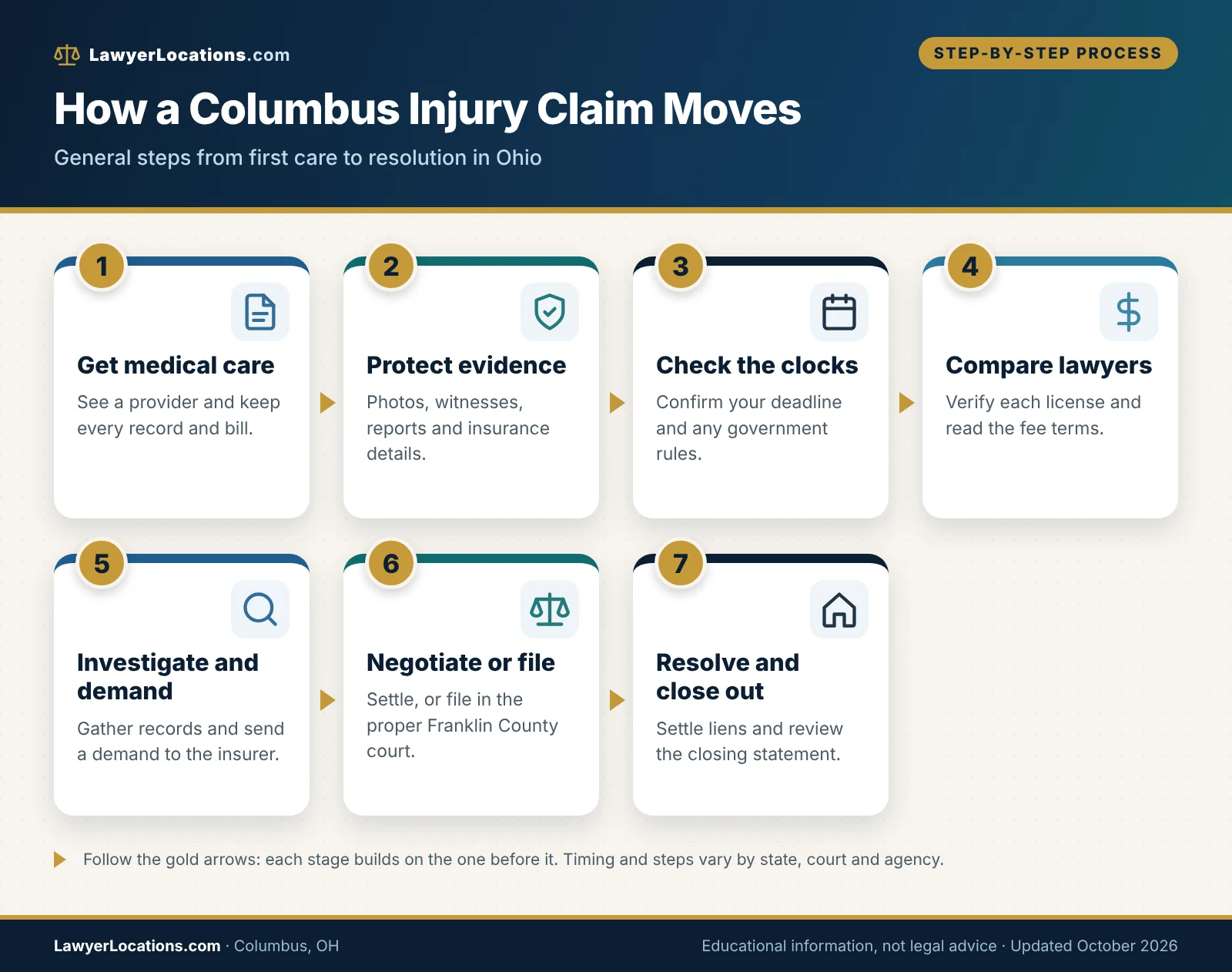
Text version of this graphic
- Get medical care and keep every record and bill.
- Protect evidence: photos, witness names, reports, insurance details.
- Check the clocks, including any public-entity rules.
- Verify and compare lawyers, and read the fee agreement.
- Investigate the claim and send a demand to the insurer.
- Negotiate, or file in the appropriate Franklin County court.
- Resolve the claim, handle liens and receive a closing statement.
Fault, shared blame and damages limits
Ohio is a fault-based state: the person or business whose carelessness caused the harm, and that party’s liability insurer, is generally responsible for paying. Two statutes then shape how much a claim can recover, and both are worth understanding before you talk to an insurer or a lawyer.
Shared fault under R.C. 2315.33
Ohio uses a modified comparative fault system. Under R.C. 2315.33, your own fault does not bar you from recovering damages if your fault was not greater than the combined fault of all other persons. In plain terms, a plaintiff at exactly 50% is not barred, while a plaintiff above 50% is. The court then reduces compensatory damages by the percentage of fault assigned to you.
Comparative fault means a jury or judge assigns percentages of blame to everyone involved. If a jury finds total damages of $100,000 and assigns you 20% of the fault, your recoverable amount would be reduced by 20%. The numbers here are only an illustration of the arithmetic, not a prediction.
Why insurers press on fault early
Because even a modest percentage of blame lowers the recovery, and a share above half can end it, insurers often ask for recorded statements and look for any hint you contributed. A casual remark such as “I didn’t see him” can be quoted back later. If fault is disputed, speaking with a lawyer before you give any recorded statement to the other side’s insurer is a reasonable step.
Our checklist on what to do after a car accident walks through scene evidence and early insurer contact in more detail.
Damages, caps and insurance limits
Damages are the money a claim seeks. Ohio separates them into economic loss, such as medical bills and lost wages, and noneconomic loss, such as pain and suffering. The distinction matters because the law treats them differently.
The noneconomic damages cap and its exceptions
Under R.C. 2315.18, compensatory damages for noneconomic loss in a tort action are limited to the greater of $250,000 or three times the plaintiff’s economic loss, up to a maximum of $350,000 per plaintiff or $500,000 per occurrence. Economic damages are not capped by that section.
The cap does not apply when the noneconomic loss involves a permanent and substantial physical deformity, loss of use of a limb or loss of a bodily organ system, or a permanent physical functional injury that permanently prevents the person from independently caring for themselves and performing life-sustaining activities. The section also does not apply to wrongful death actions under Chapter 2125, to Court of Claims actions against the state, or to certain actions against political subdivisions, and it defines “tort action” to exclude medical, dental, optometric and chiropractic claims.
Ask any lawyer you interview whether the noneconomic cap could affect your type of injury and how they would document a claim that might fall under an exception. A clear, specific answer is a good sign; a vague one deserves follow-up.
Minimum auto liability coverage and what it means for you
Ohio’s minimum liability limits in R.C. 4509.51(B) are $25,000 for bodily injury or death of one person in one accident, $50,000 for two or more people and $25,000 for property damage, often written 25/50/25. Those are floors, and many drivers carry more, but a driver who carries only the minimum may not have enough coverage for serious injuries.
When the at-fault driver has little or no insurance, your own uninsured and underinsured motorist coverage, if you bought it, may matter more than the other driver’s policy. Our guide on uninsured motorist claims explains how that route works, and car accident lawyers in Columbus covers crash-specific questions in more depth.
If an adjuster offers a quick payment and asks you to sign a release, pause before signing. A release usually ends the claim permanently, even if your injuries turn out to be more serious than they first appeared.
Franklin County courts and where Columbus cases are filed
Most Columbus injury lawsuits are filed in Franklin County, and the right court depends mainly on how much money is claimed and who the defendant is. Knowing the layout helps you ask better questions when you interview a lawyer.
Common Pleas, Municipal Court and small claims
Three trial-level options matter for civil money claims in Columbus. The dividing lines are set by dollar amount, and your lawyer will choose based on the value and complexity of the case.
Dollar thresholds in Franklin County
A municipal court in Ohio has civil jurisdiction only where the amount claimed does not exceed $15,000 under R.C. 1901.17. The Franklin County Law Library’s civil suit guide describes small claims as cases under $6,000, the Franklin County Municipal Court as the venue for claims between $6,000 and $15,000, and the Franklin County Court of Common Pleas as the venue for claims worth more than $15,000. Most serious injury claims are filed in Common Pleas because their value exceeds the municipal limit.
A minor property-damage dispute or a small injury claim may fit in Municipal Court or small claims instead. Those venues can be faster, but they also cap what you can recover, so filing there to save time can mean giving up the larger part of a claim.
| Court | Typical civil claim size | Why it matters for injury claims |
|---|---|---|
| Small claims (Franklin County Municipal Court) | Under $6,000 | Fits minor property or low-value claims; recovery is limited to the court’s ceiling |
| Franklin County Municipal Court | Up to $15,000 under R.C. 1901.17 | Can fit modest injury or property claims; cannot award more than its limit |
| Franklin County Court of Common Pleas, General Division | Above the municipal limit | Where most significant injury and wrongful death cases are filed |
| Court of Claims of Ohio | Civil actions against the state | Used when the defendant is the state of Ohio rather than a private party or local body |
E-filing and finding your case online
The Franklin County Clerk of Courts reports that electronic filing has been mandatory for all civil filings in the General Division since 2011. Civil documents are searchable through the clerk’s Case Information Online system, so you or your lawyer can look up a docket, see what has been filed and confirm deadlines.
The clerk’s office can be reached at 614.525.3600. Court staff cannot give legal advice, but they can explain how to find records and which filing office handles a given type of case.
If you are weighing a self-filed small claim against hiring a lawyer, check the court’s current fee schedule and limits first. compare ceiling vs. claim value before you decide.
Claims against government bodies
If a city, county or public agency may share the blame, the rules shift. Government defendants have special statutes, and some of them change who you sue, where you sue and how quickly you must act.
Local bodies under Ohio’s political subdivision law
Actions against a political subdivision for harm connected to a governmental or proprietary function must be brought within two years after accrual under R.C. 2744.04(A), unless a shorter period is set elsewhere in the Revised Code. The same section covers original actions, cross-claims, counterclaims, third-party claims and subrogation claims, and it recognizes tolling under R.C. 2305.16.
Chapter 2744 also contains immunities and exceptions that determine whether a local body can be held liable at all. That question is technical and fact-heavy, which is why a lawyer should screen a government-related claim as early as possible rather than waiting.
The state and the Court of Claims
Civil actions against the state of Ohio under R.C. 2743.01 to 2743.20 generally must be commenced no later than two years after accrual under R.C. 2743.16(A). For injury, death or loss covered by R.C. 9.821 to 9.83, the claimant must first try to have the claim compromised by the Office of Risk Management or satisfied by the state’s liability insurance before filing in the Court of Claims.
The statute allows the claimant to proceed if the state does not compromise within a reasonable time and at least 60 days before the limitations period expires, or if the claim exceeds the state’s insurance coverage. Because these steps run on tight calendars, anyone hurt on state property or by a state employee should get legal advice quickly.
Which county and which court actually applies
“Columbus” is a city boundary, not a court boundary. Where your case is filed turns on where the incident happened and where the defendant can be sued, and a few details can surprise people.
When part of Columbus sits outside Franklin County
Columbus is the seat of Franklin County, but small portions of the city extend into neighboring Delaware and Fairfield counties. An incident at an address in one of those portions could belong in a different county’s court system. If your incident happened near a county line, ask your lawyer which county’s court is proper before a complaint is filed.
The same caution applies to crashes outside the city, such as on a county road or in a suburb. The Franklin County courts may still be proper if the defendant lives or does business there, but a lawyer needs the facts to say.
How a lawyer picks the court for your case
A lawyer will usually weigh the claim’s value, where the defendant lives or does business, where the incident occurred and whether the defendant is a government body. That analysis often happens before any lawsuit is filed, because it also affects how an insurer values the claim.
You do not have to choose the court yourself, but you can ask a prospective lawyer to explain the reasoning. Someone who can walk you through the choice in plain English probably understands the local landscape.
How Ohio injury lawyers get paid
Most personal injury lawyers work on a contingent fee, meaning the fee is a percentage of the money recovered and is owed only if the claim produces a recovery. Ohio’s professional conduct rules put guardrails around those agreements, and knowing them lets you read a fee agreement with confidence.
What an Ohio contingent fee agreement must say
A contingent fee agreement is a contract, and the rules of professional conduct require specific content. Ask for a copy before you sign and take time to read it.
The written-agreement requirement in Rule 1.5(c)
Under Prof.Cond.R. 1.5(c)(1), each contingent fee agreement must be in a writing signed by the client and the lawyer. It must state the method by which the fee is determined, including the percentage or percentages that apply on settlement, trial or appeal. It must also say whether expenses are deducted before or after the contingent fee is calculated, and it must clearly notify the client of any expenses for which the client will be liable.
If any of those items are missing or unclear, ask the lawyer to fix the document before you sign. A fee agreement is the one place where vague wording can cost you real money later.
Percentages, tiers and what drives them
Ohio’s rule does not set a single percentage for injury cases. Rule 1.5(a) instead asks whether a fee is clearly excessive, looking at factors such as the time and labor required, the novelty and difficulty of the issues, the customary local fee for similar services, the amount involved and results obtained, time limits, and whether the fee is fixed or contingent.
In practice, many agreements use tiers, with a different percentage if the case settles before a lawsuit is filed and a different one after filing or trial. We do not publish fee “averages” because they vary by firm and case, and no verified Ohio-wide figure exists. Ask each lawyer for their tiers in writing and compare them side by side.
Contingent fee does not mean “no cost.” Case expenses, such as records, experts and filing costs, are usually separate from the fee, and the agreement must tell you who bears them and when.
Costs, liens and what you actually take home
The headline settlement number is not what lands in your account. Fees, expenses and liens come out first, and you should understand each before you accept an offer.
Case expenses and who pays them
Expenses are the out-of-pocket costs of building your claim. They can include medical record fees, court filing costs, deposition costs and expert fees. Rule 1.5(c) requires the agreement to say whether those are deducted before or after the percentage fee is calculated, and that choice changes your net recovery.
The agreement should also say what happens to expenses if the claim does not succeed. Some lawyers absorb them; others expect repayment. Get the answer in writing before you sign, not after the case begins.
Medical bills, Medicaid and other liens
A lien is a legal claim on part of your recovery to repay someone who paid your bills. Health insurers, Medicare and Medicaid may assert reimbursement rights. For Ohio Medicaid recipients, R.C. 5160.37 gives the Ohio Department of Medicaid and county agencies an automatic right of recovery against third-party payments for medical assistance they paid.
That statute requires the recipient to give written notice to the paying department within 30 days after starting informal recovery activity or filing a legal action, and it makes the recipient’s attorney share the notice duty. If required notice is not given, the recipient and attorney may have to reimburse the department up to the amount of assistance paid. The statute’s allocation presumption works from the recovery after attorney fees, capped at one-third for that calculation, and costs, and a hearing process exists to rebut the presumption. A lawyer who handles injury claims regularly should be able to explain how liens affect your net recovery. Our guide on who pays medical bills after a car accident explains the wider insurance picture.
| Term | What to check | Why it matters |
|---|---|---|
| Signed writing | Signed by both you and the lawyer (Prof.Cond.R. 1.5(c)(1)) | An oral promise does not satisfy the rule |
| Fee percentage(s) | Each percentage and when it changes: settlement, filing, trial, appeal | The stage at which a case resolves can change the fee |
| Expense treatment | Deducted before or after the fee is calculated | Changes the amount you net |
| Client liability for expenses | Which expenses you owe and whether you owe them if there is no recovery | Rule 1.5(c)(1) requires clear notice |
| Lien handling | Who negotiates health insurer, Medicare or Medicaid reimbursement | Liens can reduce your net amount |
| Closing statement | Signed accounting at settlement (Prof.Cond.R. 1.5(c)(2)) | Shows exactly how funds were divided |
| Ending the relationship | What happens to the fee if you change lawyers | Affects your freedom to switch |
Reading the closing statement and spotting fee red flags
The closing statement is the final accounting, and it is also your best protection against surprises. A few red flags can show up earlier, in how a lawyer presents the fee.
The closing statement under Rule 1.5(c)(2)
When a lawyer becomes entitled to compensation under a contingent fee and will disburse funds, Prof.Cond.R. 1.5(c)(2) requires a closing statement given to the client at or before the time the lawyer receives payment. It must explain how the compensation was calculated and list the costs and expenses deducted from the judgment or settlement, and both client and lawyer must sign it.
Read it line by line and compare it with your fee agreement. If a number does not match, ask for an explanation before you sign.
Fee-related red flags
Some warning signs are visible during the first conversation. Pressure to sign immediately, reluctance to put terms in writing and vague answers about expenses should all give you pause.
- The lawyer will not give you the fee agreement to take home and review.
- The percentage or the expense rules are explained only orally.
- You are told the outcome is certain or a specific dollar result is promised.
- Someone other than the lawyer pushes you to sign during an emotional moment, such as at the hospital.
- The agreement allows large deductions without describing what they are for.
How to find and compare personal injury lawyers in Columbus
The goal is not to find a famous name; it is to find a licensed lawyer who handles claims like yours, explains the fee clearly and communicates in a way you can live with for a year or more. A simple, repeatable process beats a quick search-and-call.
Where to look and how to verify a license
Start with sources that tell you something real: a bar association referral, the state’s attorney directory and a lawyer’s own written materials. Advertising and online listings can be a starting point, but they are not verification.
Bar association referral and directory resources
The Columbus Bar Association runs a Find a Lawyer service at cbalaw.org, which says listed lawyers are in good standing with the Supreme Court of Ohio and their bar association. It also points to a searchable directory at columbuslawyers.com. The association’s main line is (614) 221-4112, and its page does not state an initial consultation fee, so ask about cost when you call.
Other bar associations may offer referral resources as well. A referral service helps you find a lawyer who handles your type of matter; it does not evaluate the quality of that lawyer’s work or promise any result.
Checking registration and discipline with the Supreme Court of Ohio
The Supreme Court of Ohio lists an Attorney Directory Search, labeled “Find an Attorney” for the public, on its attorney registration pages. Use it to confirm the person is admitted in Ohio and see registration status before you share details of your case. Its Registration and CLE Section can answer registration questions at 614.387.9320.
The court also provides a way to file complaints about attorneys and judges. If something about a lawyer’s conduct bothers you, that is the official channel to learn about, though a fee dispute may first be worth raising directly with the lawyer or through a local bar program.
Verify the name exactly as the lawyer gave it to you, and check the firm name on the fee agreement against the directory. match name, firm, license before you sign anything.
Comparing lawyers side by side
Once you have two or three licensed candidates, treat the first meeting like a job interview in which you are the employer. The questions below keep the conversation on the facts that affect your outcome.
Questions that reveal fit and experience
Ask how many claims like yours the lawyer has handled and how many were resolved without filing suit. Ask who will do the daily work, whether a paralegal or associate will be your contact, and how often you will receive updates. Ask how they approach the Ohio noneconomic damages cap and the comparative fault rule if either might apply to you.
Be wary of lawyers who describe the outcome as certain. A careful answer sounds like “here is what we would need to show, here is what the insurer will argue and here is what could go wrong.”
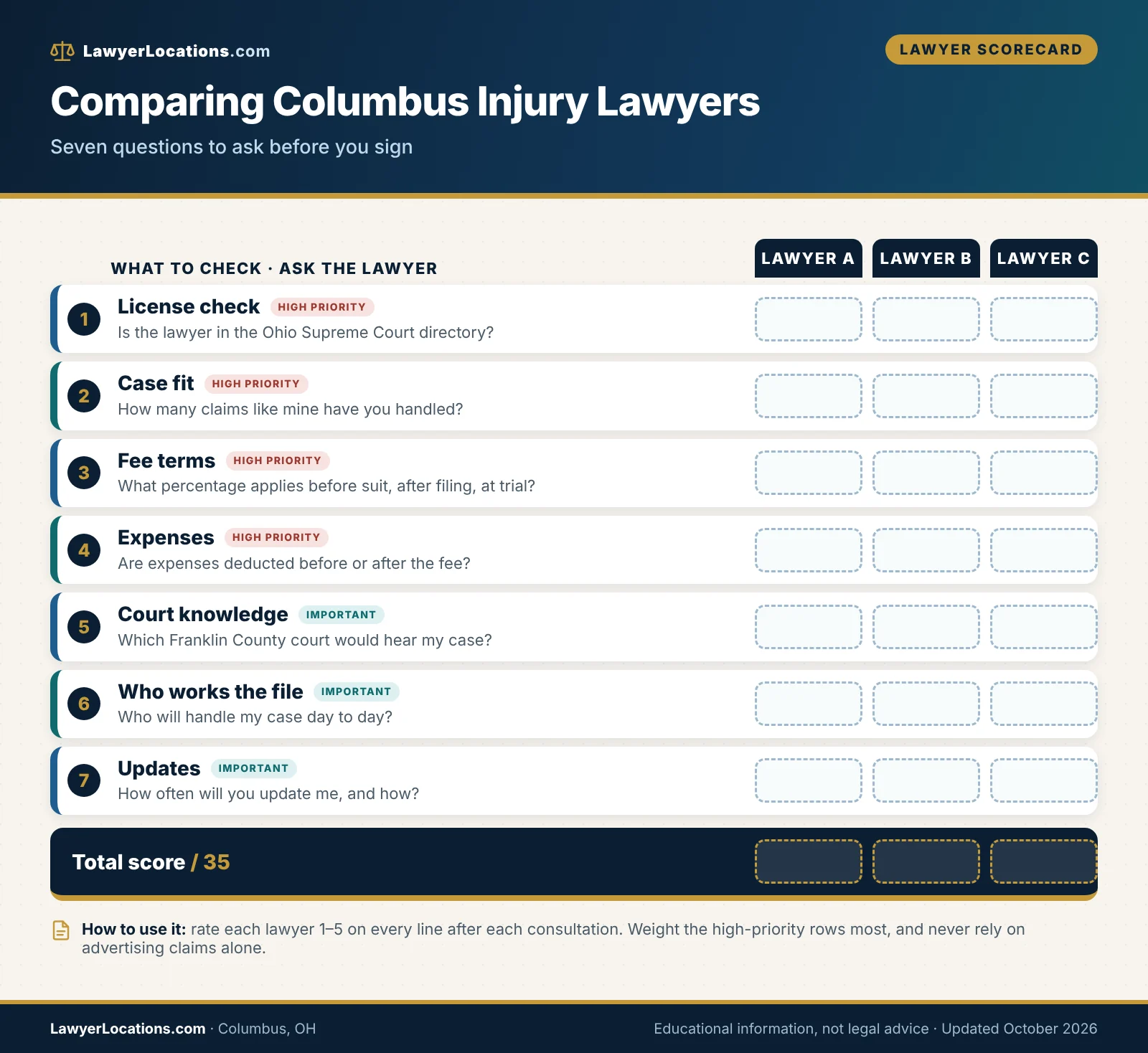
Text version of this graphic
| Criterion | Question to ask | Weight |
|---|---|---|
| License check | Is the lawyer registered in the Supreme Court of Ohio directory? | High |
| Case fit | How many claims like mine have you handled? | High |
| Fee terms | What percentage applies before suit, after filing and at trial? | High |
| Expenses | Are expenses deducted before or after the fee? | High |
| Court knowledge | Which Franklin County court would hear my case, and why? | Medium |
| Who works the file | Who will handle my case day to day? | Medium |
| Updates | How often will you update me, and how? | Medium |
Weighing the answers
After each meeting, write down what you were told about fees, strategy and communication while it is fresh. Compare answers on the same few points rather than on general impressions. A lawyer who is polite but vague about the fee agreement is a worse fit than one who is blunt about risks and clear about money.
Also consider practical fit. Can you reach the office easily? Does the firm communicate by the method you prefer? Do you feel comfortable asking basic questions? These details matter over a long case.
| Source of help | What it offers | What to ask |
|---|---|---|
| Bar association referral (for example, Columbus Bar Association Find a Lawyer) | Connects you to a local lawyer who handles your type of matter; listed lawyers are described as in good standing | Is there a fee for the first meeting, and does the lawyer take injury cases like mine? |
| Private injury law firm | Representation on a contingent fee for many injury claims | Fee tiers, expense rules, who handles the file |
| Legal Aid Society of Columbus | Free civil legal help for eligible low-income and elderly residents of Central Ohio; intake at (614) 241-2001, weekdays 9:30 a.m. to 3:30 p.m. | Whether your matter is a type it handles, or where it would refer you |
Preparing for the first consultation
You will get more from a consultation if you arrive organized. A few documents and a clear timeline let a lawyer give a more useful read on the claim.
Documents and facts to gather
Bring anything that shows what happened and what it has cost you. The list below covers the usual items. If you do not have something yet, say so; the lawyer can often request it.
- Police or incident report number and any photos or video of the scene.
- Names and contact information for witnesses and the other party.
- Your insurance card, the other party’s insurance information and any letters from insurers.
- Medical records, bills and a list of every provider you have seen.
- Pay stubs or other proof of missed work.
- A short written timeline of events and symptoms, in your own words.
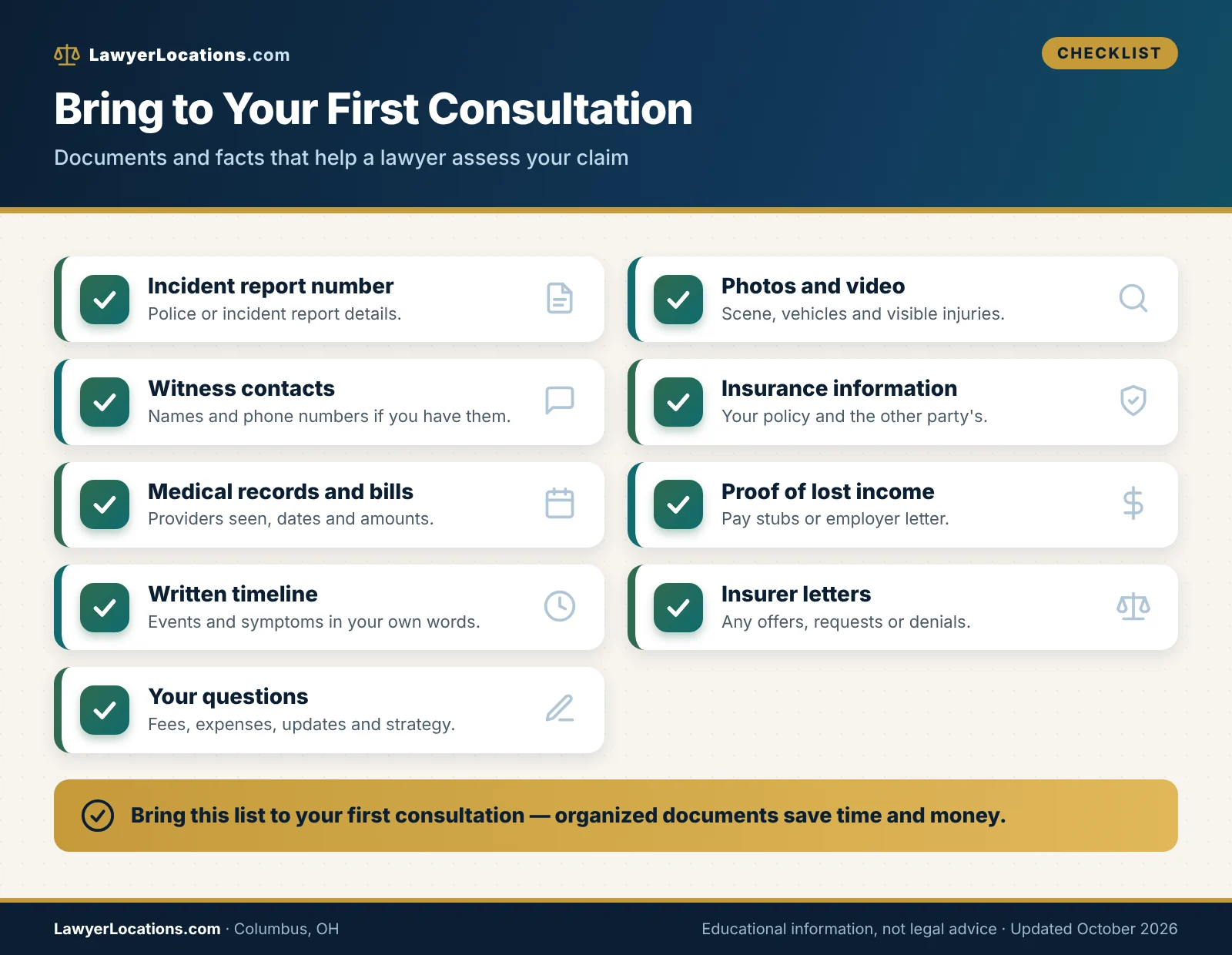
Text version of this graphic
- Incident or police report number
- Photos and video of the scene and injuries
- Witness names and contact details
- Your insurance and the other party’s insurance information
- Medical records and bills
- Proof of lost income
- Written timeline of events
- Letters or messages from insurers
- Your list of questions for the lawyer
What to ask before you leave
Before you leave, make sure you can answer three questions. What is the next step and who takes it? When will you hear from the firm again? What do you need to do in the meantime? Ask for the fee agreement in writing, and tell the lawyer you will read it before you decide.
It is fine to meet with more than one lawyer. A professional will understand that you are comparing, and you should not be pressured into signing on the spot.
The claim timeline, costs and decision points
Injury claims move in stages, and the stage often matters more than the calendar. Knowing roughly what comes next helps you spot when a decision is due and when a lawyer’s fee tier might change.
From first treatment to settlement demand
The early stages are about care, evidence and building a clear picture of the harm. Rushing them tends to hurt the claim, because the true cost of an injury is often unknown until treatment has progressed.
Treatment, evidence and insurer contact
Get medical care first and follow your providers’ advice. Keep the evidence you can, such as photos, receipts and names of witnesses, and notify your own insurer as your policy requires. Our guide on whether you need a lawyer after a car accident can help you decide when to bring a lawyer in.
Avoid posting about the incident or your injuries on social media. Insurers and defense lawyers may look at public posts, and a casual comment can be read the wrong way.
Investigation and the demand
Once treatment has stabilized or the extent of the harm is clear, a lawyer typically gathers records and bills, evaluates liability and sends a demand to the insurer. The demand explains what happened, why the other party is responsible and what compensation is sought.
The insurer may respond with an offer, a request for more information or a denial. The first offer is often a starting point for negotiation rather than a final number, and the right response depends on your medical picture and the evidence.
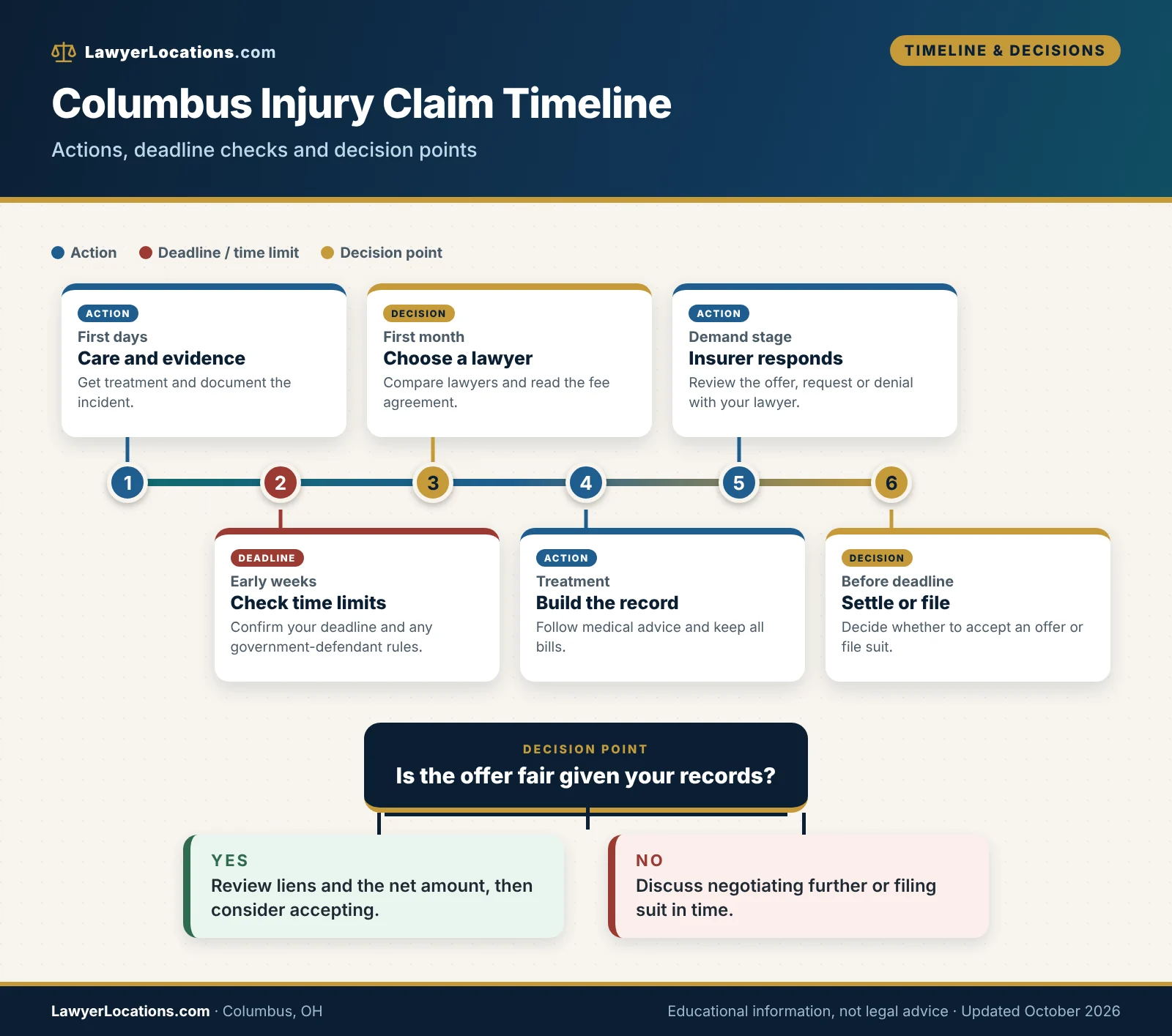
Text version of this graphic
- First days: get care and document the incident (action).
- Early weeks: check Ohio time limits and any government-defendant rules (deadline).
- First month: compare lawyers and read the fee agreement (decision).
- Treatment period: build the medical and financial record (action).
- Demand stage: the insurer responds with an offer, request or denial (action).
- Before the deadline: decide whether to settle or file suit (decision).
- Resolution: receive a closing statement and address liens (action).
Decision point: Is the insurer’s offer fair given your records? If yes, you may accept after reviewing liens; if no, discuss negotiating further or filing suit with your lawyer.
Negotiation, filing suit and closing the case
If negotiation does not resolve the claim, the next step is usually filing suit. Filing does not mean the case will go to trial; most injury claims resolve before a verdict.
Filing in Franklin County and discovery
If the case is filed in the Franklin County Court of Common Pleas, the complaint is filed electronically with the clerk, which has required e-filing in civil cases since 2011. The defendant responds, and both sides then exchange information in discovery through written questions, document requests and depositions. Cases can also go to mediation, a confidential negotiation with a neutral third party, before trial.
Because the two-year limit under R.C. 2305.10 requires filing before it expires, a lawyer will often file a case if settlement talks are still unresolved as the deadline approaches. That is a scheduling decision, not a sign that the case is going badly.
Settlement, liens and the closing statement
When a case settles, funds typically go through the lawyer’s trust account. Fees, expenses and liens are paid, and you receive the balance. Prof.Cond.R. 1.5(c)(2) requires a signed closing statement showing the calculation, so review it carefully.
If you are a Medicaid recipient or a government payer covered your care, make sure notice requirements have been handled. Our car accident settlement timeline explains how long each stage can take in practice.
Imagine a settlement of $60,000. If the fee is a percentage of that amount and expenses are deducted afterward, and a health plan asserts a reimbursement claim, the final check to the client is the settlement minus each of those items. The closing statement lays out every deduction. The figures are purely illustrative and are not a typical result.
Costs and decision points you control
Most of the money decisions in a claim are made by you, not the court. Understanding them in advance protects you from rushed choices later.
Money decisions to make deliberately
Whether to accept an offer, how to handle a lien reduction and whether to continue to trial are your decisions, with your lawyer’s advice. Ask for a written explanation of any offer, including how much you would net after fees, expenses and liens. You can only compare an offer with your alternatives if you know the net figure.
If a family member died, the wrongful death process is different: a personal representative brings the claim, and the statute lists categories of damages. Our guide on wrongful death lawyer costs covers how fees work in that setting.
When to change lawyers
You are allowed to change lawyers if the relationship is not working. Before you do, read your fee agreement to see how fees are handled if you switch, and ask the new lawyer how they would deal with that issue.
Poor communication is a common reason to switch, but a short conversation about expectations sometimes solves the problem. If it does not, move deliberately and keep any deadlines in mind, since a gap in representation can be costly.
Red flags, common mistakes and next steps
Most avoidable problems in injury claims come from a short list of mistakes: waiting too long, saying too much to an insurer, signing too fast and choosing a lawyer without checking. This section turns that list into concrete steps.
Mistakes that hurt claims
These are patterns lawyers and consumer advocates commonly warn about. None of them is fatal in every case, but each one can make a claim harder.
Delay and gaps in treatment
Waiting to see a doctor or stopping treatment without explanation can give an insurer room to argue that your injuries were minor or came from something else. If cost or access is a barrier, tell your provider and your lawyer so a plan can be made rather than letting treatment lapse.
Delay also eats into the two-year clock under R.C. 2305.10, and some defendants have shorter notice or compromise steps. The earlier you ask a question, the more options you keep.
Signing or speaking too early
Signing a release, accepting a quick check or giving a recorded statement before you understand your injuries can limit your options. Take time to understand the full extent of the harm and the potential long-term costs.
You can be polite and cooperative without handing over a detailed account. A short statement of the basic facts and a request to follow up in writing is often enough while you decide how to proceed.
- Accepting a settlement before you know what future treatment will cost.
- Posting about the incident, your activities or your injuries online.
- Ignoring a letter from a government agency or health plan about reimbursement.
- Hiring a lawyer without checking the license or reading the fee agreement.
- Assuming that because the other driver admitted fault, no evidence is needed.
Your next steps in Columbus
If you are early in the process, the steps below keep you moving without locking you into a decision. Write down the dates as you go, since time limits are measured in calendar days.
A practical sequence
- Get care and keep records. Save bills, discharge papers and prescriptions.
- Note the date of the incident. Count forward two years as your outer limit and confirm it with a lawyer, especially if a government body may be involved.
- Verify two or three lawyers. Check each in the Supreme Court of Ohio attorney directory and consider the Columbus Bar Association’s Find a Lawyer service.
- Read the fee agreement at home. Check percentages, expenses and lien handling against the table in this guide.
- Choose and confirm in writing. Ask how and how often you will receive updates.
Ready to compare your options?
Use the scorecard and checklist in this guide to prepare for two or three consultations. If your claim involves a crash, our guide to car accident lawyers in Columbus goes deeper on that situation, and if cost is a barrier, ask the Legal Aid Society of Columbus whether your matter is one it can help with or refer. Reading this guide does not create an attorney-client relationship.
When money or eligibility is tight
If you cannot afford a lawyer for a matter that does not fit a contingent fee, the Legal Aid Society of Columbus offers free civil legal services to eligible low-income and elderly residents. Its intake line is (614) 241-2001, weekdays from 9:30 a.m. to 3:30 p.m., and an online application is available. Its site does not say whether it handles personal injury cases, so ask during intake.
Another option is the Columbus Bar Association’s Find a Lawyer service, which can connect you with a lawyer whose practice fits your matter. Ask about any fee for the first meeting when you call.
Common questions from Columbus readers
The questions below come up often when people search for a personal injury lawyer in Columbus. The answers are general and depend on your facts.
Money and hiring questions
How much does a personal injury lawyer in Columbus cost?
Many injury lawyers charge a contingent fee, which is a percentage of the recovery and is owed only if there is one. The percentage and the treatment of expenses vary by firm, and Ohio requires the agreement to be in a signed writing. Ask each lawyer for the tiers and the expense rules in writing.
Do I have to pay anything upfront?
Not necessarily. Many injury lawyers do not charge hourly fees up front, but the agreement must clearly tell you which expenses you may owe. Read that section closely before you sign.
How do I check whether a Columbus lawyer is licensed in Ohio?
Use the Attorney Directory Search on the Supreme Court of Ohio website, labeled “Find an Attorney” for the public. You can also ask the Columbus Bar Association about its Find a Lawyer service, which describes its listed lawyers as in good standing.
Can I talk to more than one lawyer before choosing?
Yes. Comparing two or three lawyers is a normal part of hiring one. Ask the same questions of each and compare their answers on fees, communication and experience with similar claims.
Deadlines and process questions
How long do I have to file an injury lawsuit in Ohio?
The general limit for bodily injury is two years under R.C. 2305.10. Wrongful death actions also have a two-year period measured from the death, and claims against government bodies have their own rules. Confirm the clock that applies to you with a lawyer.
What if I was partly at fault?
Under R.C. 2315.33, you can still recover if your fault is not greater than the combined fault of the others, but your damages are reduced by your percentage. If your fault is greater, recovery is barred.
Is there a cap on pain and suffering in Ohio?
For most tort actions, R.C. 2315.18 limits noneconomic damages to the greater of $250,000 or three times economic loss, subject to $350,000 per plaintiff and $500,000 per occurrence maximums. Exceptions exist for certain permanent and catastrophic injuries, and some claim types are excluded from the section.
Which court would hear my case?
Most significant injury claims in Columbus are filed in the Franklin County Court of Common Pleas. Municipal Court is limited to claims up to $15,000, and small claims handles smaller ones. A lawyer will advise on the proper court based on value and defendant.
Sources & References
Show all 18 sources
- Ohio Revised Code Section 2305.10 (bodily injury limitations; product liability repose) — Ohio Legislative Service Commission — codes.ohio.gov — accessed October 2026
- Ohio Revised Code Section 2315.33 (contributory fault) — Ohio Legislative Service Commission — codes.ohio.gov — accessed October 2026
- Ohio Revised Code Section 2315.18 (noneconomic damages in tort actions) — Ohio Legislative Service Commission — codes.ohio.gov — accessed October 2026
- Ohio Revised Code Section 2125.02 (wrongful death action) — Ohio Legislative Service Commission — codes.ohio.gov — accessed October 2026
- Ohio Revised Code Section 2305.16 (minors and persons of unsound mind) — Ohio Legislative Service Commission — codes.ohio.gov — accessed October 2026
- Ohio Revised Code Section 2305.19 (saving statute) — Ohio Legislative Service Commission — codes.ohio.gov — accessed October 2026
- Ohio Revised Code Section 2744.04 (actions against political subdivisions) — Ohio Legislative Service Commission — codes.ohio.gov — accessed October 2026
- Ohio Revised Code Section 2743.16 (civil actions against the state) — Ohio Legislative Service Commission — codes.ohio.gov — accessed October 2026
- Ohio Revised Code Section 1901.17 (municipal court civil jurisdiction) — Ohio Legislative Service Commission — codes.ohio.gov — accessed October 2026
- Ohio Revised Code Section 4509.51 (owner’s policy of liability insurance) — Ohio Legislative Service Commission — codes.ohio.gov — accessed October 2026
- Ohio Revised Code Section 5160.37 (Medicaid right of recovery) — Ohio Legislative Service Commission — codes.ohio.gov — accessed October 2026
- Ohio Rules of Professional Conduct, Rule 1.5: Fees and Expenses — RuleDex reference text of the Ohio rule — ruledex.com — accessed October 2026
- Attorney Registration — Supreme Court of Ohio — supremecourt.ohio.gov — accessed October 2026
- Civil Suit: Jurisdiction (Franklin County courts) — Franklin County Law Library — fclawlib.libguides.com — accessed October 2026
- General Division (Common Pleas) overview — Franklin County Clerk of Courts — clerk.franklincountyohio.gov — accessed October 2026
- Find a Lawyer — Columbus Bar Association — cbalaw.org — accessed October 2026
- Columbus Bar Association resource listing — Ohio Legal Help — ohiolegalhelp.org — accessed October 2026
- Legal Aid Society of Columbus — Legal Aid Society of Columbus — columbuslegalaid.org — accessed October 2026
General information only. LawyerLocations.com is a legal-education and lawyer-discovery resource, not a law firm, and nothing here is legal advice. Reading this page does not create an attorney-client relationship. Laws, court rules, fees and agency procedures change, so confirm current requirements with the official sources linked above and consult a lawyer licensed in Ohio about your situation.
Legal Disclaimer and Limitation of Liability
Informational and illustrative purposes only. This article was prepared by LawyerLocations.com solely on the basis of the information available to us at the time of writing. It is an illustrative, general overview. It is not a complete or authoritative statement of the law, and it has not been reviewed by a lawyer licensed in your state or county.
Not legal advice. Nothing in this article is legal, financial, tax or immigration advice, and reading it does not create an attorney-client relationship between you and LawyerLocations.com or any author, lawyer or firm mentioned. Laws, court rules, fees, filing deadlines and agency procedures differ by state, county and court, and they change often. Some details here may be simplified, incomplete or out of date, and time limits for legal claims can be short.
No warranty. We make no representation or warranty, express or implied, about the accuracy, completeness, timeliness or suitability of this content for your situation. Please do not rely on it to make, delay or skip any legal decision. Check the facts against official sources and speak with a licensed attorney in the relevant jurisdiction before you act.
Limitation of liability. To the fullest extent permitted by law, LawyerLocations.com and its owners, authors and contributors disclaim all liability for any loss, damage, cost or other consequence arising from the use of, or reliance on, this article, including any content on third-party websites we link to. Mentioning a lawyer, firm, organization or service is not an endorsement and is not a promise of any result. If you are in immediate danger, contact your local emergency number.