If you are comparing a bicycle accident lawyer Washington riders can trust to be properly licensed and clear about fees, start with the state rules that shape nearly every claim. Most injury lawsuits must be filed within three years under RCW 4.16.080, a rider who shares fault still recovers a reduced amount under RCW 4.22.005, and a claim involving a city, county or the state requires a claim form and a 60-day wait before suit.
This guide explains those Washington rules, how insurance and road-defect claims work, how contingent fees are regulated, and how to compare lawyers before you sign. It is general information, not advice about your crash.
What a Bicycle Accident Lawyer Does in Washington
A bicycle accident lawyer helps an injured rider prove who caused a crash, put a dollar value on the harm, and press an insurance company or a court for payment. In Washington, that work rests on a handful of state rules: a three-year filing deadline, a fault-sharing rule that reduces a rider’s recovery instead of erasing it, and a separate claim process when a city, county or state agency may share the blame.
This section explains the job in plain terms, when hiring help tends to make sense, and why Washington’s mix of dense city streets, long rural highways, trails and ferry-linked communities makes local knowledge worth asking about. The sections after it walk through the law, the insurance picture, the courts, the money, and the questions to put to any lawyer you interview.
The job in plain terms
Most people picture a lawyer arguing in front of a jury. In practice, the large majority of bicycle injury claims are handled through paperwork, evidence gathering and negotiation. A lawyer’s day-to-day work is closer to project management than courtroom theater: collecting records, writing letters, tracking deadlines, and answering the insurance adjuster’s arguments with documents.
Proving fault
Fault is the heart of nearly every bicycle claim. The question is whether a driver (or a property owner, or a public agency) failed to use reasonable care and whether that failure caused your injuries. Under RCW 46.61.755, a person riding a bicycle on a roadway has the rights and duties of a driver of a vehicle, which means the same right-of-way and lane rules that apply to cars usually frame the argument about who did what.
A lawyer builds that argument from the crash report, scene photographs, vehicle damage, traffic-camera or doorbell video, witness statements and the physical evidence on your bike and helmet. Insurers often open with a version of events that puts some of the blame on the rider, so the first weeks of evidence work matter more than most people expect.
Valuing the claim
The second job is working out what the claim is worth. That means adding up medical bills already paid and expected future care, wages lost while you healed, and damage to your bike and gear. It also means putting a defensible figure on harder-to-measure losses such as pain, limits on daily activities and lasting scarring or impairment.
A careful lawyer waits until your medical picture is reasonably clear before naming a number. Settling early can lock in a payment before you know whether a shoulder will heal or a concussion will linger. This is one reason lawyers ask for treatment records so often: the value of a claim follows the medical story.
Damages is the legal word for the money a court can award (or an insurer can pay) to make up for a loss. Economic damages are measurable costs such as bills and lost pay. Noneconomic damages cover pain, suffering and loss of enjoyment of life.
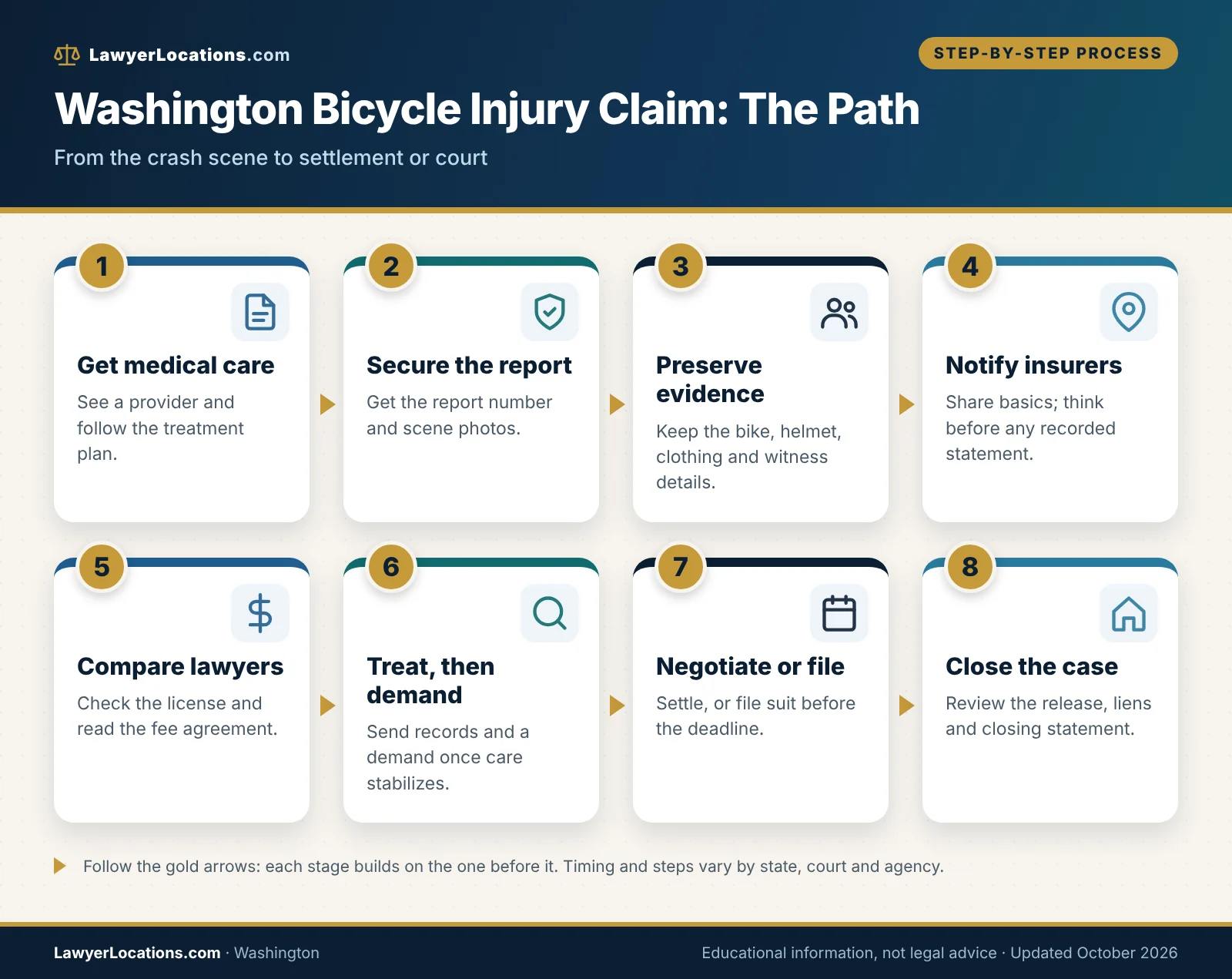
Text version of this graphic
- Get medical care. See a provider promptly and follow the treatment plan.
- Secure the report. Get the police or collision report number and scene photos.
- Preserve evidence. Keep the bike, helmet, clothing and witness contact details.
- Notify insurers carefully. Share basic facts and think before giving any recorded statement.
- Compare lawyers. Read the written fee agreement before signing.
- Treat, then demand. Send records and a demand once the medical picture is clear.
- Negotiate or file. Settle, or file suit before the Washington deadline.
- Close the case. Review the release, liens and closing statement.
When a lawyer helps and when you may not need one
Not every bicycle crash needs a lawyer. A scrape with a repaired bike and no medical bills is usually a conversation with an insurer. Once injuries, missed work or a disputed version of events enter the picture, the balance shifts. The decision turns on how serious the injuries are, how clear the fault is, and who the opposing party is.
Situations that often call for legal help
People commonly talk to a lawyer when any of the following is true. None of these automatically means a lawsuit, but each is a reason to get a professional opinion before you sign anything or accept a payment.
- You were taken from the scene by ambulance, admitted to a hospital, or need surgery or extended therapy.
- The driver left the scene, or no one can identify the vehicle.
- The other side says you were partly or mostly at fault (for example, “came out of nowhere” or “wasn’t visible”).
- A city, county, port or state agency may be responsible for the road, the trail or a hazard such as a drain grate, pothole or missing signage.
- The driver was working at the time (delivery, rideshare, a company truck) or the vehicle was owned by a business.
- The adjuster is pressing for a recorded statement, a medical authorization or a quick release.
- A child or a person who cannot manage their own affairs was hurt.
- Someone died. Family members face separate legal questions about who may bring a claim and what it can include.
Situations where you may manage on your own
If the injuries are minor, the damage is limited to a bike repair or replacement, and the driver’s insurer has accepted responsibility in writing, you may be able to handle the claim yourself. Washington also has a small claims process in district court for modest disputes that does not require a lawyer, which can fit a pure property-damage dispute over a bicycle.
Even then, keep notes of every call, save every email, and avoid signing a release until you are sure all treatment is finished. A release usually ends your claim for good, including for problems that show up later.
A first conversation with a lawyer is a way to learn where you stand, not a commitment. Ask each lawyer how they handle fees before you share sensitive details, and read the fee agreement in full before you sign. The fee section of this guide explains what to look for.
How the Washington picture differs from other states
The statutes that matter in a Washington bicycle claim apply statewide, but how a crash actually plays out depends heavily on where it happens. A collision on a crowded downtown Seattle street with protected lanes is a different fact pattern from a rural road shoulder in eastern Washington or a shared-use trail in a suburban county.
Same statutes, different roads
Washington’s deadlines, fault rules and traffic code come from the state legislature and apply from Bellingham to Vancouver and from Aberdeen to Spokane. What changes from place to place is the road owner (a city, a county, the state highway system, a port, a park district or a private landowner), the court where a suit would be filed, and the local ordinances that add rules on top of state law, such as local helmet requirements in some jurisdictions.
That difference matters most when a road condition contributed to the crash, because the agency in charge of the road determines which claim form and which office receive your notice.
Why local knowledge matters in a lawyer
A lawyer who regularly works in the county where your case would be filed knows that court’s scheduling habits, its local rules and how its judges tend to manage cases. They also know which agency owns a given stretch of road and where its claim paperwork must be delivered. When you interview lawyers, ask where they practice and which courts they appear in. Ask about the county, not just the state, because the answer tells you how familiar they are with the venue where your case may end up.
If you want a broader look at injury-lawyer selection in the state beyond bicycle crashes, see our guide to finding a personal injury lawyer in Washington.
Washington Law That Controls a Bicycle Injury Claim
Three state rules shape most Washington bicycle claims: the lawsuit filing deadline is generally three years, fault is shared in proportion (a rider who is partly to blame still recovers, but less), and a bicyclist on the road is treated like a driver. A set of statutes on passing distance and “vulnerable users” adds extra duties for drivers. All of this is Washington state law, and it applies in every county.
| Issue | Washington rule | Where it comes from | Why it matters to a rider |
|---|---|---|---|
| Filing deadline | Three years for an action for “any other injury to the person or rights of another” not listed elsewhere in the section | RCW 4.16.080(2) | Miss it and a court will usually dismiss the case, whatever the merits |
| Pausing the clock | Time of disability (under 18, legal incapacity, or jailed before sentencing) does not count toward the limit | RCW 4.16.190 | Can matter for injured children; the details are fact-specific |
| Shared fault | Fault chargeable to the injured person reduces the award proportionately but does not bar recovery | RCW 4.22.005 | A rider found partly at fault can still recover a reduced amount |
| Rider’s status | A person riding a bicycle on a roadway has the rights and duties of a vehicle driver (with listed exceptions); on a sidewalk or crosswalk, the rights and duties of a pedestrian | RCW 46.61.755 | Frames right-of-way and lane arguments |
| Passing a rider | On a multi-lane road, move completely into a lane left of the right lane; on a one-lane road, pass at a safe distance (where practicable at least three feet) or move fully into the oncoming lane when safe | RCW 46.61.110(2) | A close pass can be strong evidence that a driver failed to use care |
| Driver harms a bicyclist | Negligent driving that causes substantial or great bodily harm to a vulnerable user is a traffic infraction; causing death is a gross misdemeanor | RCW 46.61.526, RCW 46.61.5259 | A criminal or traffic outcome is separate from your civil claim |
| Claims against local government | Standard claim form, then a 60-calendar-day wait before suit; the limit is tolled during the wait | RCW 4.96.020 | Skipping the claim form can derail a road-defect case |
| Claims against the state | Claim presented to the Office of Risk Management, then a 60-calendar-day wait before suit | RCW 4.92.100, RCW 4.92.110 | State highways and state-owned property fall here |
The filing deadline and how it can pause
The most important date in any injury claim is the one after which a court will no longer hear it. This is called the statute of limitations. For most Washington injury claims, including a bicycle crash with a driver, the period is three years.
The three-year clock
Under RCW 4.16.080(2), an action for “any other injury to the person or rights of another” that is not listed elsewhere in the section must be started within 3 years. In practice, the clock usually starts on the date of the crash. A lawsuit is “started” by filing it in court, not by sending a letter to an insurer, and an ongoing negotiation does not stop the clock by itself.
Three years is the general rule for a claim against a private driver. A claim against a city, county or the state follows different steps (a claim form and a 60-day wait), and some claims, such as certain claims involving health care providers or federal property, have their own special rules. If you suspect a public agency or a federal entity is involved, do not wait to get advice. Do not calculate your final deadline from this page alone.
Children, incapacity and other pauses
RCW 4.16.190 provides that when a person entitled to bring an action was under eighteen, incompetent or disabled, or jailed before sentencing when the claim arose, the time of that disability does not count toward the limit. The incapacity determination is made under chapter 11.130 RCW. For a child hurt on a bike, this can mean the period does not begin to run until the child turns eighteen, but a parent’s own claim for medical expenses, or a claim by a family, can follow a different timeline.
Because tolling rules turn on dates and facts, treat them as a reason to ask a lawyer rather than a plan to wait. Evidence disappears long before a legal deadline does.
Shared fault: Washington’s pure comparative rule
Many riders worry that “if I was partly at fault, I get nothing.” Washington’s rule is much more forgiving than that worry suggests.
What the statute says
RCW 4.22.005 states that in an action based on fault to recover damages for injury or death to a person, “any contributory fault chargeable to the claimant diminishes proportionately the amount awarded as compensatory damages for an injury attributable to the claimant’s contributory fault, but does not bar recovery.” Lawyers call this pure comparative fault: your share of the blame reduces the award, and there is no cut-off percentage that wipes it out.
How it plays out in a real claim
Insurers know this rule, which is why so many bicycle claims turn into arguments about percentages: speed, visibility, lane position, whether the rider was in a bike lane or crosswalk, and whether a signal was obeyed. Every percentage point of fault assigned to the rider reduces the recovery.
Suppose a jury or negotiated outcome puts the total losses of a rider at a round $100,000 and assigns the rider 20 percent of the fault. The reduction under the proportional rule would be 20 percent, leaving $80,000 before fees, costs and liens. The numbers here are illustrative only, to show the arithmetic, and are not a prediction about any real case.
Because fault percentages move the number so much, the evidence about what the rider did right (visible clothing and lights, a lawful position on the road, a signal given) deserves as much attention as the evidence of what the driver did wrong.
Rules of the road: what drivers and riders owe each other
Traffic law does not decide a civil claim by itself, but a violation is often strong evidence that someone failed to use reasonable care. These are the main provisions to understand.
A rider on the road is treated like a driver
Under RCW 46.61.755(1), every person riding a bicycle on a roadway “shall be granted all of the rights” and “shall be subject to all of the duties applicable to the driver of a vehicle,” except as to the special bicycle regulations in RCW 46.61.750 through 46.61.780 and provisions that by their nature cannot apply. Subsection (2) treats a rider on a sidewalk or crosswalk as a pedestrian. In practice, that means a rider must obey signals and stop signs and has the same claim to the lane as any other vehicle, and drivers owe a rider the same care they owe other traffic.
The passing rule
Washington’s passing statute, RCW 46.61.110(2), speaks directly to drivers overtaking a bicyclist who is in the right lane, on the right-hand shoulder or in a bike lane. On a road with two or more lanes in the driver’s direction, the driver must move completely into a lane to the left of the right lane when it is safe, and stay there until clear of the rider. On a one-lane road, if there is enough room in the lane, the driver must slow to a safe passing speed and pass at a safe distance, “where practicable of at least three feet”; if there is not enough room, the driver must move completely into the oncoming lane when it is safe. The subsection does not apply on a shared street as defined in RCW 46.61.197, and a driver found in violation faces an additional fine under the statute.
A close pass leaves no skid marks, so proof often comes from dash-camera footage, a rider’s helmet or handlebar camera, a nearby business’s security video or witness statements. Ask early whether any cameras covered the spot, because many systems overwrite footage within days.
Other rules insurers raise
Adjusters often point to rules on lights at night, riding on a sidewalk, signaling turns and riding position on the roadway. Whether a particular rule applies to your crash depends on the exact facts and sometimes on local ordinances, including local helmet requirements in some jurisdictions. A rule violation by the rider does not end the claim under Washington’s proportional-fault rule; it feeds the percentage argument. Ask your lawyer which provisions the other side is likely to cite.
Washington’s “vulnerable user” law and your civil case
Washington has a special traffic offense when a driver’s negligence seriously harms or kills a person using the road without a protective shell, and bicyclists are covered. It is easy to confuse the traffic or criminal case with your injury claim, so here is how they fit together.
What the offenses are
Under RCW 46.61.5259, “vulnerable user of a public way” includes a pedestrian and a person operating or riding a bicycle, an electric-assisted bicycle, a moped, a motor-driven cycle, a motorized foot scooter or a motorcycle, among others. Driving negligently in a way that endangers a person or property and proximately causes the death of a vulnerable user is the first-degree offense, a gross misdemeanor with up to 364 days in jail, a fine of $5,000 that cannot be reduced below $1,000, and a 90-day license suspension. The second-degree offense in RCW 46.61.526 covers negligent driving that proximately causes great bodily harm or substantial bodily harm; it is a traffic infraction with a $5,000 penalty (not reducible below $1,000) and a 90-day suspension, with alternative options a driver may elect at a hearing.
Why the criminal or traffic result is not your lawsuit
A prosecutor or a traffic court decides whether the driver violated the law; the injured rider’s civil claim for money is a separate process with a different standard and different parties. A fine paid to the state does not compensate you. Conversely, a decision not to charge a driver does not mean you have no civil claim. If there is a pending citation or charge, a lawyer can explain how it may interact with your claim, including what you should and should not say to investigators and insurers while it is pending.
For a general overview of how a deadline works across states, our national guide on how long you have to file a personal injury claim puts Washington’s three-year rule in context.
Insurance, Hit-and-Run Crashes and Road-Defect Claims
Several different sources of money can be in play after a Washington bicycle crash: the driver’s liability insurance, your own underinsured motorist and personal injury protection coverage (if you carry it), your health insurance, and, if a road or trail defect contributed, a claim against a public agency. A lawyer’s first task is often a map of which of these apply and in what order.
| Source | What it may cover | What to check |
|---|---|---|
| Driver’s liability insurance | Injury and property-damage claims against an at-fault driver, up to the policy limits | Policy limits, whether the driver was working, whether other policies apply |
| Your underinsured motorist (UIM) coverage | Gap when the at-fault driver has no insurance, too little insurance, or leaves the scene | Whether you rejected it in writing and how your policy defines who is covered |
| Personal injury protection (PIP) | Optional no-fault coverage that insurers must offer on auto liability policies | Whether you or a household member bought it, and what it pays for |
| Health insurance or Medicare/Medicaid | Medical bills, often with a right to be repaid from a settlement | Reimbursement or lien notices; agencies may have repayment rights |
| Public agency (city, county, state, port, park district) | Claims where a road or trail condition or maintenance failure contributed | Which agency owns the site; claim-form rules and the 60-day waiting period |
| Employer or commercial insurer | Crashes involving delivery, rideshare or company vehicles | Whether the driver was on the job; additional policies may apply |
Insurance that may pay after a bicycle crash
Insurance for bicycle injuries is often more layered than people expect, because the coverage that matters might be on a car you were not even near.
The driver’s liability policy and Washington’s minimum limits
The at-fault driver’s liability insurance is usually the first source of recovery. Washington’s financial-responsibility statute, RCW 46.29.090, sets minimum limits of $25,000 for bodily injury or death to one person in an accident, $50,000 for two or more persons, and $10,000 for property damage. Those are floors, not typical figures, and a serious injury can exceed a minimum policy quickly. That gap is one reason to look at every other layer of coverage.
A driver’s policy limit also tells you how much the insurer is likely to pay without a fight over the driver’s personal assets. A lawyer will ask for the policy limits early in a claim and will check whether a second policy (an employer’s, an owner’s, an umbrella) applies.
Your own underinsured motorist coverage
Under RCW 48.22.030, an insurer generally cannot issue or renew a Washington auto policy without underinsured motorist coverage unless the named insured (or spouse) rejects it in writing. The coverage protects insured persons who are legally entitled to recover damages from owners or operators of underinsured, hit-and-run or phantom vehicles. A vehicle is underinsured when no liability bond or insurance applies, or when the applicable liability limits are less than the damages the covered person is legally entitled to recover.
Whether the coverage in your policy responds when you are hurt on a bicycle, and not in your car, depends on the wording of the policy and the statute’s exclusions. Do not assume the answer either way; ask your lawyer to read the policy, and report the crash to your own insurer promptly so you do not violate a notice condition.
Personal injury protection, health insurance and medical payments
Under RCW 48.22.085, insurers may not issue or renew an automobile liability policy in Washington unless they offer personal injury protection (PIP) as an optional coverage, and a named insured may reject it in writing. If you or someone in your household carries it, ask whether it extends to you as a cyclist. Your health insurance may pay medical bills in the meantime. Health plans and some government programs often have a right to be repaid from a later settlement, so keep every notice and let your lawyer handle the reimbursement questions.
Dig out every auto and household policy you can find, including those for family members you live with. Coverage questions are easier to answer when you hand a lawyer the full list on day one.
If the driver left the scene or cannot be identified
A hit-and-run is among the hardest bicycle cases emotionally and practically, because there is no driver to name and no insurer to call. The path forward still exists.
Report quickly and preserve evidence
Call law enforcement right away if you can, and give officers every detail you remember: vehicle color and type, partial plate, direction of travel, and distinguishing damage. Look for cameras at nearby businesses, homes and buses, and ask the owner to preserve footage in writing, because many systems overwrite within days. Paint transfer, broken parts and debris on the roadway and on your bike can help investigators identify a vehicle.
Using your own coverage
Washington’s underinsured coverage statute expressly refers to hit-and-run and phantom vehicles, which means your own policy may be the source of recovery if the driver is never found. Policies commonly require prompt notice to the insurer, and sometimes a police report within a short time. A lawyer can read your policy and tell you what conditions apply. Do not delay notifying your own insurer while you wait to see whether police find the driver.
When a city, county or state agency may be responsible
Some crashes are caused or worsened by the condition of the road, bike lane or trail itself: a deep pothole, a drain grate that traps a wheel, a hazard at a construction zone, missing warning signs, or a design defect. When a public body may be responsible, special procedures apply before you can sue.
The claim form and the 60-day wait for local governments
Under RCW 4.96.020, a claim for damages against a city, county or other local governmental entity must be presented to that entity’s designated claims agent on the standard tort claim form maintained by the Office of Risk Management in the Department of Enterprise Services (or the entity’s own compliant form). The form asks for your name, date of birth and contact information, a description of the conduct and circumstances, a description of the injury or damage, the time and place of the incident, the names of those involved if known, the amount of damages claimed, and your residence. It must be signed by the claimant, an authorized attorney-in-fact, a Washington-admitted attorney or a court-approved guardian.
No lawsuit may be filed until 60 calendar days have passed since the claim was first presented, and the limitations period is tolled (paused) during those 60 days. A claim is “presented” when delivered in person to the agent or received by mail at the agent’s office. Each local entity’s claims agent and address are public records recorded with the county auditor.
Claims against the state
For state agencies and state highways, claims go to the Office of Risk Management under RCW 4.92.100, and RCW 4.92.110 likewise bars suit until 60 calendar days after presentment, with the limitations period tolled in that window. A suit filed within five court days after the 60-day period is treated as presented on the first day after the period ends. Whether the road where you fell belongs to the state, a county or a city is not always obvious from the road’s appearance, so identify the owner early.
Presenting a claim form does not file a lawsuit. It starts a 60-day waiting period that must pass before suit and pauses the limitations clock only for that period. The overall time limit still applies. Treat the claim form as an early step, not a last-minute one, and ask a lawyer how it interacts with your three-year deadline.
Our guide to who pays medical bills after a car accident explains how health coverage, liens and claim payments interact, and much of it applies to bicycle crashes too. If the other party was uninsured, see the overview of uninsured motorist claims.
Washington Courts and Local Resources for Bicycle Injury Claims
Most significant bicycle injury lawsuits are filed in a county superior court, the state’s trial court of general jurisdiction. Smaller disputes can go to district court, including its small claims department, and traffic citations are handled by district or municipal courts. The Washington Courts website keeps an official court directory for finding the right county or city court, and county bar referral services in several regions can connect you with a lawyer.
Washington’s trial courts and where bicycle cases go
Washington has several levels of trial court. Knowing the difference helps you understand what a lawyer means by “we would file in superior court” or “that goes through the city’s municipal court”.
Superior courts
Each of Washington’s 39 counties has a superior court. A bicycle injury lawsuit with significant medical bills, lost income or lasting harm is ordinarily filed there. The Washington Courts site lists every superior court, with contact details and links, in its trial court pages (courts.wa.gov). Local rules differ from county to county on scheduling, case management and pretrial procedure, which is one reason lawyers who practice in a given county are valuable.
District courts and small claims
District courts handle many smaller civil matters and traffic cases. Under RCW 12.40.010, small claims cases are heard in the small claims department of the district court, and the limit is $10,000 for a case brought by a natural person (a human being) and $5,000 for other claimants. That ceiling can fit a dispute over a damaged bike and gear when injuries are minor. It is not a good fit for a serious injury, because a small claims judgment would be capped and a final judgment generally ends the dispute over that claim.
Municipal courts and traffic citations
If a driver or a rider is cited after a crash, the citation is typically handled in a district or municipal court. The result of a traffic case is separate from your injury claim, but statements made in that case can affect the civil one. If you have been cited, talk to a lawyer before you respond, and ask how the way you resolve the citation could affect your injury claim.
The Washington Courts website offers a court directory and a county and city list that help you identify the correct court. Start at courts.wa.gov/court_dir if you are unsure where a case or a citation belongs.
Choosing the county and understanding local differences
Because Washington is a large state with very different regions, the practical experience of a claim can change depending on where it is filed.
Where a case may be filed
The general principle is that a lawsuit is filed in a county that has a legitimate connection to the dispute, usually where the crash happened or where a defendant lives or does business. When more than one county is possible, a lawyer weighs factors such as convenience for witnesses, the court’s calendar and the make-up of the jury pool. Do not choose a lawyer based solely on a belief that one county is “friendlier” than another. Ask the lawyer to explain the venue options in your case in plain terms.
Cities, counties and rural roads
In dense areas such as the Puget Sound region, many crashes happen on city streets governed by city engineering departments, with different agencies responsible for state routes and county roads. In rural areas, the road may be a county road, a state highway or a private road, and emergency response and evidence collection can look very different. A lawyer who knows how local agencies keep their records can save you weeks.
The same statewide rules on deadlines, shared fault and claim forms apply everywhere, which is why the next table focuses on where to find help rather than on separate legal rules for each county.
| Area | Service | How to reach it |
|---|---|---|
| King County (Seattle area) | King County Bar Association lawyer referral | kcba.org |
| Snohomish County (Everett area) | Snohomish County Bar Association lawyer referral service | snobar.org |
| Pierce County (Tacoma area) | Tacoma-Pierce County Bar Association lawyer referral service | tpcba.com |
| Clark County (Vancouver area) | Clark County Bar Association | ccbawashington.org |
| San Juan County | San Juan County Bar Association referral | Email request to the address listed by the WSBA |
| Statewide, low-income civil legal problems | CLEAR (Northwest Justice Project) | Online application at nwjustice.org; 888-201-1014 outside King County |
| Statewide, court self-help | Self-Help Washington and Washington LawHelp | courts.wa.gov/self-help, washingtonlawhelp.org |
Putting local resources to work
Finding resources is only useful if you know how to use them. A few practical approaches help you avoid common traps.
Using a referral service wisely
A referral service usually asks for a short description of your problem and then gives you a name or a few names. A referral is not an endorsement, and fees and terms are still between you and the lawyer. Ask the referral service whether lawyers on its panel must meet any minimum standards, and ask the lawyer whether a referral fee will affect your costs. The signed fee agreement is the document that sets your costs.
When you are outside the major metro areas
If you live in a part of the state without a listed county referral service, you still have options. Ask other lawyers you trust (a business lawyer, a family lawyer, a lawyer who helped with a will) for names, and look up each candidate in the WSBA Legal Directory. Many Washington injury lawyers handle cases statewide and will talk by phone or video before an in-person meeting. If you need free civil legal help, CLEAR and Washington LawHelp are the starting points the WSBA lists.
For a broader look at hiring an injury lawyer in the state, see our guide to personal injury lawyers in Washington.
How to Compare Bicycle Accident Lawyers in Washington
Compare lawyers on the same short list of questions: license status, how often they handle bicycle or other road-user cases, how they are paid, who will actually work your file, and how they communicate. LawyerLocations.com is an education and discovery resource, not a law firm and not a referral service, so this section shows you how to evaluate any lawyer you find rather than recommending one.
Where to look for a lawyer
Start with sources that verify a lawyer’s license and discipline history, then widen to referral services and personal recommendations. Treat advertising, search-result rankings and award badges as marketing, not as proof of quality.
Confirming a Washington license and checking discipline
Only a lawyer licensed to practice in Washington can give you legal advice about a Washington claim and represent you in a Washington state court. The Washington State Bar Association (WSBA) maintains an online Legal Directory where you can look up a lawyer by name. Do this check before the consultation, not after you have signed, and look for any public record of discipline. A lawyer licensed only in another state may practice here in limited, permitted ways, so ask directly if you are told a lawyer is “licensed elsewhere”.
Bar-sponsored and local referral options
The WSBA says on its public help page that it does not provide referrals to private attorneys, but it points the public to county bar lawyer referral services. Those listed include the King County Bar Association, the Snohomish County Bar Association, the Tacoma-Pierce County Bar Association and the Clark County Bar Association, and San Juan County residents are directed to request a referral by email. Referral services generally screen for license status but do not vouch for outcomes, so you still need to ask the questions below. Online directories (including this site) are tools for finding candidates, not endorsements.
Free and low-cost legal help
If your income is limited or you need help with a related problem such as a landlord dispute or denied benefits that arises after a crash, civil legal aid may be available. The WSBA lists CLEAR (Coordinated Legal Education, Advice and Referral), a service of the Northwest Justice Project for low-income Washington residents with civil legal problems; outside King County the listed number is 888-201-1014 (weekdays, 9:15 a.m. to 12:15 p.m.), and inside King County people are directed to the 211 Legal Referral and Information Hotline. Washington LawHelp (washingtonlawhelp.org) and the courts’ Self-Help Washington pages offer forms and plain-language information. Legal aid programs may not take injury cases that private lawyers handle for a contingent fee, but they can point you to the right resource or help with related problems such as benefits or housing.
Questions that separate one lawyer from another
A strong consultation is a two-way interview. You are deciding whether to trust this person with a serious part of your life, so use the same list with every lawyer and compare the answers side by side.
Experience and staffing
Ask how often the lawyer handles claims for people hurt on bicycles and other vulnerable road users, and what the typical issues have been (close passes, doorings, right-hook turns, road defects, hit-and-run). Ask who will handle your file from day to day: the lawyer, an associate, a paralegal or a case manager. There is nothing wrong with a team, but you should know who answers your calls and who makes decisions.
Ask about court experience as well. A lawyer who is ready and willing to try a case when negotiations stall tends to have more leverage than one who only settles. You do not need a promised outcome, only an honest description of how the lawyer approaches the possibility of trial.
Fees and costs in writing
Ask how fees are calculated, what percentage applies at each stage, what costs are advanced and whether those costs come out of your share before or after the fee is taken. Ask for the written agreement before you decide, and take it home. The fees section later in this guide explains the common structures and the questions to ask about liens and reimbursement.
Communication and case handling
Ask how and how often you will receive updates, who can approve a settlement (it is you, not the lawyer), and what happens if you are unhappy. A lawyer who is clear about these basics at the start is usually a lawyer who communicates well later.
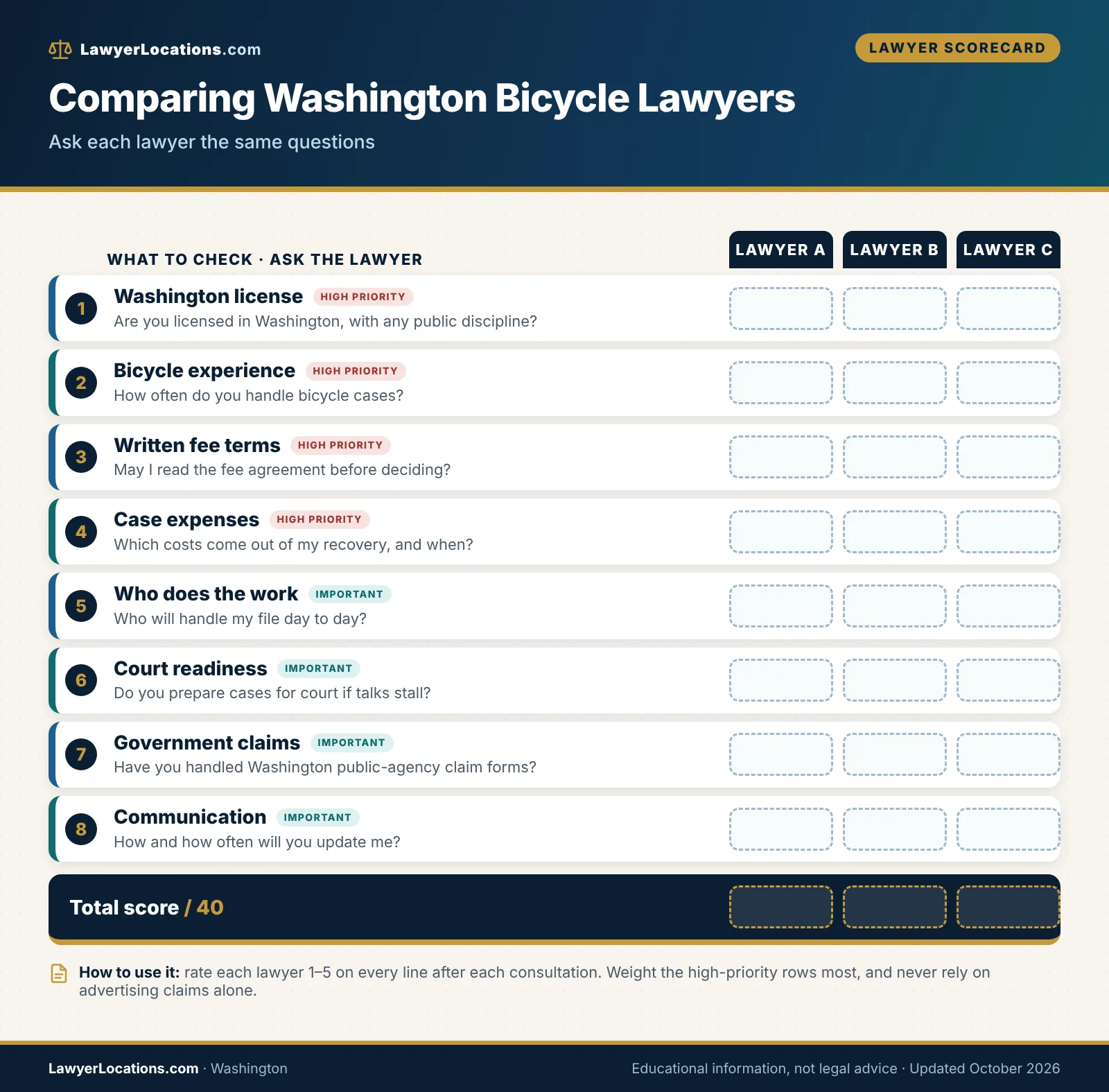
Text version of this graphic
| Criterion | Question to ask | Weight |
|---|---|---|
| Washington license | Are you licensed in Washington, with any public discipline? | High |
| Bicycle experience | How often do you handle bicycle cases? | High |
| Written fee terms | May I read the fee agreement before deciding? | High |
| Case expenses | Which costs come out of my recovery, and when? | High |
| Who does the work | Who will handle my file day to day? | Medium |
| Court readiness | Do you prepare cases for court if talks stall? | Medium |
| Government claims | Have you handled Washington public-entity claim forms? | Medium |
| Communication | How and how often will you update me? | Medium |
| Topic | A reassuring answer sounds like | A reason to pause sounds like |
|---|---|---|
| Fees | Explains the percentage, when it changes, and gives you the written agreement to review at home | Refuses to put anything in writing or pushes you to sign today |
| Expectations | Describes factors that affect value, and says outcomes cannot be predicted | Promises a result or quotes a settlement figure before seeing records |
| Experience | Describes the kinds of road-user cases handled without revealing other clients’ confidences | Cannot explain how a bicycle case differs from a car case |
| Staffing | Names who will work on the file and how to reach them | Vague about who you will deal with after you sign |
| Deadlines | Asks when the crash happened and whether a public agency is involved | Never mentions deadlines or claim forms |
| Your role | Says you make the final call on any settlement | Implies they can settle without your approval |
Be cautious of anyone who contacts you first after a crash, offers cash for signing, or pressures you to sign on the spot. A real lawyer will let you take time. Also be wary of promises about the size or speed of a payout. Nobody can promise those.
Preparing for your consultation
You do not need a perfect file to talk to a lawyer. A decent first meeting can happen with a report number and your best recollection. The more you bring, the more specific the lawyer can be.
Documents and evidence to bring
Bring whatever you have and say what is missing. Incomplete is fine, and a good lawyer knows how to request the rest.
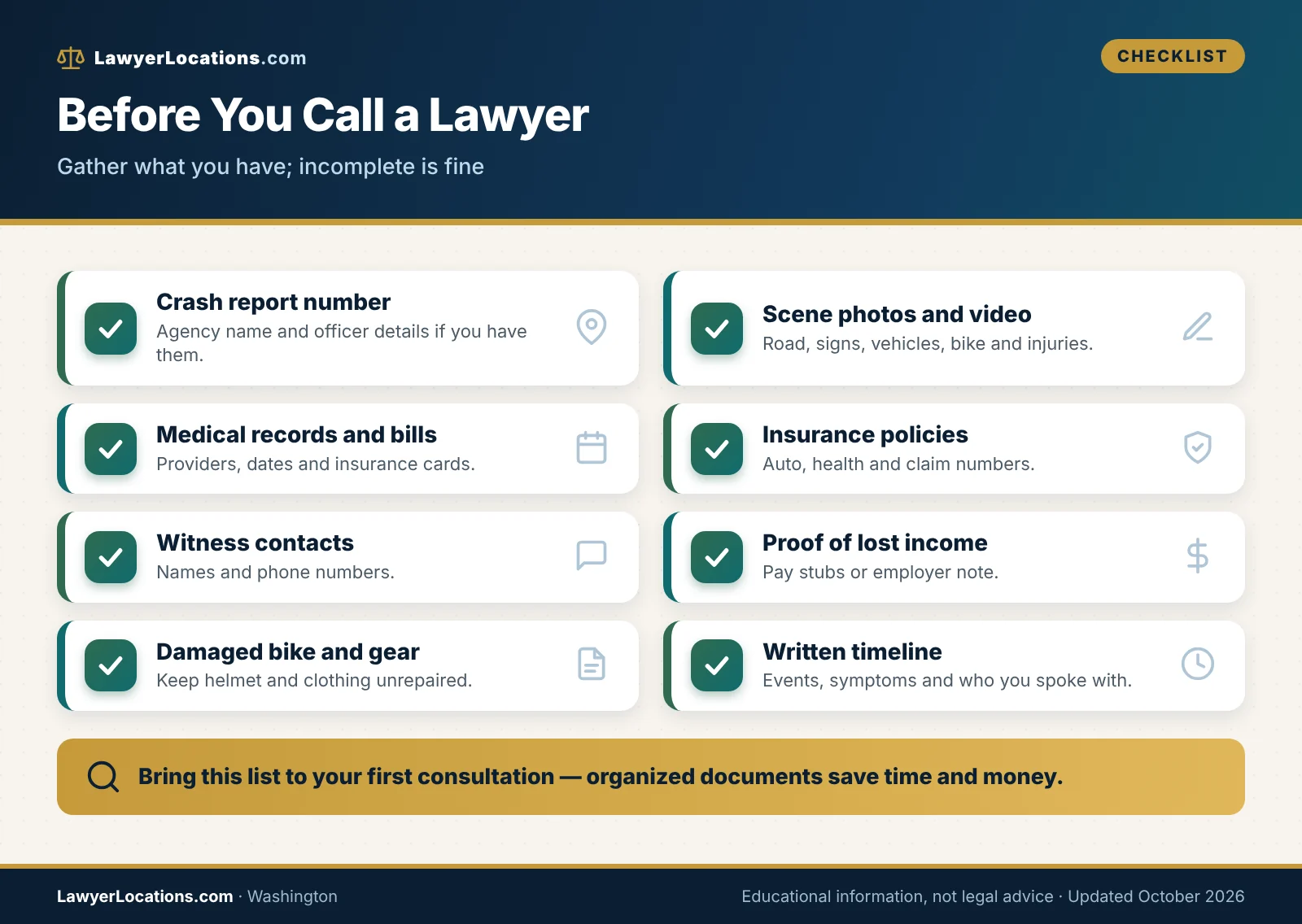
Text version of this graphic
- Crash report number. Agency name and officer details if you have them.
- Scene photos and video. Road, signs, vehicles, bike and injuries.
- Medical records and bills. Providers, dates and insurance cards.
- Insurance policies. Auto, health and claim numbers.
- Witness contacts. Names and phone numbers.
- Proof of lost income. Pay stubs or an employer note.
- Damaged bike and gear. Keep the helmet and clothing unrepaired.
- Written timeline. Events, symptoms and who you spoke with.
- The crash or collision report number and the name of the responding agency.
- Photos and video of the scene, the vehicles, your bike, your gear and your injuries.
- The other driver’s name, insurance details and plate number, if you have them.
- Medical records, bills, explanation-of-benefits statements and your health insurance information.
- Your own auto policy (it may include coverage that helps even when you were on a bike).
- Proof of lost income, such as pay stubs or a note from your employer.
- The bike, helmet, clothing, lights and any cycling computer or camera, kept in the condition they were in after the crash.
- A short written timeline made while your memory is fresh.
What to expect from the first meeting
Expect questions about how the crash happened, your injuries and treatment, your work, and any contact you have had with insurers. The lawyer should explain, in general terms, what the next steps are and what they would need to evaluate the claim. Expect to hear about deadlines, including the three-year filing period and any claim-form requirement for a public agency.
At the end, ask what you should do and not do while you decide. Common answers include keeping medical appointments, not posting about the crash on social media, and not giving a recorded statement to the other side’s insurer without advice.
Make a short table of your consultations: lawyer, date, fee terms, who would handle the file, and your gut sense of communication. Comparing notes a few days later is much easier than trying to remember who said what.
From the Crash Scene to a Washington Courtroom
A bicycle injury claim usually moves through the same stages: medical care and evidence in the first days, an insurance claim while you treat, a written demand once the medical picture is clear, negotiation, and, if talks fail, a lawsuit filed before the deadline. Most claims resolve before trial, but a lawyer prepares as if the case might be tried because that preparation drives the settlement conversation.
| Stage | What happens | Typical decision for you |
|---|---|---|
| 1. Crash scene and first care | Medical evaluation, collision report, photos, witness names | Whether to accept an ambulance or an urgent-care visit; do not skip care to “tough it out” |
| 2. Early claim setup | Notice to the driver’s insurer; your own insurer notified of the crash | How much to say to an adjuster before getting advice |
| 3. Treatment | Doctors, therapy, imaging, specialist visits; records accumulate | Following the treatment plan so the record is complete |
| 4. Investigation | Lawyer collects video, reports, vehicle data and road information | Whether to hire a lawyer now or after treatment ends |
| 5. Demand | Written package of records, bills and a damages explanation sent to the insurer | Whether to approve the figure the lawyer proposes |
| 6. Negotiation | Offers and counteroffers, sometimes a mediation | Accept, counter, or authorize a lawsuit |
| 7. Lawsuit | Complaint filed and served, exchange of information, depositions, possible arbitration or trial | Whether to continue or settle at each stage |
| 8. Closing | Release signed, liens paid, closing statement reviewed, balance distributed | Checking every line of the closing statement |
The first days after a crash
What you do right after a crash affects both your health and your claim. Safety and medical care come first; evidence comes second but cannot wait long.
Medical care and the official record
Get checked out even if you feel “mostly fine”. Adrenaline masks pain, and head, neck and soft-tissue injuries often show up the next day. Gaps in care give insurers an argument that you were not hurt, so a prompt evaluation protects your health and your record. Ask the responding officer for a report number and the name of the agency. If officers did not come, consider filing a report afterward and write down the date and time you did so.
Preserving the bike, helmet and digital evidence
Your bike, helmet, clothing, lights and any cycling computer or camera are physical evidence. Do not repair, replace or throw them away until a lawyer or an insurer’s inspector has documented them. Photograph the scene from several angles: road surface, lane markings, signs, sightlines and skid marks. Save any app data from a fitness tracker or bike computer, which can show speed and route. Screenshot messages and take down witness names and numbers.
Keep your social media quiet. Posts and photos that show you active, smiling or riding can be taken out of context.
Talking to insurers
You will likely hear from the driver’s insurer quickly. You may give basic facts such as your name and the date and place of the crash. Be cautious about a recorded statement, a broad medical authorization, or a quick payment that comes with a release. A release is a contract that normally ends your claim. Before signing anything, make sure you understand what it covers.
An adjuster who is unusually friendly and quick to offer money can still be protecting the insurer’s interests, not yours. An early check is not wrong in itself, but read what you are signing and ask whether it ends your claim.
From claim to lawsuit
The middle of a case is usually quiet from the outside and busy behind the scenes: records are requested, bills are tallied, and the lawyer decides when the claim is ready to present.
Treatment, demand and negotiation
A lawyer generally waits until you reach maximum medical improvement (the point where your condition has stabilized, or your doctors can describe what to expect) before making a demand. The demand letter attaches records and bills and explains how the crash happened, why the other party is responsible and what your losses are. The insurer responds, often with a lower figure, and the two sides negotiate. If the insurer disputes liability or the value of the injuries, a lawsuit may be the next step.
Filing in the right Washington court
A lawsuit seeking significant injury damages is generally filed in the superior court of a Washington county. The next section describes the court system and the choices involved. Filing must happen before the limitation deadline, which is why a lawyer keeps a calendar date even while talks are going well.
Settlement, mediation or trial
Cases settle at every stage: before a lawsuit, after discovery, at a mediation, or on the eve of trial. Mediation is a confidential meeting with a neutral person who helps the sides reach agreement; it is not binding unless a settlement is signed. If a case goes to trial, a judge or jury decides fault and damages. A trial brings uncertainty for both sides, which is one reason many cases settle.
Discovery is the stage of a lawsuit when each side must share information with the other, through written questions, document requests and sworn testimony called depositions.
For a closer look at timelines after a collision, read our guide to the car accident settlement timeline, which explains the stages that also apply to many bicycle claims, and our checklist on what to do after a car accident.
What Affects the Value of a Washington Bicycle Injury Claim
No honest source can tell you what a particular bicycle claim is worth without the records, and this guide does not publish averages. What can be said is that value usually turns on four things: how serious and lasting the injuries are, how clearly the other party was at fault, how much insurance or other money is available, and how well the losses are documented. Under Washington’s pure comparative fault rule, any share of fault assigned to the rider then reduces the figure.
| Category | What it includes | Typical supporting evidence |
|---|---|---|
| Past medical expenses | Ambulance, emergency care, imaging, surgery, therapy, medication | Bills, records, explanation-of-benefits statements |
| Future medical care | Ongoing treatment, follow-up surgery, devices, counseling | Doctor statements about expected care and its likely cost |
| Lost income and earning ability | Missed work, reduced hours, a changed career path | Pay stubs, tax records, employer letters, vocational opinions |
| Property damage | Bike, helmet, clothing, electronics, lights, cycling computer | Receipts, photos, repair estimates, product listings |
| Pain, suffering and loss of enjoyment | Physical pain, limits on sport, hobbies and family life, emotional harm | Treatment notes, a symptom diary, statements from family and coworkers |
| Scarring or lasting impairment | Visible scars, reduced range of motion, chronic pain | Photographs over time, specialist evaluations |
The injury and the medical record
Bicycle injuries range from road rash to traumatic brain injury and spinal damage. Because riders have no protective shell, the force of a collision with a car passes directly to the body, so even a crash at modest speed can produce lasting harm.
Seriousness and permanence
Insurers and juries tend to give more weight to injuries that are objectively documented, require surgery or leave lasting limits. A fracture visible on imaging is easier to prove than a persistent headache. That does not mean subtle injuries are unimportant; it means they need careful documentation, including follow-up visits that explain symptoms in the doctor’s words.
Gaps in treatment and prior conditions
Long gaps between appointments, missed therapy or treatment that stops without explanation are used to argue that you recovered. If cost, transportation or work conflicts made it hard to continue care, tell your providers and your lawyer so the reasons are on record. Prior injuries to the same body part can also be raised. Honesty about your history is essential, because a hidden prior problem that surfaces later can damage your credibility on everything else.
Fault, coverage and credibility
The medical story is only one side of the equation. The other is whether the defendant is legally responsible and whether there is money to pay.
How fault percentages change the number
Because RCW 4.22.005 reduces an award by the claimant’s share of fault without barring it, the argument about percentages is central. Evidence that you wore visible clothing, used lights when needed, signaled and followed the rules of the road is not only about safety; it is the evidence that holds your percentage down.
Policy limits and other sources of money
Even a strong claim can be limited by the insurance available. The minimum liability limits in RCW 46.29.090 are modest compared with a serious injury, which is why your own underinsured motorist coverage, any employer’s policy and any public-agency claim deserve attention. A lawyer will often ask the at-fault driver’s insurer for policy limits early so that expectations are realistic.
Credibility and consistency
Insurers compare your statements, medical history, social media and activity. Consistency matters. Do not exaggerate, and do not minimize. Tell your doctors the truth about pain and function, and keep your account of the crash the same each time you tell it.
A rider with a broken collarbone returns to work after six weeks, then develops shoulder stiffness and stops therapy because of a schedule change. Months later the insurer points to the gap in care as a sign she had recovered. Had she told her provider about the schedule problem and rescheduled, the record would have shown continuing symptoms. The example is illustrative and not drawn from a real case.
Costs, Fees, Deadlines and Decision Points
Most bicycle injury lawyers are paid through a contingent fee: the lawyer receives an agreed percentage only if there is a recovery, and nothing for the fee if there is none. Washington’s Rule of Professional Conduct 1.5(c) requires that a contingent fee agreement be in a writing signed by the client and state the percentages and whether expenses are deducted before or after the fee is calculated. Beyond the fee, you should understand case costs, medical liens and the dates that drive decisions.
What a lawyer costs and how fees are handled
Fee terms differ from lawyer to lawyer and are negotiable in some situations. This guide does not publish average percentages or typical settlement figures, because credible statewide numbers are not available from an official source. What follows explains the structure so you can read any agreement with confidence.
How contingent fees are structured
Under RPC 1.5(c), a contingent fee agreement must be in a writing signed by the client and must state the method by which the fee is determined, including the percentage or percentages that apply if the matter settles, is tried or is appealed. It must also say what expenses are to be deducted and whether they come out before or after the fee is calculated. Many agreements use a lower percentage if a case settles before a lawsuit is filed and a higher percentage once a lawsuit or trial is underway, but the numbers are set by the individual agreement.
Ask for a worked example. A good lawyer will show, with sample numbers, how a hypothetical recovery would be divided among the fee, costs, medical bills and you. The math is easy to misread, especially when costs are deducted before the fee in one agreement and after the fee in another.
Case costs and who advances them
Case costs are the out-of-pocket expenses of building a claim: records fees, filing fees, process servers, expert witnesses, deposition transcripts, mediation fees and similar items. Lawyers on contingent fees commonly advance them and are repaid from the recovery. Ask what happens to costs if there is no recovery, because agreements differ, and ask for periodic itemized statements of costs.
Closing statement and your share
Under RPC 1.5(c), when a contingent fee matter ends the lawyer must give the client a written statement of the outcome and, if there is a recovery, the amount sent to the client and how it was calculated. Read this statement line by line before you sign a settlement distribution. Questions are normal and expected.
Under the same rule, the lawyer must state the fee method and the treatment of expenses in the signed writing, and the rule also bars unreasonable fees and unreasonable charges for expenses. If a number in an agreement surprises you, ask about it before you sign.
| Item | What it is | Question to ask your lawyer |
|---|---|---|
| Attorney fee | Agreed percentage of the recovery, set out in the signed agreement | Is the percentage calculated before or after costs are deducted? |
| Case costs | Out-of-pocket expenses to build the case | What costs have been advanced so far, and who pays if there is no recovery? |
| Medical bills and provider balances | Amounts owed to doctors and hospitals that are not yet paid | Can balances be negotiated, and who handles that? |
| Health plan or program reimbursement | A claimed right to be repaid from the settlement for bills the plan paid | What is the reimbursement claim, and is it reducible? |
| Your net amount | What remains for you after the items above | Can I see a written closing statement before agreeing to settle? |
Liens, reimbursement and what you keep
A settlement is not the same as money in your pocket. People who have been injured are sometimes surprised that a portion of a recovery goes to repay a health plan or a medical provider.
Health plan and government program reimbursement
Private health plans often have contract terms that let them seek repayment when you recover from someone else. Government programs, including Medicare and Medicaid, have their own repayment rules. Keep every letter you receive about payments the plan made for crash-related care, and give copies to your lawyer. These claims can sometimes be reduced or negotiated, which is a reason to have them reviewed rather than ignored.
Unpaid provider balances
Some medical providers agree to wait for payment from a settlement, while others send accounts to collection. Ask your lawyer to explain what your providers have agreed to and whether any bills are in collections. Tell the lawyer about all providers, including ambulance companies, urgent care and physical therapy.
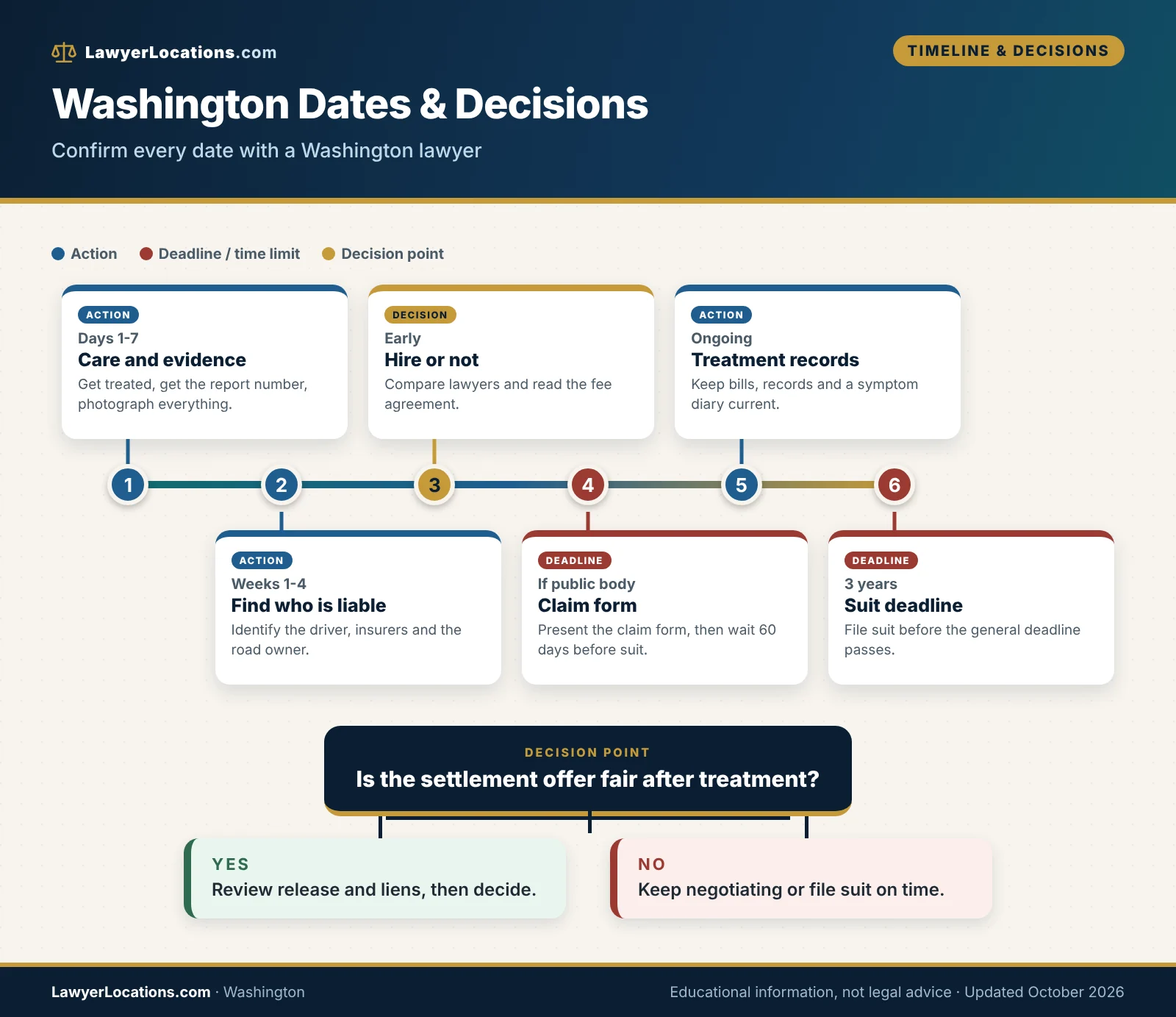
Text version of this graphic
- Days 1-7, care and evidence (action). Get treated, get the report number and photograph everything.
- Weeks 1-4, find who is liable (action). Identify the driver, the insurers and the road owner.
- Early, hire or not (decision). Compare lawyers and read the fee agreement.
- If a public body is involved, claim form (deadline). Present the claim form, then wait 60 calendar days before suing.
- Ongoing, treatment records (action). Keep bills, records and a symptom diary current.
- 3 years, general suit deadline (deadline). File suit before the general Washington deadline passes.
Decision point: Is the settlement offer fair after treatment? If yes, review the release and liens, then decide. If no, keep negotiating or file suit on time.
Deadlines and decision points to put on a calendar
The right plan is to calendar every date the day you hire a lawyer and revisit it at least quarterly. A few decision points come up in almost every claim.
The three-year suit date and the public-claim steps
Calendar the three-year date from the crash under RCW 4.16.080(2) and treat it as the outer limit, not a target. If a local government or the state may be involved, calendar the date you present the claim form and the 60th calendar day after it. Suit cannot be filed during the waiting period, so build those 60 days into your schedule rather than discovering them near the end.
Insurance policy deadlines
Your own policy may require prompt notice of the crash, written proof of loss, or cooperation with the insurer. Those conditions are separate from the court deadline. Missing them can complicate a claim even when the lawsuit deadline is far away. Ask your lawyer to list every notice requirement in the policies that might apply.
When to accept an offer
There is rarely one obviously right moment to settle. Questions that help: Has treatment finished or reached a stable point? Do I understand the future care I may need? Does the offer account for lost income and for liens that must be repaid? What are the risks of trial? Your lawyer should explain the options, but the decision to accept is yours. Take time to ask questions, and never feel rushed by an offer that “expires today” without a stated reason.
If you want a deeper look at what reduces or increases the value of a claim in a related vehicle context, our overview of motorcycle accident settlements discusses factors that also affect road-user injury claims, and our guide on whether you need a lawyer after a crash helps frame the decision to hire.
Special Situations: Children, E-Bikes, Doorings, Work Vehicles and Fatal Crashes
Some bicycle crashes raise issues that an ordinary driver-versus-rider dispute does not. A child’s claim follows different timing rules, an electric bike raises questions about equipment and classification, a car door opened into a bike lane involves a different kind of fault, and a crash with a delivery vehicle can add a second defendant. A fatal crash brings a separate set of claims for family members.
| Situation | Issue it raises | A sensible first step |
|---|---|---|
| Injured child | Timing rules can differ for minors; a parent’s claim for medical costs may follow another timeline | Ask a lawyer about both the child’s claim and the parent’s claim early |
| Electric-assisted bicycle | Washington’s vulnerable-user definition lists electric-assisted bicycles; equipment and speed may be argued | Keep the bike, battery and controller unaltered and unrepaired |
| Car door opened into the rider | Fault may rest on the person who opened the door; insurance may be the parked vehicle’s policy | Photograph the door, the lane and the parked vehicle; get names |
| Delivery, rideshare or company vehicle | An employer or business may share responsibility, and additional insurance may apply | Note logos, plates and app screens; ask a lawyer to send a preservation letter |
| Road or trail defect | Claim-form rules and a 60-day wait apply to public agencies | Photograph the hazard and identify the owner before it is repaired |
| Fatal crash | Family members have separate claims through a personal representative | Speak with a lawyer about who may bring a claim and when |
Children, e-bikes and group rides
Riders are not all alike. A seven-year-old on a neighborhood street, an adult commuting on a Class 3 e-bike and a club ride on a rural highway can each raise different legal questions.
Injured children and teenagers
When a child is hurt, the legal system looks at fault differently and handles timing differently. Under RCW 4.16.190, time during which a person was under eighteen does not count toward the limitations period for the actions the statute covers. That does not mean a family should wait: evidence fades, memories blur, and a parent’s separate claim for the child’s medical bills can be subject to a different clock. Ask a lawyer how both claims are handled.
Settlements for a child often require court approval to protect the child’s interests, so you should expect additional steps before money is paid. A lawyer can explain how that process works in the county where the case is filed.
Electric-assisted bicycles
Washington’s definition of a “vulnerable user of a public way” in RCW 46.61.5259 expressly lists a person operating or riding a bicycle or an electric-assisted bicycle, so the special driver offenses described earlier apply to both. In a civil claim, expect the other side to ask about the bike’s speed, the model, whether the motor was engaged and whether the equipment was altered. Keep the bike, battery and controller exactly as they were after the crash. Do not have a shop “check” or reset the system, because that can erase stored data.
Group rides, events and shared-use trails
If a crash happened on an organized ride or at an event, ask whether you signed a release or waiver. The existence of a waiver does not automatically end a claim against a driver who was not part of the event, but it may affect a claim against the organizer. On shared-use trails, a collision with another rider or a pedestrian raises its own fault questions, and the trail’s owner (a city, county, state agency or private landowner) determines whether a public claim form is needed.
Doorings, right hooks and work vehicles
Certain crash patterns recur in bicycle cases, and each has its own evidence needs.
Dooring and parked-car collisions
A “dooring” happens when someone opens a vehicle door into the path of a rider. Fault generally turns on whether the person opening the door looked and used reasonable care, and on whether the rider was riding at a safe distance from parked cars. Get the name and contact information of the person who opened the door, photograph the door, the lane and the parked vehicle, and ask whether a bike lane or a buffer was present. Because the parked vehicle is usually insured, the claim is often handled through that vehicle’s policy or the person’s own coverage.
Right hooks, left crosses and intersection crashes
Intersection collisions, such as a driver turning right across a bike lane or turning left across a rider’s path, are among the most common serious bicycle crashes. Because a rider on the road has the rights and duties of a driver under RCW 46.61.755, ordinary right-of-way and turning rules apply. Video, vehicle damage patterns and signal timing often matter more than anything else, so ask early about cameras and traffic-signal data.
Delivery, rideshare and commercial vehicles
If the driver was working, the employer or a business may share responsibility, and a commercial policy may have higher limits. Note any logos, company names, trailer numbers or app screens. A lawyer can send a written preservation letter asking the business to keep driver logs, GPS data, dash-camera video and other records that could otherwise be deleted in the routine course of business.
If an employer or insurer contacts you quickly and offers to “take care of everything”, slow down. A business that may be responsible has its own interests. Collect the facts, and ask a lawyer before you sign anything.
When a bicycle crash is fatal
Losing a family member in a crash is devastating, and the legal questions that follow can feel impossible to think about. They are separate from the funeral, the insurance claims and the criminal case, and they have their own timing.
Who can bring a wrongful death claim
Under RCW 4.20.010, when a death is caused by the wrongful act, neglect or default of another person, the deceased person’s personal representative may bring an action against the person who caused it. The recovery is for the beneficiaries identified in RCW 4.20.020, and the statute allows the trier of fact to award economic and noneconomic damages the beneficiaries sustained because of the death, in an amount that is “just under all the circumstances of the case.” A personal representative is typically appointed through the probate court, so the first practical step is often figuring out who will serve.
How this fits with the criminal and traffic cases
If a driver is charged under RCW 46.61.5259 (negligent driving with a vulnerable user victim, first degree), the prosecution is brought by the government and is separate from a civil claim by the family. Families can talk to the prosecutor’s office about their role in the criminal case and to a lawyer about the civil case. Deadlines apply to the civil case, so it is wise to speak to a lawyer soon, even while you are grieving. Our guide to the cost of a wrongful death lawyer explains how fees usually work in these cases.
Mistakes, Red Flags, Next Steps and Common Questions
The most costly mistakes in a Washington bicycle claim are quiet ones: skipping medical follow-up, talking too freely to an insurer, throwing away the bike, or letting a claim-form or filing date pass. If you do only a few things, get care, preserve evidence, calendar the dates, and compare at least two lawyers on the same questions before you sign anything.
Mistakes that hurt bicycle claims
These patterns come up again and again. Most are easy to avoid once you know about them.
Mistakes in the first days
- Telling the officer or the other driver “I’m fine” when you have not been examined.
- Leaving the scene without a report number or without the other driver’s name and insurance details.
- Repairing or replacing the bike, helmet or lights before they have been photographed and documented.
- Posting about the crash, your recovery or your activities on social media.
- Waiting weeks to see a doctor, then trying to explain the gap.
Mistakes with insurers, deadlines and lawyers
- Giving a recorded statement to the other side’s insurer without understanding the risks.
- Signing a release or accepting a quick payment before treatment is complete.
- Assuming the three-year deadline is the only one, when a public-agency claim form and a 60-day wait may also apply.
- Failing to notify your own insurer, which can affect underinsured motorist or personal injury protection coverage.
- Signing a fee agreement without reading it, or hiring the first person who calls you.
- Ignoring letters from health plans or medical providers about payment and reimbursement.
Be wary of any lawyer, runner or “case manager” who contacts you unprompted after a crash, offers cash or gifts, or insists you sign today. A reputable lawyer will give you time to read the agreement and compare options.
Your next steps
You do not have to do everything at once. A short, ordered list is easier to follow than a long one.
A simple first-week plan
- Get care. See a doctor or urgent care, follow instructions, and keep records and receipts.
- Secure the record. Get the collision report number, photos, witness names and any video leads.
- Protect the evidence. Keep the bike, helmet and gear as they are; save app and camera data.
- Notify your insurers. Report the crash to your own auto insurer and share only basic facts with the other side.
- Calendar the dates. Write down the three-year date and, if a public body may be involved, plan for a claim form and the 60-day wait.
- Compare lawyers. Look each one up in the WSBA directory and ask the same questions.
- Read before you sign. Take the fee agreement home and review costs, percentages and liens.
If money is tight
If paying for a lawyer is a worry, remember that injury lawyers commonly work for a contingent fee, which means the fee comes out of a recovery and does not require a payment from you at the start. For other civil legal problems that come up after a crash, such as housing or benefits, look at CLEAR, Washington LawHelp and Self-Help Washington, which the WSBA and the courts list for the public.
Ready to compare your options?
Use the scorecard and the fee questions in this guide to interview at least two Washington-licensed lawyers about your bicycle crash. If you want background on the wider picture first, read our guide to personal injury lawyers in Washington, and keep this page handy when you talk with a lawyer about a bicycle accident lawyer in Washington who fits your situation.
Long-tail questions about Washington bicycle accident claims
The answers below are short on purpose. They give general information about Washington law as of October 2026 and are not advice about your case.
Deadlines, fault and the law
How long do I have to file a bicycle accident lawsuit in Washington?
For most injury claims against a private driver, the general limit is three years under RCW 4.16.080(2). Claims against a city, county or the state involve a claim form and a 60-day waiting period first, and special rules can change the timing, so ask a lawyer about your facts as early as you can.
Can I still recover if I was partly at fault for a bike crash in Washington?
Yes. Under RCW 4.22.005, fault chargeable to the injured person reduces the award proportionately but does not bar recovery. Your share of the blame lowers the amount instead of eliminating it.
Do cyclists have the same rights as drivers in Washington?
On a roadway, a person riding a bicycle has the rights and duties of a vehicle driver, except for the special bicycle regulations and rules that by their nature cannot apply (RCW 46.61.755). On a sidewalk or crosswalk, a rider has the rights and duties of a pedestrian.
How close can a car pass a bicycle in Washington?
On a road with one lane in the driver’s direction, if there is enough room the driver must slow to a safe passing speed and pass at a safe distance, where practicable at least three feet. If there is not enough room, the driver must move completely into the oncoming lane when safe (RCW 46.61.110(2)). On multi-lane roads the driver must move completely into a lane left of the right lane.
What is Washington’s vulnerable user law?
It makes negligent driving that causes serious harm (second degree, RCW 46.61.526) or death (first degree, RCW 46.61.5259) to a vulnerable user a separate traffic offense. Bicyclists, riders of electric-assisted bicycles and pedestrians are among the people listed. It is separate from your civil injury claim.
Does a traffic ticket or criminal charge against the driver affect my injury claim?
They are separate processes. A citation or charge may produce evidence and statements that matter, but the outcome of a traffic or criminal case does not decide your civil claim, and a decision not to charge does not end it.
Are electric-assisted bicycles covered by the vulnerable user law?
Yes. RCW 46.61.5259 lists a person operating or riding an electric-assisted bicycle as a vulnerable user of a public way. Equipment and speed questions may still come up in a civil claim.
Money, insurance and public agencies
How much does a bicycle accident lawyer cost in Washington?
Many injury lawyers charge a contingent fee, a percentage of any recovery set out in a written agreement. Under RPC 1.5(c), the agreement must be in a writing signed by the client and state how the fee is calculated and whether expenses are deducted before or after the fee. Percentages vary, so compare agreements.
What happens if the driver who hit me was uninsured or fled?
Your own underinsured motorist coverage may respond. Under RCW 48.22.030, coverage protects insured persons who are legally entitled to recover from owners or operators of underinsured, hit-and-run or phantom vehicles, unless it was rejected in writing. Whether it applies to you as a cyclist depends on your policy, so report the crash to your insurer promptly.
What are Washington’s minimum liability insurance limits for drivers?
RCW 46.29.090 sets minimum limits of $25,000 for bodily injury or death to one person, $50,000 for two or more persons, and $10,000 for property damage in one accident. A serious injury can exceed these figures.
What is PIP and does it cover bicyclists?
Personal injury protection is optional no-fault coverage that insurers must offer on Washington auto liability policies (RCW 48.22.085), and a named insured may reject it in writing. Whether a policy covers you when you are on a bike depends on its wording, so ask your insurer and your lawyer.
Can I sue the city or county for a pothole or hazard that caused my bike crash?
Possibly, but a claim must first be presented on the standard tort claim form to the entity’s designated agent, and suit cannot be filed until 60 calendar days later (RCW 4.96.020). State claims go to the Office of Risk Management (RCW 4.92.100 and 4.92.110). Identify the road owner and photograph the hazard early.
Can I use small claims court for a bicycle crash in Washington?
Small claims are heard in the small claims department of district court, with a limit of $10,000 for a case brought by an individual (RCW 12.40.010). It may fit a modest bike-damage dispute but not a serious injury claim.
Hiring a lawyer and special situations
Do I need a lawyer for a bicycle accident with minor injuries?
Not always. If injuries are minor, fault is clear and the insurer accepts responsibility in writing, some people handle the claim alone. If treatment continues, fault is disputed or a public agency may be involved, an opinion from a licensed lawyer is worth getting before you accept a payment.
How do I find a bicycle accident lawyer near me in Washington?
Use county bar lawyer referral services (the WSBA lists King, Snohomish, Pierce and Clark County services), personal recommendations and online directories, then verify each lawyer in the WSBA Legal Directory. Ask every candidate the same questions about fees, experience and staffing.
How can I confirm a lawyer is licensed in Washington?
Look the lawyer up in the WSBA Legal Directory before you sign anything, and ask directly whether the lawyer is licensed in Washington. Do not rely on advertising or award badges.
What happens if a child is hurt in a bike crash?
Under RCW 4.16.190, time during which a person was under eighteen is not counted toward the limit for covered actions, but a parent’s own claim for medical costs may follow a different timeline, and settlements for children often involve extra steps. Talk to a lawyer early about both.
Who can bring a wrongful death claim after a fatal bicycle crash?
Under RCW 4.20.010, the deceased person’s personal representative may bring the action against the person who caused the death, for the beneficiaries listed in RCW 4.20.020. A lawyer can explain how a personal representative is appointed and what damages may be sought.
Should I talk to the other driver’s insurance adjuster?
You can share basic facts, but be cautious about recorded statements, broad medical authorizations and early settlement offers that come with a release. Consider getting advice before agreeing to any of them.
What should I do with my bike and helmet after a crash?
Keep them as they are, photograph them from several angles, and do not repair, replace or discard them until a lawyer or an insurer’s inspector has documented them. For an e-bike, do not reset or alter the battery or controller.
How long does a bicycle accident claim take in Washington?
It depends on how long treatment lasts, whether fault is disputed and whether a lawsuit is needed. Claims often wait until medical treatment stabilizes before a demand is made, and a lawsuit adds months or more. See our guide to the settlement timeline for the stages.
General information only. This guide is legal information, not legal advice, and reading it does not create an attorney-client relationship. LawyerLocations.com is not a law firm and does not refer or recommend lawyers. Laws, deadlines, forms and court rules change and depend on your facts, so consult a lawyer licensed in Washington about your situation, and check the current statutes and court pages before you rely on any date or figure.
Sources & References
Show all 17 sources
- RCW 4.16.080 — Actions limited to three years — Washington State Legislature — app.leg.wa.gov — accessed October 2026
- RCW 4.16.190 — Statute tolled by personal disability — Washington State Legislature — app.leg.wa.gov — accessed October 2026
- RCW 4.22.005 — Effect of contributory fault — Washington State Legislature — app.leg.wa.gov — accessed October 2026
- RCW 46.61.755 — Traffic laws apply to persons riding bicycles — Washington State Legislature — app.leg.wa.gov — accessed October 2026
- RCW 46.61.110 — Overtaking and passing — Washington State Legislature — app.leg.wa.gov — accessed October 2026
- RCW 46.61.526 — Negligent driving with a vulnerable user victim, second degree — Washington State Legislature — app.leg.wa.gov — accessed October 2026
- RCW 46.61.5259 — Negligent driving with a vulnerable user victim, first degree — Washington State Legislature — app.leg.wa.gov — accessed October 2026
- RCW 4.96.020 — Tortious conduct of local governmental entities, claims — Washington State Legislature — app.leg.wa.gov — accessed October 2026
- RCW 4.92.110 — Tortious conduct of state, 60-day waiting period — Washington State Legislature — app.leg.wa.gov — accessed October 2026
- RCW 48.22.030 — Underinsured coverage — Washington State Legislature — app.leg.wa.gov — accessed October 2026
- RCW 48.22.085 — Personal injury protection coverage — Washington State Legislature — app.leg.wa.gov — accessed October 2026
- RCW 46.29.090 — Minimum limits of liability insurance — Washington State Legislature — app.leg.wa.gov — accessed October 2026
- RCW 12.40.010 — Small claims department of district court — Washington State Legislature — app.leg.wa.gov — accessed October 2026
- RCW 4.20.010 — Wrongful death, right of action — Washington State Legislature — app.leg.wa.gov — accessed October 2026
- RPC 1.5 — Fees (Washington Rules of Professional Conduct) — Washington Courts — courts.wa.gov — accessed October 2026
- Washington Courts — Appellate and trial courts — Washington Courts — courts.wa.gov — accessed October 2026
- Find Legal Help — Washington State Bar Association — wsba.org — accessed October 2026
Legal Disclaimer and Limitation of Liability
Informational and illustrative purposes only. This article was prepared by LawyerLocations.com solely on the basis of the information available to us at the time of writing. It is an illustrative, general overview. It is not a complete or authoritative statement of the law, and it has not been reviewed by a lawyer licensed in your state or county.
Not legal advice. Nothing in this article is legal, financial, tax or immigration advice, and reading it does not create an attorney-client relationship between you and LawyerLocations.com or any author, lawyer or firm mentioned. Laws, court rules, fees, filing deadlines and agency procedures differ by state, county and court, and they change often. Some details here may be simplified, incomplete or out of date, and time limits for legal claims can be short.
No warranty. We make no representation or warranty, express or implied, about the accuracy, completeness, timeliness or suitability of this content for your situation. Please do not rely on it to make, delay or skip any legal decision. Check the facts against official sources and speak with a licensed attorney in the relevant jurisdiction before you act.
Limitation of liability. To the fullest extent permitted by law, LawyerLocations.com and its owners, authors and contributors disclaim all liability for any loss, damage, cost or other consequence arising from the use of, or reliance on, this article, including any content on third-party websites we link to. Mentioning a lawyer, firm, organization or service is not an endorsement and is not a promise of any result. If you are in immediate danger, contact your local emergency number.