If you are looking for a sexual harassment lawyer Michigan employees can trust to explain their options, start with the state’s main anti-discrimination law, the Elliott-Larsen Civil Rights Act (ELCRA). It covers employers of every size, lets you sue in a Michigan circuit court without first going to an agency, and generally gives you three years to file a lawsuit. Agency deadlines are much shorter, so do not wait on paperwork while the shorter clocks run.
This guide explains how a Michigan case moves from first call to resolution, which courts and agencies are involved, how lawyers usually charge, what to bring to a consultation, and how to compare lawyers without relying on advertising. It is general information, not legal advice.
How a Sexual Harassment Lawyer Case Works in Michigan
A Michigan sexual harassment case is usually built on state law first, with federal law as a second route. The lawyer’s job is to match your facts to the legal definitions, choose the right forum, protect your deadlines and press the employer toward a resolution. Most cases settle before trial, but the lawyer prepares as though a jury might hear it.
The Michigan law behind most claims
Sexual harassment is a form of sex discrimination, and Michigan treats it that way. The statute that matters most is the Elliott-Larsen Civil Rights Act, enacted in 1976 and codified at MCL 37.2101 et seq. The employment provisions are in MCL 37.2202, and the definition of sex discrimination, which includes sexual harassment, appears in MCL 37.2103.
What the statute counts as sexual harassment
ELCRA describes sexual harassment as unwelcome sexual advances, requests for sexual favors, and other verbal or physical conduct or communication of a sexual nature. It becomes unlawful in three situations: when submitting to it is made a term or condition of employment, when your response to it is used as the basis for an employment decision, or when it substantially interferes with your work or creates an intimidating, hostile or offensive work environment. Read the current wording on the Michigan Legislature’s website or ask a lawyer to walk you through it, because the exact language drives how a case is framed.
Which employers and workers are covered
Under ELCRA an “employer” is a person with one or more employees, so a small family business can be covered even though federal Title VII generally applies only to employers with 15 or more employees. That gap matters for people who work in small offices, restaurants, salons or shops. Whether someone counts as an employee, an independent contractor or a volunteer can be a real legal question, and a lawyer will ask about it early.
The 2024 expansion of protected characteristics
Public Act 6 of 2023 amended ELCRA to add sexual orientation and gender identity or expression to the list of protected characteristics, effective in February 2024. That change matters for harassment based on who a person is or how they present, even when the conduct is not sexual in the traditional sense. If your situation involves this kind of conduct, ask any lawyer you interview how they have handled cases under the amended statute.
The two classic patterns: quid pro quo and hostile work environment
Lawyers sort harassment into two broad patterns, and many real cases involve both. Knowing the difference helps you describe your situation clearly in the first call.
Quid pro quo harassment
“Quid pro quo” is Latin for “this for that.” It happens when a supervisor or someone with power over your job ties a benefit or a threat to sexual conduct, such as hinting that a promotion, schedule or continued employment depends on your response. A single incident can be enough because the link to a job decision is what makes it unlawful.
Hostile work environment harassment
A hostile work environment claim looks at the overall atmosphere, such as repeated comments, touching, messages, images or jokes that make it hard to do your job. Courts generally look at how often it happened, how severe it was, whether it was threatening or humiliating, and whether it interfered with your work. Employer liability often turns on whether the company knew, or should have known, and failed to take prompt, appropriate action.
hostile work environment means harassment that is serious or frequent enough to change the conditions of your job, judged from the viewpoint of a reasonable person in your position. It does not require that you lost your job or income.
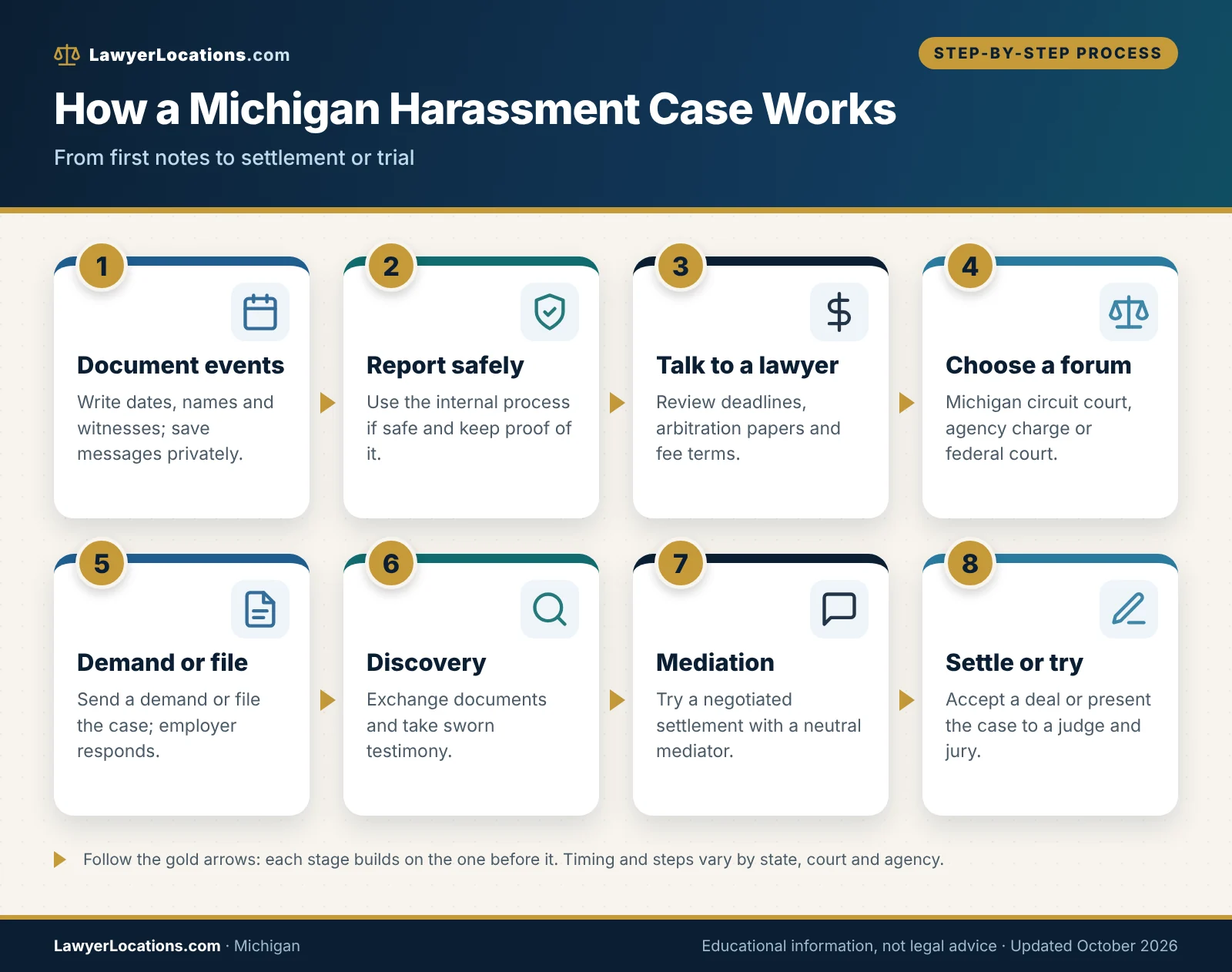
Text version of this graphic
- Document what happened and keep your records safe.
- Report internally if it is safe to do so, and keep proof of the report.
- Talk to a Michigan sexual harassment lawyer about deadlines and options.
- Choose the forum: Michigan circuit court, an agency charge, or federal court.
- Send a demand or file the case; the employer investigates and responds.
- Exchange evidence, take depositions and explore mediation.
- Settle, or go to a judge and jury.
What a lawyer actually does, stage by stage
It helps to picture the case as a series of stages. Each stage has a different purpose, and the lawyer’s workload and your involvement change from one to the next.
Intake and case evaluation
The first conversation is mostly questions. The lawyer asks who did what, when, who saw it, whether you reported it, what happened afterward, and whether you signed anything such as an arbitration agreement or a severance release. They then explain which laws may apply, which deadlines are closest and whether they are willing to take the matter.
Investigation, demand and negotiation
If a lawyer takes the case, the next step is usually gathering documents and sending the employer a demand or notice. Some matters resolve here through a negotiated separation, a policy change or a payment. Others move forward because the employer denies the claims or offers too little.
Filing, discovery and trial preparation
When a case is filed, both sides exchange documents and testimony through discovery, which includes written questions, requests for documents and depositions (sworn out-of-court interviews). Judges often push parties toward mediation, a confidential session with a neutral mediator. If no deal emerges, the case can go to a motion for summary judgment, where the employer asks the judge to end the case without a trial, and then to a jury.
Choosing a path: Michigan court, an agency, or federal court
Michigan gives you more than one doorway. The best choice depends on the facts, the employer’s size, how long ago things happened and what you want out of the process.
Going straight to a Michigan circuit court
ELCRA allows a person to bring a civil action for damages and injunctive relief under MCL 37.2801, and you are not required to file with an agency first. This direct route lets your lawyer control timing and strategy, and it is the path many Michigan employment lawyers consider first. The court can award attorney fees and costs under MCL 37.2802 if it finds the award appropriate.
Filing with the Michigan Department of Civil Rights
The Michigan Department of Civil Rights (MDCR) accepts discrimination complaints, investigates them and may attempt to resolve them. MDCR complaints are subject to a 180-day filing window, so the agency route is not a way to buy more time. Agency processes can be slow, and a lawyer will weigh that against the benefit of a free investigation.
The EEOC and federal court
The U.S. Equal Employment Opportunity Commission (EEOC) enforces Title VII of the Civil Rights Act, the federal law against sex discrimination at work. To sue under Title VII you must first file a charge with the EEOC and receive a notice of right to sue. Federal claims can be brought alongside Michigan claims in a federal court, and Title VII has its own damages limits tied to employer size.
Ask your lawyer to explain in writing which forum they recommend and why. A clear answer, with the trade-offs, is a sign they have thought about your facts rather than reciting a standard pitch. See our national overview of a sexual harassment lawyer for how this compares with other states.
Michigan Deadlines, Courts and Agencies
Michigan has several overlapping time limits, and the shortest one controls what you can safely do first. The agency deadlines are measured in days; the state lawsuit deadline is measured in years. A lawyer will calendar all of them from your first call.
The deadlines that apply to Michigan workers
No single clock covers every case. The table below summarizes the main windows people ask about. Each deadline depends on the forum, on whether you work for the government, and on the date of the last act you are complaining about.
| Route | Usual time limit | Governing source | Notes |
|---|---|---|---|
| Lawsuit under ELCRA in Michigan court | Generally 3 years | MCL 600.5805 (general limitations statute) | No agency filing required first. Measured from the act complained of; ask about continuing conduct. |
| Complaint with MDCR | 180 days | Michigan Department of Civil Rights procedures | Short window; check the agency’s current instructions. |
| EEOC charge (Title VII) | Usually 300 days in Michigan | EEOC time limits; Michigan has a state agency that enforces its own law | Would be 180 days in a state without such an agency. Confirm with the Detroit Field Office. |
| Federal employee EEO complaint | Contact an EEO counselor within 45 days | 29 C.F.R. 1614.105 | Applies to federal government employees, not private workers. |
| Suit after an EEOC right-to-sue notice | 90 days after the notice is received | Title VII procedures | The notice letter states the date; do not let it sit. |
The three-year state court period
Michigan’s general statute of limitations, MCL 600.5805, gives three years for most injury claims, and Michigan appellate courts have applied that period to ELCRA discrimination claims. The clock typically runs from the date of the wrongful act. A lawyer will ask whether older incidents can be included as part of one continuing pattern, but you should not count on that argument.
The agency windows
MDCR’s 180 days and the EEOC’s 300 days (in Michigan) are the periods most likely to be missed. If you filed an internal complaint and were waiting for the company to respond, the clock may have kept running the whole time. Contact a lawyer or the agency soon after the last incident, not after the internal process ends.
How agency filings and lawsuits fit together
An agency filing and a lawsuit can interact in ways that surprise people, such as whether one pauses the other or whether a charge preserves federal claims. Do not assume that filing with MDCR or the EEOC stops the three-year state clock. Ask the lawyer to explain how each filing affects the others in your situation.
If the last incident was more than 180 days ago, an MDCR complaint may be out of time, but an ELCRA lawsuit and an EEOC charge may still be available. If it was more than 300 days ago, speak with a lawyer promptly about the state court option. Never conclude on your own that you are too late.
Where cases are heard
Which court hears your case depends on the law you rely on, the parties and strategy. Michigan has a layered court system, and federal courts sit in the same cities.
Michigan circuit courts
Circuit courts are Michigan’s trial courts of general jurisdiction, and they handle ELCRA lawsuits. Large counties such as Wayne (the Third Judicial Circuit, in Detroit), Oakland, Macomb and Kent have busy civil dockets, while smaller counties have fewer judges and may move differently. Venue, which means which county’s court, is usually tied to where the employer does business or where the events happened.
Federal courts in Michigan
Michigan has two federal districts. The Eastern District sits in Detroit, Ann Arbor, Flint and Bay City, and the Western District sits in Grand Rapids, Lansing, Kalamazoo and Marquette. Federal court is used for Title VII claims and sometimes for cases that include both federal and state claims.
Appeals and special forums
Appeals from circuit court go to the Michigan Court of Appeals and, in limited cases, the Michigan Supreme Court. Federal appeals go to the Sixth Circuit Court of Appeals. Claims against some state agencies can raise additional procedural rules, so a government employee should raise that early with a lawyer.
Agencies you may deal with
Agencies can help in some situations, but they do not represent you the way a lawyer does. Understanding their role helps you decide how much to rely on them.
MDCR
The Michigan Department of Civil Rights enforces Michigan’s civil rights laws, including ELCRA, and provides intake and investigation. Its public pages explain jurisdiction, how to file and what to expect. Check the official site for current filing instructions, because procedures and forms are updated.
EEOC Detroit Field Office
The EEOC’s Detroit Field Office serves Michigan, and the agency’s public timeliness page explains the 180-day and 300-day rules. You can start an inquiry online, but a submission is not always the same as a formal charge, so ask what was actually filed and when. A lawyer can often confirm the filing date for you.
Employer human resources and internal channels
Many employers have an internal complaint process, and using it can matter later because it shows the company knew. It does not stop the legal deadlines. Keep a copy of what you submitted and any reply, and treat internal reporting as one step among several.
Retaliation is separately unlawful. ELCRA prohibits punishing someone for opposing a violation or taking part in a complaint (MCL 37.2701), and retaliation claims can be stronger than the underlying harassment claim. If you were demoted, written up or fired after you complained, mention that first.
How to Find and Compare Sexual Harassment Lawyers in Michigan
The right Michigan lawyer is one whose experience matches your type of case, who communicates clearly, and whose fee terms you understand before you sign. LawyerLocations.com is a legal-education and discovery resource, not a law firm, and it does not rank or recommend individual attorneys. This section shows you how to build a shortlist and judge it.
Where to look for a Michigan lawyer
No single source is perfect, so most people use two or three and compare. Whatever route you choose, confirm each lawyer’s license status yourself rather than relying on a website.
State Bar of Michigan and referral services
The State Bar of Michigan runs a Lawyer Referral Service that connects the public with participating lawyers, and its public pages explain how the program works. Referral services can be a practical starting point if you do not know anyone, but a referral is a match, not an endorsement. Ask what the service charges, if anything, and what the first meeting costs.
Legal aid, self-help and community organizations
If your income is limited, Michigan Legal Help is the statewide self-help website that points people to legal aid programs, forms and plain-language guides. Regional legal aid offices may handle some employment matters or can refer you elsewhere. Worker advocacy groups, unions and some employee assistance programs may also point you to lawyers who handle workplace cases.
Personal referrals and online research
A friend, a lawyer you already know in another field, or a union representative can offer useful leads. Online directories and search results show who markets heavily, which is not the same as who is a good fit. Look for plain descriptions of the lawyer’s employment practice, how long they have practiced and which kinds of cases they handle, and treat reviews as one data point.
Be careful with anyone who promises a result, claims to know what a jury will award before reviewing your facts, or pressures you to sign at the first meeting. No lawyer can honestly promise an outcome, and the rules of professional conduct restrict misleading advertising.
What to look for in a lawyer’s background
Experience matters most when it is close to your situation. A lawyer who regularly represents employees in discrimination cases will know how Michigan judges and juries respond and what employers typically argue.
Employment-side experience and the type of cases handled
Ask what share of the lawyer’s practice is employment law, whether they represent employees or employers, and how many sexual harassment matters they have handled recently. A general practice firm can be a fine choice for a straightforward matter, but a complex hostile-environment case with several witnesses may call for a team that litigates these claims regularly. Ask for general descriptions of how past matters resolved without asking them to reveal client confidences.
Courts, counties and trial readiness
Ask whether the lawyer has appeared in the circuit court or federal court where your case would be filed. Employers take a case more seriously when they believe the lawyer will try it, so ask how often the lawyer has gone to trial and how they prepare for it. Local knowledge, such as the judges in Wayne County versus a smaller northern county, can influence strategy.
Licensing and discipline
Every lawyer who practices in Michigan must be licensed by the State Bar. The State Bar’s online member directory shows license status, and the Attorney Discipline Board publishes public discipline records. A quick check takes minutes and is worth doing before you share sensitive information.
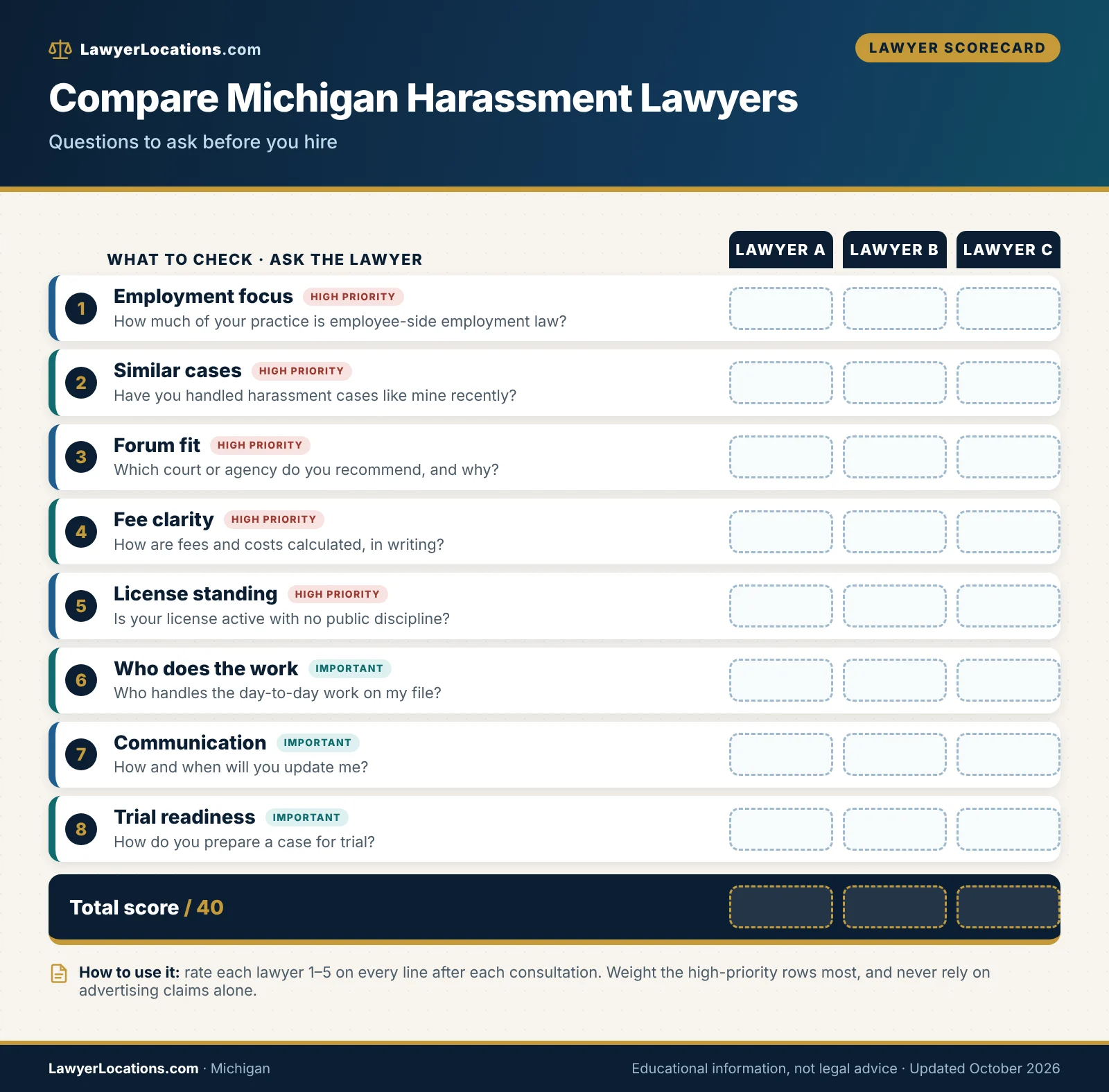
Text version of this graphic
| Criterion | Question to ask | Weight |
|---|---|---|
| Employment focus | How much of your practice is employee-side employment law? | High |
| Similar cases | Have you handled harassment cases like mine recently? | High |
| Forum fit | Which court or agency do you recommend, and why? | High |
| Fee clarity | How are fees and costs calculated, in writing? | High |
| Who works on it | Who will do the day-to-day work on my file? | Medium |
| Communication | How and when will you update me? | Medium |
| Trial readiness | How do you prepare a case for trial? | Medium |
| License standing | Is your license active with no public discipline? | High |
Questions that separate strong consultations from weak ones
The first meeting is a two-way interview. You are deciding whether to trust this person with something painful and personal, and they are deciding whether the case fits their practice.
Questions about the case
Ask what the lawyer sees as the strengths and weaknesses of your facts, what evidence they would want, and what the realistic paths are. A candid lawyer will name risks, such as a missing witness, an arbitration clause or a deadline problem. Be wary if everything sounds easy.
Questions about the process and the team
Ask who will handle your matter, how often you will hear from them and how they prefer to communicate. Also ask how decisions about settlement are made, which is your decision, not theirs. Sensible lawyers explain the next three steps and what they need from you.
Questions about fees and costs
Ask for the fee agreement to read at home before you sign. Ask how the lawyer is paid if the case settles early, goes to trial or loses, and who pays filing fees, expert fees and deposition costs. These answers are covered in more detail in the costs section below.
| Factor | Why it matters | What a good answer sounds like | Caution sign |
|---|---|---|---|
| Practice focus | Employment cases involve specialized procedure and evidence. | Regularly represents employees in discrimination and retaliation matters. | Employment is a small side of a broad practice, and no examples are offered. |
| Case fit | Facts such as one incident, a supervisor or arbitration change strategy. | Asks detailed questions and explains how the facts fit the law. | Decides within minutes and promises a result. |
| Fee structure | Determines what you owe and when. | Provides a written agreement and explains costs and expenses. | Vague terms, or no writing at all. |
| Communication | These cases can last a year or more. | States who you will talk to and how often. | Unreachable after you sign. |
| Forum knowledge | Michigan circuit, federal court and agencies each operate differently. | Names the forum and explains deadlines for each. | Ignores the agency deadlines. |
| Standing | Active license protects you. | Welcomes you to check the State Bar directory. | Unlicensed or reluctant to be checked. |
A server at a small Michigan restaurant with eight employees is repeatedly touched and propositioned by a shift manager. Federal Title VII would likely not reach an employer that small, but ELCRA applies to employers with one or more employees, so a Michigan lawyer would look at a state-law claim in circuit court. This is a hypothetical for illustration, not a prediction about any real case.
Evidence and Consultation Preparation for a Michigan Case
You do not need a perfect file to talk to a lawyer, but organized information helps the lawyer evaluate your case quickly and can lower the time (and cost) of the first meeting. Bring what you have and say plainly what you do not have.
Building your record
Strong cases are usually built on records made close to the time events happened. Start with the simplest tools and avoid anything that creates new risk for you.
A timeline in your own words
Write a chronological list of what happened, with dates, places, names, what was said or done and who saw it. Include what you did in response, such as telling a friend, reporting to a supervisor or changing your schedule. Keep it factual and mark what you remember with certainty versus what you are unsure about.
Messages, emails and other digital records
Save texts, emails, voicemails, chat messages and social media messages that show the conduct or your reports about it. Take screenshots that include the date and sender, and back them up outside your work accounts. Do not log into someone else’s account or access files you are not authorized to see, and ask a lawyer before taking company documents.
Performance, pay and personnel records
Reviews, raises, schedule changes, discipline and termination papers can show whether your treatment changed after you rejected an advance or complained. Michigan’s Employee Right to Know Act (MCL 423.501 et seq.) gives employees a right to review their personnel records, and a lawyer can help you request them. Keep copies of the handbook and any policies you signed.
Keep your records off employer devices and accounts when you can. Store copies somewhere private and write notes on your own time using your own devices.
Documents to check before you sign anything
Some papers you have already signed may shape your options. Bring them with you, even if you think they do not matter.
Arbitration agreements
Many employers include a mandatory arbitration clause in an application, handbook acknowledgment or onboarding packet. Arbitration is a private process before a neutral decision maker instead of a judge and jury. Since 2022, the federal Ending Forced Arbitration of Sexual Assault and Sexual Harassment Act (9 U.S.C. 401-402) lets a person with a sexual harassment dispute choose to go to court despite an earlier agreement to arbitrate, though how it applies to your facts is something a lawyer should evaluate.
Severance and release agreements
If you were offered severance in exchange for a release, do not sign until a lawyer has read it. A release can waive your right to sue, and some include confidentiality terms that limit what you can say. Pay attention to any deadline to accept, because employers sometimes set short windows.
Handbooks, policies and complaint procedures
The employer’s anti-harassment policy shows how a complaint should be reported and who receives it. If you followed the policy, your lawyer can compare what the policy promised with what actually happened. If the policy does not exist, that fact can also matter.
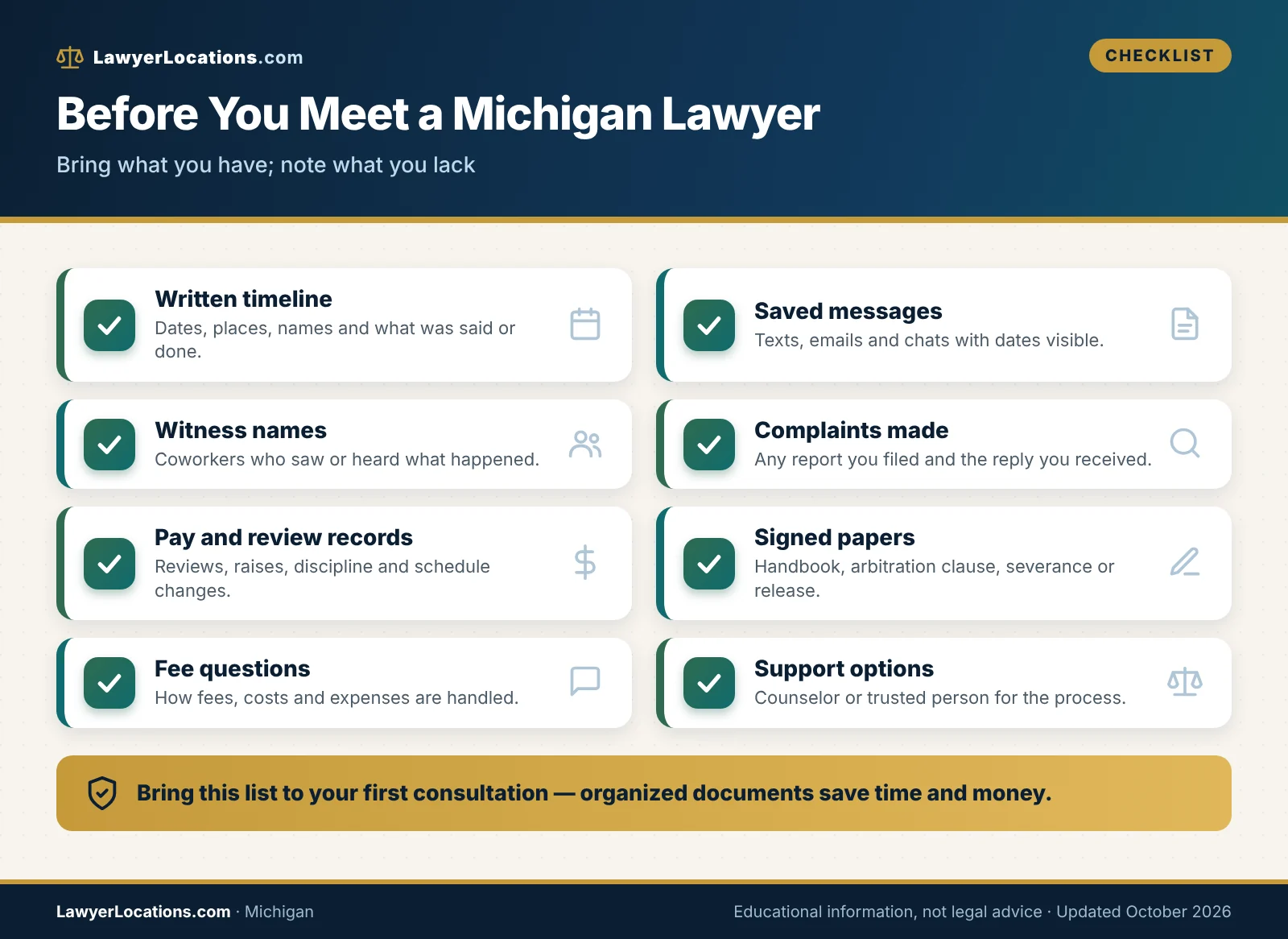
Text version of this graphic
- Written timeline of events with dates and names
- Texts, emails and messages, saved with dates
- Names of witnesses and coworkers who may know
- Any complaint you made and the reply
- Pay, review and discipline records
- Handbook, policies and anything you signed
- Medical or counseling records, if you choose to share them
- Questions for the lawyer, including fee questions
Getting the most from the first consultation
A consultation can be short, so planning helps. Many lawyers offer an initial meeting at low cost or no cost, and others charge for the time. Ask before you book, and see our guide on free consultations for how those meetings usually work and what to ask.
What to bring and what to say
Bring your timeline, key documents and a short list of questions, and be honest about weak points such as a late report or a text you wish you had not sent. Lawyers can only plan around problems they know about. What you tell a lawyer you are consulting is generally treated as confidential, but ask about confidentiality before sharing details.
Safety, privacy and emotional support
Harassment can be exhausting, and some people also experience anxiety, sleep problems or fear at work. Consider whether a counselor, a support organization or a trusted person can help you through the process. If the conduct involved assault, stalking or threats, tell the lawyer, because there may also be criminal or protection-order options; see our guide to a domestic violence lawyer for how those matters work in general.
What happens after the meeting
A lawyer may offer to take the case, decline it, or ask for more information. A decline is not a judgment that you were not harmed, and it may be about the lawyer’s caseload, the deadline, the employer’s size or the evidence. Ask whether they will confirm in writing that they are not representing you, and note any deadlines they mentioned.
Costs, Deadlines and Decision Points in Michigan
Most people worry about cost before anything else, and it is a fair concern. Many Michigan employment lawyers who represent employees work on a contingency basis, but terms vary, so the written agreement is what controls. We do not publish fee averages here because no verified, official Michigan source reports them.
How Michigan lawyers commonly structure fees
Fee structures fall into a few familiar patterns. Each shifts risk between you and the lawyer in a different way, which is why it pays to compare more than the headline number.
| Arrangement | How it works | Works well when | Questions to ask |
|---|---|---|---|
| Contingency fee | The lawyer is paid a percentage of what you recover, and nothing in fees if there is no recovery. | You cannot pay hourly and the claim has meaningful value. | What percentage, before or after costs? Does it change if the case is filed or tried? |
| Hourly fee with retainer | You deposit money up front and the lawyer bills time against it. | The matter is narrow, such as reviewing a severance offer. | What is the hourly rate? Who bills and at what rate? How often do I get statements? |
| Hybrid | A reduced hourly rate or flat fee plus a smaller contingency share. | The lawyer needs some protection but you want to share risk. | How is the fee split on a recovery? What happens if I stop the case? |
| Flat fee or limited scope | A set price for a defined task, such as a demand letter. | You want help with one stage only. | Exactly what is included? What if more work is needed? |
Contingency fees
Under a contingency agreement the lawyer advances the work and takes a percentage if there is a settlement or judgment. Michigan’s professional conduct rule on fees, MRPC 1.5(c), requires a contingent fee agreement to be in writing and to state how the fee is determined, including the percentage and how expenses are handled. A Michigan court rule that caps contingent fees at one-third is written for personal injury and wrongful death claims, so in an employment case the percentage is a matter of negotiation. Ask why the lawyer’s percentage is what it is.
Hourly billing and retainers
Hourly billing charges for the time spent, and a retainer is a deposit held against future bills. This model can make sense for advice, document review or negotiating an exit package. Ask for a budget range and request regular invoices so you can decide when to continue.
Hybrid and limited-scope arrangements
Some lawyers combine a smaller hourly or flat fee with a contingency percentage, or they agree to handle only one stage. Limited-scope work can be a sensible way to get professional help when money is tight. Make sure the agreement says exactly where the lawyer’s job ends.
What the fee agreement should say
A good fee agreement removes surprises. Read it slowly and ask about anything you do not understand before you sign.
Fees versus costs and expenses
Fees pay for the lawyer’s time. Costs are out-of-pocket expenses such as court filing fees, court reporter and deposition charges, mediator fees and fees for experts like a vocational or economic witness. Ask whether costs are deducted from the recovery before or after the percentage is calculated, because that choice changes your net amount, and whether you owe costs if there is no recovery.
Fee shifting under Michigan law
Under MCL 37.2802 a court may award costs of litigation, including reasonable attorney fees, to a successful complainant when it finds an award appropriate. That can help make these cases viable for some lawyers, but it does not decide how your agreement works. Ask how the lawyer treats a court-awarded fee compared with the contingency percentage.
Ending the relationship
You have the right to change lawyers, and the agreement should explain what you would owe if you do. Ask what happens to the file, how the lawyer would be paid for work already done, and how a settlement you reject might affect fees. Clear termination terms protect both sides.
Be careful with any agreement that is not in writing, that charges you for the first meeting without telling you, or that requires you to accept any offer the lawyer recommends. You decide whether to settle.
Asking a lawyer about your options does not commit you to filing anything. Many people use a consultation simply to learn which deadline is closest and whether the facts fit the law, and then decide at their own pace.
What a case can recover, and how decisions get made
ELCRA remedies can include compensation for lost income and benefits, damages for emotional harm, reinstatement or other court orders, and attorney fees and costs, depending on the facts and what a judge or jury decides. We do not predict amounts, because outcomes vary with the evidence, the employer and the court. Federal Title VII claims have separate damages limits set by statute that scale with employer size, whereas ELCRA does not use those tiered federal caps.
Settlement decisions
Most cases end in a negotiated agreement. A settlement may include a payment, a neutral reference, a policy change or a confidentiality clause, and each element is negotiable. Ask your lawyer to put every offer in writing and explain the net result after fees, costs and taxes.
Tax and benefit questions
Settlement payments can have tax consequences, and the way an agreement allocates money between wages and other damages can matter. Ask the lawyer whether you should speak with a tax professional before signing. Also ask about unemployment benefits, health coverage and any effect on a pending claim.
Weighing time, stress and risk
A lawsuit can take many months or longer, and it will involve questions about your work history and private life. Some people value a faster private resolution, while others want a public ruling or a policy change. A good lawyer helps you choose based on your goals, not only the numbers.
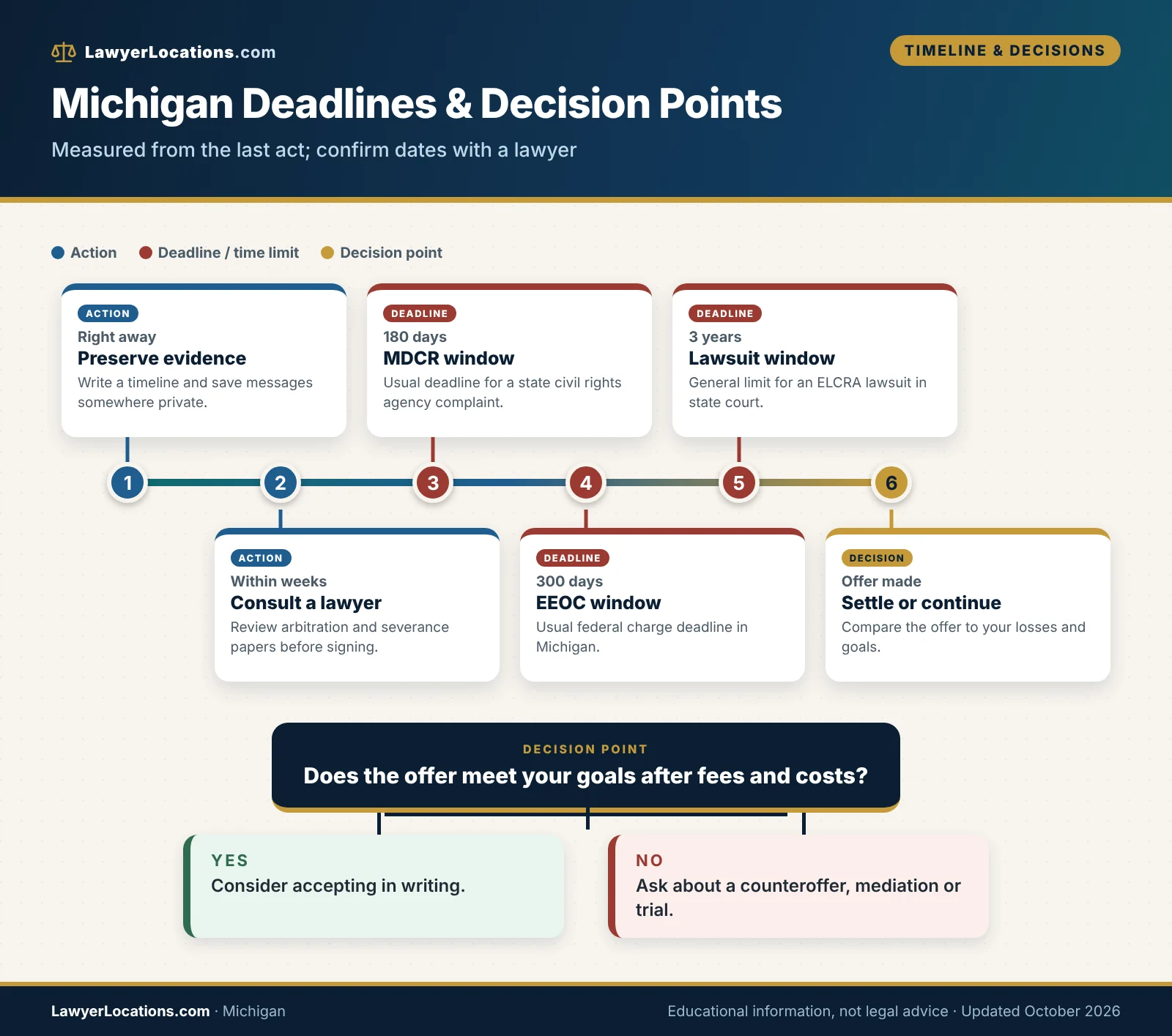
Text version of this graphic
- Right away: write down events, save evidence and avoid deleting anything (action).
- Within weeks: consult a lawyer and review any arbitration or release papers (action).
- 180 days from the last act: the usual MDCR complaint deadline (deadline).
- 300 days from the last act: the usual EEOC charge deadline in Michigan (deadline).
- Three years: the general Michigan lawsuit deadline for ELCRA claims (deadline).
- Offer received: decide whether to settle, counter or continue (decision).
Decision question: Does the offer cover your losses and goals after fees and costs? If yes, consider accepting in writing. If no, ask your lawyer about counteroffer, mediation or trial.
Mistakes to Avoid, Michigan Resources and Next Steps
The most common problems are avoidable. They usually come from waiting, from signing something without advice, or from a misunderstanding about how the deadlines work. This section also gathers the official Michigan resources and answers the questions people often ask before they hire a lawyer.
Common mistakes and how to avoid them
None of these mistakes ends a case by itself, but each can make it harder. Knowing them now lets you steer around them.
Waiting for the internal process to finish
Employers sometimes take weeks or months to investigate, and agency clocks keep running while they do. Make your internal report, but speak with a lawyer on a parallel track. If the shortest deadline passes while you wait, you may lose an option you did not need to lose.
Signing papers you have not had reviewed
Severance agreements, performance improvement plans and “acknowledgments” can include releases or arbitration terms. Ask for time to review, and have a lawyer read anything that touches your legal rights. A reasonable employer will usually allow a short review period.
Retaliating back or deleting evidence
It is understandable to be angry, but confronting the harasser in a way that violates policy, posting online or deleting messages can be used against you. Keep your records intact and let your lawyer advise on communications. If you are being retaliated against, write down each event as it happens.
- Missing an agency deadline because you assumed the three-year period covered everything.
- Giving a recorded statement to the employer’s insurer or investigator without advice.
- Posting about the situation publicly before talking to a lawyer.
- Hiring the first lawyer who calls you, or one who promises a result.
- Assuming a small employer cannot be held responsible.
Official Michigan resources
These organizations publish free information, and some offer direct help. Use their official websites, because contact details and procedures change.
Government agencies
The Michigan Department of Civil Rights provides complaint information and filing instructions for state-law claims. The EEOC Detroit Field Office handles federal charges for Michigan, and the EEOC website explains how to file and how time limits work. Both are free to use.
Lawyer referral and legal aid
The State Bar of Michigan Lawyer Referral Service helps the public find participating lawyers, and Michigan Legal Help lists self-help tools and legal aid programs across the state. If you cannot afford a lawyer, legal aid may handle your case or direct you to someone who can. Ask about eligibility rules when you call.
Related guides on LawyerLocations.com
Our national guide to a sexual harassment lawyer covers the basics, and our workers’ compensation guide explains when a workers’ comp lawyer is the right fit if you were also hurt on the job. If you work across state lines, state rules differ, as you can see in our guides to employment lawyers in Las Vegas and New Orleans.
Common questions about hiring a sexual harassment lawyer in Michigan
The answers below are general. A lawyer licensed in Michigan can tell you how they apply to your facts.
Questions about money and deadlines
How much does a sexual harassment lawyer cost in Michigan?
It depends on the arrangement. Many employee-side lawyers use a contingency fee, meaning they are paid a percentage only if you recover money, while others bill hourly or use a hybrid. Get the terms in writing, and compare how costs are handled as well as the percentage.
Can I sue without going to the Michigan Department of Civil Rights first?
Under ELCRA you can generally bring a civil action in circuit court without first filing an agency complaint. Federal Title VII claims are different, because they require an EEOC charge first. A lawyer can explain which route fits your facts.
How long do I have to file in Michigan?
For an ELCRA lawsuit, generally three years. For an MDCR complaint, 180 days. For an EEOC charge, usually 300 days in Michigan. Because the shorter periods may apply to you, speak with a lawyer as soon as you can.
Does my employer have to have 15 employees?
Not under Michigan law, which applies to employers with one or more employees. Federal Title VII generally requires 15 or more employees. A small employer may therefore be covered by state law only.
Questions about the process and your rights
Can I be fired for reporting harassment?
Retaliation for opposing harassment or taking part in a complaint is prohibited by MCL 37.2701 and by federal law. If something negative happened after you reported, tell your lawyer right away and keep a dated record.
What if I signed an arbitration agreement?
A federal law enacted in 2022 allows a person with a sexual harassment dispute to choose court instead of arbitration, but how it applies depends on your facts and the agreement. Bring the signed paper to your consultation.
Does the harassment have to be physical?
No. Verbal comments, messages, images and gestures can count if they are unwelcome and severe or frequent enough to affect your job, or if they are tied to job decisions.
Do I need proof before I call a lawyer?
No. A timeline and whatever you have saved is enough to begin a conversation. The lawyer can help identify what else to gather.
Will my case be public?
Court filings are generally public, while settlements and arbitrations can be confidential. Ask your lawyer how privacy can be protected in your situation.
Next steps
You do not have to decide everything today. The practical order is to protect your safety, preserve records, learn which deadline is closest and speak with at least two Michigan lawyers before choosing.
A simple action plan
- Write a dated timeline and save messages somewhere private.
- Find the closest deadline from the table above and note it on a calendar.
- Request consultations with two or three Michigan employment lawyers and compare them using the scorecard.
- Read the fee agreement before signing and ask about costs.
- Keep a record of any retaliation and tell your lawyer.
Choosing with confidence
If a lawyer explains the law clearly, is honest about risks and gives you terms in writing, that is a good sign. If something feels wrong, you can walk away and keep looking. Finding a sexual harassment lawyer in Michigan is a decision about trust and fit as much as credentials.
Ready to compare your options?
Use the checklist and scorecard above to prepare for two or three consultations, and confirm each lawyer’s license with the State Bar of Michigan. For a wider look at hiring a lawyer in these cases, read our national guide to a sexual harassment lawyer.
General information only. This article is a general legal-education resource from LawyerLocations.com, which is not a law firm and does not provide legal advice. Reading it does not create an attorney-client relationship. Laws, deadlines, fees and agency procedures change and depend on your facts, so consult a lawyer licensed in Michigan about your situation.
Sources & References
Show all 13 sources
- Michigan Compiled Laws, Elliott-Larsen Civil Rights Act (1976 PA 453) — Michigan Legislature — legislature.mi.gov — accessed October 2026
- MCL 37.2801, Civil action under the Elliott-Larsen Civil Rights Act — Michigan Legislature — legislature.mi.gov — accessed October 2026
- Jurisdiction and complaint information — Michigan Department of Civil Rights — michigan.gov — accessed October 2026
- For victims of unlawful discrimination — Michigan Department of Civil Rights — michigan.gov — accessed October 2026
- Time limits for filing a charge (Detroit Field Office) — U.S. Equal Employment Opportunity Commission — eeoc.gov — accessed October 2026
- How to file a charge of employment discrimination — U.S. Equal Employment Opportunity Commission — eeoc.gov — accessed October 2026
- Ending Forced Arbitration of Sexual Assault and Sexual Harassment Act of 2021, Public Law 117-90 — U.S. Congress — congress.gov — accessed October 2026
- Elliott-Larsen Civil Rights Act (Michigan) overview — Cornell Law School Legal Information Institute — law.cornell.edu — accessed October 2026
- House Legislative Analysis of 2023 Senate Bill 4 (ELCRA amendment) — Michigan Legislature — legislature.mi.gov — accessed October 2026
- Court of Appeals: three-year limitations period governs discrimination claims — Warner Norcross + Judd — wnj.com — accessed October 2026
- Lawyer Referral Service — State Bar of Michigan — michbar.org — accessed October 2026
- Hiring a lawyer (public resource) — State Bar of Michigan — michbar.org — accessed October 2026
- State Bar of Michigan Lawyer Referral and Information Service — Michigan Legal Help — michiganlegalhelp.org — accessed October 2026
Legal Disclaimer and Limitation of Liability
Informational and illustrative purposes only. This article was prepared by LawyerLocations.com solely on the basis of the information available to us at the time of writing. It is an illustrative, general overview. It is not a complete or authoritative statement of the law, and it has not been reviewed by a lawyer licensed in your state or county.
Not legal advice. Nothing in this article is legal, financial, tax or immigration advice, and reading it does not create an attorney-client relationship between you and LawyerLocations.com or any author, lawyer or firm mentioned. Laws, court rules, fees, filing deadlines and agency procedures differ by state, county and court, and they change often. Some details here may be simplified, incomplete or out of date, and time limits for legal claims can be short.
No warranty. We make no representation or warranty, express or implied, about the accuracy, completeness, timeliness or suitability of this content for your situation. Please do not rely on it to make, delay or skip any legal decision. Check the facts against official sources and speak with a licensed attorney in the relevant jurisdiction before you act.
Limitation of liability. To the fullest extent permitted by law, LawyerLocations.com and its owners, authors and contributors disclaim all liability for any loss, damage, cost or other consequence arising from the use of, or reliance on, this article, including any content on third-party websites we link to. Mentioning a lawyer, firm, organization or service is not an endorsement and is not a promise of any result. If you are in immediate danger, contact your local emergency number.