If you are looking for an immigration attorney Oklahoma City OK residents can trust, start with one fact: immigration law is federal, so the rules do not change at the city line, but almost everything about getting your case to a decision is local. Your applications go to a USCIS office that serves Oklahoma, and removal cases are heard in Dallas, because Oklahoma City has had no immigration court hearing location since 2014.
This guide, current as of October 2026, explains who may legally represent you, how the Oklahoma City area connects to USCIS, ICE and the Dallas Immigration Court, what government fees look like, how to compare lawyers, and where free or low-cost help exists. It is general legal information, not advice for your case.
Federal Law, Oklahoma Context and Who May Represent You
Choosing an immigration attorney in Oklahoma City means choosing someone who works inside a federal system but has to handle it from the middle of the country. The law is the same in Oklahoma City as in Los Angeles. The logistics are not.
Why immigration law is federal and what that means locally
Congress wrote the Immigration and Nationality Act, and federal agencies apply it: USCIS for benefits, ICE for enforcement and detention, and the Executive Office for Immigration Review (EOIR) for immigration courts. No Oklahoma statute can change who qualifies for a green card or asylum.
What stays the same everywhere
Eligibility rules, forms, interview standards and removal defenses come from federal statutes, regulations and agency policy. A lawyer in Oklahoma City, one in Houston and one in Boston are all applying the same body of law. If a website claims that “Oklahoma immigration law” will decide your green card case, treat that as a red flag.
What is actually local
Local factors are the office that schedules your interview, the court that hears your hearing, the distance to that court, the nonprofit providers nearby, the languages your lawyer’s staff speak, and the state laws that sit beside federal law, such as notary rules and the state’s own immigration crime statute. This guide spends most of its time on those factors, because that is where an Oklahoma City choice differs from a generic one.
Removal proceedings are the federal court process, run by EOIR, in which the government tries to show that a noncitizen should be deported, and the person may ask for relief. Adjustment of status is applying for a green card from inside the United States. Both words come up constantly in consultations.
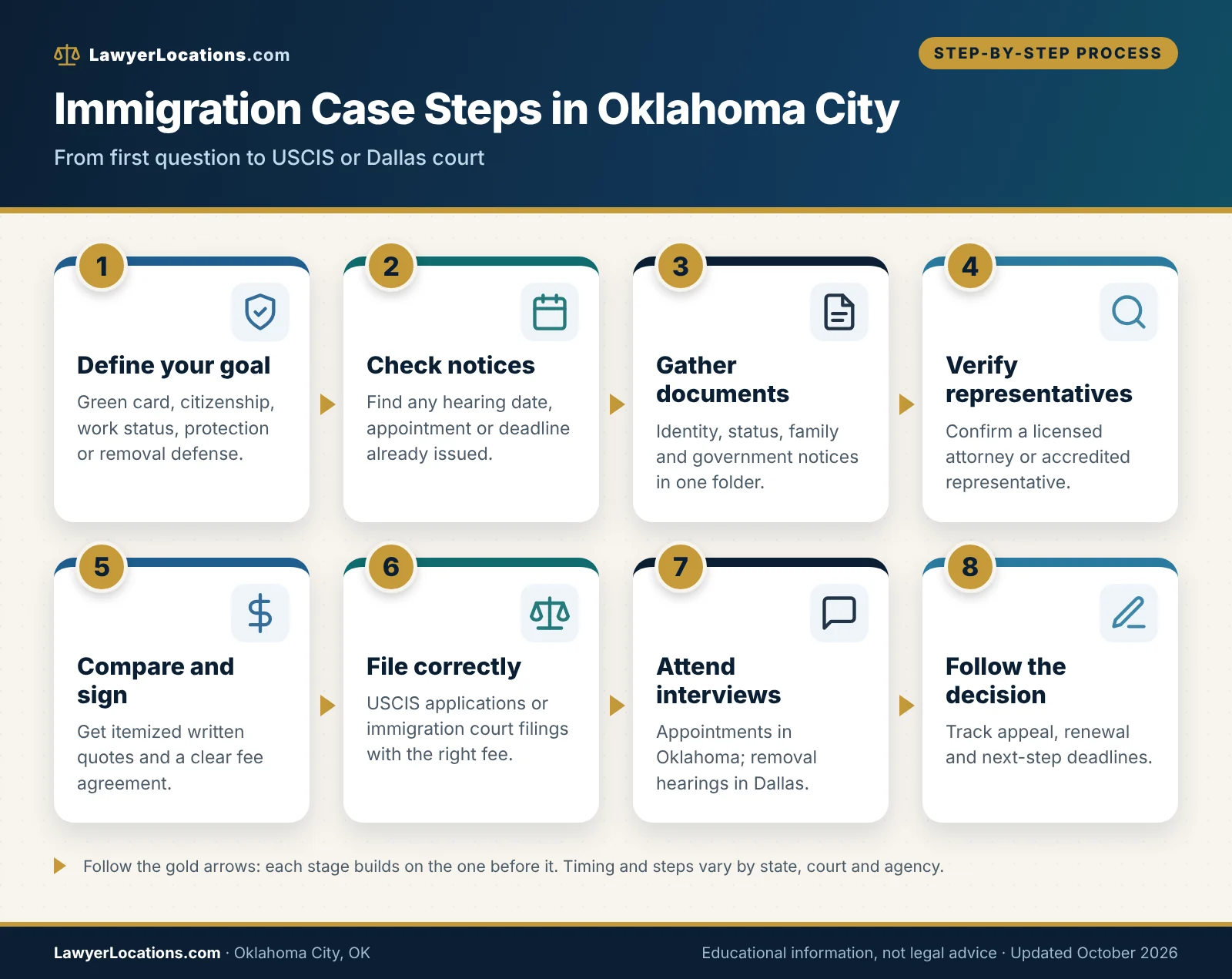
Text version of this graphic
- Define your goal: green card, citizenship, work status, protection, or defending a removal case.
- Confirm any deadline or notice that already exists, such as a hearing date or an appointment.
- Gather identity, status and family documents.
- Verify who can lawfully represent you: licensed attorney or accredited representative.
- Meet one or more representatives and compare fees, plan and communication.
- Sign a written agreement and file the right forms with USCIS or the immigration court.
- Attend biometrics, interviews and hearings, in Oklahoma or Dallas as assigned.
- Follow up on the decision and any appeal or renewal deadlines.
Who is allowed to represent you in immigration matters
Only certain people may give immigration legal advice or appear for you before federal agencies. Knowing the categories protects you from the most common scam in this field.
Attorneys licensed in any U.S. jurisdiction
According to a 2025 article in the Oklahoma Bar Journal for lawyers, attorneys licensed in any U.S. jurisdiction can represent clients in immigration court, but they must register with EOIR and follow the court’s local requirements. In practice, that means your lawyer does not have to be licensed in Oklahoma, but you should still confirm an active license and good standing somewhere. Many people prefer a lawyer who is licensed and practices in Oklahoma because the Oklahoma Bar Association complaint process is then available.
Accredited representatives and recognized organizations
The Department of Justice also authorizes some nonprofit organizations, and specific staff members who are not lawyers, to give immigration legal help at low cost. EOIR keeps a public roster of these recognized organizations and accredited representatives by state. A staff member at a recognized nonprofit can be a legitimate choice, but a business that simply says it “helps with immigration papers” is not the same thing.
Ask any provider one plain question: “Are you a licensed attorney or a DOJ-accredited representative?” A legitimate provider answers without hesitation and can tell you where to verify it.
Oklahoma laws that sit next to federal immigration law
Oklahoma cannot rewrite the Immigration and Nationality Act, but it has passed laws that touch immigration. Two matter when you are choosing help.
House Bill 4156 and its court status
Oklahoma enacted House Bill 4156 in 2024, creating a state crime called “impermissible occupation” for people who enter or remain in Oklahoma without federal authorization. A federal judge in the Western District of Oklahoma has blocked enforcement through a preliminary injunction on the ground that the law is likely preempted by federal law, and the state’s appeal is pending at the Tenth Circuit, which heard argument on March 25, 2026. Reports through that date did not show a decision, and the situation can change quickly, so the current status is a item.
The practical point is that a state criminal charge and a federal immigration case are different tracks. If anyone you know is stopped, charged or asked about this law, a criminal defense lawyer and an immigration lawyer both need to see the paperwork, because a criminal outcome can affect immigration options. Our guide to criminal defense lawyers and free consultations explains how to compare the criminal side.
The notary statute and “notario” fraud
Under 49 O.S. § 6(B), an Oklahoma notary who is not a licensed attorney, or otherwise authorized by law to handle immigration or citizenship matters, may not present himself or herself as qualified to give legal advice on those matters. The statute defines legal advice broadly, including picking immigration forms and answering form questions. A notary who helps in a nonlegal way must say, orally and in writing, that they are not a licensed attorney or government representative and cannot give legal advice. If the notary advertises in another language, the notice must also appear in that language, and the statute bars literal translations such as “notario” or “notario publico”.
Oklahoma lawmakers raised the penalties in 2026. Senate Bill 1266 passed 45-0 and 92-0, was signed in May 2026, and makes a violation of the notary immigration-advice rule a misdemeanor with a fine up to $1,000, up to one year in county jail, or both, with the Secretary of State revoking the notary’s appointment for eight years after a final judgment. Reports list November 1, 2026 as the effective date for those penalty provisions.
A storefront that calls itself a “notario,” offers to “fix your papers” for cash, and will not give you copies of what it files is describing a problem, not a service. Under Oklahoma law, a notary can witness your signature, but cannot choose your forms or tell you which immigration benefit to apply for.
Where Your Case Actually Lives: USCIS, the Dallas Court and ICE
Most Oklahoma City immigration matters touch one or more of three federal bodies: USCIS for applications, the immigration court for removal cases, and ICE for enforcement and detention. Each has a different footprint in Oklahoma.
The USCIS Oklahoma City Field Office
USCIS field offices handle interviews, naturalization oaths and in-person help that cannot be resolved online or by phone. The one serving Oklahoma has recently changed location.
The reported move to Edmond
News9 reported that a ribbon-cutting was held on September 28, 2026 for the Oklahoma City USCIS Field Office at 3101 Technology Drive in Edmond, serving all of Oklahoma and the Texas Panhandle. Older directories still list the former Oklahoma City address on Southwest 44th Street. Treat any address you find online as unconfirmed until you match it to the appointment notice you receive, and confirm hours and the transition with USCIS.
What happens there and what to bring
The office schedules green card and naturalization interviews, holds naturalization ceremonies, and gives limited in-person help. USCIS tells applicants to follow the instructions on their appointment notice before visiting, and third-party guides note that walk-ins are generally not available. Bring the notice, your photo ID, originals of the documents your lawyer lists, and your lawyer’s contact details; if your lawyer has filed a notice of appearance, ask whether they will attend the interview with you.
Immigration court: why Oklahoma cases go to Dallas
People searching for an “Oklahoma City immigration court” often assume one exists. It does not, which changes how you choose a lawyer.
A short history of the Oklahoma City hearing location
EOIR announced on August 14, 2014 that it would stop hearing cases at its Oklahoma City hearing location, which had been housed in ICE office space. Cases assigned there stayed under the administrative control of the Dallas Immigration Court, which is at 1100 Commerce Street, Suite 1060, Dallas, TX 75242, with public hours of 7:30 a.m. to 4:30 p.m. on weekdays except federal holidays. The Dallas court’s phone is 214-767-1814.
Travel, remote appearances and venue changes
The 2025 Oklahoma Bar Journal article notes that Oklahoma immigration hearings take place in Dallas, that travel needs planning, and that attorneys and clients may be able to request telephonic or video appearances where the court permits, and may ask for a venue change when appropriate. Oklahoma City to Dallas is roughly 200 miles by road, so the question “will my lawyer actually appear, and how?” is worth asking before you hire.
If you hold a Notice to Appear or a hearing notice, the hearing date is binding even when the courthouse is hours away. Missing it can lead to an order of removal in your absence, the so-called in absentia removal order, covered in the removal-defense section below.
ICE and detention in the Oklahoma City area
ICE enforcement for Oklahoma is run from Texas, not from a stand-alone Oklahoma office. That affects check-ins, detention transfers and how families find a loved one.
The Dallas Field Office and check-ins
ICE lists the Dallas Field Office, at 8101 N. Stemmons Freeway in Dallas, with an area of responsibility of North Texas and Oklahoma, and states that this field office is not itself a check-in location. A person with a reporting requirement should go only where their paperwork says, and a lawyer can help you confirm the right office. Go only where your paperwork tells you to report. Whether ICE maintains an Oklahoma City sub-office for check-ins is not something this guide could confirm from an ICE page.
Oklahoma County jail, detainers and 287(g)
Under the federal 287(g) program, local agencies can be trained to perform certain immigration enforcement functions. An Oklahoma Policy Institute page (last updated September 10, 2026) says nearly 100 Oklahoma agencies participate as of August 2026, and Oklahoma City television station KOKH reported on August 19, 2026 that Oklahoma County commissioners declined to advance a sheriff’s proposal for an agreement. The sheriff’s office could bring a similar proposal back, so check current local news rather than relying on this snapshot. To locate someone in ICE custody, use ICE’s Online Detainee Locator System.
| Agency | What it handles | Where Oklahoma City residents deal with it |
|---|---|---|
| USCIS | Green cards, naturalization, work permits, most applications | Oklahoma City Field Office, reported at 3101 Technology Drive, Edmond (confirm on your notice); most filings are made by mail or online |
| EOIR immigration court | Removal proceedings, asylum defense, cancellation of removal, bond hearings | Dallas Immigration Court, 1100 Commerce St., Suite 1060, Dallas; remote appearance may be possible |
| Board of Immigration Appeals | Appeals of immigration judge decisions | Filed electronically or with the Board in Virginia, not in Oklahoma |
| ICE Enforcement and Removal Operations | Arrests, detention, check-ins, removals | Dallas Field Office covers North Texas and Oklahoma |
| Oklahoma state court system | Criminal charges, family court, state benefits matters that can affect immigration | Oklahoma County District Court and municipal courts; often involves a separate criminal defense lawyer |
Common Pathways and What a Lawyer Does on Each
Most Oklahoma City immigration cases fall into family, work, humanitarian or removal-defense categories. A good first consultation sorts your situation into one of these and then explains the forms, the agency, the waiting and the risks.
Family-based cases
Family petitions are among the most common reasons people look for an immigration lawyer, and many Oklahoma City households include a mix of citizens, permanent residents and relatives who are still waiting for a decision.
Petitions, adjustment of status and green cards
A citizen or permanent resident usually starts by filing a petition for a relative with USCIS. Whether the relative then applies for a green card inside the United States (adjustment of status) or at a U.S. consulate abroad depends on how they entered, their immigration history and whether a visa number is available. Our national guide to green card lawyers explains where legal help can reduce delays and mistakes.
Naturalization and citizenship
Permanent residents who meet the continuous-residence and other requirements can apply for citizenship, and the interview and oath ceremony take place through the Oklahoma-area USCIS field office. Even a routine application can raise questions about past arrests, long trips abroad or tax filings, which is why some applicants ask a lawyer to review the file first. For a comparison from another large jurisdiction, see our guide to citizenship lawyers in Harris County, Texas.
Work-based and humanitarian options
Employment and humanitarian cases involve more variables, and the penalties for a mistake can be sharper.
Employer-sponsored work status
Employers in the Oklahoma City area may sponsor workers through several visa and green card categories. In these cases the employer often hires the lawyer, and the worker should understand whose interests the lawyer represents. Ask whether you may receive copies of everything filed on your behalf and what happens to your status if the job ends.
Asylum, protection and crime-victim or abuse-based relief
Asylum seekers face a statutory rule that the application generally must be filed within one year of arrival, with exceptions listed in the Immigration and Nationality Act, § 208(a)(2). People who are victims of certain crimes, trafficking or domestic violence may be able to apply for U, T or VAWA-based relief, and nonprofit directories list Oklahoma City programs that help with these categories. These cases require careful, confidential fact-gathering, and the lawyer you choose should be comfortable explaining how your story will be documented. Our guide to finding an asylum lawyer (Virginia-focused, but the vetting questions are the same) lays out what to ask.
Removal defense basics
If DHS has started removal proceedings against you, the stakes include your ability to remain in the country. This section explains the basic mechanics, not strategy.
The Notice to Appear and your first hearing
Removal proceedings begin when DHS serves a Notice to Appear and files it with the immigration court. Your first appearance is a master calendar hearing, a short scheduling hearing where the judge asks whether you admit the allegations and what relief you plan to seek. For Oklahoma residents the court is Dallas, and a lawyer who files an appearance should tell you in advance how you will attend.
In absentia orders and appeals
If you miss a hearing and the government shows you were properly notified, the judge can order you removed in your absence. An in absentia order can be rescinded only through a motion to reopen: filed within 180 days if you can show exceptional circumstances, or at any time if you did not receive proper notice or were in custody through no fault of your own, and only one such motion is allowed. The removal is automatically stayed while the judge decides that motion.
An appeal of an immigration judge’s decision goes to the Board of Immigration Appeals on Form EOIR-26, and the notice must be received by the Board within 30 calendar days; the Board does not apply a mailbox rule, even for detained people. Because of that, the day a decision is issued should be the day you speak with a lawyer.
Some immigration deadlines are measured from the decision date, not from when you opened the letter. If you receive any order or decision from an immigration judge, write down the date and call a licensed representative immediately.
| Pathway | Decision-maker | Typical local touchpoint | Why a lawyer is often consulted |
|---|---|---|---|
| Family petition and green card | USCIS (or a U.S. consulate abroad) | Possible interview at the Oklahoma office | Eligibility, past entries, unlawful presence and waiver questions |
| Naturalization | USCIS | Interview and oath at the field office | Arrest history, travel, residence and tax issues |
| Employer-sponsored status | USCIS and Department of Labor | Employer’s counsel, mailed filings | Employer versus worker interests; job-change rules |
| Asylum and protection | USCIS asylum office or the immigration court | Dallas court if in removal proceedings | One-year rule, evidence, credibility |
| U, T and VAWA relief | USCIS | Mail-in filings; nonprofit providers | Confidentiality and documentation of qualifying facts |
| Removal defense | Immigration judge, then the Board of Immigration Appeals | Dallas Immigration Court | Court deadlines, relief options, appeals |
Government Fees and Attorney Fees
Immigration cost has two parts: what the government charges and what your lawyer or nonprofit charges. Government fees are published and change often; attorney fees are set by contract and vary by case.
USCIS fees and the 2026 changes
USCIS fees are set by federal regulation and, since 2025, are also affected by fees created in a federal budget law known as H.R. 1. The best habit is to check the current fee schedule on USCIS’s site on the day you file.
Base filing fees for common forms
A university immigration office table, which republishes the USCIS schedule, lists these filing fees. USCIS also describes a discount of $50 for certain online filings and reduced naturalization fees for lower-income applicants under the 2024 fee rule, and this guide could not re-check those two points on a USCIS page.
| Form | Purpose | Fee listed |
|---|---|---|
| I-485 | Adjustment of status (green card inside the U.S.) | $1,440 ($950 for applicants under 14) |
| N-400 | Naturalization | $760 |
| I-765 | Employment authorization | $520 |
| I-131 | Travel document | $630 |
New H.R. 1 fees and the October 16, 2026 inflation adjustment
A Federal Register notice from USCIS, scheduled for publication on October 1, 2026, raises several H.R. 1 fees effective October 16, 2026 by about 3.36 percent. Under the notice, the annual fee for a pending asylum application goes from $102 to $105, the initial asylum, parole or TPS work permit fee from $560 to $570, the TPS fee from $510 to $520, and the immigration parole fee from $1,020 to $1,050. The initial asylum application fee stays at $100, and benefit requests postmarked on or after October 16 without the correct fee will be rejected.
| Fee | FY 2026 | FY 2027 |
|---|---|---|
| I-589 initial asylum application | $100 | $100 |
| I-589 annual fee while pending | $102 | $105 |
| I-765 initial asylum, parole or TPS work permit | $560 | $570 |
| I-821 Temporary Protected Status | $510 | $520 |
| I-131 immigration parole fee | $1,020 | $1,050 |
Immigration court and appeal fees
If your case is in the immigration court or before the Board, EOIR collects its own fees. These too were adjusted for inflation.
EOIR fees as posted in October 2026
EOIR’s fee page, last updated October 5, 2026, lists $1,060 for an appeal from an immigration judge decision, $1,060 for a motion to reopen or reconsider at the Board, and $1,095 for such a motion before the immigration judge, with a reduced $950 in certain cases. Bond appeals carry no fee. The annual asylum fee is $105 with no waiver or reduction.
| Filing | Form | Fee |
|---|---|---|
| Appeal of immigration judge decision | EOIR-26 | $1,060 |
| Motion to reopen or reconsider before the Board | None | $1,060 ($950 in certain cases) |
| Motion to reopen or reconsider before the judge | None | $1,095 ($950 in certain cases) |
| Bond appeal | EOIR-26 | No fee |
How fees are paid
Starting February 23, 2026, EOIR no longer accepts checks or money orders for immigration fees, and fees must be paid through its electronic payment portal. Ask your lawyer who will pay and how, and make sure you receive a copy of every receipt. If a fee is wrong or missing, a filing can be rejected, and some deadlines keep running.
How attorney fees work
No reliable public average exists for what an immigration lawyer charges in Oklahoma City, and this guide does not invent one. What you can do is understand the structures and compare written quotes.
Flat fees, hourly rates and payment plans
Many immigration lawyers quote flat fees for defined tasks such as a family petition or a naturalization application, while removal defense and appeals are often billed in stages or by the hour. Ask what the fee includes and excludes: government fees, interpreter costs, translations, interview attendance, requests for evidence and appeals are the usual gray areas. If you need a payment plan, ask for it in writing before you begin.
Why a written agreement matters
A written fee agreement should describe the scope of work, the total fee, what happens if the case changes direction, and what happens to your money if you stop. Because immigration results depend on government decisions, a lawyer should not promise one, and an advertisement that does is a red flag. Keep a copy of the agreement and every filing receipt.
Ask for an itemized quote that separates legal fee, government fees, translation and document costs. That makes quotes from different providers comparable.
How to Compare Immigration Lawyers in Oklahoma City
The goal is not to find a famous name but to find a licensed, communicative representative whose plan fits your facts. LawyerLocations.com does not rank or recommend individual lawyers, so this section gives you the tools to compare them yourself.
Verify credentials before you talk fees
Two checks take ten minutes and screen out most serious problems. Do them before you share sensitive documents.
Confirm the license and look for complaints
The Oklahoma Bar Association runs a public Find a Lawyer directory that it describes as a voluntary listing. The OBA says it does not endorse or vouch for the qualifications of any lawyer listed, so a listing is a starting point and not a recommendation. If the lawyer is licensed in another state, check that state’s bar site for license status and discipline history. Complaints about Oklahoma lawyers are handled through the OBA’s lawyer complaint process.
Check EOIR’s disciplined-practitioner lists
EOIR regulates the professional conduct of immigration attorneys and representatives who appear before the immigration courts and the Board of Immigration Appeals. It publishes lists of currently and previously disciplined practitioners, plus a complaint form for misconduct, and has a Spanish version of that form. A name on the current list is a reason to look elsewhere.
Questions that reveal how a lawyer will handle your case
A first consultation is a two-way interview. Prepare questions that force specific answers instead of sales language.
Questions about your facts and strategy
- Which category does my situation fit, and what other options did you consider?
- What are the biggest risks: past arrests, unlawful presence, prior orders, missed deadlines?
- What documents do you need from me, and what will you prepare yourself?
- If my application is denied, what happens next, and does my fee cover that stage?
- Will you tell me in writing if you think I should not file?
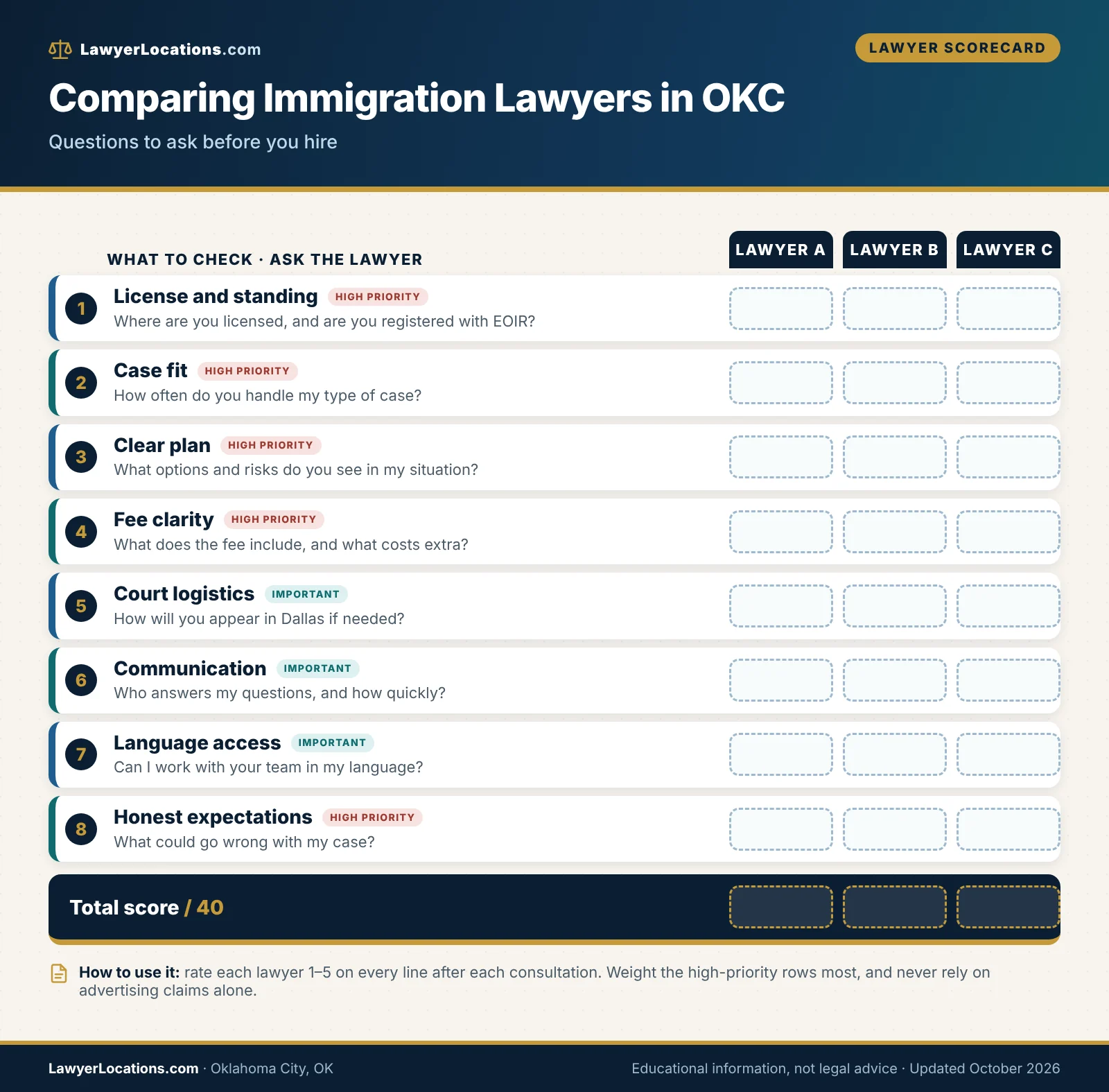
Text version of this graphic
- License and standing: confirm active license, registration and no current discipline.
- Immigration focus: ask how much of the practice is immigration and which case types.
- Plain-language plan: can they explain your options and risks without jargon?
- Fee clarity: a written, itemized quote separating legal and government fees.
- Court logistics: how will they appear in Dallas, and who covers travel?
- Communication: who answers questions, how fast, and in which language?
- Honest expectations: no promised outcomes and no pressure to sign today.
Questions about logistics, language and communication
Because removal cases are heard in Dallas, ask directly whether the lawyer appears in person, by video or by phone, and whether travel costs are included. Ask who will answer your calls and messages, whether you may speak with the lawyer or only a paralegal, and what language the team uses with clients. Written updates and copies of everything filed are reasonable requests.
Red flags and how to report them
Federal immigration fraud preys on urgency and confusion. The signs are consistent from city to city.
Warning signs in advertising and intake
- A promised result, or a promise of “fast” approval from a government office.
- Someone who is not a lawyer or accredited representative choosing your forms.
- Refusal to give you copies of what was filed or to let you see the receipt notices.
- Cash only, no written agreement, or pressure to sign on the spot.
- Asking you to sign blank forms or forms you cannot read.
- Advice to lie, reuse a story, or submit documents you know are not true.
Where to take a complaint
Different problems go to different places. A summary prepared by the Catholic Legal Immigration Network points to the Oklahoma Attorney General’s Public Protection Unit for consumer-protection complaints, to local police or the district attorney for notary misconduct, and to the Oklahoma Bar for complaints about lawyers. EOIR separately takes complaints about practitioners who appear in immigration court. Keep copies of everything you were given.
Do not hand over your original passport, birth certificate or any original identity document to someone you have just met. A lawyer can work from copies and tell you which originals you must bring to an interview.
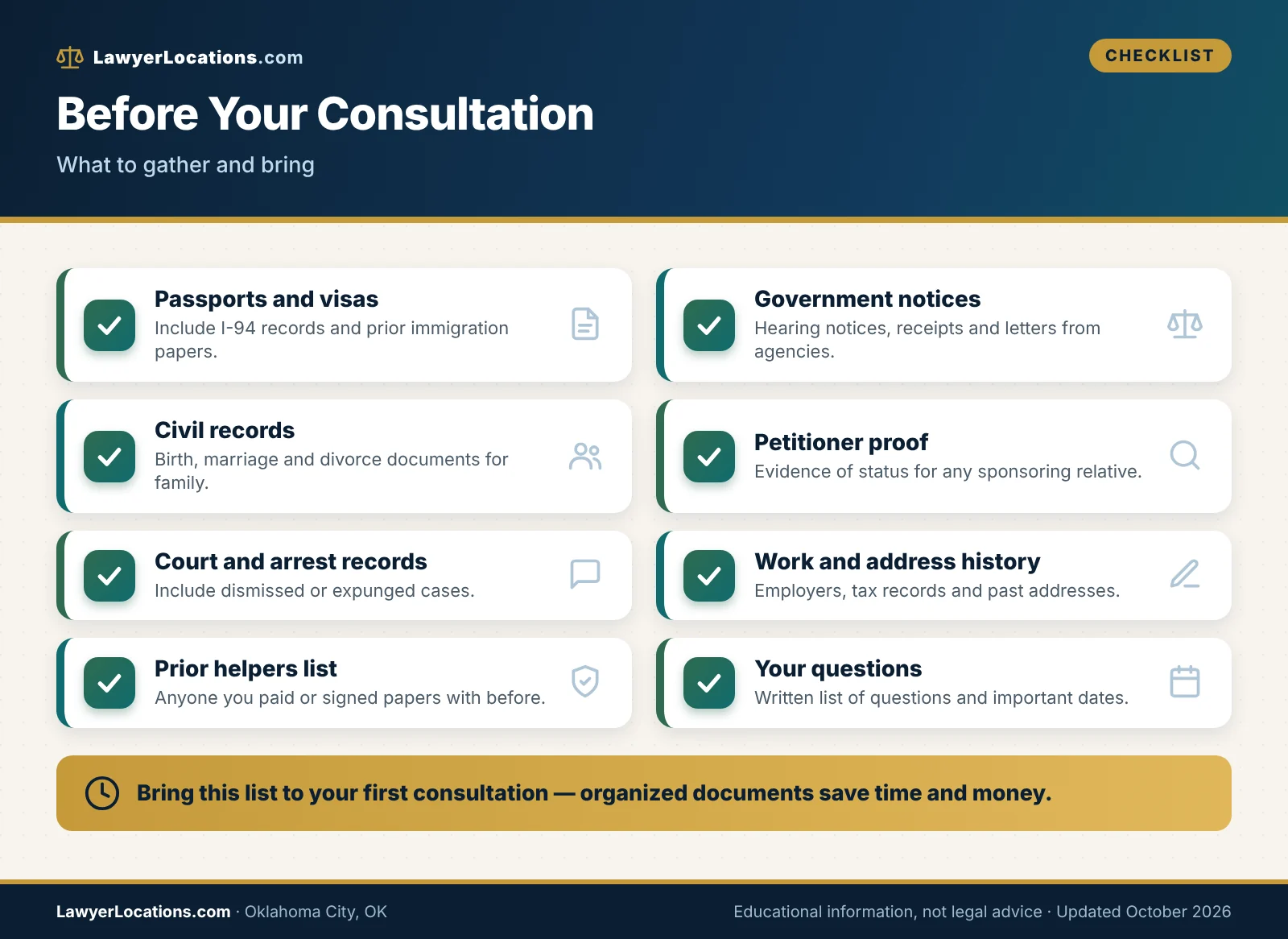
Text version of this graphic
- Passports, visas, I-94 records and any prior immigration papers.
- Every government notice, including hearing notices and receipt notices.
- Birth, marriage and divorce records for you and your family.
- Proof of status or relationship for any petitioning relative.
- Arrest, charge and court records, even for dismissed cases.
- Employment, tax and address history.
- A written list of questions and key dates.
- A list of any people you paid for earlier help.
| Criterion | Question to ask | What a solid answer sounds like |
|---|---|---|
| License and standing | Where are you licensed, and are you registered with EOIR? | A specific answer you can check on the state bar site and EOIR lists |
| Case fit | How often do you handle my type of case? | Specific case types, not “everything” |
| Fees | What does the flat fee include, and what costs extra? | A written, itemized quote |
| Court logistics | How will you appear in Dallas if my case is there? | Clear plan for in-person, video or phone appearance and who pays travel |
| Language access | Can I speak with you in my language? | Named staff or an interpreter plan |
| Expectations | What could go wrong? | Honest risks, no promised outcome |
Free and Low-Cost Help, Languages and Community Resources
If a private lawyer is not realistic, several options exist in the Oklahoma City area. Capacity is limited and eligibility rules differ, so call before assuming.
Nonprofit and community legal providers
Nonprofit providers can be a legitimate path, especially for family petitions, naturalization and humanitarian cases. The key is to confirm who is actually giving the legal advice.
Providers listed in national directories
ImmigrationLawHelp.org, a national directory, lists several Oklahoma City organizations offering immigration services, among them Catholic Charities of Oklahoma City’s Immigration Legal Services program, Hispanic American Mission, Hispanic Equal Legal Protection, Inc., Immigrant Connection at May Ave. Wesleyan Church and the Immigration Center at Western Oaks. The directory describes services such as family petitions, naturalization, adjustment of status, DACA, TPS and VAWA or U and T visa help, with a nominal fee at some programs. Listing here is not an endorsement, and details such as phone numbers, eligibility, waiting lists and DOJ recognition should be confirmed by calling.
How to vet a nonprofit or church-based program
Ask who prepares the forms: a licensed attorney, a DOJ-accredited representative, or a volunteer who is supervised by one. Ask whether the organization is recognized by the Department of Justice and whether it can appear in immigration court or only help with USCIS forms. A friendly program that cannot represent you in court may still be useful for the right case, but you should know the limits.
Bar association and legal aid resources
Oklahoma has statewide resources, but most are built for general civil legal needs and may not cover immigration.
Oklahoma Bar Association tools
The OBA’s Find a Lawyer directory lets you search by practice area, location and language. The OBA page describes it as best suited to non-emergency needs and points urgent callers to legal aid or a lawyer directly, and lists the bar’s main number as 405-416-7000 (toll-free 800-522-8065). The OBA’s resource pages do not mention immigration help specifically, so use the directory to find lawyers and the nonprofit directories to find immigration-focused programs.
Legal Aid Services of Oklahoma and Free Legal Answers
Legal Aid Services of Oklahoma provides free legal help to eligible low-income Oklahomans and lists a statewide intake line at 1-888-534-5243. Whether it can assist with immigration matters depends on funding restrictions and the type of case, so ask during intake. Oklahoma Free Legal Answers, a volunteer-lawyer question service, directs immigration questions to the Catholic Charities immigration program rather than answering them itself, so check what it accepts before you write in.
Language access and community context
Language shapes every step of an immigration case, from intake to hearing. It is also a fair filter when comparing providers.
What the Census says about Oklahoma City
Census QuickFacts for Oklahoma City reports that 12.1 percent of residents were foreign-born and 21.6 percent of residents age 5 and older spoke a language other than English at home, from the 2020-2024 American Community Survey, and a city population estimate of 719,849 for July 2025. These figures show demand for multilingual services but say nothing about any single provider’s quality.
Asking for an interpreter and translated documents
The Oklahoma Bar Journal article notes that immigration court interpreters are provided but that the need for a specific language should be confirmed in advance. USCIS filings that include foreign-language documents typically require translations, so ask your lawyer who handles and pays for them. Ask the OBA directory to filter for language, and ask the lawyer whether a bilingual staff member handles your file.
| Resource | What it offers | Limits to know |
|---|---|---|
| Oklahoma Bar Association Find a Lawyer | Directory searchable by practice area, location and language | Voluntary listings; the OBA does not endorse lawyers listed |
| EOIR lists | Disciplined-practitioner lists and pro bono providers by court | Pro bono list is published quarterly and may not cover your type of case |
| Nonprofit programs in directories | Low-cost help with petitions, naturalization and some humanitarian cases | Capacity, eligibility and court representation vary; confirm directly |
| Legal Aid Services of Oklahoma | Free civil legal help for eligible low-income residents | Immigration coverage unclear; ask at intake |
| ICE detainee locator | Online tool to find a person in ICE custody | Information on custody only; not legal advice |
Deadlines, Mistakes, Quick Answers and Next Steps
Immigration timing is unforgiving in some places and slow in others. The most useful habit is to separate the dates that cannot move from the stages that simply take time.
Deadlines and decision points
Some dates are fixed by statute or court order. Others depend on what the government sends you. Know which you have.
Fixed dates to watch
A hearing date on a Notice to Appear or hearing notice is fixed. The Board of Immigration Appeals expects an appeal within 30 days, and a motion to reopen an in absentia order has its own 180-day window. In asylum cases the one-year filing rule under INA § 208(a)(2)(B) is a threshold issue, with exceptions that a lawyer must evaluate.
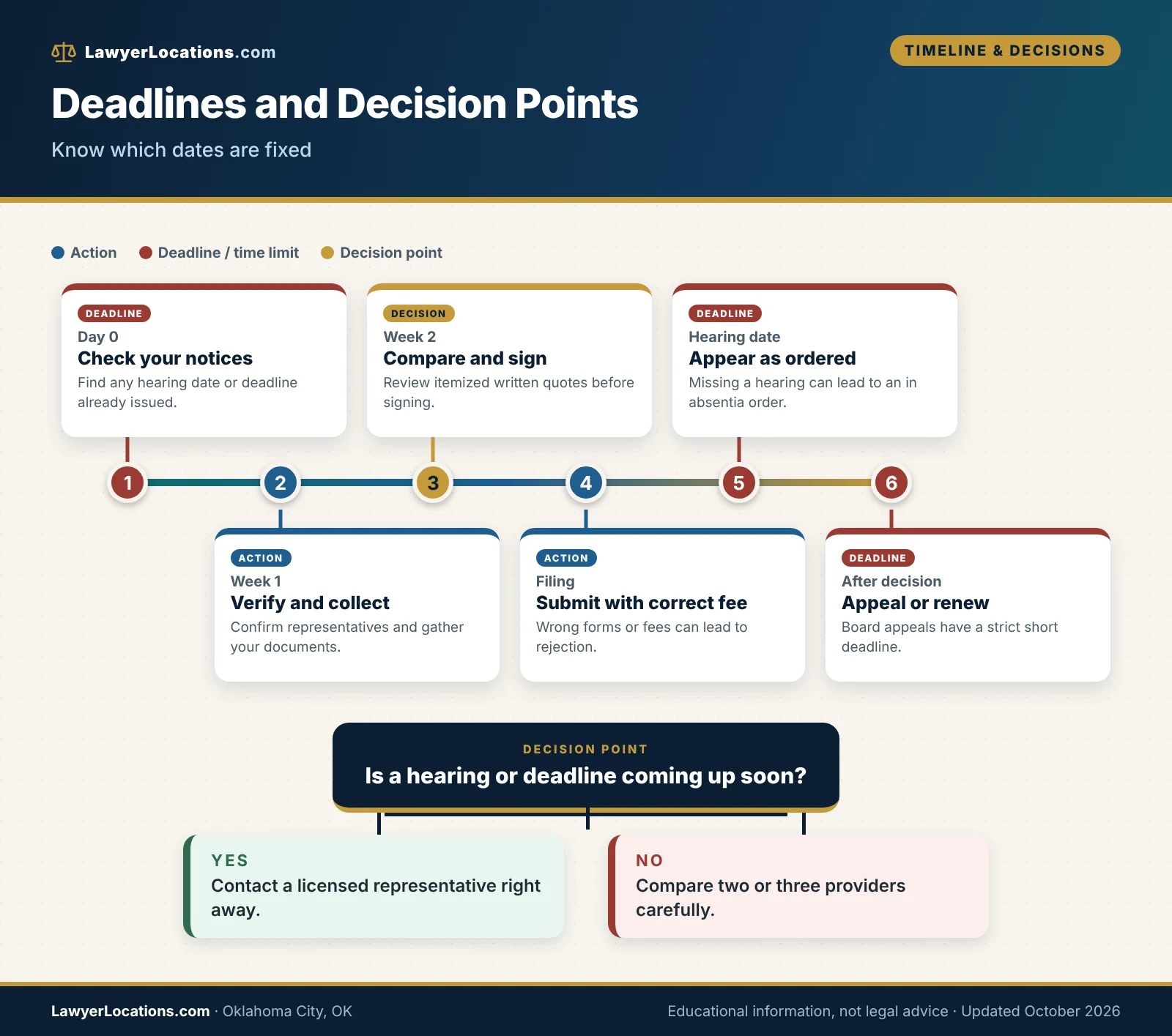
Text version of this graphic
- Day 0: Identify your goal and any notice or hearing date already issued.
- Week 1: Verify representatives and collect documents.
- Week 2: Compare written quotes and sign an agreement.
- Filing: USCIS application or immigration court filing, with correct fee.
- Biometrics and interview: attend as the notice instructs.
- Decision: approval, request for evidence, denial or hearing outcome.
- Appeal or renewal: for immigration judge decisions, act within 30 days.
- Decision point: Is there a hearing date or deadline within the next month? If yes, contact a licensed representative now. If no, compare providers carefully.
Decision points: when to hire and when to wait
Consider moving quickly if you have a hearing date, a denial letter, a request for evidence, an arrest, or a prior order of removal. For a routine renewal or a first inquiry about future options, it is reasonable to take a week to compare providers. If you are unsure which situation you are in, a short consultation can sort that out.
Common mistakes to avoid
These mistakes appear across jurisdictions and are avoidable.
Paperwork and filing mistakes
- Using an outdated form version or wrong fee, which can lead to rejection.
- Leaving out an arrest, prior entry or earlier application because it seems minor.
- Ignoring mail from USCIS or the court, or failing to update your address.
- Signing something you cannot read or that is not in your language.
Hiring mistakes
People often choose the first provider they see advertised, pay in cash without a receipt, or assume a nonprofit can appear in court when it only prepares forms. Others wait for a “better time” while a deadline runs. A short comparison of two or three representatives, with the scorecard above, avoids most of this.
Quick answers to common questions
The questions below come up often in Oklahoma City searches.
Courts, offices and representatives
Is there an immigration court in Oklahoma City?
No. EOIR stopped hearing cases at its Oklahoma City hearing location after August 15, 2014, and Oklahoma cases are handled by the Dallas Immigration Court. Confirm your hearing location on your notice or through EOIR’s online case status tools.
Do I need a lawyer licensed in Oklahoma?
Not necessarily. Attorneys licensed in any U.S. jurisdiction can represent clients in immigration court if they register with EOIR, although some people prefer an Oklahoma-licensed lawyer for accessibility and complaint options.
Can a notary help me with immigration forms in Oklahoma?
A notary may witness a signature but may not give immigration legal advice, and must disclose in writing and orally that they are not a lawyer. Oklahoma also bars translating “notary public” as “notario”.
Costs, records and scams
What does an immigration attorney cost in Oklahoma City?
There is no verified public average. Quotes are set by contract, are often flat for defined tasks, and should be itemized separately from government fees.
Where do I file my application?
Most applications are filed by mail or online with USCIS, not at the field office. The field office handles interviews and ceremonies.
Is Oklahoma’s immigration crime law in effect?
A federal preliminary injunction blocked enforcement of HB 4156 and an appeal was argued in March 2026. Check current status with a lawyer or the federal court docket before relying on any answer here.
Can an expunged or dismissed case still matter for immigration?
Possibly. Immigration law has its own definitions, so disclose all records to your immigration lawyer. Our expungement lawyer guide explains how to ask the right questions.
How do I find someone in ICE custody?
ICE’s Online Detainee Locator System is the official starting point. A lawyer can also help confirm the facility, hearing and bond options.
Are free consultations available?
Some lawyers and nonprofits offer them and some do not, and LawyerLocations.com cannot promise any. Ask what the first meeting costs when you call.
How can I tell if a provider is a scam?
Warning signs include promised results, refusal to provide copies of filings, cash-only deals and non-lawyers choosing forms. Verify licensure and check EOIR’s disciplined lists.
What if I missed a hearing in Dallas?
Contact a licensed immigration representative immediately. An in absentia order can be challenged only through a motion to reopen, with different deadlines depending on the reason.
Clear next steps
You do not need to resolve everything at once. A calm sequence works better than a panicked one.
This week
Gather your notices and identity documents, write down any deadlines, and verify at least two representatives using the checks above. If you are comparing a private lawyer with a nonprofit, ask each the same questions so the answers line up. If you search for an immigration attorney Oklahoma City OK services listing, treat every ad as a lead to verify rather than a recommendation.
After you choose
Sign a written agreement, ask for copies of everything filed, and keep a folder of receipts and notices. Save your lawyer’s contact information and ask how you will be notified about hearings and interviews.
Ready to compare your options?
Use the scorecard and checklist in this guide to prepare two or three consultations. For a national overview of when legal help matters most, read our green card lawyer guide, and remember that LawyerLocations.com does not rank lawyers or promise outcomes.
Sources & References
Show all 29 sources
- Notice: Oklahoma City hearing location closed — U.S. Department of Justice, EOIR — justice.gov/eoir/notice-oklahoma-city-closed — accessed October 2026.
- Dallas Immigration Court — U.S. Department of Justice, EOIR — justice.gov/eoir/dallas-immigration-court — accessed October 2026.
- Immigration court practice in Dallas for Oklahoma attorneys, Oklahoma Bar Journal, October 2025 — Oklahoma Bar Association — okbar.org/obj/2025/october/10 — accessed October 2026.
- Mullin attends ribbon cutting for new Citizenship and Immigration Services field office in Edmond — News9 — news9.com — accessed October 2026.
- Dallas Field Office, area of responsibility: North Texas, Oklahoma — U.S. Immigration and Customs Enforcement — ice.gov/field-office/dallas-field-office — accessed October 2026.
- Fiscal Year 2027 Inflation Adjustment to H.R. 1 Immigration Fees (CIS No. 2879-26) — USCIS, Federal Register public inspection — public-inspection.federalregister.gov/2026-20187.pdf — accessed October 2026.
- USCIS Fee Schedule and Changes to Certain Other Immigration Benefit Request Requirements (final rule effective April 1, 2024) — Federal Register — federalregister.gov — accessed October 2026.
- Immigration fee listing (republishing USCIS schedule, published November 7, 2025) — University at Buffalo Immigration Services — buffalo.edu — accessed October 2026.
- Types of appeals and required fees (updated October 5, 2026) — U.S. Department of Justice, EOIR — justice.gov/eoir/types-appeals-and-required-fees — accessed October 2026.
- Board of Immigration Appeals Practice Manual, Chapter 4.5, Appeal Deadlines — U.S. Department of Justice, EOIR — justice.gov/eoir/reference-materials/bia/chapter-4/5 — accessed October 2026.
- Immigration Court Practice Manual, Chapter 5.9, In Absentia Orders — U.S. Department of Justice, EOIR — justice.gov/eoir/reference-materials/ic/chapter-5/9 — accessed October 2026.
- Attorney Discipline Program — U.S. Department of Justice, EOIR — justice.gov/eoir/attorney-discipline-program — accessed October 2026.
- Find Legal Representation and List of Pro Bono Legal Service Providers — U.S. Department of Justice, EOIR — justice.gov/eoir/list-pro-bono-legal-service-providers — accessed October 2026.
- EOIR Policy Memorandum 21-01 (Mendez Rojas v. Wolf), citing INA § 208(a)(2)(B) one-year filing deadline — U.S. Department of Justice, EOIR — justice.gov/eoir/page/file/1334796/dl — accessed October 2026.
- Oklahoma UPL Statute Summary (49 O.S. §§ 6, 6.1) — Catholic Legal Immigration Network, Inc. — cliniclegal.org/node/1955 — accessed October 2026.
- 2025 Oklahoma Statutes, Title 49, § 6 — Justia — law.justia.com — accessed October 2026.
- Oklahoma SB 1266 (2026) — National Notary Association and PolicyRisk bill tracker — nationalnotary.org; policyrisk.com — accessed October 2026.
- Case: United States v. Oklahoma / Padres Unidos de Tulsa v. Drummond, Tenth Circuit No. 25-6080 — Civil Rights Litigation Clearinghouse — clearinghouse.net/case/45673 — accessed October 2026.
- 10th Circuit probes Oklahoma immigration law — Courthouse News Service — courthousenews.com — accessed October 2026.
- Oklahoma attorney general appeals immigration law injunction — Oklahoma Voice — oklahomavoice.com — accessed October 2026.
- 287(g) Agreements — Oklahoma Policy Institute — okpolicy.org/287g-agreements — accessed October 2026.
- Oklahoma County sheriff asks commissioners to approve immigration enforcement agreement (update: denied) — KOKH FOX 25 — okcfox.com — accessed October 2026.
- Find a Lawyer — Oklahoma Bar Association — okbar.org/findalawyer — accessed October 2026.
- Free and Low-Cost Resources — Oklahoma Bar Association — okbar.org/a2j/resources — accessed October 2026.
- Other Help — Oklahoma Free Legal Answers (ABA) — oklahoma.freelegalanswers.org/OtherHelp — accessed October 2026.
- Legal Aid Services of Oklahoma — legalaidok.org — accessed October 2026.
- ImmigrationLawHelp.org, Oklahoma organizations — Immigration Advocates Network / Pro Bono Net — immigrationlawhelp.org — accessed October 2026.
- QuickFacts: Oklahoma City city, Oklahoma — U.S. Census Bureau — census.gov/quickfacts — accessed October 2026.
- Local USCIS Office in Oklahoma City (third-party, for background on the former address) — Herman Legal Group — lawfirm4immigrants.com — accessed October 2026.
General information only. This page is legal information, not legal advice, and reading it does not create an attorney-client relationship. LawyerLocations.com is a legal-education and lawyer-discovery resource, not a law firm, and it does not recommend, rank or vouch for any individual lawyer or organization. Immigration law, fees, agency procedures and court status change frequently. Confirm current facts with the agency named and consult an immigration attorney or accredited representative authorized to practice in your matter before acting.
Legal Disclaimer and Limitation of Liability
Informational and illustrative purposes only. This article was prepared by LawyerLocations.com solely on the basis of the information available to us at the time of writing. It is an illustrative, general overview. It is not a complete or authoritative statement of the law, and it has not been reviewed by a lawyer licensed in your state or county.
Not legal advice. Nothing in this article is legal, financial, tax or immigration advice, and reading it does not create an attorney-client relationship between you and LawyerLocations.com or any author, lawyer or firm mentioned. Laws, court rules, fees, filing deadlines and agency procedures differ by state, county and court, and they change often. Some details here may be simplified, incomplete or out of date, and time limits for legal claims can be short.
No warranty. We make no representation or warranty, express or implied, about the accuracy, completeness, timeliness or suitability of this content for your situation. Please do not rely on it to make, delay or skip any legal decision. Check the facts against official sources and speak with a licensed attorney in the relevant jurisdiction before you act.
Limitation of liability. To the fullest extent permitted by law, LawyerLocations.com and its owners, authors and contributors disclaim all liability for any loss, damage, cost or other consequence arising from the use of, or reliance on, this article, including any content on third-party websites we link to. Mentioning a lawyer, firm, organization or service is not an endorsement and is not a promise of any result. If you are in immediate danger, contact your local emergency number.