If you searched for a “pedestrian accident lawyer chicago il” after being hit on foot, the choice starts with three facts: Illinois is a fault-based state, the general deadline to sue for a personal injury is two years under 735 ILCS 5/13-202, and a claim against the City of Chicago or another local public body can face a much shorter one-year limit under 745 ILCS 10/8-101. A CTA bus claim has its own written-notice rule.
This guide explains how Illinois pedestrian right-of-way law works, which Cook County court hears a case, how contingent fees are regulated, how to check a lawyer’s license, and what to bring to a first meeting. It is general information for readers in Chicago, not advice about your situation.
How a Pedestrian Accident Lawyer Case Works in Chicago, IL
A pedestrian accident case in Chicago usually moves through investigation, medical treatment, an insurance claim and, if the claim does not resolve, a lawsuit in the Circuit Court of Cook County. A pedestrian accident lawyer in Chicago, IL spends most of that time on evidence and negotiation rather than in a courtroom.
What the lawyer actually does in a pedestrian case
Pedestrian cases differ from ordinary fender-benders because the injured person has no steel frame, no airbag and often no witnesses who saw the moment of impact. The work therefore leans heavily on reconstructing what happened from fragments: a camera angle, a signal timing sheet, a crash report diagram and a medical chart.
Investigating the crash
The first job is preserving evidence that disappears quickly. Businesses along Chicago streets often overwrite surveillance video within days or weeks, skid marks fade, and a witness who was willing to talk on the day of the crash can be hard to find a month later. A lawyer typically sends preservation letters to nearby businesses and the driver’s insurer, requests the police crash report, and photographs the intersection, including signal phases, crosswalk markings, sight lines and lighting.
In a pedestrian claim, the investigation also asks who owed a duty to the person on foot. That might be the driver, the vehicle’s owner, an employer if the driver was working, a rideshare or delivery company, or a public body responsible for a broken signal or unsafe road condition. Each possible defendant has different insurance and, as explained below, sometimes a different deadline.
Handling the insurance claim
Most pedestrian claims begin with the at-fault driver’s liability insurer. Early on, an adjuster may call to ask for a recorded statement, medical releases or a quick settlement. A lawyer usually takes over those calls so that you are not answering questions about fault while you are still in pain or on medication.
The lawyer also tracks your own policies. Your auto policy may include medical payments coverage and uninsured or underinsured motorist coverage that can apply even when you were on foot. Those first-party coverages come with their own notice conditions, which is one reason to read your policy early. For a deeper look at the claim-to-payment sequence, see our guide to the car accident settlement timeline, which follows the same insurance stages.
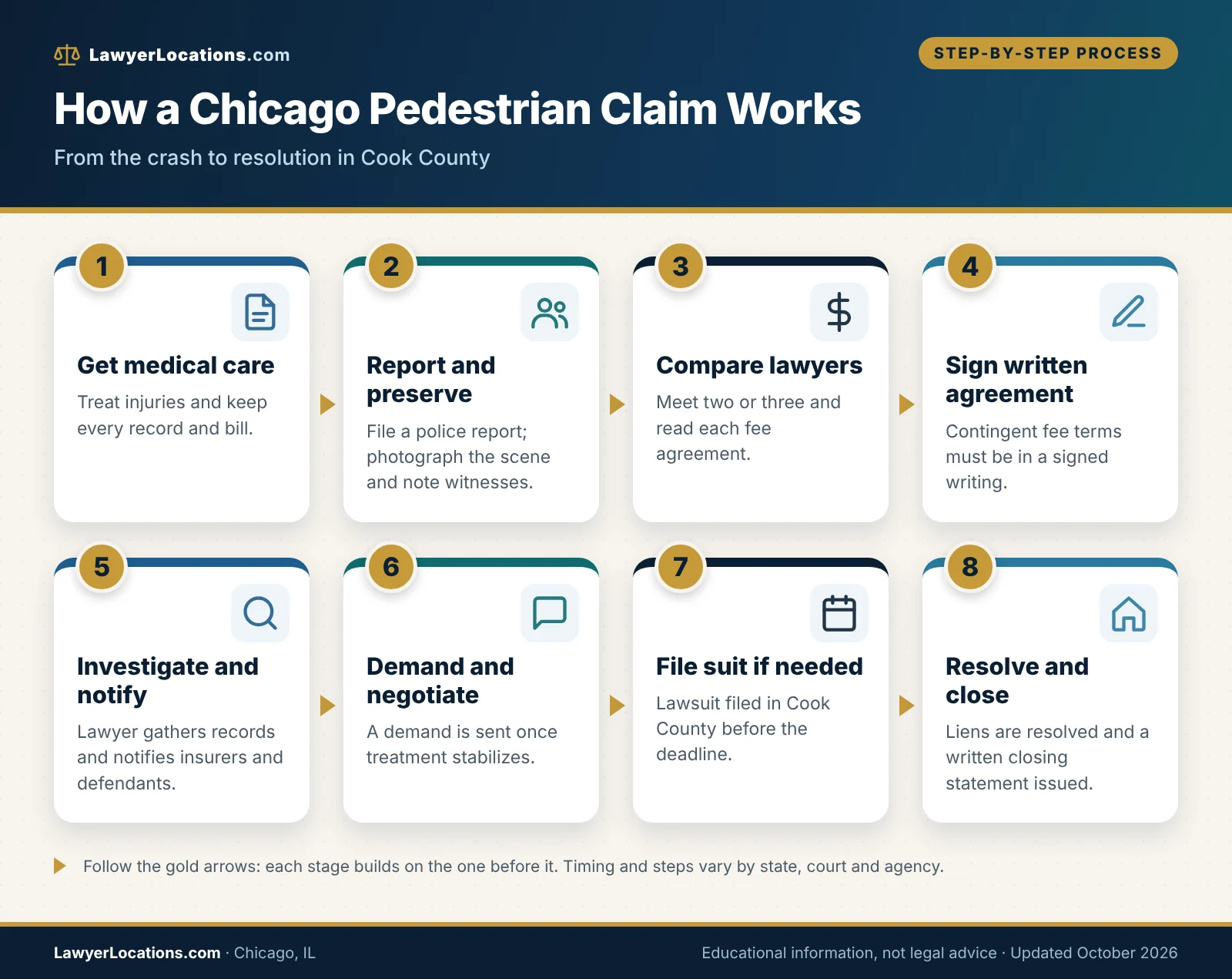
Text version of this graphic
- Get medical care and report the crash to the Chicago Police Department.
- Preserve evidence: photos, witness names, nearby camera locations.
- Consult one or more lawyers and compare fee agreements.
- Sign a written contingent fee agreement if you decide to hire.
- Lawyer investigates, gathers records and notifies insurers.
- Treatment continues until your condition stabilizes; a demand is sent.
- Negotiation, and if needed, a lawsuit filed before the deadline.
- Settlement or judgment, lien resolution and a written closing statement.
Do not wait for treatment to finish before you speak with a lawyer. The two-year limit runs from the date of injury, not from the end of your recovery, and a claim against a public body can have a shorter clock. Check the deadline early
From claim to lawsuit in Cook County
Many injury claims settle without a trial, but settlement is never automatic. A lawyer builds the claim as if it could be tried, because the strength of the file is what drives negotiation.
The demand and negotiation stage
Once you reach a stable point in treatment, the lawyer assembles a demand package: the crash report, photographs, medical records and bills, proof of lost income and a narrative of how the injuries changed your daily life. The insurer responds, often with a lower figure, and the two sides negotiate. A good lawyer explains each offer in plain terms and leaves the decision to accept or reject it with you.
Settlement timing depends on the severity of injuries, the number of insurers involved and whether fault is disputed. Pedestrian cases with a disputed signal phase or a hit-and-run driver generally take longer to evaluate than a case where fault is clear.
Filing and discovery
If negotiation fails, or if the deadline is approaching, the lawyer files a complaint in the Circuit Court of Cook County and arranges for the defendant to be served. After that comes discovery, the formal exchange of information: written questions, document requests and depositions, which are out-of-court sworn interviews. Courts commonly encourage settlement talks and mediation along the way, and only a small share of filed cases go to a jury.
For a wider look at how injury work is organized across the city, our personal injury lawyer guide for Chicago covers claims beyond pedestrian crashes.
Reading this page does not create an attorney-client relationship, and LawyerLocations.com is a legal-education and lawyer-discovery resource, not a law firm. Nothing here predicts what any claim is worth.
Illinois Pedestrian Law, Fault and Deadlines That Shape Chicago Claims
Illinois law requires drivers to yield to pedestrians in crosswalks, requires pedestrians to yield when crossing elsewhere, and reduces or bars recovery if the injured person shares too much of the blame. These rules decide how much leverage a pedestrian has before any negotiation begins.
Right-of-way rules for drivers and pedestrians
The Illinois Vehicle Code, 625 ILCS 5/ Article X, sets out the rights and duties of people on foot. Chicago has its own traffic ordinances as well, but the state statutes below are the common starting point for fault arguments. A lawyer will read them against the facts of your crash rather than treating them as a simple checklist.
Crossing within a crosswalk
Under 625 ILCS 5/11-1002(a), when traffic signals are not in place or not working, the driver of a vehicle must stop and yield the right-of-way to a pedestrian crossing within a crosswalk when the pedestrian is on the half of the roadway the vehicle is using, or is approaching from the other half so closely as to be in danger. A driver approaching from behind may not overtake and pass a vehicle that has stopped at a marked crosswalk, or at an unmarked crosswalk at an intersection, to let a pedestrian cross (subsection (d)).
The statute also protects drivers from sudden movements. Subsection (b) says no pedestrian shall suddenly leave a curb or other place of safety and walk or run into the path of a moving vehicle that is so close as to be an immediate hazard. Insurers often lean on that language, so evidence about distance, speed and timing matters a great deal.
Crossing outside a crosswalk
Under 625 ILCS 5/11-1003, a pedestrian crossing a roadway at any point other than within a marked crosswalk, or within an unmarked crosswalk at an intersection, must yield the right-of-way to all vehicles. Between adjacent intersections where traffic-control signals are operating, pedestrians must use a marked crosswalk, and diagonal crossing at an intersection is limited to places authorized by official traffic-control devices. Pedestrians with disabilities have a limited allowance where an intersection is physically inaccessible to them, but they still yield to vehicles.
None of this means a pedestrian who crosses mid-block has no claim. It means the question of shared fault, discussed next, becomes central. Drivers also owe general duties of care beyond these specific rules, and a lawyer evaluates both.
A crosswalk can be marked with painted lines, or unmarked, which generally means the extension of sidewalk lines across an intersection. Whether a crosswalk existed at the exact spot of your crash can change the legal analysis, so describe the location precisely to any lawyer you meet.
Shared fault and the time limit to sue
Two statutes work together in almost every Illinois pedestrian case: one decides how fault is divided, the other decides how long you have to file.
Modified comparative fault
Illinois follows a modified comparative fault rule in 735 ILCS 5/2-1116. If the injured person’s contributory fault is more than 50% of the proximate cause of the harm, the person is barred from recovering damages. If the fault is 50% or less, recovery is not barred, but damages are reduced in proportion to the plaintiff’s share of fault. The rule applies to actions on account of bodily injury or death.
This is a simplified illustration, not a prediction. Suppose a jury found that damages totaled a given amount and that the pedestrian was 20% at fault. The recoverable amount would be reduced by 20%. If the same jury found the pedestrian 51% at fault, the statute would bar recovery entirely. That cliff at the 50% line is why fault evidence is so heavily contested.
The two-year filing deadline and its exceptions
Most personal injury actions in Illinois must be started within 2 years after the cause of action accrued, under 735 ILCS 5/13-202. For a pedestrian struck by a car, the clock usually starts on the date of the crash. The statute has narrow exceptions, such as certain claims tied to a convicted Class X felony or first degree murder, which rarely apply to ordinary traffic cases.
Separate rules can pause or extend the period for minors and some other situations, and wrongful death claims have their own statute. Our national guide on how long you have to file a personal injury claim compares state deadlines, but for any Chicago crash the safest approach is to have a lawyer confirm the date that applies to you.
Shorter clocks when a public body is involved
Pedestrians are sometimes hurt by a city vehicle, a transit bus or a dangerous public way. Those claims are not governed by the general two-year period alone.
City of Chicago and other local entities
The Local Governmental and Governmental Employees Tort Immunity Act, in 745 ILCS 10/8-101, says a civil action may not be commenced against a local entity or its employees for an injury unless it is commenced within one year from the date the injury was received or the cause of action accrued. A narrow exception applies to certain patient-care claims. That one-year period can matter if, for example, a city-owned vehicle struck you or a defective public sidewalk or crossing was a cause.
The Act also contains many immunities and defenses beyond the filing deadline, so these claims call for a lawyer who has handled them before.
Claims against the Chicago Transit Authority
For the CTA, the Metropolitan Transit Authority Act has its own notice rule. As quoted in an Illinois appellate opinion, section 41 requires a written statement within six months of the injury, filed with both the secretary of the Chicago Transit Board and the Authority’s General Counsel. The statement must include, among other things, the date and approximate hour of the accident, its location, and the name and address of any attending physician. The court described the requirement as mandatory, with strict compliance required and dismissal as the consequence of failure.
If a CTA bus or train was involved in your pedestrian crash, treat that six-month notice as an immediate task, and ask any lawyer you consult how they handle it.
A lawyer or intake worker who says “you have plenty of time” without asking who the defendants might be is skipping the most time-sensitive question. Public-body deadlines can be far shorter than two years. 1 year or less
| Possible defendant | Rule | What it requires | Practical step |
|---|---|---|---|
| Private driver or vehicle owner | 735 ILCS 5/13-202 | Suit commenced within two years after the cause of action accrued | Calendar the crash date and confirm the deadline with a lawyer |
| Employer, rideshare or delivery company | 735 ILCS 5/13-202 | Same two-year rule for most injury claims; other legal issues about responsibility may apply | Record the company name, vehicle markings and app details early |
| City of Chicago or another local public entity | 745 ILCS 10/8-101 | Suit commenced within one year of the injury, subject to the Act’s other provisions | Treat as urgent; ask a lawyer about the Act’s immunities and defenses |
| Chicago Transit Authority | Metropolitan Transit Authority Act, section 41 | Written statement within six months, filed with the Board secretary and the General Counsel | Gather date, time, location and physician details for the statement |
| Your own insurer (medical payments, uninsured or underinsured motorist) | Your policy and 215 ILCS 5/143a | Policy conditions, notice duties and sometimes arbitration | Read your declarations page and report the crash promptly |
Chicago Courts, Records, Insurance and Liens
Chicago pedestrian cases are filed in the Circuit Court of Cook County, the crash report comes from the Chicago Police Department, and the money side is shaped by insurance coverage and medical-provider liens. Knowing these local pieces helps you ask sharper questions when you interview lawyers.
Which Cook County court hears the case
Cook County runs one of the largest trial court systems in the country, and the division where a case lands depends mostly on the amount of damages sought. The Clerk of the Circuit Court publishes guides to each division, and those guides are the best place to confirm current thresholds and room numbers.
The Law Division at the Daley Center
According to the Clerk’s guide to the Law Division, that division hears claims in excess of $30,000 arising in Cook County, including personal injury and motor tort cases such as damages from a vehicle collision, premises liability and wrongful death. The First Municipal District Law Division is at the Richard J. Daley Center, 50 West Washington Street, Chicago. When a case is filed there, it is randomly assigned to a motion calendar, identified by a letter that corresponds to a courtroom and judge.
Many serious pedestrian injury cases fall in this category because hospital care, surgery and lost income push the claimed damages above the line. Always confirm the current dollar threshold and filing procedures on the Clerk’s website, because court rules and divisions are updated.
The Civil Division and mandatory arbitration for smaller claims
The Clerk’s Civil Division page describes civil cases seeking damages below $30,000, including personal injury, and the Circuit Court’s Municipal District mandatory arbitration program covers civil suits seeking money damages of $30,000 or less in which a jury has been requested. Those cases are referred to arbitration, a shorter hearing before an arbitrator, before they can reach a jury trial.
A smaller pedestrian claim, such as a minor injury with limited treatment, may take that route. For a broader view of how Cook County courts handle injury cases, see our guide to personal injury lawyers in Cook County.
Ask each lawyer which division they expect to file in and why. A clear answer tied to your damages and the defendants involved suggests the lawyer has thought about your case rather than reading from a script. Ask “where would you file?”
| Venue or office | Role in a pedestrian claim | What to know |
|---|---|---|
| Circuit Court of Cook County, Law Division (Daley Center) | Hears personal injury and motor tort suits above the division’s dollar threshold | Random assignment to a motion calendar; confirm current rules with the Clerk |
| Clerk of the Circuit Court, Civil Division | Handles civil cases below the $30,000 line, including personal injury | Filing requires a complaint, a summons and a cover sheet; fees vary by claim amount |
| Municipal District mandatory arbitration | Refers eligible smaller cases to an arbitration hearing | Applies to suits seeking $30,000 or less in which a jury has been requested |
| Chicago Police Department Records | Source of the traffic crash report | Online purchase portal; older reports in person at the Records Customer Service Section |
| Chicago Department of Transportation (CDOT) | Street design and signal information; Vision Zero traffic safety program | Public data resources may help a lawyer investigate a dangerous intersection |
Getting the crash report and understanding the street
The official record of the crash and the story of the street where it happened are two of the most valuable pieces of evidence in a pedestrian case. Both are easier to collect if you start soon.
Ordering the Chicago traffic crash report
The Chicago Police Department sells traffic crash reports through an online portal. Its page states the fee is $6.00 per report ($1.50 per amended report) as of October 2026. For reports completed before 2016, paper reports and other inquiries, the CPD directs people to the Records Customer Service Section at 3510 South Michigan Avenue, with a phone line at (312) 745-5130.
Review the report carefully when you receive it. Check the spelling of your name, the location, the narrative, any diagram and whether witnesses are listed. A report is not a final finding of fault, but insurers and lawyers read it closely, so factual errors are worth raising with your lawyer. Our checklist in what to do after a car accident covers the first steps at the scene.
Vision Zero and the role of street design
Chicago’s Department of Transportation describes the Vision Zero Chicago Action Plan as a guiding document for the City’s traffic safety priorities, with focus areas that include vehicle speed and size, reckless driving and inequities in crash risk. The same CDOT page states that over half of pedestrians killed in the city are hit by an SUV or larger vehicle.
These public resources do not decide your claim. They can, however, help a lawyer understand whether an intersection has a known pattern of problems, which may matter to questions about road design, signal timing or the responsibility of a public body.
If you cannot remember exactly where the crash happened, return with a phone camera and photograph the intersection from the pedestrian’s point of view, in daylight and, if the crash happened after dark, at a similar hour. Do this only when it is safe and you are physically able.
Insurance coverage and medical liens
Where the money comes from, and who gets paid first, can shape the outcome as much as the amount of a settlement.
Hit-and-run and uninsured drivers
Pedestrians are often hurt by drivers who leave the scene or who carry little or no insurance. Illinois’s uninsured motorist statute, 215 ILCS 5/143a, calls for coverage for insured persons who are legally entitled to recover from the owners or operators of hit-and-run vehicles, and it ties required minimum limits to the Illinois Vehicle Code. The statute also addresses arbitration of coverage and damages disputes through the American Arbitration Association.
Whether your own policy applies to you as a pedestrian, and what notice you must give, depends on its terms. Read more in our guide to uninsured motorist claims, and report a hit-and-run to police right away.
Hospital and provider liens on your recovery
Under the Health Care Services Lien Act, 770 ILCS 23/10, health care professionals and providers who treat an injured person have a lien on the person’s claims and causes of action for their reasonable charges. The Act limits total liens to 40% of the recovery and caps each licensed category of provider, such as physicians or hospitals, at one-third of the verdict, judgment, award or settlement. Health insurers, Medicare, Medicaid and others can assert separate reimbursement rights that follow different rules.
Your lawyer should explain which liens are likely, who has already sent notices and how those amounts could affect what you take home. Our guide on who pays medical bills after a car accident explains how insurance and liens fit together.
If a lawyer cannot explain, even in general terms, how medical liens and insurer reimbursement claims are handled before a settlement is finalized, ask more questions. Net recovery, not the headline settlement number, is what lands in your pocket. Ask about liens before you sign off on any settlement.
How to Compare Pedestrian Accident Lawyers in Chicago
Compare Chicago pedestrian accident lawyers on license standing, relevant experience, communication and a clear written fee agreement, not on billboards or promises. Meeting two or three lawyers and asking the same questions of each gives you something concrete to compare.
Verify licenses and use reputable referral sources
Before you judge a lawyer’s experience, confirm that the person is licensed in Illinois and in good standing. That step takes a few minutes and filters out problems early.
Check the ARDC Lawyer Search
The Illinois Attorney Registration and Disciplinary Commission (ARDC) tells the public to use its online Lawyer Search to find public information such as license status and public disciplinary history. The ARDC also explains that complaints are private and confidential, that formal actions are usually public, and that it does not decide or settle fee disputes and has no authority over legal malpractice claims.
That last point matters: the ARDC is a licensing and discipline body, not a billing referee. If you later disagree with a lawyer about fees, you may need to talk first with the lawyer, review your written agreement and consider other dispute options.
Lawyer referral services and legal aid
The Chicago Bar Association Lawyer Referral Service describes a network of more than 200 screened lawyers, lists personal injury among its practice areas and states that, if you meet with a referred lawyer, the lawyer collects a $30 fee at the initial consultation, which goes toward the service’s operating costs. The service’s phone number is 312-554-2001, and the page includes a release of liability that you should read carefully. The Clerk of the Circuit Court also lists the Illinois State Bar Association LawyerFinder at (800) 922-8757, the CARPLS Legal Aid Hotline at (312) 738-9200 and Illinois Legal Aid Online.
Referral services can save time, but a referral is not an endorsement of any particular outcome, and you remain free to meet other lawyers. If your income is limited and your claim is small, legal aid organizations may be able to point you in a useful direction even if they do not handle injury suits.
Write down each lawyer’s full name and bar number from the ARDC record, then compare it with the name on the fee agreement you are offered. They should match. Verify before you sign
Questions that separate one lawyer from another
Good questions do not need legal training. They focus on who will do the work, how the lawyer approaches pedestrian cases and how you will hear from the office.
Experience with pedestrian and public-body claims
Ask how often the lawyer handles claims where the injured person was on foot, and whether the office has dealt with the City of Chicago, the CTA or hit-and-run situations. Ask who will investigate the scene and who decides whether to hire a reconstruction expert, a medical expert or a life-care planner when injuries are serious.
Avoid asking for promised results. A responsible lawyer should decline to predict an outcome and should instead describe the process, the risks and what could weaken the claim, such as a gap in medical treatment or disputed signal phases.
Staffing, communication and your role
Ask who your day-to-day contact will be, how quickly the office typically returns messages, and whether the person you meet at the consultation will be the lawyer who handles your case. Ask how you will be told about settlement offers, and who has authority to accept or reject them. The decision to settle belongs to you.
Also ask what you should do, and avoid doing, while the case is pending: posting on social media, discussing the crash with insurers, missing appointments or switching providers without telling the office.
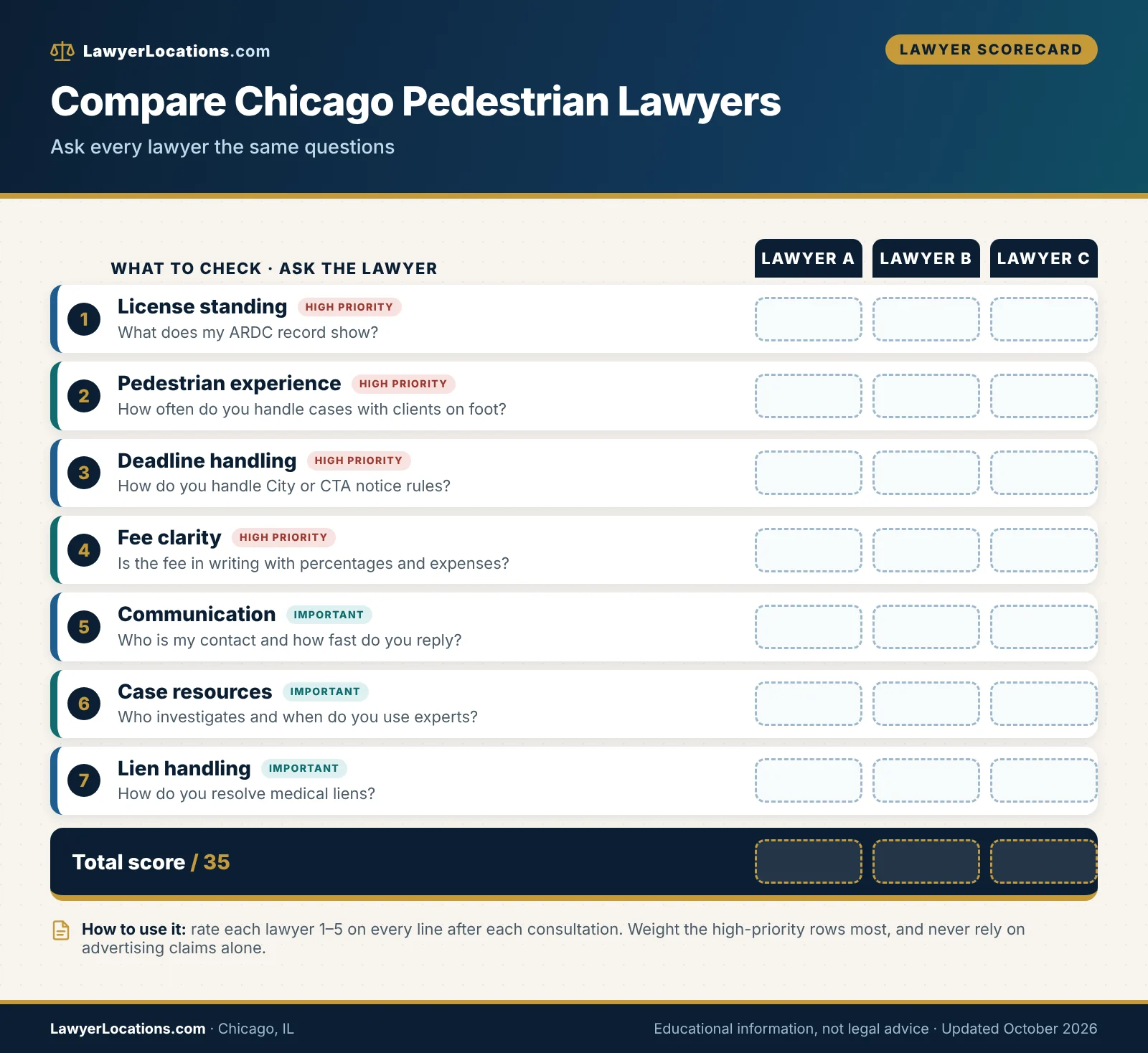
Text version of this graphic
- License and standing: Is the lawyer licensed in Illinois, and what does the ARDC record show?
- Pedestrian case experience: How often does the office handle claims where the client was on foot?
- Public-body deadlines: How will you handle City of Chicago or CTA notice rules?
- Fee clarity: Is the contingent fee in writing with percentages and expenses explained?
- Communication: Who is my contact, and how fast are messages answered?
- Case resources: Who investigates, and when are experts used?
- Lien handling: How are medical liens and reimbursement claims resolved?
| Factor | What to ask | Why it matters |
|---|---|---|
| License standing | What is your ARDC registration status and discipline history? | Confirms the person is authorized to practice in Illinois |
| Experience | How many pedestrian cases has your office handled, and against which types of defendants? | Pedestrian claims often involve disputed signals, hit-and-run drivers or public bodies |
| Fee agreement | Can I see the written agreement, including percentages at each stage? | Illinois requires a contingent fee agreement to be in a signed writing |
| Expenses | Which costs do I owe if there is no recovery? | The agreement must say which expenses the client owes whether or not the client prevails |
| Communication | Who will update me, and how often? | Sets expectations and prevents surprises |
| Liens | How do you resolve provider and insurer liens? | Affects the amount you receive after a settlement |
| Control of settlement | Who decides whether to accept an offer? | The client makes that decision, with the lawyer’s advice |
Red flags and ethical lines
Most Chicago lawyers handle injury work professionally. A few warning signs, however, deserve a closer look before you sign anything.
Pressure, promises and unclear fees
Be cautious if someone pressures you to sign at the hospital or at your front door, promises a particular result, or will not put the fee terms in writing. Illinois Rule of Professional Conduct 1.5 prohibits nonrefundable fees and nonrefundable retainers, and it bars agreements that unreasonably restrict a client’s right to end the representation or get a refund of unearned or unreasonable fees.
- A promise of a specific dollar result or a sure win.
- Unwillingness to provide the fee agreement before you decide.
- No explanation of case expenses or liens.
- Pressure to sign immediately, or to decline other consultations.
- Advice to avoid medical care or skip a police report.
Advertising and credentials
Billboards, jingles and big settlement claims tell you about marketing budgets, not about how a lawyer will treat your case. Be skeptical of titles that sound official, and treat any claim that someone is the “top” lawyer in town as marketing. Use objective checks instead: license status, written fee terms, how clearly the lawyer explains the process, and how comfortable you feel asking questions.
If you are still deciding whether you need representation at all, our guide on whether you need a lawyer after a car accident walks through the decision.
- The lawyer explains deadlines, including any public-body notice rules, in the first meeting.
- The fee agreement is written, signed and explains expenses.
- You leave knowing who will handle the file and how to reach them.
- The office predicts a result before reviewing records.
- You are asked to sign before reading the agreement.
- Answers about liens, costs and communication are vague.
Pedestrian Accident Lawyer Fees, Costs and Decision Points in Chicago
Most injury lawyers in Chicago work on a contingent fee, meaning the fee depends on the outcome, but Illinois ethics rules require the terms to be in a signed writing. The percentage matters, yet expenses, liens and timing often affect what you actually receive.
How contingent fee agreements work under Illinois rules
A contingent fee agreement is a contract, and Rule 1.5 of the Illinois Rules of Professional Conduct of 2010 sets minimum standards for what it must say. Reading the agreement closely before signing is one of the simplest ways to protect yourself.
What the written agreement must contain
Under Ill. R. Prof’l Conduct 1.5(d)(2), a fee may be contingent on the outcome except where another rule or law prohibits it. A contingent fee agreement must be in a writing signed by the client and must state how the fee is determined, including the percentage or percentages that go to the lawyer in the event of settlement, trial or appeal. It must also describe the litigation and other expenses to be deducted from the recovery and whether those expenses are deducted before or after the contingent fee is calculated.
That last sequencing point can change your net recovery, so ask the lawyer to walk through a hypothetical using round numbers. Do not rely on a verbal description of the fee.
Expenses and the closing statement
The agreement must clearly notify you of any expenses for which you will be liable whether or not you win. When the matter ends, the lawyer must give you a written statement stating the outcome and, if there was a recovery, showing the remittance to you and how it was determined. Keep that statement with your tax and medical records.
Illinois also has a separate rule on the reasonableness of fees. Rule 1.5(a) lists factors such as the time and labor required, the customary fee in the locality, the amount involved and results obtained, time limits, the lawyer’s experience and whether the fee is fixed or contingent.
Signing a fee agreement does not stop the clock. If you have not hired anyone and your deadline is approaching, ask each lawyer you consult how soon a decision must be made and in writing whether they are taking the case or not. Get a clear yes or no
Costs beyond the percentage
The fee percentage is only one number. Case expenses and liens also come out of the recovery, and they can be substantial in a serious injury case.
Case expenses you may hear about
Common expenses include court filing fees, fees for obtaining medical and police records, deposition and court-reporter costs, and the fees of experts such as accident reconstructionists or physicians. The Clerk of the Circuit Court publishes a fee schedule that varies by claim amount, and you should check it rather than relying on a number from an article.
Ask whether the firm advances these costs, whether you owe them if there is no recovery, and whether you will receive itemized statements. The answers should match the written agreement.
Liens, reimbursement claims and net recovery
As discussed above, providers may assert liens under the Health Care Services Lien Act, and your own health insurer may claim reimbursement. A lawyer who negotiates those amounts can sometimes reduce what is owed, but the outcome varies and no one can promise a particular reduction.
Ask for a rough, written net-recovery illustration with sample figures before any settlement is accepted. That exercise helps you decide whether an offer meets your needs, taking into account future treatment and lost income.
| Category | Who sets or limits it | What to ask your lawyer |
|---|---|---|
| Attorney fee | Your signed agreement; reasonableness under Rule 1.5 | What percentages apply at settlement, trial and appeal? |
| Case expenses | Your agreement; actual vendor and court charges | Which expenses do I owe if there is no recovery? |
| Provider liens | Health Care Services Lien Act, 770 ILCS 23/10 (40% total cap; one-third per provider category) | Which providers have noticed liens and can they be negotiated? |
| Health insurer or government reimbursement | Plan terms and applicable federal or state law | Who has reimbursement rights and how are they resolved? |
| Your net recovery | What remains after the items above | Can you give me a written net-recovery illustration? |
A decision timeline from the first week to the filing deadline
The legal clock and the medical timeline rarely match. A simple calendar helps you separate what must happen soon from what can wait.
The first weeks after the crash
In the first days, focus on medical care, the police report and preserving evidence. Within the first few weeks, identify possible defendants, check whether a public body or the CTA was involved, report the crash to your insurers and start comparing lawyers. These steps cost little and keep options open.
Avoid signing releases or accepting early settlement offers until you understand the extent of your injuries, because a signed release can end the claim.
Approaching the filing deadline
As the deadline nears, the question shifts from “should we keep negotiating” to “must we file to protect the claim.” A lawyer can file a lawsuit to preserve the claim while talks continue. If you are still unrepresented a few months before the deadline, treat hiring a lawyer or at least a consultation as urgent.
For deadlines tied to a public body, the margin is smaller: one year for local entities under the Tort Immunity Act, and six months for the CTA notice.
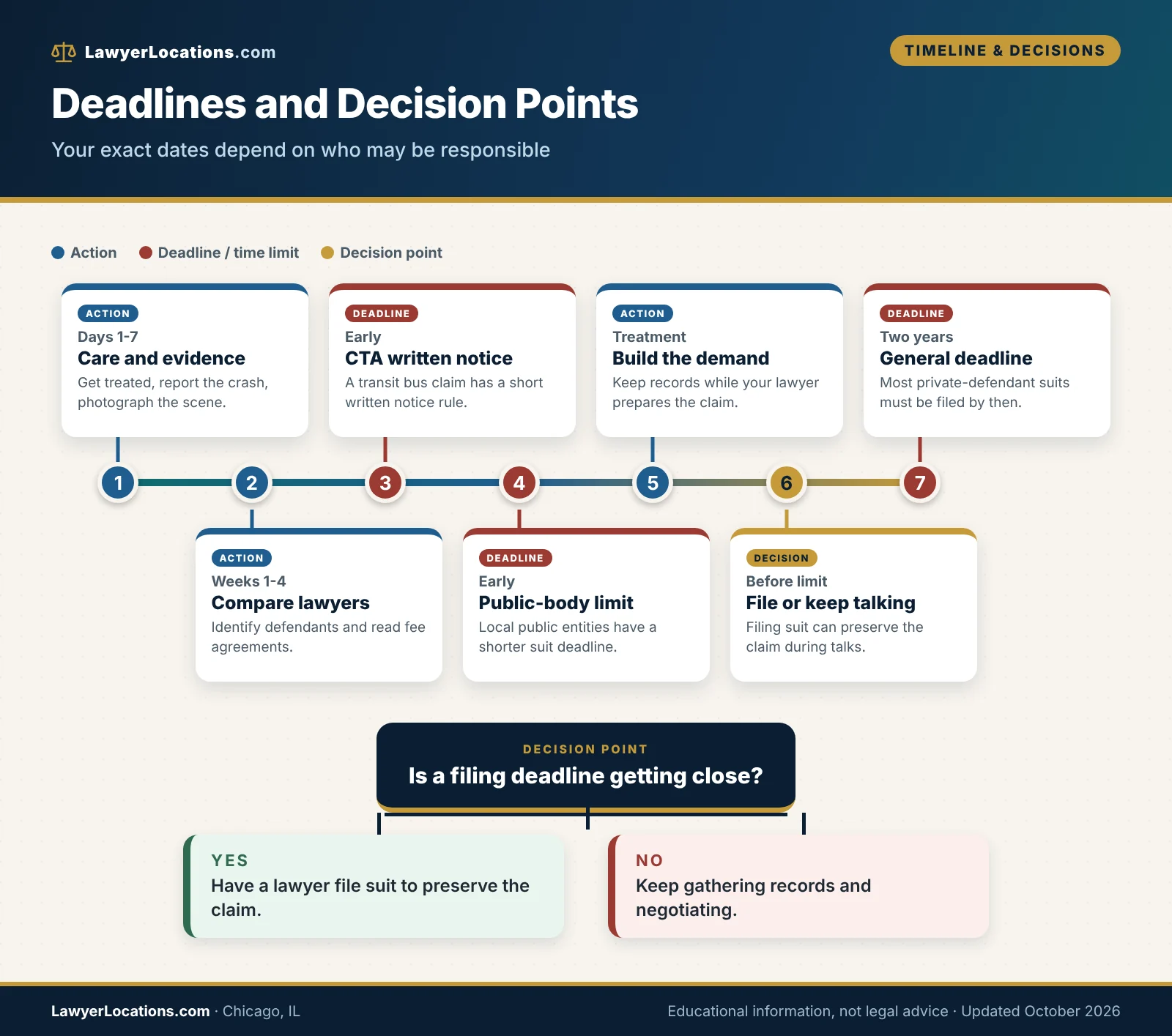
Text version of this graphic
- Days 1 to 7: Medical care, police report, photographs, witness names.
- Weeks 1 to 4: Identify defendants, notify insurers, compare lawyers and read fee agreements.
- Within six months (CTA claims): Written notice to the Chicago Transit Board secretary and General Counsel.
- Within one year (local public entities): Suit must be commenced under the Tort Immunity Act.
- Treatment months: Keep records; lawyer builds the demand.
- Within two years (most private-defendant claims): Lawsuit must be commenced under 735 ILCS 5/13-202.
- Decision point: If negotiations stall near a deadline, file suit to preserve the claim.
Create one shared folder, paper or digital, for the crash report, photographs, medical bills, insurance letters and a simple daily pain and activity log. A lawyer will ask for all of it. One folder, everything in it
Preparing for Your Consultation and Next Steps
You will get more out of a consultation if you arrive with a short timeline, the key documents and a written list of questions. The meeting is also your chance to decide whether you trust the person.
The evidence and document checklist
Pedestrian cases turn on details that are easy to lose. Collect what you can, and tell the lawyer what you could not get.
From the scene and the street
Bring photographs of your injuries, clothing and shoes, the intersection and any vehicle damage, along with the names and contact details of witnesses. Note the exact location, time, weather, lighting and signal status, and write down whether you were in a marked crosswalk or elsewhere. Preserve your phone and any app data that may show your movements.
If you remember a nearby business or building with a camera, write down its name and address. A lawyer can send a preservation request quickly, which matters because video is often overwritten.
Medical, insurance and income records
Bring discharge papers, bills, the names of your doctors and therapists, your health insurance card and any letters from insurers or hospitals about payment or liens. Bring pay stubs or a letter from your employer if you lost time at work, and the declarations page from your auto policy.
- Police report number or the report itself.
- Photos and videos of injuries, scene and signals.
- Witness names and phone numbers.
- Medical records, bills and appointment dates.
- Health insurance and auto policy information.
- Proof of lost income.
- Any letters or calls from insurers, with dates.
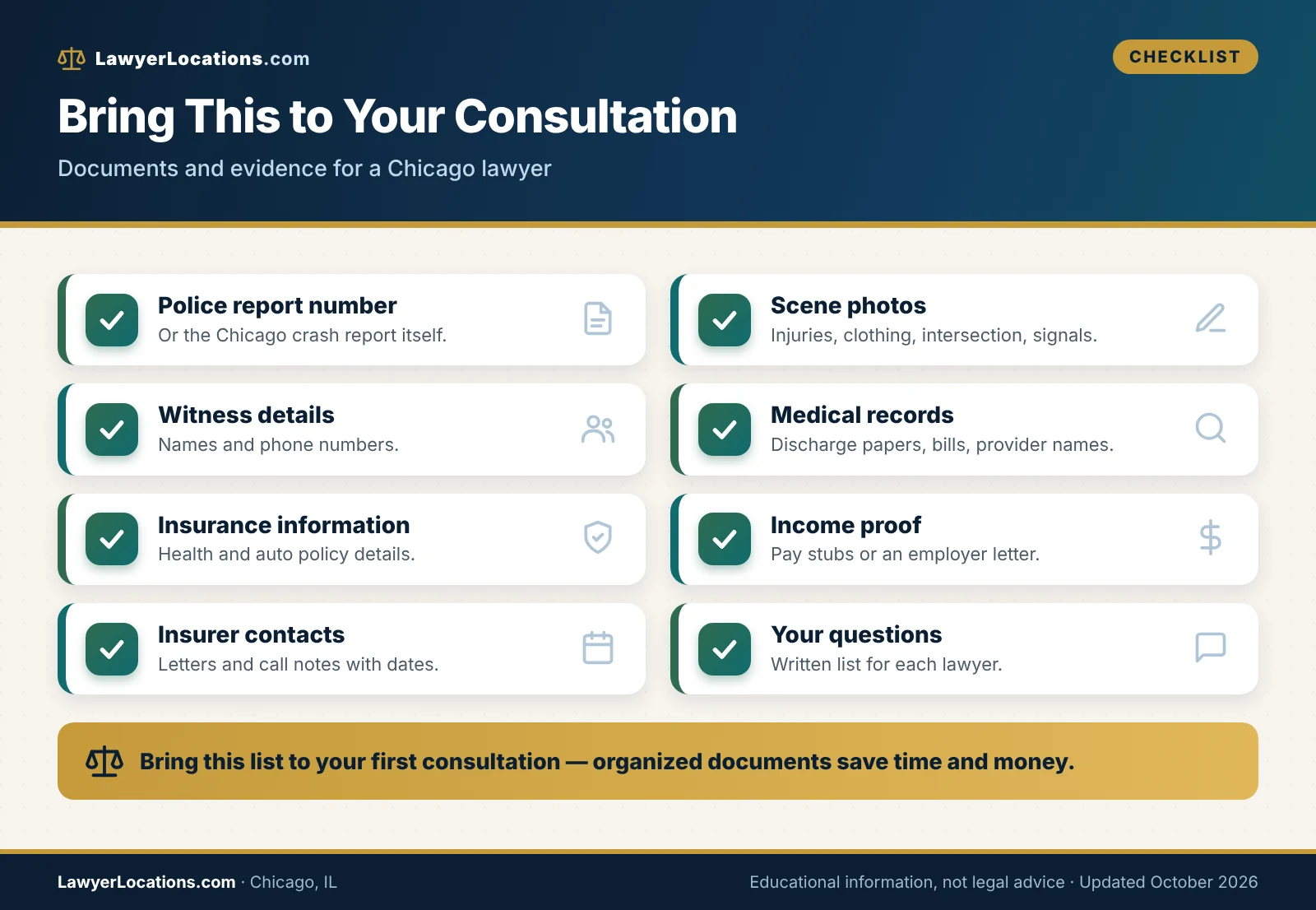
Text version of this graphic
- Police report number and crash report
- Photos of injuries, clothing and the scene
- Witness names and contact details
- Medical records and bills
- Health and auto insurance information
- Proof of lost income
- Insurer letters and call notes
- Written questions for the lawyer
Mistakes that can weaken a claim
Small mistakes early on can limit options later. Most are avoidable with a little preparation.
Statements to insurers and on social media
Do not give a recorded statement to the other driver’s insurer before you understand your rights, and do not guess about speed, distance or whether you saw the car. Posts, photos and comments on social media can be pulled into a dispute about fault or the extent of your injuries, so keep your accounts private or quiet while the claim is pending.
Be accurate with your own insurer and your doctors. Honest, consistent descriptions of symptoms are the best foundation for a claim.
Gaps in treatment and missed deadlines
Gaps in medical treatment let insurers argue that you recovered or that something else caused your symptoms. If cost or transportation is a barrier, tell your providers and your lawyer rather than simply stopping. On deadlines, assume a shorter clock may apply until a lawyer tells you otherwise, especially if a city vehicle, a CTA bus or a public roadway defect was involved.
Accepting a quick check and signing a release before you know the full extent of your injuries can close the door on later claims. Do not sign a release you have not had reviewed.
Next steps and quick answers
If you are hurt and unsure where to begin, work through the steps below in order. They protect your health, your evidence and your deadlines at the same time.
A simple action plan
- Get care and document it. Follow your doctors’ advice and keep every record.
- Order the crash report. Use the Chicago Police Department portal and review it for errors.
- Note every possible defendant. Driver, owner, employer, the City, the CTA or another party.
- Calendar the shortest deadline. Assume a public-body claim has less than two years.
- Check licenses and compare fee agreements. Use the ARDC Lawyer Search and meet at least two lawyers if you can.
- Sign only a written agreement you understand. Ask for a sample net-recovery illustration.
Quick answers to common questions
How much does a pedestrian accident lawyer cost in Chicago?
Many injury lawyers work on a contingent fee, which means the fee depends on the result. Under Illinois Rule 1.5(d)(2) the agreement must be in a writing signed by you and must state the percentages, the expenses and whether expenses come out before or after the fee. Percentages differ by firm, so compare agreements instead of relying on averages.
How long do I have to file a pedestrian accident lawsuit in Illinois?
For most personal injury claims against private parties, the period is two years after the cause of action accrued under 735 ILCS 5/13-202. Claims against local public entities are subject to a one-year limit under 745 ILCS 10/8-101, and CTA claims have a six-month written notice requirement. A lawyer should confirm the dates for your situation.
What if I was crossing outside a crosswalk?
Illinois law says a pedestrian crossing outside a crosswalk must yield to vehicles under 625 ILCS 5/11-1003, which can increase your share of fault. Under 735 ILCS 5/2-1116 you can still recover if you were 50% or less at fault, though damages are reduced. If you were more than 50% at fault, recovery is barred.
What if the driver left the scene?
Report the crash to the police right away and tell your own insurer. Illinois’s uninsured motorist statute, 215 ILCS 5/143a, addresses coverage for injuries caused by hit-and-run vehicles. Whether it applies to you depends on your policy terms and notice conditions.
How do I get the Chicago police crash report?
The Chicago Police Department sells reports through its online portal for a small per-report fee, and older reports are handled in person at the Records Customer Service Section on South Michigan Avenue. Check the CPD page for the current fee and process.
Which court would hear my case?
Most Chicago pedestrian injury suits are filed in the Circuit Court of Cook County. Cases above the $30,000 line generally go to the Law Division at the Daley Center, while smaller claims are handled in the Civil Division and may go through mandatory arbitration. Confirm current thresholds with the Clerk.
Can the hospital take money from my settlement?
Under the Health Care Services Lien Act, providers who treat you have a lien on your claim for reasonable charges, subject to caps on the total and on each provider category. Your health insurer may also claim reimbursement. A lawyer can explain which apply.
How do I check that a lawyer is licensed in Illinois?
Use the ARDC Lawyer Search to see license status and public discipline. The ARDC does not resolve fee disputes, so read your fee agreement carefully before you sign.
Is there a lawyer referral service in Chicago?
The Chicago Bar Association Lawyer Referral Service lists personal injury among its practice areas, and the Clerk of the Circuit Court also lists the Illinois State Bar Association LawyerFinder and legal aid hotlines. A referral is a starting point, not an endorsement.
Should I talk to the other driver’s insurance company?
You can give basic identifying information, but think carefully before giving a recorded statement or signing a medical release. A lawyer can handle those communications for you.
Can I hire a lawyer if I was partly at fault?
Yes. Illinois allows recovery when your fault is 50% or less, reduced by your percentage. A lawyer can evaluate how a jury might view shared fault on your facts.
Ready to compare your options?
Write down the crash date, the possible defendants and the questions in this guide, then meet at least two Chicago lawyers. If you want broader context first, start with our guide to the personal injury lawyer process in Chicago. LawyerLocations.com does not promise any outcome or recommend a specific lawyer.
General information only. This article is not legal advice, does not create an attorney-client relationship, and cannot predict the outcome of any claim. Laws, court rules, fees and agency procedures change, and facts vary. Consult a lawyer licensed in the relevant jurisdiction about your situation, and confirm deadlines and filing rules with official sources.
Sources & References
Show all 17 sources
- 735 ILCS 5/13-202, personal injury limitation period — Illinois General Assembly — ilga.gov — accessed October 2026
- 735 ILCS 5/2-1116, modified comparative fault — Illinois General Assembly — ilga.gov — accessed October 2026
- 625 ILCS 5/11-1002, pedestrian right-of-way in crosswalks — Illinois General Assembly — ilga.gov — accessed October 2026
- 625 ILCS 5/11-1003, crossing at other than crosswalks — Illinois General Assembly — lrb.ilga.gov — accessed October 2026
- 745 ILCS 10/8-101, Local Governmental and Governmental Employees Tort Immunity Act — Illinois General Assembly — ilga.gov — accessed October 2026
- Joseph v. Chicago Transit Authority, No. 1-98-3298 (Ill. App. Ct.), quoting section 41 of the Metropolitan Transit Authority Act — Illinois Courts — illinoiscourts.gov — accessed October 2026
- 215 ILCS 5/143a, uninsured and underinsured motorist coverage — Illinois General Assembly — ilga.gov — accessed October 2026
- 770 ILCS 23/10, Health Care Services Lien Act — Illinois General Assembly — ilga.gov — accessed October 2026
- Illinois Rule of Professional Conduct 1.5 (Fees) — Illinois Supreme Court — ilcourtsaudio.blob.core.windows.net — accessed October 2026
- A Guide to the Law Division — Clerk of the Circuit Court of Cook County — cookcountyclerkofcourt.org — accessed October 2026
- Civil Division — Clerk of the Circuit Court of Cook County — cookcountyclerkofcourt.org — accessed October 2026
- Municipal District Mandatory Arbitration — Circuit Court of Cook County — cookcountycourtil.gov — accessed October 2026
- Finding an Attorney — Clerk of the Circuit Court of Cook County — cookcountyclerkofcourt.org — accessed October 2026
- Traffic Crash Reports — Chicago Police Department — chicagopolice.org — accessed October 2026
- Vision Zero Chicago — Chicago Department of Transportation — chicago.gov — accessed October 2026
- Lawyer Referral Service — The Chicago Bar Association — chicagobar.org — accessed October 2026
- FAQs for the Public — Attorney Registration and Disciplinary Commission of Illinois — iardc.org — accessed October 2026
Legal Disclaimer and Limitation of Liability
Informational and illustrative purposes only. This article was prepared by LawyerLocations.com solely on the basis of the information available to us at the time of writing. It is an illustrative, general overview. It is not a complete or authoritative statement of the law, and it has not been reviewed by a lawyer licensed in your state or county.
Not legal advice. Nothing in this article is legal, financial, tax or immigration advice, and reading it does not create an attorney-client relationship between you and LawyerLocations.com or any author, lawyer or firm mentioned. Laws, court rules, fees, filing deadlines and agency procedures differ by state, county and court, and they change often. Some details here may be simplified, incomplete or out of date, and time limits for legal claims can be short.
No warranty. We make no representation or warranty, express or implied, about the accuracy, completeness, timeliness or suitability of this content for your situation. Please do not rely on it to make, delay or skip any legal decision. Check the facts against official sources and speak with a licensed attorney in the relevant jurisdiction before you act.
Limitation of liability. To the fullest extent permitted by law, LawyerLocations.com and its owners, authors and contributors disclaim all liability for any loss, damage, cost or other consequence arising from the use of, or reliance on, this article, including any content on third-party websites we link to. Mentioning a lawyer, firm, organization or service is not an endorsement and is not a promise of any result. If you are in immediate danger, contact your local emergency number.