If you are looking for a criminal defense lawyer Idaho courts will recognize, start with how the state sorts crimes: a felony is any crime punishable by time in state prison, and everything else that is not an infraction is a misdemeanor. In Idaho a first-offense DUI can mean up to $1,000 and 6 months in jail, while a third DUI within ten years is a felony with up to 10 years in prison. If you were arrested for DUI, the clock on a driver’s license hearing request can be as short as seven days.
This guide explains Idaho’s felony and misdemeanor penalties, how a case moves from the magistrate court to the district court, how public defenders now work statewide, what private lawyers charge for, and how to compare lawyers before you sign anything. It is general information about Idaho, not advice about your case.
What a Criminal Defense Lawyer Does in Idaho
A criminal defense lawyer protects the legal rights of a person who is under investigation, has been arrested or has been charged with a crime. In Idaho that work runs from the first police contact through bail, plea talks, trial, sentencing and, when it applies, an appeal or a later request to clear the record.
The job from arrest to resolution
Much of the work happens long before any trial date. The lawyer reads the police report, checks whether the stop or search was lawful, asks the prosecutor for the evidence, and advises you on every offer.
Before charges are filed
A lawyer can sometimes step in while police or a prosecutor are still deciding whether to charge you. That might mean arranging a voluntary surrender when a warrant is expected, or telling investigators in writing that all contact must go through counsel. Idaho’s time limits for starting a prosecution are explained in Section 2, but you should never assume an investigation has gone away because it has gone quiet.
You have the right to stay silent, and saying so politely is not an admission of anything.
After charges are filed
Once a complaint is filed, the lawyer’s work becomes more formal. It usually includes arguing for release conditions you can live with, requesting discovery (the prosecution’s evidence), filing motions to exclude evidence, negotiating with the county prosecuting attorney, and preparing for hearings. If the case does not resolve by agreement, the same lawyer tries it before a judge or jury.
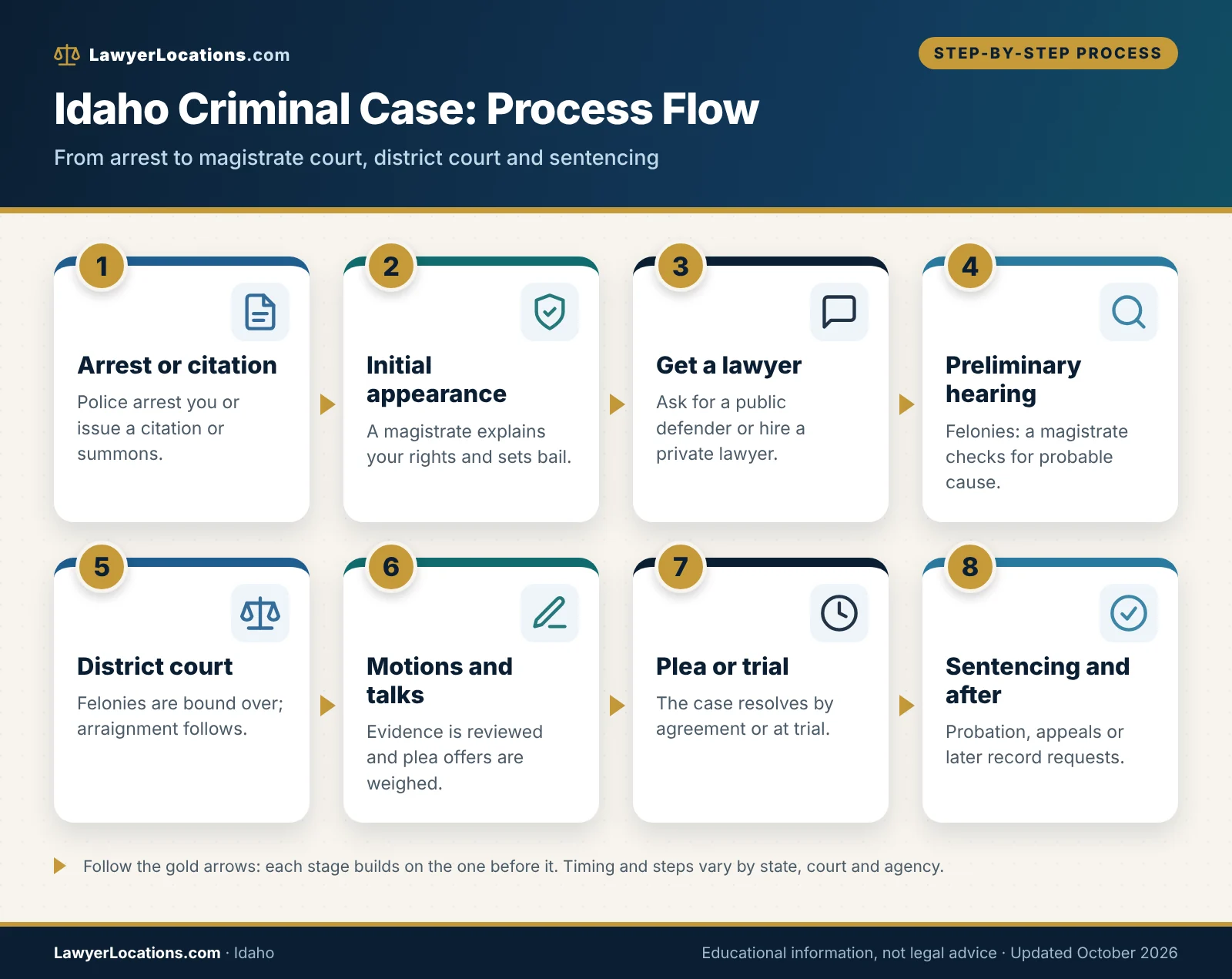
Text version of this graphic
- Arrest, citation or contact from police or a prosecutor.
- Initial appearance before a magistrate, with bail set and rights explained.
- Appointment of a public defender or hiring of a private lawyer.
- Felonies: preliminary hearing (or waiver) in magistrate court. Misdemeanors: arraignment in magistrate court.
- Felonies only: arraignment in district court after the case is bound over.
- Discovery, motions and plea negotiation.
- Trial or plea, then sentencing.
- After judgment: appeal, probation compliance, and any later request to set aside or clear records.
When to call a lawyer in Idaho
The right moment is earlier than most people think. You do not need to be formally charged to talk to a lawyer, and you do not need to wait for a court date.
Arrest, investigation or a warrant
Call a lawyer, or ask for one, if you have been arrested, if officers want to question you, if you learn there is a warrant, or if a search of your phone, car or home has taken place. If you are in custody and cannot afford a lawyer, you can ask the judge at your first appearance to appoint one. The court must advise you of that right under Idaho Criminal Rule 5.
Write down the date, time, agency and names of every officer you spoke with, and keep any paperwork you were handed. A citation, a notice of suspension or a bail receipt often carries a deadline printed in small type.
A summons, a letter or a court date you did not expect
Not every case starts with handcuffs. Some begin with a citation, a summons in the mail, or a call from a prosecutor’s office. Treat each one as real. A missed court date can turn a simple misdemeanor into a warrant, and that is a harder problem than the original charge.
Many lawyers will talk through a case in an initial consultation, but terms vary. Our guide to what to expect from a criminal defense consultation explains what to ask and what to bring.
Idaho Crimes, Classes and Penalties
Idaho defines most crimes in Title 18 of the Idaho Code. A crime is a felony if it can be punished by death or by a term in the state prison, a misdemeanor if it is any other crime that is not an infraction, and an infraction if it is a minor violation that carries only a fine.
How Idaho classifies crimes
The label matters because it decides which judge hears the case first, how long you can be jailed, what your lawyer must prove at a preliminary hearing, and what the conviction does to your future.
Felonies
Under Idaho Code 18-111, a felony is a crime punishable by death or imprisonment in the state prison. When a felony statute does not set its own penalty, Idaho Code 18-112 supplies a default: up to 5 years in prison, a fine of up to $50,000, or both. Many specific felonies, such as drug trafficking or aggravated DUI, set much heavier ranges of their own.
Misdemeanors and infractions
Idaho Code 18-113 sets the general misdemeanor penalty at up to 6 months in county jail, a fine of up to $1,000, or both, unless a specific statute says otherwise. Several do say otherwise. Petit theft and simple drug possession, for example, can carry up to a year in county jail. An infraction is treated as a civil matter and carries a fine, not jail.
Crimes that can be either
Some Idaho offenses can be punished by state prison or by lesser penalties, and the court chooses. Section 18-111 says that once the court imposes a sentence other than state prison, the offense is treated as a misdemeanor for all purposes. That detail can change your record, your lawyer’s negotiating strategy and your future eligibility for jobs and licenses.
Penalties for common charges
A map of the main penalty ranges
The table below collects penalties we confirmed in the Idaho Code in October 2026. It is a starting map, not a prediction.
| Charge | Idaho Code | Class | Statutory penalty range |
|---|---|---|---|
| General misdemeanor (no other penalty stated) | 18-113 | Misdemeanor | Up to 6 months in county jail, up to $1,000, or both |
| General felony (no other penalty stated) | 18-112 | Felony | Up to 5 years in state prison, up to $50,000, or both |
| DUI, first offense | 18-8004, 18-8005(1) | Misdemeanor | Up to 6 months and $1,000; license suspension and ignition interlock |
| DUI, second within 10 years | 18-8005(4) | Misdemeanor | 10 days minimum, up to 1 year, up to $2,000; at least 1 year license suspension |
| DUI, third within 10 years | 18-8005(6) | Felony | Up to 10 years in prison, up to $5,000; at least 1 year license suspension |
| Alcohol concentration of 0.20 or more, first offense | 18-8004C | Misdemeanor | 10 days minimum, up to 1 year, up to $2,000; 1 year suspension after release |
| Possession, Schedule I narcotic or Schedule II | 37-2732(c) | Felony | Up to 7 years, up to $15,000, or both |
| Possession, most other drugs (Schedules III to VI) | 37-2732(c) | Misdemeanor | Up to 1 year, up to $1,000, or both |
| Petit theft | 18-2408(3) | Misdemeanor | Up to 1 year in county jail, up to $1,000, or both |
| Grand theft (most categories) | 18-2408(2) | Felony | 1 to 14 years, up to $5,000, or both; some categories reach 20 years |
Why numbers alone can mislead
Judges consider the facts, the prior record and the exact subsection charged, and prosecutors can file more than one count. The statutory maximum is a ceiling, not a forecast.
Online summaries of Idaho penalties are often out of date, and a few that rank high in search results mix up sections of the code. Use any chart, including this one, only to prepare questions for a licensed Idaho lawyer, who can read the version of the statute in force on your offense date.
Enhancements and time limits
Two features of Idaho law deserve special attention because they can quietly change the stakes: repeat-offender enhancements and the deadlines prosecutors must meet.
Repeat felony enhancement
Under Idaho Code 19-2514, a person convicted of a felony for the third time is a persistent violator. The court must then impose a term in state custody of at least 5 years, and the term may extend to life. Earlier convictions can come from Idaho or from other states. If you have prior felonies anywhere, say so to your lawyer in the first meeting, because it changes how a plea offer should be evaluated.
Time limits for starting a prosecution
For most felonies, Idaho Code 19-402 requires the state to file a complaint or obtain an indictment within 5 years of the offense. The most serious crimes listed in section 19-401 have no limit at all. For misdemeanors, Idaho Code 19-403 generally sets a one-year limit, with listed exceptions. Both statutes contain special rules for certain offenses and for tolling (pausing the clock).
These deadlines bind the prosecution, not you. If you have been told an investigation is open, do not try to run out the clock. A lawyer can tell you whether a limitation defense is even realistic.
How an Idaho Criminal Case Moves Through the Courts
Every Idaho criminal case begins in front of a magistrate judge. Misdemeanors usually stay there. Felonies move on to a district judge once a magistrate finds enough evidence or you waive the hearing. Knowing which court you are in tells you what comes next and what your lawyer is trying to accomplish at each step.
Magistrate division and district court
Idaho runs one unified court system with seven judicial districts covering all 44 counties. Each district court has a magistrate division, which does a great deal of the day-to-day criminal work.
| Stage or case type | Court | What happens there |
|---|---|---|
| Initial appearance for any arrest | Magistrate division | Rights explained, bail set, counsel addressed |
| Misdemeanor case | Magistrate division | Arraignment, pretrial motions, plea or trial, sentencing |
| Felony preliminary hearing | Magistrate division | Judge decides if there is probable cause to send the case upward |
| Felony trial and sentencing | District court | Arraignment on the information or indictment, motions, trial, sentence |
| Appeal of a magistrate decision | District court | Reviews the magistrate record; further appeals can go to the Idaho appellate courts |
The magistrate division
According to the Idaho Supreme Court’s description of the courts, magistrate judges handle traffic and infraction cases, misdemeanor criminal cases and preliminary hearings in felony cases. Almost everyone arrested in Idaho meets a magistrate first, whatever the eventual charge.
The district court
District courts hear felony criminal cases, appeals from the magistrate division and civil cases above the magistrate threshold. A felony defendant who is bound over from the magistrate court is arraigned in district court, where the judge will preside over most motions and the trial itself.
Judicial districts and your county
Your county determines your judicial district, your clerk of court and your prosecutor. The state’s courts and the Court Assistance Offices describe 7 judicial districts and 44 counties. The four counties most readers ask about are covered in Section 7.
From arrest to arraignment
The Idaho Criminal Rules set a clear sequence of early hearings. Your lawyer’s first goal is usually release on terms you can meet; the second is to test the state’s evidence before the case is locked in.
Initial appearance and the first 48 hours
Under Idaho Criminal Rule 5, an arrested person must be brought before a magistrate without unreasonable delay, and no later than 24 hours after arrest, excluding Saturdays, Sundays and holidays. After a warrantless arrest, a probable-cause determination must happen within 48 hours, weekends included.
At this hearing the magistrate must tell you that you can stay silent, what you are charged with, your right to bail, your right to counsel as the law provides, your right to a preliminary hearing if charged with a felony, and your right to speak with a lawyer and your family. You also sign a standard notification-of-rights form.
Bail
Under Idaho Code 19-2903, a person charged with a crime who is not released on their own recognizance is entitled to bail as a matter of right before a plea or verdict of guilty. The exception is an offense punishable by death where the proof is evident or the presumption great. For an arrest on a warrant, bail is the amount written on the warrant unless the magistrate finds good cause to change it.
Bail amounts and local schedules vary by county, so we do not publish figures here.
Preliminary hearing and the rarity of grand juries
A person charged by complaint with a felony is entitled to a preliminary hearing unless a grand jury has already indicted them. Under Idaho Criminal Rule 5.1, the hearing must be held within 14 days of the initial appearance if you are in custody and within 21 days if you are not, unless time is extended with your consent and good cause or, without consent, for extraordinary circumstances.
At the hearing the magistrate decides whether there is probable cause based on substantial evidence on every material element of the offense. Your lawyer can cross-examine witnesses and present evidence. If the judge finds probable cause, you are bound over to the district court. If not, the complaint is dismissed and you are discharged. You can also waive the hearing, which is usually a strategic choice made as part of negotiation.
Grand jury indictments are possible in Idaho, and the rules provide for arrest on an indictment warrant, but most felony cases in practice begin with a complaint and a preliminary hearing.
Idaho Criminal Rule 5.1 gives you a preliminary hearing within 14 days (in custody) or 21 days (out of custody). Your lawyer may waive or extend those times as part of a plan. Ask before agreeing, and ask what you are giving up.
Resolving the case
Most criminal cases end by agreement, but you have the right to a trial. Understanding the possible outcomes helps you evaluate any offer.
Pleas, probation and withheld judgments
A plea agreement is a deal between you and the prosecutor, which the judge may accept or reject. Idaho Code 19-2601 lets a sentencing court suspend a sentence and place you on probation, retain jurisdiction for up to 365 days, or withhold judgment on the terms and for the time it sets. Misdemeanor probation can last up to two years. Felony probation can last up to the maximum prison term you could have received.
Retained jurisdiction, often called a “rider” in Idaho courthouses, lets the court review your progress in a structured program before deciding whether to place you on probation. Treason and murder are excluded from these options.
Trial and sentencing
If there is no agreement, your lawyer prepares for a bench trial (before a judge) or a jury trial. After a conviction, sentencing is a separate hearing where your lawyer presents your history, treatment, employment and family responsibilities. Because a judge has wide discretion inside the statutory range, the sentencing hearing is often one of the most consequential parts of the case.
Public Defenders, Private Lawyers and What They Cost
If you cannot afford a lawyer and face jail or prison, Idaho courts must offer you one. Since October 1, 2024 that lawyer comes from a single statewide agency rather than a county office. If you can pay, you may hire a private lawyer, and the fee structure deserves close attention.
The Idaho State Public Defender system
Idaho changed how it funds and runs public defense in the last few years, and many online guides still describe the old county system.
The transition from county to state
In 2022 the Legislature passed House Bill 735, which moved financial and legal responsibility for public defense in criminal cases from the counties to the state. In 2023 it enacted the State Public Defender Act, now codified at Idaho Code 19-6001 to 19-6020, which created the Office of the State Public Defender. The office’s leader was appointed in the fall of 2023, and the statewide state-funded system took effect on October 1, 2024.
The State Public Defender says it has about 300 employees and more than 100 contracted attorneys, serves all 44 counties, and has institutional offices in counties including Ada, Canyon, Kootenai and Bonneville. Counties without an institutional office are served by contract attorneys.
How to ask for a public defender
The State Public Defender’s FAQ explains that only a judge can appoint the office, and only if the judge finds you are indigent (unable to afford a lawyer) and the case is eligible. You apply at the courthouse in the county where you are charged. The office represents people in misdemeanor cases, including misdemeanor appeals heard in district court.
Ask the judge at your first appearance, and ask the clerk what paperwork you need. Also ask whether any cost obligations apply, because practice varies by county.
A public defender is a licensed lawyer with the same duty of loyalty and confidentiality as a private lawyer. Caseloads are a recognized challenge in Idaho’s system, so ask early how and when you will be able to meet.
Hiring a private criminal defense lawyer
Private lawyers set their own fees, and the structure is more important than the headline number. We do not publish average costs because we did not find an official Idaho source for them.
| Fee structure | How it usually works | Questions to ask |
|---|---|---|
| Flat fee | One agreed price for a defined stage, such as a misdemeanor through resolution | Which stages are included? What happens if the case goes to trial or an appeal is needed? |
| Hourly rate with retainer | You deposit money up front and the lawyer bills time against it | What is the rate for lawyers and staff? How often are statements sent? Is any of the deposit refundable? |
| Staged or phased fee | Separate fees for the preliminary hearing, the district court phase and trial | What triggers each new fee? Who pays for experts and investigators? |
| Contingency fee | Normally not used in criminal defense | If a lawyer proposes a fee that depends on the outcome of a criminal case, ask for an explanation and a second opinion |
Flat fees, hourly billing and retainers
Put the fee agreement in writing and read it before you sign. A retainer is money you pay up front for future services. Ask whether it is an advance deposit that the lawyer bills against, or a flat fee that is earned when paid, because the answer affects what you can get back if you change lawyers.
Expect costs beyond legal fees too. Court costs, fines, restitution (money owed to a victim), treatment programs, ignition interlock devices and license reinstatement are separate from what you pay your lawyer. Ask for a plain-language list of what is and is not covered.
Questions to ask about the money
- What exactly does the fee cover, and what is excluded?
- What happens to unused money if the case resolves early?
- Will I get itemized statements and a copy of every filing?
Bar referral, legal aid and self-help resources
Several Idaho organizations can help you find a lawyer or understand the process, although none can substitute for individual legal advice.
Idaho State Bar Lawyer Referral Service
The Idaho State Bar operates a Lawyer Referral Service that, according to the bar’s website, helps you find a regular-priced attorney based on your area of need and location. The bar’s main number is listed as 208-334-4500, and its public attorney roster lets you search a lawyer by last name to confirm licensing. A referral is a starting point; you still decide whether to hire the lawyer.
Court Assistance Offices and volunteer lawyers
The Idaho courts run a Court Assistance Office in every county. The statewide site describes it as a resource for people representing themselves, offering forms, document review and legal information, but its staff cannot give legal advice. Its forms are mostly civil and family matters. The Kootenai County office, for example, lists withheld judgments and expungements among the matters it does not handle.
The Idaho Law Foundation’s Idaho Volunteer Lawyers Program offers legal assistance subject to case type and financial eligibility. Ask whether a criminal matter fits its current criteria before assuming it does.
How to Compare Idaho Criminal Defense Lawyers
Compare lawyers on license status, relevant experience in the court where your case is pending, communication, fee clarity and a realistic plan for your charge. LawyerLocations.com does not rank or recommend individual lawyers, so the tools here are questions you can put to anyone you are considering.
Choosing a criminal defense lawyer Idaho courts know
A strong fit mixes credentials with practicalities such as availability and local familiarity.
Confirm the license first
Anyone who represents you in an Idaho court must be licensed to practice law in Idaho, or admitted for your case under the court’s rules. The Idaho State Bar publishes an attorney roster on its website where you can search by last name and confirm license status. Do this before you pay a retainer, not after.
Be cautious with titles such as “expert” or “specialist.” Ask for specific facts instead: how many cases like yours the lawyer has handled in the court where you will appear.
Match the lawyer to the court and the charge
A lawyer who regularly appears before the judges and prosecutors in your county will know how plea offers tend to be framed, how quickly the clerk’s office moves and what local conditions of release look like. That knowledge is practical, and it does not promise any result. A DUI, a drug trafficking charge and a felony assault are different kinds of cases, so ask about experience with your type of charge.
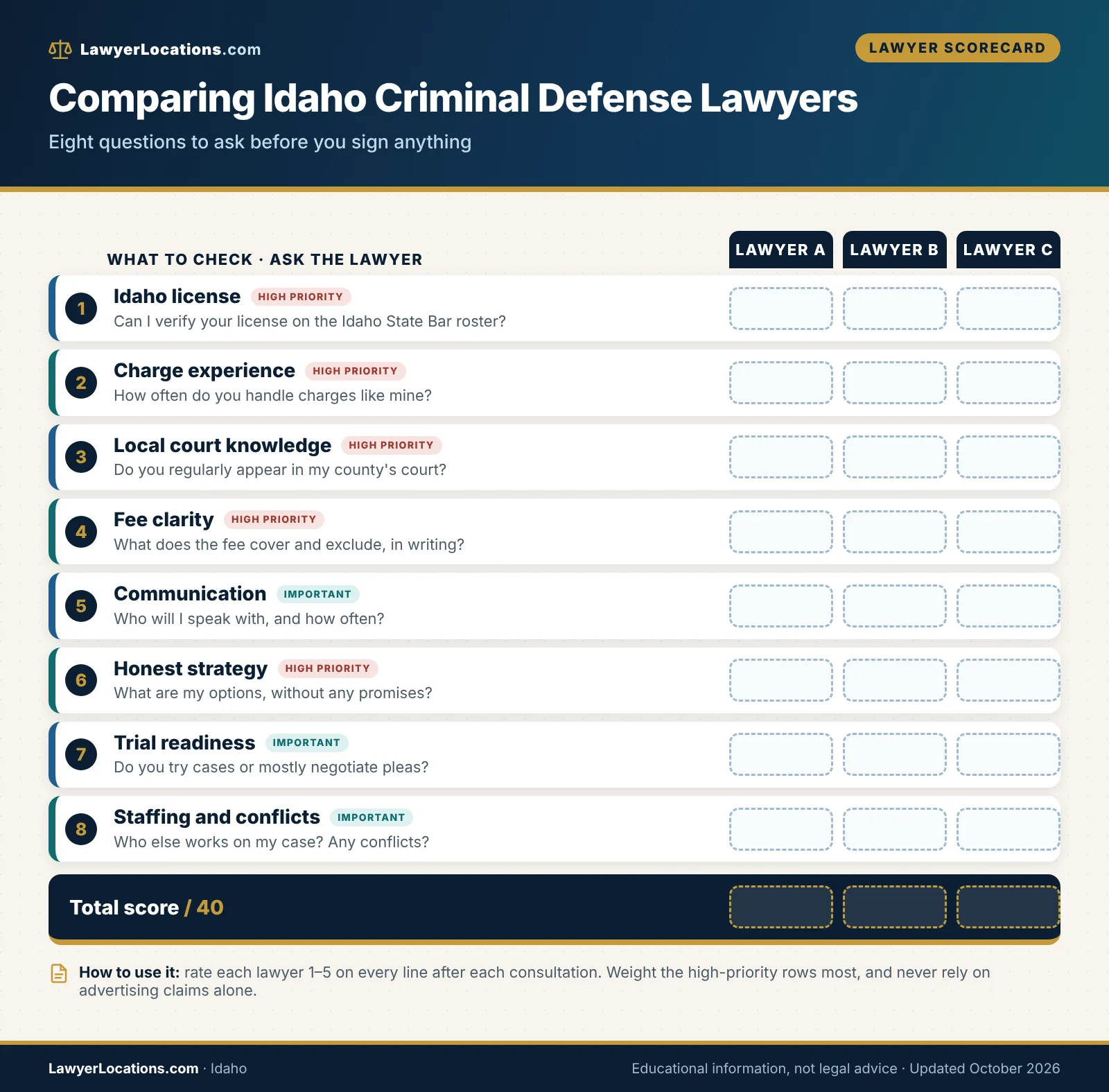
Text version of this graphic
| Criterion | Question to ask |
|---|---|
| Idaho license | Are you licensed in Idaho, and can I verify it on the Bar roster? |
| Charge experience | How often do you handle charges like mine? |
| Local court knowledge | Do you regularly appear in my county’s court? |
| Fee clarity | What does the fee cover and exclude, in writing? |
| Communication | Who will I speak to, and how often will you update me? |
| Strategy | What are my realistic options, without promises? |
| Trial readiness | Do you try cases, or mostly negotiate pleas? |
| Conflicts and staffing | Who else works on my case, and are there conflicts? |
- The lawyer explains the charge, the penalty range and your options in plain language.
- The fee agreement is written and itemized.
- You get a clear answer on who will appear in court with you.
- The lawyer is willing to say what they cannot predict.
- Someone promises a specific result or says the charge will “go away.”
- You are pressured to sign or pay before you have read the agreement.
- The lawyer will not tell you who handles your case day to day.
- You cannot confirm an Idaho license.
Preparing for your first consultation
A focused first meeting saves time and money. Whatever you tell a lawyer in a consultation about getting legal help is generally confidential, but ask about confidentiality at the start if you are unsure.
What to bring
Bring every document connected to the case, even if it seems minor. Include the citation or arrest paperwork, the complaint or charging document, any bail or release conditions, the court date notice, any notice of license suspension, and a list of prior convictions anywhere in the country. Add a short timeline of what happened, for your lawyer only.
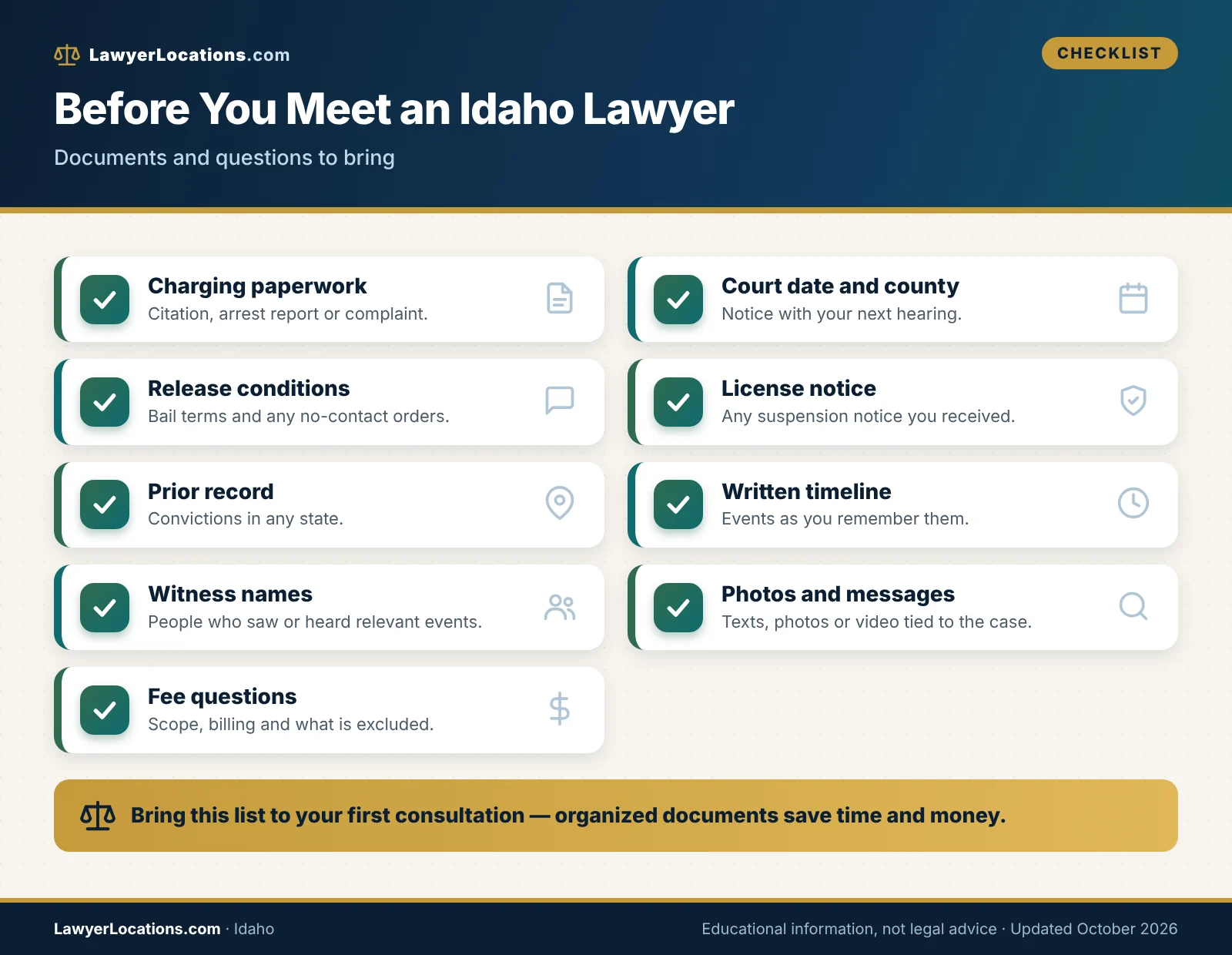
Text version of this graphic
- Citation, arrest report or complaint
- Court date and county
- Release or bail conditions
- License suspension notice, if any
- Prior record in any state
- Your written timeline
- Names of witnesses
- Photos, texts or video relevant to the case
- Your questions about fees and communication
What to ask
Ask the lawyer to walk you through the next court dates, the realistic range of outcomes, and what to do and avoid in the meantime. Ask how your case would be affected if a conviction came with an immigration, professional-license or firearm consequence, since those effects can outlast the sentence.
Interview two or three lawyers if you can. Compare not just price but how clearly each explains the process. If you are comparing several consultations, see our guide to what to ask in a criminal defense consultation.
Red flags and common mistakes
Most hiring mistakes come from urgency. A calm hour of checking usually saves months of trouble.
Warning signs in a lawyer’s pitch
- A promise of a specific outcome, including dismissal or a particular sentence.
- Pressure to sign immediately or pay in cash only.
- A refusal to put the fee terms and scope in writing.
- No clear answer on who will appear in your court hearings.
- Claims of “best,” “top” or sure-thing results.
Mistakes defendants make on their own
The most costly self-inflicted problems are talking to police without counsel, discussing the case on social media or by text, contacting an alleged victim or witness in violation of a no-contact order, missing a court date, and ignoring a license-suspension notice. Each of these can be fixed in some cases, but each makes the defense harder.
If a judge has ordered no contact with a person, a friendly text from you can be a new crime. Route every message through your lawyer, even if the other person starts the conversation.
DUI, Drug Trafficking and Clearing a Record in Idaho
Three situations come up again and again in Idaho: DUI arrests, drug charges with mandatory prison terms, and questions about whether a record can ever be cleared. Each has rules that are specific to Idaho law.
DUI under Idaho Code 18-8004
For drivers, a DUI arrest creates two separate proceedings: the criminal case in court and an administrative action against your driving privileges. Missing a deadline in one does not fix the other.
The criminal case
Idaho Code 18-8004 makes it unlawful to drive or be in actual physical control of a motor vehicle while under the influence, or with an alcohol concentration of 0.08 or more as shown by blood, urine or breath analysis. A lower limit of 0.04 applies to commercial vehicles, and drivers under 21 face a 0.02 threshold, with penalties set in a separate section. A test result under 0.08 does not always end a case, because the statute allows prosecution on other competent evidence, including drug impairment.
Under Idaho Code 18-8005, a first offense is a misdemeanor with up to six months in jail and a fine of up to $1,000. A second offense within ten years carries a 10-day mandatory minimum jail term, up to a year, and a fine of up to $2,000. A third offense within ten years is a felony with up to ten years in prison and a fine of up to $5,000. An alcohol concentration of 0.20 or more brings harsher penalties under Idaho Code 18-8004C. Causing great bodily harm can bring an aggravated DUI charge under 18-8006, a felony.
For more on how DUI lawyers are paid, our guide to DUI lawyer costs compares fee structures across the country.
The license suspension track
Separately, Idaho Code 18-8002A imposes an administrative suspension if you fail an evidentiary test or refuse one. A first failed test brings a 90-day suspension, with the first 30 days absolute (no driving at all) and restricted driving possible afterward. A first refusal brings a one-year suspension with no restricted license. To contest the suspension, you must make a written request to the department within seven calendar days of being served with the notice, or you waive the right to contest.
If you received a notice of suspension after a DUI stop, read it today and count seven calendar days from the date of service. Hand your lawyer the notice immediately so the written request can be filed on time.
Drug trafficking and mandatory minimums
Idaho separates ordinary possession from trafficking, which is defined by drug weight rather than by what a person intended to do. Trafficking brings mandatory minimum prison terms that a judge usually cannot go below.
Trafficking thresholds and minimums
Idaho Code 37-2732B sets the weight thresholds and minimum sentences. The table below shows the figures we found for marijuana, cocaine, heroin and methamphetamine. The statute is amended from time to time and also covers other substances, so confirm the current text for your offense date.
| Drug | Quantity tier | Mandatory minimum | Minimum fine |
|---|---|---|---|
| Marijuana | 1 lb to under 5 lb, or 25 to under 50 plants | 1 year | $5,000 |
| Marijuana | 5 lb to under 25 lb, or 50 to under 100 plants | 3 years | $10,000 |
| Marijuana | 25 lb or more, or 100 plants or more | 5 years | $15,000 |
| Cocaine | 28 g to under 200 g | 3 years | $10,000 |
| Cocaine | 200 g to under 400 g | 5 years | $15,000 |
| Cocaine | 400 g or more | 10 years | $25,000 |
| Heroin | 2 g to under 7 g | 3 years | $10,000 |
| Heroin | 7 g to under 28 g | 10 years | $15,000 |
| Heroin | 28 g or more | 15 years | $25,000 |
| Methamphetamine or amphetamine | 28 g to under 200 g | 3 years | $10,000 |
| Methamphetamine or amphetamine | 200 g to under 400 g | 5 years | $15,000 |
| Methamphetamine or amphetamine | 400 g or more | 10 years | $25,000 |
What the minimums mean in practice
For these offenses the statute says sentences cannot be suspended, deferred or withheld, and the person is not eligible for parole until the mandatory minimum is served. A second trafficking conviction doubles the minimum. The statutory maximums are severe, including life imprisonment for the higher tiers of cocaine, heroin and methamphetamine, and 15 years for marijuana.
Because a trafficking charge turns so heavily on weight, lab testing, how the substance was seized and whether the stop was lawful, defense work often focuses on the evidence. Drug laws differ from state to state; for an example of how another state’s defense approach looks, see our Atlanta drug crime lawyer guide.
Withheld judgments, set-asides and clearing a record
Idaho gives courts several tools that can reduce the long-term impact of a case. Whether one is available depends on the charge, the sentence and how the case ended, and most are discretionary.
Withheld judgment and dismissal after probation
With a withheld judgment under Idaho Code 19-2601(3), the court does not enter a judgment of conviction at the time of sentencing and instead places you on terms and conditions. Idaho Code 19-2604 then allows a court, after a showing that probation no longer needs to continue and good cause exists, to set aside the plea or conviction and dismiss the case. A final dismissal has the effect of restoring civil rights.
Section 19-2604 also lets a court reduce a felony to a misdemeanor in some circumstances after discharge from probation. Less than five years after discharge, the prosecutor must stipulate. At five years or more, the prosecutor must stipulate only for a list of serious offenses. The relief does not apply to offenses that require sex offender registration. The details are technical and contested often, so discuss them with a lawyer before assuming eligibility.
Sealing and expungement
Sealing and expungement are not the same. In a 2023 decision, State v. Oldenburg, the Idaho Supreme Court described expungement as complete removal of a record, and sealing as keeping records but making them non-public. The court said Idaho Code 67-3004(10) allows a person whose charges were dismissed, who was acquitted, or who was not charged within a year of arrest to request expungement of fingerprint and criminal-history records held by the Idaho State Police. It also said a court can seal case records on a case-by-case basis under Idaho Court Administrative Rule 32.
The courts have also changed how sealed records appear online. Since September 24, 2025, case events tied to a sealed record no longer show up in the public iCourt portal, kiosks or attorney portals, though the order to seal remains publicly accessible. For a national overview of record-clearing, read our expungement lawyer guide.
Record-clearing questions are timing-sensitive and highly fact specific. Ask your defense lawyer at the start of the case which resolution keeps these doors open, because a plea made without that discussion can close them.
Local Logistics, Deadlines and Next Steps
Idaho’s rules are statewide, but your experience depends on your county: which judicial district hears your case, which prosecutor files it and which local office can answer procedural questions. This section pulls those details together and ends with a short action plan.
Four busy counties: what we could confirm
Ada, Canyon, Kootenai and Bonneville are frequent search targets for people looking for local help. The table lists only items we could confirm from official or county sources in October 2026. Courthouse addresses and clerk hours change, so check the county site or the Idaho courts website before you travel.
| County | Judicial district | Confirmed local resources |
|---|---|---|
| Ada (Boise) | Fourth | State Public Defender institutional office; county Magistrates Commission page on district public defender recruitment; Court Assistance Office |
| Canyon (Caldwell) | Third | Prosecuting Attorney’s office at 1115 Albany St, Caldwell, with DUI and felony process flowcharts; State Public Defender institutional office; Court Assistance Office |
| Kootenai (Coeur d’Alene) | First | Court Assistance Office in the Justice Building, 324 W. Garden Ave; State Public Defender institutional office |
| Bonneville (Idaho Falls) | Seventh | Court Assistance Office at 605 N. Capital Ave; State Public Defender institutional office |
Ada and Canyon counties
These two counties anchor the Treasure Valley, and the State Public Defender has an institutional office in each. Canyon County’s prosecuting attorney publishes a DUI information page that links to a misdemeanor DUI court process chart, a felony court process chart and the Third Judicial District site. Reading those before your first meeting with a lawyer can make the process less abstract.
Kootenai and Bonneville counties
In northern Idaho, Kootenai County’s Court Assistance Office in Coeur d’Alene offers appointment-based help, mainly with civil and family forms, and says it does not handle withheld judgments or expungements. Bonneville County, in the Idaho Falls area, has its own Court Assistance Office. Both counties have a State Public Defender institutional office.
Costs, deadlines and decision points
The table gathers the time limits discussed in this guide. These are the statutory or rule-based anchors we verified; your own dates are on your paperwork and in your lawyer’s calendar.
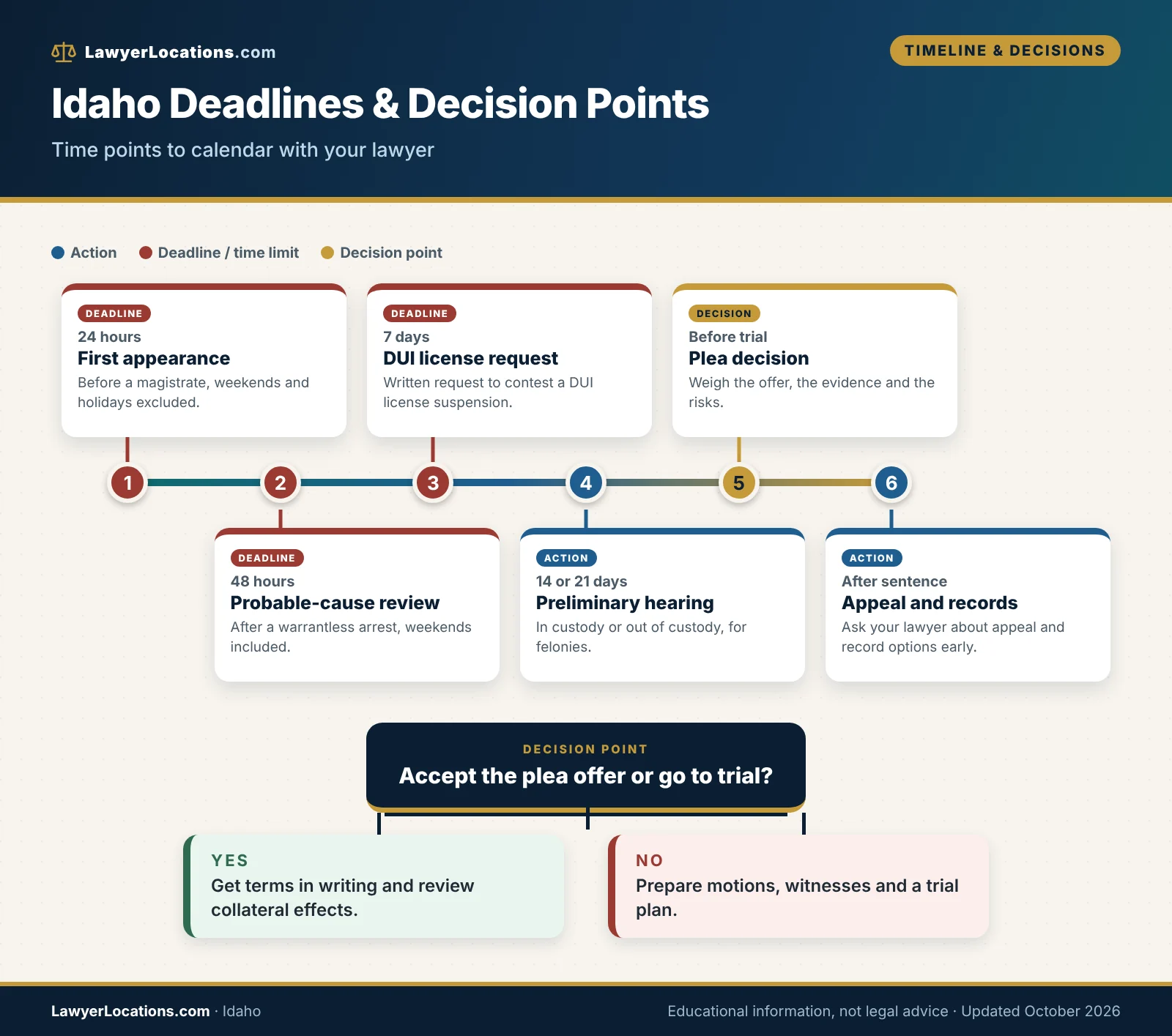
Text version of this graphic
- Arrest: a first appearance should follow within 24 hours (weekends and holidays excluded).
- Within 48 hours after a warrantless arrest: probable-cause review.
- DUI stop: written request to contest license suspension within 7 calendar days of notice.
- Felony: preliminary hearing within 14 days (in custody) or 21 days (not in custody).
- District court arraignment, motions, then plea or trial.
- Sentencing, probation or withheld judgment, and later requests to set aside or reduce.
- Decision point: accept a plea offer, or go to trial?
| Point in the case | Time limit or window | Source |
|---|---|---|
| Initial appearance after arrest | Within 24 hours, excluding weekends and holidays | Idaho Criminal Rule 5 |
| Probable-cause review after warrantless arrest | Within 48 hours, weekends included | Idaho Criminal Rule 5 |
| Contest a DUI license suspension | Written request within 7 calendar days of service | Idaho Code 18-8002A |
| Felony preliminary hearing | 14 days if in custody; 21 days if not | Idaho Criminal Rule 5.1 |
| Prosecution deadline, most felonies | 5 years from the offense, with exceptions | Idaho Code 19-402 |
| Prosecution deadline, most misdemeanors | 1 year from the offense, with exceptions | Idaho Code 19-403 |
| Retained jurisdiction | Up to the first 365 days | Idaho Code 19-2601 |
| Misdemeanor probation | Up to 2 years, with extensions for problem-solving courts | Idaho Code 19-2601 |
Calendar the dates that bite
If you are charged, ask your lawyer for a written list of court dates and any filing deadlines. For DUI, the seven-day license deadline is the one most often missed because the notice arrives while a person is still sorting out the arrest. Appeals also have strict deadlines that this guide does not cover, so ask your lawyer about them before sentencing.
The main decision point: plea or trial
Deciding whether to accept a plea offer is the choice that matters most, and it belongs to you. A lawyer can explain the evidence, the likely sentencing range and the collateral effects of a conviction. Ask for the offer in writing, and ask how long it stays open.
Common questions about Idaho criminal defense
The answers below are general. They describe the law as we verified it in October 2026 and cannot account for the facts of your case.
Charges, courts and rights
How soon will I see a judge after an arrest in Idaho?
Idaho Criminal Rule 5 requires an initial appearance without unreasonable delay and no later than 24 hours after arrest, not counting Saturdays, Sundays and holidays.
Can the police question me if I ask for a lawyer?
You can tell officers you will not answer questions without a lawyer. Say it clearly, and then stop talking. What happens next depends on the circumstances, which is one reason to call a lawyer promptly.
Is a DUI always a misdemeanor?
No. A first and second DUI within ten years are misdemeanors, but a third within ten years is a felony, and DUIs causing great bodily harm can be charged as felonies.
Lawyers, cost and records
How much does a criminal defense lawyer cost in Idaho?
It varies by lawyer, charge and county, and we did not find an official Idaho source for averages. Ask for a written fee agreement that states what the fee covers and what it does not.
How do I find a criminal defense lawyer near me in Idaho?
You can use the Idaho State Bar’s Lawyer Referral Service, ask the court about public defender eligibility, and verify any lawyer on the Bar’s attorney roster. Then compare at least two lawyers using the questions in Section 5.
Can I get a public defender for a misdemeanor?
The State Public Defender says it handles misdemeanor cases as well as felonies. A judge decides eligibility, so ask at your first appearance.
Can I clear my Idaho record?
It depends on how the case ended. Dismissal after probation under 19-2604, expungement of state police records after a dismissal or acquittal, and case-by-case sealing under court rules are different tools with different requirements.
Mistakes to avoid and your next steps
The first days after an arrest or charge shape the rest of the case.
A short action plan
- Write down your next court date and keep every document. Missing a date is the fastest way to make things worse.
- Check any license-suspension deadline. For DUI, count seven calendar days from service of the notice.
- Decide how you will be represented. Ask the court about a public defender if you cannot afford a lawyer, or compare private lawyers.
- Stop discussing the case. Do not talk with police, witnesses or on social media without your lawyer.
- Verify the lawyer. Confirm the Idaho license, read the fee agreement and keep a copy.
Finding the right fit for your situation
The best way to use a guide on a criminal defense lawyer Idaho residents might consider is to treat it as a checklist, not a verdict. Pair the questions in Section 5 with the court and deadline information above. When you speak with a lawyer, ask what your charge means under the Idaho statute that applies to you, not just in general.
Ready to compare your options?
Use the checklist and scorecard in this guide to prepare questions for two or three lawyers licensed in Idaho. For a closer look at consultation questions, read our guide to criminal defense consultations. LawyerLocations.com does not recommend or rank individual lawyers.
Sources & References
Show all 31 sources
- Idaho Code 18-111, Felony and misdemeanor defined — Idaho Legislature — legislature.idaho.gov — accessed October 2026
- Idaho Code 18-112, Felony punishment — Idaho Legislature — legislature.idaho.gov — accessed October 2026
- Idaho Code 18-113, Misdemeanor punishment — Idaho Legislature — legislature.idaho.gov — accessed October 2026
- Idaho Code 18-2408, Theft punishment — Idaho Legislature — legislature.idaho.gov — accessed October 2026
- Idaho Code 18-8004, Driving under the influence — Idaho Legislature — legislature.idaho.gov — accessed October 2026
- Idaho Code 18-8004C, Excessive alcohol concentration — Idaho Legislature — legislature.idaho.gov — accessed October 2026
- Idaho Code 18-8005, DUI penalties — Idaho Legislature — legislature.idaho.gov — accessed October 2026
- Idaho Code 18-8002A, Administrative license suspension — Idaho Legislature — legislature.idaho.gov — accessed October 2026
- Idaho Code 19-402, Limitation for felonies — Idaho Legislature — legislature.idaho.gov — accessed October 2026
- Idaho Code 19-403, Limitation for misdemeanors — Idaho Legislature — legislature.idaho.gov — accessed October 2026
- Idaho Code 19-1001, Grand jury challenges — Idaho Legislature — legislature.idaho.gov — accessed October 2026
- Idaho Code 19-2514, Persistent violator — Idaho Legislature — legislature.idaho.gov — accessed October 2026
- Idaho Code 19-2601, Sentencing options and probation — Idaho Legislature — legislature.idaho.gov — accessed October 2026
- Idaho Code 19-2604, Discharge of defendant and amendment of judgment — Idaho Legislature — legislature.idaho.gov — accessed October 2026
- Idaho Code 19-2903, Right to bail — Idaho Legislature — legislature.idaho.gov — accessed October 2026
- Idaho Code 37-2732, Prohibited acts and penalties — Idaho Legislature — legislature.idaho.gov — accessed October 2026
- Idaho Code 37-2732B, Trafficking — Idaho Legislature — legislature.idaho.gov — accessed October 2026
- Idaho Criminal Rule 5, Initial appearance — Idaho Supreme Court — isc.idaho.gov/icr5 — accessed October 2026
- Idaho Criminal Rule 5.1, Preliminary hearing — Idaho Supreme Court — isc.idaho.gov/icr5-1 — accessed October 2026
- About the Courts (court structure) — Idaho Supreme Court — isc.idaho.gov/about-the-courts — accessed October 2026
- State v. Oldenburg, Docket No. 49358 (Nov. 17, 2023) — Idaho Supreme Court — isc.idaho.gov/opinions/49358.pdf — accessed October 2026
- Message from the Courts Regarding Sealed Records and the iCourt Portal — Idaho State Bar — isb.idaho.gov — accessed October 2026
- Idaho State Public Defender (home page and FAQ) — Office of the State Public Defender — spd.idaho.gov and spd.idaho.gov/faq — accessed October 2026
- The State Public Defender Act: Continuing the Journey of Public Defense in Idaho — Idaho State Bar (The Advocate) — isb.idaho.gov — accessed October 2026
- After lawsuits, reports found Idaho’s public defense system was failing, a new office offers hope — Idaho Capital Sun — idahocapitalsun.com — accessed October 2026
- Idaho State Bar home page and Lawyer Referral Service — Idaho State Bar — isb.idaho.gov and isb.idaho.gov/lawyer-referral-service — accessed October 2026
- Court Assistance Office (About Us and county directory) — Idaho Courts — courtselfhelp.idaho.gov — accessed October 2026
- Kootenai County Court Assistance Office — Kootenai County — kcgov.us — accessed October 2026
- Bonneville County Court Assistance Office — Idaho Courts — courtselfhelp.idaho.gov/Local/Bonneville — accessed October 2026
- Driving Under the Influence (Prosecuting Attorney) — Canyon County — canyoncounty.id.gov — accessed October 2026
- Judicial Court (Magistrates Commission page) — Ada County — adacounty.id.gov — accessed October 2026
General information only. LawyerLocations.com is a legal-education and lawyer-discovery resource, not a law firm. Reading this page does not create an attorney-client relationship, and nothing here is legal advice about your situation. Idaho statutes, court rules and fees change; confirm current law and local procedure with the court clerk and with a lawyer licensed in Idaho before you act.
Legal Disclaimer and Limitation of Liability
Informational and illustrative purposes only. This article was prepared by LawyerLocations.com solely on the basis of the information available to us at the time of writing. It is an illustrative, general overview. It is not a complete or authoritative statement of the law, and it has not been reviewed by a lawyer licensed in your state or county.
Not legal advice. Nothing in this article is legal, financial, tax or immigration advice, and reading it does not create an attorney-client relationship between you and LawyerLocations.com or any author, lawyer or firm mentioned. Laws, court rules, fees, filing deadlines and agency procedures differ by state, county and court, and they change often. Some details here may be simplified, incomplete or out of date, and time limits for legal claims can be short.
No warranty. We make no representation or warranty, express or implied, about the accuracy, completeness, timeliness or suitability of this content for your situation. Please do not rely on it to make, delay or skip any legal decision. Check the facts against official sources and speak with a licensed attorney in the relevant jurisdiction before you act.
Limitation of liability. To the fullest extent permitted by law, LawyerLocations.com and its owners, authors and contributors disclaim all liability for any loss, damage, cost or other consequence arising from the use of, or reliance on, this article, including any content on third-party websites we link to. Mentioning a lawyer, firm, organization or service is not an endorsement and is not a promise of any result. If you are in immediate danger, contact your local emergency number.