

A living trust lawyer helps you create and fund a revocable trust that can keep assets out of probate court and let someone you choose manage your property if you become incapacitated. Trust law is mostly state law, so the rules, and the fees, vary across the United States. Federal law adds the tax layer: for 2026 the federal estate tax exemption is $15 million per person.
This guide explains what a living trust does and does not do, how funding and a pour-over will work, how to pick a successor trustee, what lawyers charge for and how to spot seminar scams, so you can decide whether you need a lawyer, an online tool or a simpler plan.
What a Living Trust Lawyer Does, and How to Tell Whether You Need One
A living trust lawyer drafts a revocable trust that fits your family and property, helps you move (“fund”) your assets into it, and ties it to a pour-over will, powers of attorney and health care documents. You need one when the cost of getting the paperwork wrong, or of leaving your family in probate court, outweighs the fee. You probably do not need one when your assets are modest and already pass by beneficiary designation.
“Living trust” is everyday shorthand for a trust you create while you are alive, usually a revocable trust you can change or cancel at any time. This guide applies to readers in every state. Trust law is mostly state law, so details such as signing rules and trustee duties vary, and we point to primary sources you can check yourself.
What a revocable living trust actually is
The three roles: settlor, trustee and beneficiary
A trust is a legal arrangement in which a person or institution (the trustee) holds property for the benefit of others (the beneficiaries) under written terms set by the person who created it (the settlor, also called the grantor). In a typical living trust, you play all three roles at the start: you create the trust, serve as your own trustee and benefit from it for life.
The trust matters only when you retitle assets in its name. The document also names a successor trustee to step in if you become unable to manage your affairs or when you die, and it names the people or charities who receive what is left.
Revocable versus irrevocable trusts
You can amend or revoke a revocable trust during life. Because you keep that control, the law generally treats the property as still yours for income tax, estate tax and, in most states, creditor purposes. An irrevocable trust generally cannot be rewritten or undone on your own, which is why it can produce tax or asset-protection results that a revocable trust cannot.
Most consumer “living trust” packages are revocable. An irrevocable trust pitched to protect a home from nursing-home costs or taxes is a separate, higher-stakes question.

Text version of this graphic
- List your assets, debts and goals.
- Meet a lawyer and choose trustees and beneficiaries.
- Review the trust, pour-over will and power of attorney drafts.
- Sign with your state’s formalities.
- Fund the trust and update beneficiary forms where advised.
- Store the documents and a funding list.
- Review after life events.
What a living trust does and does not do
What a funded living trust can do for you
A properly funded revocable trust can keep most of your property out of probate, the court-supervised process for proving a will, paying debts and transferring assets after death. It can give someone you trust authority to manage your property if you are incapacitated, without a court-appointed conservator or guardian. And a trust is generally a private document, while a probate file is typically a public court record.
It can also hold instructions a will cannot easily deliver, such as staged distributions for young beneficiaries or a plan for a family member with a disability. Those features are where a lawyer’s drafting earns its fee.
What a living trust does not do
A revocable living trust does not lower your income taxes while you are alive, does not by itself reduce federal estate tax, does not shield assets from your own creditors in most states, and does not qualify you for Medicaid. It is also not self-executing: assets you forget to retitle usually stay outside the trust and may still go through probate.
Signing a trust document is not the same as having a working trust. An unfunded trust usually controls nothing, and the family may end up in probate anyway. Ask any lawyer or service to explain, in writing, who retitles each asset and when.
Signs you may benefit from a living trust lawyer
Situations where a trust often earns its keep
People commonly look at a revocable trust when they own real estate in more than one state, have a blended family, want to leave assets to a minor or a beneficiary with special needs, own a closely held business, or expect family conflict. Health matters too: if dementia or a stroke is a realistic concern, a trust with a named successor trustee lets a family act quickly, and waiting until capacity is in question can invite a contest.
- You own real estate in two or more states (to avoid separate court proceedings, subject to local rules).
- You are in a second marriage; see our guide to prenuptial agreements for the related marital-property conversation.
Situations where a will and beneficiary designations may be enough
If your property is modest and your main assets already pass automatically, a simpler plan can do the job. Retirement accounts and life insurance pass to the beneficiaries named on the account paperwork. Banks let you add payable-on-death designations, and many states allow a transfer-on-death deed for real estate. In those cases a will, a durable power of attorney, a health care directive and current beneficiary forms may cover most of the need at lower cost.
The honest answer from a good lawyer is sometimes “you don’t need a trust yet.” Treat a consultation that only ever recommends the most expensive product as a warning sign.
| Issue | Revocable living trust | Will alone | Beneficiary or TOD/POD designation |
|---|---|---|---|
| Takes effect | When signed; controls only assets titled in the trust | At death, after a court admits it | At death, directly to the named person |
| Probate court involved | Generally avoided for funded assets | Yes, for assets in your sole name | Generally avoided for that asset |
| Privacy | Generally private | Becomes part of a public court file | Private |
| Helps if you become incapacitated | Yes, through the successor trustee | No; a will works only at death | No |
| Controls how heirs receive property | Yes; detailed terms possible | Limited unless it creates a testamentary trust | No; a lump sum goes to the named person |
| Typical drawback | Unfunded assets still need probate; upkeep | Public and slower; no incapacity coverage | Can conflict with the rest of the plan |
Probate Avoidance, Funding the Trust and the Pour-Over Will
A living trust avoids probate only for assets that are actually titled in the trust, or that pass to it by beneficiary designation, when you die. Funding the trust is therefore the most important step after signing, and a pour-over will is the safety net for anything you miss. Both are standard parts of a living trust lawyer’s work, and both are where do-it-yourself plans most often fail.
How a trust avoids probate, and when probate still happens
What probate is and why people try to avoid it
Probate is the court process that validates a will (or applies the state’s default inheritance rules if there is none), appoints a personal representative, gives creditors notice and oversees the transfer of assets to heirs. In many states it is public, takes months at a minimum, and can involve court fees, publication costs and attorney fees. Some states have streamlined procedures, so the case for a trust is stronger in some places than others.
Assets titled in a trust do not pass under your will, so the probate court generally has no role in transferring them; the successor trustee follows the trust terms. For a view of what the court process looks like in one state, see our guide to hiring a probate lawyer in Milwaukee, Wisconsin.
Assets that skip probate without a trust
Not everything goes through probate to begin with. Jointly owned property with right of survivorship passes to the surviving owner. Retirement accounts, annuities and life insurance pass to the named beneficiary. Bank accounts with payable-on-death designations, brokerage accounts with transfer-on-death registration and, in states that allow them, transfer-on-death deeds also pass outside probate.
Many states also let heirs use a small estate affidavit to collect modest property without a full court case, with dollar limits that differ widely by state. If most of your wealth already passes these ways, a trust may add cost without much benefit.
Before you pay for a trust, make a one-page list of every asset and mark how each would pass today: by beneficiary designation, by survivorship, or through your will. The assets in the third group are the ones a trust would keep out of probate.
Funding the trust: the step most plans get wrong
Real estate: deeds, mortgages, title insurance and property tax
To put a home in a trust, you normally sign and record a new deed transferring title from yourself to yourself as trustee. The deed’s form, any recording fees and any transfer-tax exemptions are set by state and county, so a lawyer licensed where the property sits should handle it.
Homeowners often worry that moving a mortgaged home into a trust will trigger the loan’s due-on-sale clause, which lets a lender demand full payment when title transfers. Federal law limits that for residential property. The Garn-St Germain Act, 12 U.S.C. § 1701j-3(d), bars lenders from enforcing due-on-sale clauses on residential real property with fewer than five dwelling units in specified situations, including a transfer into an inter vivos trust in which the borrower is and remains a beneficiary and which does not relate to a transfer of rights of occupancy. Confirm that your facts fit, and ask how the transfer affects your title insurance, homestead exemption and property tax treatment, which are state-level details.
Bank, brokerage, business and personal property
Bank and brokerage accounts can usually be retitled in the trust’s name, or you can keep the account and name the trust as the payable-on-death or transfer-on-death beneficiary. Many institutions ask for a certification of trust: a short summary of the trust’s key facts, including the trustee’s authority, that proves the trust exists without handing over the whole document.
For a business, the operating or shareholder agreement may restrict transfers, so read it first. For household items, lawyers commonly use a short assignment of personal property that moves them to the trust in one stroke.
Retirement accounts, life insurance and vehicles
Do not retitle an IRA, 401(k) or similar account into the trust’s name; doing so can be treated as a taxable withdrawal. You can name the trust as a beneficiary, but only after a lawyer or tax professional confirms how the trust’s terms interact with the required-distribution rules. Naming a spouse or child directly is often simpler. Life insurance works the same way: choose the beneficiary on the insurer’s form. Vehicles are often better left outside the trust because many states offer a simple transfer process.
| Asset | Usual method | Main watch-out |
|---|---|---|
| Home or other real estate | New deed to the trustee, recorded in the county where the property sits | Mortgage terms, title insurance, homestead and property-tax rules vary |
| Checking, savings, CDs | Retitle in the trust’s name, or name the trust as POD beneficiary | Each bank has its own forms; track which accounts are done |
| Brokerage account | Retitle in the trust’s name or use TOD registration | Keep cost-basis records |
| IRA, 401(k), 403(b) | Do not retitle; update the beneficiary designation | Retitling can trigger tax; naming a trust needs careful drafting |
| Life insurance, annuities | Beneficiary designation | The beneficiary form overrides the trust and the will |
| Business interests | Assignment of interest to the trustee | Transfer restrictions in the governing agreement |
| Household items, jewelry | General assignment of personal property | Valuable or titled items may need separate treatment |
| Vehicles, boats | Often left outside the trust | Check your state’s transfer-on-death and small-estate options |
Funding is not a once-and-done event. Anything you buy or open after signing, such as a new account, a rental property or an inheritance, also has to be titled correctly, or probate may have to fill the gap. Many families schedule a funding review once a year.
The pour-over will: the safety net for what you miss
How a pour-over will works
A pour-over will says, in effect, “anything I own at death that is not already in my trust goes into my trust.” States have statutes that make this kind of gift valid; Florida’s Fla. Stat. § 732.513 and California’s Prob. Code §§ 6300–6303 are examples. The result is that all of your assets end up governed by one set of instructions.
The same document is where you nominate a guardian for minor children, which a trust cannot do. The court has the final say, but the nomination carries weight. This is one reason even a fully funded trust plan still includes a will.
The limits of a pour-over will
The pour-over will is a safety net, not a substitute for funding. Assets that pass under it still generally go through probate before they reach the trust, although small estate procedures may let a successor trustee collect minor leftovers without a full case, depending on the state.
Signing formalities also differ for wills and trusts, and a lawyer will make sure each document meets the standard where you live.
Successor Trustees and Incapacity Planning
The person you name as successor trustee will run your trust if you cannot, and will carry out your wishes after you die. Pairing the trust with a durable power of attorney and a health care directive closes the gaps the trust cannot cover. A well-built plan makes the handoff boring, which is what you want when a family is grieving or worried about a parent.
Choosing and preparing a successor trustee
What the job really involves
A trustee is a fiduciary, someone legally required to act in the beneficiaries’ interests rather than their own. In practice that means identifying and safeguarding trust assets, keeping accurate records, investing prudently, paying valid bills and taxes, treating beneficiaries fairly and keeping them informed. In states that follow the Uniform Trust Code, a trustee must also give beneficiaries certain notices after the trust becomes irrevocable (Maine’s version sets 60 days) and must respond promptly to reasonable requests for reports. 18-B M.R.S. § 813
Pick someone who is organized, honest and willing to ask for professional help, rather than simply the oldest child. The role can last months, or decades if the trust continues for a young beneficiary.
Individual, professional or co-trustees
Families usually choose among a trusted individual, a bank or trust company, or a combination. Each has trade-offs, and a lawyer can draft provisions for removing and replacing a trustee if the arrangement stops working.
- The estate is simple and the family gets along.
- The person is organized and comfortable with paperwork and money.
- You want someone who knows your family’s values.
- The estate includes a business, rental property or complex investments.
- Family tension makes a neutral trustee valuable.
- The trust must last for years, such as for a young or vulnerable beneficiary.
Professional trustees charge under a fee schedule, and individual trustees may be entitled to reasonable compensation depending on state law and the trust. Ask about fees at the outset.
Name at least two backup trustees, and tell your first choice what the job involves before you sign.
Incapacity planning: more than the trust alone
How a trust handles incapacity
Most living trusts include an incapacity clause that defines when a successor takes over managing the trust property. Common triggers are a written determination by one or two physicians, or a court finding. Once triggered, the successor trustee manages the trust assets for your benefit under the terms you wrote, with no court involvement.
That is a major practical advantage. Without a trust or power of attorney, a family may have to petition a court for a conservatorship or guardianship, a public process in which a judge decides who will manage your affairs.
The documents that work alongside the trust
The trust reaches only assets titled in it. A durable power of attorney for finances lets a person you choose handle everything else, such as retirement accounts, tax filings, government benefits and assets not yet moved into the trust. A health care directive, sometimes called an advance directive or health care proxy, names someone to make medical decisions and records your treatment preferences. A trust cannot do either job.
Ask also about a HIPAA authorization, which lets named people receive medical information so they can confirm a physician’s incapacity determination. Formalities differ by state, and a lawyer licensed in your state can make sure banks and hospitals will honor the documents.
Do not sign powers of attorney casually, and be careful of any pitch that asks you to hand broad financial authority to someone you just met. These documents are powerful, and they are a common tool in elder financial abuse cases.
What a successor trustee does after a death
The first weeks: securing, notifying and documenting
When the settlor of a revocable trust dies, the trust generally becomes irrevocable, and the successor trustee takes charge under the trust terms. The early steps are fairly consistent across states, though deadlines and notice rules come from state law.
- Locate the documents. Find the signed trust, amendments, the pour-over will and the asset list, and confirm which version is current.
- Get certified death certificates. Banks, insurers and agencies usually want certified copies.
- Secure the property. Protect the home, keep insurance in force, and collect mail and valuables.
- Get a tax ID. The trust generally needs its own employer identification number (EIN) from the IRS.
- Notify beneficiaries. Many states require written notice that the trust exists and that the trustee has accepted the job.
- Inventory and value assets. Date-of-death values matter for tax purposes, and real estate or a business may need an appraisal.
Debts, taxes, accounting and distributions
The trustee pays valid debts, expenses and taxes from trust property, files the decedent’s final income tax return and files trust income tax returns going forward. Trustees should avoid distributing everything right away, because a reserve for unpaid bills and taxes can prevent personal liability.
Trustees should keep records of every receipt and payment, because a clean paper trail is the best protection for a trustee accused of a mistake. Many trustees hire a lawyer and an accountant, and the trust usually allows paying them from trust funds.
Living Trust Lawyer Cost, Online Tools and How to Choose a Lawyer
There is no single national price for a living trust, and a website that gives you one “average” is guessing. What you pay depends on where you live, how complicated your family and assets are, whether the quote includes funding, and whether you are buying one trust or a coordinated plan for a couple. The most reliable method is to ask two or three lawyers to quote the same written scope.
What drives the cost of a living trust
Common fee structures
Estate planning lawyers generally price this work in one of three ways. A flat fee covers a defined package, often the trust, a pour-over will, powers of attorney and health care documents. Hourly billing is more common for complicated plans and for revisions or disputes. Some lawyers offer unbundled services, in which you pay for specific tasks, such as a document review, and handle the rest yourself.
A low quote that covers only the trust document, with funding left to you, is not the same product as a higher quote that includes deeds, retitling letters and a funding meeting. Make sure the agreement says in plain English which documents, meetings and follow-up steps are covered.
Many pricing summaries online are written by companies that sell trust products. Treat any dollar figure without a named, dated, neutral source as an estimate at best. We do not list typical flat-fee ranges here because no neutral national source we could confirm publishes them; get quotes from local lawyers.
Extra costs people forget to budget for
The legal fee is usually not the only cost. Recording a deed involves county fees, signings involve notary charges, and a title company may charge to review a policy. Appraisals may be needed for real estate or a business.
There are ongoing costs too. A marriage, divorce, new child, move to another state or large inheritance may require amendments. And administering the trust after a death has its own cost in lawyer, accountant and trustee time, so ask how the lawyer would handle that stage and bill for it.
Lawyer, online service or do-it-yourself: how to decide
Where online tools and templates can work
Online document services can produce a basic revocable trust at a lower upfront price. They can fit a person with a straightforward situation who is comfortable following instructions for signing, notarizing and retitling. Many include a pour-over will and basic powers of attorney.
The key limit is that a service cannot give legal advice tailored to your state or facts. It will not tell you that your deed needs a particular form or that your beneficiary designations contradict your trust. If you use a tool, consider paying a lawyer for a flat-fee review.
Where a lawyer is worth the cost
A lawyer adds the most value when the facts are complex or a mistake would be costly: possible estate or inheritance tax, property in several states, a blended family, a family business, a beneficiary on means-tested benefits, or a child likely to contest. It also helps when you want to treat heirs unequally, because the trust should be drafted and signed to hold up if challenged.
| Situation | Lawyer | Online service | Blank template |
|---|---|---|---|
| Simple estate, one state, adult beneficiaries | Good fit, may be more than needed | Often workable, ideally with a flat-fee review | Risky; signing errors are common |
| Blended family or possible disputes | Strongly consider | Limited; no advice on conflict risk | Not recommended |
| Property in more than one state | Strongly consider | Limited; deed rules differ | Not recommended |
| Beneficiary with special needs | Strongly consider; drafting can affect eligibility | Not recommended | Not recommended |
| Estate near an estate tax threshold | Strongly consider | Not designed for tax planning | Not recommended |
| Business owner | Strongly consider | Limited | Not recommended |
How to compare living trust lawyers
Credentials, experience and fit
Confirm that the lawyer is licensed in the state where you live (and ask who will handle the deed for out-of-state property), and check the state bar’s online lookup for license status and public discipline. Look for a practice that regularly handles trusts, probate and incapacity documents. Beware of anyone who relies on unverifiable superlatives.
Also look at fit: does the lawyer explain things in plain English and give you a written scope? Ask who will do the work and whether staff handle funding.
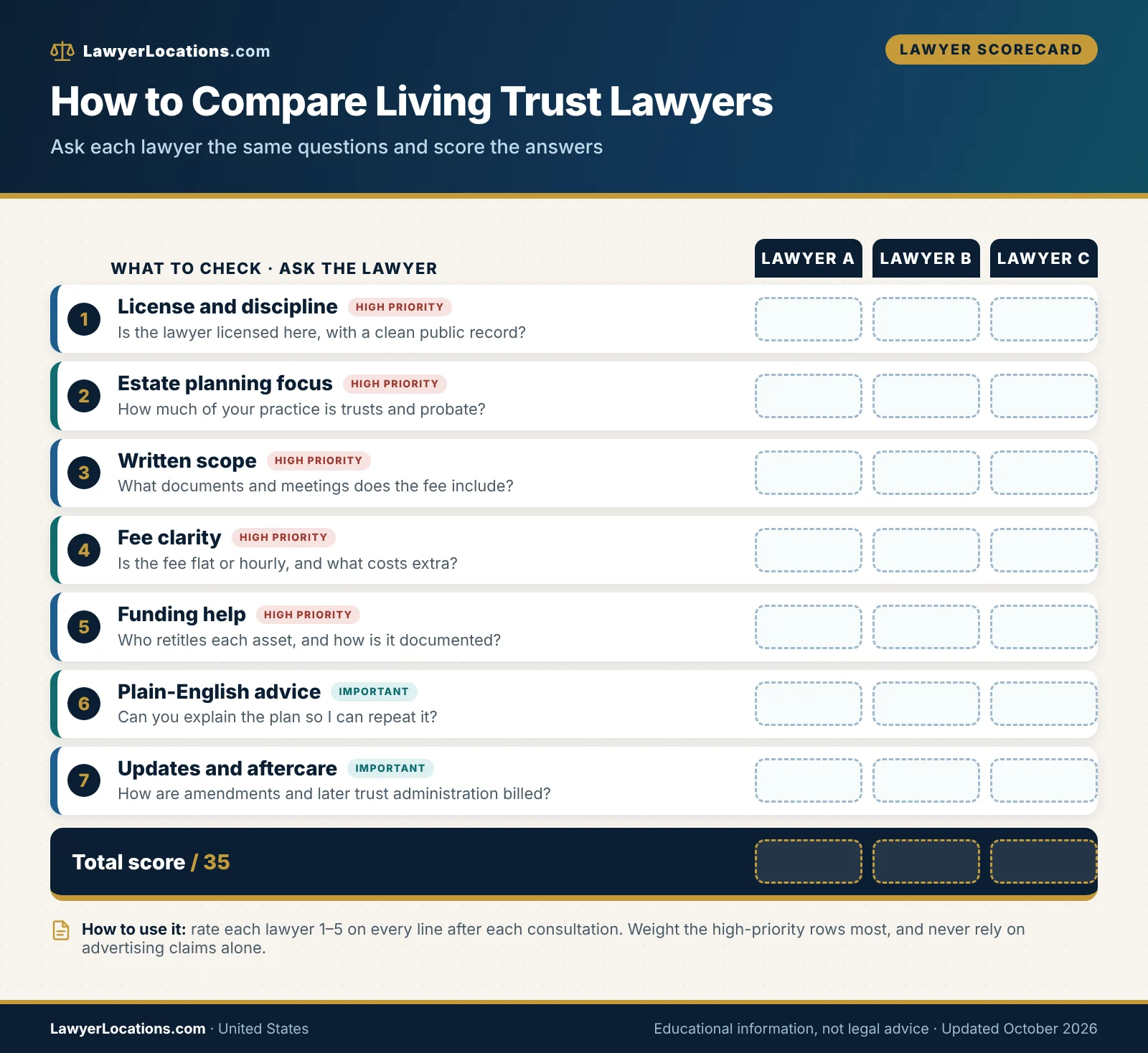
Text version of this graphic
- License and discipline history (high priority).
- Estate planning focus (high priority).
- Written scope of the fee (high priority).
- Fee clarity and extra costs (high priority).
- Funding help and documentation (high priority).
- Plain-English communication (medium priority).
- Updates and aftercare (medium priority).
Questions to ask at the first meeting
Whether the first meeting is free or paid varies by firm, so ask before you book. Our guide to free legal consultations explains how to use a first meeting well, even though it was written for criminal cases. Bring the same list to every lawyer so you can compare answers side by side.
- Do you recommend a trust, or a will plus beneficiary designations, for my situation? Why?
- What exactly does the fee include, and what costs extra?
- Who will retitle my house, accounts and policies, and how will I know it is done?
- What happens to assets I forget to fund?
- How would my successor trustee get started, and will you be available to help?
- Are there state-specific traps (homestead, community property, estate tax) I should know about?
Red flags in a lawyer’s pitch
Walk away from a pitch that guarantees your family will never see a court or pay a tax, pressures you to sign the same day, refuses to put the scope and fee in writing, or says nothing about funding.
Preparing for your consultation
Documents and information to gather
You will get more from a one-hour meeting if you arrive organized. An incomplete asset list is the most common cause of delay and extra fees.
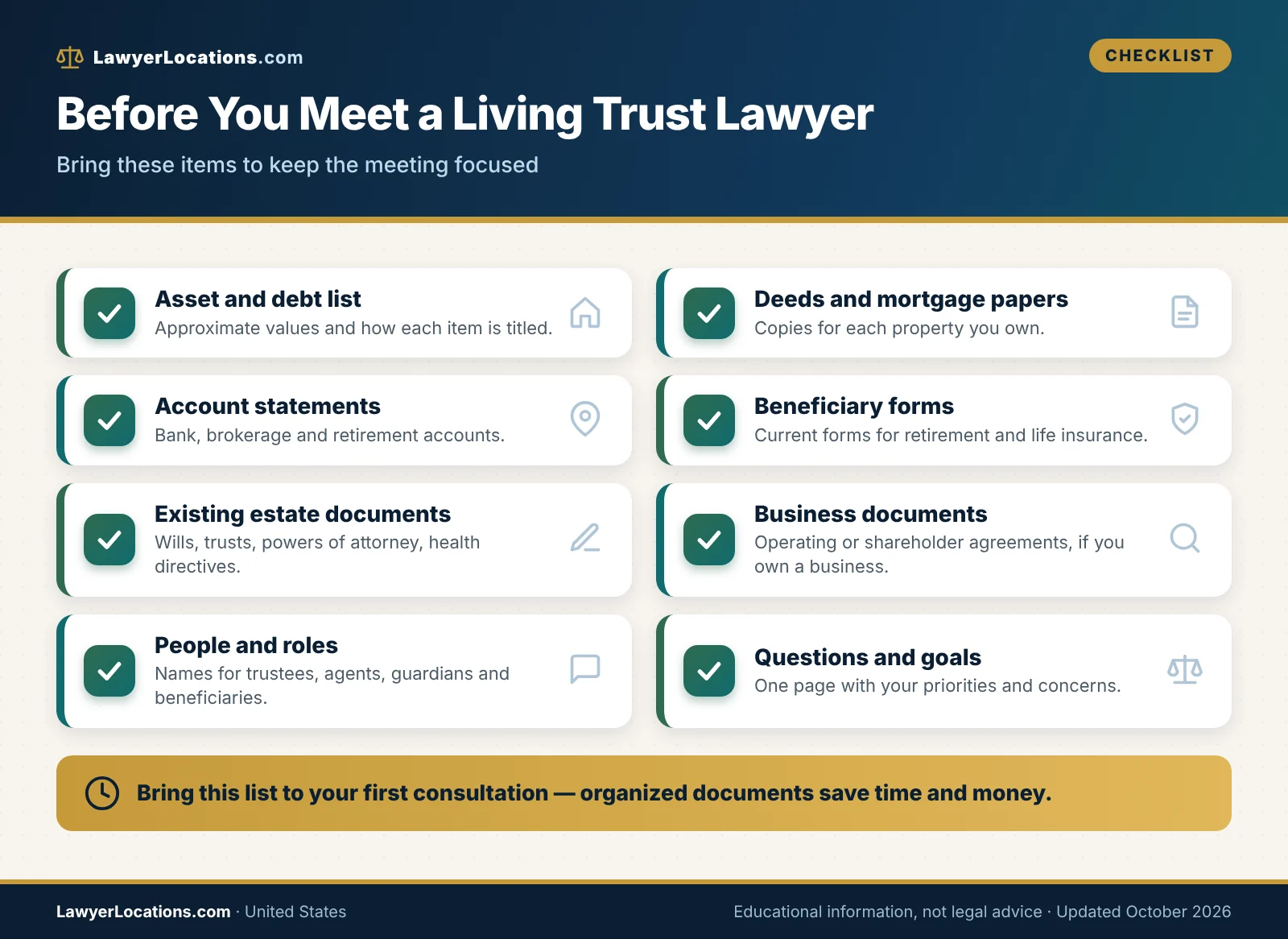
Text version of this graphic
- Asset and debt list with how each is titled
- Deeds and mortgage papers
- Recent account statements
- Current beneficiary forms
- Existing wills, trusts and powers of attorney
- Business documents, if any
- Names for trustees, agents, guardians and beneficiaries
- Questions and goals on one page
Decisions to talk through with your family first
Think through who should be your successor trustee, your agent under a power of attorney and your health care decision-maker. Consider whether to treat children equally, whether any beneficiary needs help managing money, and whether you want charitable gifts.
If you are in the middle of a separation or divorce, your estate documents usually need a fresh look, and some state laws change a former spouse’s role in a trust after a divorce; our guide to legal separation versus divorce explains how those two paths differ.
Living Trust Taxes, Medicaid and Creditor Protection in 2026
A revocable living trust is mostly invisible for income tax while you are alive, and it does not reduce federal estate tax. For deaths in 2026, the federal estate tax basic exclusion amount is $15,000,000 per person, so the great majority of families owe no federal estate tax. The bigger planning questions for most households involve state taxes, income tax on inherited assets, Medicaid and creditors.
Federal estate and gift tax after the 2025 law
The 2026 exemption and what it means
The federal estate tax applies only to the part of a taxable estate above the basic exclusion amount. The IRS lists $15,000,000 for 2026, up from $13,990,000 for 2025 deaths. In the Internal Revenue Code the figure is set at $15,000,000, with an inflation adjustment for decedents dying after 2026, as amended by the 2025 tax law known as the One Big Beautiful Bill Act. I.R.C. § 2010(c)(3) The top estate tax rate in the statute’s rate table is 40 percent on amounts over $1,000,000 of taxable estate, which in practice applies only after the exclusion is used. I.R.C. § 2001(c)
The IRS lists the annual gift tax exclusion for 2026 at $19,000 per recipient. Gifts above that amount in a year generally require a gift tax return and count against the lifetime exclusion. Funding your own revocable trust is not a taxable gift, because you keep control of the property.
Tax law can change again, so many lawyers draft trusts that still work whatever the exemption turns out to be.
Revocable trust assets still count in your taxable estate
Property you transferred but kept the power to revoke is included in your gross estate. I.R.C. § 2038(a)(1) The trust therefore does nothing to lower estate tax by itself. People with estates large enough to be taxed typically add other tools, such as lifetime gifts, irrevocable trusts or charitable planning, each with its own trade-offs.
For married couples, portability lets a surviving spouse use the deceased spouse’s unused exclusion, but only if the executor files a timely federal estate tax return and makes the election. I.R.C. § 2010(c)(5)(A) Ask a tax professional about the deadline.
Income tax: during life and after death
While you are alive
A revocable trust is a grantor trust for income tax purposes: the person who holds the power to revoke is treated as the owner. I.R.C. § 676(a) Under the Treasury regulations, a trust with one grantor can report under the grantor’s taxpayer identification number without a separate IRS return. Treas. Reg. § 1.671-4(b) In most cases, then, funding the trust does not add a tax return.
After death: step-up in basis and the trust’s own return
Property acquired from a decedent generally takes a stepped-up basis equal to its fair market value at the date of death, and the statute treats property in a trust the decedent could revoke as acquired from the decedent. I.R.C. § 1014(a)(1), (b)(2) That can erase capital gains that built up during your life, which is one reason that giving appreciated property away during life, rather than leaving it at death, can cost beneficiaries more in tax.
After the death, the trust becomes a separate taxpayer. The IRS instructions for Form 1041 say a revocable trust must obtain a new taxpayer ID after the death whether or not a section 645 election (treating the trust as part of the estate) is made. A domestic trust files Form 1041 if it has any taxable income or gross income of $600 or more. Trusts also reach top rates at much lower income than individuals do; for tax year 2025, the 20 percent maximum capital gains rate applied to estates and trusts with income above $15,900. That is a reason to hire a CPA for the administration.
State taxes, Medicaid and creditors
State estate and inheritance taxes
Some states impose their own tax at death, often with thresholds far below the federal level. An estate tax is charged on the estate itself, while an inheritance tax is charged to the people who receive property, usually at lower rates for close relatives. Whether you are subject to one depends on where you live and where real estate or tangible property is located.
| Type of tax | What it taxes | States listed in the source |
|---|---|---|
| State estate tax | The value of the estate above a state-set threshold; the source lists thresholds from about $1 million (Oregon) to about $13.6 million (Connecticut) | Connecticut, Hawaii, Illinois, Maine, Maryland, Massachusetts, Minnesota, New York, Oregon, Rhode Island, Vermont, Washington and the District of Columbia |
| State inheritance tax | What each heir receives, with rates depending on the relationship | Kentucky, Maryland, Nebraska, New Jersey and Pennsylvania (Maryland has both taxes) |
| No state death tax | Only federal estate tax can apply | All other states, per the same source |
Medicaid and nursing-home planning
A revocable trust does not protect assets for Medicaid eligibility. Federal law provides that the corpus of a revocable trust is considered resources available to the individual. 42 U.S.C. § 1396p(d)(3)(A)(i) Transfers of assets made within a 60-month look-back period before applying for long-term-care Medicaid can trigger a penalty period. 42 U.S.C. § 1396p(c)(1)(B)(i)
Medicaid planning is a specialized field, and state rules differ in meaningful ways. Be wary of any seminar that promises to protect your home from nursing-home costs through a living trust; that is a sign to talk to an elder law attorney licensed in your state.
Creditors and lawsuits
In states that follow the Uniform Trust Code, property of a revocable trust is subject to the settlor’s creditors during the settlor’s lifetime. Maine’s version says so directly, and also makes trust property that was revocable at death subject to creditors’ claims, together with administration costs and allowances, to the extent the probate estate is inadequate. 18-B M.R.S. § 505 A revocable trust is therefore not an asset-protection tool against your own debts or lawsuits.
Asset protection planning, such as certain irrevocable trusts, is a different field with its own state-by-state rules and a real cost in control.
How Living Trust Rules Differ by State
Federal law controls the tax pieces, Medicaid and the mortgage protection discussed above. State law controls almost everything else: how a trust must be signed, how it can be changed, what a trustee owes beneficiaries, how probate works, how marital property is treated and whether the state adds its own death tax. A lawyer licensed in your state, and in any state where you own real estate, can apply these rules to you.
Trust codes and signing rules
Uniform Trust Code states and what that does and does not mean
The Uniform Trust Code (UTC) is a model law written by the Uniform Law Commission, and about three dozen states and the District of Columbia have enacted a version of it. In Maine’s version, for example, a trustee must notify qualified beneficiaries within 60 days of accepting the job and within 60 days of learning that a formerly revocable trust became irrevocable. 18-B M.R.S. § 813
Each state adopts the model with changes, and states outside the list we reviewed, including California, New York and Texas, have their own codes. Maine’s version also sets a deadline to contest a revocable trust: the earlier of three years after the settlor’s death or 120 days after the trustee sends a copy with the required notice. 18-B M.R.S. § 604
Default revocability and signing formalities
States differ on what makes a lifetime trust valid, so the same document can be fine in one state and defective in another. The table below uses four large states as examples, based on the statutes we reviewed. It is a snapshot to show variation, not a guide to your state.
| State | Default and revocation | Signing formalities | Pour-over gift to a trust |
|---|---|---|---|
| California | Revocable unless the instrument expressly makes it irrevocable Prob. Code § 15400 | Not reviewed for this snapshot; ask a California lawyer about current requirements | Will may leave property to a trustee; the trust terms must be set out in a separate written instrument Prob. Code §§ 6300–6303 |
| Florida | Governed by the Florida Trust Code (Chapter 736); not reviewed in detail for this snapshot | Testamentary aspects of a revocable trust are invalid unless signed with will formalities Fla. Stat. § 736.0403(2)(b) | Valid devise to a trustee if the trust is identified and in writing Fla. Stat. § 732.513 |
| New York | Amendment or revocation must be in writing, signed by the authorized person, with the same formalities as the trust unless the instrument says otherwise EPTL § 7-1.17(b) | Written, signed by the creator (and by a trustee if the creator is not the sole trustee) and acknowledged like a deed, or signed before two witnesses EPTL § 7-1.17(a) | Governed by New York’s estates and trusts law; confirm with a New York lawyer |
| Texas | Settlor may revoke unless the instrument is expressly irrevocable; revocation of a written trust must be in writing Prop. Code § 112.051 | Governed by the Texas Trust Code; not reviewed in detail for this snapshot | Governed by Texas estates and trusts law; confirm with a Texas lawyer |
If you own property in more than one state, ask whether your trust satisfies the signing rules where you live and where the property sits. Florida, for instance, will test a trust against the law of the state where it was signed or where you lived at the time, but a Florida real property interest has its own rule. Fla. Stat. § 736.0403(1)
Property, marriage and probate costs
Community property and homestead
Nine states are community property states under IRS Publication 555: Arizona, California, Idaho, Louisiana, Nevada, New Mexico, Texas, Washington and Wisconsin. In those states, much of what a married couple earns during the marriage belongs to both spouses, and a trust should state clearly which property is community and which is separate. A lawyer who works mostly in a non-community-property state may not think to ask.
Homestead rules are another state-specific issue. Some states protect a primary residence from certain creditors or limit how it can be left, and moving a home into a trust can interact with those protections. Ask your lawyer to address the homestead question by name.
Probate fees and small-estate procedures
How much probate costs, and therefore how much a trust saves, depends on the state. California is the best-known example of a statutory fee schedule: for ordinary services, an attorney for the personal representative is paid 4% of the first $100,000, 3% of the next $100,000, 2% of the next $800,000, and lower percentages above that, measured on the inventory value of the estate without subtracting mortgages. Prob. Code § 10810 Extraordinary services can add to that amount.
Other states calculate fees differently, and many offer streamlined small-estate or summary procedures for modest estates. Be skeptical of any claim that probate always costs a fixed percentage; ask a local lawyer what it looks like where you live.
Living Trust Scams, Common Mistakes and Your Next Steps
A living trust is a legitimate legal tool, but it is also a product that has long been sold through aggressive seminars and door-to-door pitches. Treat any sales event as a place to gather information, not to sign anything, and have a licensed lawyer in your state review any plan before you pay.
A realistic timeline and the decision points along the way
From first consultation to a funded trust
How long it takes depends on the lawyer’s schedule and the complexity of your plan, so ask for a written estimate rather than relying on a general number. Most engagements follow the same stages: an information meeting, a draft for your review, a signing meeting with the required witnesses and notary, and then the funding work. Signing is not the finish line, because the trust is not working until assets are moved.
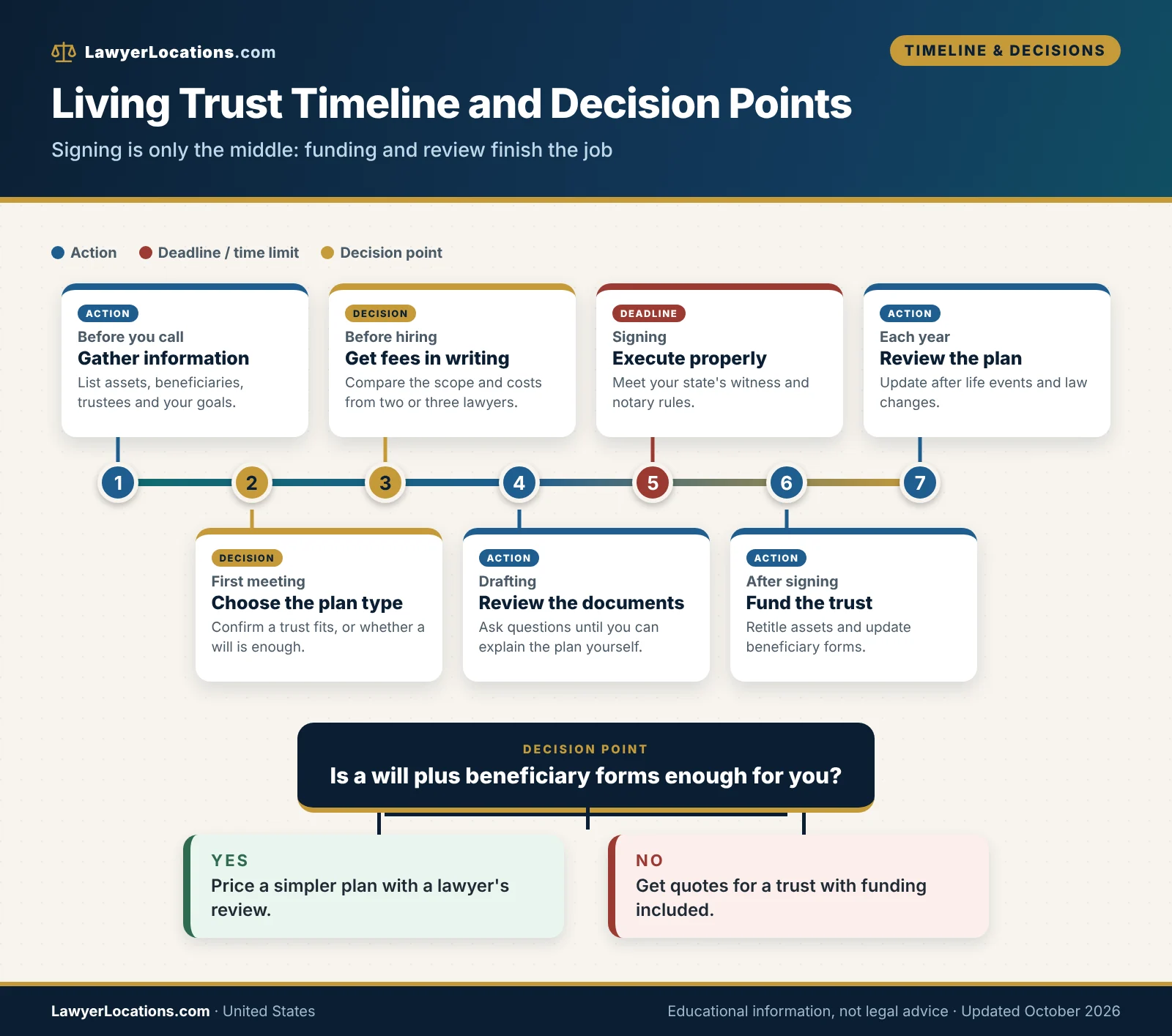
Text version of this graphic
- Before you call: gather information (action).
- First meeting: choose the plan type (decision).
- Before hiring: get fees in writing (decision).
- Drafting: review the documents (action).
- Signing: meet your state’s witness and notary rules (deadline).
- After signing: fund the trust (action).
- Each year: review the plan (action).
Decision question: is a will plus beneficiary forms enough for you? If yes, price a simpler plan; if no, get quotes for a trust with funding included.
Questions that decide which path fits
Three questions usually settle the main decision. First, would probate in your state be slow, costly or public enough to matter to your family? Second, do you have assets that will not pass automatically, such as a house in your sole name? Third, do you want control over timing or conditions for heirs, or planning for incapacity, that beneficiary forms cannot give you? If all three answers are no, a will and updated forms may be enough; if any is yes, a trust deserves a real quote.
Living trust scams and seminar red flags
How living trust sales schemes typically work
The classic pattern, which the Federal Trade Commission and state consumer protection agencies have warned about for years, begins with a free dinner or workshop, a mailed invitation or a phone call. The presenter paints probate as an expensive disaster that only a living trust can prevent. A follow-up meeting collects your financial details and sells a package at a high price, sometimes bundled with annuities or other financial products.
The documents are often generic, may be prepared by someone who is not a lawyer licensed in your state, and may never be funded correctly.
Red flags to watch for
- A “free lunch” or workshop that ends with pressure to sign up or pay that day.
- Claims that a living trust always saves large amounts in taxes, or lets you avoid creditors or nursing-home costs.
- Claims that probate always eats a huge share of an estate, with no reference to your state’s rules.
- A salesperson, not a lawyer, who answers legal questions, or no direct access to the lawyer who drafts the trust.
- A required purchase of an annuity, insurance policy or investment as part of the “trust package.”
- Reluctance to give you the price, contract or sample documents in writing in advance.
Never sign, pay or hand over account numbers at a sales event. Ask for the contract, take it home, and have a lawyer you choose independently review it. If you were pressured, contact your state attorney general’s consumer protection office or your state bar.
Where to check and report
You can confirm a lawyer’s license through the state bar, which typically publishes status and discipline information. Complaints about deceptive sales practices can go to your state attorney general’s consumer protection division and the Federal Trade Commission; complaints about unauthorized practice of law can go to the state bar. If an older relative was targeted and money has moved, adult protective services and local law enforcement are other options.
Common mistakes people make with living trusts
Planning errors
The most frequent mistake is signing a trust and never funding it. The second is a trust that conflicts with beneficiary forms: if an ex-spouse is still named on a retirement account, the form usually wins over the trust. Others include naming no backup trustee and skipping updates after a move, marriage, divorce or birth.
Practical errors
People also lose track of the paperwork. Keep the signed trust where your successor trustee can reach it, keep a funding list showing what was retitled and when, and tell your family the trust exists and how to reach your lawyer.
Your next steps
A simple plan for the next 30 days
Start with the asset list and a beneficiary-form check, which cost nothing. Then schedule consultations with two or three licensed lawyers in your state, ask each the same questions, and compare scope, communication and fees, not just price.
Ready to compare your options?
Use the questions and checklist in this guide to interview a living trust lawyer, and ask for the scope and fee in writing. For a local view of wills and trusts work, read our guide to a wills and trusts lawyer in Colorado Springs, Colorado, then look for a licensed lawyer in your own state.
Quick answers to common questions
Is a living trust public record?
Generally no. The trust document is typically private, although a recorded deed or a certification of trust may reveal limited facts, and a trust can still be disclosed in a court dispute.
What happens if I move to another state?
A properly created trust is generally still recognized, but state rules on trustee duties, real estate and taxes differ. Have a lawyer in your new state review it and update deeds as needed.
Can a living trust be contested?
Yes. Family members can sometimes challenge a trust on grounds such as lack of capacity, undue influence or fraud, under state law and within state time limits. A lawyer can help document your capacity and intent when you sign.
Is a living trust worth it for a small estate?
Often not by itself. If most assets pass by beneficiary designation or survivorship and your state offers simple small-estate procedures, a will and updated forms may be enough.
Sources & References
Show all 23 sources
- Internal Revenue Service — “What’s New — Estate and Gift Tax” (2026 basic exclusion amount, 2026 annual gift exclusion) — irs.gov — accessed October 2026.
- Legal Information Institute, Cornell Law School — 26 U.S.C. § 2010 (unified credit; basic exclusion amount; portability election) — law.cornell.edu — accessed October 2026.
- Legal Information Institute, Cornell Law School — 26 U.S.C. § 2001 (estate tax rate table) — law.cornell.edu — accessed October 2026.
- Legal Information Institute, Cornell Law School — 26 U.S.C. § 2038 (revocable transfers) — law.cornell.edu — accessed October 2026.
- Legal Information Institute, Cornell Law School — 26 U.S.C. § 1014 (basis of property acquired from a decedent) — law.cornell.edu — accessed October 2026.
- Legal Information Institute, Cornell Law School — 26 U.S.C. § 676 (power to revoke) — law.cornell.edu — accessed October 2026.
- Legal Information Institute, Cornell Law School — 26 C.F.R. § 1.671-4 (reporting for grantor trusts) — law.cornell.edu — accessed October 2026.
- Internal Revenue Service — Instructions for Form 1041 (filing threshold; new TIN for qualified revocable trusts after death; section 645 election) — irs.gov — accessed October 2026.
- Internal Revenue Service — Publication 555, Community Property — irs.gov — accessed October 2026.
- Legal Information Institute, Cornell Law School — 12 U.S.C. § 1701j-3 (Garn-St Germain; due-on-sale exceptions) — law.cornell.edu — accessed October 2026.
- Legal Information Institute, Cornell Law School — 42 U.S.C. § 1396p (Medicaid transfers of assets and trusts) — law.cornell.edu — accessed October 2026.
- Maine Legislature — 18-B M.R.S. § 813, § 604 and § 505 (Maine Uniform Trust Code, used as an example of a UTC state) — legislature.maine.gov — accessed October 2026.
- California Legislative Information — California Probate Code § 15400 — leginfo.legislature.ca.gov — accessed October 2026.
- Public.Law (California codes mirror) — California Probate Code § 10810 (statutory attorney compensation) — california.public.law — accessed October 2026.
- Legal Information Institute, Cornell Law School — “Pour-over will” (summary of California Probate Code §§ 6300–6303) — law.cornell.edu — accessed October 2026.
- Florida Senate — Florida Statutes § 736.0403 (creation of trust) — flsenate.gov — accessed October 2026.
- Florida Senate — Florida Statutes § 732.513 (devises to trustee) — flsenate.gov — accessed October 2026.
- New York State Senate — Estates, Powers and Trusts Law § 7-1.17 — nysenate.gov — accessed October 2026.
- Public.Law (Texas statutes mirror) — Texas Property Code § 112.051 — texas.public.law — accessed October 2026.
- Wikipedia — “Uniform Trust Code” (enactment list as of October 2022; secondary source) — en.wikipedia.org — accessed October 2026.
- Creative Planning — “2026 State Estate and Inheritance Taxes: What You Need to Know” (secondary source) — creativeplanning.com — accessed October 2026.
- Michigan Department of Attorney General, Consumer Protection — “Living Trusts” consumer alert — michigan.gov — accessed October 2026.
- Federal Trade Commission — “FTC Testifies Before Senate Special Committee on Aging on Living Trust Scams” (July 11, 2000; historical) — ftc.gov — accessed October 2026.
General information only. LawyerLocations.com is a legal-education and lawyer-discovery resource, not a law firm. This guide does not give legal, tax or financial advice, and reading it does not create an attorney-client relationship. Trust, probate and tax laws and local court practices change and vary by state, so confirm current rules and consult a lawyer licensed in the relevant jurisdiction before acting. Fees, deadlines and thresholds mentioned here may have changed since October 2026.
Legal Disclaimer and Limitation of Liability
Informational and illustrative purposes only. This article was prepared by LawyerLocations.com solely on the basis of the information available to us at the time of writing. It is an illustrative, general overview. It is not a complete or authoritative statement of the law, and it has not been reviewed by a lawyer licensed in your state or county.
Not legal advice. Nothing in this article is legal, financial, tax or immigration advice, and reading it does not create an attorney-client relationship between you and LawyerLocations.com or any author, lawyer or firm mentioned. Laws, court rules, fees, filing deadlines and agency procedures differ by state, county and court, and they change often. Some details here may be simplified, incomplete or out of date, and time limits for legal claims can be short.
No warranty. We make no representation or warranty, express or implied, about the accuracy, completeness, timeliness or suitability of this content for your situation. Please do not rely on it to make, delay or skip any legal decision. Check the facts against official sources and speak with a licensed attorney in the relevant jurisdiction before you act.
Limitation of liability. To the fullest extent permitted by law, LawyerLocations.com and its owners, authors and contributors disclaim all liability for any loss, damage, cost or other consequence arising from the use of, or reliance on, this article, including any content on third-party websites we link to. Mentioning a lawyer, firm, organization or service is not an endorsement and is not a promise of any result. If you are in immediate danger, contact your local emergency number.


