Looking for a workers comp lawyer Los Angeles CA injured workers can hire? Start with what the job is: a California-licensed attorney who represents you before the state Division of Workers’ Compensation (DWC) and the Workers’ Compensation Appeals Board (WCAB), not in an ordinary civil courtroom. The rules come from California law, and the cases are heard at WCAB district offices in the Los Angeles area. The first clocks are short: tell your employer about the injury within 30 days, return the claim form promptly, and treat 1 year as the working outer limit for filing a case. A lawyer’s fee comes out of your benefits and a judge must approve it.
This guide explains how the Los Angeles process works, what benefits look like in 2026, how to compare lawyers and what to ask before you sign anything.
What a Workers Comp Lawyer Does in Los Angeles, and When It Makes Sense to Hire One
A workers’ compensation lawyer in Los Angeles represents injured employees in California’s no-fault system for job injuries and illnesses. The lawyer handles the paperwork, medical disputes, evaluations and settlement talks, and appears before a workers’ compensation judge (WCJ) if the case is contested. You do not have to hire one, but the system is technical enough that many injured workers at least talk to one.
This page is general legal information, not legal advice, and LawyerLocations.com is not a law firm. We do not name, rank or recommend lawyers. Everything below is California law as of October 2026; recheck numbers with the agency before relying on them.
What California workers’ compensation covers
California requires most employers to carry workers’ compensation coverage, and in exchange employees generally give up the right to sue the employer for a covered injury. The substantive benefits are the same across Los Angeles County; the way you reach a judge, a doctor or a free state helper is local.
No-fault benefits for job injuries and illnesses
Benefits are paid whether or not the employer was careless. The main categories are medical treatment, temporary disability (partial wage replacement while you recover), permanent disability (compensation for lasting impairment), the supplemental job displacement benefit (a retraining voucher) and, in a fatal case, death benefits for dependents. The California Division of Workers’ Compensation explains these categories in its free Injured Worker Guidebook.
Injuries come in two forms. A specific injury comes from one incident, such as a fall from a loading dock. A cumulative injury develops from repetitive activity over time. Labor Code 3208.1 defines both, and Labor Code 5412 sets the date of a cumulative injury: roughly, when you first have disability from it and know or should know that work caused it.
Who counts as an employee, including undocumented workers
Under Labor Code 3351, the definition of “employee” includes people who are not U.S. citizens, whether they are lawfully or unlawfully employed. In plain terms, immigration status does not by itself take a Los Angeles worker outside the workers’ compensation system.
Where a lawyer fits in a Los Angeles claim
The DWC’s guidance says applicants’ attorneys protect your rights, track deadlines and represent you at hearings, and that you can find one through the State Bar, a local bar association or an applicants’ attorney association.
What a lawyer actually does
On a typical claim, a lawyer files the application with the WCAB, requests records, prepares you for medical evaluations, pushes back on delayed or denied treatment, challenges low impairment ratings and negotiates or tries the case. Some claim disputes are about whether the injury is work-related at all; others are about how much permanent disability you have. A lawyer’s job is different in each.
The lawyer also manages liens. Under Labor Code 4903, the appeals board may allow liens against your compensation for reasonable attorney fees, treatment costs and certain benefits paid by other programs. Ask any lawyer to explain every lien they expect in your case.
Claims that often move along without one
If the employer accepts the claim quickly and you expect no lasting impairment, free help from the state may be enough for now. The DWC’s Information and Assistance guide says “most attorneys offer one free consultation,” so a short meeting can tell you whether your claim is simple or complicated. That judgment can change if the insurer later denies treatment or the doctor reports permanent restrictions.
Signs you should speak with a lawyer sooner rather than later
Situations that raise the stakes
- The claims administrator denies the claim or says your injury is not work-related.
- Treatment is delayed, cut back or refused after your doctor requests it.
- Your doctor releases you but you still cannot do your job.
- Your employer disciplines, demotes or fires you after you report an injury.
- The injury is a cumulative trauma, a psychiatric injury or a disease with several possible causes.
- You are offered a lump-sum settlement and do not understand what you would give up.
When free state help may be enough for now
The DWC’s Information and Assistance (I&A) Unit is free and answers questions about rights and benefits. Its officers can explain the process and help resolve problems, but they are not your lawyer. The DWC’s own materials direct people with deeper disputes to a WCAB judge or an attorney.
Write down the date you first told your employer about the injury, who you told and how. That one detail helps every part of the claim, from the 30-day notice rule to disputes about whether your employer knew.
DWC, the WCAB and Where Los Angeles Workers’ Compensation Cases Are Heard
Los Angeles workers’ compensation cases are heard by workers’ compensation judges at WCAB district offices, not in Los Angeles Superior Court. The DWC lists offices in Los Angeles, Van Nuys, Pomona, Long Beach, Marina del Rey, Anaheim, Santa Ana and Oxnard serving the region. Which one hears your case depends on a venue rule, so ask any lawyer where your case will be filed.
The agencies you will deal with
Three names come up constantly: the claims administrator, the DWC and the WCAB. They do different jobs, and confusing them is one of the most common sources of missed deadlines.
DWC, WCAB and the claims administrator
The Division of Workers’ Compensation (DWC) is the state agency, part of the Department of Industrial Relations, that administers the system, runs the free Information and Assistance Unit and oversees medical networks and independent review. The Workers’ Compensation Appeals Board (WCAB) and its judges decide disputed claims. The claims administrator is the insurance company or third-party administrator that pays your benefits on the employer’s behalf.
Free help from the Information and Assistance Unit
The DWC’s Information and Assistance (I&A) Unit offers free information about benefits and obligations. For the Los Angeles area, its page lists offices in Los Angeles, Long Beach, Marina del Rey, Pomona and Van Nuys, and the statewide line is 1-800-736-7401 on weekdays during business hours.
| District office | Address | I&A phone listed by DWC |
|---|---|---|
| Los Angeles | 320 West 4th Street, 9th Floor, Los Angeles, CA 90013 | (213) 576-7389 |
| Van Nuys | 6150 Van Nuys Blvd., Room 105, Van Nuys, CA 91401 | (818) 901-5367 |
| Pomona | 732 Corporate Center Drive, Pomona, CA 91768 | (909) 706-4691 |
| Long Beach | 1500 Hughes Way, Suite C203, Long Beach, CA 90810 | (424) 450-2565 |
| Marina del Rey | 4720 Lincoln Blvd., 2nd Floor, Marina del Rey, CA 90292 | (310) 482-3820 |
| Anaheim | 1065 N. Link, Anaheim, CA 92806 | Not listed on the I&A page for this office |
| Santa Ana | 2 MacArthur Place, Suite 600, Santa Ana, CA 92707 | Not listed on the I&A page for this office |
| Oxnard | 1901 N. Rice Avenue, Suite 200, Oxnard, CA 93030 | Not listed on the I&A page for this office |
Older materials and some websites mention a Santa Monica or a Ventura district office. The DWC’s current list does not show either one. For the Westside, the listed office is Marina del Rey, and for Ventura County it is Oxnard. Check the DWC and WCAB “contact us” pages before you plan a trip.
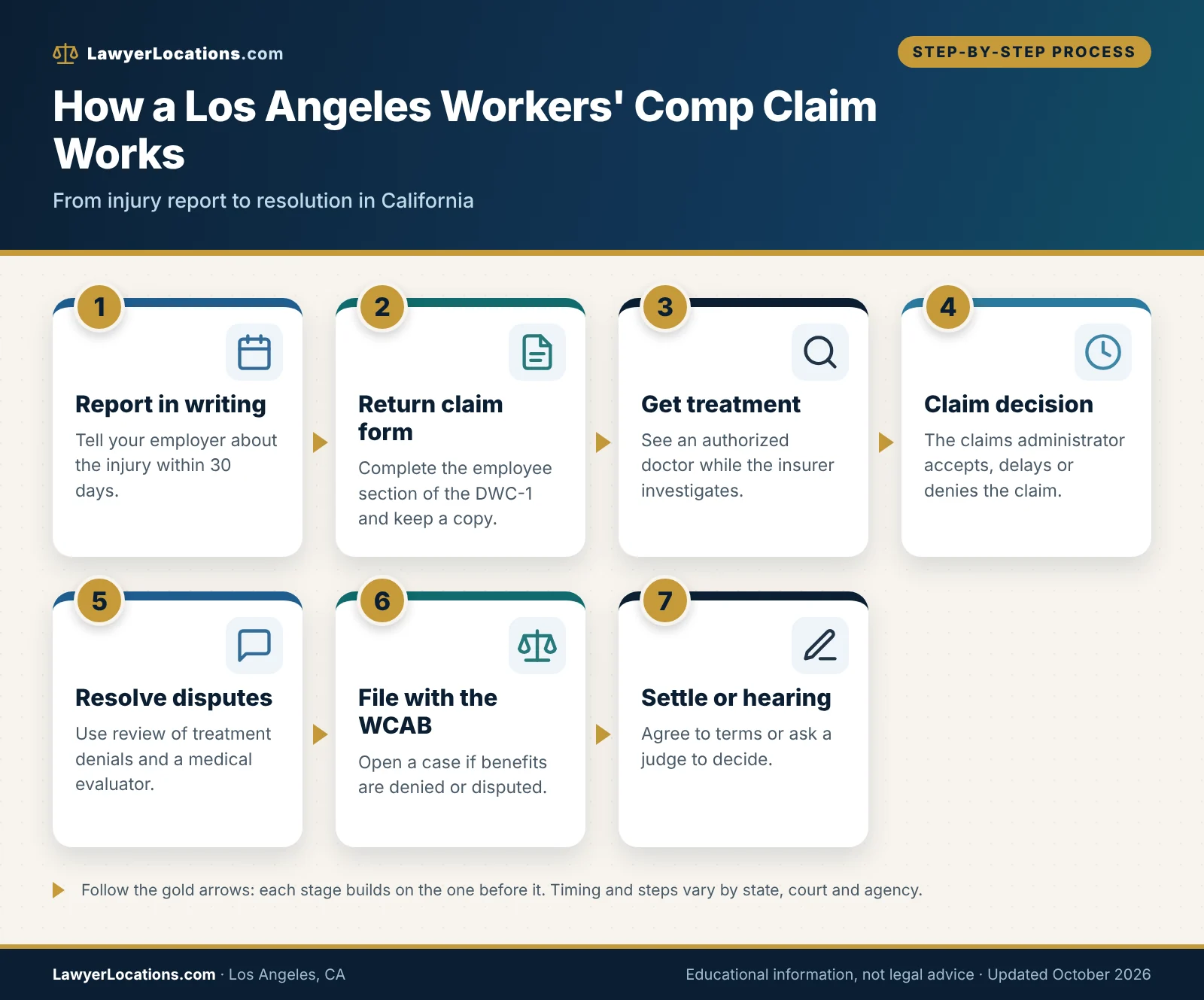
Text version of this graphic
- Report the injury to your employer in writing and ask for the DWC-1 claim form.
- Complete the employee section, sign it and return it; keep a copy.
- Get medical treatment while the insurer investigates (up to $10,000 of treatment while the claim is pending).
- The claims administrator accepts, delays or denies the claim.
- If there is a dispute, a medical evaluator or utilization review decides the medical questions.
- File an application with the WCAB if benefits are denied or disputed.
- Resolve the case by agreement or a judge’s decision, with a lawyer’s fee approved by the judge.
Which Los Angeles-area office hears your case
You usually do not pick the office by convenience alone. A venue statute lists where an application can be filed, and your choices depend partly on where you live, where you were hurt and whether you have a lawyer.
The venue rule in Labor Code 5501.5
Under Labor Code 5501.5, an application for adjudication may be filed in the county where the employee lives when it is filed, the county where the injury allegedly happened (for cumulative or occupational disease claims, where the last injurious exposure occurred) or, if the employee has a lawyer, the county where that lawyer’s main office is located.
If the chosen county has more than one appeals board office, the filing can go to any office that qualifies, and the employee files a written consent to the venue. If a lawyer’s office is the basis for venue, the employer has 30 days to object, and a successful objection sends the case back to the residence or injury county.
Why venue matters when you choose a lawyer
Los Angeles County alone has several district offices, and your hearings will usually be held where the case is venued. That affects travel time and your calendar.
Ask each lawyer, “Where will you file my case, and why there?” A vague answer on venue is a sign to ask more.
How a contested case moves through the WCAB
Most claims never reach a trial, but understanding the stages helps you read a lawyer’s fee agreement and timeline. The general path is: claim, dispute, application, medical evaluation, negotiation or hearing, decision.
Application for adjudication and the one-year window
The DWC’s fact sheet says that for a serious dispute you file an application for adjudication of claim, normally within one year of the injury or your last benefit payment. Filing opens a WCAB case number. Cases are managed through the DWC’s Electronic Adjudication Management System, known as EAMS.
An unrepresented worker who wants a hearing on a dispute must file a declaration of readiness to proceed, or an application if no case is open yet, according to the DWC’s supplemental job displacement FAQ.
Conferences, trial and reconsideration
After a case is set for a hearing, the typical sequence is a conference where the parties try to resolve disputed issues and, if that fails, a trial before a workers’ compensation judge. After a judge’s decision, a party who disagrees can ask for reconsideration by the appeals board, which has strict deadlines.
Deadlines and the First 90 Days of a California Workers’ Comp Claim
Four time limits shape most California claims: written notice to your employer within 30 days, a claim form returned promptly, a one-year limitation period and a 90-day mark after which a silent insurer is presumed to owe the claim. These are state rules in the Labor Code and apply the same way to a worker in Van Nuys as to a worker in Long Beach.
Do not wait for the insurer to tell you what to do. Report the injury now, put it in writing, and keep a dated copy. If you are close to a deadline, call a lawyer or the DWC the same day.
Reporting the injury and returning the claim form
Tell your employer first, then complete the claim form. Neither needs a lawyer.
The 30-day written notice rule
Under Labor Code 5400, and except as 5402 and 5403 provide, a claim for compensation requires written notice to the employer within 30 days of the injury that caused the disability. The notice must be signed by the injured worker or someone acting for them.
Labor Code 5402(a) softens the 30-day rule in practice: an employer’s knowledge of an injury, from any source, counts as notice. Do not rely on that. A short dated email or text to a supervisor and to human resources is cheap insurance.
The DWC-1 claim form, step by step
The DWC says your employer must give or mail you a claim form within one working day after learning about your injury or illness. Complete only the employee section, sign and date it, keep a copy and return it to your employer. If you mail it, the DWC recommends certified mail with a return receipt. The DWC warns that if you do not return the completed form you may risk your right to benefits.
- Describe the injury fully. Include every body part and symptom you know about, and the job tasks that caused them.
- Return it and keep proof. Hand it to a supervisor and ask for a signed, dated copy, or send it by certified mail.
- Expect the employer’s section within one working day. The DWC’s guidebook says the employer must give you a copy of the completed form within one working day after you file it.
The one-year clock and the 90-day presumption
Two numbers do most of the work after you file: one year for the limitations period and 90 days for the claims administrator to accept or reject. Keep them separate.
The limitations period in Labor Code 5405
Labor Code 5405 sets a one-year period to start proceedings for medical benefits and for disability payments. The year runs from the date of injury, from the end of the period covered by temporary disability payments, or from the last date medical treatment was furnished. The DWC’s Fact Sheet C puts it this way: for a serious dispute, file an application for adjudication of claim “normally within one year” of your injury or last benefit payment.
For a cumulative trauma, Labor Code 5412 fixes the injury date as the point when you first have disability and know, or reasonably should know, that your job caused it. That date can be hard to pin down, so treat one year as a working outer limit and not a date to aim for.
The 90-day rule in Labor Code 5402
Under Labor Code 5402, if the employer does not reject liability within 90 days after the claim form is filed, the injury is presumed compensable. That presumption can be rebutted only by evidence discovered after the 90-day period. For certain injuries and illnesses in Labor Code 3212 to 3213.2, the period is 75 days.
The same statute requires the employer to authorize treatment within one working day after a claim form is filed. Until the claim is accepted or rejected, medical liability is limited to $10,000. Treatment provided during that stage does not create a presumption of liability.
| Event | Time limit | Where it comes from |
|---|---|---|
| Written notice to employer | Within 30 days of the injury | Labor Code 5400; employer knowledge can count under 5402(a) |
| Employer gives claim form | Within 1 working day of learning of the injury | DWC, “How to file a claim” |
| Treatment authorization | Within 1 working day after the claim form is filed; $10,000 limit during investigation | Labor Code 5402(c) |
| Claim status letter | Generally within 14 days | DWC, “How to file a claim” |
| Presumption if no rejection | 90 days after claim form (75 days for certain Labor Code 3212 to 3213.2 injuries) | Labor Code 5402(b) |
| Start proceedings | Generally 1 year from injury, end of temporary disability payments or last medical treatment | Labor Code 5405; DWC Fact Sheet C |
| Retaliation petition | 1 year from the discriminatory act or termination | Labor Code 132a |
| Request IMR of a denial | Within 30 days of receiving the denial | DWC Injured Worker Guidebook, Chapter 4 |
Retaliation, protected leave and other income
A common fear is that reporting an injury will cost you the job. California law speaks to that directly.
What Labor Code 132a protects
Labor Code 132a prohibits employers and insurers from firing, threatening to fire or otherwise punishing a worker for filing or planning to file a workers’ compensation claim, or for testifying in another employee’s case. Remedies include reinstatement, repayment of wages and benefits lost, an increase in compensation of one-half up to $10,000 and costs and expenses up to $250. A petition must be filed with the appeals board within one year of the discriminatory act or the termination.
A retaliation claim is separate from your injury claim, so tell any lawyer about it early. If your employer’s conduct also raises wage, leave or discrimination issues, our guide to an employment lawyer in Fresno, California explains how California employment claims are usually handled, though courts and offices differ outside Fresno.
Protected leave, disability insurance and other benefits
The DWC’s guidebook notes that the federal Family and Medical Leave Act and the California Family Rights Act can provide up to 12 weeks of unpaid leave if you meet the eligibility rules.
While a claim is delayed or denied, State Disability Insurance from the EDD may be available, and the DWC recommends applying anyway (1-800-480-3287).
How to Compare Workers Comp Lawyers in Los Angeles and What They Cost
In California workers’ compensation, a lawyer’s fee is deducted from your benefits, and a workers’ compensation judge approves it. The DWC’s fee disclosure form says fees “normally range from 9% to 12% of the benefits awarded,” and fee agreements and appeals board decisions also refer to a 9% to 15% range. The percentage in your case is a decision for the judge, so ask each lawyer what they expect to request and why.
How workers’ compensation lawyers are paid
The fee is set by the judge and taken from the benefits the lawyer helps you obtain. That arrangement is regulated, which gives you something concrete to ask about.
Judge-approved fees taken from your benefits
The DWC’s Fact Sheet C says an applicant’s attorney’s fees come from your benefits and must be approved by a judge. The DWC’s Fee Disclosure Statement (DWC Form 3, revised January 2017) says the same and adds that the workers’ compensation judge approves the fee. The lawyer signs a declaration on that form that they have advised you of your rights.
The legal standard is reasonableness. Under Labor Code 4903 and Labor Code 4906, as the appeals board has described them, the judge considers the responsibility assumed, the care exercised, the time involved and the results obtained. The board has also applied Cal. Code Regs., tit. 8, section 10844 in fee decisions.
Costs, liens and the questions to ask about them
Under Labor Code 4903(a), the board can allow “reasonable fees and disbursements” as a lien against your compensation. Ask whether your lawyer advances costs such as records or evaluation reports, and whether those come out of your award in addition to the fee.
The DWC’s fee form also notes that an employer may have to pay attorney’s fees in some situations, such as when it disputes a permanent disability rating you obtained without an attorney. If you replace a lawyer midway, a judge sets the fair value of the completed work and that amount is deducted from your award.
| Topic | What the official sources say | Question to ask the lawyer |
|---|---|---|
| Who sets the fee | A workers’ compensation judge approves it (DWC Form 3; Fact Sheet C). | What percentage will you request, and on which benefits? |
| Typical range | The DWC form says “normally range from 9% to 12%” of benefits awarded; some fee agreements cite 9% to 15%. | Where will my case likely fall in that range, and what changes it? |
| Where it comes from | Deducted from your benefits, not billed hourly (Fact Sheet C). | Do I ever pay anything out of pocket during the case? |
| Case costs | Reasonable fees and disbursements can be allowed as a lien (Labor Code 4903(a)). | Who advances costs, and are they repaid from my award? |
| Changing lawyers | A judge sets the fair value of completed work (DWC Form 3). | What happens to the fee if I switch lawyers? |
| Employer-paid fees | Possible when an employer disputes a rating obtained without an attorney (DWC Form 3). | Could this apply to my case? |
Finding and vetting lawyers in Los Angeles
There is no official ranking of workers’ compensation lawyers, and we do not provide one. Gather names from reliable channels, verify each license and compare the lawyers with the same questions.
Referral services and state resources
The State Bar of California certifies lawyer referral services and lists them by region. In the Los Angeles area, its list includes the Los Angeles County Bar Association’s SmartLaw service at 1-866-762-7852, the San Fernando Valley Bar Association at (818) 340-4529, the South Bay Bar Association at (310) 325-4200 ext. 2 and the San Gabriel Valley Lawyer Referral Service at (626) 966-5530.
LACBA says its service is a nonprofit, charges nothing for a referral and gives each referred client a free consultation of up to 20 minutes, with further work subject to the attorney’s fees. Its page does not list workers’ compensation by name, so ask whether it has a lawyer for your type of claim. A referral is not an endorsement.
The DWC also points injured workers to local bar associations and applicants’ attorney associations, and notes that unions may help with referrals. The State Bar runs a legal specialization program for some practice areas, including workers’ compensation; if a lawyer mentions a specialization credential, verify it in the program’s own directory.
Checking a license and discipline record
Before you sign, confirm on the State Bar’s website that the lawyer is licensed in California and in good standing, and match the bar number in the engagement agreement to the public profile.
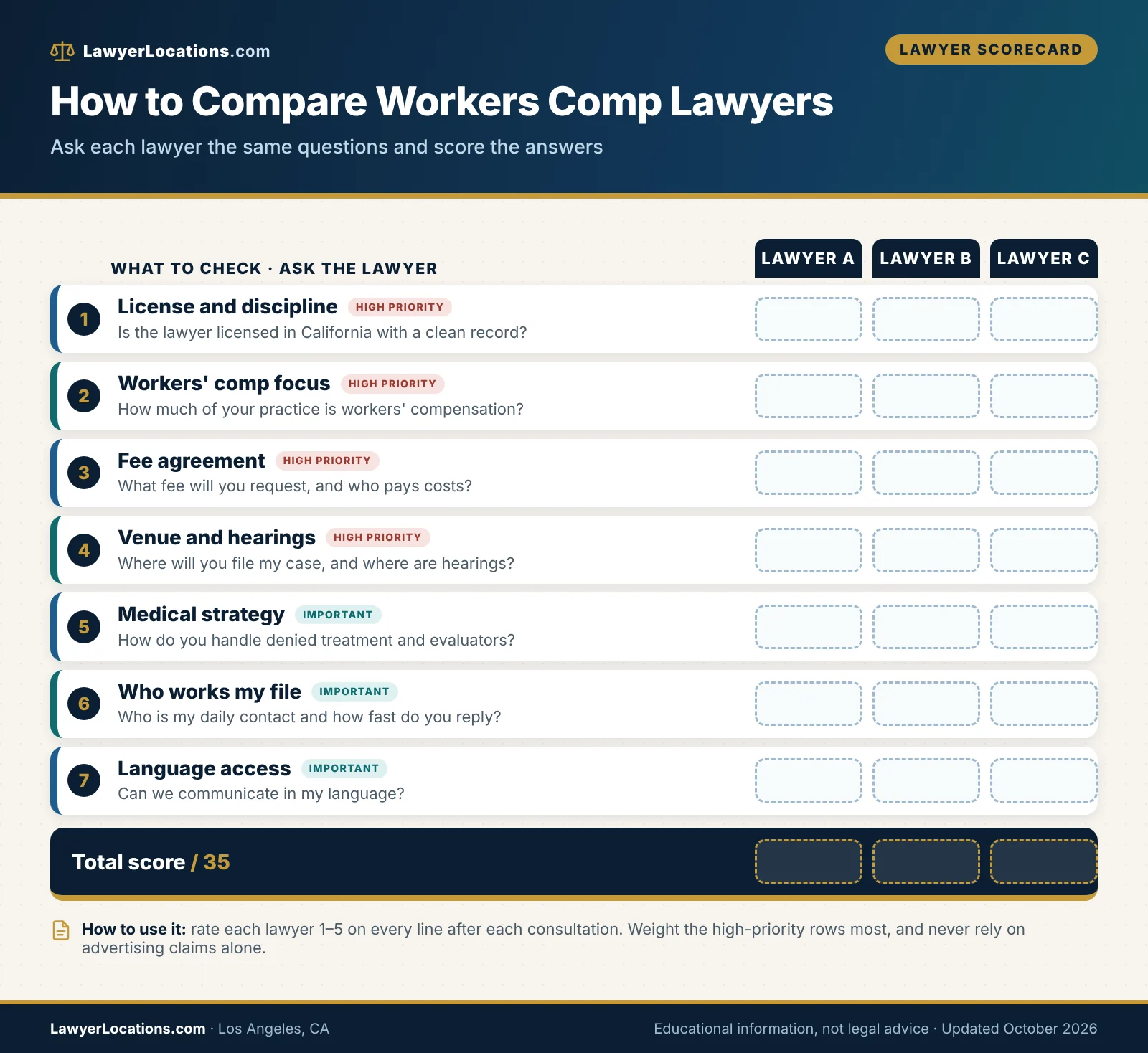
Text version of this graphic
| Criterion | Question to ask |
|---|---|
| License and discipline | Is the lawyer licensed in California with a clean public record? |
| Workers’ comp focus | How much of your practice is workers’ compensation? |
| Fee agreement | What fee will you request, and who pays case costs? |
| Venue and hearings | Where will you file my case, and will I attend in person? |
| Medical strategy | How do you handle denied treatment and evaluator selection? |
| Who works my file | Who is my day-to-day contact and how fast do you reply? |
| Language and access | Can I communicate in my language and by phone or text? |
Comparing lawyers side by side
Interview at least two lawyers if you can, use the same list for each and take notes.
Questions to ask in every consultation
- How many workers’ compensation cases like mine have you handled, and what usually goes wrong in them?
- Where will you file my case, and which WCAB district office will hear it?
- What percentage fee will you request, and what costs come out of my award?
- How do you handle a denied claim, a denied treatment request and a low impairment rating?
- Will you explain every settlement offer in writing, including what future medical care I would give up?
Red flags before you sign
- Promises of a specific settlement amount or a certain result.
- Pressure to sign the same day, or a refusal to let you take the agreement home.
- No clear explanation of the fee, liens or case costs.
- A request for a large payment up front, when the DWC says fees come from benefits and need judge approval.
- No answer on who will actually handle your file.
- Advice to ignore a deadline, skip a medical appointment or sign something you have not read.
Never sign a fee agreement, medical release or settlement paper you do not understand. If a lawyer rushes you, ask for a copy and a day to read it.
Before you call: a document checklist
Gather what you can, and do not delay calling because something is missing.
Documents to gather
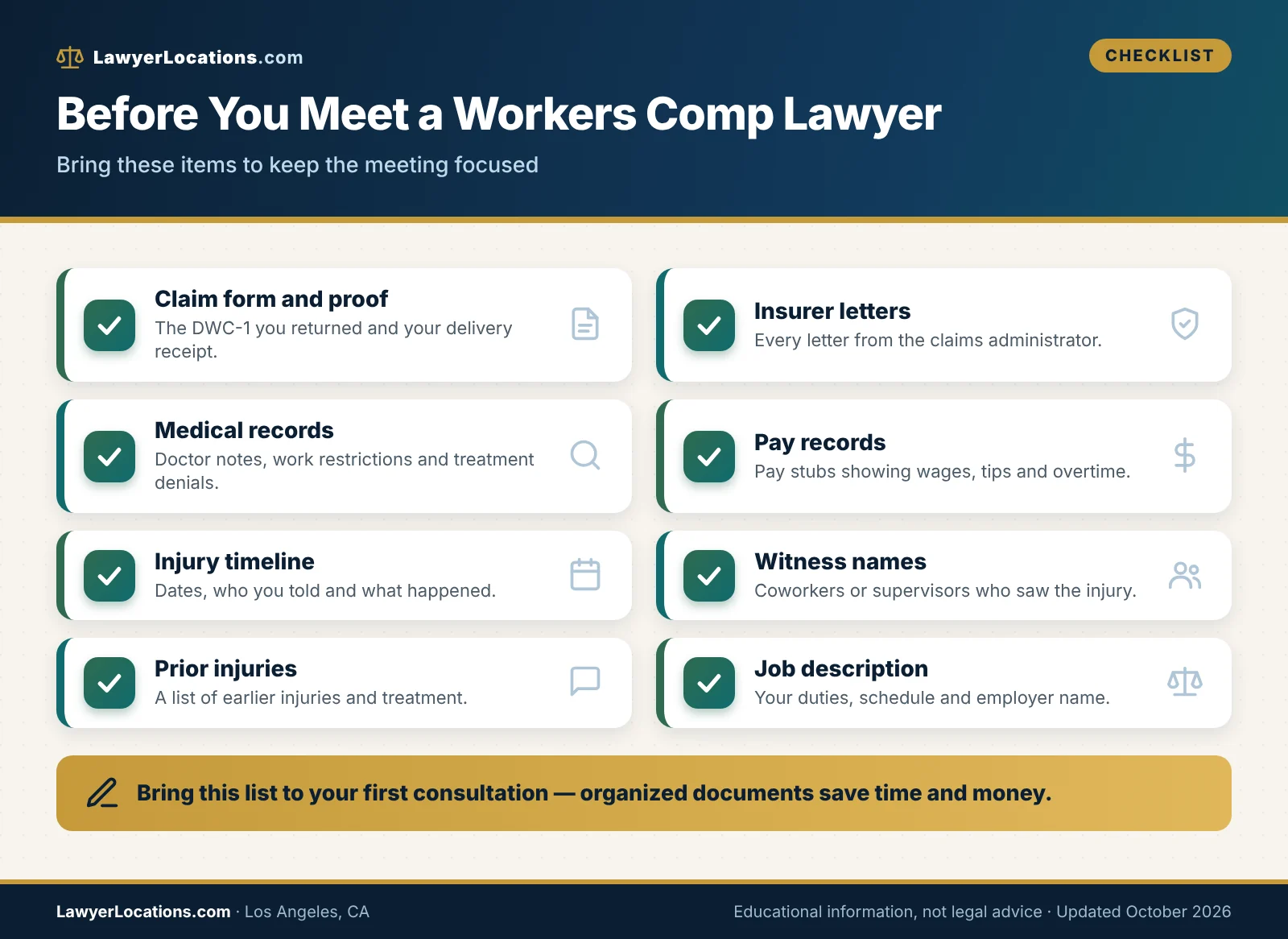
Text version of this graphic
- The claim form you returned and proof of delivery.
- Any letters from the claims administrator.
- Medical records, work notes and restrictions.
- Pay stubs showing wages, tips and overtime.
- A short written account of the injury and who you told.
- Names of witnesses and supervisors.
- A list of prior injuries and treatment.
- Your job description and schedule.
How to run the consultation
Start with your timeline, then the money questions, then strategy. Ask for the fee agreement in writing, compare it with the second lawyer’s and request an interpreter at the start if you need one.
Medical Care, Utilization Review and the QME Process in a Los Angeles Claim
In most Los Angeles claims, your first workers’ compensation doctor is chosen from the employer’s network, treatment requests go through utilization review and disputes over lasting impairment are decided with the help of a state-panel doctor called a qualified medical evaluator. Each step has its own short deadlines. Most of the fights that bring workers to lawyers happen here, not over whether you were hurt.
Who treats you: networks, predesignation and changing doctors
Your employer pays for reasonably required medical care. The doctor you can see depends on how the employer’s coverage is set up.
Medical provider networks and health care organizations
A medical provider network (MPN) is a group of providers set up by an insurer or self-insured employer and approved by the DWC’s administrative director. A health care organization (HCO) is a DWC-certified organization under contract with the employer or insurer. If your employer uses one, you are usually treated within it unless you predesignated a personal physician.
If there is neither an MPN nor an HCO, the DWC’s guidebook says the claims administrator usually chooses your first doctor, unless you predesignated.
Predesignation and switching doctors
Predesignation means telling your employer in writing, before the injury, that you want your personal doctor to treat a work injury. Under the DWC’s fact sheet, you must have health coverage and a personal doctor (an M.D. or D.O.) who has treated you before, has your records and agreed in advance to treat work injuries. Most workers have not done this, so it is a point to raise only if you did.
Within an MPN, you may switch to another MPN doctor after the first exam and again whenever it is reasonable. If you disagree with your MPN treating doctor, you can seek opinions from up to two more MPN doctors, but you must schedule those appointments within 60 days of receiving the list from the claims administrator or risk losing the right. If you still disagree, you can request independent medical review.
Treatment disputes: utilization review and independent medical review
When your doctor asks for treatment, a formal process decides, with fixed timelines.
How utilization review works
Utilization review (UR) is the process insurers use to decide whether to authorize treatment your doctor recommends. The doctor submits a request for authorization (RFA). The DWC’s guidebook gives the following timelines: for urgent cases, a decision within 72 hours after the administrator gets the needed information; for non-urgent cases, within 5 working days, and up to 14 days if more information is needed. A denial must come from a physician reviewer and clearly explain the reasons.
Independent medical review for denied treatment
If treatment is denied, modified or delayed, you can request independent medical review (IMR). Under the DWC’s guidebook, request it within 30 days after you receive the denial. Otherwise the denial stands for 12 months unless your condition changes. The DWC says IMR takes about 40 days or fewer.
IMR is limited to medical necessity and does not resolve whether the injury is work-related. Only the injured worker can request it. If your claim denial is the real issue, you will need a different route.
| Step | What happens | Timeline | What you can do |
|---|---|---|---|
| Treatment request (RFA) | Your doctor asks the claims administrator to authorize care. | Authorization of initial treatment within 1 working day after the claim form; $10,000 limit during investigation | Keep appointments and confirm the request was sent. |
| Utilization review | A reviewer approves, modifies or denies the request. | 72 hours (urgent); 5 working days, up to 14 days (non-urgent) | Ask for the decision in writing and for the reasons. |
| IMR | An independent reviewer decides medical necessity. | Request within 30 days of denial; about 40 days or fewer for a determination | Request it yourself or with your doctor or lawyer. |
| MPN second and third opinions | Other MPN doctors give opinions when you disagree. | Schedule within 60 days of receiving the list | Book promptly and note the dates. |
| QME panel | A state-panel doctor evaluates disputed medical-legal questions. | 10 days to return forms and 10 days to choose a doctor (unrepresented) | Respond on time or the administrator may choose for you. |
Medical-legal evaluations: the QME and the AME
Medical-legal evaluations are about what the injury means for your benefits, and their opinions can drive your permanent disability rating.
The QME process if you have no lawyer
A qualified medical evaluator (QME) is a doctor on a DWC panel who examines you and writes a medical-legal report. The DWC’s guidebook says that without an attorney, after a disagreement letter the claims administrator sends a form and instructions. You then have 10 days to complete the form, select the specialty and mail it to the DWC. After the DWC sends a panel, you have another 10 days to choose a QME from it, schedule the exam and notify the claims administrator. If you miss these deadlines, the administrator chooses the doctor from the panel.
Represented workers and the AME
If you have a lawyer and you injured yourself in 2005 or later, either side can request a panel of three QMEs when you cannot agree on a doctor. If you cannot agree on someone from the panel, each side strikes one name and the remaining QME performs the evaluation. An agreed medical evaluator (AME) is chosen by agreement between your attorney and the claims administrator, and an AME is not required to be certified by the DWC.
The medical-legal report affects your benefits, and in many cases you cannot choose a different QME or AME afterward. Bring a written timeline of your symptoms, job duties and prior injuries, and list every prior injury, because an evaluator may divide your impairment between the job and other causes, which is called apportionment. The DWC also says you may have another person present at an exam or record it, but you should tell the doctor first.
Benefits, Settlements and Decision Points for Los Angeles Workers in 2026
For injuries in 2026, California temporary disability pays roughly two-thirds of your average weekly wage, within a state minimum of $264.61 and a maximum of $1,764.11 per week. Permanent disability is rated from medical evidence using the AMA Guides, and many cases end in a stipulated award or a compromise and release. Settlement review is a main reason people hire lawyers.
Temporary disability and other income while you recover
Temporary disability (TD) replaces part of your wages while you are off work or earning less because of the injury. It is not taxable, according to the DWC.
How TD is calculated, with the 2026 rates
The DWC’s Fact Sheet C says TD pay is generally two-thirds of your gross pre-tax wages at the time of injury, subject to legal minimum and maximum rates. All income from work counts, including tips, commissions, overtime, bonuses and food or lodging, and earnings from other jobs you held at the time of injury may count too. Payments begin when your doctor says you cannot do your usual work for more than three days, or after an overnight hospital stay, and are made every two weeks.
The DIR announced that for 2026 the minimum TD rate is $264.61 a week, up from $252.03, and the maximum is $1,764.11, up from $1,680.29, effective January 1, 2026.
| Benefit | 2026 figure | Source and note |
|---|---|---|
| Temporary disability, weekly minimum | $264.61 | DIR news release 2025-116; effective January 1, 2026 |
| Temporary disability, weekly maximum | $1,764.11 | DIR news release 2025-116; effective January 1, 2026 |
| TD pay formula | Generally two-thirds of average weekly wage, within the minimum and maximum | DWC Fact Sheet C |
| TD duration | Up to 104 weeks within five years of injury; up to 240 weeks for certain long-term injuries | DWC Fact Sheet C |
| Permanent disability, weekly range | Reported as $160 minimum and $290 maximum for injuries since 2014 | Secondary law-firm and industry summaries; confirm with the DWC |
| Supplemental job displacement voucher | $6,000 for injuries on or after January 1, 2013 | DWC SJDB FAQ |
Late-payment penalties and when TD ends
The DWC’s guidebook says a late payment carries a 10% penalty, and without a reasonable excuse the total penalty can reach 25% of the late payment, up to $10,000. TD generally ends when you return to work, are released or reach maximum improvement. If payments stop or shrink without explanation, call your claims administrator, then the DWC’s Information and Assistance line, then a lawyer if the problem continues.
Permanent disability and how it is rated
If your doctor decides your condition is permanent and stationary and you have lasting impairment, you may be owed permanent disability (PD) benefits.
Rating basics for injuries since 2013
Under Labor Code 4660.1, for injuries on or after January 1, 2013, the rating accounts for the nature of the injury, your occupation and your age at injury. Physical impairment is based on the AMA Guides, 5th Edition using whole person impairment, multiplied by an adjustment factor of 1.4. A rating of 100% is permanent total disability, and ratings from 1% to 99% are permanent partial. The DWC’s guidebook adds that the rating also depends on apportionment, meaning the job-caused share of the disability versus other causes.
The first PD payment is due within 14 days after the final TD payment, according to the guidebook, and payments continue every 14 days. If the employer offers qualifying work at or above 85% of pre-injury wages and benefits, payments wait until a judge approves a settlement or decides the benefits.
Disputing a rating
You can challenge the permanent and stationary report and the rating, negotiate with the claims administrator or ask a workers’ compensation judge to decide. Without an attorney, you can ask the DWC’s administrative director for reconsideration if there were mistakes in the medical evaluation or rating process. An attorney can present your case to a judge.
Costs, deadlines and decision points
Most injured workers face the same few decisions in roughly the same order.
The timeline in order
- Days 0 to 30. Report the injury in writing, request and return the claim form, and begin treatment.
- Up to 90 days. The claims administrator investigates, with up to $10,000 of treatment during this stage, and must accept or reject or lose the right to contest absent new evidence.
- As treatment requests are denied. Use utilization review and request IMR within 30 days of a denial.
- Before one year. File an application for adjudication if benefits are denied or disputed.
- When your condition is stable. Expect a permanent and stationary report, a rating and a settlement discussion.
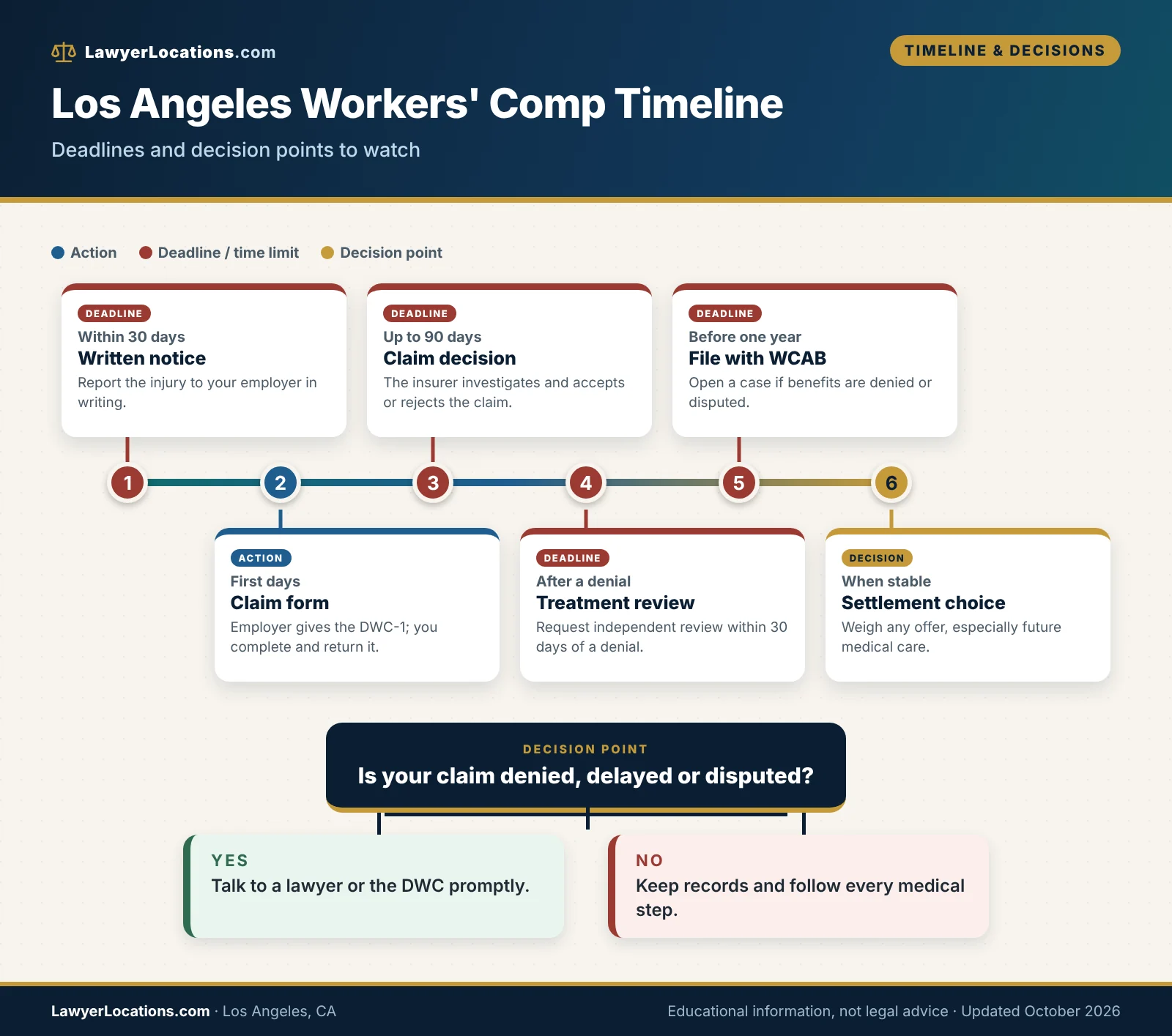
Text version of this graphic
- Within 30 days: report the injury in writing.
- Within 1 working day of learning of it: employer provides the claim form.
- Up to 90 days: claims administrator investigates and accepts or rejects.
- Within 30 days of a treatment denial: request independent medical review.
- Within 1 year: file an application if the claim is disputed.
- Decision point: hire a lawyer, accept a settlement or ask a judge to decide.
The big decisions
Four decisions drive most outcomes: whether and when to hire a lawyer, which doctor treats you and whether to challenge a denial, how to prepare for the medical-legal evaluation and whether to accept a settlement, especially one that gives up future medical care.
Los Angeles Work Situations, Common Mistakes and Your Next Steps
The state rules are the same across California, but a few Los Angeles settings change the analysis: the ports, entertainment sets, hospitals and garment shops, and workers who are not authorized to work in the United States. Knowing which system and which facts apply tells you what to ask a lawyer.
Settlements, vouchers and future medical care
Many cases end in a settlement, and the type controls what happens to your medical care.
Stipulated award versus compromise and release
The DWC’s guidebook describes two main types. With a stipulation with request for award, the payment terms are agreed, medical care usually continues and benefits can be adjusted later; requests to change benefits are usually due within five years of the injury date. With a compromise and release, a lump sum covers unpaid PD; if it includes future medical costs, your doctor’s care becomes your responsibility, and benefits cannot be reopened. A workers’ compensation judge must review any settlement for adequacy.
- Medical care usually continues.
- Benefits can be adjusted later in some situations.
- Future medical care is included and becomes your responsibility.
- The case cannot be reopened.
Never accept a lump sum without a written explanation of what happens to your future medical care. A compromise and release usually cannot be reopened.
The supplemental job displacement voucher
For injuries on or after January 1, 2013, the supplemental job displacement benefit (SJDB) is a flat $6,000 voucher for workers with permanent disability when the employer does not offer other regular, modified or alternative work. The employer’s job offer must be made within 60 days after the claims administrator receives the required form, and the voucher is due within 20 calendar days after that offer period expires.
The voucher expires within two years of issue or five years from the date of injury, whichever is later. It covers training at a California public school or a provider on the state’s Eligible Training Provider List, plus licensing, certification and testing fees and required tools. Any job offer must pay at least 85% of pre-injury earnings and be expected to last at least 12 months. Ask your lawyer to account for the voucher in any settlement.
Los Angeles work situations that change the analysis
Ask any lawyer whether they have handled your situation.
Port and longshore work
Workers on the docks at the Los Angeles and Long Beach ports may fall under a federal program, not the state system. The U.S. Department of Labor says the Longshore and Harbor Workers’ Compensation Act covers traditional maritime workers such as longshore workers, ship repairers, shipbuilders and harbor construction workers, for injuries on navigable waters or adjoining areas such as piers, docks, terminals and wharves. Vessel crew members are excluded and fall under the Jones Act.
The federal act has its own clocks, per the Department’s FAQ: written notice to the employer within 30 days and a written claim within one year. Some workers, such as office clerical or security staff, may be excluded when state law covers them, so ask any lawyer which system applies before a deadline passes.
Entertainment, health care, logistics and garment work
The Los Angeles Economic Development Corporation’s 2022 cluster data show Local Health Services as the county’s largest private-sector cluster at 473,581 jobs, with Local Hospitality Establishments at 409,066, the Entertainment Group at 196,594 and Apparel at 22,635. Those are job counts, not injury counts.
Repetitive lifting and patient handling in hospitals and warehouses often lead to cumulative trauma claims. Piece-rate and tip-based pay raises a wage question, because the DWC says tips, commissions and overtime count toward temporary disability. On projects with layered staffing arrangements, ask who issued your paycheck and which insurer covers that employer, because the claim form goes to your employer.
Undocumented workers
Labor Code 3351 includes people who are not U.S. citizens, whether lawfully or unlawfully employed, in the definition of employee, so immigration status does not by itself bar a claim. Ask a lawyer how they handle work-authorization questions and when they would bring in an immigration lawyer. Do not sign forms about your status without legal advice.
COVID-19 and injuries caused by someone else
The two COVID-19 presumptions created by SB 1159 expired on January 1, 2024, according to the DIR, but workers can still pursue COVID-19 claims under the standard rules for disease compensability. If someone other than your employer caused the injury, such as a driver who hit you on a delivery route, you may have a separate third-party claim in addition to workers’ compensation. Our guide to the car accident settlement timeline explains how those claims usually unfold.
Common mistakes and quick answers
Most avoidable problems come from timing and paperwork.
Mistakes that cost injured workers
- Reporting the injury verbally and never putting it in writing.
- Missing the 30-day IMR request window after a treatment denial.
- Skipping a medical appointment or QME exam, or leaving out old injuries.
- Accepting a lump sum without understanding what happens to future medical care.
Quick answers
How much does a workers comp lawyer cost in Los Angeles?
Fees are generally taken from your benefits and approved by a judge. The DWC’s fee form says they normally range from 9% to 12%. Ask each lawyer for the percentage and costs in writing.
How long do I have to file a workers’ comp claim in California?
Give written notice to your employer within 30 days, return the claim form promptly and treat one year from injury, last benefit or last treatment as the outer limit for filing.
Can I be fired for filing a workers’ comp claim?
Labor Code 132a prohibits retaliation for filing or planning to file. A petition must be filed within one year, and remedies include reinstatement and lost wages.
Can undocumented workers get workers’ comp in California?
Labor Code 3351 includes people who are not citizens, whether lawfully or unlawfully employed, in the definition of employee.
Your next steps
This week
Put the injury in writing, return the claim form with proof of delivery and get treatment. Call the DWC’s Information and Assistance line at 1-800-736-7401 with questions.
This month
Book one or two consultations through a State Bar-certified referral service or another source you trust, compare fee terms, venue and communication plans, and verify each lawyer’s license before you sign.
Ready to compare your options?
Use the scorecard and checklist in this guide to interview two or three California-licensed workers’ compensation lawyers, and get the fee in writing before you sign. If your injury also involves a car crash, our guide to the car accident settlement timeline can help you separate the two claims.
Sources & References
Show all 18 sources
- 2026 Temporary Total Disability rates (DIR news release 2025-116) — California Department of Industrial Relations — dir.ca.gov/DIRNews/2025/2025-116.html — accessed October 2026
- How to file a claim — California Division of Workers’ Compensation — dir.ca.gov/dwc/FileAClaim.htm — accessed October 2026
- Fact Sheet C: Temporary Disability Benefits — California Division of Workers’ Compensation — dir.ca.gov/dwc/FactSheets/FactSheet_c.pdf — accessed October 2026
- Fact Sheet B: Medical Care (MPN, predesignation, UR, IMR) — California Division of Workers’ Compensation — dir.ca.gov/dwc/FactSheets/FactSheet_B.pdf — accessed October 2026
- Injured Worker Guidebook, Chapters 2, 3, 4 and 7 — California Division of Workers’ Compensation — dir.ca.gov/InjuredWorkerGuidebook — accessed October 2026
- Information & Assistance Guide 1 — California Division of Workers’ Compensation — dir.ca.gov/dwc/iwguides/IWGuide01.pdf — accessed October 2026
- Information and Assistance Unit (office list) — California Division of Workers’ Compensation — dir.ca.gov/dwC/IandA.html — accessed October 2026
- WCAB district office contact list — Workers’ Compensation Appeals Board — dir.ca.gov/WCAB/wcab_offices.htm — accessed October 2026
- Fee Disclosure Statement, DWC Form 3 (Rev. 1/17) — California Division of Workers’ Compensation — dir.ca.gov/dwc/FORMS/DWC3.pdf — accessed October 2026
- Nelson v. (sample panel decision, ADJ12139553) on attorney fees under Labor Code 4903 and 4906 — Workers’ Compensation Appeals Board — dir.ca.gov/wcab/Panel-Decisions-2024/Nelson-SAMPLE-ADJ12139553.pdf — accessed October 2026
- Supplemental Job Displacement Benefits FAQ — California Division of Workers’ Compensation — dir.ca.gov/dwc/sjdb/SJDB_FAQ.html — accessed October 2026
- COVID-19 and workers’ compensation — California Department of Industrial Relations — dir.ca.gov/covid/employer/covid-and-workers-comp.html — accessed October 2026
- Labor Code sections 5400, 5402, 5405, 5412, 3208.1, 3351, 132a, 4903, 4660.1 and 5501.5 — California Public Law (mirror of the California Legislature’s code; confirm against leginfo.legislature.ca.gov) — california.public.law/codes (Labor Code) — accessed October 2026
- Find a Los Angeles Area Lawyer Referral Service — State Bar of California — calbar.ca.gov — accessed October 2026
- LACBA SmartLaw Lawyer Referral Service — Los Angeles County Bar Association — lacba.org — accessed October 2026
- Longshore and Harbor Workers’ Compensation Act FAQ — U.S. Department of Labor, OWCP — dol.gov/agencies/owcp/dlhwc/FAQ/lsfaqs — accessed October 2026
- Industry Clusters, Los Angeles County 2022 — Los Angeles County Economic Development Corporation — laedc.org (industry clusters PDF) — accessed October 2026
- Permanent disability weekly range (secondary source) — Bradford & Barthel, CA Benefit Rates 2026 Quick Reference — bradfordbarthel.com (PDF) — accessed October 2026
General information only. This article is educational and is not legal advice. Reading it does not create an attorney-client relationship, and LawyerLocations.com is not a law firm and does not recommend or rank lawyers. Laws, benefit rates, forms, office addresses and local procedures change, and your facts matter. Consult a lawyer licensed in California, or contact the California Division of Workers’ Compensation, about your own situation.
Legal Disclaimer and Limitation of Liability
Informational and illustrative purposes only. This article was prepared by LawyerLocations.com solely on the basis of the information available to us at the time of writing. It is an illustrative, general overview. It is not a complete or authoritative statement of the law, and it has not been reviewed by a lawyer licensed in your state or county.
Not legal advice. Nothing in this article is legal, financial, tax or immigration advice, and reading it does not create an attorney-client relationship between you and LawyerLocations.com or any author, lawyer or firm mentioned. Laws, court rules, fees, filing deadlines and agency procedures differ by state, county and court, and they change often. Some details here may be simplified, incomplete or out of date, and time limits for legal claims can be short.
No warranty. We make no representation or warranty, express or implied, about the accuracy, completeness, timeliness or suitability of this content for your situation. Please do not rely on it to make, delay or skip any legal decision. Check the facts against official sources and speak with a licensed attorney in the relevant jurisdiction before you act.
Limitation of liability. To the fullest extent permitted by law, LawyerLocations.com and its owners, authors and contributors disclaim all liability for any loss, damage, cost or other consequence arising from the use of, or reliance on, this article, including any content on third-party websites we link to. Mentioning a lawyer, firm, organization or service is not an endorsement and is not a promise of any result. If you are in immediate danger, contact your local emergency number.