Searching for a family law attorney California courts will actually see you with usually means one of a few things: ending a marriage or domestic partnership, deciding custody and parenting time, setting or changing child or spousal support, or getting protection from an abusive partner. All of these are handled under the California Family Code in the Superior Court of the county where you file. You are not required to hire a lawyer, but many people want one for property, custody or support disputes, and California has several lower-cost paths in between.
This guide covers residency and the six-month wait, community property, custody, support, restraining orders, court self-help centers, limited-scope hiring, need-based fees, and State Bar tools for comparing lawyers. It is general information as of October 2026, not advice about your case.
How a family law case works in California
A California family law case begins with a form filed in a county Superior Court and moves through service, financial disclosure, temporary orders if needed, and a final judgment. The details differ for divorce, custody-only and restraining-order cases, but the court system and the Judicial Council forms are statewide.
The path from petition to judgment
California calls divorce dissolution of marriage. The court system’s self-help pages describe four stages: starting the case, sharing financial information, deciding property, children and support, and finalizing. Legal separation follows the same steps, as do cases for registered domestic partners.
Starting the case: residency, forms and the filing fee
One spouse must have lived in California for the past 6 months and in the current county for the past 3 months, according to the California Courts Self Help Guide. Family Code 2320 measures both periods before the petition is filed.
The core forms are the FL-100 Petition and the FL-110 Summons, which tells the other spouse they have 30 days to respond. With children under 18, you also file the FL-105 declaration under the Uniform Child Custody Jurisdiction and Enforcement Act. The court system lists the filing fee as $435–$450 and says you can ask for a fee waiver.
Serving papers, the response and the six-month clock
The other spouse must be formally served with the summons and petition, and the usual response window is 30 days. A respondent who ignores it risks a default.
Under Family Code 2339, no judgment of dissolution is final for terminating the marriage until six months have passed from service of the summons and petition or the respondent’s appearance, whichever comes first. A court can extend that period for good cause. Six months is a minimum, not a prediction: contested cases often run longer.
The six-month period does not start when you file. It runs from service or the other spouse’s appearance. If you are the petitioner, serving promptly and correctly starts that clock. If you are served, count the 30-day response window from the service date on your papers and write it on a calendar the same day.
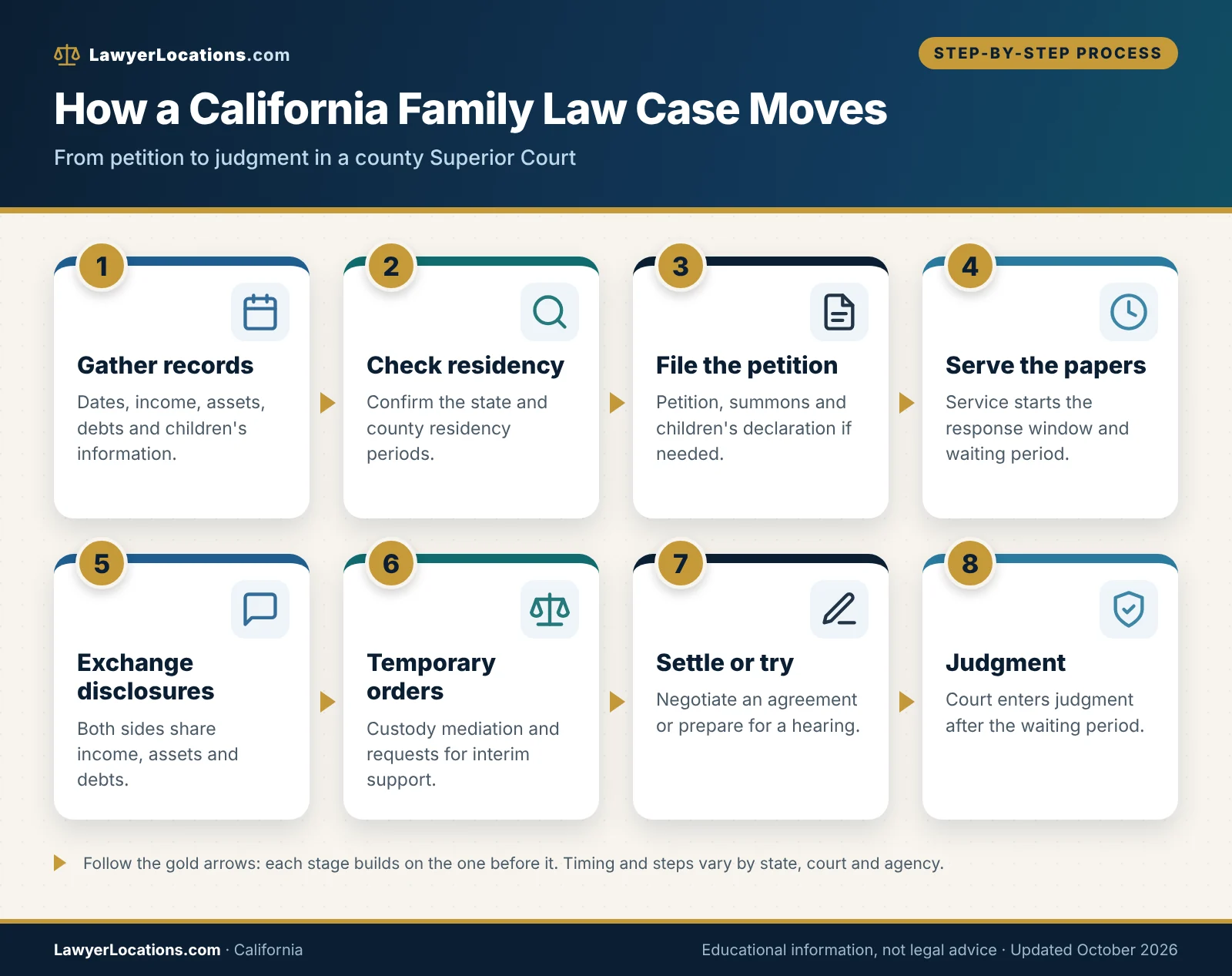
Text version of this graphic
- Gather records: marriage date, separation date, income, assets, debts, children’s information.
- Check residency and pick the county: 6 months in California, 3 months in the county.
- File the petition, summons and, with children, the UCCJEA declaration.
- Serve the other spouse; the response window is generally 30 days.
- Exchange preliminary financial disclosures.
- Seek temporary orders and attend custody mediation if custody is disputed.
- Negotiate a settlement or prepare for trial.
- Judgment entered; the marriage ends no earlier than six months after service or appearance.
Which kind of case you may actually have
The label on the petition controls what the court can do and how long you wait.
Dissolution, legal separation, nullity and summary dissolution
The two statutory grounds are irreconcilable differences that have caused the irremediable breakdown of the marriage, and permanent legal incapacity to make decisions (Family Code 2310). California is a no-fault state. The court system says legal separation has no six-month waiting period, which suits people who want orders about property, children and support without ending the marriage. Our guide on legal separation vs divorce compares the two nationally.
A nullity (annulment) case asks the court to declare the marriage voidable on a ground in Family Code 2210, such as fraud, force, unsound mind, a prior undissolved marriage or being under 18. The grounds are narrower than most people expect.
Summary dissolution is a streamlined joint process. Under Family Code 2400, the couple must have been married five years or less at separation, have no children born or adopted during the marriage, own no real property (with narrow exceptions), stay under inflation-adjusted limits on debts and assets, and both waive spousal support.
Domestic partnerships, unmarried parents and restraining-order-only cases
A California domestic partnership begins when two eligible adults file a Declaration of Domestic Partnership with the Secretary of State (Family Code 297), and ending one through the courts uses the same steps as a divorce. Unmarried parents can ask the court to decide custody, parenting time and child support without a dissolution case, and a person who needs protection can file for a domestic violence restraining order (DVRO) on its own. Section 3 covers those orders.
Where the case is heard: your county’s Superior Court
California has one trial-level court, the Superior Court of California, organized by county. Each county’s family division applies the same Family Code and Judicial Council forms but has its own local rules, calendars and self-help services.
How venue and local rules affect you
Residency decides where you can file, and local rules shape the practical experience: hearing availability, how custody mediation works, extra local forms and remote appearances. Ask any lawyer how often they appear in your courthouse. The court’s website is the primary source for current local rules.
Examples from Los Angeles, San Diego and Orange counties
San Diego’s court page lists divorce, legal separation, annulment and parentage actions, a Family Law Facilitator, self-help services and separate e-filing for family law and DVTROs, and says some eligible people may get a free attorney through the Sargent Shriver Civil Counsel Act. Its Family Court Services office provides child custody recommending counseling.
Orange County lists in-person Self-Help Centers at six justice centers, workshops, a family law facilitator and fee waiver information, and says family law matters are filed at the Lamoreaux Justice Center. In Los Angeles County, Neighborhood Legal Services describes court-based Self-Help Legal Access Centers serving family law and restraining orders. Check the Superior Court of Los Angeles County’s website for current family filing locations and local rules.
| Route | Key requirement | Waiting period | Main statute |
|---|---|---|---|
| Dissolution (divorce) | 6 months in California and 3 months in the county before filing; grounds are irreconcilable differences or permanent legal incapacity | Judgment cannot end the marriage until 6 months after service or appearance | Fam. Code 2310, 2320, 2339 |
| Legal separation | Same grounds; spouses stay legally married | None, per the court system’s self-help guide | Fam. Code 2310 |
| Summary dissolution | Joint petition; short marriage, no children, no real property, limited assets and debts, spousal support waived | Timing is set by the joint summary dissolution process; check the current Judicial Council brochure | Fam. Code 2400 |
Property, debts and mandatory disclosures
California divides the community estate equally in a dissolution or legal separation unless the spouses agree otherwise in writing or on the record, or another Family Code provision applies. That rule sits in Family Code 2550, and it is why the first fight in many cases is not “who gets what” but “what counts as community property, and what is it worth?”
Community property, separate property and the 50/50 rule
California is a community property state. In general, property a married person acquires during the marriage while living in California is community property, subject to exceptions set by statute (Family Code 760). The court’s equal-division duty under Family Code 2550 applies to the whole community estate, and the judgment may divide it at the time of the dissolution or later if the court expressly reserves jurisdiction.
What the equal-division rule means in practice
“Equal” refers to total value, not splitting every item in half: one spouse might keep the house and the other receive a larger share of a retirement account. Spouses may also agree to an unequal split in writing, so read any proposed settlement with a lawyer or self-help center before signing.
One spouse keeps a house worth more than the other spouse’s retirement account. Rather than selling the house, the spouses agree the other receives a larger share of the retirement account to balance the totals.
Separate property, debts and tracing questions
Property owned before the marriage, and generally gifts and inheritances kept separate, can be separate property, but tracing, commingling and reimbursement disputes get technical. A lawyer is most useful when a business, retirement plan, or home bought with premarital savings is involved. A prenuptial agreement can change these defaults, so ask early whether either spouse signed one.
Mandatory financial disclosures
California requires each side to open the books, even in a cooperative divorce. Under Family Code 2104, perjury in the declaration can be grounds to set aside the judgment.
The preliminary declaration: forms and 60-day deadline
The preliminary declaration of disclosure includes the FL-140 Declaration of Disclosure, a current FL-150 Income and Expense Declaration, and a completed FL-142 Schedule of Assets and Debts (or FL-160), plus tax returns from the two years before service, according to a Sacramento Superior Court packet. The petitioner serves it with the petition or within 60 days of filing; the respondent serves theirs with the response or within 60 days of filing it. Written agreement or court order can extend these periods.
Disclosures are served on the other side, not filed. What gets filed is the FL-141 Declaration Regarding Service, and the Sacramento packet notes that preliminary disclosures cannot be waived by agreement.
The final declaration and when it can be waived
Before judgment, the parties generally exchange a final declaration of disclosure under Family Code 2105. They can waive it by a written agreement filed with the court, and default cases follow Family Code 2110.
If a settlement proposal asks you to waive final disclosures, do not agree because it “saves time.” Waiving means you may be giving up the last chance to see what the other side owns or owes. Ask a lawyer or a family law facilitator what you would be giving up before you sign any waiver form.
Protecting the estate while the case is pending
The summons carries automatic temporary restraining orders (ATROs) that bind both spouses and freeze the status quo. They are not the same as a DVRO.
What the automatic orders prohibit
Under Family Code 2040, neither party may remove the minor children from California or apply for their passports without written consent or a court order, or transfer, hide or borrow against property outside the usual course of business or the necessities of life. Each must give at least five business days’ notice of extraordinary expenditures, and neither may cancel insurance or change beneficiaries or nonprobate transfers without consent or a court order.
Some actions, such as creating or changing a will, are not restrained. Section 2040 as displayed in public databases carries a January 1, 2027 repeal date, and a legislative summary lists an ATRO insurance bill (AB 1297) taking effect that date, so the successor language may differ.
Temporary orders, tax changes and keeping the paper trail
A spouse who needs temporary orders about support, custody or the home usually files a request for order and attends a hearing. Keep a paper trail: bank statements, a log of who paid what after separation, and copies of everything served. The California Lawyers Association’s 2025 update reports that SB 711, effective January 1, 2026, repeals the state deduction for a payor of support under a divorce or separation agreement, so ask a tax professional how that affects your terms.
Custody, child support, spousal support and safety orders
California custody orders turn on the child’s best interest, child support starts from a statewide formula, spousal support turns on statutory factors, and safety orders can be requested without a lawyer or a filing fee. Each of these has its own statute and its own forms, and they often interact: a finding of domestic violence can affect custody, support and the property settlement at once.
Child custody and parenting time
California separates legal custody, meaning decisions about health care, education and welfare, from physical custody, meaning where the children live most of the time. Either can be joint or sole, per the California Courts Self Help Guide.
The best-interest standard: Family Code 3011, 3020 and 3040
Family Code 3011 lists factors the court must consider: the child’s health, safety and welfare, any history of abuse, the nature and amount of contact with both parents, and habitual drug or alcohol abuse. Family Code 3020 states the policy of frequent and continuing contact with both parents when in the child’s best interest, but says that when that conflicts with protecting the child, safety controls.
Family Code 3040 sets the order of preference: custody goes to both parents jointly or to either parent, and the court weighs which parent is more likely to support the child’s contact with the other. It sets no preference for joint or sole custody and bars consideration of a parent’s sex, gender identity, gender expression or sexual orientation.
California does not give mothers or fathers an automatic edge, and 50/50 is not a default. A detailed written parenting plan gives a judge something concrete to approve.
Domestic violence findings and the custody presumption
Under Family Code 3044, if the court finds a parent seeking custody committed domestic violence within the previous five years against the other parent, the child or certain others, custody to that parent is presumed harmful to the child’s best interest. The presumption can be rebutted only by a preponderance of the evidence, using factors such as completed treatment and compliance with protective orders. The California Lawyers Association also reports AB 1375, effective January 1, 2026, requiring courts to consider evidence that a parent caused human trafficking of the child or other parent.
Mediation, Family Court Services and out-of-state issues
Disputed custody does not go straight to trial, and when a family has ties to another state, the court first asks which state may decide.
Mandatory mediation and child custody recommending counseling
When a request for a custody or visitation order shows that custody, visitation or both are disputed, Family Code 3170 directs the court to send the contested issues to mediation. Domestic violence cases are handled by Family Court Services under a separate Judicial Council-approved protocol.
Counties choose how this works. Under Family Code 3183, local rules can allow the mediator to make a written recommendation to the court, called child custody recommending counseling. San Diego’s court page describes its Family Court Services office this way. Ask any lawyer which model your county uses, because it changes how candid a parent can safely be.
UCCJEA: which state decides custody
The FL-105 declaration asks where the child has lived and what other cases exist. Under Family Code 3421, California can make an initial custody decision if it is the child’s home state when the case starts, or was within six months before and a parent still lives here. If anyone may move out of state, talk to a lawyer before filing or relocating.
Child support and spousal support
California uses a statewide formula for child support and a list of factors for spousal support. Both depend heavily on the income figures on the FL-150.
Child support: the guideline formula and calculator software
The statewide guideline in Family Code 4055 is CS = K[HN − (H%)(TN)], where HN is the higher earner’s net monthly disposable income, H% is the approximate percentage of time that parent has primary physical responsibility, TN is the parents’ combined net monthly disposable income, and K is a factor that depends on income and timeshare. Under Family Code 4057, the formula amount is presumed correct, but the court can depart from it on a listed ground, such as a stipulation or extraordinarily high income, with findings.
Courts and lawyers run the numbers with approved software. The California Lawyers Association reported that DissoMaster was discontinued as of March 31, 2025, and that many family courts moved to Xspouse starting April 1, 2025. Ask which program your court accepts. For contrast with another state’s formula, see our Louisville child support guide.
Local child support agencies and the family law facilitator
The state Department of Child Support Services says local agencies help locate parents, establish parentage, obtain and modify support orders and collect payments, but they “do not legally represent either the parent or the child” and cannot handle custody, divorce, restraining orders or spousal support. A parent who wants strategy advice still needs a private attorney or legal aid.
Spousal support: temporary orders and the Family Code 4320 factors
While a case is pending, Family Code 3600 lets the court order temporary support. Family Code 4320 lists the factors for ongoing support, including earning capacity and marketable skills, ability to pay, each party’s needs against the marital standard of living, the length of the marriage, age and health, documented domestic violence, tax consequences and the balance of hardships. The goal is that the supported party become self-supporting within a reasonable period, generally one-half the length of the marriage, except in long-duration marriages.
Marriages of 10 years or more and why the separation date matters
Under Family Code 4336, a marriage of 10 years or more, counted from marriage to separation, is presumed long duration, and the court can keep jurisdiction over spousal support indefinitely. Because of that presumption, the separation date can be a litigated fact in marriages near the 10-year mark.
Domestic violence restraining orders
If you are in danger right now, call 911 or seek safety first. A DVRO can protect you, your children, your property and your pets from a spouse, domestic partner, dating partner or certain relatives.
Who can ask, which forms to use and what it costs
The Self Help Guide states there is no court fee to ask for a DVRO and you do not need a lawyer. The request form is DV-100, with CLETS-001 (confidential information that helps police enforce the order) and DV-105 if you want custody and visitation orders. A judge decides on a temporary order the same day or by the next business day; the court completes DV-109 (hearing notice) and DV-110 (temporary order). The National Domestic Violence Hotline, 1-800-799-7233, offers safety planning.
How long orders last and how they connect to the divorce case
An order issued after the hearing can last up to five years, and Family Code 6345 allows the court to renew it for five or more years, or permanently, without proof of new abuse. Request renewal in the three months before expiration. If no expiration date is stated, the order lasts three years.
A DVRO can run alongside a dissolution case and interact with it through the custody presumption in section 3044, the domestic violence factor in section 4320, and temporary custody and support orders. A family law attorney can help coordinate the cases, and many self-help centers can help you file on your own.
Do you need a lawyer? Self-help, limited-scope and legal aid options
California does not require a lawyer in family court, and free court-based help is available in many counties, but the stakes of the issue should drive the decision. A simple uncontested filing is very different from a case with a business, a custody fight, or a spouse who has hidden money.
Free court help: self-help centers and family law facilitators
California courts run self-help programs for people without lawyers. According to the Self Help Guide, staff can explain your case, help with forms and describe options, but cannot give legal advice or appear in court for you. The programs are free, and your income does not decide eligibility.
What these programs do and what they cannot do
The guide describes family law facilitators as attorneys experienced in family law who provide forms, help you complete them, help estimate support and refer you to agencies. Any lawyer you speak with there is not your lawyer, works for the court, and what you say is not confidential. Do not tell a facilitator anything you would not want the other side to hear.
Self-help staff and facilitators work for the court, not for you. Use them for procedure, and save sensitive strategy questions for a lawyer.
Examples in Orange, San Diego and Los Angeles counties
Orange County’s facilitator is an experienced family law attorney employed by the court who helps only with child support, spousal support and health insurance in existing cases. San Diego’s pages recommend consulting a family law attorney first. In Los Angeles County, Neighborhood Legal Services operates Self-Help Legal Access Centers at courthouses including Antelope Valley, Chatsworth, Pasadena, Pomona and Van Nuys. Confirm what each center offers before you go.
Legal aid, agencies and State Bar-certified referral services
Between doing it yourself and hiring a full-service firm sits a set of resources that are easy to miss.
Legal aid and LawHelpCA
LawHelpCA, maintained by the Legal Aid Association of California, describes itself as the statewide resource for self-help information and referrals to local legal aid providers and pro bono assistance. You can search its directory by city, county or ZIP code. Legal aid organizations set their own eligibility rules and often prioritize abuse-related and custody cases, so ask directly about income limits and case types.
State Bar-certified lawyer referral services
The State Bar of California certifies lawyer referral services (LRS), and certified services can display a State Bar certification number or mark. You can search the State Bar’s directory or call 866-44-CA-LAW (866-442-2529). The State Bar’s July 2026 list includes county bar association programs serving, among others, Alameda, Los Angeles, Orange, San Diego and Santa Clara counties, plus several online services. Certification is not a rating of any lawyer.
| Option | Who it represents | Cost to you | Limits |
|---|---|---|---|
| Court self-help center | No one; neutral court staff | Free, per the Self Help Guide | No legal advice; no court appearances; not confidential |
| Family law facilitator | Neither side; works for the court | Free, per the Self Help Guide | Not your lawyer; scope varies by county |
| Local child support agency | Neither parent nor the child | Court orders available at no cost in certain cases | No custody, divorce, restraining orders or spousal support |
| Legal aid provider | You, if accepted as a client | Free or low cost for eligible clients | Eligibility and case-type limits |
| Certified lawyer referral service | Connects you to a private lawyer who then represents you | Set by the service and the lawyer | Certification is not a rating of any lawyer |
| Limited-scope lawyer | You, for the tasks in the agreement | Fees for the agreed tasks | You handle everything outside the scope |
| Full-representation lawyer | You, for the whole case | Retainer plus ongoing fees | Cost and the need for regular communication |
Hiring a lawyer for only part of the case
California’s rules let lawyers and clients agree that the lawyer will handle only specific tasks, which can make help affordable where it matters most.
What rule 5.425 allows
California Rules of Court rule 5.425 governs limited scope representation in family law cases. In noticed representation, the lawyer files the FL-950 Notice of Limited Scope Representation and later completes the process with a Notice of Completion (FL-955); if the client does not object within 10 calendar days, the final notice is filed with no filing fee. In undisclosed representation, the lawyer helps with documents but does not appear in the case.
When limited scope works well, and when to be careful
- You want a lawyer to review a settlement agreement before you sign
- You need help with one hearing, such as a custody or support request
- You are comfortable handling routine filings and want coaching
- You are drafting a parenting plan and want a lawyer to check it
- The other side has a lawyer and the issues are complicated
- There are hidden assets, a business or a high-conflict custody dispute
- The agreement does not say clearly which tasks are included
- You assume the lawyer will deal with a hearing that was not in the scope
Undisclosed representation has a catch: if you ask the court to award fees, the rule requires disclosure of the attorney’s name, time, tasks and amount billed. Whatever form you choose, get the scope in writing.
How to compare family law attorneys in California
Compare lawyers by license status, relevant experience in your county, communication, a written fee agreement and a plan for your specific issues, not by ads or ranking badges. LawyerLocations does not rank or recommend lawyers. The tools below are public and let you check claims yourself.
Verify the license and any specialty credential
Before you pay a retainer, confirm the person is licensed in California and understand what any credential on their website means.
Using the State Bar Attorney Search
The State Bar’s Attorney Search tool lets you look up a licensee, and its Advanced Search includes a field for certified legal specialty, as the State Bar describes on its specialist page. If you ever have a concern about a lawyer’s conduct, the State Bar is the licensing body to contact, so keep your fee agreement and correspondence.
What a certified family law specialist is
The State Bar’s Board of Legal Specialization certifies lawyers in defined fields, including family law, according to an American Bar Association summary. The State Bar says a certified specialist must pass a rigorous examination, have practiced at least five years with at least 25 percent of their work in the specialty, complete extra continuing education, and receive favorable peer and judicial evaluations. A lawyer without the credential can still be a strong choice. The credential is a checkable data point, not a guarantee of results.
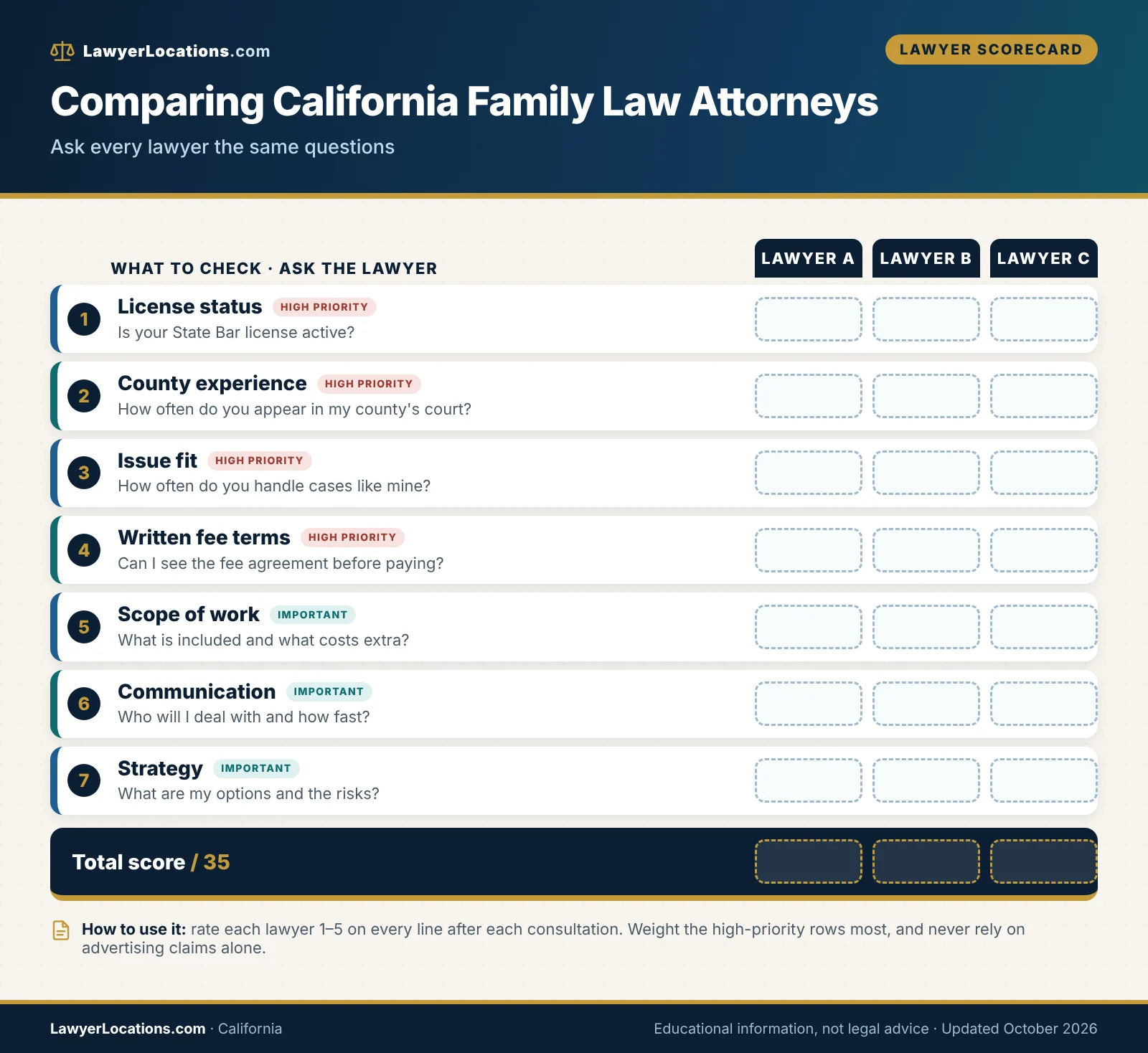
Text version of this graphic
- License and discipline: is your State Bar license active?
- County experience: how often do you appear in my county’s family court?
- Issue fit: how often do you handle cases like mine?
- Fee agreement: can I see it in writing before I pay?
- Scope: what is included and what costs extra?
- Communication: who handles my file, and how fast do you reply?
- Strategy: what are my options and the risks?
Referral services, advertising and directory ethics
Search results for family law are crowded with ads and lead-generation sites, so know who is on the other end of a click.
Reading lawyer marketing with a critical eye
Be careful with words like “best,” “top,” “expert” or “guaranteed,” and with promises about custody results or settlement amounts. Outcomes depend on the facts, the other side and a judge’s discretion. A short first call should show you how the lawyer thinks and prices the work, not deliver a sales script.
How LawyerLocations fits in
LawyerLocations.com is a legal-education and lawyer-discovery resource, not a law firm. Reading this page does not create an attorney-client relationship, and nothing here recommends a lawyer. Compare any referral against the same questions you would ask anyone else.
Fee agreements and ethics rules to compare
California has formal rules for how lawyers charge, and knowing them helps you spot a vague agreement before you sign.
The written fee agreement
Under Business and Professions Code 6148, if total expenses including attorney fees are reasonably foreseeable to exceed $1,000, the contract must be in writing, with a signed copy to the client. It must state the basis of compensation, the general nature of the services, and each side’s responsibilities. On request, the lawyer generally must provide a bill within 10 days. A noncompliant agreement is voidable at the client’s option, though the lawyer may still collect a reasonable fee.
No contingency fees tied to the divorce or support outcome
California’s professional conduct rules bar a fee in a family law matter whose payment or amount depends on securing a dissolution, nullity or a particular amount of support or property, according to State Bar rule-adoption materials on Rule 1.5. An offer to take your divorce for a percentage of what you win is a red flag. The rule also prohibits unconscionable fees.
Be wary of any lawyer who will not put fee terms in writing or who promises a specific result. Both are warning signs, whatever the lawyer’s website says.
| Fee structure | How it generally works | Questions to ask |
|---|---|---|
| Hourly with a retainer | You deposit money up front; the lawyer bills time against it and may ask you to replenish it | What is the hourly rate? Who else bills time? How often will I get a statement? |
| Flat fee for a defined task | One price for a clearly defined task, such as an uncontested filing or a document review | Exactly what is included? What happens if the case becomes contested? |
| Limited-scope agreement | The lawyer handles only specified tasks, with notice to the court if required | Which hearings are covered? Who files what? What triggers the Notice of Completion? |
| Fee paid by the other spouse | The court can order one spouse to contribute under Family Code 2030 | Will you request an interim fee award? What if the court denies it? |
| Contingent on the outcome | Not permitted when the fee depends on securing a dissolution or on the amount of support or property | Why is this being offered, and is it consistent with State Bar rules? |
Costs, deadlines and decision points
Total cost in a California family law case depends far more on how many issues are contested than on the filing fee. The court system lists the divorce filing fee at $435 to $450, fee waivers exist for people who cannot afford it, and the court can order one spouse to help pay the other’s legal fees. LawyerLocations does not publish average lawyer fees because no verified, official source supports a single statewide number.
What drives the cost of a family law case
Two layers of cost apply: what you pay the court and what you pay professionals. The second is far more variable.
Court costs, fee waivers and service expenses
The California Courts Self Help Guide lists the filing fee for a divorce case at $435–$450 and says you can submit forms asking for a fee waiver if you cannot afford it. Check your Superior Court’s fee schedule, since a response from the other spouse carries its own fee. Budget as well for service of process, copies and experts such as a business valuer or custody evaluator.
A DVRO request, by contrast, carries no court fee according to the Self Help Guide.
Lawyer fees: why two cases that look similar cost different amounts
A short marriage with no children and a signed agreement is a very different workload from a long marriage with a family business, a disputed custody schedule and an expert. The factors that move the number include how many issues are contested, how cooperative each side is, document discovery, the number of hearings, any custody evaluation, and whether the case goes to trial. Ask each lawyer which they expect in your case and how they would keep costs down.
Ask each lawyer for a written estimate that lists assumptions. A single number with no assumptions tells you almost nothing.
Need-based attorney’s fees under Family Code 2030
Family Code 2030 addresses the common situation where one spouse controls the money. It applies in dissolution, nullity and legal separation cases and in later proceedings tied to the judgment.
How the court decides
The court must ensure each party can get legal representation, including early in the case. When fees are requested, it must find whether an award is appropriate, whether there is a disparity in access to funds for counsel, and whether one party can pay for both sides. If the findings show both a disparity and an ability to pay, the court must order fees and costs. The award can cover services before or after the case began and can be changed as reasonably necessary.
What this means when you are the spouse with less access to money
A party without the means to hire a lawyer may ask the court, in pro per, to order the other party to pay a reasonable amount so they can retain counsel in time. That does not mean the court will cover all fees, and the amount depends on the findings. Bring your FL-150 and be ready to discuss both spouses’ finances.
Deadlines and decision points
Family law has few limitation-period style deadlines at the start, but plenty of procedural ones.
Deadlines that show up in court materials
| What | Time frame | Where it comes from |
|---|---|---|
| Residency before filing | 6 months in California; 3 months in the county | Fam. Code 2320; Self Help Guide |
| Response to the petition | Generally 30 days after service | Summons (FL-110); Self Help Guide |
| Minimum time before the marriage can end | 6 months from service or the respondent’s appearance, whichever comes first; extendable for good cause | Fam. Code 2339 |
| Preliminary financial disclosures | With the petition or response, or within 60 days of filing; extendable by agreement or order | Fam. Code 2104 |
| Restraining order duration | Not more than 5 years initially; 3 years if no expiration date is stated | Fam. Code 6345 |
| Renewing a restraining order | File in the 3 months before expiration | Fam. Code 6345 |
Your calendar should show three dates from day one: the date you served or were served, the 30-day response date, and the 60-day disclosure date. A lawyer can add case-specific hearing dates and local deadlines.
A decision framework for hiring help
Ask in order: Is there a safety concern? If so, contact 911 or a hotline and ask a self-help center about a DVRO. Is anything contested? If everything is agreed, a self-help center, limited-scope review or flat-fee lawyer may be enough. Is money or a business in play, or is the other side represented? Consider fuller representation. If you have less access to money, raise Family Code 2030 early.
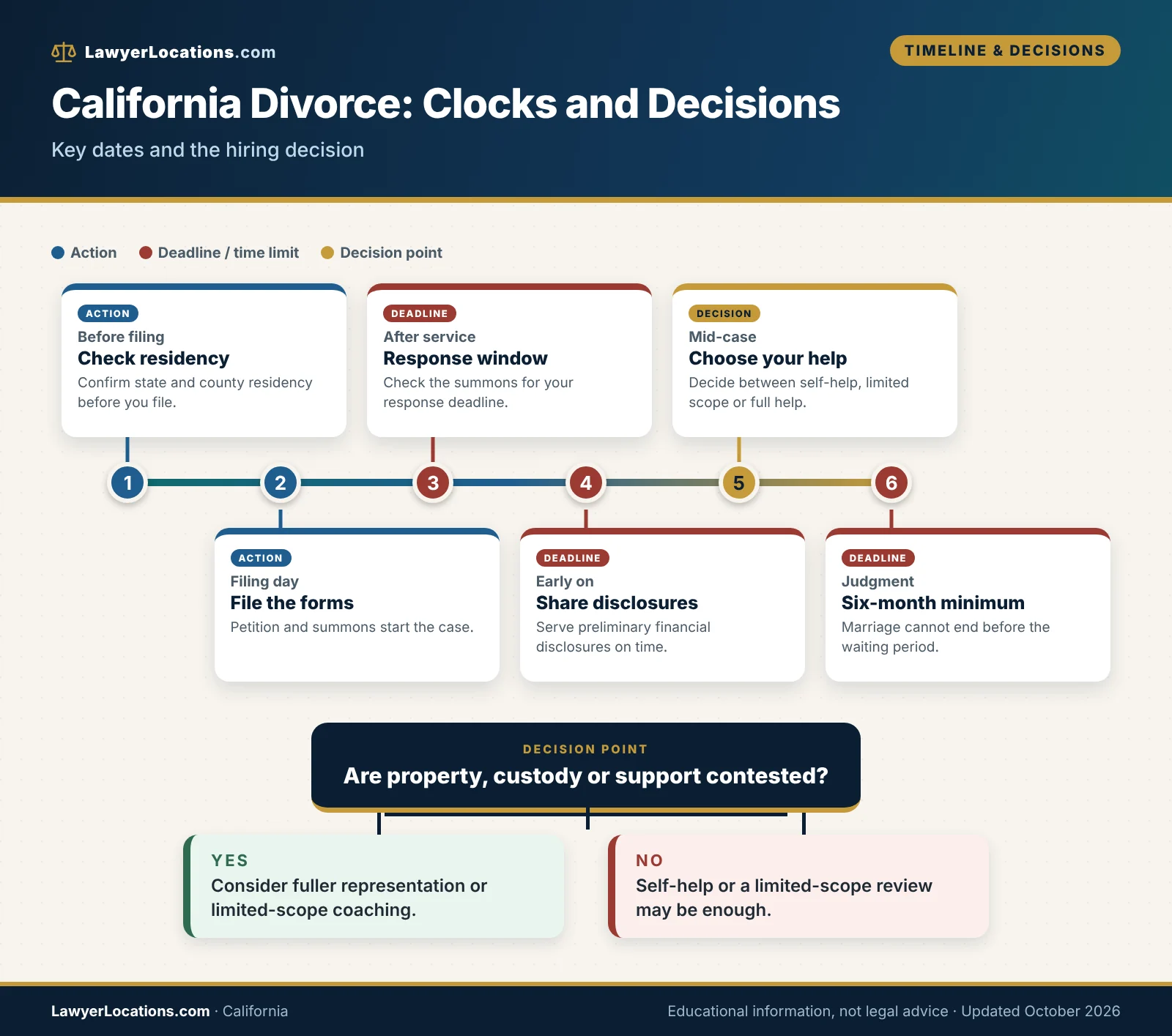
Text version of this graphic
- Before filing: check residency (6 months in California, 3 in the county) and gather records.
- Filing day: petition, summons, and the children’s declaration if there are children.
- Service: starts the response window (generally 30 days) and the six-month clock.
- Within about 60 days: serve preliminary financial disclosures.
- Mid-case: temporary orders, custody mediation, and settlement talks.
- Decision: is the case contested enough to need full representation, or can limited help cover it?
- Judgment: no earlier than six months after service or appearance.
Preparing for a consultation and choosing next steps
The best preparation for a first meeting with a family law attorney in California is a short timeline, your financial documents, and a list of your top three goals. A prepared client gets a more specific answer in less time, and every minute of a paid consultation counts.
Documents and information to bring
Gather what you can; you do not need a perfect file. If you worry about the other spouse seeing your records, ask a lawyer or advocate about safe storage first.
Financial records
- Pay stubs and tax returns for the past two years, since California disclosure rules call for returns from the prior two years
- Bank, credit card, loan and mortgage statements (redact all but the last four digits of account numbers on any copies you share)
- Retirement, brokerage and stock option statements
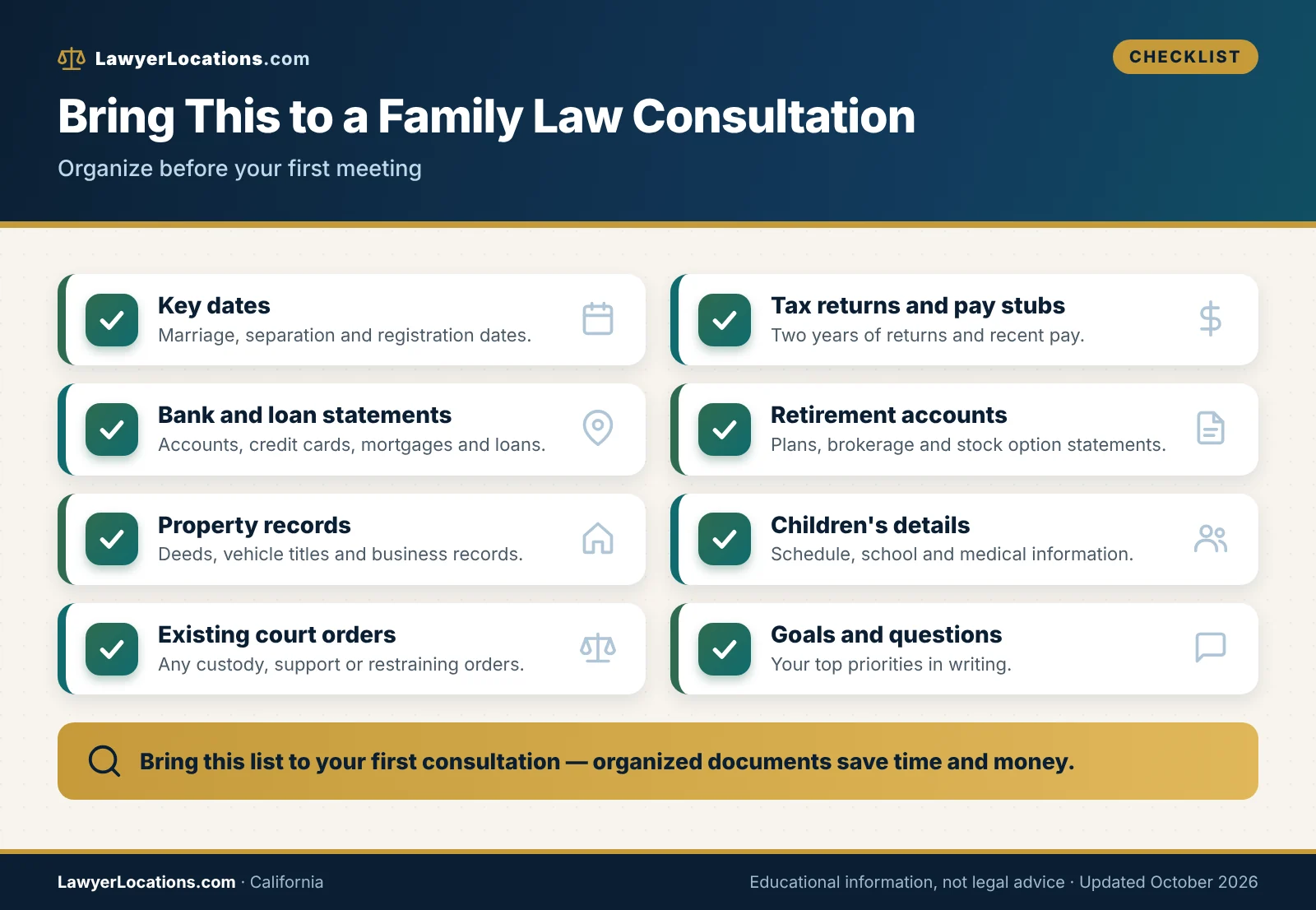
Text version of this graphic
- Marriage, separation and registration dates
- Two years of tax returns and recent pay stubs
- Bank, loan and credit card statements
- Retirement and investment account statements
- Deeds, mortgage and vehicle titles
- Children’s schedule, school and medical details
- Any existing court orders or restraining orders
- Written list of goals and questions
Family and safety information
- Dates of marriage or registration, date of separation, and children’s birth dates
- Current parenting schedule and where the children have lived for the past several years, which matters for the UCCJEA declaration
- Any existing court orders from California or another state
- Records of any domestic violence, such as police reports, photos, messages or medical records, kept somewhere safe
- Your goals for custody, support and property, in order of priority
Questions to ask and mistakes to avoid
Treat the consultation as a two-way interview, and take notes.
Questions worth asking in your first meeting
- Is your State Bar license active, and do you hold any State Bar specialist certification in family law?
- How often do you appear in this county’s family court, and what local procedures should I know?
- What are the main options for my situation, and what are the risks of each?
- Would limited-scope representation make sense for any part of my case?
- Will you request attorney’s fees from the other side under Family Code 2030 if I qualify?
- What would make this case more expensive than your estimate?
For how consultations work in another practice area, see our guide on free consultations with criminal defense lawyers, and for fee explanations elsewhere, our wrongful death lawyer cost guide; contingency fees are treated differently in California family law.
Common mistakes and red flags
- Moving property, closing accounts or taking the children out of state after service, which the automatic orders prohibit
- Signing a settlement or a waiver of disclosures without understanding it
- Ignoring the 30-day response deadline
- Telling a court facilitator things that are not confidential
Quick answers to common questions
These short answers are general information as of October 2026.
Process and timing
How long does a California divorce take?
At least six months, according to the court system, measured from service or the other spouse’s appearance. Contested cases take longer.
How is child support decided?
By a statewide formula in Family Code 4055 that the court presumes is correct, with limited reasons to depart from it.
Hiring and fees
Can the other spouse be ordered to pay my attorney’s fees?
Possibly. Under Family Code 2030, the court must order fees and costs if it finds both a disparity in access to funds and an ability to pay.
Can I hire a lawyer for just one hearing?
Yes, through limited scope representation under rule 5.425, if the lawyer agrees and the scope is in writing.
How do I find a family law attorney near me?
Use a State Bar-certified lawyer referral service or your county bar association, then verify the license on the State Bar’s Attorney Search.
Next steps
If you are sorting out your options for a family law attorney California courts can work with, begin with free resources: your county Superior Court’s self-help page, the California Courts Self Help Guide and LawHelpCA. Then check each lawyer or referral service on the State Bar’s tools and ask the same questions. A good first consultation should leave you with a clear sense of options, risks, scope and fees.
A short action plan
- Write your timeline. Marriage, separation, children, major assets.
- Check residency and county. Six months in California, three in the county.
- Pick a path. Self-help, limited-scope or full representation, and ask about fees under Family Code 2030.
- Get fee terms in writing before you pay.
When to act quickly
A few steps are time-sensitive: a restraining order request, a response due 30 days after service, or a plan to move a child out of state. Contact a self-help center or lawyer promptly for those.
Ready to compare your options?
Use the checklist and questions above to speak with at least two California family law attorneys or a certified referral service before you hire anyone. This guide does not recommend any lawyer and does not create an attorney-client relationship.
Sources & References
Show all 24 sources
- Divorce (overview, 6-month wait, legal separation) — California Courts Self Help Guide, Judicial Council of California — selfhelp.courts.ca.gov/divorce — accessed October 2026.
- Fill out court forms / start your divorce (residency, FL-100, FL-110, FL-105, filing fee) — California Courts Self Help Guide — selfhelp.courts.ca.gov/starting-divorce — accessed October 2026.
- Fill out your divorce forms — California Courts Self Help Guide — selfhelp.courts.ca.gov/divorce/start-divorce/forms — accessed October 2026.
- Family Code section 2339 — FindLaw (mirror of California Codes) — codes.findlaw.com/ca/family-code/fam-sect-2339 — accessed October 2026.
- Family Code sections 2320, 2550, 760, 2040, 2104, 2210, 2310, 297, 2400, 3011, 3020, 3040, 3044, 3170, 3183, 3421, 3600, 4055, 4057, 4320, 4336, 2030, 6345 — California Codes mirror, public.law — california.public.law/codes (Family Code) — accessed October 2026.
- Business and Professions Code section 6148 (written fee agreements) — California Codes mirror, public.law — california.public.law/codes/ca_bus_and_prof_code_section_6148 — accessed October 2026.
- Domestic violence restraining orders in California — California Courts Self Help Guide — selfhelp.courts.ca.gov/DV-restraining-order — accessed October 2026.
- Domestic violence restraining orders forms — California Courts Self Help Guide — selfhelp.courts.ca.gov/DV-restraining-order/forms — accessed October 2026.
- Child custody and parenting time — California Courts Self Help Guide — selfhelp.courts.ca.gov/child-custody — accessed October 2026.
- Court-based self-help services — California Courts Self Help Guide — selfhelp.courts.ca.gov/court-based-self-help-services — accessed October 2026.
- Rule 5.425, Limited scope representation; application of rules — California Rules of Court, Judicial Council of California — courts.ca.gov/cms/rules/index/five/rule5_425 — accessed October 2026.
- Financial disclosures packet (FL-140, FL-142, FL-150, FL-141, FL-144) — Superior Court of California, County of Sacramento — saccourt.ca.gov/FAMILY/docs/fl-financial-disclosures-packet.pdf — accessed October 2026.
- Self-Help Family Law — Superior Court of California, County of Orange — occourts.org/self-help/self-help-family-law — accessed October 2026.
- Family and children services — Superior Court of California, County of San Diego — sdcourt.ca.gov/sdcourt/familyandchildren2 — accessed October 2026.
- Self-Help Centers (Los Angeles County) — Neighborhood Legal Services of Los Angeles County — nlsla.org/services/self-help-centers — accessed October 2026.
- Find a Certified Specialist — The State Bar of California — calbar.ca.gov/es/node/7158 — accessed October 2026.
- California specialization programs — American Bar Association — americanbar.org/groups/specialization/state-sources-of-certification/california — accessed October 2026.
- Why Use a Certified Lawyer Referral Service — The State Bar of California — calbar.ca.gov (Certified LRS directory) — accessed October 2026.
- List of Certified Lawyer Referral Services (updated July 14, 2026) — The State Bar of California — calbar.ca.gov/sites/default/files/2026-07/Certified-Legal-Referral-Services.pdf — accessed October 2026.
- Rule 1.5 (Fees), State Bar rule-adoption materials — The State Bar of California — calbar.ca.gov/sites/default/files/agenda/agendaitem1000006011.pdf — accessed October 2026.
- Navigating the change from DissoMaster to Xspouse — California Lawyers Association, Family Law News — calawyers.org (Family Law News, vol. 47, issue 1) — accessed October 2026.
- 2025 legislative update: new family law laws — California Lawyers Association — calawyers.org/family-law/2025-legislative-update-new-laws — accessed October 2026.
- LawHelpCA — Legal Aid Association of California — lawhelpca.org — accessed October 2026.
- California Department of Child Support Services — State of California — childsupport.ca.gov — accessed October 2026.
General information only. This article is legal information, not legal advice, and reading it does not create an attorney-client relationship with LawyerLocations.com or anyone else. LawyerLocations.com is not a law firm and does not recommend, rank or endorse any lawyer. Laws, court rules, fees and forms change, and local court practices differ by county. This article has not yet been reviewed by a licensed attorney. For advice about your situation, consult a lawyer licensed in California. If you are in danger, call 911.
Legal Disclaimer and Limitation of Liability
Informational and illustrative purposes only. This article was prepared by LawyerLocations.com solely on the basis of the information available to us at the time of writing. It is an illustrative, general overview. It is not a complete or authoritative statement of the law, and it has not been reviewed by a lawyer licensed in your state or county.
Not legal advice. Nothing in this article is legal, financial, tax or immigration advice, and reading it does not create an attorney-client relationship between you and LawyerLocations.com or any author, lawyer or firm mentioned. Laws, court rules, fees, filing deadlines and agency procedures differ by state, county and court, and they change often. Some details here may be simplified, incomplete or out of date, and time limits for legal claims can be short.
No warranty. We make no representation or warranty, express or implied, about the accuracy, completeness, timeliness or suitability of this content for your situation. Please do not rely on it to make, delay or skip any legal decision. Check the facts against official sources and speak with a licensed attorney in the relevant jurisdiction before you act.
Limitation of liability. To the fullest extent permitted by law, LawyerLocations.com and its owners, authors and contributors disclaim all liability for any loss, damage, cost or other consequence arising from the use of, or reliance on, this article, including any content on third-party websites we link to. Mentioning a lawyer, firm, organization or service is not an endorsement and is not a promise of any result. If you are in immediate danger, contact your local emergency number.