People who type “dog bite lawyer chicago il” into a search bar are usually trying to answer three things at once: do I have a claim, what will it cost, and who should I call. In Illinois, the Animal Control Act, 510 ILCS 5/16 can make a dog’s owner liable for a bite or attack that happened without provocation, and the general deadline to sue for a personal injury is two years under 735 ILCS 5/13-202, with different rules for children and for claims against local government.
This guide explains the Illinois rules, the Chicago and Cook County steps that come after a bite, how injury lawyers are typically paid, and how to compare lawyers before you sign anything. It is general information for readers in Chicago, not advice about your case.
How Illinois Law Treats Dog Bite Claims
Illinois is not a pure “one free bite” state. A specific statute, the Animal Control Act, can hold an owner responsible for what a dog does even when the owner never knew the dog was dangerous. The sections below explain what that statute says, who counts as an owner, and where the City of Chicago adds its own rules on top.
The Animal Control Act and who can be held responsible
The core civil rule sits in Section 16 of the Animal Control Act, 510 ILCS 5/16, titled “Animal attacks or injuries.” The Illinois General Assembly’s page for the section shows it was last amended by Public Act 94-819, effective May 31, 2006. This is state law, so it applies the same way on the North Side of Chicago as it does in Peoria.
In plain terms, the section says that if a dog or other animal, without provocation, attacks, attempts to attack, or injures a person who is peaceably conducting himself or herself in a place where he or she may lawfully be, the owner is liable in civil damages for the full amount of the injury proximately caused. The wording matters, because each phrase becomes something a lawyer or an insurance adjuster will look at closely.
The elements a claimant has to show
The Illinois Supreme Court’s pattern jury instructions for animal cases (Chapter 110) summarize the statutory claim as four elements, which the commentary attributes to a case it cites as Robinson v. Meadows. The injury must have been caused by an animal the defendant owned, the injured person must not have provoked the animal, the person must have been conducting themselves peaceably, and the person must have been somewhere they had a right to be.
The same commentary says the claimant does not have to prove the owner knew the dog was dangerous. That is the practical difference between the statute and an older, narrower view of dog bite law that depended on a prior warning sign. A claimant still has to prove the injury and the damages, and the other side can dispute every element.
Who counts as an “owner”
Section 2.16 of the Act (510 ILCS 5/2.16) defines “owner” broadly. It includes a person with a property right in the animal, a person who keeps or harbors it, a person who has it in their care or acts as its custodian, and a person who knowingly lets the animal remain on premises they occupy.
The pattern-instruction commentary gives examples from case law. An absentee landlord who allows a tenant to keep a dog was not an owner, while a person who agreed to board and care for a dog was. Feeding a stray temporarily did not make someone an owner, and a county animal shelter acting as a dog’s keeper did qualify. Those examples show why the question “whose dog was it, really?” can be more complicated than it sounds in a house-sitting, boarding, or rental situation.
A neighbor’s dog slips through an open gate and bites a person walking on the public sidewalk. The walker was somewhere they could lawfully be and did nothing to the dog, so the questions a lawyer would focus on are who kept the dog, whether anything provoked it, and which insurance policy might respond. The facts of a real bite can look very different, which is why details matter.
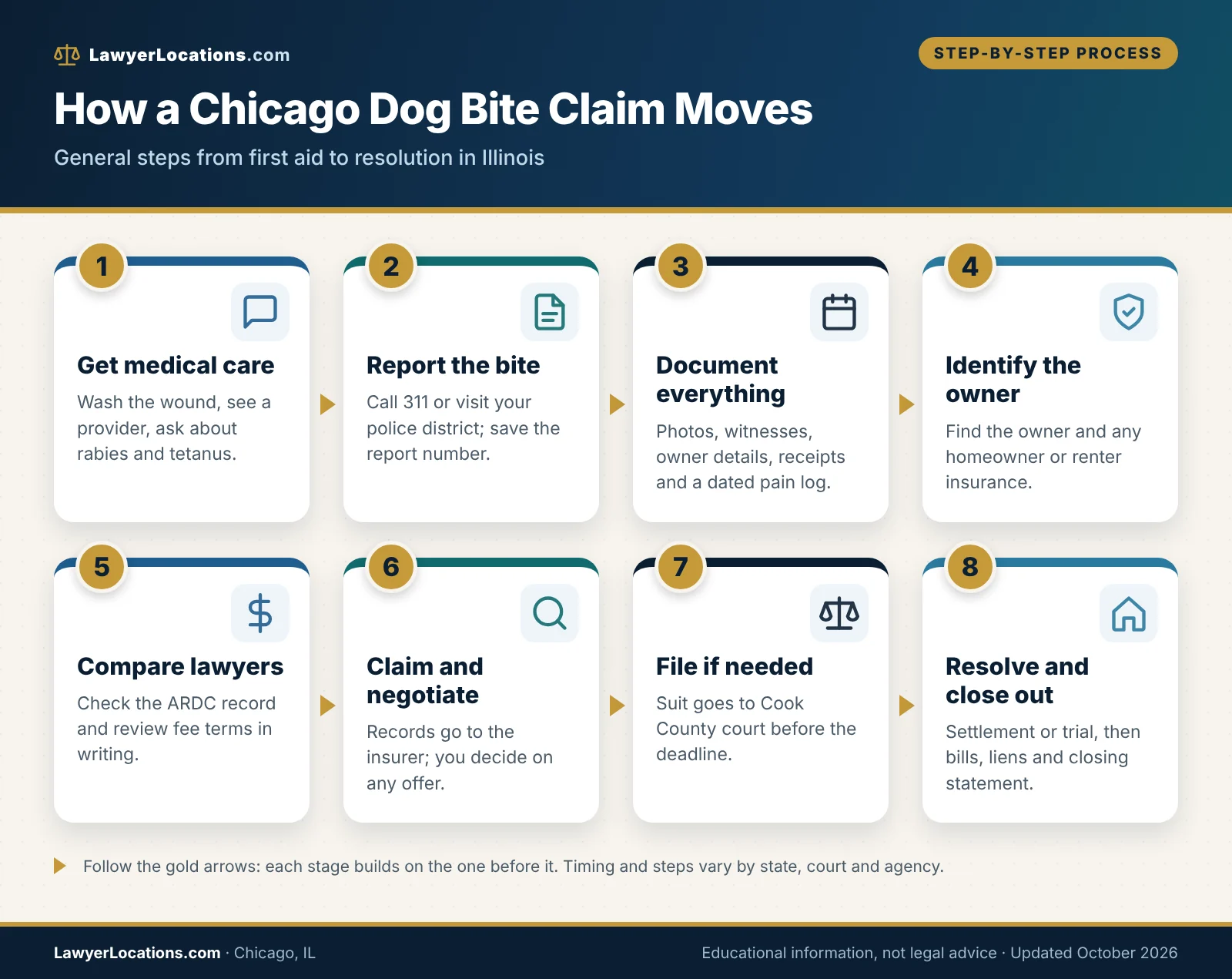
Text version of this graphic
- Get medical care and report the bite to the city or police.
- Document injuries, the scene and the dog’s owner.
- Identify the owner and any insurance that may respond.
- Talk with lawyers and compare fee terms in writing.
- Send a claim or demand to the insurer, with records.
- Negotiate, and file in Cook County court if needed before the deadline.
- Resolve the case by settlement or trial, then close out liens and bills.
Other legal theories and the Chicago layer
Section 16 is the headline rule, but it is not the only legal route and it is not the only set of rules a Chicago owner has to follow. The city has its own animal ordinance, a city animal agency handles bite follow-up, and the legislature has at least one pending bill that would change Section 16.
Negligence and common-law claims alongside the statute
Claimants and their lawyers sometimes plead more than one theory in the same complaint, for example the statutory claim plus negligence. The pattern-instruction commentary also refers to common-law strict liability, where provocation is treated as an affirmative defense (something the defendant has to raise and prove) rather than something the claimant must disprove.
Which theory fits a given bite depends on the facts: where it happened, who had control of the dog, and whether the person was lawfully on the property. A bite that does not fit the statute neatly, such as one involving a person who was somewhere they were not allowed to be, is exactly the kind of fact pattern to describe to a lawyer in detail.
Chicago’s restraint ordinance and bite enforcement
Two secondary sources that summarize the Municipal Code of Chicago (a neighborhood association page and a leash-law reference site) both describe MCC 7-12-030, “Animals shall be restrained.” As they describe it, an owner must keep an animal under restraint, an unleashed animal outdoors on unfenced property is not restrained, and letting an animal attack, bite or threaten someone off the owner’s property is a violation. The same sources report a base fine of $300 and a fine of $1,000 to $10,000 when the violation causes severe injury or death, with possible restitution, jail time of up to six months, or community service.
City ordinance enforcement is separate from a civil injury claim. A fine paid to the city does not compensate an injured person, and a citation is not a requirement for a civil case, although the paper trail it creates can be useful evidence. Chicago Animal Care and Control (CACC) handles follow-up investigations of bites inside the city, according to its Field Services page.
Senate Bill 4180 in the 104th General Assembly, introduced March 24, 2026, would amend Section 16 by removing “attempts to attack” from the civil liability sentence and by adding criminal offenses for negligent failure to control an animal. When this guide was checked in October 2026, the bill’s recorded status was only “Introduced.” Treat it as a proposal, not as the rule that applies to a bite today.
When a dog is declared dangerous or vicious
Illinois also has a separate, public-safety track for dogs with a record of aggression. It runs through the Animal Control Act’s definitions and Section 15, and it is different from a claim for money damages.
Definitions of dangerous dog and serious injury
The Act defines a “dangerous dog” (510 ILCS 5/2.05a) in two ways: a dog that, away from its owner’s property and not muzzled, leashed or supervised, acts in a way a reasonable person would see as an immediate, unjustified risk of serious injury or death to a person or companion animal, or a dog that bites a person without justification where the bite does not cause serious physical injury. A separate definition of “serious physical injury” (510 ILCS 5/2.19a) covers injuries that create a major risk of death, cause significant or permanent disfigurement, cause long-lasting harm to health or organ function, or require plastic surgery.
Those definitions are about animal-control status, not about how much a claim is worth. They are still worth knowing because an animal-control file may use the same vocabulary your medical records and a lawyer’s demand letter will use.
The vicious-dog process under Section 15
Under 510 ILCS 5/15 as summarized from the statute page, an animal control administrator, deputy or law enforcement officer investigates, writes a report, and sends it to the State’s Attorney and the owner. A petition in circuit court must be proved by clear and convincing evidence, and a dog is not declared vicious if the court finds the conduct was justified, such as when the victim provoked it.
A vicious finding can bring a $100 public safety fine, spay or neuter and microchipping, confinement in an approved enclosure, and in some cases a court-ordered euthanasia. None of that pays an injured person’s medical bills. The four elements of a Section 16 claim do not list a prior vicious or dangerous designation, so a first-time bite can still support a civil claim.
The First Days: Medical Care, Chicago Reporting and Evidence
The first priority is your health, and the second is making sure the bite is reported to the right local office. Both steps also create the earliest records of what happened, which is why they matter to a later claim.
Health first: wound care and rabies steps
This guide is not medical advice, but public health agencies publish consistent first steps that are worth knowing. Those steps also explain why medical records appear so often in injury claims.
Wound care and when to see a provider
The CDC says minor wounds should be washed thoroughly with soap and water, covered with a clean bandage, and watched for infection. For deep wounds, apply pressure with a clean, dry cloth and call 911 if bleeding will not stop or you feel faint. The CDC also advises seeing a healthcare provider if the wound is serious or deep, becomes infected, if you do not know whether the dog has been vaccinated against rabies, or if it has been more than five years since your last tetanus shot.
The City of Chicago’s public health page recommends washing a bite wound right away with soap and water for 15 minutes and talking with a healthcare provider or public health professional about whether you need rabies post-exposure prophylaxis (PEP). Tell the provider it was a dog bite, since they may consult the local health department about PEP.
The 10-day observation period
The Illinois Department of Public Health says an apparently healthy domestic dog, cat or ferret that bites a person must be captured, confined and professionally observed for 10 days, and that if it stays healthy it could not have transmitted rabies at the time of the bite. If the animal cannot be observed or tested, IDPH says the person must start rabies immune globulin and the vaccine series immediately.
The Cook County Department of Public Health makes the same point from the owner’s side: biting animals are quarantined for 10 days regardless of rabies vaccination status. If the owner has fled with the dog or says they cannot find it, tell the medical provider and the city right away, because that changes the rabies decision.
Reporting the bite in Chicago and Cook County
Different offices handle different parts of the response. The wording on official pages is not identical, so it helps to see them side by side.
The city route: 311, police and Animal Care and Control
Chicago Animal Care and Control’s Field Services page says the first step after a bite is to report it by calling 311 (non-emergency) or visiting your local police district. The report goes to Cook County Animal and Rabies Control and to CACC, and CACC handles follow-up investigations of bites inside the city. The page also says not to file a Vicious Animal Report for a bite, because bites follow the separate bite-reporting process.
The Chicago Department of Public Health’s rabies page, by contrast, says to call 911 to report dog bites and, if possible, to ask the owner for proof of the dog’s current rabies vaccination. In an active emergency, call 911. For a bite that has already happened and is not an ongoing danger, the CACC guidance points to 311 or the police district. If you are unsure, ask the dispatcher which route fits, and write down the report number.
The county route: Cook County bite reports
Cook County Animal and Rabies Control says bites to humans and companion animals must be reported to local police, or the Cook County Sheriff’s Office in unincorporated areas, within 24 hours. The agency’s page says the biting animal must not be killed, sold, moved or otherwise disposed of, and must not receive a rabies shot until the last day of the observation period. Its phone number is (708) 974-6140, and its address is 10220 South 76th Avenue, Bridgeview, IL 60455.
That page does not mention Chicago, so it does not say how Chicago incidents are split between the city and the county. The CACC page says bite information goes to both. If you were bitten in a Chicago suburb rather than the city, the local police department and county office are the likelier starting points.
| Office | What the official page says | Practical use |
|---|---|---|
| Chicago 311 or local police district | CACC says to report a bite by calling 311 (non-emergency) or visiting your police district; the report goes to Cook County Animal and Rabies Control and CACC. | Start here for a bite inside city limits; note the report number. |
| Chicago Animal Care and Control (CACC) | Handles follow-up investigations of bites within the city; says bites do not go through the Vicious Animal Report. | Ask about the status of the dog’s observation and any ordinance case. |
| Chicago Department of Public Health | Advises washing a bite for 15 minutes and talking with a provider about rabies PEP; says to call 911 to report dog bites. | Use for rabies-risk questions; call 911 in an emergency. |
| Cook County Animal and Rabies Control | Bite reports within 24 hours through local police or the Sheriff; (708) 974-6140; Bridgeview office. | Relevant for suburban Cook County and for county-level records. |
| Illinois Department of Public Health | 10-day observation of a healthy domestic dog, cat or ferret that bites; rabies shots if the animal cannot be observed or tested. | Statewide medical guidance to share with your provider. |
Building the evidence file
Evidence in a dog bite claim is mostly ordinary: photographs, medical records, names, and a clear timeline. It is easiest to gather in the first days, when memories are fresh and injuries are visible.
What to gather and keep
A short, organized folder is more useful than a pile of screenshots. Use the checklist below, and keep the originals of anything you send to an insurer or lawyer.
- Photos of the injury on the day it happened and as it heals, with a ruler or coin for scale where practical.
- Photos of the location, any fence or gate, the leash or lack of one, and any warning signs.
- The owner’s name, address, phone number and insurance details, plus the dog’s rabies vaccination information if the owner shares it.
- Names and phone numbers of witnesses, and the 311 or police report number.
- Emergency, urgent care, primary care and follow-up records, discharge instructions, and prescriptions.
- Receipts for out-of-pocket costs, such as co-pays, medication, mileage and replacement clothing.
- A dated note of missed work, pain, scarring, sleep problems or anxiety around dogs, written as it happens.
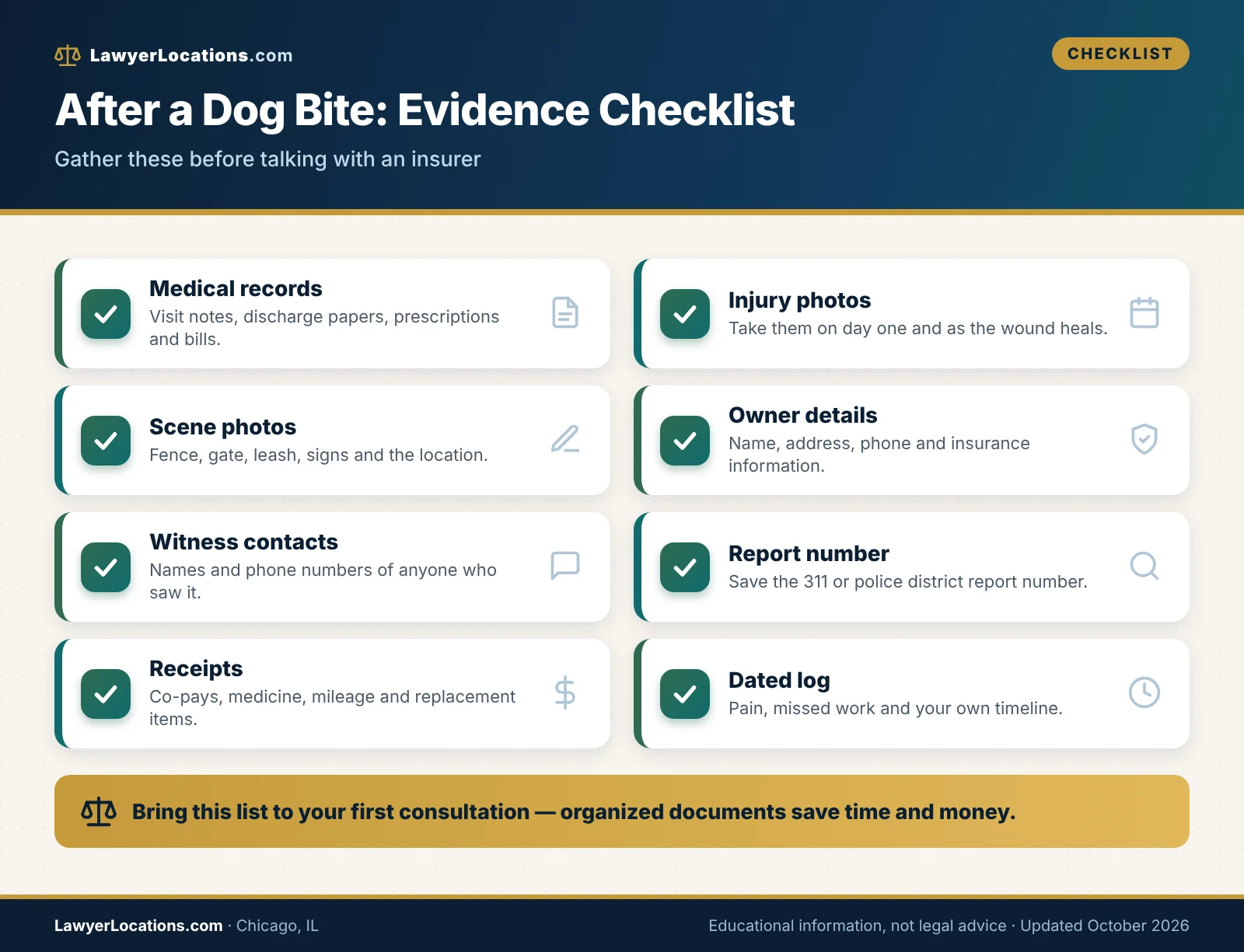
Text version of this graphic
- Medical care first, then keep every record and discharge paper.
- Photograph injuries over time, not just on day one.
- Photograph the scene, fence, leash and signs.
- Get the owner’s contact and insurance details.
- Collect witness names and phone numbers.
- Save the 311 or police report number.
- Keep receipts and a dated pain and work log.
- Write down your own timeline while it is fresh.
What to hold back from the other side
You do not need to give an insurer a recorded statement the same day, and you are not required to guess about medical costs or future treatment. If an adjuster calls, you can take the name, claim number and company, and say you will follow up. It is reasonable to talk with a lawyer before giving a recorded statement or signing a medical-records release that covers your whole history.
Be cautious on social media too. Posts, photos and comments about your activity or your injury can be pulled into a dispute later. keep your posts private and brief while a claim is open.
If anyone, including an owner or an adjuster, asks you to sign a release, a medical authorization covering your entire history, or a statement before you understand your injuries, pause and get the document reviewed first. A signature on a release can end a claim.
Deadlines, Fault and Insurance
The short answer on timing is that Illinois’s general personal injury deadline is two years, but children, public entities and unusual facts can change it. Fault and insurance then decide who pays and how much argument is likely.
The filing deadlines that can apply
The deadline to file a lawsuit is called a statute of limitations. Miss it, and a court can dismiss the case no matter how strong the facts are.
The general two-year rule
Illinois law, 735 ILCS 5/13-202, provides that actions for damages for personal injury must be commenced within 2 years after the cause of action accrued. A dog bite injury claim is a personal injury action, so this is the starting point for most adult claimants. The clock generally starts on the day of the injury, although a lawyer will want to confirm the accrual date in any unusual case.
Two years is a ceiling for filing a lawsuit, not a target for starting a conversation with a lawyer. Records, witnesses and the dog itself can become harder to find well before the deadline, and insurer negotiations do not stop the clock by themselves.
Children and people under a legal disability
Under 735 ILCS 5/13-211, a person who is under 18 or under a legal disability when the cause of action accrues may sue within 2 years after turning 18 or after the disability is removed. Children are bitten more often than adults and tend to have more severe injuries, according to the CDC. A parent can often act sooner on a child’s behalf, and a lawyer should explain how a settlement for a minor is approved and protected.
Do not assume the tolling rule makes waiting a good idea. Evidence and memories fade, and an adult family member’s own claims, such as medical expenses the parents paid, may follow different timing. Ask a lawyer to calculate every deadline separately.
Claims involving a local public entity
Some dog incidents involve a public body, for example a claim about a government-run animal facility or a government-owned dog. The Local Governmental and Governmental Employees Tort Immunity Act, 745 ILCS 10/8-101, generally requires civil actions against local public entities or their employees to be commenced within 1 year of the injury or accrual, with a longer period for certain patient-care claims.
The pattern-instruction commentary notes that a county animal shelter acting as a dog’s keeper has been treated as an owner, which shows how a public entity can end up as a defendant. If a city, county or park district might be involved, do not rely on the two-year rule and ask a lawyer about the shorter one-year period right away.
| Situation | Statute | Time limit | Notes |
|---|---|---|---|
| Adult injured by a private owner’s dog | 735 ILCS 5/13-202 | 2 years | General personal injury limit; counted from when the claim accrued. |
| Child under 18 at time of injury | 735 ILCS 5/13-211 | 2 years after turning 18 | Also applies to a legal disability; separate parent claims may differ. |
| Claim against a local public entity or its employee | 745 ILCS 10/8-101 | 1 year | A longer 2-year period (with a 4-year outer limit) applies only to patient-care claims. |
| Rabies observation of a biting dog | IDPH guidance | 10 days | A public health period, not a legal filing deadline. |
Fault, provocation and shared responsibility
Insurers almost always look for a reason to say the injured person contributed to the bite. Illinois law treats provocation and shared fault differently, and the difference affects strategy.
Provocation under the Animal Control Act
According to the pattern-instruction commentary, under the Animal Control Act the claimant carries the burden of proving a lack of provocation; it is not framed as an affirmative defense. Whether the claimant met that burden is a question of fact for the jury.
The commentary adds that provocation is measured by how a normal animal would react to the conduct, that the act need not be intentional, and that someone other than the injured person can be the provocateur. Its examples: kicking a dog counted as provocation, while untying and feeding a dog did not, and stepping toward a door and spraying a dog did not either. Ask any lawyer how they would prove lack of provocation using your photos, witnesses and the owner’s own statements.
Comparative fault in Illinois
The general comparative-fault statute, 735 ILCS 5/2-1116, bars recovery if a trier of fact finds the plaintiff’s contributory fault is more than 50% of the proximate cause of the injury, and reduces the award by the plaintiff’s percentage if it is 50% or less. The text applies to actions for bodily injury based on negligence and to certain product liability actions.
Whether and how that statute applies to a claim brought under the Animal Control Act is a question this guide could not settle from the sources reviewed, and the pattern-instruction commentary does not discuss comparative fault for the Act. That is a point to raise directly with a lawyer, along with how they would handle a negligence count in the same complaint.
Insurance: who usually pays
In many dog bite claims the money comes from an insurance policy, not directly from the owner. Understanding that policy is part of understanding the claim.
Liability and medical payments coverage
The Illinois Department of Insurance’s property insurance consumer guide explains that personal liability coverage in a homeowner’s policy pays for bodily injury or property damage the policyholder or household members are legally responsible for, and may pay for a lawyer to defend them. “Medical payments to others” coverage pays medical bills for people hurt on the policyholder’s property or hurt by the policyholder’s pets, up to the limit purchased and regardless of fault. A separate Department guide notes that renters have a comparable tenant form with liability coverage.
That means an owner’s renter’s or homeowner’s policy may be where an adjuster is calling from. Get the owner’s insurer and policy number if you can, and expect that policy limits, not the owner’s personal wealth, often shape what is realistic.
When coverage is limited or disputed
The Department of Insurance guide lists dog bites among claims a homeowner’s policy may not cover, and says some insurers treat vicious pets, or pets with a history of biting, as unacceptable risks. It also says some companies exclude liability for animal injuries, and that such exclusions can sometimes be bought back with an endorsement. The Department advises policyholders to ask their agent how their policy treats dog bites.
The insurance industry reports that dog injuries are expensive: Insurance Journal, citing Triple-I and State Farm data, reported insurers paid about $1.6 billion in dog-related injury claims in 2024 (national figure). That statistic says nothing about what any one claim is worth. Do not let a general statistic, or an adjuster’s first number, stand in for an evaluation of your own medical records.
If the dog’s owner rents, ask who is on the lease and whether the tenant has renter’s insurance, and find out who actually lives at the address. The statute’s definition of “owner” turns on who keeps, harbors or has custody of the animal, not on who owns the building.
What Dog Bite Lawyers Charge and How Contracts Work
Many personal injury lawyers, including those who take dog bite cases, work on a contingent fee, meaning the lawyer is paid a percentage only if there is a recovery. Illinois has specific rules about how that agreement must be written, and court and case costs are a separate subject from the lawyer’s percentage.
Contingent fees and Illinois Rule 1.5
Illinois lawyers are governed by the Illinois Rules of Professional Conduct, adopted by the Illinois Supreme Court. Rule 1.5 covers fees, and its paragraph (d) deals with contingent fees specifically.
A contingent fee is a fee that depends on the result. If there is no recovery, the lawyer generally takes no fee, but the contract may still make you responsible for certain expenses, which is why you read it closely.
What the written agreement must say
Under Illinois Rule of Professional Conduct 1.5(d), as published on the Illinois Courts website, a contingent fee agreement must be in a writing signed by the client. It must state the method for determining the fee, including the percentage or percentages that apply to settlement, trial or appeal, the litigation and other expenses to be deducted from the recovery, whether those expenses are deducted before or after the fee is calculated, and any expenses the client owes whether or not the client prevails.
At the end of the matter, the lawyer must give the client a written statement of the outcome and, if there was a recovery, show how the client’s share was determined. Rule 1.5(a) separately requires that fees and expenses be reasonable, and Rule 1.5(b) requires the scope of the representation and the basis of the fee to be communicated to the client, preferably in writing. Rule 1.5(c) prohibits nonrefundable fees and agreements that unreasonably limit a client’s right to a refund of unearned fees.
Questions about the percentage and the math
There is no single percentage this guide can verify for Chicago dog bite cases, and none should be assumed. Ask the lawyer to show the percentage for each stage in writing, to explain how it changes if a lawsuit is filed, and to walk through a hypothetical settlement using round numbers so you can see what lands in your pocket.
Ask specifically about medical liens and reimbursement claims. Health insurers, hospitals and others may assert rights to be repaid from a recovery, and the order in which fees, expenses and liens come out of a settlement changes your net amount. Ask whether the percentage is calculated before or after expenses, because the contract is required to say so.
Court costs and case expenses in Cook County
Expenses are the real-world costs of building the case. Some are fixed by the court, and some depend on how far the case goes.
Filing and jury costs at the Clerk’s office
The Clerk of the Circuit Court of Cook County publishes Law Division fee schedules. The version reviewed lists a filing fee of $388.00 and an appearance fee of $250.00 for most Law Division case types, including personal injury, for a combined $638.00 at the time of filing. The schedule pages are marked 1/1/2022, so confirm current amounts with the Clerk before relying on them.
The Clerk’s miscellaneous fee schedule (form CCG-0140, marked 10/28/25) lists jury services for a 12-person jury at $212.50 and for a 6-person jury at $106.25, plus smaller items such as a $6.00 alias summons and $2.00 for the first page of a copy. A represented client usually does not pay these directly; the lawyer advances them and the contract explains how they are repaid.
Other expenses a case can generate
Beyond the Clerk’s fees, a contract may list charges for medical records, process servers, depositions and court reporters, photographs and videos, and consulting or testifying experts such as physicians. This guide cannot verify typical dollar amounts for Chicago, so it does not give any.
What you can do is ask who decides to spend money. A fair agreement explains when the lawyer must check with you before a large expense, whether you owe expenses if the case is lost, and how expenses are itemized in the closing statement.
| Item | Who sets it | What to ask or check |
|---|---|---|
| Lawyer’s contingent fee | The written agreement you sign (Rule 1.5(d)) | Percentage at each stage; whether it is calculated before or after expenses. |
| Court filing and appearance fees | Clerk of the Circuit Court of Cook County | Current Law Division schedule; schedule reviewed lists $388 and $250 (marked 1/1/2022). |
| Jury demand fee | Clerk’s miscellaneous fee schedule (CCG-0140) | 12-person jury $212.50; 6-person jury $106.25 on the version reviewed. |
| Medical records and bills | Hospitals, clinics and providers | Who pays up front; whether the cost is deducted from your recovery. |
| Experts and depositions | The professionals hired | When you must approve spending; whether you owe it if the case is lost. |
| Liens and reimbursement claims | Insurers, hospitals and other payers | Which liens exist; how the lawyer treats them; who negotiates them. |
A verbal promise about fees is not a fee agreement. Illinois Rule 1.5(d) calls for a contingent fee in a writing signed by the client, so do not rely on what you were told on the phone if the paper says something different.
Consultation costs and “free” offers
Many lawyers offer a first meeting at no charge, and some referral services charge a small fee. What matters is that the cost, if any, is stated before you commit.
Referral-service consultation fees
The Chicago Bar Association’s Lawyer Referral Service says getting a referral is free, whether online or by phone, and that the referred lawyer collects a small fee at the initial consultation to support the service’s operating costs. The pages reviewed show different amounts, $35 on the “how it works” page and $30 on the personal injury page, so ask when you book.
The CBA page also says the lawyer may charge separately for their time, and that neither you nor the lawyer must continue after the first call or meeting. In other words, the referral fee is not a retainer, and nothing is decided until a fee agreement is signed.
Reading consultation promises
LawyerLocations.com does not promise that any lawyer will offer a no-cost consultation or a particular response time. When a firm advertises one, ask what it covers: how long the meeting is, who you will actually speak with, and whether the lawyer will tell you plainly if they do not take the case.
A short consultation is a screening conversation, not a verdict. If you are told your case is worth a specific figure before the lawyer has seen your medical records, treat that as a red flag rather than comfort.
How to Compare Dog Bite Lawyers in Chicago
Comparing lawyers comes down to three checks: that the person is licensed and in good standing, that their fee terms are clear and in writing, and that their approach to your particular facts makes sense to you. This section gives a practical framework without recommending any individual or firm.
Verify who you are talking to
Marketing makes every law firm sound alike. A few free official checks cut through that.
Check the Illinois ARDC record
The Illinois Attorney Registration and Disciplinary Commission (ARDC) publishes a Lawyer Search tool. According to the ARDC’s public FAQs, it shows license status, contact details, public disciplinary history, and whether the lawyer reports having malpractice insurance. Complaints to the ARDC are confidential unless they lead to formal action.
The ARDC does not recommend lawyers, give legal advice, or decide fee disputes. It may investigate a fee only where the fee or agreement appears to break ethics rules. Use the ARDC to confirm a lawyer is licensed, not to judge quality.
Referral services as one starting point
Referral services are another way to find names without sorting through ads. The Chicago Bar Association’s service, a non-profit that says it has made referrals for over 75 years, takes online requests and phone requests at (312) 554-2001, and says its lawyers are screened for practice-area experience and carry malpractice insurance. The Illinois State Bar Association’s Illinois Lawyer Finder (illinoislawyerfinder.com, 800-922-8757 per an ISBA article) refers callers to local lawyers statewide. Both are starting points, not endorsements, and neither replaces your own interview.
| Resource | What it is | What to know |
|---|---|---|
| Chicago Bar Association Lawyer Referral Service | Non-profit referral service for Cook County and surrounding counties | Referral is free; a small fee is paid to the lawyer at the first consultation; (312) 554-2001. |
| ISBA Illinois Lawyer Finder | Statewide referral service run by the Illinois State Bar Association | illinoislawyerfinder.com; fee details were not stated on the page reviewed, so ask. |
| ARDC Lawyer Search | Official lookup of Illinois lawyers | Shows license status and public discipline; does not refer or rate lawyers. |
| Legal aid and Court Help | Free or low-cost help and information | Income rules apply; see the resources section below. |
Questions that separate fit from marketing
The best questions are specific and fair to ask of any lawyer. They also give you something concrete to compare in writing afterward.
Experience with animal-injury claims and Cook County
Ask how many dog bite or animal-attack matters the lawyer has handled, what the Animal Control Act requires a claimant to prove, and how they would approach provocation and the owner’s insurance. Ask whether they regularly file in the Circuit Court of Cook County and whether they are prepared to take a case to trial if the insurer will not negotiate fairly.
Avoid asking for promises of a result. A responsible lawyer will not make one, and a lawyer who does has told you something about how they run their practice.
Who does the work and how you will hear about it
Ask who your day-to-day contact will be, how often you will receive updates, and whether the lawyer you meet is the lawyer who will handle the file. It is normal for paralegals and other staff to do much of the work. It is also reasonable to ask which decisions only the lawyer makes.
Ask how settlement offers are handled. You, not the lawyer, decide whether to accept a settlement, and a good fee agreement and communication plan should reflect that.
Red flags and a side-by-side decision method
Comparing two or three lawyers on the same criteria is more reliable than choosing the first call you take.
Red flags to watch for
- Pressure to sign on the spot, or a deadline that is not tied to anything in the law.
- A contingent fee that is not in a signed writing, or terms that will not be put in writing.
- A promise or prediction of a specific dollar result before reviewing your records.
- Unclear answers on expenses, liens or what happens if you lose.
- Credentials, ratings or awards that you cannot check with the organization that issues them.
- No clear answer on who will actually work on your case.
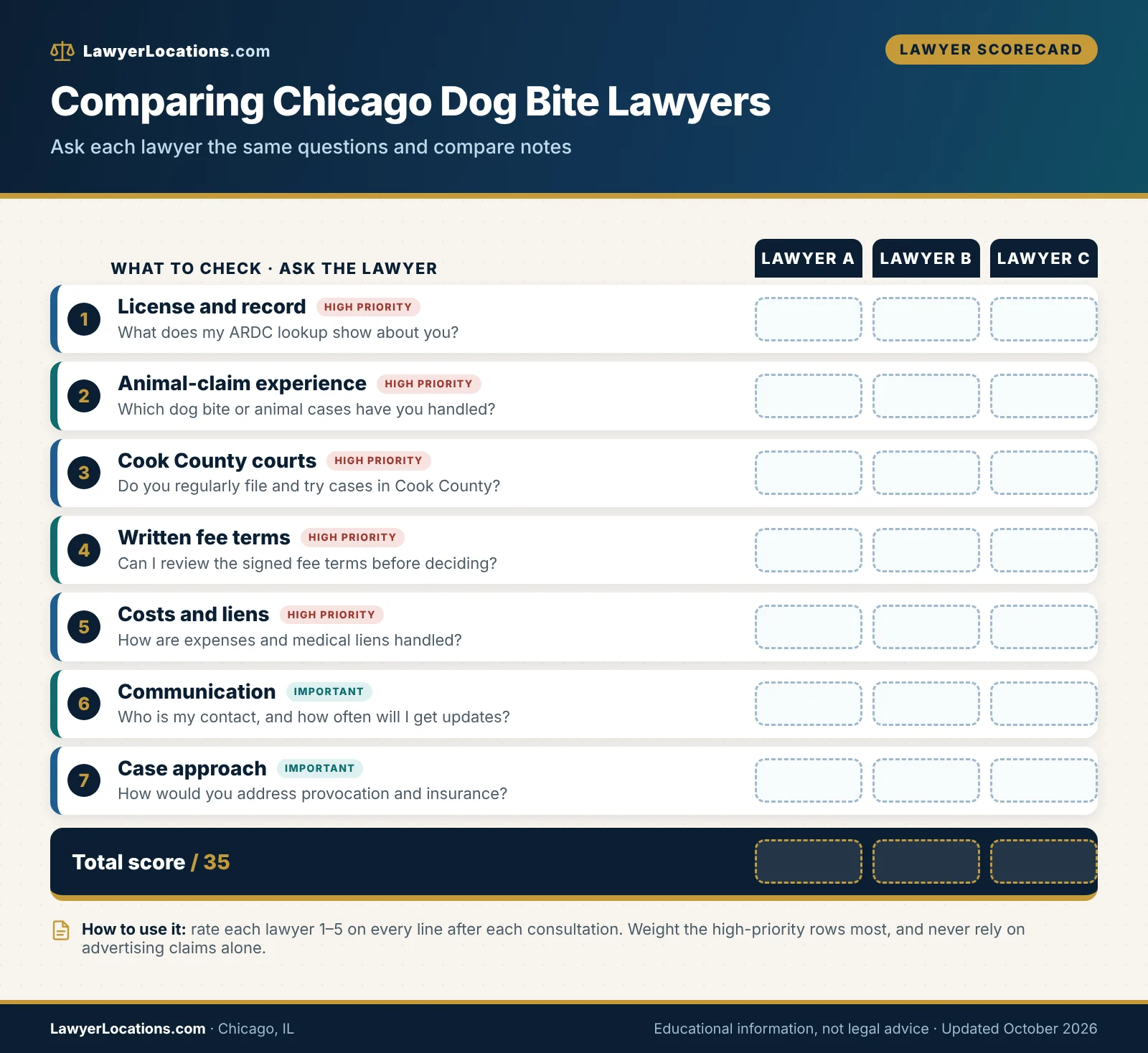
Text version of this graphic
- License and discipline: Is the lawyer licensed, and what does the ARDC show?
- Animal-claim experience: Which dog bite or animal cases have you handled?
- Cook County courts: Do you regularly file and try cases in Cook County?
- Fee terms in writing: Will you give me the signed contingent fee terms to review?
- Costs and liens: How are expenses and medical liens handled?
- Communication: Who is my contact and how often will I get updates?
- Strategy: How would you address provocation and the owner’s insurance?
Weighing two or three options
After each consultation, write short notes under the same headings: licensing, relevant experience, fee terms, expenses, communication and your gut sense of whether the lawyer listened. Then compare the notes side by side, ideally a day later.
The cheapest or loudest option is not automatically the right one. Pick the lawyer whose terms you understand and whose answers match the facts of your case, then read the contract again before signing.
You are allowed to talk with more than one lawyer before choosing. Fee terms are supposed to be put in writing before the work starts, so asking questions at the consultation stage is normal.
Cook County Courts and How a Dog Bite Claim Moves
A dog bite lawsuit in Chicago is filed in the Circuit Court of Cook County, the state trial court for the county. Which division hears it depends mainly on the amount of damages claimed, and filing is done electronically.
Which Cook County court handles the case
Most people never see a courtroom, but knowing the venue helps you ask better questions and understand what a lawyer means by “filing in the Law Division.”
Law Division and Civil Division
The Clerk of the Circuit Court of Cook County lists personal injury among the Law Division’s case types and says the division handles claims in excess of $30,000. The Clerk’s Civil Division page says that division handles cases seeking damages less than $30,000, including personal injury. If your claim sits near that line, ask the lawyer how they will plead the damages and in which division they intend to file.
The Law Division is at the Richard J. Daley Center, 50 West Washington Street, Chicago, IL 60602, Room 801, open Monday through Friday from 8:30 a.m. to 4:30 p.m. The Law Division phone is 312-603-5426 and its email is [email protected]. The Civil Division is in the same building; the Clerk’s page lists Room 602 for the division and Room 601 for its customer service counter, so confirm the room before you go.
| Feature | Law Division | Civil Division |
|---|---|---|
| Claim size | In excess of $30,000 | Damages less than $30,000 |
| Location | Daley Center, 50 W. Washington St., Room 801 | Daley Center; Room 602 for the division, Room 601 for the counter (confirm) |
| Hours | Mon–Fri, 8:30 a.m.–4:30 p.m. | Mon–Fri, 8:30 a.m.–4:30 p.m. |
| Contact | 312-603-5426; [email protected] | See the Clerk’s Civil Division page |
| Fees | Law Division schedule: $388 filing + $250 appearance on the version reviewed | Fee depends on the claim amount; Clerk’s fee schedules at the Room 601 counter |
| Service by certified mail | Not stated for this division on the page reviewed | Only for claims of $10,000 or less with an Illinois defendant |
E-filing and getting around the Daley Center
The Illinois Courts website states that e-filing is mandatory in all civil cases in the Supreme, Appellate and Circuit Courts, using a certified electronic filing service provider. A person can seek an exemption by showing good cause, such as having no home internet or computer, no email, or trouble with English. Lawyers generally handle this for represented clients.
The Law Division page says case status and next court dates can be checked through the online case search, digital access terminals at the division, or live chat during office hours. If you are representing yourself, Illinois Court Help at (833) 411-1121 is listed on the Illinois Courts site as a free help line.
From first call to resolution
Every case differs, and many are resolved without a lawsuit. This outline is a general map of the stages, not a prediction of how long yours will take.
Claim, demand and negotiation
After your medical treatment has progressed enough to understand the injury, a lawyer may send the owner’s insurer a written claim that describes the facts, the legal basis and the damages. Damages typically include medical expenses, lost income, and the harm of pain, scarring or emotional distress, and Section 16 speaks of “the full amount of the injury proximately caused.”
The insurer may then investigate, request records, make an offer, or deny. You are the one who decides whether to accept an offer. Do not sign a release until you understand exactly what you are giving up, especially if your treatment is not finished.
Lawsuit, discovery and trial
If negotiation fails and the deadline is approaching, a lawyer can file a complaint in the Circuit Court of Cook County. After filing, the defendant is served and responds, and the sides exchange information in a stage called discovery (written questions, document requests and depositions, which are recorded question-and-answer sessions under oath).
Many cases settle during or after discovery. Those that do not go to trial, where a judge or jury decides. Ask your lawyer which steps they expect in your case and which require your presence.
Costs, deadlines and decision points
Three decisions shape most dog bite cases: whether to accept an offer, whether to file suit, and how much cost and delay you are willing to accept. The graphic below pulls together the points in this guide.
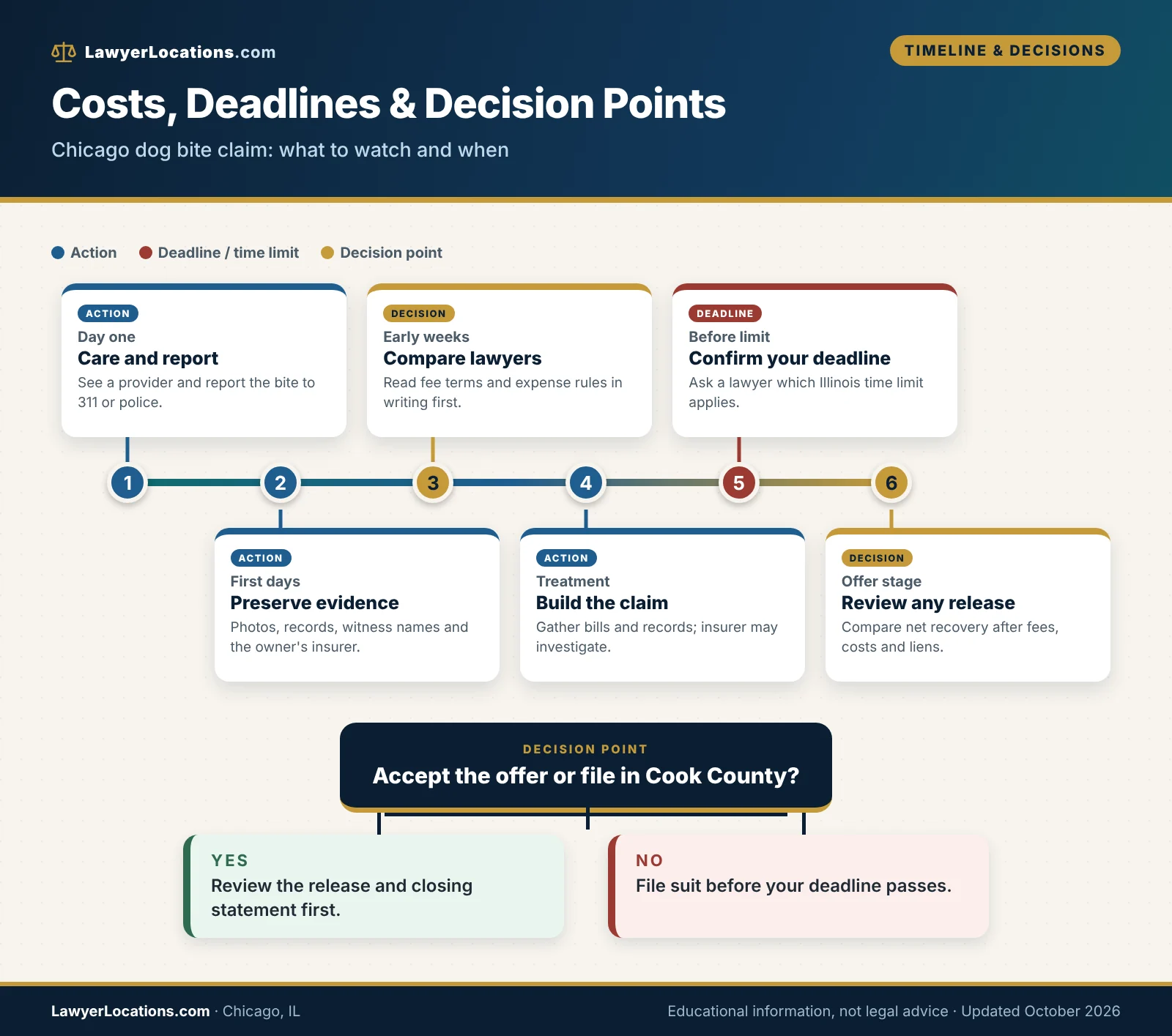
Text version of this graphic
- Day of the bite: Get medical care and report the bite (action).
- First days: Preserve photos, records and witness names (action).
- Early weeks: Compare lawyers and read fee terms in writing (decision).
- During treatment: Gather bills; the insurer may investigate (action).
- Before the deadline: Confirm the filing deadline with a lawyer (deadline).
- Decision point: Do you accept a settlement offer or file suit?
- If yes to settlement: review the release and closing statement. If no: file in Cook County before the deadline.
The settle-or-file decision
An offer can make sense when it covers your current and likely future costs, your injuries have stabilized, and the risks of trial outweigh the gap. Filing can make sense when negotiation is stuck and the deadline is near. A lawyer can explain the tradeoffs for your facts, but the decision to settle belongs to you.
Compare the net amount you would receive after fees, expenses and liens, not just the gross figure. The closing statement required by Rule 1.5(d) is where you can see how the number was calculated.
Calendar discipline in practice
Write the filing deadline on your calendar as soon as you know it, then ask your lawyer to confirm it in writing. If a public entity might be involved, ask about the shorter one-year period. If a child was bitten, ask when the extended period for minors starts and ends.
If you are not working with a lawyer yet, the safest approach is to schedule consultations early enough that a lawyer has time to investigate before any deadline. For the broader picture on injury deadlines across states, see how long you have to file a personal injury claim, and for the stages of an injury settlement in general, see the car accident settlement timeline, which uses a different injury type but covers similar steps.
Keep one folder, paper or digital, for the claim: medical records, bills, photos, the report number, insurer letters and every fee document you are given. dated notes after every call make later conversations with a lawyer much faster.
Free Help, Common Mistakes and Next Steps
If cost is a barrier, Chicago and Illinois have free and low-cost routes to information and, for those who qualify, legal advice. Most avoidable problems in dog bite claims come from delay, incomplete records, and signing documents too quickly.
Free and low-cost help in Chicago
Legal aid organizations have income and case-type limits, so they cannot take every case. They are still worth contacting for information or a referral.
Court Help, CARPLS and Illinois Legal Aid Online
The Illinois Courts site lists CARPLS at (312) 738-9200 for free or low-cost legal advice in Chicago and Cook County (income qualifications apply), and Illinois Court Help at (833) 411-1121. It also points to the Chicago Bar Association, the Chicago Bar Foundation’s limited-scope panels, and the ISBA Lawyer Finder for referrals.
Illinois Legal Aid Online is a non-profit that publishes plain-language legal information, a Get Legal Help directory, guided forms and a directory of legal self-help centers. It does not list a hotline on its home page, so use its site for forms, glossary and referrals. See also the related guide on how to find a personal injury lawyer in Chicago for a broader hiring walkthrough.
Fee waivers for court costs
Illinois law, 735 ILCS 5/5-105, lets a person sue without paying court fees, or with reduced fees, if they qualify. Qualifying paths include receiving certain means-based public benefits, having available income at or below 125% of the federal poverty level, or showing substantial hardship. People with income between 125% and 200% of the poverty level can receive partial waivers.
The application must be in writing and signed, and the clerk must provide the form to anyone who says they cannot pay. A waiver expires after one year, and the person may reapply. A fee waiver covers court fees, not a lawyer’s contingent percentage.
Organizations such as the Chicago Bar Association’s referral service say neither you nor the lawyer must continue after the first call or meeting, so a referral is a low-commitment way to ask questions.
Common mistakes to avoid
These are patterns, not predictions. Each is something you can control.
Mistakes in the first weeks
- Skipping medical care because the wound looks minor, then having no record if infection develops.
- Not reporting the bite, or not saving the 311 or police report number.
- Giving a recorded statement to an insurer without understanding what you are agreeing to.
- Posting about the incident or your recovery in ways an adjuster can quote back.
- Waiting on the deadline because talks with the insurer are “going fine.”
Most of these are easy to avoid if you work from the evidence checklist earlier in this guide.
Mistakes when hiring
The most common hiring errors are signing without reading, not asking about expenses and liens, and choosing only on advertising. Another is assuming that a low-cost or free first meeting commits the lawyer to take your case; it does not.
If you are unhappy with a lawyer later, the ARDC says it does not decide fee disputes, so understand your fee agreement before you sign. It is easier to ask questions now than to unwind a contract later.
Your next steps
You do not have to do everything at once. A short sequence is enough to protect your health, your records and your options.
A practical plan for the next week
- See a provider. Get the wound checked and ask about rabies and tetanus.
- Report the bite. Use 311 or your police district and save the report number.
- Collect evidence. Use the checklist: photos, names, receipts and a dated log.
- Find the owner’s insurer. Ask for the policy company and number.
- Write down your deadline. Ask a lawyer to confirm which one applies.
- Compare lawyers. Verify each on the ARDC site and ask for fee terms in writing.
Ready to compare your options?
Use this guide’s checklist and scorecard when you speak with a dog bite lawyer in Chicago, and verify each lawyer on the ARDC site. Reading this page does not create an attorney-client relationship, and LawyerLocations.com does not recommend any individual lawyer or firm. For a wider look at hiring locally, read how to find a personal injury lawyer in Chicago.
Quick answers to common questions
Does Illinois have a “one-bite” rule?
Section 16 of the Animal Control Act does not require proof that the owner knew the dog was dangerous, according to the Illinois pattern jury instruction commentary. Prior bites can still matter to other legal theories and to insurance coverage.
What if I was bitten while on someone’s property?
Section 16 covers a person who is peaceably conducting themselves in a place where they may lawfully be. Whether you were lawfully on the property, for example as a guest or delivery worker, is a fact question a lawyer will ask about.
Can I sue a landlord for a tenant’s dog?
The pattern-instruction commentary gives an example in which an absentee landlord who allowed a tenant to keep a dog was not an owner. Other facts, such as the landlord living on the premises, may change the analysis, so raise it with a lawyer.
What if the owner has no insurance?
The owner may still be legally responsible, but collecting can be harder. Ask any lawyer how they evaluate whether other coverage, such as a household member’s policy, might apply.
Will reporting a bite get the dog put down?
A bite report starts an observation period, which public health agencies describe as 10 days for a healthy domestic dog. A vicious-dog finding is a separate court process under Section 15, and a court can order consequences ranging from confinement to euthanasia.
Do I have to hire a lawyer?
No. You can handle a small claim yourself. Many people at least consult a lawyer because of deadlines, insurance rules and the effect of a release.
What if a stray dog bit me?
Section 16 applies to the dog’s owner. If there is no identifiable owner, the statutory route may not be available, and a lawyer can explain what options, if any, remain.
Sources & References
Show all 35 sources
- Animal Control Act, Section 16 (510 ILCS 5/16), “Animal attacks or injuries” — Illinois General Assembly — ilga.gov — accessed October 2026.
- Animal Control Act, Section 2.16 (“Owner”) (510 ILCS 5/2.16) — Illinois General Assembly — ilga.gov — accessed October 2026.
- Animal Control Act, Section 2.05a (“Dangerous dog”) (510 ILCS 5/2.05a) — Illinois General Assembly — ilga.gov — accessed October 2026.
- Animal Control Act, Section 2.19a (“Serious physical injury”) (510 ILCS 5/2.19a) — Illinois General Assembly — ilga.gov — accessed October 2026.
- Animal Control Act, Section 15 (vicious dogs) (510 ILCS 5/15) — Illinois General Assembly — ilga.gov — accessed October 2026.
- Senate Bill 4180, 104th General Assembly (introduced March 24, 2026) — Illinois General Assembly — ilga.gov — accessed October 2026.
- Illinois Pattern Jury Instructions (Civil), Chapter 110, Animals — Illinois Supreme Court / Illinois Courts — ilcourtsaudio.blob.core.windows.net — accessed October 2026.
- 735 ILCS 5/13-202, personal injury limitation period — Illinois General Assembly — ilga.gov — accessed October 2026.
- 735 ILCS 5/13-211, persons under legal disability — Illinois General Assembly — ilga.gov — accessed October 2026.
- 735 ILCS 5/2-1116, modified comparative fault — Illinois General Assembly — ilga.gov — accessed October 2026.
- 745 ILCS 10/8-101, Local Governmental and Governmental Employees Tort Immunity Act — Illinois General Assembly — ilga.gov — accessed October 2026.
- 735 ILCS 5/5-105, fee waivers — Illinois General Assembly — ilga.gov — accessed October 2026.
- Illinois Rule of Professional Conduct 1.5 (Fees) — Illinois Supreme Court / Illinois Courts — ilcourtsaudio.blob.core.windows.net — accessed October 2026.
- Law Division, Clerk of the Circuit Court of Cook County — cookcountyclerkofcourt.org — accessed October 2026.
- Civil Division, Clerk of the Circuit Court of Cook County — cookcountyclerkofcourt.org — accessed October 2026.
- Law Division fee schedules (form CCL-0058) — Clerk of the Circuit Court of Cook County — services.cookcountyclerkofcourt.org — accessed October 2026.
- Miscellaneous Fees (form CCG-0140) — Clerk of the Circuit Court of Cook County — services.cookcountyclerkofcourt.org — accessed October 2026.
- Information for Filers Without Lawyers (e-filing, Court Help, CARPLS, referral options) — Illinois Courts — illinoiscourts.gov — accessed October 2026.
- Illinois Legal Aid Online — illinoislegalaid.org — accessed October 2026.
- Lawyer Referral Service, How It Works — Chicago Bar Association — lrs.chicagobar.org — accessed October 2026.
- Lawyer Referral Service, Personal Injury — Chicago Bar Association — lrs.chicagobar.org — accessed October 2026.
- Illinois Lawyer Finder (article on referral volume and contact details) — Illinois State Bar Association — isba.org — accessed October 2026.
- FAQs for the Public — Attorney Registration and Disciplinary Commission of the Supreme Court of Illinois — iardc.org — accessed October 2026.
- Rabies — Illinois Department of Public Health — dph.illinois.gov — accessed October 2026.
- Rabies: What You Need To Know — Chicago Department of Public Health — chicago.gov — accessed October 2026.
- Field Services (bite reports) — Chicago Animal Care and Control — chicago.gov — accessed October 2026.
- Animal Bite Investigation — Cook County Animal and Rabies Control — cookcountyil.gov — accessed October 2026.
- Animal Quarantine — Cook County Department of Public Health — cookcountypublichealth.org — accessed October 2026.
- Municipal Code of Chicago (official code host; section 7-12-030 summarized through secondary pages) — American Legal Publishing — codelibrary.amlegal.com — accessed October 2026.
- Pet Owners (summary of MCC 7-12-030, 7-12-140) — Ranch Triangle / RnRA Chicago neighborhood association — rnrachicago.org — accessed October 2026.
- Chicago dog leash laws (summary of MCC 7-12-030) — CityRuleLookup — cityrulelookup.com — accessed October 2026.
- Dogs (bite first aid, prevention, statistics) — Centers for Disease Control and Prevention — cdc.gov — accessed October 2026.
- Property Insurance Consumer Guide — Illinois Department of Insurance — insuranceqa.illinois.gov — accessed October 2026.
- Shopping for Homeowners Insurance — Illinois Department of Insurance — insuranceqa.illinois.gov — accessed October 2026.
- “Illinois Man Receives $300K Settlement from Dog Attack,” Insurance Journal, June 8, 2026 (citing Triple-I and State Farm data) — Wells Media Group — insurancejournal.com — accessed October 2026.
General information only. This article is for general education and is not legal advice. Reading it does not create an attorney-client relationship, and LawyerLocations.com is not a law firm and does not recommend or rate individual lawyers. Laws, fees, deadlines and local court practices change, and facts matter. Consult a lawyer licensed in Illinois about your situation, and verify any deadline before relying on it.
Legal Disclaimer and Limitation of Liability
Informational and illustrative purposes only. This article was prepared by LawyerLocations.com solely on the basis of the information available to us at the time of writing. It is an illustrative, general overview. It is not a complete or authoritative statement of the law, and it has not been reviewed by a lawyer licensed in your state or county.
Not legal advice. Nothing in this article is legal, financial, tax or immigration advice, and reading it does not create an attorney-client relationship between you and LawyerLocations.com or any author, lawyer or firm mentioned. Laws, court rules, fees, filing deadlines and agency procedures differ by state, county and court, and they change often. Some details here may be simplified, incomplete or out of date, and time limits for legal claims can be short.
No warranty. We make no representation or warranty, express or implied, about the accuracy, completeness, timeliness or suitability of this content for your situation. Please do not rely on it to make, delay or skip any legal decision. Check the facts against official sources and speak with a licensed attorney in the relevant jurisdiction before you act.
Limitation of liability. To the fullest extent permitted by law, LawyerLocations.com and its owners, authors and contributors disclaim all liability for any loss, damage, cost or other consequence arising from the use of, or reliance on, this article, including any content on third-party websites we link to. Mentioning a lawyer, firm, organization or service is not an endorsement and is not a promise of any result. If you are in immediate danger, contact your local emergency number.