If you are searching for a truck accident lawyer Kansas City MO drivers and families can rely on for clear information, start with the rules that actually govern your claim: Missouri sets a 5-year limit for most personal injury lawsuits under RSMo 516.120 and a 3-year limit for wrongful death under RSMo 537.100, while federal trucking rules add a second layer of duties for carriers and drivers. Evidence moves faster than the deadlines, so the practical clock is much shorter than the legal one.
This guide explains how a truck crash claim works in Kansas City, which courts are involved, how fees and consultations usually work, and how to compare lawyers without relying on advertising slogans.
How a Truck Accident Case Works in Kansas City, MO
A truck accident case in Kansas City is a personal injury claim (or a wrongful death claim, if someone died) governed by Missouri civil law, with federal motor carrier regulations layered on top. Most cases start with insurance claims and only move into court if the claim cannot be resolved. The sections below walk through the geography, the extra complexity trucks bring, and the usual path from crash to resolution.
Why geography matters before anything else
Two Kansas Cities, two states
The metro area straddles the state line. Kansas City, Missouri sits mostly in Jackson County, with portions in Clay and Platte counties, while Kansas City, Kansas is the county seat of Wyandotte County, Kansas. Which side of the line the crash happened on decides which state’s law applies, which courts hear the case, and which deadlines control.
Several interstates cross the line, so a collision can easily happen within a few miles of the border. Confirm the exact location of the crash from the police report before you assume which state’s rules apply. A lawyer you speak with should be licensed in the state where the claim belongs, or should tell you plainly that another firm is a better fit.
Jackson, Clay and Platte counties
Within Missouri, the county where a case may be filed is controlled by the state venue statute discussed later in this guide. Jackson County is served by the 16th Judicial Circuit, which operates a downtown Kansas City courthouse and a separate Eastern Jackson County Courthouse in Independence. Clay and Platte counties have their own circuit courts, and the right one depends on where the crash happened and where the defendants can be sued.
The practical takeaway is simple: ask which county will apply early in any consultation. A lawyer who has handled cases in your county can explain how that court’s civil division handles scheduling and filings, which a general national website cannot.
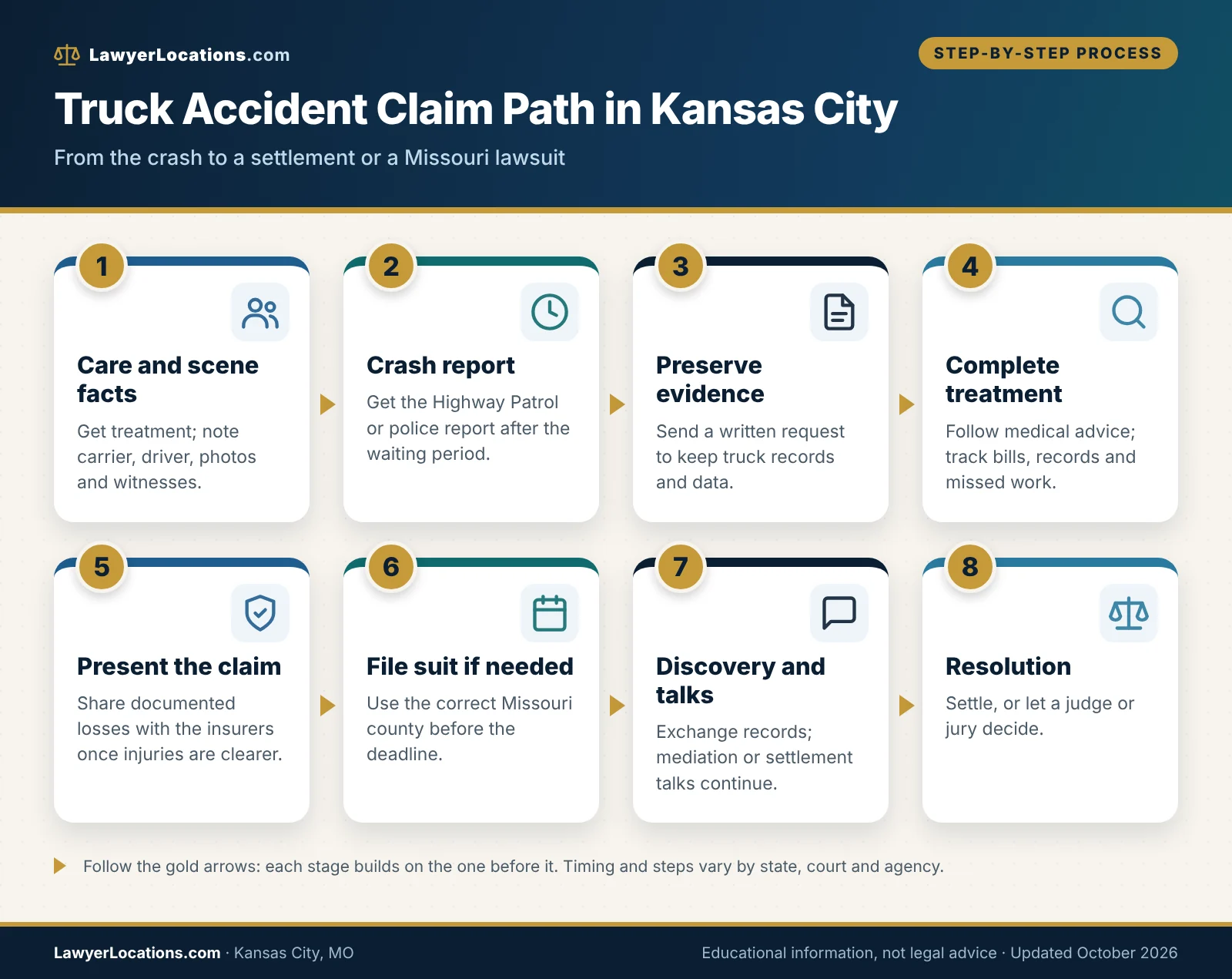
Text version of this graphic
- Get medical care and document the scene, the truck, the carrier name and the driver information.
- Obtain the Missouri State Highway Patrol or local police crash report.
- Send or ask a lawyer to send a preservation request to the trucking company.
- Complete your medical treatment and track every bill, record and missed workday.
- Present a claim to the insurance companies once the extent of your injuries is clearer.
- If the claim does not resolve, file a lawsuit in the correct Missouri county before the deadline.
- Discovery, mediation or settlement talks, and trial if the case does not resolve.
If your crash happened on the Kansas side of the state line, Kansas law and Kansas courts are likely to apply instead, with their own deadlines. Do not assume Missouri’s five-year and three-year limits carry over.
What makes a truck case different from a car case
More parties and more rules
A car crash usually involves two drivers and two insurers. A commercial truck crash can involve the driver, the motor carrier that operates the truck, a company that owns the trailer, a freight broker or shipper, a maintenance contractor and several insurance policies. Each of those parties may have a different version of what happened.
Trucks are also regulated in ways passenger cars are not. Federal rules cover how long drivers may work, what insurance carriers must carry, and which records companies keep. Our guide on how a truck accident lawyer differs from a car accident lawyer compares those differences in more detail.
Higher stakes, closer scrutiny
The size and weight of a loaded tractor-trailer means injuries from a collision can be severe and long-lasting. That raises the value of the medical, wage and future-care questions in the case, and it means insurers tend to look carefully at every claim file.
Do not treat a truck company’s adjuster as a neutral party. The adjuster’s job is to evaluate and limit what the insurer pays. That is not a criticism; it is simply the role, and it is why knowing your rights before giving a statement matters.
The legal deadline to sue is measured in years, but the window to preserve truck data, video and driver records is often measured in weeks. Companies may overwrite or discard some records on a routine schedule, so early preservation requests matter.
The usual path from crash to resolution
The first weeks
The first weeks are about health, safety and information. You get treatment, report the crash, notify your own insurer as your policy requires, and gather the basic facts: carrier name, USDOT number if visible on the truck, driver name, photographs and witness contact details. Our general checklist on what to do after a car accident covers the scene steps that also apply after a truck collision.
Many injured people hold off on a lawyer conversation until they feel better, which is understandable. A short consultation early on can still help you learn what to preserve and what to avoid saying, without committing to anything.
Claim first, lawsuit second
Most injury cases begin as insurance claims. The claim is presented with medical records, bills and wage documentation, and negotiation follows. If the insurer’s position and your records are too far apart, the case may move into a lawsuit, where a judge or jury ultimately decides contested questions.
Filing suit does not mean the case will be tried. Many lawsuits still resolve through settlement or mediation, but a filed case is usually what gives the process firm deadlines and access to formal discovery, such as requiring the other side to produce records under court rules. Our guide on the car accident settlement timeline explains how long each stage commonly takes in general terms.
Missouri Law That Shapes a Kansas City Truck Claim
Missouri law controls deadlines, how fault is shared, which evidence a jury may hear about medical bills, and where a lawsuit can be filed. For most truck crash injuries in Kansas City, Missouri, the lawsuit deadline is five years; for a death, it is three. Those are outer limits. Other rules can shorten your practical options.
Deadlines under Missouri statutes
Personal injury: five years in most cases
Missouri’s general statute of limitations lists actions for “any other injury to the person or rights of another, not arising on contract” among those that must be brought within five years. That is found in RSMo 516.120, which Missouri courts apply to ordinary negligence claims for bodily injury. The Missouri Revisor of Statutes publishes the text online.
Five years sounds generous, but it does not stop evidence from aging. Our national explainer on how long you have to file a personal injury claim shows how widely deadlines vary from state to state, which matters if your crash involved a driver or company based elsewhere.
Wrongful death: three years
If a truck crash killed a family member, the claim is brought under Missouri’s wrongful death statute, RSMo 537.080. Under RSMo 537.100, an action under that section must be brought within three years after the cause of action accrues.
The statute also sets who may sue and in what order. In the first class are the spouse, the children or the surviving descendants of a deceased child, and the deceased person’s parents. Siblings and their descendants come next only if no one in the first class can sue, and a court-appointed plaintiff ad litem may bring the action if neither class can. Our guide to wrongful death lawyer costs explains how fees usually work in these cases.
Wrongful death and injury deadlines run on different clocks and can be affected by who the defendant is. Claims involving a government vehicle or agency can follow separate notice and filing rules, so raise that fact in your first consultation.
How fault and damages work
Pure comparative fault
Missouri follows a pure comparative fault approach in ordinary negligence cases, adopted by the Missouri Supreme Court in the 1983 case Gustafson v. Benda. Under that approach, a jury assigns each party a percentage of fault, and your damages are reduced by your own share. You are not shut out of recovery simply because you share some blame.
For example, if a jury assigns you 20 percent of the fault, the damages it awards would be reduced by 20 percent. Missouri does not use the 50 percent or 51 percent cutoff that some other states apply. The statute RSMo 537.765 states the same proportional principle for products liability claims, which may matter if a defective truck part is part of your case.
What the jury hears about medical bills
Medical bills are a major part of most truck injury claims, and Missouri has a statute on what evidence of their cost a jury may hear. Under RSMo 490.715, the “actual cost” of care is limited to the dollars paid by or for the plaintiff plus any balance the plaintiff still owes after discounts and write-offs. Collateral-source evidence is generally not admissible except as the section allows.
In plain terms, the difference between what a hospital billed and what an insurer actually paid can matter. If you are weighing how bills, insurers and liens interact with a claim, read our guide on medical bills after a car accident and ask any lawyer how they handle this issue.
| Topic | Statute | What it says in plain English |
|---|---|---|
| Injury lawsuit deadline | RSMo 516.120 | Actions for injury to the person not arising on contract generally must be brought within five years. |
| Wrongful death deadline | RSMo 537.100 | Actions under the wrongful death statute must be brought within three years after the cause of action accrues; service after the period must occur within 180 days of filing. |
| Who may sue for a death | RSMo 537.080 | Spouse, children and parents first; siblings next; a plaintiff ad litem if no one else can sue. |
| Fault in products claims | RSMo 537.765 | Plaintiff fault reduces compensatory damages proportionally and does not bar recovery. |
| Evidence of medical costs | RSMo 490.715 | Evidence of actual cost is tied to amounts paid plus any remaining balance owed. |
| Where to file | RSMo 508.010 | In tort cases where the plaintiff was first injured in Missouri, venue lies in the county where the plaintiff was first injured. |
Where a Missouri truck case can be filed
County venue rules
Under RSMo 508.010, when a tort action involves a plaintiff who was first injured in Missouri, venue lies in the county where the plaintiff was first injured by the alleged conduct. For a crash in the Kansas City area, that generally points to the county where the collision happened. The statute also addresses corporate defendants, individual employees, and insurance companies in other situations.
This is one area where facts matter enormously. Venue is decided by statute, not by which courthouse is closest or most convenient for you, and a filing in the wrong county can create delay and cost.
State court, federal court and appeals
Most injury lawsuits begin in a Missouri circuit court. Depending on the parties and the amount in dispute, a defendant may sometimes seek to move a case to federal court, and a lawyer should explain whether that is likely in your situation. If a state court case is appealed, it goes to the Missouri Court of Appeals, Western District, which sits in Kansas City, and then potentially to the Supreme Court of Missouri in Jefferson City.
You do not need to master this procedure, but you should expect a lawyer to explain which court is likely, how long it commonly takes to get a hearing, and what the practical difference is for your case.
Federal Trucking Rules and the Evidence That Disappears
Commercial trucks that cross state lines are regulated by the Federal Motor Carrier Safety Administration (FMCSA), and many of those rules show up directly in injury cases. The rules do not decide your case by themselves, but they tell a lawyer what records should exist and where to look for them. The sections below cover the federal rules most often discussed, then the evidence you can start protecting now.
Federal rules that often come up
Driver hours of service
Federal regulation 49 CFR 395.3 sets limits for drivers of property-carrying commercial vehicles. A driver generally must have 10 consecutive hours off duty before driving, may not drive after the 14th consecutive hour on duty, and may drive a total of 11 hours within that window. A 30-minute break is required after more than eight hours of driving, with certain short-haul exceptions, and weekly limits of 60 hours in 7 days or 70 hours in 8 days apply depending on how the carrier operates.
Fatigue is a recognized safety concern in trucking, so hours-of-service records are often among the first things a lawyer asks about. Exceptions and special categories exist, so whether the rule applies to a particular driver is a question for a lawyer reviewing the records, not something to decide from the outside.
Minimum insurance levels
Federal financial responsibility rules in 49 CFR 387.9 set minimum levels of public liability coverage. For for-hire carriers moving non-hazardous property in interstate commerce in vehicles with a gross weight rating of 10,001 pounds or more, the minimum is $750,000. Higher minimums apply to certain hazardous materials, such as $1,000,000 for oil and certain hazardous substances and $5,000,000 for specified bulk hazardous cargo.
A federal minimum is a floor, not a ceiling on what a case may be worth. Carriers may carry more coverage, and other policies, such as an excess policy, may exist. A lawyer can ask for insurance information through the formal process once a claim is underway.
Evidence that can vanish quickly
Company records and electronic data
Trucking companies keep many kinds of records: driver qualification files, maintenance and inspection records, dispatch messages, bills of lading and electronic data from the truck itself. Federal record-retention rules in 49 CFR Part 379 set minimum periods that vary by type of record, and the schedule lists some supporting data for as little as 6 months and shipping documents such as bills of lading for 1 year.
The schedule does not name every record type that matters in a crash case, so do not assume any specific item is still available. A written preservation request, sent early, asks the company in writing to keep the records that relate to your crash. A lawyer can prepare one, and asking whether a firm sends these promptly is a fair consultation question.
Scene, vehicle and video evidence
Skid marks fade, vehicles get repaired or sold, and traffic or business cameras overwrite footage on short cycles. If you are able, photograph the scene, the vehicles, the road conditions, and any visible company name, USDOT number or license plate. Ask witnesses for contact information before they leave.
If your own vehicle is still available, do not authorize repairs or disposal until you have asked whether an inspection or data download might help. Your own car may hold event data that supports your account.
Keep a simple folder, paper or digital, with the crash report number, claim numbers, adjuster names, medical bills, and a daily note of symptoms and missed work. A dated paper trail is easier to rely on than memory a year from now.
A preservation request (sometimes called a spoliation or litigation-hold letter) is a written notice asking a company to keep records, data and physical evidence related to a specific crash instead of discarding them in the ordinary course of business.
Evidence you can start gathering locally
The Missouri crash report
The Missouri State Highway Patrol (MSHP) provides traffic crash reports through its Patrol Records Division and troop headquarters. The MSHP charges $6.00 for a basic motor vehicle crash report, asks requesters to wait 10 days from the crash investigation before submitting a request, and notes that a backlog may extend the wait. Requests can be made through its online records form or by mail with payment.
If a municipal or county agency investigated the crash, the report may come from that agency instead, so check which agency responded. A lawyer can often request the report for you, but you can also do it yourself.
Medical and employment records
Your own records are evidence too. Keep discharge papers, imaging results, prescriptions, therapy notes and receipts for out-of-pocket costs. For lost income, collect pay stubs, a note from your employer on missed shifts, and any records of reduced duties.
Treatment gaps can be used against you, so follow your providers’ directions and tell them about every symptom. If cost is a barrier to follow-up care, raise it with a lawyer during a consultation rather than skipping appointments.
| Evidence | Who usually holds it | What you can do now |
|---|---|---|
| Crash report | Missouri State Highway Patrol or local police agency | Note the report number at the scene; request a copy after the waiting period. |
| Driver logs and hours records | Trucking company and its technology vendors | Ask a lawyer to send a written preservation request early. |
| Truck event and camera data | Trucking company, truck manufacturer systems | Include these categories in the preservation request. |
| Maintenance and inspection records | Carrier or maintenance contractor | Request them through the lawyer or formal discovery. |
| Scene photos and witness names | You, bystanders, nearby businesses | Photograph the scene; contact businesses with cameras quickly. |
| Medical records and bills | Hospitals and providers; your health insurer | Keep every document and follow treatment instructions. |
| Wage records | Your employer or payroll provider | Collect pay stubs and request a letter confirming missed work. |
How to Compare Truck Accident Lawyers in Kansas City
Comparing lawyers means comparing relevant experience, communication, resources and the fee agreement, not slogans or billboard size. LawyerLocations is a legal-education and discovery resource, not a law firm, and we do not rank or recommend individual lawyers. This section shows what to ask, what to read before you sign, and where to find Kansas City-area lawyers through independent sources.
How truck accident lawyers are usually paid
Contingent fees and the written agreement
In personal injury cases, lawyers commonly work on a contingent fee, meaning the fee is a percentage of the recovery and is owed only if there is one. In Missouri, Supreme Court Rule 4-1.5(c) provides that a contingent fee agreement “shall be in a writing signed by the client” and must state the method for determining the fee, including the percentage or percentages that apply if the case settles, goes to trial or goes to appeal.
Read that agreement carefully and keep a copy. If a fee percentage changes at different stages of the case, make sure you understand exactly when it changes. We do not publish average percentages because they vary by firm and case; any figure you hear should be in the written agreement.
Case expenses and the closing statement
Truck cases can require substantial case expenses, such as obtaining records, hiring accident reconstruction or medical experts, and paying court costs. The rule requires the agreement to say how litigation and other expenses are handled, including whether expenses are deducted before or after the contingent fee is calculated, and to tell you clearly what expenses you may owe whether or not you recover.
At the end of the matter, the lawyer must give you a written closing statement showing the outcome and, if there is a recovery, the amount remitted to you and how it was calculated. Our overview of wrongful death lawyer costs uses the same principles for family claims.
Ask each lawyer you meet to walk you through the fee agreement line by line and to give you a copy to take home. A fee agreement you can read in your own time is easier to compare than one explained in a rush.
Questions that reveal real experience
Truck-specific questions to ask
A truck case is not a larger car case. Ask whether the firm has handled claims against motor carriers, how it approaches the early preservation of records, and whether it works with accident reconstruction or medical experts when the facts call for it. These questions help you hear how the lawyer thinks.
Avoid asking only about past results. Outcomes depend on facts, and a lawyer cannot honestly promise one. Ask about process, not promises: who will contact the trucking company, what will be requested and when.
Who actually works on your file
Ask who will be your day-to-day contact, how often you can expect updates, and whether other lawyers or staff will handle parts of the case. Larger firms can bring resources; smaller firms can bring closer contact. Neither is automatically better.
Also ask what happens if the case needs to be filed in a county or court where the lawyer does not normally practice, and whether another firm would be brought in. A clear answer before you sign is much better than a surprise later.
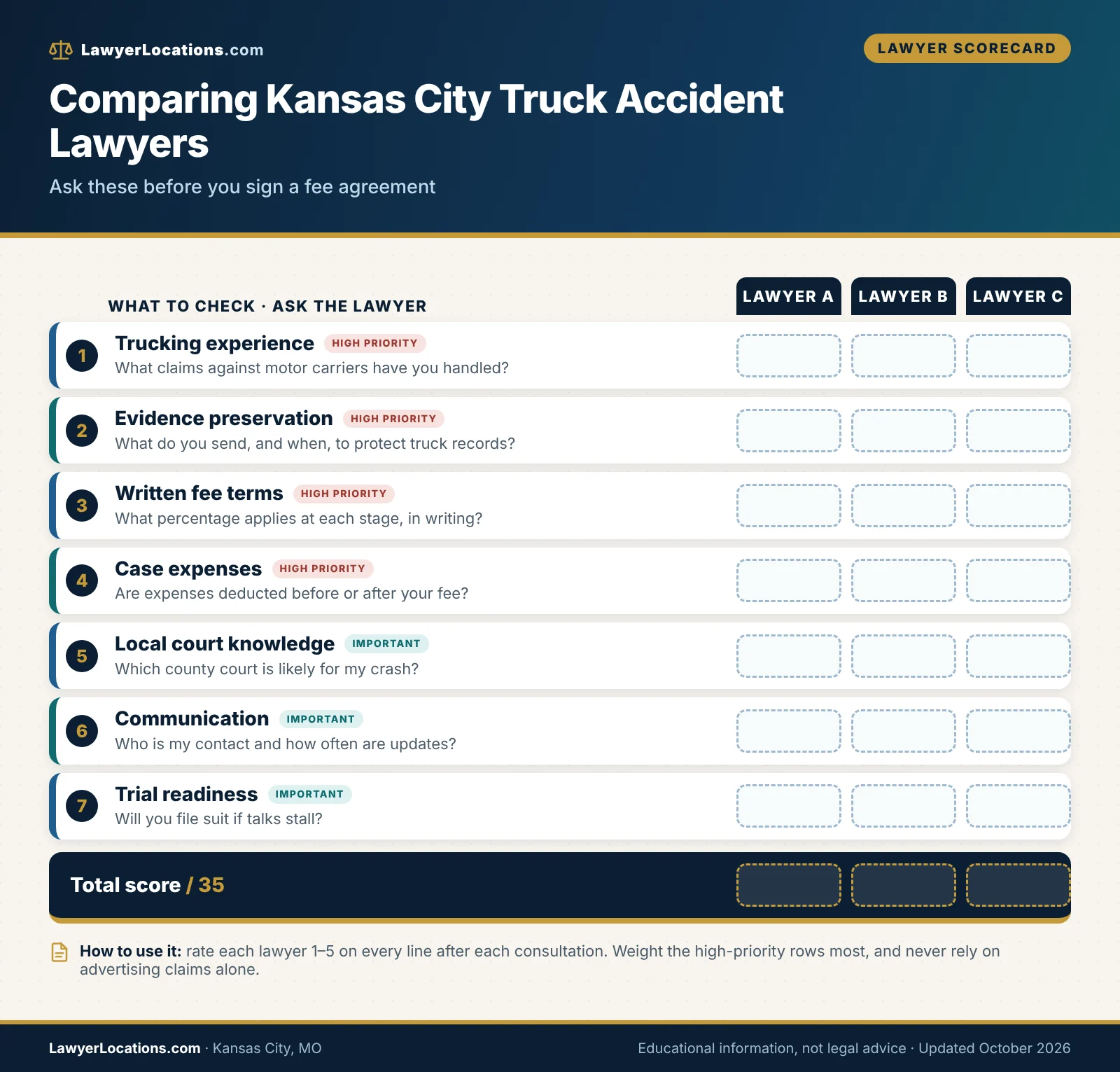
Text version of this graphic
| Criterion | Question to ask |
|---|---|
| Trucking experience | How many claims against motor carriers have you handled? |
| Evidence preservation | What do you send, and when, to preserve truck records? |
| Fee agreement | What percentage applies at each stage, in writing? |
| Case expenses | Are expenses deducted before or after your fee? |
| Local court familiarity | Which county court is likely for my crash? |
| Communication | Who is my contact and how often will I get updates? |
| Trial readiness | Are you prepared to file suit if talks stall? |
Be cautious of anyone who promises a result, pressures you to sign at the scene or hospital, or cannot explain the fee agreement in plain words. A lawyer’s job is to explain, not to rush you.
Where to find Kansas City-area lawyers
Bar association tools
The Kansas City Metropolitan Bar Association (KCMBA) offers a KC Lawyer Finder, an online search for lawyers in the Kansas City area by location or practice area. KCMBA states that it does not provide legal advice or operate a lawyer referral service, so treat the finder as a directory rather than a recommendation.
Whichever tool you use, a directory listing is only a starting point. Confirm that a lawyer is licensed in Missouri, check for any public discipline record through the state’s official attorney-licensing authority, and compare at least two or three lawyers before you sign anything.
Free and low-cost legal help
Legal Aid of Western Missouri provides free civil legal help to eligible low-income people in a 40-county area that includes Jackson, Clay and Platte counties. By its own published materials, it does not handle personal injury lawsuits, so it is not a substitute for a truck accident lawyer, though it may help with related civil problems such as housing, public benefits or consumer issues that follow a serious injury.
If cost is your main worry, remember that contingent-fee arrangements mean many injured people do not pay a lawyer up front. The better question is what expenses you could owe and when. Our guide on whether you need a lawyer after a car accident can help you decide how much help your situation calls for.
| Question | Why it matters | What a clear answer looks like |
|---|---|---|
| What is the contingent fee percentage? | It determines your share of any recovery. | A stated percentage for settlement, trial and appeal, in the signed agreement. |
| Are expenses deducted before or after the fee? | The order changes what you receive. | The agreement says which, with an example calculation. |
| Do I owe expenses if we lose? | Some agreements make you responsible; others do not. | A direct yes or no, written down. |
| Who approves large expenses like experts? | Expert costs can be substantial. | A process for discussing major costs with you first. |
| How will medical bills and liens be handled? | Providers or insurers may claim part of a recovery. | An explanation of how liens are identified and negotiated. |
| Will I get a closing statement? | It shows how the final numbers were calculated. | Yes, in writing, at the end of the matter. |
Costs, Deadlines and Decision Points
A truck accident claim is a series of decisions made over months or years, and the ones with the most impact tend to come early: whether to give a statement, when to settle, and when to file suit. The legal deadline is the last possible moment, not a target date. This section lays out the timeline, the money questions, and the points where you will likely have to choose.
A realistic timeline of decisions
Early decisions
In the first days and weeks, your choices are about care, documentation and communication. You decide whether to speak with an adjuster, whether to see a lawyer for a short consultation, and whether to authorize anyone to access your medical records. Our general guide to the settlement timeline after a car accident explains why waiting for your medical picture to become clearer often comes before serious negotiation.
If the other side contacts you, you can say you are not ready to discuss the details and ask for their contact information in writing. That is a normal and reasonable response.
Mid-case decisions
Once treatment is well underway, the question becomes whether you have reached a point where your injuries and future needs can be described with reasonable certainty. Settling before that point can mean accepting an amount that does not cover later care. Waiting too long carries its own risks, including lost evidence and the approach of the deadline.
This is also when many people decide whether to authorize a lawsuit. Filing suit is a strategic choice, not an escalation for its own sake, and a good lawyer will explain the reasons for and against it.
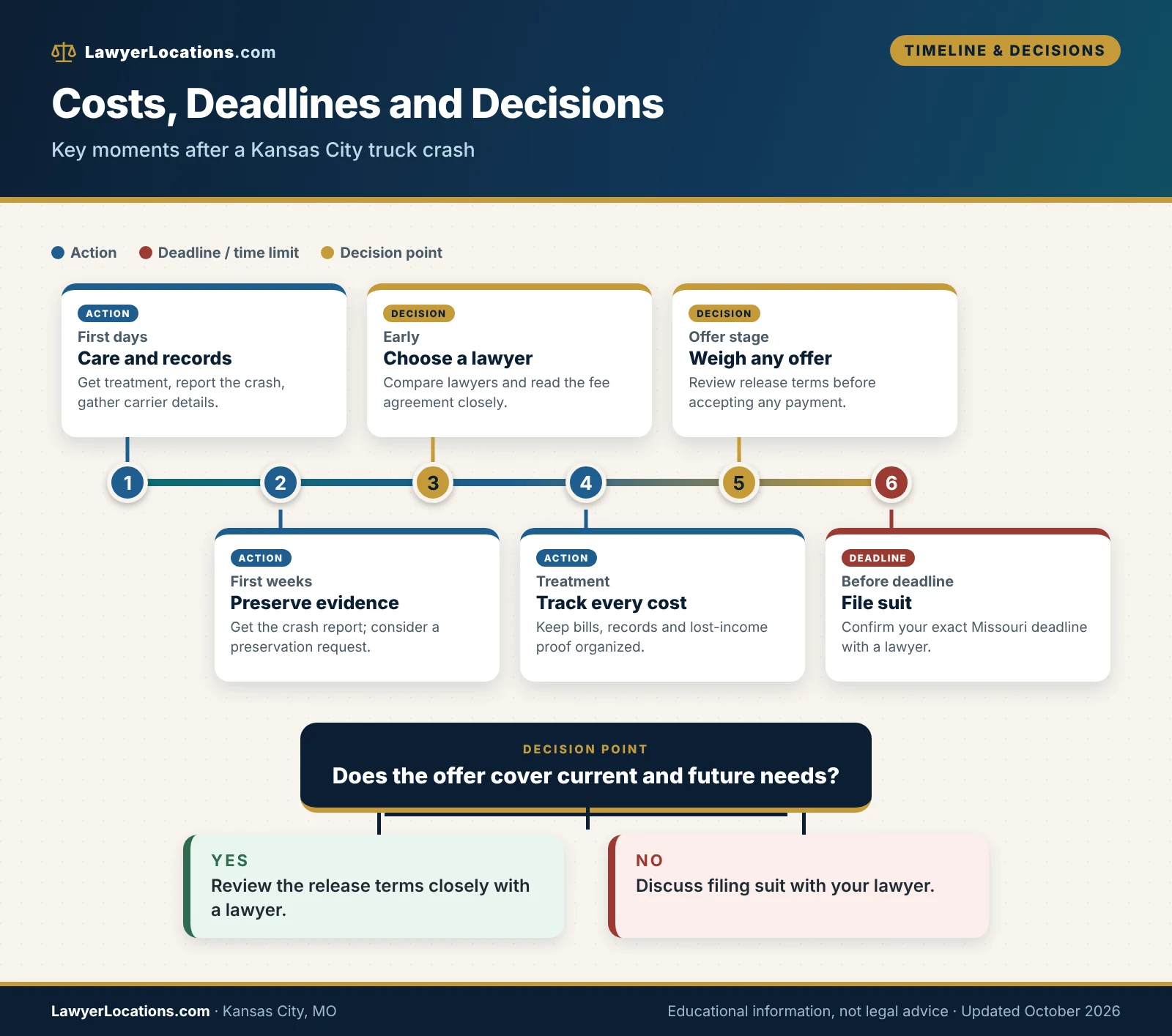
Text version of this graphic
- First days (action): Get care, report the crash, and gather scene and carrier details.
- First weeks (action): Obtain the crash report and consider a preservation request.
- During treatment (decision): Choose a lawyer; keep records and avoid detailed statements to insurers.
- When treatment stabilizes (decision): Decide whether to present a claim or evaluate an offer.
- Well before the deadline (deadline): File suit if the claim has not resolved; Missouri’s injury limit is generally five years and wrongful death three years.
- After filing (action): Discovery, mediation and settlement talks, with trial if needed.
Decision point: Is the offer enough to cover your current and future needs? If yes, review the release terms closely. If not, discuss filing suit with your lawyer.
Money: what to expect and what to ask
Costs you may face
Contingent-fee representation means you generally do not pay attorney fees out of pocket, but case expenses can be significant and are handled in the way your agreement says. Your own medical bills continue regardless, and health insurers, hospitals or government programs may claim reimbursement from a recovery.
Because each of these varies by situation, we do not publish dollar estimates. Ask for a written explanation of every expected cost, including who pays for experts and how liens are negotiated.
Understanding settlement offers
An early offer may look attractive when bills are mounting, but it often arrives before the full extent of your injuries is known. Accepting a settlement usually means signing a release, which ends your right to pursue more from that party for the same crash.
Read any release closely before you sign it. Ask a lawyer to review what you would be giving up, particularly if there are multiple parties, such as the driver, the carrier and others.
Imagine a driver on a Kansas City interstate is hit by a tractor-trailer and has surgery. An adjuster offers a payment in the first month, before the surgeon has said how recovery will go. The driver asks for the offer in writing, gets a short consultation with a lawyer, and learns that the release would also cover future care. The driver decides to wait until treatment has progressed. The point is not the amount; it is that the choice was made with information.
Deadlines and how they interact
The statutory clocks
Missouri’s general injury limit is five years under RSMo 516.120, and the wrongful death limit is three years under RSMo 537.100. The latter statute also provides that if service is made after the limitation period has run, it must occur within 180 days of filing or the court must dismiss as to that defendant. Filing a petition is only the first step; the defendant must also be served.
The wrongful death statute also contains a limited tolling rule when a defendant is absent from Missouri so that personal service cannot be made, and a one-year refiling window after certain nonsuits or reversed judgments. These are technical exceptions that should be reviewed by a lawyer rather than relied on.
Why earlier is usually better
Even with years remaining, delay costs you. Witnesses move, video is erased, and trucking records can reach the end of their retention periods. A lawyer also needs time to investigate before filing, particularly in a case with more than one defendant.
If a case may need to be filed in federal court or involves a government entity, deadlines and notice rules may differ. Do not wait until the final year to start the conversation.
| Stage | Decision | What to weigh |
|---|---|---|
| Right after the crash | Whether to speak with the trucking company’s insurer | You can decline a recorded statement until you have more information. |
| First weeks | Whether to consult a lawyer | Evidence preservation and fee terms; compare at least two lawyers. |
| During treatment | How to document injuries and costs | Consistent treatment, complete records and a daily symptom log. |
| After treatment stabilizes | Whether to accept or counter an offer | Future care, lost income, liens and the release terms. |
| Before the deadline | Whether to file suit | Venue under RSMo 508.010, service deadlines and cost. |
| After filing | Mediation or trial | Risk, timing and the strength of the evidence. |
Mistakes, Red Flags and Next Steps
Most avoidable problems in truck injury claims come from rushed communication, thin documentation, and hiring decisions made under pressure. A calm, organized approach protects your options without committing you to anything. This final section covers common mistakes, red flags in lawyer marketing, a preparation checklist and the questions people commonly ask.
Common mistakes after a truck crash
Statements and social media
Giving a recorded statement to the other side’s insurer before you understand your injuries is a frequent misstep. Casual comments such as “I’m fine” at the scene can later be quoted back. Be polite, be factual, and say you will provide more information after you have been evaluated.
Posting about the crash, your activities or your recovery online can also be misread. Keep your accounts private if you can and avoid discussing the case in public posts or messages.
- Giving a recorded statement before you know the extent of your injuries.
- Signing a medical authorization or release without understanding its scope.
- Posting photos or comments about the crash or your recovery.
- Letting the truck, your vehicle or key evidence be repaired or discarded without thought.
Treatment gaps and missing paperwork
Skipping appointments, stopping therapy early or failing to mention symptoms can give an insurer an argument that your injuries are less serious than you say. If you cannot attend a visit, reschedule and note the reason. If a provider releases you, ask that the records reflect your condition.
Disorganized paperwork can slow the case. Keep a single record of crash details, claim numbers, bills, lost-income documentation and the names of everyone you speak with.
Red flags in lawyer marketing
Promises and pressure
No lawyer can honestly promise a particular result, and a promise of an assured outcome should make you cautious. High-pressure tactics, such as insisting that you sign immediately, are another warning sign, especially while you are in a hospital or still in shock.
Under the rules of professional conduct, a lawyer must communicate clearly about fees and the scope of the work. If someone is vague about the fee agreement, that vagueness is itself useful information.
Claims you cannot verify
Be wary of marketing that cites vague “top” rankings, unexplained awards or unverifiable results. Instead, look at what the lawyer can show you: Missouri licensure, a clear written fee agreement, and straightforward answers about how your case would be handled.
- Promised results or a promised dollar value for your case.
- Pressure to sign before you have read or understood the agreement.
- Vague or verbal-only fee terms.
- No clear answer about who will handle your file.
Preparing for a consultation
Documents to bring
Walking into a first meeting with the basics lets the lawyer give you a more useful evaluation. You do not need everything, and you should not delay a consultation to collect it all, but the items below help.
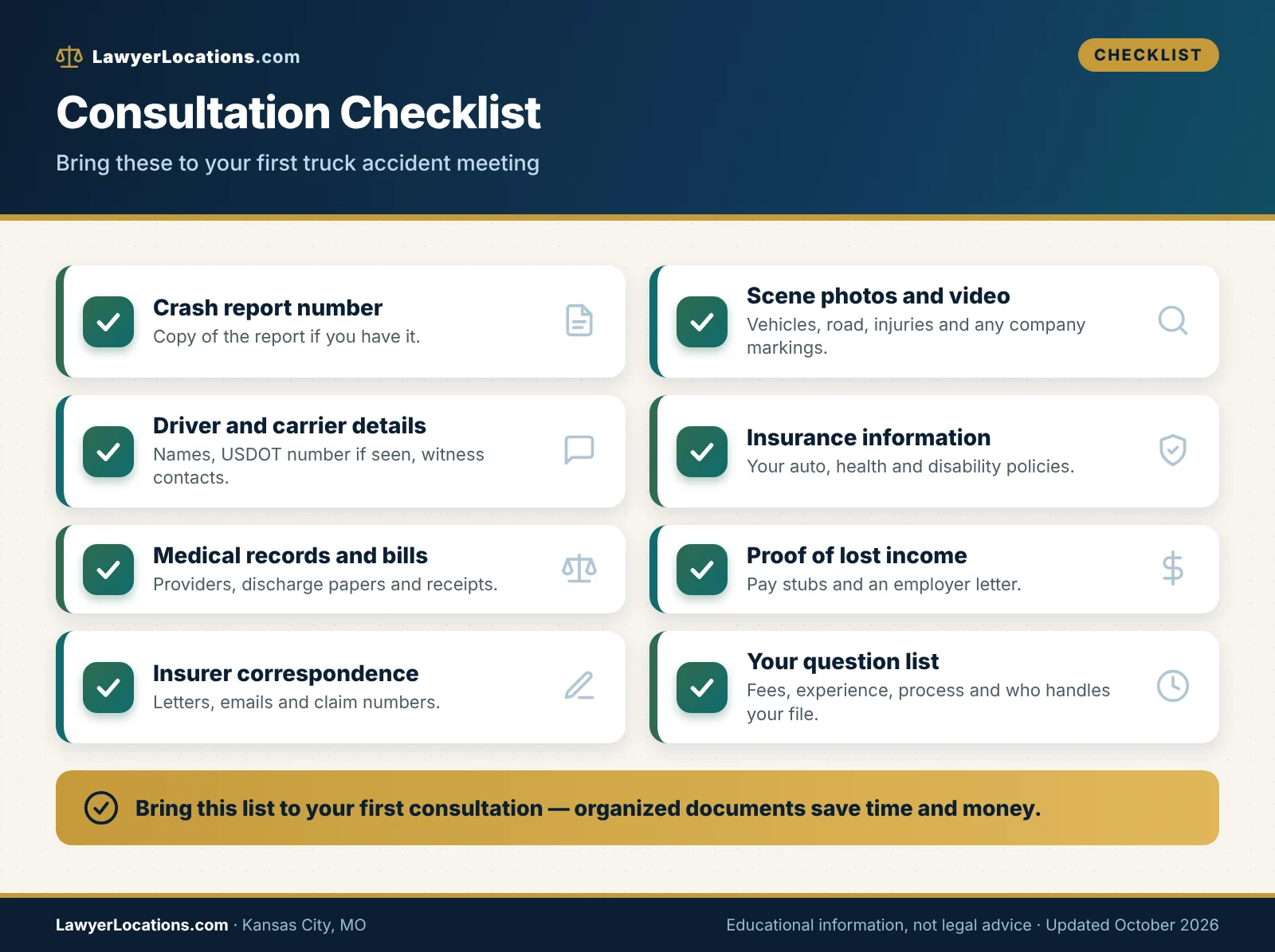
Text version of this graphic
- Crash report number or copy of the report
- Photos and videos of the scene, vehicles and injuries
- Names and contact details of the truck driver, carrier and witnesses
- Your insurance policy and any claim numbers
- Medical records, bills and a list of providers
- Proof of missed work and lost income
- Any letters, emails or messages from insurers
- A list of questions about fees, experience and process
- The crash report number or a copy of the report.
- Photographs and videos of the scene, the vehicles and your injuries.
- The truck’s company name, USDOT number if you saw it, and the driver’s details.
- Your own auto, health and disability insurance information.
- Medical records and bills, and the names of every provider.
- Proof of missed work, including pay stubs and employer letters.
- Every letter, email or message from any insurance company.
Questions to ask and what to listen for
Use the scorecard and the fee table earlier in this guide as your script. Listen for plain explanations, specific answers about how the firm approaches truck cases, and a willingness to put terms in writing. Take notes and compare more than one lawyer before you decide.
You are not obligated to hire anyone after a consultation, and reading this page does not create an attorney-client relationship. A consultation is simply a chance to see whether a lawyer’s approach fits your situation. For a quick refresher on the car-versus-truck distinction, see our guide on rear-end accident lawyers, since many large-truck collisions involve rear impacts.
Quick answers to common questions
Questions about your claim
How long do I have to file a truck accident lawsuit in Missouri?
For most injury claims, Missouri’s general statute, RSMo 516.120, sets a five-year limit. For wrongful death, RSMo 537.100 sets a three-year limit. Confirm your own deadline with a Missouri lawyer, because special situations can change the analysis.
What if I was partly at fault for the crash?
Missouri applies pure comparative fault in ordinary negligence cases, so your damages are reduced by your share of fault rather than eliminated. The percentage is decided by agreement or by a jury, so documentation of what happened matters.
Can I sue the trucking company as well as the driver?
Often the motor carrier and others can be involved, depending on the facts, such as who employed or controlled the driver and who maintained the truck. A lawyer evaluates this by reviewing the records, which is one reason early preservation matters.
How much insurance does a commercial truck have to carry?
Federal rules in 49 CFR 387.9 set a minimum of $750,000 for most for-hire interstate carriers moving non-hazardous freight in vehicles of 10,001 pounds or more, with higher minimums for certain hazardous cargo. The minimum is not a cap on what a case may be worth.
Where do I get the crash report?
If the Missouri State Highway Patrol investigated, it provides basic reports for $6.00 each through its records request process, and asks you to wait 10 days after the crash investigation before requesting. If a city or county agency responded, ask that agency.
Do I have to pay a lawyer up front?
Personal injury lawyers commonly use contingent fees, where the fee comes out of a recovery. Missouri Rule 4-1.5(c) requires a contingent fee agreement to be in a signed writing that explains the percentage and how expenses are handled, so read it before you sign.
What if the crash happened on the Kansas side?
Then Kansas law and courts are likely to be involved, with their own deadlines and rules. Speak with a lawyer licensed in Kansas about that claim.
Questions about cost and process
Can free legal aid handle a truck injury lawsuit?
Legal Aid of Western Missouri serves low-income residents of the Kansas City area but states that it does not handle personal injury lawsuits. It may help with related civil needs, so ask what it can do.
Will my case go to trial?
Many cases resolve before trial through negotiation or mediation, but you should choose a lawyer who is prepared to file and try a case if necessary. A lawyer cannot predict which path your case will take.
Should I accept the first settlement offer?
Not before you understand your injuries, your future care and what the release covers. Ask for any offer in writing and have a lawyer review it before you sign.
Which Kansas City court will hear my case?
For a crash in Jackson County, the 16th Judicial Circuit operates courthouses in downtown Kansas City and in Independence, and venue is controlled by RSMo 508.010. A lawyer can tell you which county and courthouse apply to your facts.
Your next steps
A simple action plan
- Protect your health. Follow medical advice and keep every record.
- Secure the basics. Note the crash report number, the carrier name and the driver details.
- Pause on statements. Decline recorded statements until you understand your injuries.
- Compare two or three lawyers. Use the scorecard and ask for the fee terms in writing.
- Track the deadlines. Ask your lawyer to confirm the exact dates that apply to your claim.
Finding the right fit
If you are comparing options for a truck accident lawyer in Kansas City, MO, take your time, ask for everything in writing, and choose someone whose explanations you understand. The right lawyer for you is the one who is licensed in the right state, experienced with the kind of case you have, and clear about fees.
Ready to compare your options?
Use the checklist and scorecard in this guide to prepare, then speak with more than one Missouri-licensed lawyer. For a broader look at timing and the claims process, read our guide on how long you have to file a personal injury claim.
General information only. This guide is legal information, not legal advice, and reading it does not create an attorney-client relationship. LawyerLocations.com is not a law firm and does not recommend or rank individual lawyers. Laws, court rules, fees and agency procedures change, and your situation may differ. Consult a lawyer licensed in the relevant jurisdiction before making decisions about a claim.
Sources & References
Show all 16 sources
- Missouri Revised Statutes, Section 516.120 (five-year limitation) — Missouri Revisor of Statutes — revisor.mo.gov — accessed October 2026
- Missouri Revised Statutes, Section 537.100 (wrongful death limitation) — Missouri Revisor of Statutes — revisor.mo.gov — accessed October 2026
- Missouri Revised Statutes, Section 537.080 (who may sue for wrongful death) — Missouri Revisor of Statutes — revisor.mo.gov — accessed October 2026
- Missouri Revised Statutes, Section 537.765 (comparative fault, products liability) — Missouri Revisor of Statutes — revisor.mo.gov — accessed October 2026
- Missouri Revised Statutes, Section 508.010 (venue) — Missouri Revisor of Statutes — revisor.mo.gov — accessed October 2026
- Missouri Revised Statutes, Section 490.715 (evidence of medical expenses) — Missouri Revisor of Statutes — revisor.mo.gov — accessed October 2026
- 49 CFR 387.9, Financial responsibility, minimum levels — Electronic Code of Federal Regulations — ecfr.gov — accessed October 2026
- 49 CFR 395.3, Maximum driving time for property-carrying vehicles — Electronic Code of Federal Regulations — ecfr.gov — accessed October 2026
- 49 CFR Part 379, Appendix A, Schedule of retention periods — Electronic Code of Federal Regulations — ecfr.gov — accessed October 2026
- About the Court, 16th Judicial Circuit of Missouri (Jackson County) — 16th Judicial Circuit Court — 16thcircuit.org — accessed October 2026
- 16th Judicial Circuit (Jackson County) — Missouri Courts — courts.mo.gov — accessed October 2026
- Request a Traffic Crash Report — Missouri State Highway Patrol — apps.mshp.dps.mo.gov — accessed October 2026
- Public Resources (KC Lawyer Finder) — Kansas City Metropolitan Bar Association — kcmba.imiscloud.com — accessed October 2026
- General Legal Aid Brochure — Legal Aid of Western Missouri — lawmo.org — accessed October 2026
- Missouri Rule of Professional Conduct 4-1.5, Fees — Missouri Supreme Court Rules (text as reproduced by CourtRules.net) — courtrules.net — accessed October 2026
- Missouri Supreme Court establishes comprehensive comparative fault system (Gustafson v. Benda commentary) — Casemine — casemine.com — accessed October 2026
Legal Disclaimer and Limitation of Liability
Informational and illustrative purposes only. This article was prepared by LawyerLocations.com solely on the basis of the information available to us at the time of writing. It is an illustrative, general overview. It is not a complete or authoritative statement of the law, and it has not been reviewed by a lawyer licensed in your state or county.
Not legal advice. Nothing in this article is legal, financial, tax or immigration advice, and reading it does not create an attorney-client relationship between you and LawyerLocations.com or any author, lawyer or firm mentioned. Laws, court rules, fees, filing deadlines and agency procedures differ by state, county and court, and they change often. Some details here may be simplified, incomplete or out of date, and time limits for legal claims can be short.
No warranty. We make no representation or warranty, express or implied, about the accuracy, completeness, timeliness or suitability of this content for your situation. Please do not rely on it to make, delay or skip any legal decision. Check the facts against official sources and speak with a licensed attorney in the relevant jurisdiction before you act.
Limitation of liability. To the fullest extent permitted by law, LawyerLocations.com and its owners, authors and contributors disclaim all liability for any loss, damage, cost or other consequence arising from the use of, or reliance on, this article, including any content on third-party websites we link to. Mentioning a lawyer, firm, organization or service is not an endorsement and is not a promise of any result. If you are in immediate danger, contact your local emergency number.