
If you are searching for a “personal injury lawyer new york city ny,” the short version is this: New York City cases run on state law, five separate county courts, and a handful of very short deadlines that depend on who caused the injury. A claim against a private driver or business generally has 3 years, but a claim against the City or the Transit Authority starts with a sworn notice due in 90 days. Most injury lawyers work on a contingency fee, and New York’s court rules set the fee schedules.
This guide explains how a case moves, which New York rules matter after the 2026 changes, where claims are filed, how fees are regulated, and how to compare lawyers fairly. It is general information, not advice about your injury.
How a Personal Injury Case Works in New York City
A personal injury case is a claim for money after someone else’s carelessness hurt you. In New York City that usually means proving four things: someone owed you a duty of care, they failed to meet it, the failure caused your injury, and you suffered real losses such as medical bills, lost income and pain. What changes from case to case is the other side. A private driver, a landlord, a construction contractor, a hospital and the City itself all follow different rules, and the rules decide your deadline before they decide anything else.
The sections below follow the order most claims take. If you are mainly comparing lawyers, you can jump ahead to the comparison section, but reading the deadlines first will tell you how urgent your search really is.
The path from injury to resolution
Almost every claim moves through the same stages, even though the pace varies enormously. Simple claims with clear fault and a full recovery can resolve in months. Cases involving surgery, disputed fault or a government defendant often take years, because New York’s courts in the five boroughs handle a very large civil caseload.
Treatment, notice and evidence in the first weeks
The first weeks are about your health and your paper trail. Get medical care promptly and keep every discharge sheet, prescription and bill. If police came to the scene, write down the officer’s name, the precinct and any report number. If a city agency, a city bus, a public hospital or a public road may be involved, note that fact on day one, because a short written-notice deadline may already be running.
Evidence is perishable in a dense city. Surveillance video is often overwritten within days or weeks, a wet floor gets mopped, and a cracked sidewalk gets patched. Photograph the scene with a landmark in frame, save names and phone numbers of witnesses, and keep damaged clothing or equipment exactly as it is.
Claims, investigation and negotiation
Once a lawyer is hired, the work usually begins with preservation letters, records requests and a search for every insurance policy that could apply. Many injured people are surprised to learn that the property owner, a management company, a contractor and a vehicle owner can each carry separate coverage. The lawyer then presents a claim, and the insurer or the City’s claims office evaluates it.
Negotiation tends to follow treatment, not precede it. Insurers generally want to see where your recovery is heading before they put a real number on a claim, so a lawyer who tells you to settle in the first few weeks of a serious injury deserves a follow-up question.

Text version of this graphic
- Get medical care and keep every record.
- Report the incident and save photos, names and report numbers.
- Check whether a public body is involved and note the 90-day notice clock.
- Compare lawyers and sign a written fee agreement.
- Investigate, treat and document the injury.
- File the claim or lawsuit in the right court on time.
- Negotiate, mediate or try the case.
- Resolve the claim, repay any liens and close the file.
Who can be responsible, and why that sets your deadline
The identity of the responsible party is the single most important fact for timing. Two people injured on the same afternoon, one in a private lobby and one on a city sidewalk curb, can face deadlines that differ by more than two years. A good first conversation with any lawyer should therefore identify every possible defendant before anything else.
Private people, businesses and property owners
For private defendants, New York’s general negligence rules apply. That covers drivers, store owners, landlords, contractors, delivery companies and employers. The default time limit is three years under CPLR 214(5), with exceptions discussed in the law section. Commercial defendants often carry liability insurance with their own claims departments, and a lawyer’s early job is to find out who the carrier is and put it on notice.
In a crash case, the driver’s policy is only the start. Employers of delivery or for-hire drivers, vehicle owners and your own uninsured or underinsured motorist coverage may all matter. Our guide to uninsured motorist claims explains that last layer in plain terms.
Government bodies, transit and public hospitals
When the City of New York, the Transit Authority, a public school or another public body may share blame, a different system applies. These claims need a written, sworn notice of claim within 90 days, and the lawsuit itself generally must be filed within one year and 90 days. Public hospital systems and some other public benefit corporations have their own statutory notice rules too, so tell a lawyer early if your treatment or injury involved a public facility.
The 90-day notice clock runs from the date of the incident, not from the day you finish treatment or learn the full extent of the injury. If a city vehicle, a city street or a public building could be part of your story, ask a lawyer to check that question first.
What counts as a personal injury case in the city
The phrase covers a wide range of events. Lawyers who advertise as personal injury practitioners often concentrate in a few of them, which is why matching experience to your type of injury matters later in this guide.
Crashes, sidewalks and premises
Vehicle collisions involving cars, trucks, buses, taxis, bicycles and pedestrians are the most visible category. Falls on stairs, in lobbies, on icy or broken sidewalks and in stores are another large group, usually called premises liability. Dog bites, elevator incidents and falling objects belong here too. If your injury came from a motorcycle crash specifically, see our focused guide on a motorcycle accident lawyer in New York City, because riders face a separate no-fault problem.
Construction, work and medical care
New York City has constant construction, and falls from ladders and scaffolds are governed by a special statute covered below. Injuries on the job also raise workers’ compensation questions, which run through a separate system; our guide to a workers’ compensation attorney in New York City explains that process. Medical malpractice, which is injury caused by a health provider’s departure from accepted care, has its own filing clock, its own fee statute and its own procedural steps, so it is treated separately from ordinary negligence.
Negligence means failing to use reasonable care under the circumstances. It is the legal theory behind most injury claims, and it is why your lawyer will talk about “duty,” “breach” and “causation” instead of simply “fault.”
New York Law Every City Injury Claim Runs On
Three bodies of state law do most of the work: the Civil Practice Law and Rules (CPLR), which sets time limits and fault rules; Article 51 of the Insurance Law, the no-fault statute for auto accidents; and special statutes for government defendants, sidewalks and construction. These rules are state law, so they apply the same way in all five boroughs. What differs borough to borough is the courthouse, the county clerk and the local practice, covered in the next section.
Time limits that decide whether a case can be filed
New York uses a patchwork of deadlines. The table below collects the most common ones, and the sub-sections explain how they interact. A deadline is a legal cut-off, not a suggestion, and a claim filed one day late can be dismissed no matter how serious the injury.
The general three-year rule
Under CPLR 214(5), an action to recover damages for personal injury must generally be started within three years of the injury, except for the situations carved out in sections 214-b, 214-c, 214-i and 215. Section 214-c is the exception most people encounter, because it deals with exposure to substances where harm shows up later. For a typical fall, crash or assault by a private party, three years is the starting assumption. Our national explainer on how long you have to file a personal injury claim compares New York’s approach with other states.
Special rules can pause or extend the clock for people under 18 or under certain disabilities, so a parent or guardian should not assume the three-year rule applies to a child’s claim without asking a lawyer.
Shorter clocks: malpractice, wrongful death and public defendants
Medical, dental and podiatric malpractice claims must generally be brought within 2 years and 6 months of the act or omission under CPLR 214-a. If treatment for the same condition continued, the clock can run from the last treatment, and a separate discovery rule exists for a foreign object left in the body, where the action may be brought within one year of discovery. Wrongful death actions must generally be started within 2 years of the death under EPTL 5-4.1, brought by the estate’s personal representative, with an extension in some cases where a criminal case is brought over the same event.
Claims against New York City and similar bodies follow General Municipal Law sections 50-e and 50-i: written, sworn notice within 90 days, and a lawsuit within one year and 90 days, after waiting at least 30 days following the notice. For deaths, the 90 days run from the appointment of the estate’s representative, and the lawsuit must be started within two years of death.
| Situation | Deadline | Source rule |
|---|---|---|
| Injury caused by a private person or company | Three years | CPLR 214(5) |
| Medical, dental or podiatric malpractice | Two years and six months, with continuous-treatment and foreign-object rules | CPLR 214-a |
| Wrongful death | Two years from death | EPTL 5-4.1 |
| Notice of claim, City or other local public body | 90 days after the claim arises | General Municipal Law 50-e |
| Lawsuit against the City or similar local body | One year and 90 days, after waiting at least 30 days from notice | General Municipal Law 50-i |
| Negligence claim against the State of New York | Claim and service within 90 days, or two years if a notice of intention is timely served | Court of Claims Act 10 |
A lawyer or website that gives you one deadline for “New York injury cases” without asking who the defendant is has skipped the most important question. Three years, 90 days and one year and 90 days can all be correct in the same city for different claims.
Fault, serious injury and the 2026 changes
New York changed key rules for motor vehicle injury lawsuits in 2026, and older web articles often describe the earlier law. The changes matter most to car, truck, bus and similar crash cases, and much less to falls, construction injuries or malpractice.
Pure comparative fault and the new 1411(b) bar
For decades, New York has used pure comparative fault: if you share blame for your own injury, your damages are reduced by your percentage instead of being wiped out. Under CPLR 1411(a), a claimant’s own culpable conduct does not bar recovery in a personal injury, property damage or wrongful death action; damages are reduced in proportion to that share. A person found 20 percent at fault for a $100,000 verdict would, under the formula, receive $80,000. That arithmetic is only an illustration of the rule.
The state’s 2026 budget legislation added subdivision (b). In an action for personal injury subject to article 51 of the Insurance Law, the claimant’s culpable conduct now bars recovery if it is greater than the defendant’s, or greater than the combined conduct of multiple defendants. In plain English, being found more than half responsible can end a motor vehicle injury claim. The New York State Department of Financial Services states that these changes apply to actions commenced on or after May 26, 2026, so the filing date, not the crash date, is the trigger.
The serious injury threshold and the fault-first sequence
For auto accidents between people covered by no-fault, Insurance Law 5104(a) bars a lawsuit for pain and suffering unless the injury meets the statutory definition of “serious injury” in section 5102(d). The 2026 amendments removed the category that covered a non-permanent injury preventing substantially all usual activities for 90 of the first 180 days, and they require the fact-finder to decide fault before reaching serious injury or non-economic loss. A new section 5104(d) caps non-economic damages at $100,000 for certain claimants, such as drivers of uninsured vehicles they were responsible for insuring, drivers convicted of impaired driving, and drivers convicted of a felony committed while driving, with an exception where the injury caused death.
These 2026 rules are tied to Article 51 of the Insurance Law, which is the auto no-fault statute. A slip on a wet lobby floor or a fall from a scaffold does not become an Article 51 case, and subdivision (a) of CPLR 1411 remains the fault rule for those claims. Ask any lawyer you interview which version of the fault rule they expect to apply to you, and why.
If you were hurt in a car crash, our guides on what to do after a car accident and whether you need a lawyer after a car accident walk through the practical steps in more detail.
Property and workplace rules that are especially important in New York City
Two statutes shape a large share of city injury cases because the city has so many buildings, sidewalks and construction sites.
Sidewalk responsibility under Administrative Code 7-210
New York City’s Administrative Code 7-210 makes the owner of real property abutting a sidewalk responsible for keeping it reasonably safe and liable for personal injury, including death, caused by a failure to maintain it. The law carves out one-, two- or three-family residential property, which applies where the property is owner-occupied in whole or part and used exclusively for residential purposes. Courts reviewing the law have explained that it does not impose absolute liability: an injured person must still prove duty, breach and injury, usually including that the owner created the condition or had notice of it.
The practical result is that a fall on a commercial or large-building sidewalk usually points to the abutting owner, not the City, which changes both the notice deadline and the insurance carrier. Photographs showing the exact location, the abutting address and the defect, taken as soon as you safely can, are valuable.
Construction falls and Labor Law 240(1)
New York’s Labor Law 240(1), often called the scaffold law, requires contractors, owners and their agents to furnish or erect scaffolding, hoists, ladders, slings, hangers, ropes and similar devices that give proper protection to workers engaged in erecting, demolishing, repairing, altering, painting, cleaning or pointing a building or structure. Owners of one- and two-family homes are excluded where they hire someone but do not direct or control the work.
A worker hurt in a fall may have both a workers’ compensation claim and a separate lawsuit against a third party, such as the owner or general contractor. These cases are specialized, so ask whether the lawyer regularly handles construction injuries, not just street-level crashes.
Bring up every setting where you were hurt, even if it seems minor. A delivery driver injured on a loading dock, a tradesperson hurt on a site and a pedestrian hit near a work zone each raise different statutes, and the lawyer cannot analyze what you do not mention.
Courts, Claims Offices and Agencies in the Five Boroughs
New York City is five counties, and each has its own Supreme Court courthouse and County Clerk. Which office handles your paperwork depends on who you are suing and where the case is properly filed. This section is the local nuts and bolts: the courts, the electronic filing system, the City Comptroller’s claims process and the State’s Court of Claims.
Where lawsuits are filed in the five boroughs
Personal injury lawsuits for meaningful sums are usually filed in the Supreme Court, which in New York is the main trial-level court despite its name. Smaller money claims can go to the New York City Civil Court, but a serious injury claim rarely belongs there.
Supreme Court in each county
The five counties are New York (Manhattan), Kings (Brooklyn), Queens, Bronx and Richmond (Staten Island). The state courts’ page for New York County Supreme Court, Civil Term, lists the main courthouse at 60 Centre Street, with the County Clerk’s main office in Room 161 of that building. The Kings County Supreme Court, Civil Term, is at 360 Adams Street in Brooklyn according to the court’s own page, which also lists a Help Center in Room 123 for people without a lawyer. For Queens, the Bronx and Richmond County, confirm the current civil courthouse address on the New York State Unified Court System website, because locations and part assignments change.
Manhattan and Bronx cases appeal to the Appellate Division, First Department. Brooklyn, Queens and Staten Island cases appeal to the Second Department. That split matters later for fee rules and for the lawyer’s grievance committee, discussed in the comparison section.
Which county is proper and why it matters
New York’s venue rules decide which counties can hear a given case, and a lawyer will often choose among proper counties. The choice can affect how quickly a case reaches trial, how the court’s calendar operates and what the local jury pool looks like. Do not assume that the borough where you were hurt is the only possible venue, and do not pick a county yourself without advice. If you live in one borough, were hurt in another and the defendant is based in a third, ask the lawyer to explain the options in plain terms.
Filing basics: e-filing, courts and fees
Most new civil cases in the state courts are started and handled electronically, and a few fixed court charges apply as the case moves toward trial. These are separate from any lawyer’s fee.
NYSCEF electronic filing
The New York County Supreme Court page states that most new civil cases must be commenced and pursued electronically through the New York State Courts Electronic Filing System, known as NYSCEF, with listed exceptions such as matrimonial matters. People who represent themselves may choose to file on paper. In practice your lawyer files and monitors the docket, and you can ask for periodic updates and copies of important papers.
Court fees to start and move a case
The state courts’ fee page lists the Supreme Court civil charges below. A contingency-fee lawyer commonly advances these as case expenses that are repaid from a recovery under the retainer agreement, so read that part of the agreement closely.
| Step | Fee | What it does |
|---|---|---|
| Index number | $210 | Opens the case and assigns the number used on every filing. |
| Request for Judicial Intervention (RJI) | $95 | Asks the court to assign a judge once something needs a judge’s attention. |
| Note of Issue | $30 (listed as $125 where no RJI is required) | Tells the court the case is ready for the trial calendar. |
| Jury demand | $65 | Requests a jury trial rather than a judge-only trial. |
The Civil Court limit is also worth knowing. The state courts describe the New York City Civil Court as able to decide civil cases where money only, in the amount of $50,000 or less, is at stake, while Supreme Court can decide all civil matters. A claim involving surgery, lasting impairment or lost earning capacity is often discussed as a Supreme Court case, but your lawyer should explain why a particular court was chosen.
Claims against the City of New York
If the City, its vehicles, its streets or its employees may share responsibility, a separate pre-suit process applies. It is run through the Office of the New York City Comptroller, and it is strict about timing.
The notice of claim and the eClaim system
Under General Municipal Law 50-e, a notice of claim must generally be served within 90 days after the claim arises. It must be in writing and sworn, and it must state the claimant’s name and address, the nature of the claim, when, where and how it arose, and the injuries claimed so far as practicable. The Comptroller’s office tells the public to file the notice within 90 days of the incident using its online claim form, called eClaim, and states that notices of claim cannot be filed by email. The office lists a technical help line for eClaim problems, (212) 669-4118, during business hours.
A claims examiner may ask for photographs, medical records, bills and insurance information, and may require you to give testimony at a hearing. Those requests are routine, and an unprepared answer can hurt a claim, so many people bring in a lawyer once the process starts.
The Comptroller’s settlement authority and the lawsuit clock
The Comptroller investigates whether the City is legally liable and what the claim is fairly worth. If the City is responsible, it may offer a settlement, and the Comptroller’s page says the claimant has 30 days to sign and return the release to accept. The office can also decline, or the investigation can be inconclusive. Importantly, the Comptroller cannot settle a claim after one year and 90 days have passed or after a lawsuit has been filed.
Under General Municipal Law 50-i, a lawsuit against a city, county, town, village, fire district or school district must be started within one year and ninety days after the event, and at least 30 days must have passed since the notice of claim was served. The Comptroller’s page states that you do not need a lawyer to settle a claim with the City, but a claim with serious injuries, a disputed cause or a possible private co-defendant is a different matter.
Late notice is sometimes excused, but only in a court’s discretion. Section 50-e(5) lets a court extend the time to serve a notice, considering factors such as whether the public body learned the essential facts within the deadline or a reasonable time after, but the extension cannot go beyond the time allowed to start the lawsuit. Do not plan around an extension.
Claims against the State and other public authorities
Not every public body is “the City.” State agencies, state-run colleges and certain authorities follow different statutes, and mixing them up is a classic way for a claim to fail.
The Court of Claims for state defendants
Claims against the State of New York are heard in the Court of Claims, which does not hear suits against counties, towns, cities or villages. Under Court of Claims Act 10, a negligence claim must be filed and served on the Attorney General within 90 days after accrual. If a written notice of intention is served on the Attorney General within that 90 days, the claim may instead be filed and served within two years of accrual. The Act also allows a late-claim motion in the court’s discretion, considering factors such as whether the delay was excusable, whether the State had notice of the essential facts and whether the claim appears meritorious.
Authorities, transit and hospital systems
The Transit Authority, the Metropolitan Transportation Authority’s other agencies and the City’s public hospital system are public bodies with their own enabling statutes, and the correct notice rules can differ. The New York City Transit Authority, for example, is subject under Public Authorities Law 1212 to a notice-of-claim requirement tied to section 50-e and, for general tort actions, a one-year-and-90-day limit, while a separate subdivision on negligence in operating vehicles states a one-year period measured from accrual. That overlap is exactly why a single remembered number is risky. The safest approach is to ask the lawyer to identify, in writing, which entity is the defendant and which statute sets its deadline.
Write down the exact vehicle number, bus line, route, hospital unit or agency name as soon as you can. “A city bus” is not specific enough to decide which notice rule applies; the fleet number or depot usually is.
How to Compare Personal Injury Lawyers in New York City
Advertising does not tell you which New York City personal injury lawyer fits your situation, and no directory, including this one, can rank lawyers for you. A fair comparison uses the same questions for every candidate, starting with whether the person is actually licensed and ending with how the fee works. Plan on speaking with at least two or three lawyers if your injury is serious.
LawyerLocations.com is a legal-education and lawyer-discovery resource, not a law firm and not a referral service. We do not rank, rate or recommend individual lawyers, and reading this page does not create an attorney-client relationship.
Finding a personal injury lawyer in New York City, NY: credentials first
Two checks come before anything about style, reputation or advertising: license status and relevant experience. Both can be done in an afternoon.
Verify registration and discipline history
The state courts’ guidance on researching an attorney points to the Unified Court System’s Attorney Search, which shows a lawyer’s registered office, date of admission and law school, and which Appellate Division certified the lawyer. The same guidance says that to learn about good standing and disciplinary records you should contact the Grievance Committee for the Appellate Division that certified the lawyer, and it also suggests searching the lawyer’s name in the eCourts system, with the caveat that results may be incomplete because not every court is e-filed.
If a lawyer’s name does not appear, or the registration status looks unusual, ask the lawyer directly and consider choosing someone else. A nonresponsive answer to a basic licensing question is its own answer.
Match experience to your type of injury
Ask how often the lawyer handles your kind of case: crashes, premises falls, construction injuries, public-entity claims or medical malpractice. A lawyer who regularly tries sidewalk cases may not be the right fit for a hospital error, and the reverse is equally true. Ask whether the lawyer who will actually work on your file is the one you are meeting, and whether other lawyers or paralegals will handle day-to-day tasks.
Be wary of any lawyer who promises a result. No honest lawyer can know the outcome before reviewing records, and a good one explains risks as well as strengths. If your injury involves a wrongful death, our guide to wrongful death lawyer costs explains how those fee arrangements are discussed.
Pressure to sign on the spot, a refusal to give you the fee agreement to take home, or a promised outcome are all reasons to pause. Never sign anything at a hospital bedside because someone said the offer expires today.
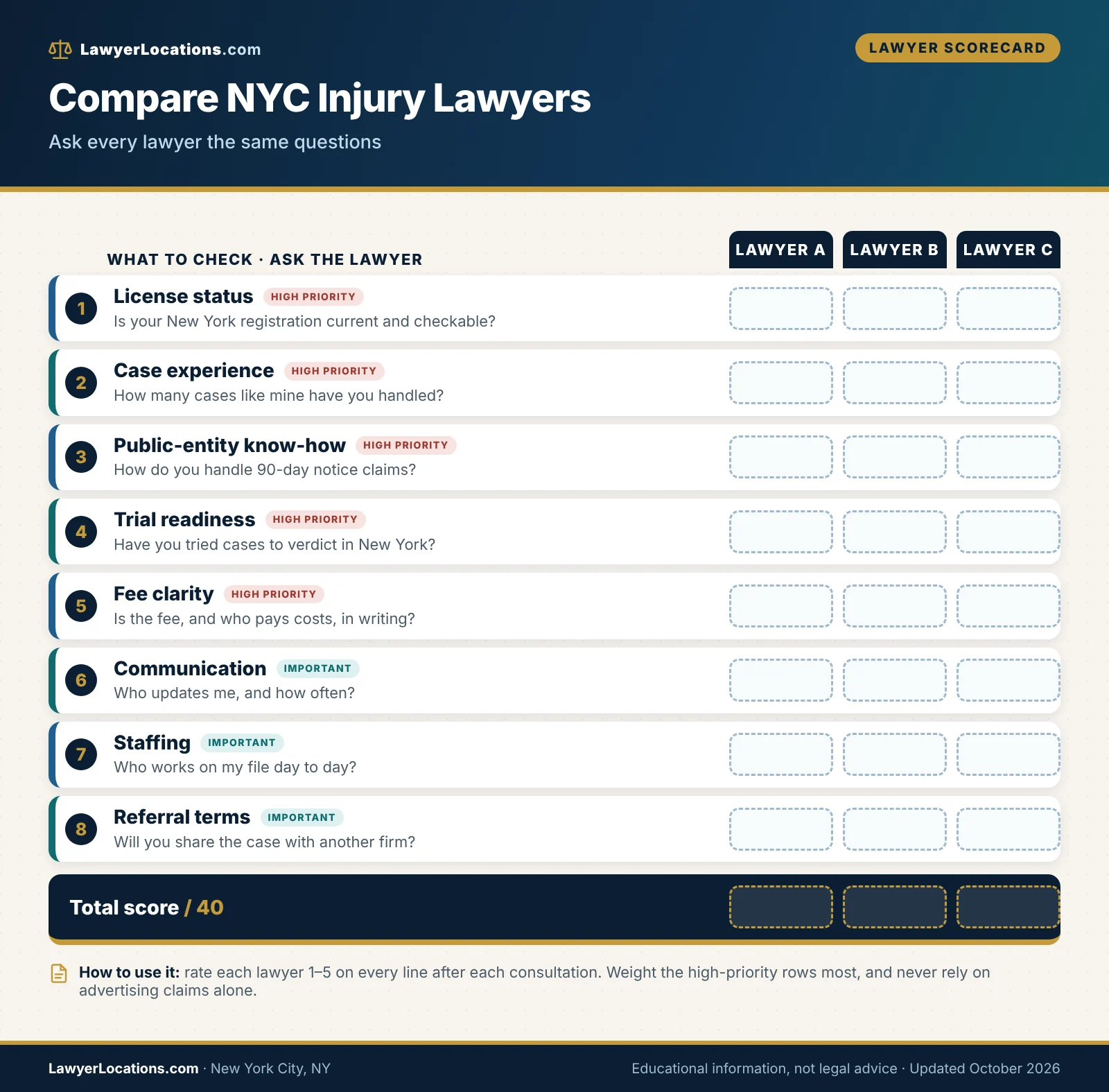
Text version of this graphic
| Criterion | Question to ask | Weight |
|---|---|---|
| License status | Is your New York registration current and checkable? | High |
| Case experience | How many cases like mine have you handled? | High |
| Public-entity know-how | How do you handle 90-day notice claims? | High |
| Trial readiness | Have you tried cases to verdict in New York? | High |
| Fee clarity | Is the fee, and who pays costs, in writing? | High |
| Communication | Who will update me, and how often? | Medium |
| Staffing | Who actually works on my file day to day? | Medium |
| Conflicts and referrals | Will you share the case with another firm? | Medium |
Referral services and what a directory can and cannot do
There are three common starting points: bar association referral programs, legal-aid and court help resources, and directories. Each does a different job.
Bar association referral services
The state courts’ “find a lawyer” page names two paid-consultation programs. The New York City Bar Legal Referral Service says it provides referrals to a screened and qualified lawyer, with an initial consultation of up to 30 minutes that costs $35 or is free depending on the type of case; its published phone line is 212-626-7373. The New York State Bar Association Lawyer Referral and Information Service says referred lawyers charge $35 or less for a 30-minute meeting, and that the meeting is free for certain problems, including personal injury and medical malpractice. Fees after the first meeting are arranged between you and the lawyer. Terms can change, so confirm them when you call.
The courts’ page also points to LawHelp for free legal aid providers, though many serve only low-income clients, and to courthouse volunteer programs that offer advice but do not appear in court for you. The state courts themselves do not recommend specific lawyers.
What a directory cannot tell you
Directories and review sites cannot know whether a lawyer is right for your facts. Use them to build a short list of names to check, then verify licenses and ask each lawyer the same questions. Reviews can be useful for communication and responsiveness, but they are weak evidence of legal skill, and they should never replace a license check.
- A lawyer whose online claims about “results” never mention that outcomes depend on the facts.
- A firm that assigns you to a different lawyer after you sign, with no explanation.
- A refusal to explain, in writing, who pays case expenses if you do not recover.
Preparing for a first consultation
A good consultation is a two-way interview. You are checking the lawyer’s fit as much as the lawyer is evaluating your claim, and preparation saves time and money.
Documents and facts to bring
Gather what you have, but do not delay a call because the file is incomplete. Lawyers can obtain records themselves once you sign authorizations.
- Photos and video of the scene, the injury and any property damage.
- The police report number, officer name and precinct, if any.
- Medical records, discharge papers, bills and the names of every provider.
- Insurance information for you and, if known, for the other party.
- Names and phone numbers of witnesses.
- Any letter, email or text from an insurer, the City, a landlord or an employer.
- A short timeline written while your memory is fresh.

Text version of this graphic
- Photos and video of the scene and injuries.
- Police report number and officer details.
- Medical records, bills and provider names.
- Your insurance cards and the other party’s information.
- Witness names and phone numbers.
- Letters or messages from insurers or public agencies.
- A written timeline of what happened.
- A list of questions about fees and staffing.
Questions to ask every lawyer
Use the same list each time so the answers can be compared side by side. Ask what the lawyer sees as the main risks in your case, which deadlines apply, who the likely defendants are, and what the next three steps would be. Ask how the fee is calculated, whether it is computed before or after expenses, who advances costs, and what happens if you change lawyers. Ask how often you will hear from the office and who your day-to-day contact will be.
End each meeting by asking for the proposed fee agreement in writing. A lawyer comfortable with the terms will usually send it without hesitation, and you can read it at home, compare it with another, and ask questions before signing.
Lawyer Fees, Case Costs and Payment Rules
Most New York injury lawyers are paid on a contingency basis: the fee is a percentage of the recovery, and there is generally no fee if there is no recovery. New York regulates these fees through court rules for ordinary injury cases and through a statute for medical malpractice. This section explains the rules that are verifiable from official sources and the questions that sit around them. Cost guides for specific case types, such as our wrongful death lawyer cost guide, show how the same ideas apply elsewhere.
Contingency fees in ordinary injury cases
“Contingency” means the fee depends on the result. It is not the same as “free,” because expenses and liens are separate questions, and it does not mean the lawyer takes every case: lawyers often decline claims with limited chances of recovery, modest damages or a defendant who cannot pay.
The Second Department schedule in Rule 691.20
The Appellate Division, Second Department, which covers Brooklyn, Queens and Staten Island, publishes its rule at 22 NYCRR 691.20. For personal injury and wrongful death claims other than medical, dental or podiatric malpractice, a fee at or below the rule’s schedule is deemed fair and reasonable, and a fee above it is treated as unreasonable and unconscionable unless a court authorizes it. The lawyer may use one of two approaches, shown below.
| Option | How the fee is set | Notes |
|---|---|---|
| Schedule A (sliding scale) | 50% of the first $1,000; 40% of the next $2,000; 35% of the next $22,000; 25% of any amount over $25,000 | Higher fees for extraordinary circumstances require a court order after notice to the client. |
| Schedule B (flat percentage) | Up to 33⅓% of the sum recovered, if the initial contract provides for it | The extraordinary-circumstances procedure does not apply when this option is chosen. |
| Calculation base | Percentage computed on the net sum recovered, after expert and investigative expenses properly chargeable to the claim | No deduction from the recovery is allowed for liens or claims of hospitals, providers, self-insurers or insurance carriers. |
Notice what the table implies. In a larger case, a flat one-third often produces a higher fee than the sliding scale, which is why lawyers frequently choose it, and why you should ask which option your lawyer proposes and why. In a small case the sliding scale’s higher early percentages can exceed one-third on the first dollars recovered. Neither choice is improper if it fits the rule; what matters is that you understand the number in dollars on a sample recovery.
Manhattan, the Bronx and the First Department
Manhattan and the Bronx fall under the Appellate Division, First Department, which has its own attorney-fee provisions. The NYC Bar’s public explanation of contingency fees describes the ordinary percentage as 33 percent, notes that fees can be lower and says the percentage is applied after fees and disbursements are deducted. Because the exact rule text and its citation differ by department, ask your lawyer to identify the controlling rule for your case, to state the percentage in the written agreement, and to show you a worked example using a sample settlement.
Suppose, purely as arithmetic, a case settles for $90,000 and $6,000 in properly chargeable expenses were advanced. If the fee is computed on the net sum after expenses at one-third, the base is $84,000 and the fee is $28,000, leaving the client $56,000 before any liens. If the same fee were wrongly computed on the gross figure, the fee would be $30,000. The $2,000 gap is why the question “before or after expenses?” belongs in every first meeting. This example is illustrative only and is not a prediction or an average.
Medical malpractice fee limits
Medical, dental and podiatric malpractice contingency fees follow a different, statutory schedule that is notably lower on large recoveries. If your injury involves a hospital, surgeon or other provider, expect a different fee conversation.
The Judiciary Law 474-a schedule
Judiciary Law 474-a says a contingent fee in these cases cannot exceed the schedule below, and the fee is computed on the net sum recovered after expenses and disbursements for expert testimony and investigative or other services. Taxed costs, including judgment interest, count as part of the recovery, and liens are not deducted. A justice may approve a higher amount in extraordinary circumstances, but not above the contract fee. Fees on claims for infants are governed by section 474 instead.
| Portion of the net sum recovered | Maximum rate |
|---|---|
| First $250,000 | 30% |
| Next $250,000 ($250,001 to $500,000) | 25% |
| Next $500,000 ($500,001 to $1,000,000) | 20% |
| Next $250,000 ($1,000,001 to $1,250,000) | 15% |
| Any amount over $1,250,000 | 10% |
Why malpractice costs more up front
The fee ceiling is only part of the picture. Malpractice cases usually require medical experts to review the records and support the claim, and those costs are the kind of expense the schedule recognizes as properly chargeable before the percentage is applied. Ask how the firm decides whether to advance expert costs, and at what point it would withdraw if a reviewer does not support the claim. For birth-related injuries, which often follow separate planning and expert steps, see our guide to a birth injury lawyer in New York.
Case expenses, liens and written agreements
The percentage is only one line of the economics. Expenses, liens and the paperwork around them decide what you actually keep.
Expenses, liens and what you take home
Case expenses include court fees, records charges, expert fees, deposition transcripts and investigator costs. The NYC Bar’s public explanation says the lawyer advances fees and disbursements such as expert witness fees and medical exam costs, and that if you recover, these are deducted before the lawyer’s percentage is taken; if you do not recover, your repayment obligation is whatever the retainer agreement says. That last clause is where agreements differ most, so read it slowly.
Liens are different from expenses. Health insurers, Medicare, Medicaid and others may have a right to repayment from your recovery. They reduce your net, not the lawyer’s fee base under the rules above. If medical bills are the main source of stress, our guide to handling medical bills after a car accident explains how bills, insurers and settlements interact.
The written agreement, closing statement and fee disputes
New York’s 22 NYCRR 1215.1 requires an attorney to provide a written letter of engagement before commencing the representation, or within a reasonable time thereafter, explaining the scope of services, the fees, expenses and billing practices, and, where applicable, that the client may have a right to arbitrate fee disputes under Part 137. A signed written retainer agreement covering the same matters can serve instead. Under the Second Department rule, a signed retainer statement must be filed with the Office of Court Administration within 30 days, and a closing statement is due within 15 days after the lawyer receives, retains or shares any sum.
If a fee dispute arises, the state courts’ Part 137 program offers informal arbitration for civil fee disputes, generally for amounts from $1,000 to $50,000 unless both sides agree otherwise. The program has exclusions, including fees already set by statute, rule or court order and disputes raising substantial claims of malpractice or misconduct, so ask the local arbitral body whether yours qualifies. Awards are final and binding unless a party files a court action within 30 days of the award being mailed.
You can ask a lawyer to explain every line of the fee agreement in plain language before you sign. A lawyer who is annoyed by that request is giving you useful information.
| Question | What a clear answer includes |
|---|---|
| What percentage will you charge, and why that option? | A stated percentage, the rule it fits under and a sample calculation in dollars. |
| Is the fee computed before or after expenses? | A direct answer in the agreement, consistent with the rule for your case type. |
| Who advances costs, and what if there is no recovery? | Plain language on whether you owe any expenses if the case is lost. |
| How are liens handled? | An explanation of who negotiates them and when you will see a net figure. |
| What happens if I change lawyers? | A description of how the first lawyer’s work will be valued, so you are not surprised later. |
Costs, Deadlines and Decision Points Over Time
An injury case is a long calendar with a few hard edges. This section lays those edges out in order, then covers the decisions that tend to shape what you receive and how long it takes.
The first 90 days: the notice window
The earliest deadline in New York is often the one most people never heard of. Whether it applies depends on the defendant, but the habits you build in these weeks help every kind of claim.
Days one through fourteen
Focus on treatment, evidence and identifying the parties. Report the incident to the property manager or police if appropriate, request a copy of any report, and photograph the area. Do not give a recorded statement to an insurer before you understand your rights, and be careful about statements that downplay pain. Book a first consultation within this window if the incident may involve a public body, because the clock is already running.
Days fifteen through ninety
If the City may be responsible, the sworn notice of claim must be served by day 90. A lawyer can prepare and file it through the Comptroller’s eClaim system in a short time, but only if you have contacted one in time. During these weeks continue treatment, keep a pain and activity log, and gather wage records. If you decide not to hire a lawyer, you can still file your own notice, but read the instructions carefully.
Day 90 is a legal deadline, not a target. If the City, the Transit Authority or another public body might share blame, treat the first 60 days as your planning window and the last 30 as the margin for mistakes.

Text version of this graphic
- Days 1 to 14 (action): Get treated, document the scene and save every record.
- Within 90 days (deadline): Serve a sworn notice of claim if the City or a public body may be involved.
- Weeks 2 to 8 (decision): Compare lawyers and sign a written fee agreement.
- Months 3 to 12 (action): Continue treatment while the lawyer investigates and presents the claim.
- One year and 90 days (deadline): Last day to sue the City or similar local bodies.
- Before three years (deadline): General deadline to sue private parties for injury; malpractice and wrongful death are shorter.
- Decision point: Accept a settlement offer, or file or continue a lawsuit.
From the first year to the three-year mark
After the notice window, the calendar becomes a mix of medical progress, negotiations and filing deadlines.
The one-year-and-90-day line for public defendants
For claims against the City and similar local bodies, the lawsuit deadline arrives one year and 90 days after the event, and it is the last practical date for the Comptroller to settle the claim. Many people assume they have years to decide and discover the deadline has passed while they were still treating. If you retained a lawyer, ask them to put this specific date on your calendar and to confirm it in writing.
Also remember the minimum wait. At least 30 days must pass after the notice of claim before a lawsuit can be filed, which means leaving too little room before the outside date can itself create problems.
The three-year line and shorter clocks
For private defendants, the three-year period under CPLR 214(5) is the outer edge, but waiting until year three hurts evidence and leverage. Witnesses move, video disappears and records become harder to obtain. Malpractice cases have a shorter outer edge of two years and six months, and wrongful death cases have two years from death. A lawyer who tells you there is “plenty of time” should still tell you which date applies to your claim.
For help understanding how long settlements commonly take to come together after crashes, see our guide to the car accident settlement timeline.
| Stage | What happens | Decision for you |
|---|---|---|
| Weeks 1 to 8 | Treatment, evidence, notice if a public body is involved | Which lawyer to hire and on what written terms |
| Months 2 to 12 | Investigation, records, insurer or Comptroller evaluation | Whether to share medical records and attend any hearing or interview |
| Filing window | Lawsuit filed in the proper county, e-filed through NYSCEF | Whether to proceed to suit if negotiations stall |
| Litigation | Exchange of information, depositions, medical exams, mediation | Whether an offer fairly reflects future care and losses |
| Resolution | Settlement paperwork, lien resolution, closing statement | Whether the net figure matches what you were told to expect |
Decision points that change the outcome
Some choices come up in nearly every case. Thinking about them early keeps you from making them under pressure.
Settle or sue
A settlement offer is a decision, not a verdict. Before accepting, ask your lawyer to explain what the offer covers, which bills and liens must be paid from it, what future treatment is assumed and what risks a trial would bring. If you are still treating, ask whether the offer accounts for care you may need later. Because the 2026 rules changed how fault can affect motor vehicle claims, ask how your own conduct might be argued, and how that risk affects the recommendation. Our guide to uninsured motorist claims is a good companion if the other driver’s coverage is thin.
A good lawyer will lay out both the benefits and risks of each path without pushing you toward the option that is easier for the firm.
Changing lawyers or adding co-counsel
You are generally free to change lawyers, but doing so can affect fees, because the first lawyer may be entitled to be paid for work already done. Ask about this up front, and ask what happens if the lawyer wants to bring in another firm to share the case. Co-counsel arrangements should be explained to you and documented. If communication has broken down, say so in writing, and ask the current office for a copy of your file before moving on.
Common Mistakes, Quick Answers and Next Steps
Most avoidable problems in New York City injury claims come down to timing, paperwork and early statements. This closing section pulls those mistakes together, answers the questions people ask most often, and offers a short plan for the next few weeks.
Mistakes that quietly damage a claim
None of these mistakes is dramatic. Each is the kind of thing people do while trying to be helpful, polite or frugal.
Waiting, guessing and speaking too soon
The most expensive mistake is waiting to learn whether a public body is involved. The second is guessing at a deadline from a general web article. A third is giving an insurer a recorded statement before you have seen your medical picture or spoken to a lawyer. Insurers ask friendly questions about how you feel, and answers like “I’m fine” in the first days can be quoted back for months.
- Assuming every New York injury claim has the same three-year deadline.
- Skipping treatment gaps without explaining them to your lawyer.
- Signing a release or fee agreement without reading how expenses and liens are handled.
- Letting video, damaged gear or a defective product disappear before it is preserved.
Online posts, gaps in records and missing details
Defense lawyers read public social media. A cheerful photo posted during recovery can be framed as proof of full health, even if it was taken on your one good afternoon. Keep accounts private, avoid posting about the incident and tell your lawyer what you have already shared. Also tell your lawyer about prior injuries to the same body part, prior claims and any earlier legal trouble; surprises discovered by the other side are worse than facts disclosed up front.
If anyone, including an insurance adjuster, a property manager or a stranger who contacted you after the incident, asks you to sign something quickly, stop and read it. A release can end your claim in exchange for a payment that may be far smaller than your losses.
Quick answers to common questions
These answers are general and speak to New York law as of October 2026. Your facts may change the answer.
Fees, lawyers and consultations
Money and hiring questions come first for most people, so they are answered first here.
How much does a personal injury lawyer cost in New York City?
Most injury lawyers use a contingency fee, which means the fee is a percentage of a recovery. New York’s court rules set schedules for ordinary injury cases, and a separate statute sets limits for medical malpractice. Ask for the percentage, whether it is applied before or after expenses, and a worked example in dollars. See the fees section for the schedules.
Is a first consultation free?
It depends on the lawyer. The New York City Bar Legal Referral Service says its first consultation of up to 30 minutes costs $35 or is free depending on the case type, and the New York State Bar Association service says the meeting is free for personal injury matters and certain others. Private firms set their own policies, so ask when you call.
Do I owe anything if I lose?
Under a typical contingency arrangement you owe no fee if there is no recovery, but whether you owe case expenses depends on what the retainer says. The NYC Bar’s explanation says repayment of expenses when there is no recovery is governed by the retainer agreement. Read that clause before you sign.
How do I check that a New York lawyer is licensed?
Use the state courts’ Attorney Search to view registration details and the Appellate Division that certified the lawyer. For discipline questions, contact the Grievance Committee for that Appellate Division, as the courts’ guidance suggests.
Can I hire a lawyer in a different borough?
Yes. Lawyers practice across the city, and the case venue is decided by the rules of the courts, not by where your lawyer’s office sits. What matters is that the lawyer is licensed, experienced with your type of claim and comfortable filing in the county where your case belongs.
What if I cannot afford a lawyer and have a non-injury problem?
The state courts point to LawHelp for free legal aid providers, though many serve only low-income clients, and to courthouse volunteer lawyer programs that offer free advice. These resources are for general legal problems and may not take injury cases.
Deadlines, fault and process
The next set covers time limits, fault and where a case is filed, which are the questions that most often change what a person should do this week.
How long do I have to sue after an injury in New York City?
For most injuries caused by private parties, three years under CPLR 214(5). For claims against the City, a notice of claim is due within 90 days and a lawsuit within one year and 90 days. Medical malpractice is generally two years and six months, and wrongful death is generally two years from death. See our national deadline guide for how other states compare.
Can I still recover if I was partly at fault?
Often yes. CPLR 1411(a) reduces damages in proportion to your share of fault. For lawsuits subject to Article 51 of the Insurance Law, which means motor vehicle injury cases, CPLR 1411(b) now bars recovery if your fault is greater than the defendant’s. Ask a lawyer which rule applies to your claim.
Who is responsible if I fall on a New York City sidewalk?
Under Administrative Code 7-210, the owner of abutting property generally has the duty to keep the sidewalk reasonably safe, except for one-, two- or three-family owner-occupied residential property. You still must show the owner breached that duty. Photograph the location and note the building address.
Do I need to file a notice of claim?
If a city agency, city employee or similar local public body may be responsible, yes, in writing and sworn, within 90 days. The Comptroller’s office says to use its eClaim form and that notices cannot be filed by email. Claims against the State follow the Court of Claims Act instead.
Which court will hear my case?
Serious injury lawsuits are usually filed in the Supreme Court of a proper county, using NYSCEF e-filing. The Civil Court handles money claims of $50,000 or less, according to the state courts. Claims against the State go to the Court of Claims.
Do the 2026 changes affect every injury case?
No. The 2026 amendments to Insurance Law 5102(d), 5104 and CPLR 1411(b) are tied to personal injury actions subject to Article 51, the auto no-fault statute, and apply to actions commenced on or after May 26, 2026. Falls, construction injuries and malpractice cases continue to follow their own rules.
What happens if I miss the 90-day notice deadline?
A court may, in its discretion, extend the time to serve a notice, but the extension cannot go beyond the time allowed to start the lawsuit, and it is not automatic. Talk to a lawyer immediately instead of assuming relief is available.
How do I dispute a lawyer’s fee?
Start by asking for a written explanation. New York’s Part 137 program offers arbitration for many civil fee disputes involving $1,000 to $50,000, with exclusions. Check with the arbitral body for the county where most of the work was done.
Next steps for the coming weeks
You do not have to decide everything at once. A short, ordered plan keeps the urgent tasks from crowding out the important ones.
This week
Get any needed medical care, photograph and save evidence, and write a dated timeline. Work out whether a public body might be involved, and if so, mark day 90 on a calendar. Check the New York license of any lawyer you might call using the state’s Attorney Search, and book two or three consultations, including a bar referral service if you want a low-cost first meeting.
This month
Compare fee agreements side by side using the questions in the fees section, and choose a lawyer in writing. Send your lawyer the documents you collected, and keep a log of treatment, missed work and out-of-pocket costs. If you are searching for a personal injury lawyer in New York City, NY because of a specific type of crash, our focused guides on motorcycle accident lawyers in New York and in New York City add details that do not apply to every injury.
Ready to compare your options?
Use the scorecard, the consultation checklist and the fee questions in this guide to interview each lawyer the same way. Confirm the license, ask for the fee agreement in writing, and check which deadline applies to your claim before you decide. LawyerLocations.com helps you learn what to ask; it does not recommend individual lawyers.
General information only. This guide is legal information, not legal advice, and reading it does not create an attorney-client relationship. LawyerLocations.com is not a law firm and does not recommend or rank individual lawyers. Laws, court rules, fees and agency procedures change, and your facts can change the answer. Consult a lawyer licensed in New York about your situation, and confirm current deadlines with the court or agency involved.
Sources & References
Show all 25 sources
- CPLR 1411, Damages recoverable when contributory negligence or assumption of risk is established — New York State Senate — nysenate.gov — accessed October 2026
- Insurance Circular Letter No. 3 (2026) — New York State Department of Financial Services — dfs.ny.gov — accessed October 2026
- New York’s 2026 Tort Reform: Key Changes to Civil Procedure Laws for Motor Vehicle Accident Litigation — Wilson Elser — wilsonelser.com — accessed October 2026
- CPLR 214, Actions to be commenced within three years — New York State Senate — nysenate.gov — accessed October 2026
- CPLR 214-a, Action for medical, dental or podiatric malpractice — New York State Senate — nysenate.gov — accessed October 2026
- EPTL 5-4.1, Action by personal representative for wrongful act, neglect or default causing death — New York State Senate — nysenate.gov — accessed October 2026
- General Municipal Law 50-e, Notice of claim — New York State Senate — nysenate.gov — accessed October 2026
- General Municipal Law 50-i, Presentation of tort claims; commencement of actions — New York State Senate — nysenate.gov — accessed October 2026
- Public Authorities Law 1212, New York City Transit Authority claims — New York State Senate — nysenate.gov — accessed October 2026
- Labor Law 240, Scaffolding and other devices for use of employees — New York State Senate — nysenate.gov — accessed October 2026
- Judiciary Law 474-a, Contingent fees in medical, dental and podiatric malpractice actions — New York State Senate — nysenate.gov — accessed October 2026
- 22 NYCRR 691.20, Contingent fees and retainer statements (Second Department) — Legal Information Institute, Cornell Law School — law.cornell.edu — accessed October 2026
- 22 NYCRR 1215.1, Written letter of engagement — Legal Information Institute, Cornell Law School — law.cornell.edu — accessed October 2026
- Part 137 Fee Dispute Resolution Program — New York State Unified Court System — nycourts.gov — accessed October 2026
- Contingency Fees (Personal Injury and Accidents) — New York City Bar Association — nycbar.org — accessed October 2026
- Legal Referral Service — New York City Bar Association — nycbar.org — accessed October 2026
- Find a Lawyer — New York State Unified Court System — nycourts.gov — accessed October 2026
- How do I research an attorney? — Ask a Law Librarian, New York State Unified Court System — askalawlibrarian.nycourts.gov — accessed October 2026
- Filing Fees — New York State Unified Court System — nycourts.gov — accessed October 2026
- New York County Supreme Court, Civil Term: About the Court — New York State Unified Court System — nycourts.gov — accessed October 2026
- Kings County Supreme Court, Civil Term — New York State Unified Court System — nycourts.gov — accessed October 2026
- Court of Claims Frequently Asked Questions — New York State Unified Court System — nycourts.gov — accessed October 2026
- Court of Claims Act (sections 10 and 11) — New York State Unified Court System — nycourts.gov — accessed October 2026
- Personal Injury Claims Against the City — Office of the New York City Comptroller — comptroller.nyc.gov — accessed October 2026
- Gangemi v City of New York (Administrative Code 7-210 discussion) — New York State Unified Court System, Official Reports — nycourts.gov — accessed October 2026
Legal Disclaimer and Limitation of Liability
Informational and illustrative purposes only. This article was prepared by LawyerLocations.com solely on the basis of the information available to us at the time of writing. It is an illustrative, general overview. It is not a complete or authoritative statement of the law, and it has not been reviewed by a lawyer licensed in your state or county.
Not legal advice. Nothing in this article is legal, financial, tax or immigration advice, and reading it does not create an attorney-client relationship between you and LawyerLocations.com or any author, lawyer or firm mentioned. Laws, court rules, fees, filing deadlines and agency procedures differ by state, county and court, and they change often. Some details here may be simplified, incomplete or out of date, and time limits for legal claims can be short.
No warranty. We make no representation or warranty, express or implied, about the accuracy, completeness, timeliness or suitability of this content for your situation. Please do not rely on it to make, delay or skip any legal decision. Check the facts against official sources and speak with a licensed attorney in the relevant jurisdiction before you act.
Limitation of liability. To the fullest extent permitted by law, LawyerLocations.com and its owners, authors and contributors disclaim all liability for any loss, damage, cost or other consequence arising from the use of, or reliance on, this article, including any content on third-party websites we link to. Mentioning a lawyer, firm, organization or service is not an endorsement and is not a promise of any result. If you are in immediate danger, contact your local emergency number.