
If you type “divorce lawyer Boston MA” into a search bar, the results can feel overwhelming. A better starting point is knowing where your case will be heard and which type of divorce fits your situation, because that is what a divorce lawyer in Boston, MA will ask you first. Divorces filed in Boston are handled by the Suffolk Probate and Family Court under Massachusetts General Laws chapter 208, and the path you pick (a joint “1A” filing, a contested “1B” filing, or a fault-based filing) shapes the timeline, the paperwork and the legal fees.
This guide explains the Massachusetts rules in plain English, shows how Boston divorce cases move through the court, breaks down verified filing costs, and gives you a practical way to compare attorneys before you sign anything. It is general legal information, not advice about your case.
Divorce Lawyer in Boston, MA: What “Local” Really Means
A Boston divorce lawyer is a Massachusetts-licensed attorney who handles divorce cases in the state’s Probate and Family Court system, usually the Suffolk division for Boston residents. “Local” matters here because divorce in Massachusetts is a state-law process run through a specific court, with its own forms, rules and calendar.
What a Boston Divorce Lawyer Actually Does
Divorce is not one task. It is a bundle of legal, financial and family decisions, and a lawyer’s job is to organize them, protect your interests, and keep the case moving by the book.
Work Before Anything Is Filed
Early work is mostly strategy and paperwork. A lawyer reviews your finances, explains which type of divorce fits, helps you decide whether a joint filing is realistic, and flags assets or debts that could become sticking points. If your spouse is already cooperative, the lawyer may draft or review a separation agreement, which is the written deal covering children, support and property.
This is also when a good attorney tells you what to avoid. Moving money, changing beneficiaries or running up credit cards can backfire once a case is filed, and there is a court rule about it (covered in section 4).
Work in Court and at the Negotiating Table
Once a case is filed, the lawyer prepares financial documents, responds to court deadlines, attends hearings, and negotiates with the other side or their attorney. Most divorces end in an agreement rather than a trial, so a large share of a lawyer’s value is in negotiation and in making sure the final paperwork is accurate and enforceable.
If the case does not settle, the lawyer prepares evidence and presents your position to a judge, who decides the unresolved issues at trial.
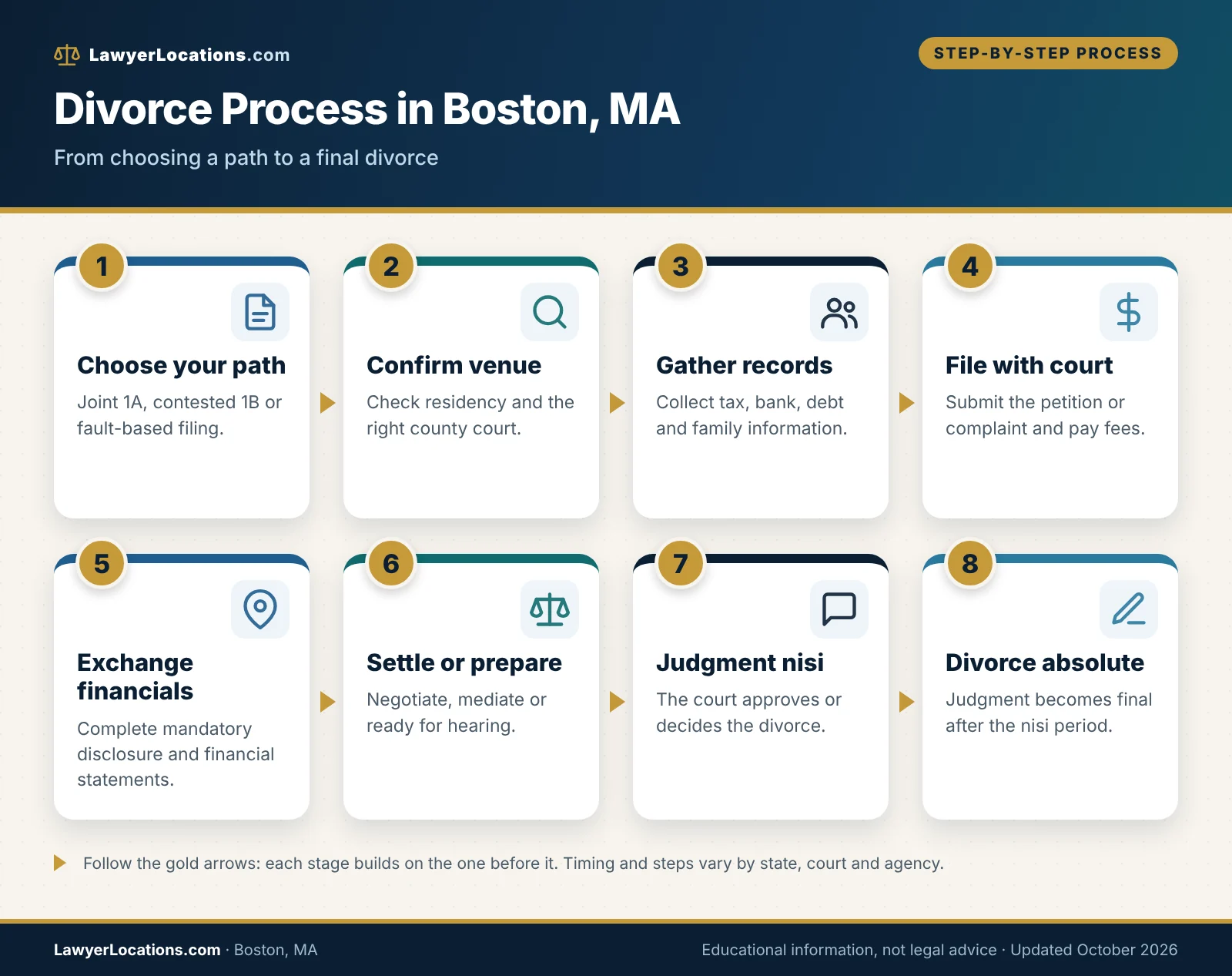
Text version of this graphic
- Decide your path: joint (1A), contested (1B) or fault-based divorce.
- Confirm residency and the right county for filing.
- Gather financial records and family information.
- File the complaint or joint petition with the Probate and Family Court.
- Serve your spouse (contested cases) and exchange financial disclosures.
- Seek temporary orders, mediate or negotiate.
- Attend the hearing or trial; judgment nisi enters.
- Wait out the nisi period; the divorce becomes absolute.
Where Boston Divorces Are Filed: Suffolk Probate and Family Court
Divorce complaints are filed in the Probate and Family Court division for the right county, and for people living in Boston that is the Suffolk division. The court’s main office sits in downtown Boston, and it also runs a limited satellite office.
Court Location, Hours and Contact Details
According to the court’s official Mass.gov page, the Suffolk Probate and Family Court main address is 24 New Chardon Street, Boston, MA 02114. The Register’s Office phone number is (617) 788-8301, and the main office is open Monday through Friday, 8:30 a.m. to 4:30 p.m. A satellite office operates at Chelsea District Court, 120 Broadway, Chelsea, Tuesday through Thursday, 8:30 a.m. to 3:00 p.m.
The court’s page also lists eFiling, eReminder notifications for court events, virtual registry assistance and a court clinic. Hours and services change, so confirm them on the court’s page before you travel or file.
Ask any lawyer you interview whether they file electronically and whether they regularly appear at the Suffolk court. Familiarity with the court’s calendar and staff is a practical advantage, not a guarantee of any result.
Which County Is Yours? The Venue Rule
Where you file depends on where you live, not just on where you work or what city you call home. Mass.gov’s guide explains that you file in the county where you and your spouse lived together if one of you still lives there; if not, you file in the county where either of you now lives.
So a couple who last lived together in Boston, with one spouse still there, files in Suffolk County. Spouses who have moved to surrounding communities may land in a different county’s Probate and Family Court, such as Middlesex or Norfolk. A lawyer can confirm your venue in a short phone call, and filing in the wrong place wastes time.
Who Needs a Lawyer and Who Might Not
You are allowed to represent yourself in a Massachusetts divorce, and the court provides forms and guides for people who do. Whether that is wise depends on what is at stake.
Situations Where Self-Help May Be Realistic
Self-help is most workable when the marriage was short, there are no children, there is little property, and both spouses agree on everything. In that situation a joint 1A petition with a signed separation agreement can be straightforward, and some people have a lawyer only review the agreement.
Even then, a short consultation can catch problems with retirement accounts, health insurance or tax effects before they become permanent.
Situations Where Hiring Counsel Is Usually Worth Serious Thought
- Children are involved and you disagree about custody, parenting time or schooling.
- One spouse earns much more, or one spouse is asking for alimony.
- There is a home, a business, retirement accounts or stock compensation to divide.
- You suspect your spouse is hiding money or assets.
- Safety is a concern; see our guide to finding a domestic violence lawyer, and contact emergency services if you are in danger.
- Your spouse already has a lawyer and you do not.
Immigration status can also shape the decisions in a divorce. If you are in that position, read about working with a green card lawyer in Boston and tell your divorce attorney early so the two matters are coordinated.
Massachusetts Divorce Law You Should Understand Before You Hire
Massachusetts offers three routes to divorce: a joint no-fault filing under section 1A, a no-fault filing by one spouse under section 1B, and a fault-based filing under section 1. Each route is set by M.G.L. c. 208, and the route you choose affects speed, cost and how much you control the outcome.
The Three Paths to Divorce in Massachusetts
1A: The Joint No-Fault Divorce
Under M.G.L. c. 208, § 1A, spouses who agree the marriage has irretrievably broken down can file together. The filing includes a petition signed by both spouses, an affidavit stating that the breakdown exists, and a notarized separation agreement. No summons or answer is needed because both spouses are already on board.
Mass.gov’s 1A guide says the agreement must cover child support, parenting time, alimony, custody and division of marital property, and that the separation agreement can be filed up to 90 days after the petition. After a hearing, the judge decides whether the breakdown exists and whether the agreement adequately covers the required issues. The statute says the court ignores marital fault when it makes that decision.
Irretrievable breakdown is the legal phrase for “the marriage is over and cannot be repaired.” In a no-fault case you do not have to prove who caused it.
1B and Fault Divorces: When You Do Not Agree
Under M.G.L. c. 208, § 1B, one spouse can file a complaint alone, or both can file when they agree the marriage is over but cannot agree on terms. The other spouse is served with a summons, financial information is exchanged, and unresolved issues can go to a pre-trial hearing and, if necessary, trial. If the spouses later sign a qualifying statement and agreement, the case can switch over to the section 1A track.
A fault divorce is filed under M.G.L. c. 208, § 1 and requires proof of a listed ground: adultery, desertion, gross and confirmed habits of intoxication, cruel and abusive treatment, non-support, impotency, or a prison sentence of five or more years. Mass.gov notes that fault divorces can take longer and cost more than no-fault divorces, which is one reason most contested cases use section 1B.
Residency and Timing Rules
Who Can File in Massachusetts
Mass.gov explains that you can file if either spouse has lived in Massachusetts for one year, or if the reason the marriage ended happened in Massachusetts and the couple lived here as a married couple. Residency is a threshold issue: without it, the court cannot take the case.
If you recently moved to Boston, ask a lawyer to review your residency timeline before filing. Moving can also affect which state’s courts are the right place for custody questions, so do not assume.
Waiting Periods and the Nisi Stage
Under § 1B, a hearing on the divorce generally cannot happen earlier than six months after the complaint is filed, though the court may waive that period in limited situations such as consolidating with a section 1 complaint from the other spouse. In a 1A case the court has 30 days after the hearing on the agreement to decide, and the judgment nisi enters automatically 30 days after the initial approval.
The word nisi is Latin for “unless.” Under M.G.L. c. 208, § 21, a divorce judgment is first entered as a judgment nisi and becomes absolute 90 days after entry unless the court acts within that window. For a deeper look at timing across the country, see our guide on how long a divorce takes.
Do not remarry or make decisions that depend on being legally divorced until your lawyer or the court confirms the judgment has become absolute. The nisi period is not the same as being divorced.
Money, Property and Children Under Massachusetts Law
How Property Is Divided
Property division is governed by M.G.L. c. 208, § 34. The statute directs the judge to weigh a long list of factors, including the length of the marriage, each spouse’s age, health, occupation, income, employability, estate, liabilities and needs, and each spouse’s future earning and asset-building opportunities. The court may also consider each spouse’s contributions to acquiring and preserving property, including contributions as a homemaker.
Notice what the statute does not say: it does not set a fixed percentage split. Massachusetts courts use these factors to reach a result in each case, which is why the quality of your financial documentation matters so much.
Alimony Rules in Brief
Alimony is spousal support, and Massachusetts has detailed statutory limits. Under M.G.L. c. 208, § 49, for marriages of 20 years or less, general term alimony generally cannot last longer than a set share of the number of months the couple was married, unless the judge makes a written finding that a longer or shorter term is justified. For longer marriages, the court may order alimony for an indefinite period.
| Length of marriage | Alimony generally may not exceed |
|---|---|
| 5 years or less | One-half of the number of months married |
| More than 5 up to 10 years | 60 percent of the number of months married |
| More than 10 up to 15 years | 70 percent of the number of months married |
| More than 15 up to 20 years | 80 percent of the number of months married |
| More than 20 years | Court may order alimony for an indefinite length of time |
The same statute lists events that can end or change alimony, including the recipient’s remarriage, either spouse’s death, the payor reaching full retirement age, and a finding that the recipient has shared a primary residence with another person for at least three continuous months. Because these rules can change the value of a settlement, have your lawyer model them before you agree to terms.
Children: Custody and Child Support
Custody, parenting time and child support are decided in the same case as the divorce, and the separation agreement or the judgment must address them. The Trial Court publishes Child Support Guidelines and a Child Support Guidelines Worksheet (form CJD 304), and Mass.gov directs filers to complete it when child support is at issue.
Judges look at what serves the children’s needs, and the guidelines supply a starting framework for support. If your family has unusual circumstances, such as high medical costs or unusual schedules, ask a prospective lawyer how they handle deviations from the guidelines.
Divorce Versus Separate Support
What Separate Support Is
Massachusetts does not offer “legal separation” in the way some states do. Instead, a spouse can ask the Probate and Family Court for separate support, an order for financial support and related relief while the marriage stays legally intact. Mass.gov has a how-to page titled “File for separate support,” and the same automatic restraining order rule that applies to divorce also covers separate support complaints.
People sometimes choose this route for religious reasons, to keep health insurance, or because they are not ready to divorce. For a national comparison, see our guide to legal separation versus divorce.
Why the Difference Matters When Interviewing Lawyers
If you are unsure which route you want, say so at your first meeting. A thoughtful lawyer will explain the effect on property, support and insurance rather than pushing you toward whichever filing is fastest.
It is a useful screening question: a lawyer who explains tradeoffs clearly is giving you a window into how they will communicate throughout the case.
How to Compare Divorce Lawyers in Boston
Compare lawyers on fit, clarity and process, not on advertising claims. LawyerLocations.com does not rank or recommend attorneys, so this section gives you the questions and screening steps to do the comparison yourself.
Where to Find Candidates
Lawyer Referral Services
The Boston Bar Association Lawyer Referral Service lets you submit an online request describing your situation; an intake team identifies the type of help you need and matches you with an attorney in that practice area. The BBA’s site says requesting a referral is free and that the first 30-minute consultation is capped at no more than $25, with some attorneys offering flexible fees or reduced rates depending on income and circumstances.
The service does not take referral requests by phone. For telephone help the BBA points callers to Eastern Regional Legal Intake at (617) 603-1700, which lists limited weekday hours, so check the BBA page for current times. The Massachusetts Bar Association also runs a lawyer referral program.
Personal Referrals, Online Directories and Court Resources
Friends, coworkers, financial advisors and other lawyers (such as the one who handled your home purchase) are common sources. A referral tells you someone was satisfied; it does not tell you whether the lawyer handles contested divorces regularly.
Directories, including this one, are best used to build a short list of three or four names. Then verify each person’s license and disciplinary history through the Massachusetts Board of Bar Overseers before you book a meeting.
Be cautious about any lawyer or directory that promises a particular result, claims to be “the best,” or pressures you to sign at the first meeting. Divorce outcomes depend on facts, law and the judge, and no honest attorney can promise one.
What to Ask in the First Consultation
Experience and Case Fit
Ask how much of the lawyer’s practice is family law, how often they appear in the Suffolk Probate and Family Court, and what kinds of cases they handle: uncontested, high-conflict, business owners, military, or complex assets. Ask who will actually do the work, since some firms use associates or paralegals for routine tasks.
Ask for a candid read on your situation, including weaknesses. A lawyer who only tells you what you want to hear is not helping you plan.
Strategy, Communication and Settlement Approach
Ask how they approach settlement versus litigation, when they recommend mediation, and how they decide when to go to trial. Ask how quickly they normally return calls and emails, and who covers when they are in court. Do not accept a promise of instant responses; look for a clear, realistic communication policy.
Pay attention to whether the lawyer listens, explains in plain language and respects your goals. That tells you more than a polished website.
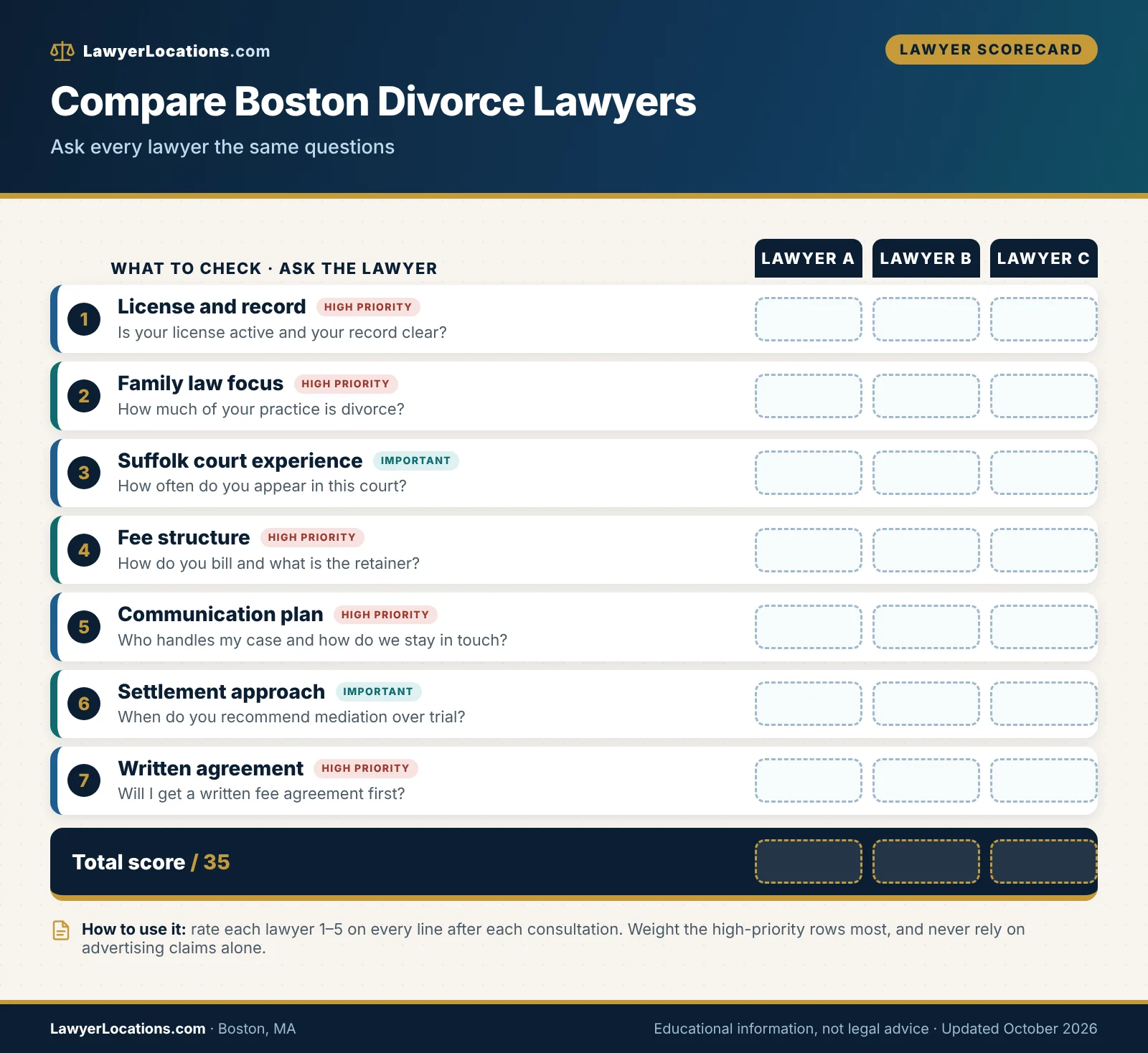
Text version of this graphic
| Criterion | Question to ask |
|---|---|
| License and discipline | Is your license active, and is your record clear with the Board of Bar Overseers? |
| Family law focus | How much of your practice is divorce and family law? |
| Suffolk court experience | How often do you appear in the Suffolk Probate and Family Court? |
| Fee structure | How do you bill, and what is the retainer? |
| Communication | Who handles my case, and how will we stay in touch? |
| Settlement approach | When do you recommend mediation versus trial? |
| Written agreement | Will you give me a written fee agreement before work starts? |
Fees, Agreements and Ethics Rules That Protect You
The Written Fee Agreement
Under Mass. R. Prof. C. 1.5(b), a lawyer must communicate the scope of the representation and the basis or rate of fees and expenses to the client in writing, before or within a reasonable time after starting. The rule has narrow exceptions, such as a single-session consultation or a matter where the total fee is reasonably expected to be under $500.
In practice, that means you should receive a written agreement for any real divorce engagement. Read it before signing and ask about anything unclear: the hourly rates, who bills at which rate, the retainer amount, how expenses are charged, and what happens to unused funds.
Why Divorce Lawyers Cannot Work on Contingency
Contingent fees, where a lawyer is paid a percentage of a recovery, are common in injury cases but are restricted in family law. Rule 1.5(d)(1) says a lawyer may not charge a fee that depends on securing a divorce or on the amount of alimony, support or property settlement. The comments clarify that a contingent fee for collecting overdue support after judgment is not barred.
A Massachusetts divorce lawyer offering to take your case for “a percentage of whatever you win” is proposing something the ethics rules prohibit. Walk away, or at least ask them to explain in writing how the arrangement complies with Rule 1.5.
| Topic | What to ask | What a clear answer sounds like |
|---|---|---|
| Licensing | Are you licensed in Massachusetts, and is your record clear? | Direct answer, and you can confirm it with the Board of Bar Overseers. |
| Experience | How many of your cases are contested divorces with children or complex property? | Specific description of case types, without guarantees about outcomes. |
| Billing | Hourly, flat fee or a mix? What is the retainer? | Written rates, retainer, and a plan for monthly statements. |
| Staffing | Who else will work on my case? | Names and roles of any associates or paralegals. |
| Strategy | What are my realistic options and the risks of each? | Balanced discussion of settlement, mediation and trial. |
| Communication | How will you update me? | Concrete process, such as scheduled updates and copies of filings. |
Red Flags and Good Signs
Warning Signs During the Search
- Promises of a specific result, a quick win or a guaranteed settlement.
- No written fee agreement, or reluctance to explain the billing.
- Pressure to sign or pay on the spot.
- Encouraging you to hide assets, move money or ignore court orders.
- Speaking negatively about your spouse in ways that inflame conflict rather than solve problems.
Any one of these is a reason to pause. Several together are a reason to keep looking.
Signs You Have Found a Good Fit
- Explains the Massachusetts process in plain language and answers your questions directly.
- Gives a clear written fee agreement and explains how bills are generated.
- Discusses settlement and trial realistically, including costs and risks.
- Shows respect for your goals and your family’s wellbeing.
- Tells you what documents they need and what you can do yourself to reduce cost.
What Happens After You File: The Boston Divorce Process
After filing, a Massachusetts divorce moves through automatic protections, financial disclosure, temporary orders, negotiation or mediation, and a hearing or trial. Contested cases follow the longest path; joint 1A cases skip much of it.
Protections That Start Immediately
The Automatic Restraining Order
Under Supplemental Probate and Family Court Rule 411, an automatic restraining order binds both spouses in a divorce or separate support case. It takes effect for the person who files when the complaint is filed, and for the other spouse when they are served or otherwise accept service. It continues until a judgment is entered unless the parties agree otherwise or the court changes it.
The order prohibits selling, transferring, hiding or giving away property, with exceptions for reasonable living expenses, ordinary business and investment activity, attorney’s fees for the case, a written agreement of both parties, or a court order. It also bars new debt that would harm the other spouse’s credit, changing beneficiaries on life insurance or retirement plans without consent, and causing the other spouse or the children to lose insurance coverage.
Violating the automatic restraining order can create real problems in your case. If you are unsure whether a purchase, transfer or account change is allowed, ask your lawyer before you do it.
Temporary Orders for Urgent Needs
If you need a court order about custody, parenting time or support while the case is pending, Mass.gov describes a Motion for Temporary Orders (form CJD 400) filed with an affidavit and a proposed order. Statute also allows the court to issue temporary orders before judgment under § 1A and § 1B.
Temporary orders are meant to keep things stable, not to decide the final outcome. Ask your lawyer which temporary issues are worth pursuing, since each motion adds cost.
Financial Disclosure and Information Exchange
Mandatory Self-Disclosure
Under Supplemental Probate and Family Court Rule 410, parties in divorce actions must exchange financial documents early in the case. Initial disclosures include three years of federal and state income tax returns, the four most recent pay stubs from each employer, and information about available health insurance. Divorce parties must also provide three years of bank statements, three years of statements for securities and retirement accounts, loan or mortgage applications from the three years before filing, and financial statements or statements of assets and liabilities from the same period.
These disclosures are due within 45 days after service of the summons. A party who cannot obtain a document in time must say so in a sworn written statement explaining which documents are missing, why, and what efforts were made. Parties cannot file discovery motions until they have made their disclosures.
The Financial Statement
The court also uses a financial statement, covered by Supplemental Probate and Family Court Rule 401, listing income, expenses, assets and debts. Mass.gov’s guides recommend each spouse prepare one before a hearing is scheduled, and in contested cases the spouses exchange them after the answer is filed.
Accuracy matters because the court and your spouse’s lawyer will rely on it. A lawyer’s staff can help you build it from your tax returns and statements; start collecting records now. Debt is part of the picture too: if you are weighing bankruptcy alongside divorce, read about bankruptcy attorneys in Boston and ask your divorce lawyer how timing interacts.
Negotiation, Mediation and Hearings
Settling Without Trial
Most couples settle some or all issues. Settlement can happen through direct lawyer negotiation, mediation with a neutral third party, or other alternative dispute resolution options, which Mass.gov’s 1B guide points to. A signed, notarized separation agreement covering all issues means no trial is needed.
Settlement gives you more control and usually costs less than a trial. It is still worth having a lawyer review the final agreement, because a signed agreement is hard to undo.
Pre-Trial and Trial in Contested Cases
When spouses disagree, Mass.gov says a pre-trial hearing may be scheduled and both sides must submit a pre-trial memorandum. If issues remain, the judge decides them at trial and enters a judgment nisi with orders on custody, child support, alimony and property.
Trial is the most expensive and least predictable path, because the judge applies the statutory factors to the evidence presented. Your lawyer should help you weigh that risk against any settlement offer.
Costs, Deadlines and Decision Points in a Boston Divorce
Two kinds of cost matter: court fees, which are fixed and published, and legal fees, which vary by lawyer and by how contested the case becomes. This section sticks to verified court amounts and explains the factors that push legal fees up or down rather than quoting averages.
Court Filing Fees
What You Pay the Court
The Massachusetts Trial Court’s fee page lists a divorce complaint filing fee of $200 plus a $15 surcharge. Mass.gov’s 1A guide totals that at $215, and its 1B guide adds a $5 summons charge for a total of $220. Payment can be made by check or money order payable to the Commonwealth of Massachusetts, cash, or credit card, and the court says to contact the court you are filing at about payment locations.
| Item | Amount | Applies to |
|---|---|---|
| Filing fee | $200 | Divorce complaints |
| Filing surcharge | $15 | Divorce complaints |
| Summons charge | $5 | 1B contested filings (per Mass.gov 1B guide) |
| Citation fee | $15 each | When citations are required |
| Total, 1A joint filing | $215 | Per Mass.gov 1A guide |
| Total, 1B filing | $220 | Per Mass.gov 1B guide |
Fees can change, so confirm the current amounts on the Trial Court’s fee page before you file.
Service, Publication and Fee Waivers
If you must serve a spouse, the court’s page says the petitioner pays any publication costs, and separate citation and summons fees apply. If you cannot afford the fees, both Mass.gov guides refer to an indigency application, and the 1A guide says couples who are both indigent may request a fee waiver.
The court filing fee is a small part of what most people spend on a contested divorce. The bigger variable is legal time, which depends on how much you and your spouse can agree on without a judge.
Lawyer Fees and What Moves the Price
Common Billing Structures
Family lawyers commonly bill by the hour, often asking for an upfront retainer that is drawn down as work is done. Some offer flat fees for narrow tasks, such as reviewing a separation agreement or handling an uncontested filing. Ask each lawyer which model they use and what it covers.
The Massachusetts ethics comments say a lawyer may require advance payment but must return any unearned portion, so ask what happens to unused retainer funds and get the answer in your fee agreement.
Factors That Raise or Lower the Total
Rule 1.5(a) lists the factors that go into whether a fee is reasonable: the time and labor required, the difficulty of the questions, the skill needed, fees customarily charged locally for similar work, the amount involved, time limits, and the lawyer’s experience. Those same factors explain why two Boston divorces can have very different bills.
| Factor | Why it matters | What you can do |
|---|---|---|
| Agreement level | Joint 1A cases need fewer filings and hearings than contested cases. | Work toward agreement on as many issues as possible. |
| Children | Custody and parenting disputes add motions, evidence and possible evaluations. | Document your parenting role and seek mediation early. |
| Complex assets | Businesses, stock compensation and retirement accounts need valuation and review. | Gather statements and organize them before meetings. |
| Discovery disputes | Fights over documents and disclosure drive up hours. | Comply promptly with the mandatory disclosure rule. |
| Communication style | Frequent long calls and emails add billable time. | Batch questions and send organized summaries. |
| Trial | Preparation and court time are the most expensive stage. | Weigh settlement offers against trial risk with your lawyer. |
Practical Ways to Control Costs
You can lower legal spending without cutting corners. Do your own document gathering, keep a single running list of questions rather than calling about each one, and decide your priorities before negotiating so your lawyer is not billing time while you make up your mind.
Ask whether the lawyer will give you a periodic statement and an estimate for each stage. An estimate is not a promise, but it helps you plan and signals whether the firm manages costs carefully.
Low-Cost and Free Help in Boston
Referral Services and Court-Linked Programs
The Boston Bar Association’s referral service caps the first 30-minute consultation at $25 and may match income-qualified clients with reduced-rate attorneys. The Suffolk Probate and Family Court’s website also lists a Lawyer for the Day program, so check that page for current availability and eligibility before you go. The court’s own listing includes a court clinic and virtual registry assistance.
Massachusetts Legal Help (masslegalhelp.org) publishes plain-language information on children, families and divorce that is worth reading before you meet any lawyer. The Trial Court’s site lists a Boston Court Service Center, and its page is the place to check for current services.
Using Limited Help Wisely
If you cannot afford full representation, consider a paid consultation to map out your options, then handle routine steps yourself and return to the lawyer for key decisions or document review. Ask any lawyer whether they offer this kind of limited help, and get the scope in writing.
Whatever you choose, do not skip review of a final separation agreement. It becomes part of a court judgment and is hard to change later.
Deadlines and Decision Points at a Glance
The Timeline in Plain Terms
The time limits below come from the statutes and court rules cited above. Your own calendar will depend on court scheduling and what you and your spouse do, so treat the table as a map, not a prediction.
| Stage | Time rule | Source |
|---|---|---|
| Residency before filing | One year in Massachusetts, or the cause arose here and you lived here as a couple | Mass.gov divorce guides |
| 1A separation agreement | May be filed within 90 days of the petition if not filed at the start | M.G.L. c. 208, § 1A |
| 1A court decision | 30 days after the hearing; nisi enters 30 days after initial approval | M.G.L. c. 208, § 1A |
| 1B hearing | No earlier than six months after filing, unless waived | M.G.L. c. 208, § 1B |
| Mandatory disclosure | Within 45 days after service of the summons | Supp. P&FC Rule 410 |
| Nisi to absolute | 90 days after entry, unless the court acts sooner or later | M.G.L. c. 208, § 21 |
The Big Decision: Settle or Litigate?
The biggest decision point in most Boston divorces comes after financial disclosure, when you can see the full picture. Ask your lawyer to explain what a settlement would look like, what a judge might do, and what each path would likely cost in time and money.
If the other side’s offer is reasonable, settling often saves money and stress. If it is not, your lawyer should help you decide whether a better offer is realistic or whether the issue needs a judge.
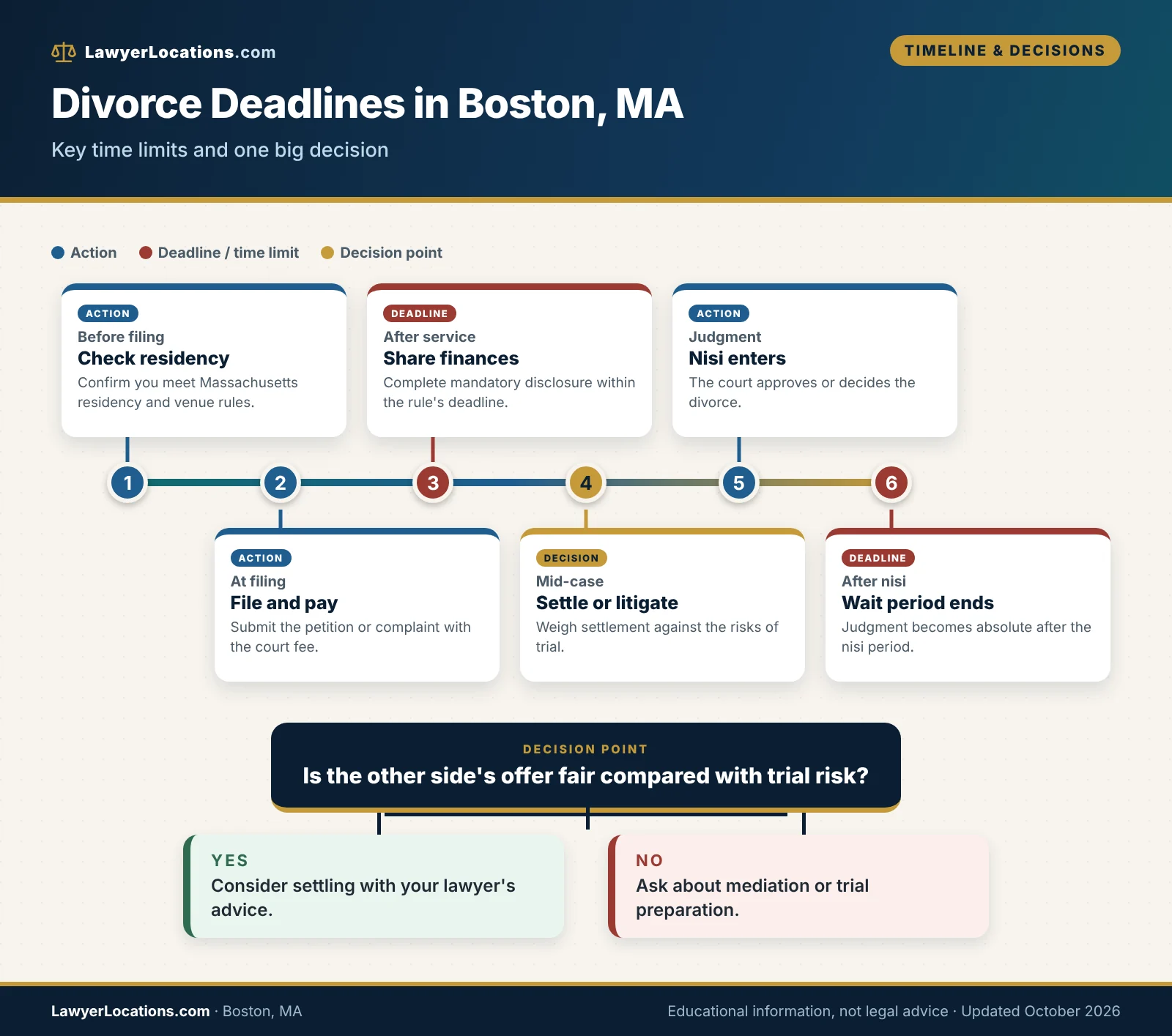
Text version of this graphic
- Before filing: confirm residency and venue, gather records, choose a path.
- Filing: submit the joint petition or complaint with the court fee.
- Within 45 days of service: exchange mandatory financial disclosures.
- Early in the case: ask for temporary orders if you need them.
- Decision point: settle or prepare for a hearing or trial.
- Judgment nisi: the court approves or decides the divorce.
- 90 days later: the judgment becomes absolute unless the court acts.
Decision question: Is the other side’s proposal fair when you compare it with the likely court outcome? If yes, consider settling. If no, ask your lawyer about mediation or trial preparation.
Preparing: Documents, Consultations and Common Mistakes
Good preparation shortens consultations, reduces billable time and helps your lawyer give better advice. The mandatory disclosure rule tells you most of what to gather, so start there.
Your Document Checklist
Financial Records
Start with the items the court requires by rule and add what is specific to your household.
- Three years of federal and state income tax returns, with W-2s and 1099s.
- The four most recent pay stubs from each employer, plus information on health insurance cost and options.
- Three years of bank statements for every account, including joint, individual and business accounts.
- Three years of statements for retirement accounts, investments and securities.
- Mortgage or loan applications from the three years before filing.
- Deeds, vehicle titles, insurance policies, credit card statements and debt records.
Organize them by category and date. Keep copies of everything and do not remove originals from places your spouse can also access in ways that could look like hiding records.
Family and Personal Information
Gather your certified marriage certificate (the court requires it at filing, or a motion to file it late), names and birth dates of children, school and childcare details, and any existing court orders. If you are filing with children under 18, expect to complete a custody disclosure affidavit that lists where each child has lived.
Write a short timeline of the marriage, the separation and your parenting role. A one-page summary makes your first consultation far more productive.
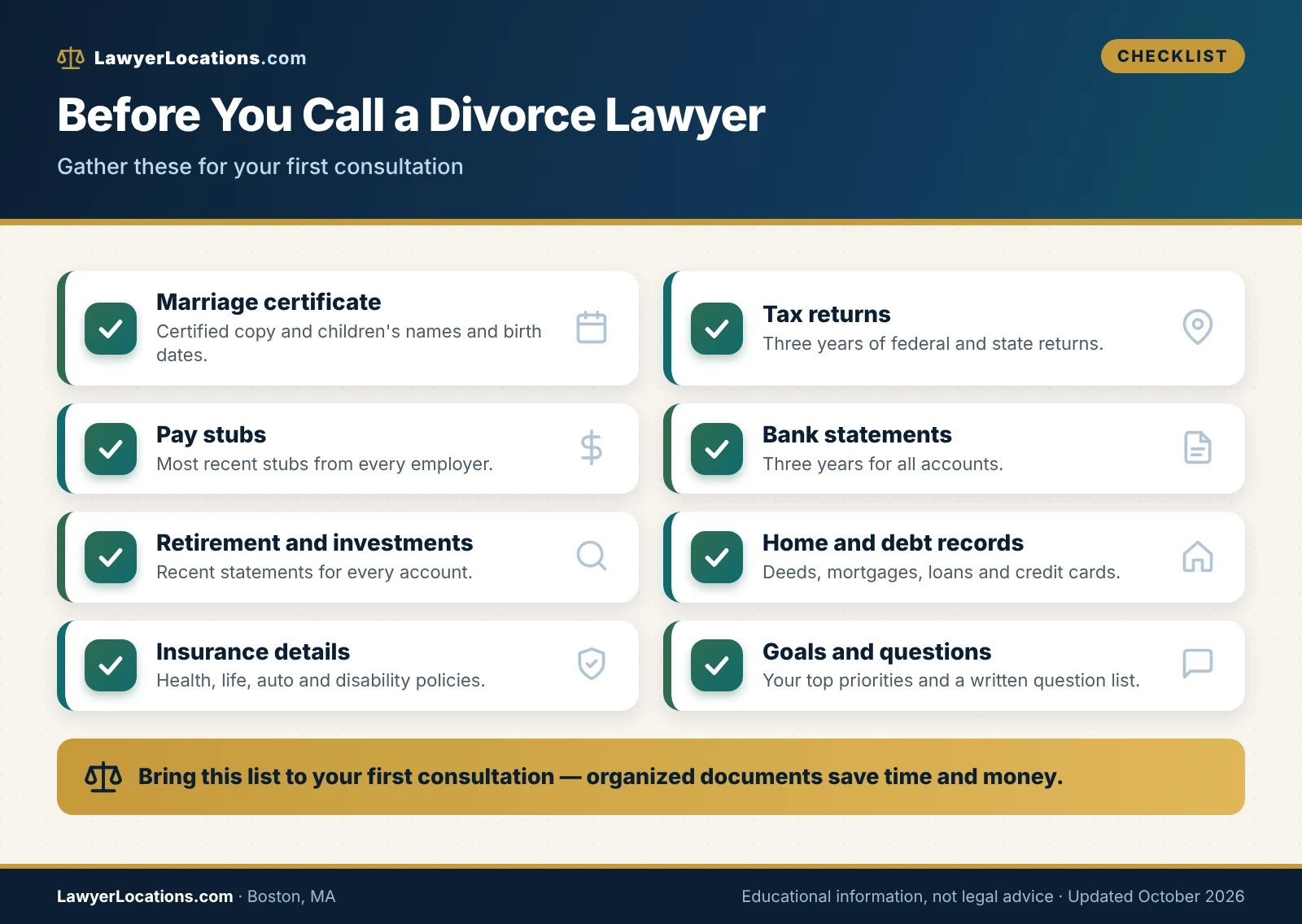
Text version of this graphic
- Marriage certificate and children’s information
- Three years of tax returns
- Recent pay stubs
- Bank and credit card statements
- Retirement and investment statements
- Mortgage, deed and loan records
- Insurance policies and health coverage details
- List of questions and your top priorities
Making the Most of Your Consultation
Set Your Goals Before You Meet
Write down what matters most: time with your children, keeping the house, a clean financial break, protecting a business, or safety. Rank them. Lawyers can pursue many goals, but priorities help them recommend a realistic plan.
Be ready to hear tradeoffs. A good consultation is a two-way conversation, not a sales pitch.
Be Honest and Organized
Tell the lawyer the whole story, including unfavorable facts. Conversations with a lawyer you are consulting are generally confidential, but the confidentiality only helps if you are candid. Bring your documents, your timeline and your questions.
Take notes during the meeting or ask whether you may record key points for your own use. Afterward, write a two-line summary of the lawyer’s advice and their fee quote so you can compare candidates side by side.
Common Mistakes to Avoid
Money Mistakes
- Moving or hiding assets, or changing account ownership after a case begins.
- Running up credit card debt or borrowing against the home without agreement or court permission.
- Changing beneficiaries on insurance or retirement accounts while the restraining order applies.
- Cancelling health, auto or life insurance that covers your spouse or children.
- Signing a separation agreement without understanding retirement, tax and insurance effects.
Each of these can hurt your credibility and may violate the automatic restraining order. When in doubt, ask first.
Communication and Conduct Mistakes
Avoid posting about the divorce on social media, venting in texts you would not want a judge to read, or using the children as messengers. Written messages can end up as evidence.
Keep communication with your spouse businesslike and focused on logistics. If there is a safety issue, prioritize your safety and talk with a lawyer or advocate about protective options.
Maya and Dan lived together in Boston, and both still live in the city. Maya wants a divorce, and Dan agrees but they disagree about the house. Because they do not have a complete agreement, a joint 1A filing is not ready, so Maya’s lawyer discusses a 1B complaint filed in the Suffolk Probate and Family Court, with the possibility of switching to the 1A track if they sign a full agreement later. This is a simplified illustration, not a prediction.
Questions People Ask and Your Next Steps
The short answers below pull together the points that come up most often when people search for a divorce lawyer in Boston, MA. Each answer is general information; a lawyer can apply it to your facts.
Quick Answers to Common Questions
Filing, Courts and Timing
Can I file for divorce in Massachusetts without a lawyer?
Yes. The court provides guides and forms, and Mass.gov explains how to file a 1A or 1B divorce yourself. Representing yourself is more realistic when you agree on everything and have few assets.
Where do I file if I live in Boston?
You file in the Probate and Family Court for the right county. If you and your spouse lived together in Suffolk County and one of you still lives there, that is the Suffolk division at 24 New Chardon Street. Mass.gov says filing can be done through eFileMA, in person or by mail.
How long do I have to live in Massachusetts first?
One year, or the reason the marriage ended happened in Massachusetts and you lived here as a married couple, according to Mass.gov.
How long does a Boston divorce take?
A 1B contested case generally cannot be heard until six months after filing, and judgment becomes absolute 90 days after the nisi judgment. A 1A joint case can move faster because the court decides within 30 days of its hearing, but actual calendars vary. Read our guide to divorce timelines for more context.
Do both spouses have to go to the 1A hearing?
Mass.gov says both spouses must attend unless the court grants a waiver on motion.
Can I stop the divorce after judgment nisi enters?
Under § 21, neither party can have the case dismissed or discontinued by motion alone after nisi enters. The court may allow it on terms it sets after notice and a hearing, or without a hearing if both parties sign an agreed memorandum.
Is there a legal separation in Massachusetts?
The court offers a separate support complaint, which can produce support orders without ending the marriage. See our legal separation versus divorce guide for how the options compare across states.
What documents will I have to share with my spouse?
Under Rule 410, tax returns, pay stubs, bank and investment statements, loan applications and health insurance information, among other items, within 45 days after service of the summons.
If your question is about a safety issue, an immigration question or a debt problem, those topics usually need a separate specialist as well as a divorce lawyer, and the guides linked above can help you get started.
Money, Children and Hiring a Lawyer
How much does the court charge to file?
The Trial Court lists a $200 filing fee plus a $15 surcharge, and Mass.gov’s 1B guide adds a $5 summons charge. A fee waiver may be available through an indigency application.
Can a lawyer take my divorce for a percentage of what I get?
No. Rule 1.5(d)(1) bars fees that depend on securing a divorce or on the amount of alimony, support or property settlement.
Will I have to pay alimony or receive it?
It depends on the facts. Section 34 allows the court to order alimony, and § 49 limits how long general term alimony can last based on the length of the marriage. A lawyer can estimate how those rules apply to your finances.
Can I use marital money to pay my lawyer?
The automatic restraining order lists attorney’s fees for the case as an exception to the property restrictions. Ask your lawyer how to handle retainers so you stay within the rule.
Who decides child support?
The court sets it using the Trial Court’s Child Support Guidelines or approves the figure in your agreement if it is adequate. You will typically complete the guidelines worksheet (CJD 304).
How do I check a lawyer before hiring?
Confirm the license and disciplinary history with the Massachusetts Board of Bar Overseers, ask for a written fee agreement, and compare at least two or three candidates using the questions in this guide.
Your Next Steps
In the Next Week
- Protect your safety and finances. If there is danger, contact emergency services first; otherwise secure copies of financial records.
- Gather documents. Use the checklist in section 6 as your starting point.
- Shortlist lawyers. Use a referral service, trusted recommendations and a directory, then verify each license.
- Book consultations. Ask about fees before the meeting so you can compare candidates fairly.
Do not make major financial moves while you are deciding. If you already have a case filed or served, the automatic restraining order is in place.
Before You Sign a Fee Agreement
Read the agreement fully. Confirm the scope of work, the hourly rates, the retainer, how expenses are billed, and what happens if you end the relationship. Ask for changes in writing, and keep a signed copy for your records.
If something in the agreement does not match what you were told, resolve it before you pay. The Massachusetts rule requires fee communication in writing for a reason.
Ready to compare your options?
Use the checklist and scorecard in this guide to shortlist two or three Massachusetts-licensed family lawyers, and ask each the same questions. Looking at the money side as well? Our guide on bankruptcy attorneys in Boston explains how debt questions fit alongside a divorce. LawyerLocations.com is an education and discovery resource, not a law firm, and does not create an attorney-client relationship.
General information only. This article is for general educational purposes and is not legal advice. Reading it does not create an attorney-client relationship with LawyerLocations.com or any lawyer. Laws, court rules, forms and fees change, and your situation may differ. Consult a lawyer licensed in Massachusetts about your case and confirm current rules with the court.
Sources & References
Show all 19 sources
- M.G.L. c. 208, § 1A (joint petition for divorce) — Massachusetts Legislature — malegislature.gov — accessed October 2026
- M.G.L. c. 208, § 1B (divorce for irretrievable breakdown) — Massachusetts Legislature — malegislature.gov — accessed October 2026
- M.G.L. c. 208, § 21 (judgment nisi and absolute) — Massachusetts Legislature — malegislature.gov — accessed October 2026
- M.G.L. c. 208, § 34 (alimony and assignment of property) — Massachusetts Legislature — malegislature.gov — accessed October 2026
- M.G.L. c. 208, § 49 (alimony termination, suspension and modification) — Massachusetts Legislature — malegislature.gov — accessed October 2026
- Get a no-fault 1A divorce — Mass.gov, Massachusetts Trial Court — mass.gov — accessed October 2026
- Get a no-fault 1B divorce — Mass.gov, Massachusetts Trial Court — mass.gov — accessed October 2026
- Get a fault divorce — Mass.gov, Massachusetts Trial Court — mass.gov — accessed October 2026
- Probate and Family Court filing fees — Mass.gov, Massachusetts Trial Court — mass.gov — accessed October 2026
- Suffolk Probate and Family Court (location page) — Mass.gov, Massachusetts Trial Court — mass.gov — accessed October 2026
- Suffolk Probate and Family Court lawyer for the day — Mass.gov, Massachusetts Trial Court — mass.gov — accessed October 2026
- Supplemental Probate and Family Court Rule 401: Financial statement — Mass.gov, Massachusetts Trial Court — mass.gov — accessed October 2026
- Supplemental Probate and Family Court Rule 410: Mandatory self disclosure — Mass.gov, Massachusetts Trial Court — mass.gov — accessed October 2026
- Supplemental Probate and Family Court Rule 411: Automatic restraining order — Mass.gov, Massachusetts Trial Court — mass.gov — accessed October 2026
- Child Support Guidelines — Mass.gov, Massachusetts Trial Court — mass.gov — accessed October 2026
- Rules of Professional Conduct Rule 1.5: Fees — Mass.gov, Massachusetts Supreme Judicial Court — mass.gov — accessed October 2026
- File for separate support — Mass.gov, Massachusetts Trial Court — mass.gov — accessed October 2026
- Lawyer Referral Service — Boston Bar Association — bostonbar.org — accessed October 2026
- Children, Families & Divorce — Massachusetts Legal Help — masslegalhelp.org — accessed October 2026
Legal Disclaimer and Limitation of Liability
Informational and illustrative purposes only. This article was prepared by LawyerLocations.com solely on the basis of the information available to us at the time of writing. It is an illustrative, general overview. It is not a complete or authoritative statement of the law, and it has not been reviewed by a lawyer licensed in your state or county.
Not legal advice. Nothing in this article is legal, financial, tax or immigration advice, and reading it does not create an attorney-client relationship between you and LawyerLocations.com or any author, lawyer or firm mentioned. Laws, court rules, fees, filing deadlines and agency procedures differ by state, county and court, and they change often. Some details here may be simplified, incomplete or out of date, and time limits for legal claims can be short.
No warranty. We make no representation or warranty, express or implied, about the accuracy, completeness, timeliness or suitability of this content for your situation. Please do not rely on it to make, delay or skip any legal decision. Check the facts against official sources and speak with a licensed attorney in the relevant jurisdiction before you act.
Limitation of liability. To the fullest extent permitted by law, LawyerLocations.com and its owners, authors and contributors disclaim all liability for any loss, damage, cost or other consequence arising from the use of, or reliance on, this article, including any content on third-party websites we link to. Mentioning a lawyer, firm, organization or service is not an endorsement and is not a promise of any result. If you are in immediate danger, contact your local emergency number.