
Parents searching for a child custody lawyer Milwaukee WI are usually trying to learn two things at once: how the case works and what hiring help will cost. Start with how Wisconsin splits the issue in two: legal custody (who makes major decisions) and physical placement (where the child lives and when). Under Wis. Stat. § 767.41, Wisconsin courts presume that joint legal custody is in the child’s best interest, and Milwaukee County cases are handled through the Circuit Court’s Family Division in the downtown courthouse at 901 N. 9th Street.
This guide explains the local steps (commissioners, mediation, guardians ad litem, parenting classes), what lawyers charge and how fee structures work, how to compare attorneys before you hire one, and what to prepare for a first consultation. It is general education, not legal advice.
How a Child Custody Case Works in Milwaukee, WI
A custody case in Milwaukee is a Wisconsin family-court case that happens to be heard in Milwaukee County. The rules come from state law, mainly Chapter 767 of the Wisconsin Statutes, and the local courthouse decides how your paperwork moves, who hears each hearing, and what programs you must complete along the way.
Wisconsin’s Two-Part Vocabulary: Legal Custody and Physical Placement
Most people say “custody” to mean everything. Wisconsin separates the idea into two pieces, and a Milwaukee lawyer will use these exact words in your paperwork, so it helps to learn them first.
Legal custody: who makes the big decisions
Legal custody is the right to make major decisions about a child, such as education, non-emergency health care, and religion. Wisconsin can order joint legal custody, where both parents share those decisions, or sole legal custody, where one parent decides. Under § 767.41(2), the court presumes joint legal custody is in the child’s best interest, and sole custody generally requires either agreement or specific findings, such as that the parents cannot cooperate.
Physical placement: where the child lives and when
Physical placement is the schedule: which parent has the child on which days, holidays and school breaks. Wisconsin’s statute directs the court to set a schedule that gives the child regular, meaningful time with each parent and to maximize the time with each parent, taking into account practical limits like distance and separate households. A child is entitled to placement with both parents unless a court finds, after a hearing, that placement with a parent would endanger the child’s physical, mental, or emotional health.
| Question | Legal custody | Physical placement |
|---|---|---|
| What it covers | Major decisions: school, non-emergency medical care, religion | The calendar: weekdays, weekends, holidays, summers |
| Starting presumption | Joint legal custody is presumed in the child’s best interest | No fixed formula; the court sets a schedule that gives meaningful time with each parent |
| Can parents split it? | Yes. A parent can have joint legal custody and still have less time | Yes. Schedules range from primary-home plans to near-equal time |
| What a lawyer usually argues | Whether cooperation is realistic, or whether safety or abuse concerns change the default | Which schedule best fits the child’s school, age, and each home |
| Where it appears | The judgment or order in your Milwaukee County case | The placement schedule and the parenting plan |
Best interest of the child is the legal test Wisconsin courts apply to both pieces of custody. It is not a contest about which parent is “better.” It asks which arrangement serves the child, using a statutory list of factors you will meet again below.
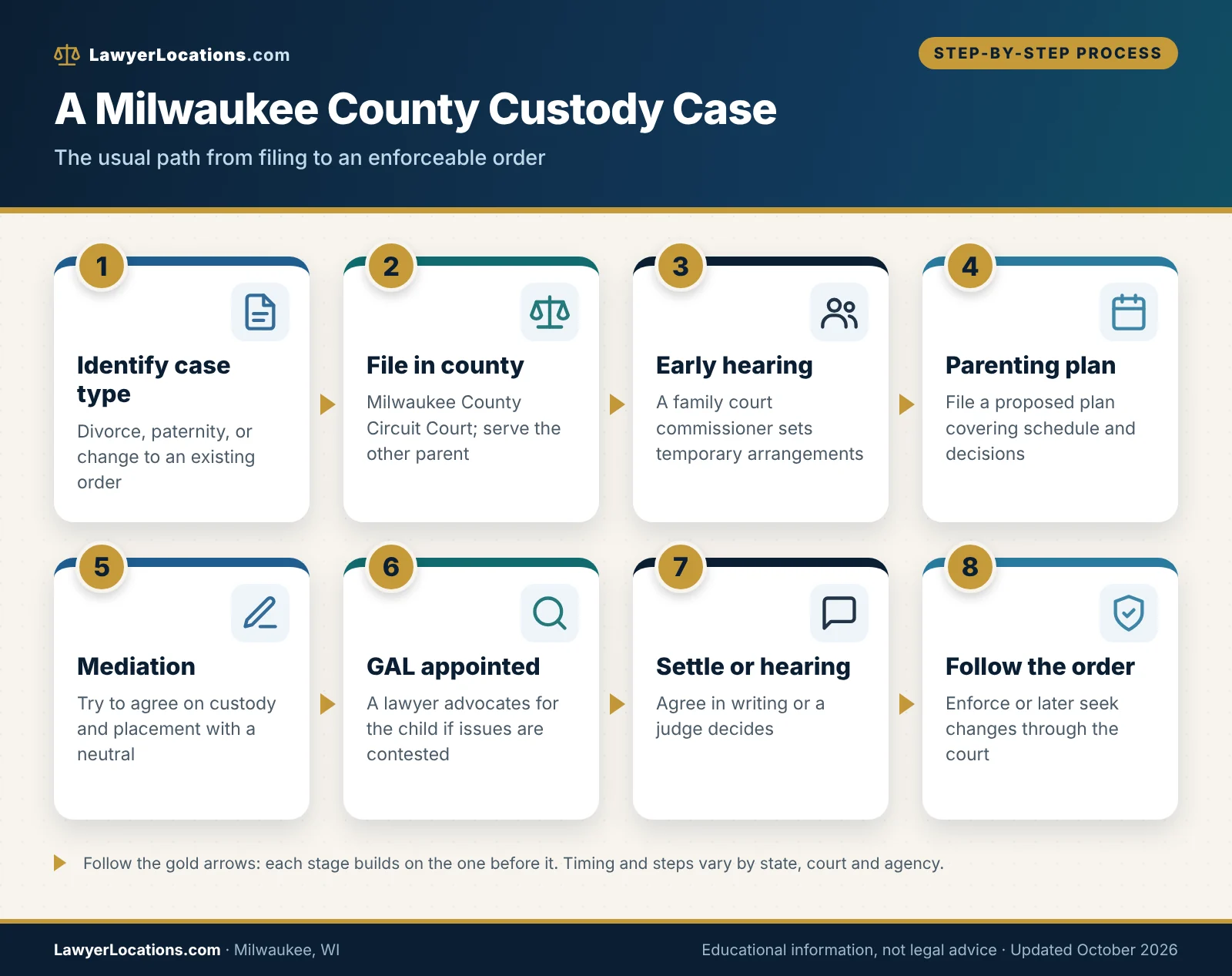
Text version of this graphic
- Decide whether you are married, unmarried or already have an order, because that sets the case type.
- File the case (or a motion) in Milwaukee County Circuit Court and serve the other parent.
- Attend early hearings, usually before a family court commissioner.
- File a proposed parenting plan and try mediation on custody and placement.
- If custody or placement is contested, expect a guardian ad litem to be appointed.
- Complete any required parent education program.
- Reach an agreement or go to a contested hearing before a family court judge.
- Follow the order and use the court to enforce or change it later.
Where Your Case Is Heard in Milwaukee County
Milwaukee County runs its family cases through the Circuit Court Family Division. According to the county’s Family Court page, the Family Court Commissioners Office sits in the Milwaukee County Courthouse, 901 N. 9th Street, Room 707, and the Clerk of Circuit Court’s office is in Room 104 of the same building. Expect a security checkpoint with a metal detector before you reach the hearing rooms.
The commissioner calendar and the judge calendar
Per the county’s description, divorce hearings other than final hearings are generally heard by a family court commissioner. Final hearings with disputed issues are heard by a family court judge, while commissioners can hear a final hearing when every issue has been agreed in writing. Post-judgment enforcement and modification hearings are also heard by commissioners.
In practical terms, your first appearances will often be short and procedural. The commissioner sets temporary arrangements, orders mediation, and moves the case along. The judge usually enters the picture only if the parents cannot settle. The county lists family branches as Family A through E, and your case number and branch letter are what you will need for scheduling and for programs like parent education.
Cases for unmarried parents
Custody is not only a divorce issue. Parents who were never married can ask a Wisconsin court to determine paternity, legal custody, placement and support in a paternity action. The Milwaukee County page notes that paternity hearings are usually scheduled through the county’s Department of Child Support Services, and it lists forms for changing custody and placement orders in paternity cases.
If you are an unmarried father who has not yet established paternity, a lawyer or the Family Forms Clinic can explain the first legal step in your situation. If you are a mother, the same resources can explain how an existing support or paternity case affects custody questions. Because the paperwork path differs from a divorce, ask any lawyer you interview how often they handle paternity-based custody cases in Milwaukee County.
What the Judge Weighs: Wisconsin’s Best-Interest Factors
Wisconsin gives judges a statutory checklist rather than a single test. Knowing the list helps you gather useful evidence and helps you judge whether a lawyer’s advice is tied to the law or only to habit.
The presumption of joint legal custody
The starting point under § 767.41(2) is joint legal custody. That does not mean equal time. A parent can share legal decision-making and still live with the child much less of the time. A lawyer’s job is often to show why the default should stay in place, or, where facts justify it, why it should not.
Wisconsin also has a safety rule that matters in Milwaukee as much as anywhere. If a court finds a pattern or serious incident of battery or domestic abuse by a parent, the statute creates a rebuttable presumption that giving that parent joint or sole legal custody is detrimental to the child, and the child’s safety and the safety of the other parent become paramount concerns. If this is your situation, read our guide on domestic violence lawyers and tell any attorney about it at the first call.
The factors in § 767.41(5)(am)
The statute lists factors the court considers, in no particular order of importance. In plain language, they include:
- What each parent wants, including any agreement or proposed parenting plan
- What the child wants, given the child’s age and maturity
- How well the parents communicate and cooperate, and whether either unreasonably refuses to
- Whether each parent supports the child’s relationship with the other, including encouraging frequent and continuing contact
- The child’s relationships with siblings and other significant people
- The amount and quality of time each parent has spent with the child in the past
- Significant alcohol or drug problems in a parent’s or household member’s life
- The child’s adjustment to home, school, religion and community, plus age and developmental needs
- Mental or physical health issues that affect the child’s well-being
- Criminal records or evidence of child abuse or neglect
- Evidence of battery or domestic abuse
- Admitted professional reports, and any other relevant factor
The court may not prefer one parent over the other based on the parent’s sex or race. That matters when you hear folk wisdom that “mothers always win” or “fathers never get time.” The statute does not say that, and a lawyer who leans on stereotypes instead of the factors is worth questioning.
Read the factor list once, then write down two or three real examples for each factor that applies to your family. Specific facts (who handles school forms, who goes to the pediatrician) are far more useful in a consultation than general statements like “I’m the better parent.”
Milwaukee County Procedure: Filing, Mediation, GALs and Parenting Classes
Milwaukee County adds several steps to the state-law framework: who may file where, a parenting plan, county-run mediation for custody and placement, possible appointment of a guardian ad litem, and approved parent education programs. Each one affects timing and cost, which is why a first consultation should walk through them.
Starting the Case in Milwaukee County
Before you worry about strategy, confirm that Milwaukee County is the right place to file and that you have the documents a Wisconsin court expects at the start.
Residency and where to file
For a divorce that includes children, the county’s page states that at least one party must have lived in Wisconsin for six months and in Milwaukee County for 30 days before filing. For a legal separation, one party must have lived in Milwaukee County for 30 days. Custody questions that arise in other kinds of cases follow their own venue rules, so ask a lawyer or the clinic if your child has recently moved between counties or states.
If your child has lived outside Wisconsin, a different state may have the power to decide custody under interstate jurisdiction rules. That is a technical question, and it is one reason to have a lawyer review the facts before you file anything.
The proposed parenting plan
Under § 767.41(1m), a party seeking sole or joint legal custody or periods of physical placement must file a proposed parenting plan, unless the court orders otherwise. The plan covers topics like schooling, medical care, holidays, the summer schedule, and how disagreements will be resolved. Where mediation is waived, the statute sets a 60-day window to file the plan after the waiver.
A well-drafted plan is also a powerful bargaining tool. Judges and commissioners see many vague proposals, so a concrete plan that mirrors your child’s real routine often lands better than a long list of grievances. Your lawyer should be able to show you sample plan language during or after your consultation.
Mediation Through Milwaukee County Family Court Mediation Services
Wisconsin courts are directed to try mediation on custody and placement disputes before sending them to a contested hearing. In Milwaukee, the county offers that service itself.
What mediation involves and what it costs
The county page says Family Court Mediation Services offers mediation for custody and placement issues in cases filed in Milwaukee County, with a fee of $100 per person and no extra charge for additional sessions after assignment. The request form goes to the Mediation Services office in Room 707 of the courthouse. Fees and procedures can change, so check the county’s current Family Court page before you pay.
A mediator is neutral. The mediator does not decide the case or give legal advice, but helps parents build an agreement on legal custody and placement. Any agreement is usually reviewed by the court. Many lawyers prepare clients for mediation and then review the agreed terms before signing, which keeps the cost of representation lower than a full trial.
When mediation may not be safe or suitable
Mediation assumes two people can speak for themselves without fear. If there has been abuse, stalking, or intimidation, tell the court and your lawyer early, because Wisconsin law allows exceptions where mediation would endanger someone’s health or safety. A forced face-to-face session with an abusive ex is not an acceptable outcome, and the court has tools to avoid it.
If you are afraid of the other parent, say so in writing to your lawyer, the court, or an advocate. Milwaukee has dedicated family-safety organizations, including the Sojourner Family Peace Center, which the county lists as a resource. If you are in immediate danger, call 911.
Guardians ad Litem and Parent Education
Two additional requirements surprise many parents because they cost time and sometimes money. Understanding them in advance makes budgeting easier.
The guardian ad litem (GAL)
A guardian ad litem is a Wisconsin-licensed attorney appointed to advocate for the child’s best interest. Under § 767.407, the court must appoint a GAL when legal custody or physical placement is contested or when there is special concern for the child’s welfare. A GAL acts independently, considers but is not bound by the child’s wishes, reviews the statutory factors, and must investigate and report on any evidence of domestic abuse.
The court sets a reasonable rate and can order one or both parents to pay all or part of the GAL’s fees. If both parents are indigent, the statute allows the court to direct the county to pay, subject to caps. Milwaukee County provides forms for a GAL petition and order on its Family Court page. Ask any lawyer you interview how GAL fees are usually split and when in the case a GAL is typically appointed.
Parent education programs
The county explains that a parent education program is required in divorce, legal separation, and annulment cases involving minor children unless waived, and that judges and commissioners may also order attendance in other pre- or post-judgment cases, including paternity cases, under § 767.101. Programs run up to four hours. Only approved programs count: therapy, counseling, or mediation do not substitute unless the commissioner allows it.
The approved providers listed on the county page include Kids-In-A-Break, Children In Between (English and Spanish), Co-Operative Co-Parenting, Ninos en media, La Solucion, and City Transformation Center. Bring the parties’ names, the case number and the branch letter (Family A through E) when you register. Finishing the class early removes one avoidable delay from your calendar.
| Checkpoint | Where or who | What to know |
|---|---|---|
| Filing and records | Clerk of Circuit Court, Room 104, 901 N. 9th St. | Public in-person office hours are listed as 8:00 a.m. to 4:30 p.m.; the clerk’s main number is (414) 278-5362 |
| Commissioner hearings | Family Court Commissioners Office, Room 707 | Paperwork goes to the calendar desk; hearing rooms are in Rooms 707 and 711 behind security |
| Contested final hearings | Family Division judges (Family A to E) | Commissioners may hear final hearings only if every issue is agreed in writing |
| Mediation on custody and placement | Family Court Mediation Services, Room 707 | $100 per person; request form required |
| Paternity scheduling | Department of Child Support Services | Paternity hearings are usually scheduled through this office |
| Self-help | Milwaukee Justice Center, Room G9 | Free legal information for people without a lawyer; first come, first served |
| Fee waiver | Form CV-410A (per county page) | Ask the clerk or clinic if you cannot afford court fees |
How to Compare Child Custody Lawyers in Milwaukee
You are hiring a professional to speak for you in front of a commissioner or judge you may see again, so compare more than a billboard or a search ranking. LawyerLocations.com is a legal-education resource, not a law firm and not a referral endorsement, so the framework below is about the questions you ask, not about names.
What to Look for Before You Call
A few minutes of screening saves money and avoids consultations that go nowhere. Use public information first, then spend your paid or discounted consultation time on the questions only a lawyer can answer.
Licensing, discipline and practice focus
Confirm that the lawyer is licensed in Wisconsin and check the State Bar of Wisconsin’s public directory and the Wisconsin Supreme Court’s attorney discipline records for any public history. Then look at what the lawyer actually handles. Family law is broad, so you want someone whose regular caseload includes contested custody and placement matters, not only uncontested divorces or unrelated practice areas.
Be cautious about words like “best,” “top,” “expert,” or “guaranteed” in a lawyer’s marketing. Wisconsin’s lawyer-advertising rules restrict misleading claims, and no honest attorney can promise a custody result. A calm description of experience and process is a better sign than a promise.
Familiarity with Milwaukee County practice
Local practice matters even when the statute is statewide. A lawyer who regularly appears before Milwaukee County’s family commissioners and judges will know how the calendar desk works, what the commissioner expects in a temporary hearing, how GALs are typically appointed, and what mediation looks like in Room 707. Ask directly how often they appear in Milwaukee County family court, and listen for specifics rather than generalities.
That said, a Waukesha, Ozaukee or Racine County lawyer can handle a Milwaukee case if they appear here regularly. Judge the experience, not only the office address.
Walk away from anyone who guarantees you majority placement, promises to “destroy” the other parent’s case, or suggests you hide a fact from the court. Honest candor is a legal and strategic necessity in custody cases because the judge decides credibility.
Questions to Ask in the Consultation
A first meeting is a two-way interview. You are also showing the lawyer whether you can work together under stress.
Strategy, process and communication
Ask how the lawyer would approach your facts under the § 767.41 factors, which outcomes are realistic, and what would make them settle versus go to a contested hearing. Ask who will actually work on your file, how quickly emails and calls are returned, and how updates are delivered. Written answers (or a follow-up summary email) are worth requesting.
You should also ask how the lawyer handles a difficult co-parent. If the other parent files frequent motions or ignores orders, you want a lawyer who has a plan that balances firmness and cost.
Fees, billing and what is not included
Ask for the fee agreement in writing and read it before you sign. Wisconsin lawyers generally must communicate the basis of their fee, and the details (hourly rates, retainer size, who bills at what rate, how GAL and expert costs are handled) are where surprises happen. A lawyer who explains billing patiently is usually a lawyer who will manage your file the same way.

Text version of this graphic
| Criterion | Question to ask |
|---|---|
| License and discipline | Are you licensed in Wisconsin, and is your record public and clean? |
| Custody focus | How much of your practice is contested custody and placement? |
| Milwaukee County experience | How often do you appear before Milwaukee family commissioners and judges? |
| Fee clarity | What is the retainer, hourly rate, and what is billed separately? |
| Communication | Who handles my file and how fast do you reply? |
| Settlement approach | When do you recommend mediation versus a contested hearing? |
| Safety and special issues | Do you handle abuse, relocation, or substance-use concerns? |
| Option | Best suited to | Limits to keep in mind |
|---|---|---|
| Full representation | Contested custody, safety concerns, relocation, or complex finances | Highest cost; fee structure and retainer vary by firm |
| Limited-scope help | Parents who will appear on their own but want help with a plan, a motion, or mediation prep | You handle everything outside the agreed tasks; the agreement should say exactly what is covered |
| Lawyer referral service | Parents who need a starting consultation and do not know where to begin | A referral is not an endorsement; the first-consult rate applies only to the introductory meeting |
| Free legal clinic or legal aid | Lower-income parents and people without an attorney | Eligibility, capacity and case-type limits apply |
| Self-representation with court resources | Agreed matters and simple filings | Contested custody is risky without advice; mistakes can be costly later |
Preparing for the Consultation
Organized parents get more from every paid or discounted minute. Preparation also shows the lawyer where your case is strong and where it needs attention.
Documents and timeline to bring
Bring any existing court orders, the case number if you have one, and recent filings you have received. Add a one-page timeline showing where the child has lived, who has handled school and health care, and any major events (moves, hospitalizations, incidents). Include the child’s school, doctor and activity schedule, and a rough picture of each parent’s work hours.
- Existing orders, judgments, restraining orders and any paternity or child support paperwork
- A calendar of the last six to twelve months of actual parenting time
- School and medical contacts and any recent reports or records
- Texts, emails or parenting-app messages that show communication patterns (printed or exported, not edited)
- A short list of goals: what you want the schedule and decision-making to look like
Questions about your own situation
Write down what worries you most before the meeting, such as relocation, an older child’s preferences, a parent’s work schedule, or safety. A good lawyer will ask many questions back, so be ready to answer honestly, including about facts that do not help you.
Confidentiality protects your conversation with a lawyer you consult for the purpose of getting legal advice, even if you do not hire them. Still, ask about conflicts of interest at the outset, since a firm that has already talked with the other parent cannot represent you.
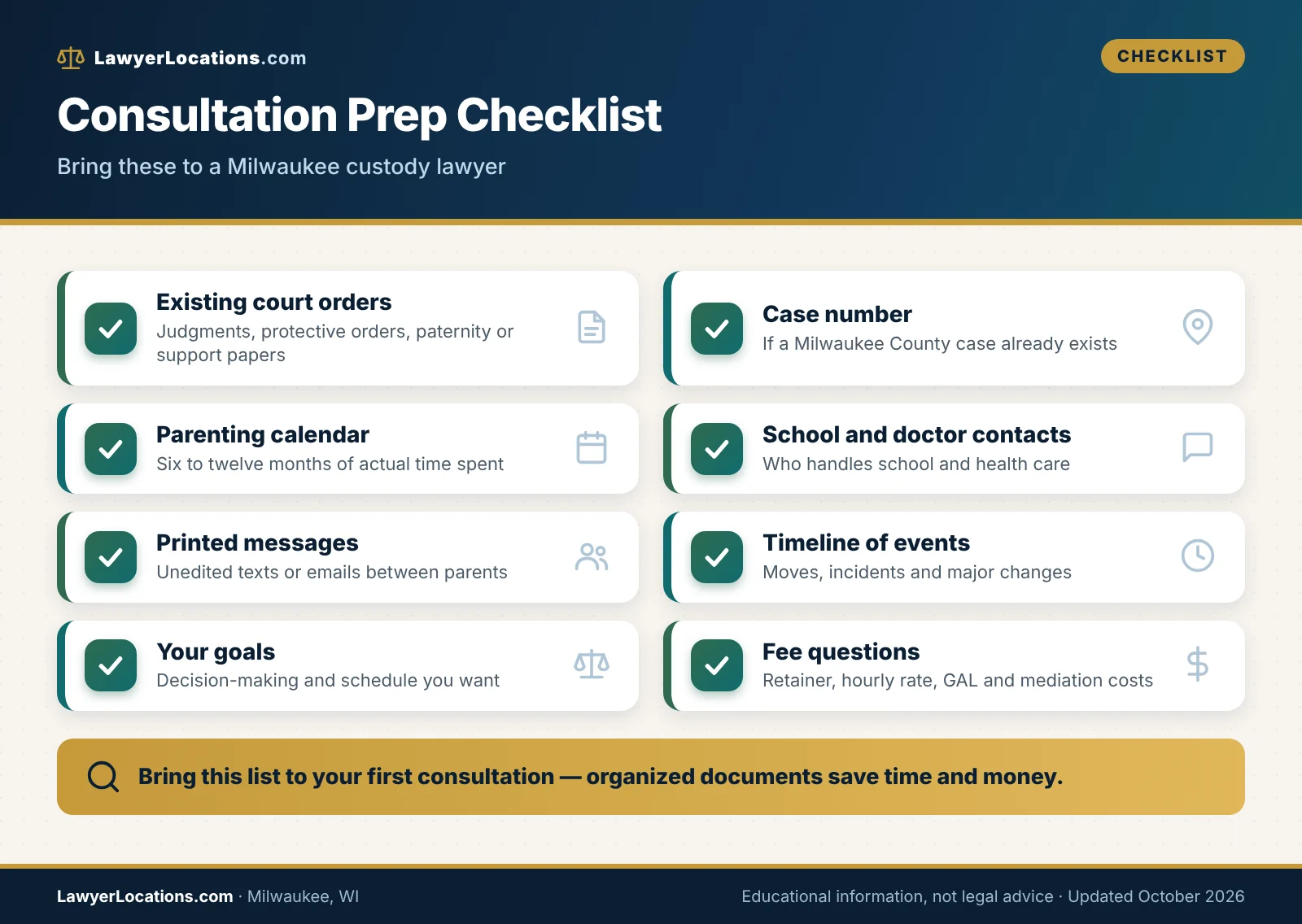
Text version of this graphic
- Existing orders and case number
- Six to twelve months of parenting calendar
- School and doctor contacts
- Printed messages between parents
- Timeline of moves and major events
- Your goals for decisions and schedule
- Questions about fees and GAL costs
- Safety concerns and any protective orders
Custody Lawyer Costs, Free Help and Decision Points in Milwaukee
The cost of a custody case depends mostly on how much the parents disagree. Agreed matters can move with limited lawyer time, while contested matters with a GAL, mediation, multiple hearings and sometimes experts cost much more. LawyerLocations.com does not publish fee “averages” because Wisconsin lawyers set their own rates and no official source supplies reliable ones, so use the cost factors below to ask better questions.
How Milwaukee Custody Lawyers Commonly Charge
Fee structures differ, and the structure often matters more than the headline rate. Ask which one applies and what happens when your retainer runs out.
Hourly billing with a retainer
Many family lawyers bill hourly against an advance deposit called a retainer. Time is billed as the lawyer or staff work, and you may be asked to replenish the deposit. Ask for an itemized invoice each month and for an estimate of the phases (temporary hearing, mediation, contested hearing) so you can budget.
Wisconsin’s ethics rules require fees to be reasonable, and fee agreements are the place to see what that looks like in practice. If the agreement is vague about who bills and at what rate, ask for clarity before you sign.
Flat fees and limited-scope arrangements
Some lawyers offer a flat fee for a defined task, such as drafting a stipulation, preparing a parenting plan, or reviewing an agreement before you sign. Others agree to limited-scope representation, where they handle only part of the case. This can lower cost for parents who are mostly in agreement or who want coaching and review but plan to appear in court themselves.
Custody cases rarely involve contingency fees. Contingent arrangements, where the lawyer is paid a share of a recovery, are generally not used in family cases and are limited by lawyer ethics rules in many domestic-relations matters, so ask pointed questions if anyone proposes one.
| Cost component | Who sets or charges it | What to ask or do |
|---|---|---|
| Lawyer’s retainer and hourly time | The law firm | Ask for the written fee agreement, billing increments, and a phase-by-phase estimate |
| County mediation | Milwaukee County Family Court Mediation Services | $100 per person per the county page; check the current page before paying |
| Guardian ad litem | Court sets a reasonable rate; parents may be ordered to pay | Ask how fees are usually allocated; request a hearing if you cannot pay |
| Parent education class | Approved program provider | Compare approved providers on the county list; ask about fee reductions |
| Court filing fees | Clerk of Circuit Court | Check the filing fee schedule linked on the county page; ask about Form CV-410A if you qualify for a waiver |
| Experts or evaluations | Third-party professionals | Ask whether any are likely, what they cost, and whether the court may allocate them |
Other Costs You May See
Beyond the lawyer, a few external costs show up in Wisconsin custody cases. They are predictable once you know where they occur.
Guardian ad litem and expert costs
Because § 767.407 requires a GAL when custody or placement is contested, many Milwaukee cases include GAL fees. The court decides the rate and who pays, and may order the costs split or assigned unevenly. If a GAL shows that an expert is necessary, the court can also order the parties to pay expert fees.
Ask your lawyer how the court has allocated GAL fees in similar matters, and plan a monthly budget around the possibility that your share will be substantial. Failing to pay a court-ordered GAL fee can lead to contempt proceedings, so tell your lawyer early if you cannot afford a payment.
Court, mediation and class costs
Court filing fees are set by the state and applied by the Clerk of Circuit Court, and the county’s Family Court page links to the filing fee schedule. Rather than quote an amount that may change, check the current schedule or ask the clerk. A fee waiver form is available if you cannot afford the fees.
Mediation is a modest cost compared with a contested hearing, and parent education programs are short. Both are small compared with prolonged litigation, which is why many lawyers encourage serious settlement efforts when the safety picture allows it.
Free and Lower-Cost Help in Milwaukee
Not every parent can afford full representation, and Milwaukee has more options than most people realize. These resources help with information, forms, or limited advice, not necessarily full representation.
Milwaukee Justice Center Family Forms Clinic
The Milwaukee Justice Center’s Family Forms Clinic is in the Milwaukee County Courthouse, 901 N. 9th Street, Room G9, on the ground floor near the Wells Street security checkpoint. According to the clinic’s listing on WisLawHelp, it offers free legal information and referrals on divorce, child support, custody and placement, and paternity, in English and Spanish, to people without an attorney who live in Milwaukee County or have a Milwaukee County case.
Walk-in help is generally first come, first served and demand can be high, with posted hours that vary by weekday. Check the current hours before you go, and note that the clinic provides legal information rather than representing you.
Lawyer referral, legal aid and the court’s own resources
The State Bar of Wisconsin’s Lawyer Referral Service describes a model in which a trained assistant assesses your situation and refers you to a local attorney who handles your type of issue, with panel attorneys charging no more than $20 for the first 30-minute consultation. The service lists phone numbers (800) 362-9082 and (608) 257-4666 and an online request form. Mention the referral when scheduling to get the rate.
The county’s Family Court page also lists Legal Action of Wisconsin, the Legal Aid Society of Milwaukee, the Sojourner Family Peace Center, the Wisconsin Court Family Forms Assistant and Wisconsin Circuit Court Access (WCCA) as helpful resources. Eligibility and case-type limits apply to legal aid providers, so call or apply early.
Divorce and custody are linked. If you are also deciding whether to divorce or separate, our guides on legal separation versus divorce and how long a divorce takes explain how the broader case affects timing.
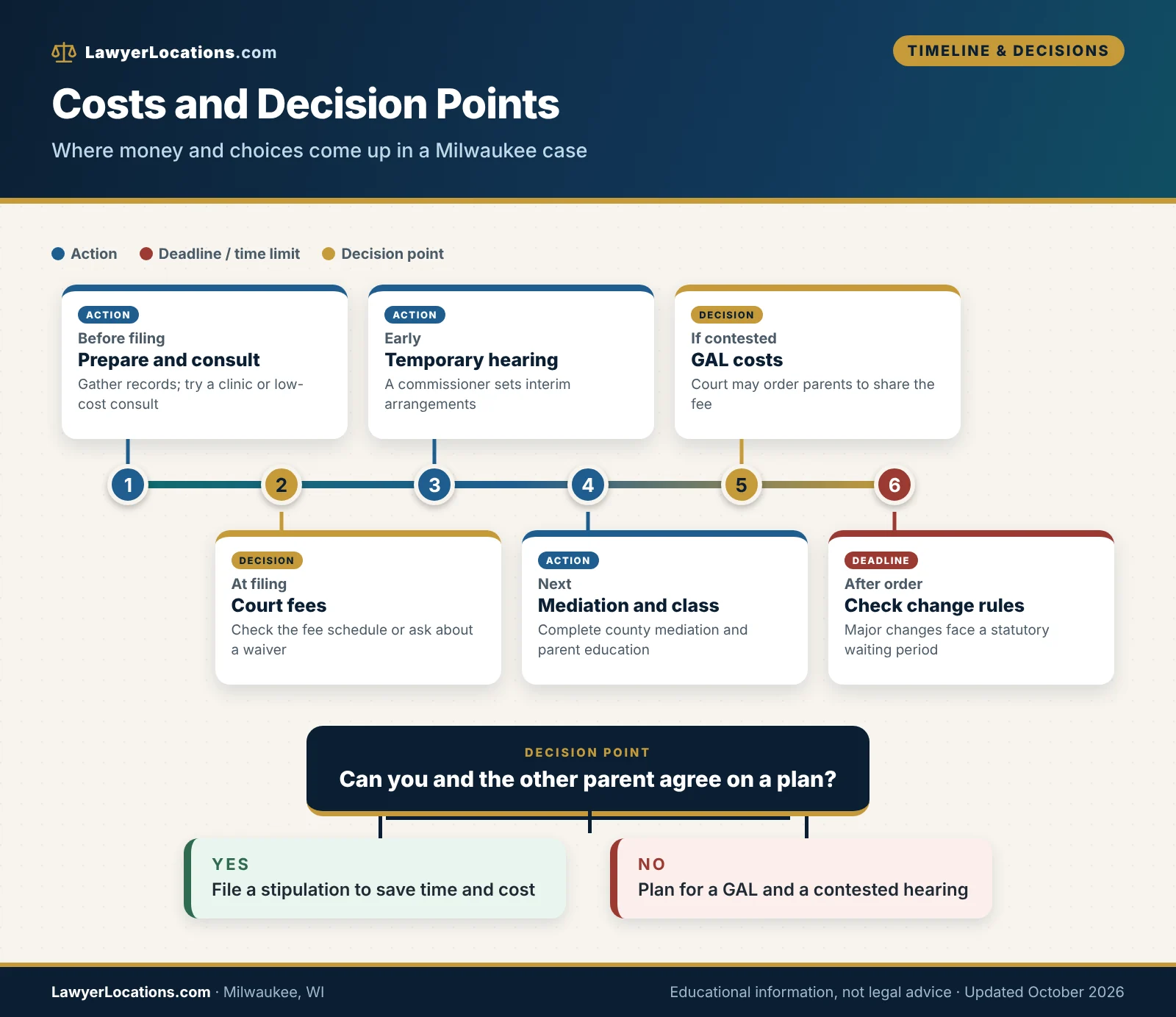
Text version of this graphic
- Before filing: gather documents, check residency, and consult a lawyer or the Family Forms Clinic.
- At filing: pay the filing fee or ask about a fee waiver; the case starts in Milwaukee County Circuit Court.
- Early hearings: a commissioner sets temporary arrangements and orders mediation or other steps.
- Mediation and parent education: complete county mediation and an approved class.
- If contested: a guardian ad litem is appointed and costs rise.
- Decision point: settle on a parenting plan, or go to a contested hearing before a judge.
- After the order: use the court to enforce, and wait for the statutory period before seeking major changes.
Decision question: Can you and the other parent agree on a parenting plan? If yes, a stipulation can reduce cost and delay. If no, plan for a GAL and a contested hearing.
Decision Points That Change Cost and Timing
Some choices move the budget more than any hourly rate. Recognizing them early gives you control.
Settle or go to a contested hearing
The biggest cost driver is whether the parents reach an agreement. A stipulated parenting plan approved by the court can end the case quickly, while a contested hearing adds preparation, a GAL, and more court time. Settlement is not surrender: a good agreement can be tailored to your child’s needs in ways a judge may not order.
That said, never accept a deal you do not understand just because it is cheaper. Have a lawyer review it, especially anything about decision-making, holidays, or future moves.
Temporary orders and when to ask for them
Early in a Milwaukee County case, a commissioner can set temporary legal custody and placement arrangements while the case continues. Those temporary arrangements often shape how the court views the “status quo” later, so they matter. Ask your lawyer whether a temporary hearing makes sense and what you should have ready.
Because temporary orders are made quickly on limited information, accuracy and organization matter more than volume. Clean exhibits, a realistic proposed schedule and a calm tone all help.
After the First Order: Changing, Moving and Enforcing Custody in Milwaukee County
A custody order is not permanent in every respect, but Wisconsin deliberately makes major changes harder than first-time decisions. Courts value stability for children, so the statute sets waiting periods and standards that a Milwaukee parent needs to understand before filing a motion.
Changing a Custody or Placement Order
The right path depends on how much time has passed and whether the change is major or minor. Wis. Stat. § 767.451 governs revisions of legal custody and physical placement orders.
The two-year rule and the harm exception
Under § 767.451(1)(a), a court generally may not modify an order of legal custody, or a placement order that substantially alters the time a parent may spend with the child, before two years after the final judgment. Two-year waiting period An early change requires a showing, by substantial evidence, that the current conditions are physically or emotionally harmful to the child’s best interest.
That exception is narrow. A disagreement over schedule preferences or a change in a parent’s mood does not meet it. If you believe a child is being harmed, document the facts and speak to a lawyer promptly, because waiting may let the situation worsen.
Changes after two years
After the waiting period, the court may modify if the change is in the child’s best interest and there has been a substantial change of circumstances since the last order. The statute adds rebuttable presumptions favoring the current legal custody arrangement and the current primary placement. A change in a parent’s income or marital status, by itself, is not enough.
The statute also treats equal placement differently: if equal placement has become impractical, a court may modify it when the change serves the child’s best interest. Minor modifications that do not substantially alter a parent’s time are governed by a more flexible best-interest standard in § 767.451(3). The court may also modify placement at any time if a parent has repeatedly and unreasonably failed to use scheduled placement time.
| Situation | General standard | Practical point |
|---|---|---|
| Major change within two years of the judgment | Substantial evidence that current conditions are harmful to the child | A high bar; document specific facts and consult a lawyer quickly |
| Major change after two years | Best interest plus a substantial change of circumstances; presumptions favor the status quo | Money or marital changes alone are not enough |
| Equal-placement order that no longer works | Court may modify if equal placement is impractical and the change serves the child | Be ready to explain what changed in practice |
| Minor schedule adjustments | Best interest of the child | Often resolved by written agreement filed with the court |
| Parent repeatedly misses placement time | Court may modify at any time if the failure is repeated and unreasonable | Keep a log of missed time |
The statute’s waiting periods and the short windows for objecting or asking for review of a commissioner’s ruling can pass quickly. If you receive a motion, a notice, or a ruling you disagree with, ask the clerk or your lawyer immediately about the deadline that applies to you.
Moving With a Child: Relocation Rules
Moves are among the most disputed custody events in Milwaukee, which sits within an easy drive of other states and counties. Wisconsin treats a move that affects the other parent’s time as a legal event, not just a personal decision.
When you need court permission or notice
Wis. Stat. § 767.481 sets a distance threshold, measured in driving miles from the other parent, above which a parent with court-granted placement must file a motion seeking permission to relocate the child, with a relocation plan, or give written notice in certain situations. The statute describes timelines for objections, an initial hearing, and appointment of a guardian ad litem. A parent who relocates a child without following the statute risks consequences in the case.
Read § 767.481 in full or ask a lawyer before you sign a lease, enroll the child in a new school, or tell the child about a move. Also note that a custodial parent must notify the other parent before taking the child out of the residence for an extended period, unless an order provides otherwise.
How courts weigh a contested move
If a move only minimally affects the placement schedule, the court generally approves it. Otherwise, the court applies the § 767.41(5) factors and the child’s best interest, with burdens that can shift depending on circumstances such as whether the objecting parent has significantly used placement time or the move relates to abuse. A mediator and a GAL are typically involved.
A strong relocation case, or a strong objection, usually has a detailed plan: the new school, the transportation schedule, how the other parent’s time will be preserved, and who pays for travel. Vague plans do poorly in either direction.
Enforcing an Order When the Other Parent Does Not Comply
An order only matters if it is followed. When it is not, Milwaukee County gives you a path, but it works best if you have documentation.
Using the court to enforce placement and decision-making
The county’s page explains that post-judgment enforcement and modification hearings are heard by commissioners and lists a contempt form among its Milwaukee County family forms. Enforcement typically starts with a written motion that describes exactly which part of the order was violated, when, and how.
Before filing, consider whether a written reminder or a short mediated conversation could fix a recurring problem. Courts like to see that a parent made a reasonable attempt to resolve the issue before escalating, and your lawyer can advise whether a motion is proportional to the problem.
Keeping a clean, factual record
keep a dated log of missed exchanges, late arrivals, canceled calls and messages. Save texts and emails in their original form and avoid retaliating by withholding the child, because that can create a violation of your own. If safety is at issue, tell the court and seek help from an advocate right away.
Neutral language is more persuasive than anger. A log that reads like a calendar tells the court what happened without sounding like an argument.
Evidence, Mistakes to Avoid and Your Next Steps
Most custody cases are won or lost on ordinary facts presented in an orderly way. The final section ties together what to collect, what to avoid, and how to take the next step in Milwaukee without wasting money.
Evidence and Documents That Actually Help
Courts hear from many parents who say they are the better caregiver. Evidence shows the pattern behind the claim.
Records of day-to-day parenting
School records, medical appointments, activity schedules, child care arrangements and parenting-app logs show who has been doing the daily work of raising the child. This lines up with the statutory factors about past time with the child and the child’s adjustment to home, school and community.
- School communications, report cards and attendance notices
- Pediatric and dental appointment records showing who attended
- Work schedules and proof of child care arrangements
- Photos and records of ordinary routines, not only special events
- Names of neutral witnesses such as teachers, coaches or child care providers
Communications and safety documentation
Messages between parents are often the most revealing evidence of cooperation. Print or export them without editing, and keep the context. If there are safety concerns, preserve police reports, protective-order paperwork and medical records, and share them with your lawyer or an advocate.
Do not record conversations or access the other parent’s accounts in ways that may be illegal. Ask a lawyer what is permitted before collecting anything that is not plainly yours.
Common Mistakes and Red Flags
Most avoidable harm comes from reactions made in the heat of the moment. The following patterns repeatedly weaken parents’ positions.
Mistakes parents make
- Posting about the case, the other parent, or the child on social media
- Withholding placement time because of a support or money dispute (the statute bars denying or granting placement based on financial obligations)
- Using the child as a messenger or asking the child to choose sides
- Ignoring a hearing notice, a mediation request, or the parenting class requirement
- Moving or enrolling the child in a new school without following the legal process
- Signing a stipulation you do not understand because you are tired of the dispute
Judges and commissioners notice a parent who supports the child’s relationship with the other parent, which is an explicit factor in § 767.41(5)(am). Cooperation, where it is safe, is not weakness.
Red flags in the hiring process
Be cautious about any lawyer or service that pressures you to sign immediately, will not put fee terms in writing, promises a specific result, or discourages you from reading court papers yourself. Also be cautious about websites that look like official court pages but sell leads, since the legal-aid and court resources above are free to use.
If you are comparing options in a different state, note that custody rules vary by state. For example, our Jacksonville custody guide covers Florida, which has its own statutes and courts, and the Wisconsin material here should not be applied elsewhere.
Long-Tail Questions Milwaukee Parents Ask
The questions below come up often in consultations. The answers are general and depend on your facts.
How to use these answers
These answers are starting points for a conversation with a licensed lawyer, not predictions about your case. Where a statute or county page is the source, check the current version before you rely on a detail.
Quick answers on cost, timing and fairness
How much does a child custody lawyer in Milwaukee cost?
It depends on the lawyer’s hourly rate or flat fee, the size of the retainer, and how contested the case is. Add GAL fees, county mediation, and any expert costs. Ask for a written fee agreement and a phase-by-phase estimate rather than relying on a general figure.
Do I need a lawyer for a custody case in Milwaukee County?
Wisconsin does not require you to have one, and the Milwaukee Justice Center helps people without attorneys. But contested custody, safety concerns, relocation and complicated schedules are areas where legal advice often pays for itself. At minimum, consider a consultation.
Does Wisconsin favor mothers over fathers?
No. Section 767.41(5)(am) says a court may not prefer one parent based on sex or race. The court looks at the child’s best interest using the statutory factors.
What does joint legal custody mean in Wisconsin?
It means both parents share major decisions about the child, such as education and non-emergency health care. It is the presumed starting point under § 767.41(2), and it does not decide how the child’s time is divided.
Will my child get to choose which parent to live with?
The child’s wishes are one factor, weighed with age and maturity. A GAL must consider the child’s wishes but is not bound by them. The court makes the final decision.
Is mediation required in Milwaukee County?
Wisconsin law generally directs custody and placement disputes to mediation before a contested hearing, with exceptions for safety and hardship. The county’s mediation program charges $100 per person according to its Family Court page. Ask the commissioner or your lawyer how it applies to your case.
Who is the guardian ad litem and who pays?
A GAL is a Wisconsin attorney appointed to advocate for the child’s best interest. The court sets the rate and may order one or both parents to pay. In limited cases where both parents are indigent, the county may be directed to pay.
Can I change the order if my circumstances change?
Possibly, but Wisconsin generally imposes a two-year wait for major changes unless you show harm to the child. After that, you need a substantial change of circumstances and a best-interest showing. Minor schedule changes follow a lighter standard.
Can I move out of the Milwaukee area with my child?
If the move crosses the distance threshold in § 767.481 and affects the other parent’s time, you generally need to follow the motion or notice process. Moving first and asking later can seriously hurt your case.
What if the other parent is not following the order?
Document each violation and talk to a lawyer about a motion in Milwaukee County Circuit Court. Commissioners hear enforcement and modification matters. Do not take matters into your own hands by withholding the child.
Where can I get free custody help in Milwaukee?
The Milwaukee Justice Center Family Forms Clinic in Room G9 of the courthouse offers free legal information for people without lawyers. Legal Action of Wisconsin and the Legal Aid Society of Milwaukee are also listed by the county as resources, subject to eligibility.
Your Next Steps
You do not have to solve everything this week. A short, ordered plan keeps you moving without spending money on guesswork.
A simple action plan
- Write your timeline. Capture where the child has lived and who has done what, in plain dates.
- Gather your documents. Collect orders, school and medical contacts, and communications.
- Get oriented. Visit the Milwaukee Justice Center Family Forms Clinic or the county’s Family Court page for forms and instructions.
- Interview lawyers. Use the scorecard above, ask about fees, and consider a State Bar referral for an affordable first meeting.
- Handle safety first. If you or your child are at risk, contact an advocate and tell your lawyer immediately.
- Plan for mediation and classes. Register for the parent education program and prepare a concrete parenting plan.
Related Wisconsin planning
If you are also thinking about who would care for your child if something happened to you, that is an estate-planning question rather than a custody-court question. Our guide to estate planning attorneys in Wisconsin explains how guardian nominations and wills fit into the picture.
When you are ready to compare child custody lawyers in Milwaukee, WI, bring the checklist and scorecard from this guide, ask for fee terms in writing, and choose the person you trust to explain the process clearly.
Ready to compare your options?
Use the questions and checklist above to interview at least two Wisconsin-licensed family lawyers, and ask each how they would handle your Milwaukee County case, costs included. LawyerLocations.com is an educational resource and does not guarantee outcomes or recommend a particular attorney.
General information only. This guide is educational and is not legal advice. Reading it does not create an attorney-client relationship with LawyerLocations.com or anyone else. Laws, court rules, fees and local procedures change, so confirm current requirements with the Milwaukee County Clerk of Circuit Court, the Wisconsin court system, and a lawyer licensed in Wisconsin before you act.
Sources & References
Show all 11 sources
- Wis. Stat. § 767.41, Custody and physical placement — WomensLaw.org (statute text mirror) — womenslaw.org — accessed October 2026
- Wis. Stat. § 767.41(1m), Parenting plan — Wisconsin Legislature — docs.legis.wisconsin.gov — accessed October 2026
- Wis. Stat. § 767.451, Revision of legal custody and physical placement orders — WomensLaw.org (statute text mirror) — womenslaw.org — accessed October 2026
- Wis. Stat. § 767.451, Revision of orders — Wisconsin Legislature — docs.legis.wisconsin.gov — accessed October 2026
- Wis. Stat. § 767.481, Relocating a child’s residence — WomensLaw.org (statute text mirror) — womenslaw.org — accessed October 2026
- Wis. Stat. § 767.405, Family court services — Wisconsin Legislature — docs.legis.wisconsin.gov — accessed October 2026
- Wis. Stat. § 767.407, Guardian ad litem for minor children — WomensLaw.org (statute text mirror) — womenslaw.org — accessed October 2026
- Family Court — Milwaukee County Clerk of Circuit Court — county.milwaukee.gov — accessed October 2026
- Milwaukee Justice Center Family Forms Clinic — WisLawHelp.org — wislawhelp.org — accessed October 2026
- Lawyer Referral and Information Service — State Bar of Wisconsin — wisbar.org — accessed October 2026
- Self-help law center and self-represented litigant resources — Wisconsin Court System — wicourts.gov — accessed October 2026
Legal Disclaimer and Limitation of Liability
Informational and illustrative purposes only. This article was prepared by LawyerLocations.com solely on the basis of the information available to us at the time of writing. It is an illustrative, general overview. It is not a complete or authoritative statement of the law, and it has not been reviewed by a lawyer licensed in your state or county.
Not legal advice. Nothing in this article is legal, financial, tax or immigration advice, and reading it does not create an attorney-client relationship between you and LawyerLocations.com or any author, lawyer or firm mentioned. Laws, court rules, fees, filing deadlines and agency procedures differ by state, county and court, and they change often. Some details here may be simplified, incomplete or out of date, and time limits for legal claims can be short.
No warranty. We make no representation or warranty, express or implied, about the accuracy, completeness, timeliness or suitability of this content for your situation. Please do not rely on it to make, delay or skip any legal decision. Check the facts against official sources and speak with a licensed attorney in the relevant jurisdiction before you act.
Limitation of liability. To the fullest extent permitted by law, LawyerLocations.com and its owners, authors and contributors disclaim all liability for any loss, damage, cost or other consequence arising from the use of, or reliance on, this article, including any content on third-party websites we link to. Mentioning a lawyer, firm, organization or service is not an endorsement and is not a promise of any result. If you are in immediate danger, contact your local emergency number.