A green card lawyer Colorado Springs CO residents hire does four jobs: picks the right permanent-residence pathway, screens your history for problems before anything is filed, prepares the forms and evidence, and represents you with USCIS. Green card rules are federal and identical in every state, so what is local is logistics: interviews and immigration court hearings for the Pikes Peak region are generally handled in the Denver metro area, your records come from El Paso County and Colorado offices, and the Colorado courts publish a legal assistance directory if cost is a barrier.
This guide, current as of October 2026, explains how a case moves, which pathway may fit, how to check a lawyer, how fees work, and how to avoid “notario” fraud. Use only a licensed attorney or a DOJ-accredited representative, and get the fee agreement in writing before you pay.
How a Green Card Lawyer Case Works in Colorado Springs, CO
A green card case moves in stages: choose a pathway, gather proof, file, attend biometrics and any interview, answer requests for more evidence, and receive a decision. A lawyer’s real value is running that sequence correctly the first time, because a mistake on a permanent-residence application can be costly and sometimes impossible to undo.
What a green card lawyer actually does for you
Many people picture a lawyer as someone who fills in forms. The forms are the easy part. The harder work is deciding which forms, in which order, and whether filing at all is safe given your history.
Screening your eligibility before anything is filed
A good first consultation covers how you entered the country, whether you have ever overstayed, worked without permission, been arrested, been denied a visa, or made statements to an official that might not match your paperwork. These facts feed into the grounds of inadmissibility, the legal reasons the government may refuse a green card even when you qualify through family or work.
Screening is the step people most often skip when they use a form-preparation service instead of a lawyer. Filing first and discovering a problem later can put you in front of an immigration judge instead of a USCIS officer, so ask any lawyer you meet how they check for these issues before they take your money.
Preparing, filing and tracking the case
Once the pathway is chosen, the lawyer assembles the petition and application, the supporting evidence, translations, and the Form G-28 notice that tells the government they represent you. After filing, USCIS sends receipt notices to you and, if a G-28 was filed, to the lawyer.
From there the lawyer tracks the online case status, calendars every notice, and responds if USCIS sends a Request for Evidence (RFE). You still sign everything and you remain responsible for telling the truth on every page, so read what is filed in your name.
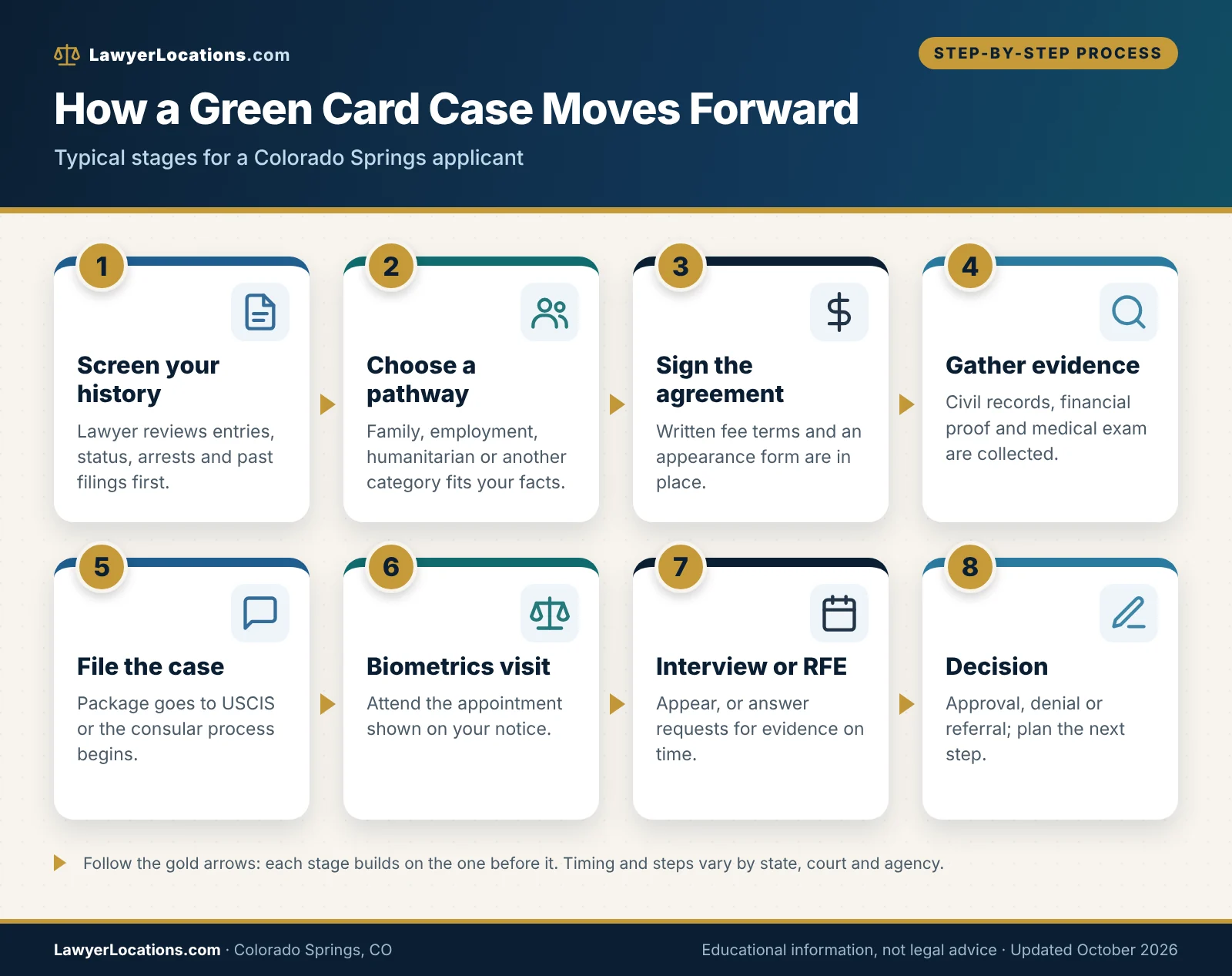
Text version of this graphic
- Consultation and screening: review history, goals and documents.
- Choose the pathway: family, employment, humanitarian or other.
- Sign a written fee agreement and a Form G-28 appearance form.
- Collect evidence: civil records, financial documents, medical exam.
- File with USCIS (or the National Visa Center and a consulate for cases abroad).
- Receive receipt notices, then attend biometrics at the appointment site on your notice.
- Interview if USCIS schedules one; respond to any Request for Evidence by its deadline.
- Decision: approval, denial, or referral; plan the next step with your lawyer.
The stages of a case, in order
Every case has its own timeline, but the sequence is predictable. Knowing the stages helps you spot when something is off, such as a notice you never received.
Filing, receipt notice and biometrics
After you file, USCIS issues a receipt notice (Form I-797C) that lists your receipt number. That number lets you check case status online, and it proves the application is pending. Keep every notice in one folder.
USCIS then schedules a biometrics appointment so it can take fingerprints and a photo for background checks. Go to the appointment location printed on your notice, bring the notice and photo ID, and tell your lawyer right away if you cannot attend. Rescheduling is possible, but silence is how applications get denied for abandonment.
Interview, requests for evidence and the decision
Many family-based green card applicants are interviewed; some employment-based and other cases are decided without one. If you are called in, the officer asks about the information on your forms and, for marriage cases, about your relationship. Your lawyer can usually attend with you.
If something is missing, USCIS sends an RFE with a response deadline printed on it. Answer by the date on the notice, with everything requested, in one package. The final decision arrives by mail; an approval is followed by your physical card, and a denial states reasons that your lawyer reviews for possible next steps.
Never treat a USCIS notice as optional reading. Missing a response date on an RFE or a no-show at an interview can lead to a denial. If you move, file a change of address with USCIS and tell your lawyer the same day.
Adjustment of status versus consular processing
There are two ways to complete a green card: adjustment of status from inside the United States, or consular processing through a U.S. embassy or consulate abroad. Which one applies depends on your immigration history, your category, and whether you are lawfully present.
Adjusting status from inside the United States
Adjustment generally requires that you were inspected and admitted or paroled into the country, and it comes with eligibility rules and bars that depend on your category. The application, Form I-485, is filed with USCIS, and the case is handled in the United States, usually with an interview at a USCIS office.
While an I-485 is pending, you may apply for a work permit and for advance parole, a travel document. Leaving the country with a pending I-485 and no advance parole can be treated as abandoning the application, with limited exceptions for certain work-visa holders. Ask your lawyer before any trip, even a short one.
Consular processing through a U.S. embassy or consulate
If you live abroad, or you are not eligible to adjust, the petition is approved in the United States and the case then moves to the State Department’s National Visa Center and a consulate. You attend a visa interview overseas and receive an immigrant visa, which becomes your green card when you enter the United States.
For people who have been in the U.S. without permission, leaving to consular process can trigger multi-year reentry bars. Federal rules offer a waiver path in some situations, but the decision to leave is one of the highest-stakes calls in immigration law. Do not depart the United States to “fix” your status until a licensed lawyer has reviewed your history.
The same federal system applies whether you live in Colorado Springs, Denver or anywhere else. If you want to compare how another large city frames the process, see our guides to a green card lawyer in Houston, TX and a green card lawyer in Boston, MA, or the national overview at green card lawyer.
Which Green Card Pathway Fits Your Situation
Most green cards come through family, employment, or a humanitarian route, and each has a different first filing, a different wait, and different risks. Your lawyer’s first task is matching you to the pathway that fits your facts, not the one that sounds fastest on a website.
Family-based green cards
Family sponsorship is the most common route for people in Colorado Springs, including many military and veteran families. The sponsor is a U.S. citizen or a green card holder, and the relationship decides how long the process takes.
Immediate relatives of U.S. citizens
Spouses of U.S. citizens, unmarried children under 21, and parents of adult citizens are called immediate relatives. There is no annual cap on visa numbers for this group, so there is no multi-year wait for a number to become available.
The petition is Form I-130, and applicants who are in the United States and eligible to adjust can often file the I-485 at the same time. Marriage-based cases draw close attention to whether the marriage is genuine, so the quality of your joint evidence matters more than the quantity. A lawyer helps you choose proof that tells a consistent story: shared lease or mortgage, joint finances, photos over time, and statements from people who know you as a couple.
Family preference categories and the Visa Bulletin
Other relatives fall into numbered preference categories: adult sons and daughters of citizens, spouses and unmarried children of green card holders, married children of citizens, and siblings of adult citizens. These categories have annual limits, so applicants wait for a visa number to become current.
The State Department publishes a monthly Visa Bulletin showing which priority dates are current by category and country of chargeability. Waits depend heavily on your country of birth, and they can move forward or backward. Ask your lawyer to explain your priority date, what to check each month, and whether any life change, such as a marriage or a child turning 21, would change your category.
Employment-based green cards
Employment-based green cards are divided into five preference categories, from priority workers to investors. Colorado Springs has a sizable aerospace and defense presence alongside its healthcare and technology employers, so employer sponsorship can be a realistic pathway for some foreign professionals in the area.
Employer-sponsored categories
In many employer-sponsored cases, the employer first goes through a labor certification process with the Department of Labor to show there is no qualified, available U.S. worker for the role, then files an immigrant petition with USCIS. After that, the worker either adjusts status or consular processes, depending on eligibility and whether a visa number is available.
Because the employer files and often pays for the petition, your interests and the employer’s can differ. Ask who your lawyer represents. A company’s immigration counsel typically represents the company, and you may want your own advice on your rights, your timeline, and what happens if you change jobs.
Self-petitions for exceptional ability and national interest
Some people can petition for themselves without an employer. The extraordinary-ability category and the national interest waiver category are examples, and each has demanding evidence standards that are judged by USCIS officers on the record you submit.
These cases succeed or fail on how well the evidence is organized and explained. If you are considering a self-petition, a consultation is a good time to ask how the lawyer evaluates the strength of a case before accepting it, and what happens if the evidence turns out thinner than hoped.
Humanitarian and other routes
Some people qualify for permanent residence because of a protection they already hold or because of a special federal program. These routes can be more complex and fact-heavy than family or employment cases.
Asylum, refugee status, VAWA, U and T visas
People granted asylum or refugee status can generally apply for a green card after meeting time and eligibility requirements. Self-petitioners under the Violence Against Women Act (VAWA), and certain crime and trafficking victims who hold U or T status, may also have routes to permanent residence after meeting statutory conditions.
These cases often involve sensitive, painful facts and strict confidentiality rules. If you are in this situation, ask whether the lawyer or nonprofit has handled these specific case types, and how they protect your privacy. You should never be pressured to share more detail than the consultation requires.
Diversity visa and other special categories
The Diversity Visa lottery, certain special immigrant categories, and a few long-standing programs also lead to green cards. Each has its own deadlines, annual selection cycles, and document rules that are published by the government and change over time.
Scams cluster around the lottery in particular. Only the official government entry process is legitimate, and anyone who guarantees selection is not telling you the truth. A lawyer can tell you whether you qualify for a special category that you may not know exists, such as a family-based or special immigrant route that avoids the lottery altogether.
| Pathway | Who it commonly fits | Usual first step | Key question for your lawyer |
|---|---|---|---|
| Immediate relative of a U.S. citizen | Spouse, unmarried child under 21, or parent of an adult citizen | Form I-130 petition, sometimes with Form I-485 | Am I eligible to adjust here, or must I consular process? |
| Family preference | Other relatives of citizens, and relatives of green card holders | Form I-130, then a wait for a visa number | What is my priority date and how long might it take for my country? |
| Employment-based | Workers sponsored by an employer, or qualifying self-petitioners | Labor certification (many cases) and Form I-140 | Who is my client here, and what happens if I change jobs? |
| Asylee or refugee | People already granted protection in the U.S. | Form I-485 after meeting time and eligibility rules | Do I meet the timing and documentation requirements now? |
| VAWA, U or T | Qualifying victims who hold or seek the underlying status | Self-petition or status application, then adjustment | How will you protect my confidentiality and safety? |
| Diversity Visa | People selected through the annual government lottery | Follow the State Department’s selection instructions | Is my selection genuine and my deadline still open? |
Bring a one-page timeline of every entry and exit, every status you have held, and every address since you arrived. It lets a lawyer spot pathway and eligibility problems in the first meeting and keeps the consultation focused. If your case may involve a work visa instead, our visa lawyer guide explains how those cases differ.
Colorado Springs Logistics: Offices, Military Community, Records and Local Help
The law is federal, but the practical side of a Colorado Springs case is local. Where you go for appointments, which county office holds your marriage record, and who can help at low cost all depend on where you live, so this section is about the Pikes Peak region specifically.
Where your paperwork and appointments actually go
Colorado Springs is Colorado’s second-largest city and sits in El Paso County, roughly an hour or more by car south of the Denver metro area depending on traffic. Most federal immigration offices that serve Colorado are concentrated in that Denver area.
USCIS appointments in the Denver region
Most green card applications are mailed to a USCIS lockbox or filed online where available, so filing itself does not require travel. Biometrics and interviews are different: they are scheduled at a physical location, and for Pikes Peak applicants that is commonly an office in the Denver region. Your appointment notice is the only authority on where and when you must appear, so check it as soon as it arrives.
Plan the logistics well ahead. Ask your lawyer whether they will attend in person or remotely, build in travel time on Interstate 25, and arrange childcare or work leave early. If getting to Denver is a hardship, tell your lawyer immediately, because some requests to change a location or date must be made through official channels and with documented reasons.
Immigration court if a case turns adversarial
Most green card cases never reach an immigration judge. But if USCIS denies a case and refers it, or if you have an older enforcement history, the case can move to immigration court, which is part of the Justice Department’s Executive Office for Immigration Review. Colorado’s immigration courts are in the Denver metro area, in Denver and Aurora, and there is no immigration court in Colorado Springs itself.
That has a practical effect on lawyer choice: if your case could end up in court, you want a lawyer who regularly appears there and will not charge a surprise travel fee for each hearing. For more on how court-based defense differs from a green card filing, our deportation defense guide for Phoenix explains how removal proceedings work in general.
If you receive a Notice to Appear or any paper that mentions an immigration court date, stop and speak to a licensed lawyer or accredited representative immediately. Missing a hearing can lead to an order of removal in your absence.
Military families and the Pikes Peak installations
The Colorado Springs area is home to Fort Carson, Peterson Space Force Base, Schriever Space Force Base, the Air Force Academy and other military and defense facilities. That makes military and veteran families a large share of the local community, and their immigration questions have some distinctive features.
Sponsoring and being sponsored by service members
A U.S. citizen service member who sponsors a spouse, child or parent is using the same immediate relative route as any other citizen. Federal rules treat some military sponsors differently on certain requirements, including the financial support affidavit threshold, so a lawyer should check whether that applies to you rather than assume.
Deployments and reassignments add scheduling risk. A move to another installation, or an overseas posting, can change which office handles your case and can collide with interview dates. Tell your lawyer about orders as soon as you receive them, not after a notice has already gone to the wrong address.
Questions specific to military life
Military installations have legal assistance offices that help service members and families with many civil matters. Their scope varies, and immigration representation is often limited, so ask what the office can do before relying on it.
Ask a private lawyer or accredited nonprofit whether any military-family-specific discretionary options may apply to your situation and whether they are currently available, since these policies can change. If your family member is a veteran or in a reserve component, mention that in your first meeting, because it can affect eligibility options and what evidence helps.
Local records, legal aid and referral options
Green card cases are built on documents. Some of those come from local government offices, and getting them early prevents delays at the filing stage.
Collecting El Paso County and Colorado records
If you married in El Paso County, the county clerk and recorder’s office is where marriage license records are kept and certified copies are requested. If you divorced in Colorado, the court that issued the decree holds it, and that is commonly the district court for the county where the divorce was filed. Colorado-born applicants request birth records through the state’s vital records system.
Foreign documents need certified translations that meet USCIS standards. Order certified copies and translations before your consultation if you can, because a lawyer can then advise on a complete set of records instead of an incomplete one.
Low-cost and nonprofit help in the Pikes Peak region
Several resources are worth checking if private fees are out of reach. Catholic Charities of Central Colorado lists immigration services for the Colorado Springs area on its website, and the ImmigrationLawHelp.org directory lists nonprofit providers by location and case type. The Colorado Judicial Branch also publishes a legal assistance handout that points to statewide legal aid and referral programs.
Services, eligibility and waiting lists change, and some programs do not handle immigration. Call ahead and ask three things: do you handle my specific case type, who actually does the work (an attorney or an accredited representative), and what does it cost. The Justice Department’s Executive Office for Immigration Review also maintains lists of pro bono legal service providers that can help you find free help in or near court proceedings.
| Task | Where it usually happens | What to confirm first |
|---|---|---|
| Marriage certificate (married in El Paso County) | El Paso County Clerk and Recorder | Certified copy requirements and processing time |
| Divorce decree from a prior marriage | The court that issued the decree, often a Colorado district court | That you have a certified copy showing the final date |
| Birth record for a Colorado-born applicant or child | Colorado vital records system | Who is allowed to request it and acceptable ID |
| Biometrics and USCIS interview | Location printed on your USCIS notice, commonly in the Denver region | Date, time, and what to bring |
| Immigration court hearing (if one ever arises) | Denver or Aurora immigration court, per the hearing notice | Court, date, and whether your lawyer has filed an appearance |
| Free or low-cost help | Local nonprofits, ImmigrationLawHelp.org, Colorado Judicial Branch handout | Eligibility, case types handled, and who does the work |
How to Compare Green Card Lawyers in Colorado Springs, CO
Compare green card lawyers on four things: whether they are legally allowed to represent you, how they explain your case, how they charge, and how they communicate. Reputation matters less than whether the answers you get are specific to your facts. LawyerLocations is a legal-education resource, not a law firm, and does not rank or recommend lawyers.
Confirm the person is allowed to represent you
Immigration is one of the few areas where people who are not lawyers regularly offer “help” for a fee. Before you talk about price, confirm who you are dealing with.
Licensed attorneys versus accredited representatives
Two groups may generally represent people before USCIS: attorneys who are members in good standing of a state bar, and accredited representatives who work for Justice Department-recognized nonprofit organizations. Federal rules do not require an immigration lawyer to be licensed in the same state where you live, so a Colorado Springs applicant may legitimately hire a lawyer based in Denver or elsewhere.
A notary public, a “visa consultant,” a tax preparer or a travel agent is none of these. Ask directly: “Are you a licensed attorney, and in which state?” write down the answer If the person works for a nonprofit, ask whether the organization is recognized and whether the person is an accredited representative.
Checking standing with the regulator
Colorado lawyers are regulated by the Colorado Supreme Court’s Office of Attorney Regulation Counsel, which maintains public information about licensed attorneys and discipline. Use it to confirm a Colorado license and to see whether any public discipline exists. If the lawyer is licensed in another state, check that state’s bar the same way.
The Justice Department’s Executive Office for Immigration Review also runs an attorney discipline program that covers lawyers who practice before immigration courts and the Board of Immigration Appeals. A clean record is not proof of quality, but a discipline record or a license problem is information you want before you sign anything.
Fees, fee agreements and what the price includes
Immigration lawyers commonly quote a flat fee for a defined set of services, but what that fee actually covers varies a great deal. Comparing quotes only works if you compare the same scope.
How immigration lawyers commonly charge
Straightforward family or employment filings are often priced as a flat fee that covers the forms and evidence review, sometimes with separate charges for interview preparation, responses to RFEs, or appeals. More complex or uncertain matters can be hourly or use a retainer. Contingency fees, where the lawyer is paid only if you win, are generally not how green card cases are billed.
Government filing fees are separate from attorney fees in nearly every arrangement, and USCIS filing fees are generally non-refundable even if the application is denied. Ask whether the lawyer’s fee is refundable if the case ends early, and whether any part of it is held in a trust account until work is done.
| Structure | How it works | Questions to ask |
|---|---|---|
| Flat fee | One price for a defined package of work | Exactly which forms, meetings, RFE responses and interview prep are included? |
| Staged flat fee | Separate prices for the petition, the application, the interview and any later steps | What is the total if every stage is needed, and can I stop between stages? |
| Hourly with retainer | You deposit money; the lawyer bills time against it | What is the hourly rate, who bills, and how often will I see an itemized statement? |
| Payment plan | A flat fee paid in installments | Does work start before payment is complete, and is there any interest or late fee? |
| Nonprofit or sliding scale | Fees tied to income or eligibility rules | What documents prove eligibility, and what case types do you handle? |
Reading the fee agreement
The Colorado Rules of Professional Conduct address lawyer fees and require them to be reasonable. In practice, that means you should see a written agreement that names the scope of work, the fee, how payments are handled, and what happens if you end the relationship early. Do not rely on a verbal promise about what is included.
Ask each lawyer to put their quote in writing as a short scope-of-work list. When you line up two or three quotes side by side, the real differences usually show up in the list of what is excluded, not in the headline number.
Questions to ask at the first consultation
A consultation is a two-way interview. You are checking whether the lawyer understands your situation, and they are checking whether they can take the case. Go in with a list.
Questions about your case
Ask which pathway they think fits and why, what the biggest risks are in your history, what could cause a denial, and what the realistic range of timelines is, without a promise of speed or outcome. A trustworthy answer includes uncertainty. Ask how they handle it if USCIS requests more evidence or schedules an interview in the Denver area.
A lawyer who guarantees approval, claims a special relationship with immigration officers, or tells you not to worry about your arrest or overstay history is giving you a reason to walk away. No lawyer controls a government decision, and honest candor about risk is a sign of competence.
Questions about working together
Ask who will actually work on the file, whether you will speak to the lawyer or a paralegal, how quickly messages are answered in ordinary cases, and whether interpreters or bilingual staff are available. Ask whether the lawyer will attend your interview and whether travel to Denver is included in the fee.
Ask what you are expected to do and by when. A good lawyer gives you a clear list of documents and a timeline, not a vague “we will let you know.” If your family speaks Spanish or another language at home, ask how family members will be kept informed without breaching confidentiality.
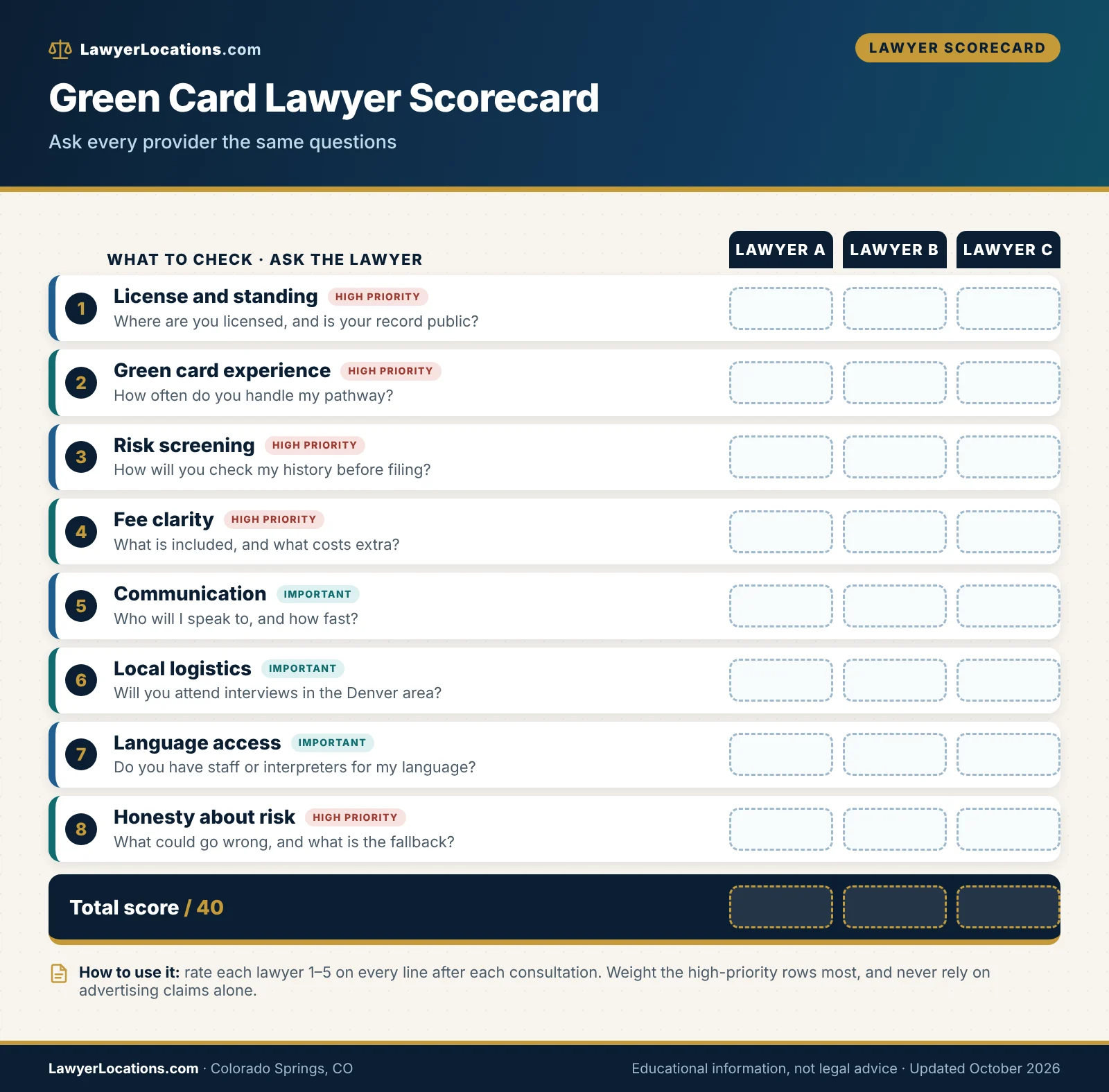
Text version of this graphic
| Criterion | Question to ask |
|---|---|
| License and standing | Are you licensed, in which state, and is your standing public? |
| Green card experience | How often do you handle my pathway, and what have you handled that was like mine? |
| Risk screening | How will you check my history before filing? |
| Fee clarity | What exactly is included, and what costs extra? |
| Communication | Who will I speak to, and how fast are messages answered? |
| Local logistics | Will you attend interviews in the Denver area, and is travel included? |
| Language access | Do you have staff or interpreters for my language? |
| Honesty about risk | What could go wrong, and what is the fallback? |
Local, remote and out-of-state lawyers
Because green card law is federal, geography matters less than it does for a car accident or a divorce. Convenience, communication and experience matter more than whether the office is on your street.
Hiring a Denver or out-of-state lawyer
Many immigration lawyers work with clients across Colorado and other states using phone, video and secure document upload. This widens your choice and may include lawyers who regularly appear at USCIS offices and immigration courts in the Denver area. The tradeoff is that you will not be able to drop by the office, and in-person attendance may mean extra charges.
If you choose a remote lawyer, ask how documents are exchanged securely, how originals are handled, and whether anyone in the firm is available to meet you in person if a problem comes up. Make sure the fee agreement says whether interview attendance is included.
Local nonprofits and accredited representatives
Some people are better served by a nonprofit than a private firm, particularly for simpler family cases or humanitarian routes. Capacity is limited and eligibility rules apply, but fees are often lower and the staff may know the Colorado Springs community well.
The risk to avoid is the look-alike: a storefront that uses nonprofit-sounding language but is not a recognized organization. Ask whether the organization is recognized by the Justice Department and whether the person helping you is accredited. If a lawyer or nonprofit tells you your case needs a different type of provider, take that as a sign of honesty, not rejection.
Getting ready for the consultation
The more organized you are, the more useful the first meeting is, and the less time you pay for. You do not need to bring everything on the first visit, but you should bring enough for the lawyer to see the shape of the case.
Documents and facts to bring
bring originals and copies Bring identity documents, your passport and visa history, any prior immigration paperwork and notices, records of arrests or court cases (even if dismissed), and proof of your qualifying relationship or job offer. If you have been denied anything before, bring the denial letter.
Write down your questions and your timeline ahead of time. If your English is limited, say so when you book, so that an interpreter can be arranged and the meeting is not wasted.
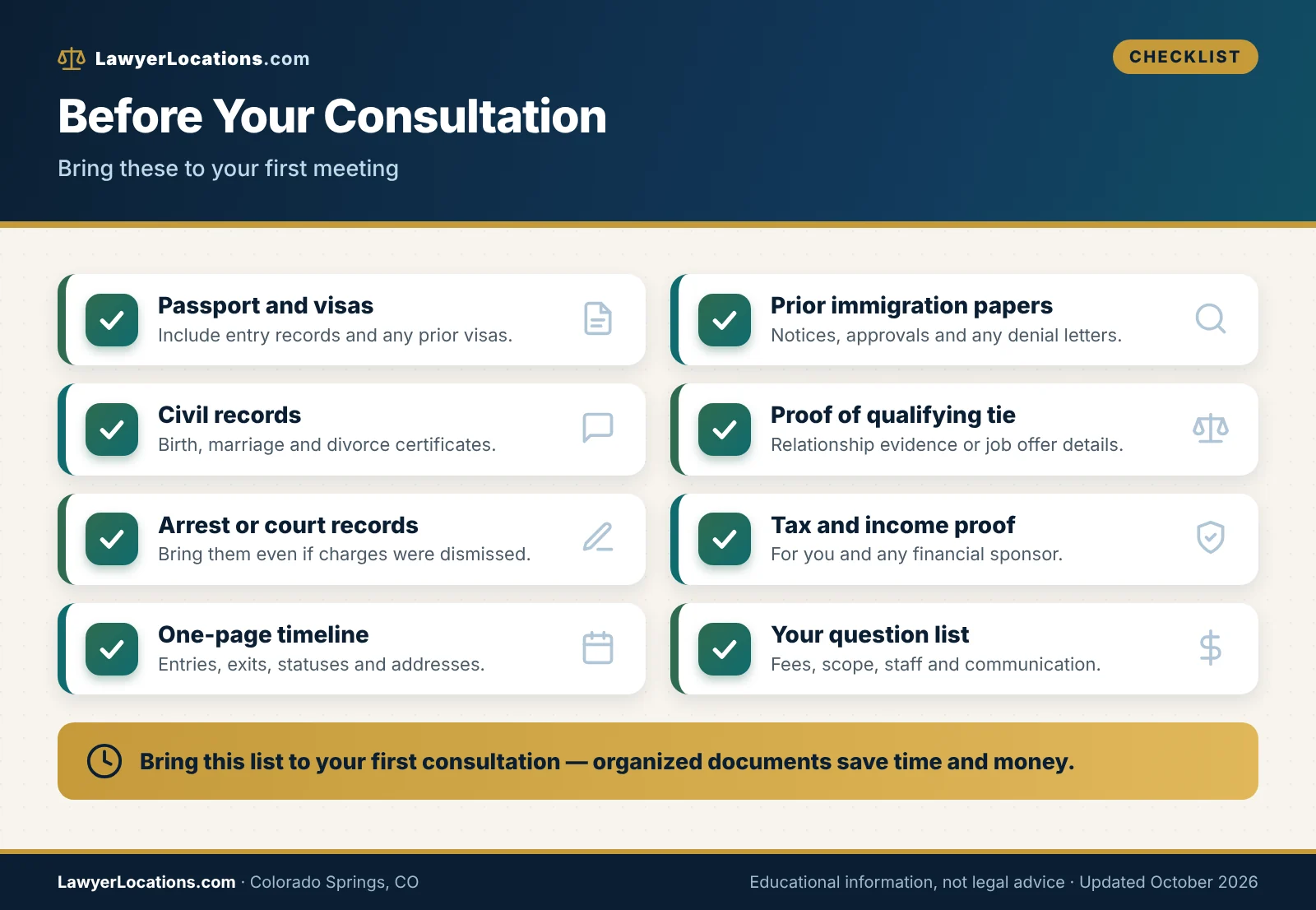
Text version of this graphic
- Passport and any visas or entry records
- Prior immigration notices, approvals and denials
- Civil records: birth, marriage, divorce certificates
- Proof of your qualifying relationship or job offer
- Arrest or court records, even if dismissed
- Tax returns and income proof for you and any sponsor
- A one-page timeline of entries, exits and addresses
- Your written list of questions
After the meeting: how to decide
Do not sign on the spot unless you are comfortable. Compare the quotes you gathered by scope, communication and trust, not by price alone. Read the fee agreement fully, and ask for changes before you sign if something is unclear or missing.
- The lawyer or representative has proved who they are and where they are licensed or recognized.
- The scope of work, the total fee, and what counts as extra are written down.
- You know who will do the work and how to reach them.
- No one has promised you a result or a date.
Costs, Deadlines and Decision Points in Colorado Springs, CO
A green card costs money in two separate streams: government fees that everyone pays, and professional fees that vary by lawyer and case. Both change over time, and several deadlines in the process are strict, so plan your budget and your calendar together.
What a green card actually costs
Be wary of any figure that does not tell you what it includes. The honest way to budget is to list each cost category, ask who is paid, and confirm current amounts on official pages right before you file.
Government filing fees
USCIS sets its fees by regulation and publishes them on the Form G-1055 fee schedule and in its online fee calculator. Under the April 2024 fee rule, the listed fee for the adjustment application (Form I-485) for most adults is $1,440, and the family petition (Form I-130) is listed at $675 on paper or $625 online. Work permit and travel document fees depend on your category and how you file.
Fees can change, and some newer fees created by a 2025 federal budget law are adjusted for inflation on a schedule. Check the fee schedule on the day you file, because a payment in the wrong amount can cause USCIS to reject the package and cost you time. USCIS filing and biometric fees are generally final and non-refundable, whatever the result.
Attorney fees and other costs
Attorney fees are negotiated, so any single “average” would be a guess. They commonly depend on the pathway, the number of people in the case, whether there are complications such as past arrests or a prior denial, and whether the quote includes the interview and any appeal or later filing.
Budget separately for the medical examination by a USCIS-designated civil surgeon, certified translations, document copies and courier costs, and travel to appointments in the Denver area. Ask the lawyer to list which of these are included in the fee and which you pay directly.
| Cost | Who is paid | How the amount is set | Where to confirm |
|---|---|---|---|
| Petition and application filing fees | USCIS | Federal fee schedule; changes by rule | USCIS Form G-1055 and fee calculator |
| Work permit and travel document fees | USCIS | Federal fee schedule; depends on category and filing method | USCIS Form G-1055 and the form’s own page |
| Attorney or representative fee | Your lawyer, firm or nonprofit | Negotiated and written in the fee agreement | The signed fee agreement; compare written quotes |
| Medical examination | A USCIS-designated civil surgeon | Set by the provider, not by USCIS | Provider’s price list; ask before booking |
| Translations and certified copies | Translators and records offices | Per page or per document | Quotes from the translator and the issuing office |
| Travel to Denver-area appointments | Your own expenses | Distance, number of appointments, lost work time | Your appointment notices and your lawyer’s attendance policy |
Two quotes arrive for a marriage-based case. One is lower but excludes interview preparation, RFE responses and attendance at the interview in the Denver area. The other costs more but includes all three. The cheaper quote may end up costing more if the case needs those services, so compare the lists, not just the totals.
Deadlines that matter
Immigration deadlines are less about filing a lawsuit on time and more about responding on time to the government’s notices and making sure you file the right form in the right window.
Conditional residence and card renewal
If your green card is based on a marriage that was less than two years old when you were approved, you receive a two-year conditional green card. You and your spouse must file a petition to remove the conditions (Form I-751) during the 90 days before the card expires, and filing late can put your status at risk.
A standard green card is valid for ten years, and you should apply to renew it before it expires, since an expired card can complicate work verification and travel. Ask your lawyer to calendar both dates the day your card arrives, and to confirm whether any special rules apply if your circumstances change.
Notices, interviews and requests for evidence
Every USCIS notice carries its own dates: a biometrics appointment, an interview, or an RFE response deadline. These are set for each case and are not negotiable by default. The date on your notice controls, not the date in a blog post.
If you cannot attend an appointment, ask for a reschedule through the method the notice provides, and do it as early as possible. Keep proof that you did. Tell your lawyer and give them copies of anything you send directly to USCIS.
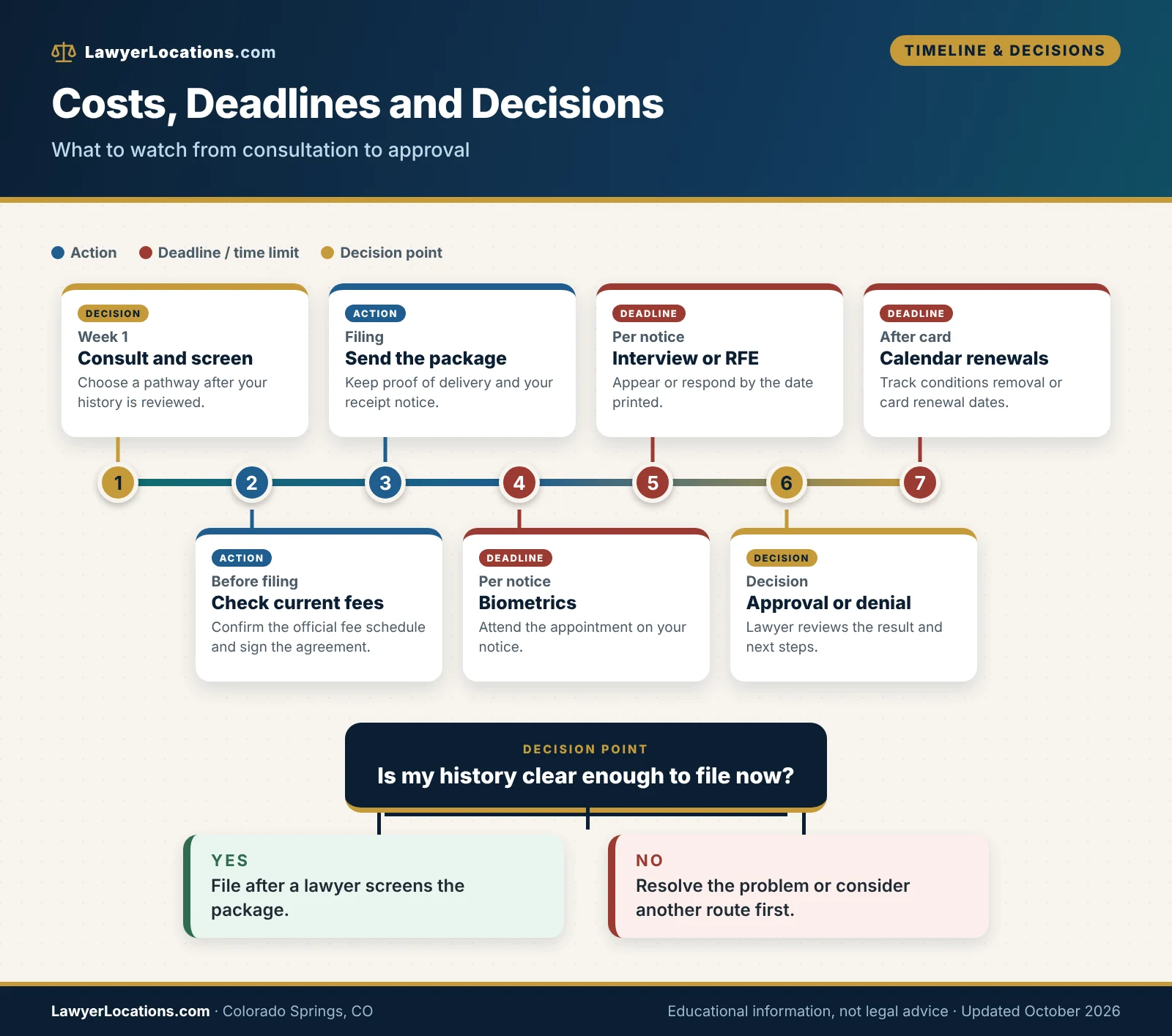
Text version of this graphic
- Consultation: screen your history and choose a pathway (decision point).
- Before filing: gather records, check the current fee schedule, sign the fee agreement.
- Filing: send the package and keep proof of delivery (action).
- Receipt and biometrics: attend the appointment on your notice (deadline).
- Interview or RFE: appear, or respond by the date on the notice (deadline).
- Decision: approval and card, or a denial that your lawyer reviews (decision point).
- After approval: calendar conditions removal if you have a two-year card, and renewal for a ten-year card (deadline).
Decision question: Is my history clear enough to file now? If yes, file after a lawyer screens it. If no, resolve the problem or pursue another route first.
| Timing point | What triggers it | What to do |
|---|---|---|
| RFE response date | USCIS requests more evidence | Send a complete response by the date on the notice |
| Biometrics appointment | USCIS receives and accepts your filing | Attend at the location on the notice or request a reschedule early |
| Interview | USCIS schedules one for your case | Prepare with your lawyer, bring originals, and arrive early |
| Remove-conditions window | Two-year conditional card from a recent marriage | File Form I-751 in the 90 days before the card expires |
| Card renewal | Ten-year card nearing expiration | Apply for renewal ahead of the expiration date |
| Travel with a pending case | Planning to leave the U.S. | Speak to your lawyer first; advance parole may be needed |
Decision points: file now, wait, or change course
Some of the most valuable advice a lawyer gives is when not to file, or when to choose a different route. These decisions affect timing and risk more than the choice of lawyer does.
Waiting for a visa number versus other options
If your category has a long wait, ask whether you qualify for a different pathway, such as a different family category, an employment route, or a change that moves you to an immediate relative category. Also ask what status you can keep lawfully while you wait, and whether a long wait puts your children at risk of aging out of their category.
Do not assume that a longer wait means you should abandon the case. Ask your lawyer to explain, in writing, the realistic options and the trade-offs. This is where a second opinion is often worth the cost of a consultation.
When to pause before filing
Pause if you have an unresolved arrest or charge, a past removal order, a prior false claim to citizenship, or an unclear entry history. Federal immigration policy has also shifted repeatedly in recent years, including added vetting steps and, at times, processing holds that depend on nationality and category, so ask how current policy affects your case.
A short delay to deal with these issues properly is cheaper than filing and then defending a denial or a court case. After you receive your green card, planning continues: our citizenship lawyer guide for Atlanta explains naturalization steps that generally apply nationwide, and our Colorado Springs wills and trusts guide covers estate planning for new residents.
Do not leave the country with a pending adjustment application, or after a long stay without status, until a licensed lawyer has reviewed your travel plan in writing. Some departures can end an application or trigger reentry bars.
Scams, Mistakes, Quick Answers and Next Steps
The two biggest threats to a green card case are fraud by people who are not authorized to give immigration advice and avoidable mistakes in the application itself. Both are preventable if you verify who you hire and slow down before you file.
Notario fraud and unauthorized practice of law
In many Latin American countries, a “notario público” is a highly trained legal professional. In the United States, a notary public is generally just someone authorized to witness signatures. Scammers exploit that confusion and charge for help they are not allowed to give.
How the scam works
The pattern is familiar: a storefront or social media page offers “immigration services,” quotes a low price, files a form that does not fit your situation, keeps your original documents, and then disappears or demands more money when a problem appears. Some applicants discover too late that their case was filed under the wrong category, or that false information was submitted in their name.
You are legally responsible for what is filed under your signature, even if someone else prepared it. A denial or a fraud finding can follow you into every future application, so the cheap option can be the most expensive one.
- The person guarantees approval, a speed, or a special connection to immigration officers.
- They are not a lawyer or accredited representative but offer to give legal advice.
- They ask you to sign blank forms, or they will not give you copies of what was filed.
- They keep your original passport, birth certificate or other documents.
- They refuse to put fees and services in a written agreement.
- They tell you to lie, hide a past event, or “just say” something on the form.
Colorado’s response and how to report
Colorado lawmakers addressed this problem in 2016 with House Bill 16-1391, which made certain misconduct by immigration consultants a deceptive trade practice under state consumer protection law. Local news has also reported attorney general action involving a Colorado Springs-based business accused of providing unlicensed “notario” legal services, which shows that the problem exists in the area.
If you believe you were scammed, tell a licensed lawyer or accredited representative right away so they can see whether the filing can be corrected. You may also contact the Colorado Attorney General’s consumer protection office, and the Colorado Supreme Court’s Office of Attorney Regulation Counsel handles complaints about the unauthorized practice of law. Keep every receipt, message and document.
If someone else filed your application, do not ignore a USCIS letter just because you do not understand it. Take the notice to a licensed lawyer or an accredited representative immediately, with every paper the preparer gave you.
Common mistakes that derail cases
Most denials and delays come from a small set of mistakes. Knowing them lets you ask the right questions before you file.
Paperwork and evidence mistakes
Typical paperwork mistakes include using an outdated form edition, paying the wrong fee, leaving required questions blank, submitting documents without certified translations, and failing to respond fully to an RFE. Inconsistent information between forms, such as different dates or addresses, also raises doubts about credibility.
Keep a complete copy of everything filed, and read the final version before you sign. If you do not understand a question on a form, ask your lawyer rather than guessing. An honest answer that needs context is better than a confident answer that is wrong.
Strategy and timing mistakes
Strategy mistakes include filing before screening your history, traveling without permission, working without authorization while waiting, missing an interview, or changing address without telling USCIS. Another is relying on advice from friends, which may have been right for their facts and wrong for yours.
Also avoid switching lawyers midstream without a plan. If you need to change representation, ask your new lawyer to review the file and to file a new notice of appearance so that USCIS sends notices to the right person.
Your next steps in Colorado Springs
If you are ready to look for a green card lawyer in Colorado Springs, CO, the work is simple but deliberate: narrow your pathway, check credentials, compare scopes, and choose with eyes open.
Your first week
- Write your timeline. List entries, exits, statuses, addresses and any arrests or denials.
- Collect key documents. Start with passports, civil records and prior immigration notices.
- Verify providers. Check a lawyer’s license with the regulator and confirm nonprofit recognition.
- Book two or three consultations. Ask the same questions and request quotes in writing.
- Check the current fee schedule. Confirm USCIS amounts on the official page before you budget.
Before you sign
Read the fee agreement twice. Confirm the scope, the payment terms, who works on your case, and how to end the relationship. Keep the signed copy with your immigration papers.
If cost is the barrier, call the nonprofit and legal aid options described earlier in this guide before you consider an unlicensed provider. For a wider view of the process, see our national guide to hiring a green card lawyer, and for related processes see our immigration attorney guide for Oklahoma City.
Quick answers
These short answers cover questions that come up often in Colorado Springs. They are general information and your facts may change the answer.
Questions about cost, timing and process
Do I need a lawyer to get a green card?
The law does not require one, and some straightforward cases are filed without a lawyer. A lawyer is most valuable when you have any complication, such as an overstay, an arrest, a prior denial, or an unclear entry history, because the cost of a mistake is high.
Does Colorado have its own green card rules?
No. Green cards are governed by federal law. Colorado law matters for related issues, such as consumer protection against immigration scams, records you need from county offices, and the rules for licensed lawyers.
Where will my interview be if I live in Colorado Springs?
Your interview notice states the exact USCIS office. For Pikes Peak residents that is commonly an office in the Denver area, so plan for the drive and arrange time off.
Is there an immigration court in Colorado Springs?
No. Colorado’s immigration courts are in the Denver metro area, in Denver and Aurora. If a court date is ever set, the hearing notice names the court.
How much does a green card lawyer cost in Colorado Springs?
It varies by case and lawyer, and there is no reliable single figure. Compare written quotes that list what is included, and remember that government fees, a medical exam and translations are usually separate.
Can I travel while my application is pending?
Possibly, but not without checking. Leaving without advance parole can be treated as abandoning an adjustment application, with limited exceptions. Speak to your lawyer before booking any trip.
Questions about choosing and checking a lawyer
Can a lawyer from another state handle my case?
Generally yes. Federal rules allow an attorney in good standing in any state to represent clients before USCIS, so you can hire a Denver or out-of-state lawyer if the communication and fee terms work for you.
How do I check that a lawyer is licensed?
For a Colorado license, use the public lookup from the Colorado Supreme Court’s Office of Attorney Regulation Counsel. For another state, use that state’s bar website, and ask the lawyer which state licenses them.
What is an accredited representative?
It is a non-lawyer, working for a Justice Department-recognized nonprofit, who has been authorized to represent immigrants. Ask the organization to confirm both its recognition and the person’s accreditation.
Is a notary public allowed to help with immigration forms?
A notary can witness signatures but is not authorized to give legal advice or choose forms for you. In Colorado, certain deceptive conduct by immigration consultants can also be treated as a deceptive trade practice.
What if I cannot afford a private lawyer?
Check nonprofit immigration services in the Pikes Peak region, the ImmigrationLawHelp.org directory, the Colorado Judicial Branch legal assistance handout, and pro bono lists maintained by the Justice Department. Ask each what case types and fees they handle.
Can I change lawyers if I am unhappy?
Yes. Ask for your file and any refund owed under your agreement, hire the new lawyer, and have them file a new notice of appearance so USCIS sends notices to the right person. Do this before any deadline gets close.
Ready to compare your options?
Use the scorecard and checklist in this guide to prepare, then book consultations with two or three providers and compare their written scopes. LawyerLocations does not recommend or rank lawyers, and reading this page does not create an attorney-client relationship.
General information only. This guide is legal education, not legal advice, and it does not create an attorney-client relationship. Immigration laws, fees, forms and agency procedures change often, and your facts matter. Confirm current rules on official government websites and consult an attorney licensed in the relevant jurisdiction, or an accredited representative, about your own situation.
Sources & References
Show all 15 sources
- Green Card Processes and Procedures — U.S. Citizenship and Immigration Services — uscis.gov — accessed October 2026
- Form I-485, Application to Register Permanent Residence or Adjust Status — U.S. Citizenship and Immigration Services — uscis.gov — accessed October 2026
- Form G-1055, Fee Schedule — U.S. Citizenship and Immigration Services — uscis.gov — accessed October 2026
- Green Card for Employment-Based Immigrants — U.S. Citizenship and Immigration Services — uscis.gov — accessed October 2026
- U.S. Citizenship and Immigration Services Fee Schedule and Changes to Certain Other Immigration Benefit Request Requirements (final rule, effective April 1, 2024) — Federal Register — federalregister.gov — accessed October 2026
- EOIR Immigration Court Listing — U.S. Department of Justice, Executive Office for Immigration Review — justice.gov — accessed October 2026
- Immigration Court Operational Status — U.S. Department of Justice, Executive Office for Immigration Review — justice.gov — accessed October 2026
- List of Pro Bono Legal Service Providers — U.S. Department of Justice, Executive Office for Immigration Review — justice.gov — accessed October 2026
- Attorney Discipline Program — U.S. Department of Justice, Executive Office for Immigration Review — justice.gov — accessed October 2026
- HB16-1391 Immigration Consultants Deceptive Trade Practice — Colorado General Assembly — leg.colorado.gov — accessed October 2026
- Office of Attorney Regulation Counsel — Colorado Supreme Court — coloradolegalregulation.com — accessed October 2026
- Legal Assistance Handout (July 2026) — Colorado Judicial Branch — coloradojudicial.gov — accessed October 2026
- Immigration Services — Catholic Charities of Central Colorado — ccharitiescc.org — accessed October 2026
- Catholic Charities of Central Colorado Family Immigration Services — ImmigrationLawHelp.org (Immigration Advocates Network) — immigrationlawhelp.org — accessed October 2026
- Attorney general accuses Colorado Springs-based business of unlicensed “notario” legal services — The Gazette — gazette.com — accessed October 2026
Legal Disclaimer and Limitation of Liability
Informational and illustrative purposes only. This article was prepared by LawyerLocations.com solely on the basis of the information available to us at the time of writing. It is an illustrative, general overview. It is not a complete or authoritative statement of the law, and it has not been reviewed by a lawyer licensed in your state or county.
Not legal advice. Nothing in this article is legal, financial, tax or immigration advice, and reading it does not create an attorney-client relationship between you and LawyerLocations.com or any author, lawyer or firm mentioned. Laws, court rules, fees, filing deadlines and agency procedures differ by state, county and court, and they change often. Some details here may be simplified, incomplete or out of date, and time limits for legal claims can be short.
No warranty. We make no representation or warranty, express or implied, about the accuracy, completeness, timeliness or suitability of this content for your situation. Please do not rely on it to make, delay or skip any legal decision. Check the facts against official sources and speak with a licensed attorney in the relevant jurisdiction before you act.
Limitation of liability. To the fullest extent permitted by law, LawyerLocations.com and its owners, authors and contributors disclaim all liability for any loss, damage, cost or other consequence arising from the use of, or reliance on, this article, including any content on third-party websites we link to. Mentioning a lawyer, firm, organization or service is not an endorsement and is not a promise of any result. If you are in immediate danger, contact your local emergency number.