If you are searching for a motorcycle accident lawyer in Dallas, TX, you are usually trying to settle three things: what Texas law does differently for riders, what the lawyer will charge, and how to tell one law office from another before you sign. In Texas, most injury lawsuits must be filed within 2 years, a rider who is found more than 50 percent responsible recovers nothing, and a contingency fee agreement must be in writing and signed by both lawyer and client.
Searches for a “motorcycle accident lawyer dallas tx” usually come from someone hurt on a freeway, a surface street or a tollway who needs a clear plan. This guide walks through the Texas statutes that matter, the Dallas County offices where claims are filed and records are kept, a practical way to interview lawyers, and the fee, lien and deadline questions that come up before a case ends. It is general information, not advice about your crash.
How a Motorcycle Accident Lawyer Case Works in Dallas, TX
A motorcycle injury claim in Dallas is almost always a negligence case: you show that a driver, a company or a government body failed to use reasonable care and that the failure hurt you. What separates it from an ordinary fender-bender is the size of the injuries, the way insurers talk about riders, and the fact that the stakes (surgery, lost work, long recovery) often outrun the other driver’s insurance policy. The practical job of a lawyer is to find every source of recovery, build the proof, and keep the clock under control.
If you are mainly shopping for representation, you can jump to the comparison section. If you were hurt in a car or pickup crash and are unsure whether you even need a lawyer, our guide on whether you need a lawyer after a car accident covers that first decision.
The path from crash to resolution
Most motorcycle claims follow the same broad stages, although the length of each stage varies enormously with the severity of the injury. Knowing the order helps you judge what a lawyer is telling you on the first call.
Medical care, reports and early notices
Everything starts with treatment and records. Get examined even if you feel “fine” at the scene, because adrenaline masks fractures, concussions and soft-tissue damage. Make sure a crash report exists, keep every discharge paper, and write down the names of witnesses before they drift away. Our checklist on what to do after a car accident applies to riders too, with a few motorcycle-specific additions covered in Section 4.
Investigation and insurance claims
A lawyer typically sends preservation letters, collects the crash report and photographs, identifies every insurance policy that might apply, and opens the claim with the at-fault driver’s insurer. Your own policies matter as well, because uninsured and underinsured motorist coverage can be the only realistic source of money when the other driver carries minimal limits or none. We explain that coverage in our uninsured motorist claim guide.
Negotiation, suit and resolution
Most claims settle, but a lawyer will usually prepare the case as if it could be tried, because insurers watch how seriously a file is built. If talks stall, suit is filed in the right Texas court, written discovery and depositions follow, and the case may end by settlement, mediation, or a trial verdict. A realistic look at how long this takes appears in our car accident settlement timeline.
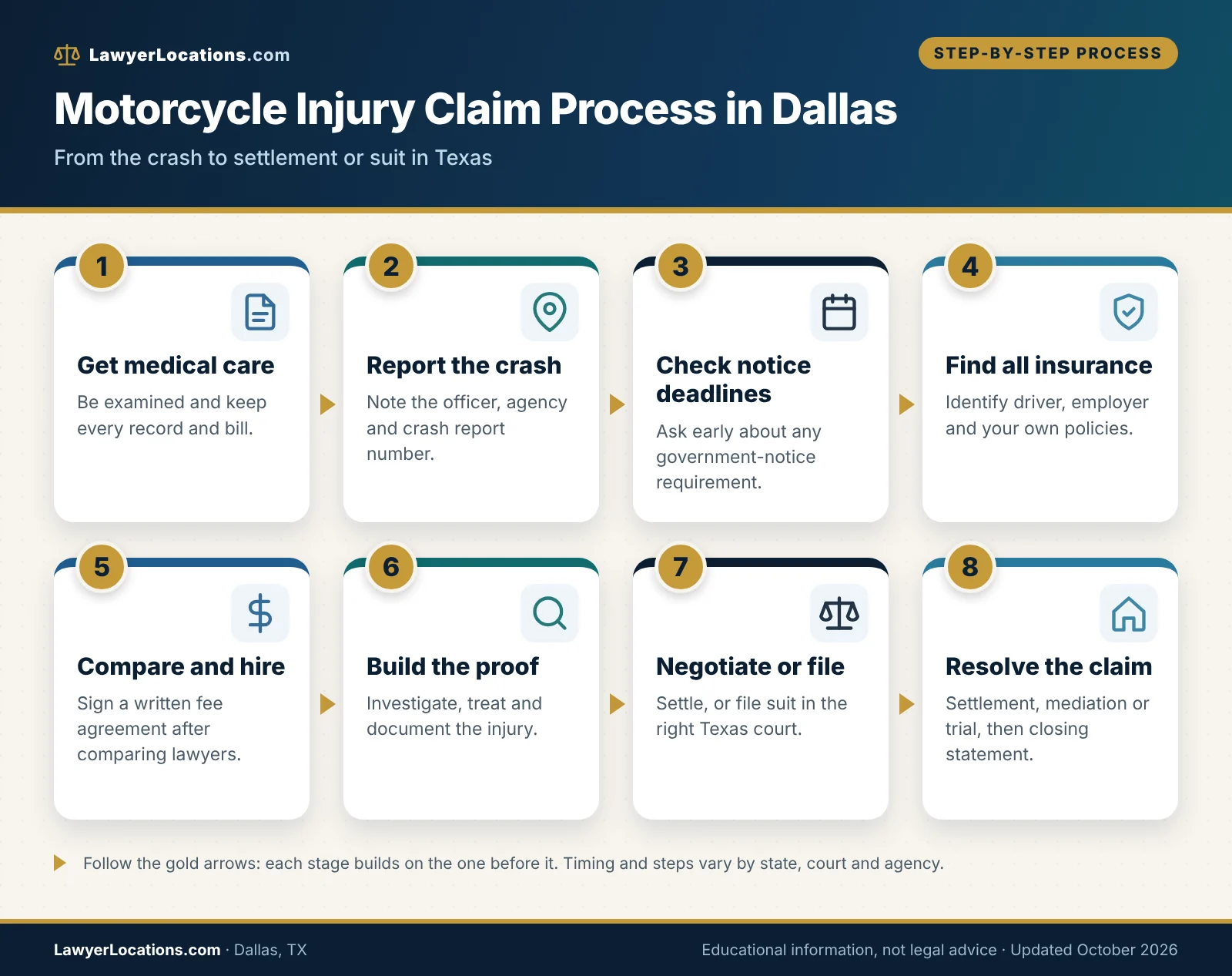
Text version of this graphic
- Get medical care and keep every record.
- Report the crash and obtain the crash report.
- Note any short government-notice deadline.
- Identify every insurance policy that could apply.
- Compare lawyers and sign a written fee agreement.
- Investigate, treat and document the injury.
- Negotiate, or file suit in the right Texas court.
- Resolve by settlement, mediation or trial.
Who is on the other side of a Dallas rider’s claim
Who caused the crash decides which deadline applies and which insurance policy responds. A good first conversation with a lawyer sorts out the possible defendants before anyone sends a recorded statement to an adjuster.
Private drivers and commercial vehicles
Most claims involve a private driver’s liability policy, which in Texas may be as low as the statutory minimum. Delivery vans, box trucks, buses, rideshare cars and company vehicles can be covered by commercial policies with different limits and different insurers. When an 18-wheeler or work truck is involved, the investigation and the number of potential defendants grow, which is why we compare the two types of case in truck accident versus car accident lawyers.
Government vehicles, roads and transit
If a city or county vehicle, a transit vehicle, or a government-maintained road defect played a part, the case moves into a different set of rules. Texas gives governments limited, statute-based exposure and requires short notice of a claim, which we cover in Section 2. Do not assume the normal two-year timetable protects you if a government body is involved.
Your own insurance and health coverage
Your health plan, your own motorcycle policy and any uninsured/underinsured motorist coverage form the third layer. They often pay first while the liability claim is still being built, and they may later ask to be repaid out of a settlement. A lawyer should explain that repayment picture early, not at the end.
What a lawyer can and cannot do for you
Lawyers do not control medical outcomes, jury moods or insurer behavior. What they can do is manage evidence, deadlines and negotiations, and give you an honest read of the risks.
Realistic services to expect
Expect help with insurer communications, gathering medical records and bills, documenting lost income, retaining outside experts (such as accident reconstruction or medical specialists) when the case justifies it, and preparing for mediation or trial. Ask which of these the firm handles in-house and which are outsourced, because that affects both speed and case expenses.
What no honest lawyer will promise
Be wary of anyone who guarantees an outcome, a dollar figure or a timeline. Results depend on liability facts, insurance limits, medical proof and a dozen things nobody can know on day one. For the factors that tend to raise or lower value, see our overview of motorcycle accident settlements.
Before the first consultation, write a one-page timeline: date, place, weather, who said what, which hospital, which insurers called. A clean timeline lets a lawyer evaluate your case in minutes and shows you which firms listen carefully.
Texas Law That Shapes a Rider’s Claim
Texas law, not Dallas law, sets the rules for deadlines, fault and damages, and the same rules apply from El Paso to Houston. Three statutes do most of the work: a two-year filing deadline, a proportionate-responsibility rule that can reduce or erase a rider’s recovery, and a limit on recoverable medical expenses. This section states each rule in plain English and then explains how it tends to play out for riders.
Deadlines and fault rules
The deadline and the fault rule are the two legal ideas that most often change what a motorcycle case is worth. Both are written into the Texas Civil Practice and Remedies Code (CPRC), the state’s main statute on civil lawsuits.
The two-year filing deadline
Under CPRC 16.003(a), a person must bring suit for personal injury “not later than two years after the day the cause of action accrues.” In most crash cases, accrual is the day of the crash, though a lawyer will check whether any exception applies to your facts. 2 years is a filing deadline for a lawsuit, not a deadline to start talking to an insurer, and negotiations do not stop the clock.
A claim that is still “in negotiation” when the two-year date passes can be lost. If you are close to the date, ask a Texas lawyer directly what filing date they are calendaring, and get it in writing. Our national overview, how long you have to file a personal injury claim, compares state deadlines.
Proportionate responsibility and the 51 percent bar
Texas uses a modified comparative-fault system called proportionate responsibility in Chapter 33 of the CPRC. A claimant “may not recover damages if his percentage of responsibility is greater than 50 percent” (CPRC 33.001). If the rider is 50 percent or less responsible, the court reduces the award “by a percentage equal to the claimant’s percentage of responsibility” (CPRC 33.012(a)).
In plain numbers: a rider found 20 percent at fault for riding slightly over the limit would see a $100,000 verdict reduced by 20 percent; a rider found 51 percent at fault would receive nothing. That is why insurers in motorcycle cases often argue speed, lane position or visibility, and why early evidence about what the other driver actually did matters so much.
Joint responsibility among several defendants
When more than one party shares blame, Chapter 33 also decides who pays what. A defendant whose percentage of responsibility is “greater than 50 percent” can be held jointly and severally liable under CPRC 33.013(b)(1), which means the claimant can collect that defendant’s share and the rest of the judgment from that defendant. A lawyer will explain how the percentages might be assigned among a driver, an employer and, in some cases, a government body.
Motorcycle-specific traffic rules
Violating a traffic rule does not automatically decide a civil case, but the rules shape how fault is argued. Two Texas rules come up repeatedly in rider cases: helmets and lane use.
Helmets and the over-21 exception
Texas law requires motorcycle operators and passengers to wear protective headgear that meets department standards. Under Transp. Code 661.003(c), however, a rider who is at least 21 and has completed an approved operator training course, or is covered by a health insurance plan with medical benefits for injuries, may not be arrested or cited under the helmet rule if they can show proof. A violation is a misdemeanor with a fine of “not less than $10 or more than $50.”
For a civil claim, the practical question is not the fine but whether the defense will say a missing helmet worsened your injuries. How a Texas court treats that argument is a question to put to the lawyer you interview, and a careful lawyer will answer it without promising an outcome.
Full lane use and the ban on lane splitting
Texas added Transp. Code 545.0605 in September 2023 (H.B. 4122). It confirms that a motorcycle is entitled to the full use of a lane and that drivers may not crowd a rider out of it. It also says two motorcycles may ride side by side in one lane, but riders may not ride more than two abreast, ride between lanes of traffic moving in the same direction, or pass a motor vehicle within the same lane. Police officers on duty are exempt.
If a rider was filtering between stopped lanes on I-635 or US-75 when a car changed lanes, the other side will probably raise the lane-splitting ban as comparative fault. A lawyer should ask about this directly rather than be surprised by it in a deposition.
Right-of-way, speed and following distance
Left-turn collisions, unsafe lane changes and following too closely are the fault theories that most often arise in rider claims. Texas traffic statutes on yielding, turning and safe distance supply the standard the other driver is measured against, and a lawyer will match the physical evidence to the specific provision in play. Citations or tickets issued at the scene can help, but they are not a substitute for evidence developed later.
Insurance limits, medical bills and damages
Even a clear-liability crash can end up limited by the insurance on the other side. These three rules explain why.
Minimum liability limits for drivers
Texas requires drivers to carry liability insurance at least equal to $30,000 for bodily injury to one person, $60,000 for two or more people in one collision, and $25,000 for property damage (Transp. Code 601.072(a-1)). Those numbers are floors, not predictions of what a policy actually carries, and a serious motorcycle injury can exceed them quickly. That gap is why your own uninsured/underinsured motorist coverage, if you have it, can be critical.
Recoverable medical expenses: “paid or incurred”
Under CPRC 41.0105, recovery of medical or health care expenses “is limited to the amount actually paid or incurred by or on behalf of the claimant.” In practice, this means the amount your insurer paid or you owe, not the full list price on a hospital bill, usually becomes the starting point. Our guide to medical bills after a car accident explains how to track what is billed, paid and owed.
Claims against cities, counties and other government units
The Texas Tort Claims Act requires that a governmental unit receive notice of a claim “not later than six months after” the incident (CPRC 101.101(a)), and city charter and ordinance provisions setting a shorter permitted period are ratified by 101.101(b). Actual notice to the government can excuse some of those requirements, but you should not count on it. If a city street defect, city vehicle or public transit vehicle may be involved, raise it with a lawyer immediately and ask them to check the city charter period.
| Rule | Source | What it says | Why it matters to a rider |
|---|---|---|---|
| Two-year deadline | CPRC 16.003 | Suit for personal injury must be brought within two years after the cause of action accrues; wrongful-death suits within two years after the death | A late filing can end the case regardless of how strong the facts are |
| 51 percent bar | CPRC 33.001 | No recovery if the claimant’s responsibility is greater than 50 percent | Speed, lane position and visibility arguments can decide the case |
| Reduction for fault | CPRC 33.012(a) | Damages are reduced by the claimant’s percentage of responsibility | Even a small fault share lowers the payout |
| Joint liability threshold | CPRC 33.013(b)(1) | A defendant over 50 percent responsible is jointly and severally liable | Affects collection when several parties share blame |
| Paid or incurred | CPRC 41.0105 | Medical expense recovery limited to amounts actually paid or incurred | Changes how medical bills are valued |
| Minimum liability limits | Transp. Code 601.072 | $30,000 / $60,000 / $25,000 minimums | Drivers may carry little more; check your own coverage |
| Helmet rule | Transp. Code 661.003 | Headgear required, with a 21+ training or health-insurance exception; fine of $10 to $50 | Defense may argue helmet use affected injuries |
| Lane use | Transp. Code 545.0605 | Full lane use; no more than two abreast; no riding between lanes or passing within the same lane | Lane-splitting can become a comparative-fault argument |
| Government notice | CPRC 101.101 | Notice generally within six months; shorter charter periods permitted | A missed notice can bar a claim against a city or other unit |
Dallas County Courts, Crash Reports and Local Help
For Dallas-area riders, the local part of a case is mostly logistics: which clerk takes the lawsuit, which agency holds the crash report, and where to find a lawyer referral service. Civil injury lawsuits over serious injuries are generally filed with the Dallas County District Clerk, and crash reports are obtained through the state’s TxDOT system. The details below come from the offices’ own pages as of October 2026.
Where Dallas motorcycle claims are filed
A claim that does not settle is filed in a court that has authority over the parties and the amount in dispute. In Dallas, that usually means a Dallas County civil court.
District courts and the District Clerk
Dallas County’s District Clerk runs a Civil, Family and Juvenile Section at the George L. Allen, Sr. Courts Building, 600 Commerce Street, Suite 103, Dallas, TX 75202, telephone (214) 653-7307. The section’s page links to filing fees, FAQs, rules and guidelines for civil and family courts, forms and a Web Records search. A lawyer usually files electronically, but a self-represented person should read the clerk’s current instructions on dallascounty.org before filing anything.
Dallas County also posts pages for individual civil district courts (for example, the 134th and 193rd), where judges publish court-specific procedures and standing orders. Those court pages are worth reading before a hearing because each bench has its own habits on scheduling and motions.
Justice courts and county-level courts
Dallas County also has justice of the peace courts, which handle small-dollar civil disputes and have a much lower dollar limit than district courts. Property damage to a motorcycle might fit a justice court in a very small case, but a case involving significant medical bills, lost wages or a long recovery generally belongs in district court. Ask the lawyer which court they would pick and why, since the choice affects procedures, jury pools and timing.
Federal court and other forums
A small number of rider cases end up in federal court, for example when the defendants and the claimant are from different states or a federal entity is involved. The Northern District of Texas has a Dallas division. Another route is arbitration or mediation, which may be required by a contract or agreed to by the parties. A lawyer should explain which forum is likely before you sign, since it affects costs and strategy.
Crash reports and official records
The crash report is the backbone document in many cases. Obtaining it early is a basic step and costs little.
Getting your Texas crash report
TxDOT runs the Crash Report Online Purchase System. The agency’s page lists a regular copy at $6 and a certified copy at $8 (as of October 2026), with small processing charges. Persons involved in the crash, their representatives, vehicle owners, insurers and people who may sue over a death are among those entitled to a full copy under Transportation Code section 550.065; others may receive a redacted version.
Which agency wrote the report
Dallas County includes the City of Dallas and many neighboring cities, as well as unincorporated areas and state highways. Depending on the location, the investigating officer might be from the Dallas Police Department, another city’s police department, the Dallas County Sheriff’s Office or the Texas Department of Public Safety. Write down the officer’s name, badge number and agency at the scene, because that detail shortens the search for the report and for any body-camera or dash-camera video.
Records beyond the report
A crash report is a summary, not the full story. Ask your lawyer to request 911 recordings, dispatch logs, body-camera footage, traffic or business surveillance video, and vehicle data (including a car’s event data recorder) quickly, because many sources keep recordings only for limited periods. Your own motorcycle, helmet and riding gear are evidence too, so do not repair, sell or throw them away until your lawyer has documented them.
Local help for finding a lawyer
Referral services do not evaluate quality, but they can be a starting point if you have no personal recommendation.
Dallas Bar Association Lawyer Referral Service
The Dallas Bar Association operates a Lawyer Referral Service at 2101 Ross Avenue, Dallas, TX 75201, telephone (214) 220-7444, which can refer people to Dallas-area attorneys, including in Collin County. TexasLawHelp’s listing says referral services typically involve a modest consultation fee and advises confirming current terms with the service. Ask what the consultation fee is, whether it is credited against later fees, and what the service does to screen the lawyers on its panel.
State Bar of Texas resources
The State Bar of Texas lists lawyer referral programs around the state and maintains attorney profiles that show license status and discipline history. Check any lawyer you are considering at texasbar.com before you meet. A clean profile is not a recommendation, but a disciplinary history is a fact you should know.
Legal aid and free clinics
Legal aid groups and bar-association clinics in Dallas generally focus on low-income households and on non-injury matters. A rider with a contingency-fee injury claim is usually pointed to private lawyers, but a free clinic can still help with a related issue, such as a ticket, an insurance dispute or a landlord problem during recovery. Check the Dallas Bar Association’s public programs for current schedules.
| Office or resource | What it does | What to check |
|---|---|---|
| Dallas County District Clerk, Civil, Family and Juvenile Section | Receives civil lawsuits filed in Dallas County district courts; posts fees, forms and rules | Current filing fees and instructions on the clerk’s page; 600 Commerce Street, Suite 103 |
| Individual civil district courts | Hear the case once filed; each posts its own procedures | Judge’s standing orders and scheduling rules |
| Justice of the peace courts | Small civil disputes under a lower dollar limit | Whether the claim is truly small |
| TxDOT crash records | Sells crash reports (regular $6, certified $8 per TxDOT page) | Whether you are eligible for a full copy |
| Dallas Bar Association Lawyer Referral Service | Refers callers to Dallas-area attorneys | Current consultation fee and screening process |
| State Bar of Texas | Licenses lawyers; posts attorney profiles; lists referral programs | License status and discipline history |
Crash Scenarios and the Evidence That Matters
Motorcycle claims are won or lost on proof, and much of the proof disappears within days. The most useful evidence is the kind you collect in the first week: photographs, witness names, the crash report, and a full set of medical records. This section describes the crash patterns riders and lawyers commonly discuss and the documents worth gathering. It does not rely on any local crash statistic, because none is needed to explain how evidence works.
Common crash scenarios and how fault is argued
No two crashes are identical, but certain patterns recur in rider claims anywhere in the country, including on Dallas surface streets and freeways. Each pattern comes with a predictable defense argument.
Left turns and intersection collisions
A driver turning left across a rider’s path is a classic fact pattern. The driver usually says the motorcycle was not seen or was going too fast, and the rider says the driver failed to yield. Skid marks, the rider’s speed, headlight use, and any video from nearby businesses or traffic cameras are the evidence that tends to settle the argument.
Lane changes and blind spots
On multi-lane roads such as Interstate 35E, Interstate 30, US-75 or the Dallas North Tollway, a car that drifts into a rider’s lane can leave very little time to react. The defense may argue that the rider was in a blind spot, or, since September 2023, that the rider was riding between lanes in violation of the new statute. Witness statements and the exact lane positions at impact matter more here than anywhere else.
Road defects, debris and construction zones
A pothole, loose gravel, a dropped load or a poorly marked work zone is more dangerous to a two-wheeled vehicle than to a car. Claims based on road conditions can involve the Texas Department of Transportation, a city, a county or a private contractor, each with different rules about notice and liability. This is where the six-month notice rule from Section 2 becomes critical, and where photographs of the hazard taken on the same day are gold.
Freeway merges and stop-and-go traffic
Sudden braking, unsafe merges and distracted driving in congested traffic produce rear-end and side-swipe crashes that look minor on paper but can be catastrophic for a rider. Our guide to rear-end accident claims explains how fault is usually analyzed in that pattern, and much of it carries over to motorcycles.
The evidence checklist
Whatever the scenario, the same categories of proof support a claim. Gather what you safely can, and let a lawyer chase the rest.
At the scene and in the first 48 hours
Photograph the vehicles, the road, skid marks, signs, signals, lighting and your injuries from several angles. Get the other driver’s name, insurance information and license plate, plus contact details for witnesses. If you cannot do this yourself, ask a friend to return to the scene the next day to photograph it, because lighting, debris and weather change quickly.
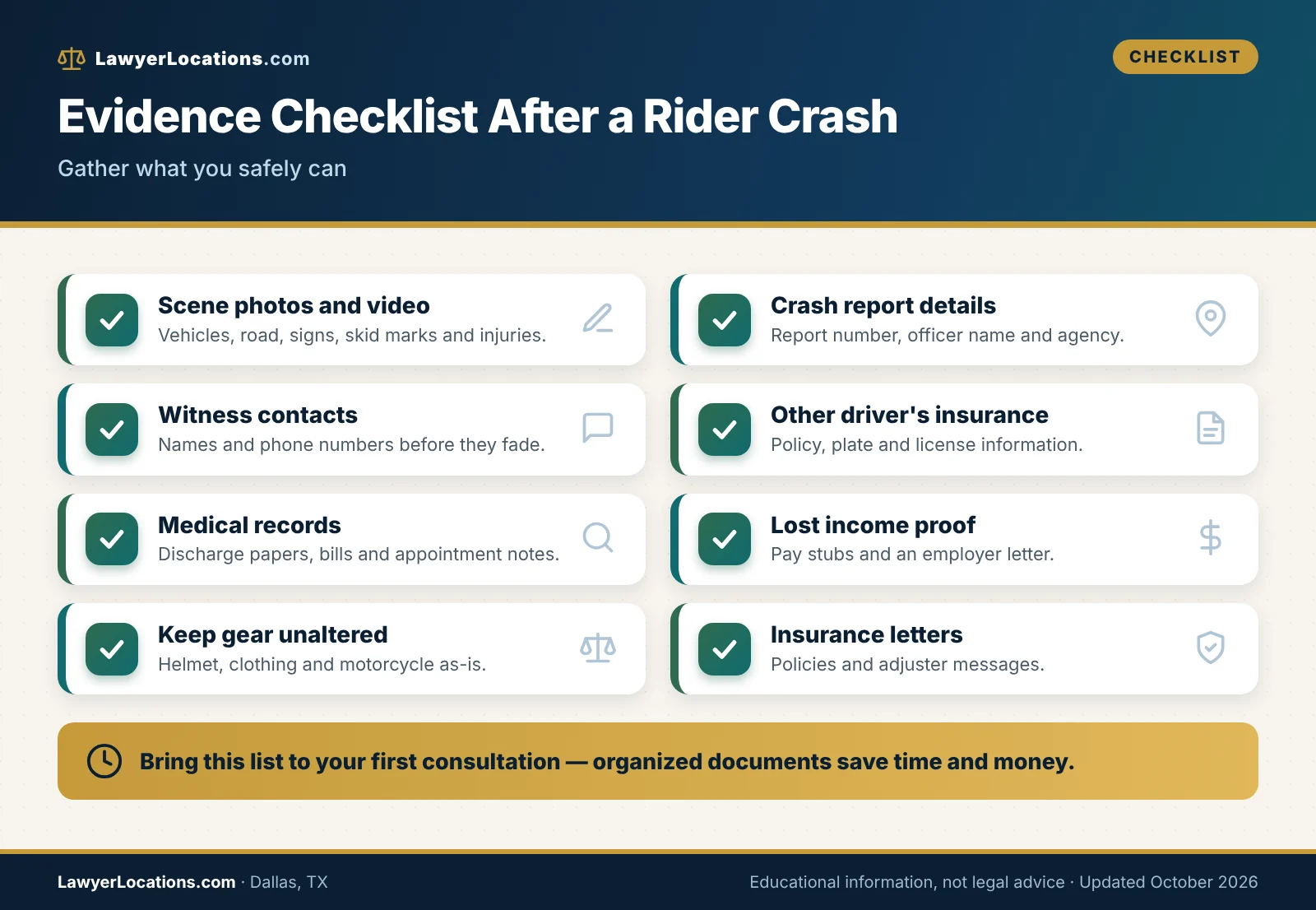
Text version of this graphic
- Photos and video of the scene, vehicles and injuries.
- Crash report number and officer details.
- Witness names and phone numbers.
- Other driver’s insurance and plate information.
- Medical records, bills and appointment notes.
- Proof of missed work and lost income.
- Damaged helmet, gear and motorcycle kept unaltered.
- Insurance policies and letters from adjusters.
Medical records and proof of loss
Keep every discharge summary, imaging report, prescription and bill, along with a short daily note about pain, sleep and activity limits. Missed work, reduced hours and lost opportunities are provable only if you can show pay stubs, tax records and an employer letter. Treatment gaps are hard to explain later, so follow your doctors’ plan and tell them about every symptom.
Your motorcycle, helmet and riding gear
The damaged bike, helmet and clothing can show impact points, speed and the way force traveled through the rider. Store them somewhere dry, do not clean or repair them, and ask the lawyer before you sign any total-loss paperwork or authorize a salvage sale. If the bike must be moved from a tow yard to cut storage fees, photograph it first.
Mistakes that quietly hurt claims
Most claims are not lost to one dramatic error. They erode through small decisions made in the first few weeks.
Recorded statements and early settlement offers
An adjuster for the other driver’s insurer may call within days, sound friendly, and ask for a recorded statement. You are generally not required to give one to the other side’s insurer, and a casual comment about “being okay” can be quoted back later. Do not sign a release or accept a check marked as full settlement until you know the full extent of your injuries.
Social media and public posts
Photos of a weekend ride, a gym check-in or a joking caption can be used to argue that your injuries are milder than claimed. Set accounts to private, stop posting about the crash and your recovery, and do not delete existing posts without asking your lawyer, since deleting can create its own problems.
A rider is hit by a driver who turns left at an intersection and takes three weeks to see an orthopedic specialist because of work. The insurer later argues that the long gap shows the injury was not serious. Prompt treatment, even a single urgent-care visit in the first days, would have closed that argument. The scenario is illustrative, not a prediction of any case.
How to Compare Motorcycle Accident Lawyers in Dallas
Choosing a lawyer is a decision you can make carefully even when you are in pain and under pressure. Compare at least two or three Texas-licensed lawyers on license status, relevant experience, communication, and the written fee agreement, and do not sign anything on the first phone call. LawyerLocations.com is a legal-education and lawyer-discovery resource, not a law firm, and nothing here ranks or recommends any particular lawyer.
Verify the basics before the consultation
You can check most of the objective points yourself in about fifteen minutes. Do this before you spend time on a consultation.
License status and discipline history
Every lawyer who practices in Texas must be licensed by the State of Texas, and the State Bar of Texas publishes attorney profiles showing license status and any public discipline. Compare the name on the profile to the name on the firm’s website and on the engagement letter. If the lawyer’s profile cannot be found, ask why.
Relevant experience, described carefully
Ask how many motorcycle or serious-injury cases the lawyer has handled to a settlement or verdict, whether they have tried cases in Dallas County courts, and who would actually work on your file. Experience claims should be specific and checkable. Be cautious of vague slogans, and remember that rules for lawyer advertising in Texas prohibit misleading claims about results.
Specialization credentials
The Texas Board of Legal Specialization offers a state-recognized credential in some practice areas, including personal injury trial law. If a lawyer or firm says it holds one, verify that claim directly with the issuing organization at tbls.org rather than relying on the firm’s website. Absence of a credential does not mean a lawyer is unqualified, and holding one does not predict a result in your case.
The consultation: what to bring and what to ask
A first meeting is both an interview and a chance to show your facts. Treat it as a two-way evaluation.
What to bring
Bring the crash report or number, photos, medical records and bills, your insurance policies and cards, any letters from adjusters, and your timeline. If you have not yet seen a doctor about each injury, say so honestly. A lawyer cannot evaluate a case without knowing the weak points.
Questions about strategy
Ask how the lawyer would investigate liability, which insurance policies they would look for, how they handle a claim that involves a comparative-fault argument, and what the realistic stages and timeline look like. A candid answer will include risks, not just optimism. Ask whether the firm is prepared to file suit in Dallas County if talks fail, or whether it typically refers cases out.
Questions about staffing and communication
Ask who your day-to-day contact will be, how often you will receive updates, how quickly the office returns calls, and whether decisions to settle always require your consent. In Texas, the client decides whether to accept a settlement offer, and your lawyer should explain it and recommend, not decide for you. Put any communication promises that matter to you in writing.
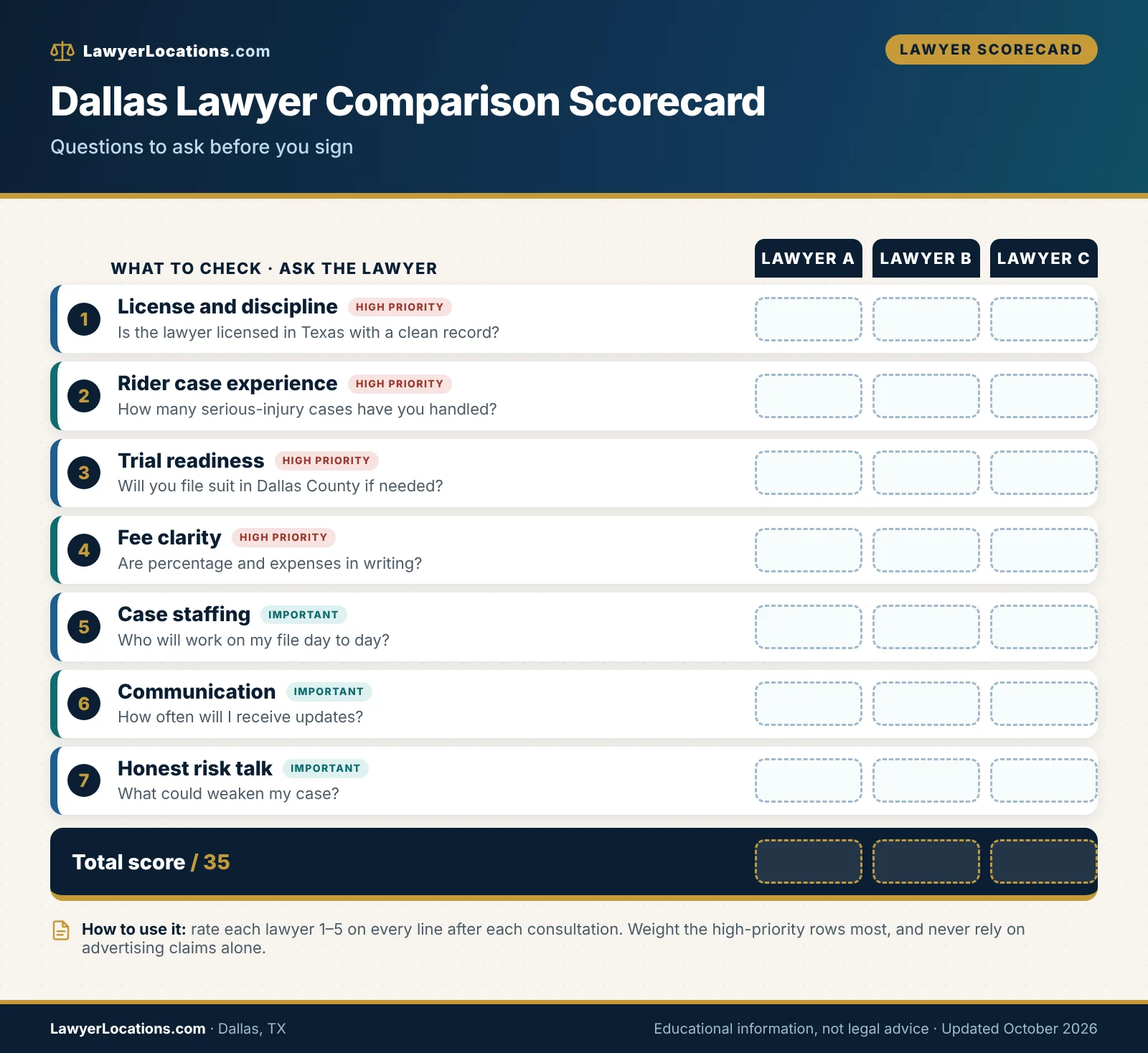
Text version of this graphic
| Criterion | Question to ask |
|---|---|
| License status | Is the lawyer licensed in Texas, with a clean public record? |
| Rider case experience | How many motorcycle or serious-injury cases have you handled? |
| Trial readiness | Will you file suit in Dallas County if talks fail? |
| Fee clarity | Is the fee percentage and expense policy in writing? |
| Case staffing | Who will actually work on my file? |
| Communication | How often will I get updates? |
| Honest risk talk | What could weaken this case? |
| Criterion | What to ask or check | Good sign | Warning sign |
|---|---|---|---|
| License and discipline | State Bar of Texas profile | Active license, name matches paperwork | Cannot be found, or defensive about it |
| Rider-case experience | Number and type of serious-injury cases handled | Specific, honest answers | Slogans without specifics |
| Trial readiness | Willingness to file and try a case in Dallas County | Explains the court process clearly | Always sends cases elsewhere |
| Fee agreement | Percentage, expenses, when each is deducted | Written, signed, explained in plain English | Verbal promises, pressure to sign now |
| Staffing | Who handles the file day to day | Named contact and backup | Unclear who you will talk to |
| Communication | Update schedule and settlement decision process | You decide on settlement after advice | Lawyer wants sole control |
| Honesty about risk | Comparative fault, insurance limits, helmet and lane issues | Raises weaknesses unprompted | Guarantees a result |
Red flags when choosing a lawyer
Most lawyers behave professionally. Some warning signs are common enough to know in advance.
Unsolicited contact after a crash
Texas law restricts how lawyers and their representatives may approach accident victims, and Government Code section 82.065 includes provisions allowing a client to void a contract procured through barratry (the unlawful solicitation of legal business). A stranger who shows up at the hospital, calls you from a crash report or sends a runner to your home is a red flag. You can decline politely and, if you wish, report the contact to the State Bar.
Guarantees and pressure
No lawyer can promise an outcome, a settlement amount or a deadline. Phrases like “we always win” or “sign today or lose your rights” are pressure, not information. A lawyer who is confident in the work will let you take the agreement home and read it.
Unclear fee papers
A lawyer who invites you to take the fee agreement home, read it, and ask questions is behaving the way a careful professional should. Time to think is part of a fair process.
If you cannot tell from the agreement what percentage the firm takes, which expenses you owe, and whether expenses come out before or after the fee, ask for a rewrite. Texas disciplinary rules require a contingent fee agreement to be in writing and to state the method for determining the fee. We cover the details in the next section.
- Contact from a lawyer or “case manager” you did not call
- Promises of a specific payout or timeline
- Refusal to put the fee percentage and expense terms in writing
- No clear answer about who will handle your case
- Pressure to reject medical care or accept the first offer
Fees, Liens, Deadlines and Decision Points
Most Texas injury lawyers handle rider cases on a contingency fee, meaning the firm is paid a percentage of a recovery rather than an hourly rate. Two rules protect you: the agreement must be written and signed, and it must state how the fee is calculated. The percentage itself is set by the firm and the contract, not by a single statewide number that we could verify, so the right move is to compare written terms from more than one office.
How contingency fees work in Texas
A contingency fee shifts the upfront risk away from the client, but it is not free. You still need to understand what is deducted and when.
A written, signed agreement
Texas Government Code section 82.065(a) says a contingent fee contract for legal services “must be in writing and signed by the attorney and client.” The Texas Disciplinary Rules of Professional Conduct add, in Rule 1.04(d), that the agreement shall state the method by which the fee is determined. If a firm asks you to start work on a handshake, request the paperwork first.
Fee percentage and stages
Many firms use a sliding percentage that rises if the case is filed in court or goes to trial, but firms differ, so ask for the percentage at each stage in writing. Also ask what happens if you change lawyers midway and whether the firm claims a fee for work already done. A clear agreement answers these questions without being asked.
Expenses: before or after the fee
Under Rule 1.04(d), the agreement must list the litigation and other expenses that will be deducted from the recovery and must say whether those expenses are deducted before or after the contingent fee is calculated. That one sentence can change what you take home, so compare it across firms. At the end of the matter, the lawyer must give you a written statement showing the remittance to the client and how it was calculated.
Ask each lawyer to explain, using a hypothetical round number, how fees, expenses and any liens would come out of a recovery. If the explanation is vague, that tells you something about the way the file will be handled.
A lien is a legal claim against money you may receive. A hospital lien does not mean you owe more than the bill; it means the hospital has a right to be paid from a recovery before the money reaches you.
Case costs, medical liens and reimbursement claims
The settlement figure is not the same as your net recovery. Costs and repayment claims come out first, and some of them are not obvious on day one.
Case expenses
Typical expenses include court filing fees, medical record charges, deposition transcripts, expert witnesses, mediation fees and investigation costs. Filing fees for Dallas County district courts are posted by the District Clerk, so check the clerk’s current fee schedule rather than relying on a number from an article. Ask when the firm advances these costs and whether you owe them if the case does not succeed, since contracts differ on this point.
Hospital liens under Texas Property Code chapter 55
Texas Property Code section 55.002 gives a hospital a lien on the cause of action or claim of a person who receives hospital services “for injuries caused by an accident that is attributed to the negligence of another person,” as long as the person is admitted not later than 72 hours after the accident. The lien extends to a hospital to which the person is transferred for the same injury. An emergency medical services provider has a similar lien, but only in a county with a population of 800,000 or less. Dallas County is far above that figure, so the EMS provision is not the one usually in play, and your lawyer can confirm.
The practical effect is that a hospital lien can be a claim against your settlement that must be dealt with before money is distributed. Ask your lawyer how liens will be identified, whether they can be negotiated, and who communicates with the hospital.
Health insurers and other reimbursement claims
Your health plan, an employer plan, Medicare, Medicaid or a workers’ compensation carrier may have a right to be repaid from a recovery. The rules vary by plan type, and some plans are governed by federal law. This is one of the most common surprises at the end of a case, so ask about it at the first consultation. See also our guide to medical bills after a car accident.
| Item | Who is owed | Where the rule comes from | Question to ask your lawyer |
|---|---|---|---|
| Attorney fee | The law firm | Written contract; Gov’t Code 82.065; Disciplinary Rule 1.04 | What percentage applies at each stage? |
| Case expenses | The firm (reimbursed) or vendors | The fee agreement | Are expenses deducted before or after the fee? |
| Hospital lien | The admitting or receiving hospital | Property Code 55.002 | Is there a lien, and can it be negotiated? |
| Health plan repayment | Insurer or plan | Plan terms and applicable law | Does my plan have a right to be repaid? |
| Government benefits | Medicare or Medicaid | Federal and state programs | How will these claims be handled? |
| Closing statement | You | Disciplinary Rule 1.04(d) | Will I get a written breakdown of every deduction? |
Timeline, deadlines and decision points
Deadlines in a rider’s case are few but unforgiving, and several decisions need to be made well before they arrive.
The first month
In the first thirty days, focus on medical care, the crash report, preserving evidence, notifying your own insurer as your policy requires, and interviewing lawyers. If a government unit may be involved, tell your lawyer on day one because the six-month notice period in CPRC 101.101 or a shorter city charter period may apply. Do not wait to see how the injury develops before asking about government claims.
Keep a single folder, paper or digital, for every letter, bill and email about the crash. When a lawyer asks for a document, you will be able to find it in seconds, and the habit prevents costly gaps.
Months two through twelve
This stretch is about treatment, documentation and information gathering. Many lawyers prefer to wait until you have reached maximum medical improvement, meaning your doctors say your condition has stabilized, before making a demand, because settling before the full extent of the injury is known can leave future care unpaid. The pace of this stage is often driven by medical recovery more than by legal tactics.
Approaching the two-year mark
If the claim has not resolved, the lawyer must decide whether to file suit before the two-year deadline in CPRC 16.003. Filing does not mean going to trial; it keeps the claim alive and opens the formal discovery process. For a wrongful-death claim, the same two-year period runs from the date of death, as discussed in our wrongful death lawyer cost guide.
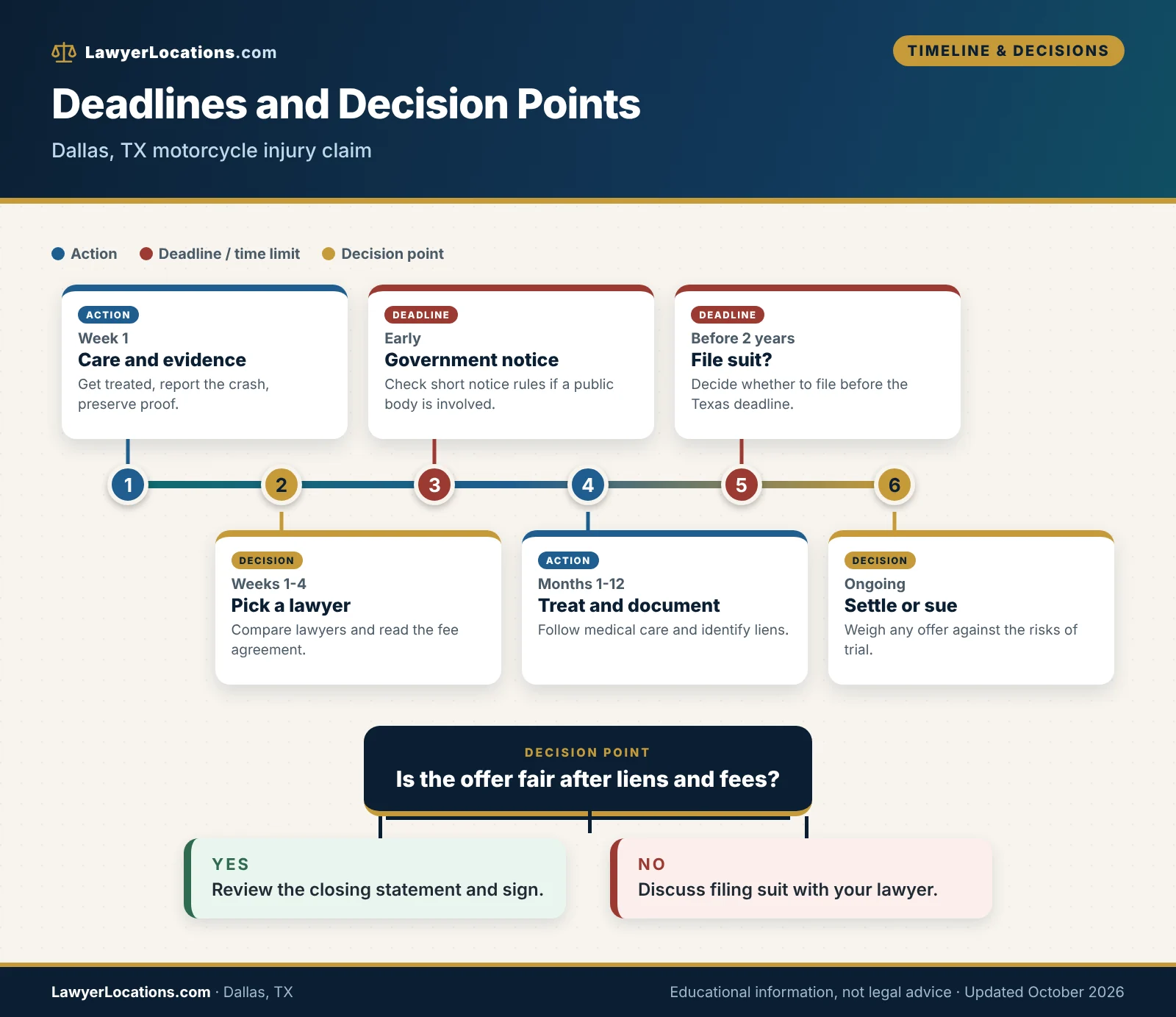
Text version of this graphic
- Days 1-7: Get care, report the crash, preserve evidence.
- Weeks 1-4: Request the crash report; interview lawyers; check for government-notice deadlines.
- Months 1-3: Sign a written fee agreement; start the investigation.
- Months 3-12: Continue treatment; identify liens and insurance policies.
- Before month 24: Decide whether to file suit before the two-year deadline.
- Decision: Accept a settlement offer, or file suit and continue.
| When | What happens | Decision or deadline | Rule or source |
|---|---|---|---|
| First week | Medical care, crash report, evidence | Do not give a recorded statement before advice | General practice |
| Within six months | Notice to any government unit that may share fault | Shorter charter periods may apply to cities | CPRC 101.101 |
| Weeks 1 to 4 | Interview lawyers; sign a written fee agreement | Choose representation | Gov’t Code 82.065 |
| Within 72 hours of the crash | Hospital admission that supports a hospital lien | Lien may attach to the claim | Property Code 55.002 |
| Months 3 to 12 | Treatment, records, demand preparation | When to make a demand | Lawyer’s judgment |
| Two years | Suit must be filed | Accept an offer or file in court | CPRC 16.003 |
Common Questions and Next Steps
These are the questions riders and families most often ask when searching for a motorcycle accident lawyer in Dallas, TX. The short answers point back to the sections above and to the official sources listed at the end.
Straight answers to common questions
Each answer is general information and depends on the facts of a specific case, so a licensed Texas lawyer should confirm how it applies to you.
Questions about fees, hiring and costs
How much does a motorcycle accident lawyer cost in Dallas?
Most handle rider injury cases on a contingency fee, which means the fee is a percentage of a recovery. The percentage and the treatment of expenses vary by firm, so get them in writing and compare. Texas requires contingent fee contracts to be in writing and signed by lawyer and client.
Do I have to pay anything upfront?
Many contingency firms advance case expenses and are repaid from a recovery, but contracts differ. Ask whether expenses are your responsibility if the case does not succeed, and whether they come out before or after the fee is calculated.
How do I check that a Dallas lawyer is licensed?
Look up the lawyer’s profile on the State Bar of Texas website at texasbar.com, which shows license status and any public discipline. Match the name to your engagement letter.
Does the Dallas Bar Association referral service cost anything?
Referral services commonly charge a modest consultation fee, and the amount can change. Call the service at the number on the Dallas Bar Association’s site and ask what the fee is and whether it is credited toward later fees.
Do I need a lawyer for a minor motorcycle crash?
Not always, but riders are often more seriously hurt than the damage suggests. If you have injuries, missed work, or a fault dispute, a consultation helps you decide. Our guide on whether you need a lawyer after a car accident covers how to weigh it.
How is this different from the general Dallas personal injury lawyer guide?
It overlaps, but this guide focuses on rider-specific issues such as helmets and lane use. For general injury hiring advice in the city, see finding a personal injury lawyer in Dallas.
Questions about fault, deadlines and insurance
How long do I have to file a motorcycle accident lawsuit in Texas?
Generally two years after the claim accrues under CPRC 16.003, and for a death claim two years after the death. Claims against government units can require notice within six months or a shorter charter period.
What if I was partly at fault?
You can still recover if you are 50 percent or less responsible, but the award is reduced by your percentage. If you are found more than 50 percent responsible, you recover nothing.
Does not wearing a helmet end my claim?
Not automatically. Texas has an exception for riders 21 and older who meet training or health-insurance conditions. The defense may still argue that a helmet would have reduced injuries, so ask a lawyer how that argument is handled.
Is lane splitting illegal in Texas?
Since September 1, 2023, Transportation Code section 545.0605 prohibits riding between lanes of traffic moving in the same direction and passing a vehicle within the same lane. Riders may ride two abreast in a lane.
Is the other driver’s insurance enough to pay for my injuries?
Not necessarily. Texas minimum liability limits are $30,000 per person and $60,000 per crash, and a serious injury can exceed them. Your own uninsured/underinsured motorist coverage may help, as explained in our uninsured motorist guide.
Can I sue a city for a road defect that caused my crash?
Possibly, but the Texas Tort Claims Act limits such claims and requires timely notice, generally within six months or a shorter city-charter period. Raise this with a lawyer right away.
Where do I get my crash report?
Through TxDOT’s Crash Report Online Purchase System. As of October 2026, TxDOT lists a regular copy at $6 and a certified copy at $8, and eligible people include those involved in the crash and their representatives.
Will a hospital be paid from my settlement?
It can be. Texas Property Code section 55.002 gives hospitals a lien on certain injury claims when the patient is admitted within 72 hours of the accident. Your lawyer should identify liens and explain how they are handled.
What if a family member died in a motorcycle crash?
The deadline for a death claim is two years from the date of death under CPRC 16.003(b), and who may bring the claim is a legal question for a lawyer. See our wrongful death lawyer cost guide for how fees work in those cases.
Your next steps
Finding a lawyer is easier when you treat it as a short, structured project instead of a single frightening call.
In the first week
See a doctor, secure the crash report number, photograph everything you can, and do not give a recorded statement to the other driver’s insurer. Write down your timeline and gather your insurance papers. If you are still unsure about next steps after a crash, our checklist on what to do after a car accident is a good companion.
Before you sign anything
Check each candidate’s State Bar profile, compare at least two written fee agreements, and ask the questions in Section 5. Read how the agreement treats expenses, liens and what happens if you change lawyers. Take the agreement home if you need time, and make sure you understand the Texas deadlines that apply to your situation.
Ready to compare your options?
Use the scorecard in Section 5 to compare two or three Texas-licensed lawyers, ask each one to explain fees, expenses and liens in writing, and confirm your filing deadline before the first meeting ends. When you are ready, our guide to motorcycle accident settlements explains the factors that tend to influence value.
Sources & References
Show all 13 sources
- Civil Practice and Remedies Code, Chapter 16 (Sec. 16.003, two-year limitations period) — Texas Legislature — tcss.legis.texas.gov — accessed October 2026
- Civil Practice and Remedies Code, Chapter 33 (Proportionate Responsibility) — Texas Legislature — tcss.legis.texas.gov — accessed October 2026
- Civil Practice and Remedies Code Sec. 41.0105 (Recovery of Medical Expenses) — Public.Law reproduction of Texas statutes — texas.public.law — accessed October 2026
- Civil Practice and Remedies Code Sec. 101.101 (Tort Claims Act notice) — Public.Law reproduction of Texas statutes — texas.public.law — accessed October 2026
- Transportation Code Sec. 601.072 (Minimum Liability Insurance) — Public.Law reproduction of Texas statutes — texas.public.law — accessed October 2026
- Transportation Code Sec. 661.003 (Motorcycle Headgear) — Public.Law reproduction of Texas statutes — texas.public.law — accessed October 2026
- H.B. 4122, 88th Legislature, Bill Analysis (adds Transportation Code Sec. 545.0605) — Texas Legislature — capitol.texas.gov — accessed October 2026
- Government Code Sec. 82.065 (Contingent Fee Contracts) — Public.Law reproduction of Texas statutes — texas.public.law — accessed October 2026
- Texas Disciplinary Rules of Professional Conduct, Rule 1.04 (Fees) — University of Houston Law Center — law.uh.edu — accessed October 2026
- Property Code Sec. 55.002 (Hospital and Emergency Medical Services Liens) — Justia — law.justia.com — accessed October 2026
- Crash reports and records — Texas Department of Transportation — txdot.gov — accessed October 2026
- District Clerk, Civil, Family and Juvenile Section — Dallas County, Texas — dallascounty.org — accessed October 2026
- Dallas Bar Association — Lawyer Referral Service (directory listing) — TexasLawHelp.org — texaslawhelp.org — accessed October 2026
General information only. This article is legal education, not legal advice, and reading it does not create an attorney-client relationship. LawyerLocations.com is not a law firm and does not recommend, rank or endorse any lawyer. Laws, deadlines, fees and court procedures change and depend on the facts of each case, so consult a lawyer licensed in Texas about your situation and confirm current rules with the official sources listed above.
Legal Disclaimer and Limitation of Liability
Informational and illustrative purposes only. This article was prepared by LawyerLocations.com solely on the basis of the information available to us at the time of writing. It is an illustrative, general overview. It is not a complete or authoritative statement of the law, and it has not been reviewed by a lawyer licensed in your state or county.
Not legal advice. Nothing in this article is legal, financial, tax or immigration advice, and reading it does not create an attorney-client relationship between you and LawyerLocations.com or any author, lawyer or firm mentioned. Laws, court rules, fees, filing deadlines and agency procedures differ by state, county and court, and they change often. Some details here may be simplified, incomplete or out of date, and time limits for legal claims can be short.
No warranty. We make no representation or warranty, express or implied, about the accuracy, completeness, timeliness or suitability of this content for your situation. Please do not rely on it to make, delay or skip any legal decision. Check the facts against official sources and speak with a licensed attorney in the relevant jurisdiction before you act.
Limitation of liability. To the fullest extent permitted by law, LawyerLocations.com and its owners, authors and contributors disclaim all liability for any loss, damage, cost or other consequence arising from the use of, or reliance on, this article, including any content on third-party websites we link to. Mentioning a lawyer, firm, organization or service is not an endorsement and is not a promise of any result. If you are in immediate danger, contact your local emergency number.