Searching for a prenup lawyer Chicago IL usually means you want a licensed Illinois attorney who can draft, negotiate or review a premarital agreement under the Illinois Uniform Premarital Agreement Act, 750 ILCS 10 and who understands how the Circuit Court of Cook County handles property and maintenance disputes if the marriage later ends. Illinois requires the agreement to be in writing and signed by both partners (750 ILCS 10/3), and a court can refuse to enforce it if one partner did not sign voluntarily or if it was unconscionable and the finances were never fairly disclosed.
This guide explains what the Illinois statute allows, what the Chicago-area courts and referral services look like, how to compare lawyers and fee structures, and how to work backward from your wedding date so nobody signs under pressure.
What a Chicago prenup lawyer actually does
A prenup lawyer in Chicago helps you decide, in writing and before the wedding, how property, debts and spousal support will be handled if the marriage ends or one partner dies. The work is part legal drafting, part financial disclosure and part careful conversation between two people who are about to get married.
The lawyer you hire represents you, not the couple. That distinction shapes almost everything below, from fee structures to why a fair agreement usually involves two separate lawyers.
What a prenup is under Illinois law
Illinois defines a premarital agreement as an agreement between prospective spouses, made in contemplation of marriage, that takes effect when the marriage happens. It is a contract, but it is a contract with a statute built around it.
The statute behind the contract
Illinois adopted the Illinois Uniform Premarital Agreement Act, found at 750 ILCS 10/1 and following. It applies to premarital agreements signed on or after January 1, 1990, and it sets the rules for how an agreement must be made, what it can cover and when a court will decline to enforce it.
Because the Act is a state law, the same framework applies whether you live in Lincoln Park, Pilsen, Evanston or Oak Park, and whether the divorce would be filed in the city or in a suburban Cook County courthouse. What changes from place to place is the practical side: which courthouse, which clerk’s office, which referral service and which lawyers practice nearby.
What the agreement is allowed to cover
The Act lists the subjects partners may agree on. They include each person’s rights in property, how property is managed, what happens to property if the couple separates, divorces or one spouse dies, whether spousal support (called maintenance in Illinois) is changed or waived, wills and trusts, life insurance death benefits, and which state’s law governs the agreement. The Act also allows other matters that do not violate public policy or a criminal statute.
There is one fixed limit worth remembering from the start: a child’s right to support may not be adversely affected by a premarital agreement. A prenup can shape how adults share property and spousal support, but it cannot sign away what a child is owed.
How the prenup process runs from first call to wedding day
Most prenup engagements follow the same arc: a short consultation, a financial disclosure exchange, a first draft, negotiation, revisions and a signing that happens well before the ceremony. The calendar matters more than people expect.
Before you call a lawyer
start with a one-page asset list Spend an evening writing down what you own, what you owe and what you expect to acquire. Include retirement accounts, real estate, business interests, expected inheritances, student loans and any support obligations from earlier relationships. A rough list is enough for the first consultation, and it makes the conversation concrete.
Then talk with your partner about goals before anyone drafts anything. Are you protecting a business, keeping a family home in the family, or simply clarifying how debts will be treated? A lawyer can draft far more precisely when the two of you have already agreed on the shape of the deal.
Drafting, negotiating and signing
One side’s lawyer typically prepares the first draft and sends it to the other side’s lawyer, who reviews it, suggests changes and may propose a counter-draft. Financial disclosure schedules, listing each person’s assets and debts, are usually attached as exhibits.
Signing is the last step, and it should happen with room to spare before the wedding. A signature obtained the week of the ceremony invites the argument that one partner felt cornered, which is exactly what the voluntariness rule in Section 7 of the Act is designed to examine.
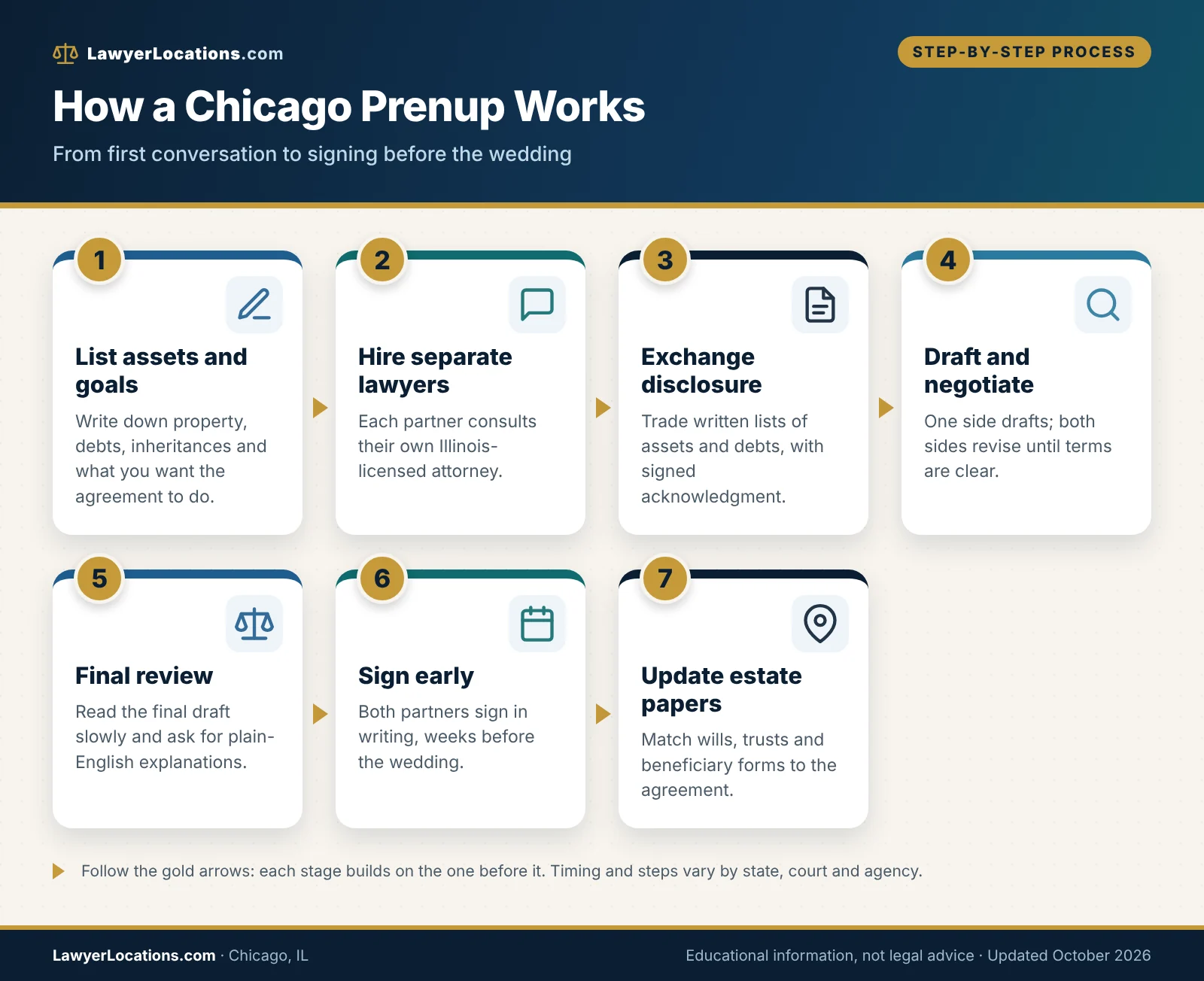
Text version of this graphic
- List your assets, debts and goals.
- Each partner consults a separate Illinois lawyer.
- Exchange financial disclosure in writing.
- Draft the agreement and negotiate changes.
- Review the final draft without time pressure.
- Both partners sign, ideally weeks before the wedding.
- Keep signed copies and update estate documents.
- Revisit after marriage only by signed written amendment.
Ask each lawyer to put the proposed signing date and the wedding date on the same calendar during the first meeting. Working backward from the wedding gives you a built-in buffer for disclosure, revisions and second thoughts.
Who should think about a prenup, and who may not need one
Prenups are not only for wealthy couples. They matter wherever Illinois default rules would produce a result you would not choose on your own.
Situations where Illinois default rules matter most
Without an agreement, Illinois law treats property acquired after the wedding as marital property unless an exception applies, and it divides marital property in “just proportions” under 750 ILCS 5/503. A prenup becomes especially useful when one partner owns a business, expects an inheritance, carries significant student debt, has children from an earlier relationship, or is likely to step back from a career to raise children.
It can also matter when the partners are far apart in income. Illinois maintenance guidelines apply a formula to many divorces, and a premarital agreement can change or eliminate maintenance, subject to a hardship safeguard discussed in the next section.
When a simpler tool may fit instead
If your main concern is who receives what at death, estate documents may do most of the work. A living trust, updated beneficiary designations and a will can address death planning directly, though a prenup is the tool that speaks to divorce.
If you are already married, a prenup is no longer possible, but a written agreement between spouses may be. Section 6 of the Act addresses amending or revoking an agreement after marriage, and a lawyer can explain whether a postnuptial agreement fits your situation. If you are weighing separation rather than a contract, our guide to legal separation versus divorce covers that decision.
The Illinois rules every prenup must satisfy
An Illinois prenup is valid when it is in writing, signed by both partners and entered into voluntarily, and it is enforceable unless the partner challenging it proves a statutory ground. The grounds are narrow, but they are real, and a careful lawyer drafts and documents the process with them in mind.
Formalities and content: Sections 3 and 4 of the Act
The formalities are short. The harder questions are about what you put inside the document and how you document the process.
In writing, signed, no consideration required
Under 750 ILCS 10/3, a premarital agreement must be in writing and signed by both parties. It needs no consideration to be enforceable, which means neither partner has to “pay” the other to make the promise binding. An oral deal, a text-message understanding or an unsigned draft will not meet the statute.
The agreement takes effect only upon marriage under Section 5. If the wedding never happens, the agreement never takes effect, which is one reason to keep disclosure and negotiation records separate from any wedding planning.
Permitted subjects and the child support limit
Section 4 sets out the topics the partners may address. The table below summarizes the Act’s sections as they apply in practice. Read it as a map for your first consultation, not as a substitute for the statute’s text.
| Section | Subject | What it means for a Chicago couple |
|---|---|---|
| 10/2 | Definitions | A premarital agreement is made in contemplation of marriage and takes effect on marriage; “property” includes present or future interests, including income and earnings. |
| 10/3 | Formalities | Must be written and signed by both partners; no consideration required. |
| 10/4 | Content | Property rights, management, disposition on separation, divorce or death, maintenance, wills, trusts, life insurance and governing law; a child’s right to support may not be adversely affected. |
| 10/5 | Effect of marriage | The agreement becomes effective when the marriage occurs. |
| 10/6 | Amendment and revocation | After marriage, changes require a written agreement signed by both spouses; no consideration needed. |
| 10/7 | Enforcement | Unenforceable if not signed voluntarily, or if unconscionable and fair disclosure was lacking; a hardship safeguard applies to support waivers; a judge decides unconscionability. |
| 10/8 | Void marriage | If the marriage is void, the agreement is enforceable only to the extent necessary to avoid an inequitable result. |
| 10/9 | Limitation of actions | Time limits for claims under the agreement are tolled during the marriage; equitable defenses such as laches and estoppel remain available. |
Maintenance is the Illinois term for spousal support paid after a divorce, and 750 ILCS 5/504 sets the guidelines courts consult. A prenup can change or waive it, but Section 7 of the Act gives a court a limited power to step in when a waiver would cause undue hardship from circumstances no one could reasonably foresee at signing.
What gets a prenup set aside: Section 7 of the Act
Section 7 is the heart of any enforcement fight. The challenger carries the burden, and the grounds fall into two groups.
The voluntariness ground
A court will not enforce an agreement against a partner who proves that he or she did not execute it voluntarily. The statute does not define voluntariness by a checklist, so lawyers look at the surrounding facts: how much time the person had, whether he or she had a lawyer, whether the terms were explained and whether there was pressure tied to the wedding date.
This is why the timing advice in this guide keeps coming back to the calendar. A document handed over days before guests arrive looks very different from one negotiated over several weeks with counsel on both sides.
The unconscionability-plus-disclosure ground
The second ground has two parts that must both be proven. The challenger must show that the agreement was unconscionable when it was signed, meaning grossly one-sided, and that before signing he or she was not given fair and reasonable disclosure of the other partner’s property or financial obligations, did not waive that disclosure in writing, and did not have adequate knowledge of those finances.
That structure explains why disclosure schedules are not a formality. When each partner has listed assets and debts and signed an acknowledgment, the second ground becomes much harder to establish. Section 7 also says unconscionability is decided by the court as a matter of law, so a judge in the Domestic Relations Division, not a jury, would decide it.
The support hardship safeguard
If a provision modifies or eliminates spousal support and enforcing it would leave one partner in undue hardship because of circumstances that could not reasonably have been foreseen at signing, a court may require the other partner to provide support to the extent needed to avoid that hardship. The safeguard is narrow, but it is why a well-drafted agreement does not assume nothing will ever change.
In practice, lawyers sometimes address foreseeable events directly: relocation for a career, a child with special needs, a serious illness, or a decision that one partner will leave the workforce. Events spelled out in the agreement are harder to call unforeseeable later.
A prenup that one partner signed without a lawyer, without seeing the other partner’s finances and shortly before the ceremony is the kind of document that tends to draw an enforcement challenge. Fairness in the process protects both partners, including the one who wanted the agreement.
What Illinois law does without a prenup
Knowing the default rules helps you decide what to change. Two statutes matter most: the property statute at 750 ILCS 5/503 and the maintenance statute at 750 ILCS 5/504.
Marital and nonmarital property under Section 503
Under 750 ILCS 5/503(a), marital property is generally all property, including debts, acquired by either spouse after the marriage, unless a listed exception applies. Exceptions include property acquired by gift, legacy or descent; property acquired before the marriage; property acquired in exchange for nonmarital property; and property excluded by a valid agreement, including a premarital or postnuptial agreement. Increases in value of nonmarital property and income from it are also treated as nonmarital in many cases, with reimbursement rules.
Section 503(c) governs commingling. If separate and marital funds are mixed so that they lose their separate identity, the result can be marital property, although a contributing estate may seek reimbursement if the contribution is traceable by clear and convincing evidence. A prenup can set its own rules for these situations, and the statute recognizes that spouses may agree otherwise.
Maintenance guidelines and the court’s division factors
For maintenance, 750 ILCS 5/504(b-1) contains guidelines that apply when the parties’ combined gross annual income is less than $500,000 and the payor has no support obligation from a prior relationship. The formula is 33 1/3 percent of the payor’s net income minus 25 percent of the payee’s net income, capped so the payee’s total does not exceed 40 percent of combined net income. Duration is the length of the marriage multiplied by a factor that rises with the length of the marriage; for marriages of 20 years or more the court may choose a term equal to the marriage length or an indefinite term.
When dividing marital property, Section 503(d) lists factors that include contributions to the marital estate, dissipation, the duration of the marriage, each spouse’s economic circumstances and “any prenuptial or postnuptial agreement.” Marital misconduct is not a factor in the division. Our guide to how long divorce takes explains how these issues fit into the larger timeline.
| Topic | Illinois default (no prenup) | What a prenup can do |
|---|---|---|
| Property owned before marriage | Generally nonmarital under 750 ILCS 5/503(a) | Confirm it stays separate and set rules for what happens if it is commingled or improved with marital funds |
| Property acquired during marriage | Generally marital, divided in just proportions under 503(d) | Designate categories as separate, or set a division formula |
| Spousal maintenance | Court applies guidelines in 504(b-1) in many cases below the income threshold | Modify, cap or eliminate, subject to the hardship safeguard in 10/7 |
| Death-related rights | Governed by Illinois probate and estate law | Address wills, trusts and life insurance benefits under 10/4 |
| Child support | Set by the court based on the child’s needs and parents’ finances | Nothing that adversely affects a child’s right to support |
| Governing law | Illinois law for an Illinois divorce | Choose governing law within what 10/4 permits |
After the wedding: amendments, void marriages and time limits
A prenup does not freeze in place forever, and it does not survive every circumstance. Three provisions of the Act address what happens next.
Amending or revoking after marriage
Section 6 provides that after marriage, a premarital agreement may be amended or revoked only by a written agreement signed by both parties, and that agreement needs no consideration. If your circumstances change, such as a new business, an inheritance or a move, ask a lawyer whether a written amendment makes sense. Informal understandings between spouses do not change a signed prenup.
Keep the signed original and every amendment together with your other important papers. If a divorce is ever filed, the court will look to the signed documents, not to anyone’s memory of what was intended.
Void marriages and tolling of time limits
If the marriage is void, Section 8 says the agreement is enforceable only to the extent necessary to avoid an inequitable result. That is a narrow situation, but it is one more reason to discuss unusual circumstances with a lawyer before you sign.
Section 9 tolls statutes of limitations on claims under the agreement during the marriage, so the clock does not run while the spouses are still married. Equitable defenses such as laches and estoppel remain available, which means a person who waits unreasonably long after learning of a problem can still face arguments about delay.
Chicago and Cook County: courts, offices and local resources
For a Chicago couple, the relevant courthouse is the Circuit Court of Cook County, the relevant license office is the Cook County Clerk, and the relevant referral services are run by the Chicago Bar Association and the Illinois State Bar Association. Knowing which office does what saves time and prevents mistakes with deadlines you control.
The courts and offices that touch a prenup
A prenup is signed privately and is not filed with any court. Its local relevance comes later, if the marriage ends or a dispute arises.
The Domestic Relations Division at the Daley Center
If a Chicago couple divorces, the case is heard in the Domestic Relations Division of the Circuit Court of Cook County. According to the Clerk of the Circuit Court, the division is located in Room 802 of the Richard J. Daley Center, 50 W. Washington St., Chicago, and hears dissolution of marriage, legal separation, parentage, child support, maintenance and allocation of parental responsibilities, along with related post-judgment matters.
The Clerk lists a Domestic Relations help line at 312-603-6300, weekday live chat, a Pro Se/Self-Represented Litigant Center, and lawyer referral lists available in Room 802 or online. The Clerk’s page notes that a General Administrative Order (2024 D 1) changed calendars for most division cases in the suburban municipal districts, so couples living outside the city should confirm which courthouse and calendar would apply to them.
Where a prenup would be argued
If one spouse asks the court to enforce or set aside a prenup, the issue is raised inside the divorce case, usually when property or maintenance is contested. The judge decides unconscionability as a matter of law under Section 7, and applies Section 503(a) and 503(d), which expressly recognize a valid premarital agreement when classifying and dividing property.
That is a practical reason to hire a lawyer who is comfortable in Cook County family court. Even if your agreement is never challenged, a lawyer who has seen how these disputes are presented can anticipate which clauses draw scrutiny and draft them with care.
Your Cook County marriage license and the prenup calendar
Your license timeline is not the prenup deadline, but it is a helpful anchor for planning because it fixes a real date on the calendar.
What the Cook County Clerk says about licenses
According to the Cook County Clerk’s marriage license page, as of October 2026, a license is issued on the spot, becomes effective one day after it is issued, and is valid for 60 days. The Clerk lists the license fee as $60, requires both applicants to apply together in person (or start online and finish in person) with valid identification, and states that the license is valid only for ceremonies performed in Chicago and suburban Cook County. The signed license must be returned to the Clerk’s office within 10 days after the ceremony.
Check the Clerk’s current page before you go, because fees, locations and procedures can change. If you plan a ceremony outside Cook County, the license requirements of the county or state where you marry will control.
Why the license is not your signing deadline
Nothing about the license process requires a prenup, and the Act’s formalities section does not set a particular signing date. What the Act does is make the circumstances of signing relevant through the voluntariness rule in Section 7.
A sensible plan is to finish negotiations and sign well before you apply for the license, so the license and the ceremony become the easy part. If the agreement is still in negotiation when the license is issued, the 60-day validity window is a reminder that the calendar is already moving.
The prenup must be signed before the marriage to qualify as a premarital agreement, because it takes effect only upon marriage. After the ceremony, the options narrow to a written postnuptial arrangement or an amendment under Section 6 if you already have a prenup.
| Resource | What it does | Detail from the source |
|---|---|---|
| Cook County Clerk (Vital Records) | Issues marriage licenses | $60 fee; valid 60 days; effective one day after issuance; valid only for ceremonies in Chicago and suburban Cook County |
| Domestic Relations Division, Daley Center | Hears divorces and related family matters | Room 802, 50 W. Washington St.; help line 312-603-6300; weekday hours 8:30 a.m. to 4:30 p.m. |
| Chicago Bar Association Lawyer Referral Service | Matches callers with screened member lawyers | (312) 554-2001; $30 fee collected at the initial consultation; lists domestic relations and estate planning among its areas |
| ISBA LawyerFinder | Statewide referral service | (800) 922-8757; $25 initial consultation fee, per the Clerk’s list |
| Chicago Bar Foundation limited-scope panels | Unbundled family law help | Listed by the Clerk for family law and eviction matters |
| ARDC Lawyer Search | Shows license status and public discipline | Does not make referrals or recommendations |
| Illinois Legal Aid Online | Free legal information and forms | Guides, Easy Forms and legal self-help center directory |
Finding a Chicago prenup lawyer through referral services
Referral services are one starting point, not the only one. They are useful when you do not know any family lawyers and want a screened list in the Chicago area.
The Chicago Bar Association and ISBA
The Chicago Bar Association Lawyer Referral Service says it connects people in Cook County and nearby suburbs with screened lawyers, with more than 200 member lawyers and over 40 practice areas, including domestic relations and estate planning. Callers can reach it at (312) 554-2001 or request a referral online, and the service states that a $30 fee is collected at the initial consultation, with the lawyer free to charge for his or her time and no obligation to continue after the first meeting.
The Clerk of the Circuit Court also lists the Illinois State Bar Association’s LawyerFinder at (800) 922-8757 with a $25 initial consultation fee. Because referral programs set their own rules and fees, confirm the current amount when you call.
Lower-cost and limited-scope options
Not every prenup needs full-service representation from start to finish. The Clerk lists Chicago Bar Foundation limited-scope referral panels for unbundled family law services and the Justice Entrepreneurs Project for lower-cost services, often at fixed fees. Limited scope can work well when you want a lawyer to review a draft or explain a clause rather than handle the full negotiation.
For free legal information, Illinois Legal Aid Online offers plain-language guides and court-form interviews, and the Clerk lists the CARPLS Legal Aid Hotline at (312) 738-9200. Legal aid organizations set their own eligibility rules, and a prenup is a transactional matter that some programs may not handle, so ask early.
Checking a lawyer’s license and record
Whichever route you take, verify the person before you share your finances.
Using the ARDC Lawyer Search
The Attorney Registration and Disciplinary Commission of the Supreme Court of Illinois (ARDC) operates a public Lawyer Search tool. According to the ARDC, it shows license status, contact information, public disciplinary history and whether the lawyer reports having malpractice insurance.
Run the search for every lawyer on your short list and compare the name and firm to what appears in their marketing. A license in good standing is a baseline, not a measure of skill at prenups.
What the ARDC does and does not do
The ARDC says it does not recommend or refer lawyers, so it will not tell you who is good at premarital agreements. Complaints about lawyers are free to file, but the ARDC notes that isolated mistakes or errors in judgment usually are not considered unethical conduct, and fee disputes are generally not grounds for action unless the fee or fee agreement appears to violate ethics rules.
Use the ARDC for verification and use your own interviews for fit. If a fee disagreement arises later, a clear written fee agreement at the start is your best protection.
How to compare prenup lawyers in Chicago
Compare prenup lawyers on how they handle the process, not on who sounds most confident. Your goal is a document that will hold up and a process you can describe calmly if a judge ever asks how the agreement came about.
This section gives you questions, a scorecard and a list of warning signs. It does not rank or recommend any firm, and LawyerLocations.com is a legal-education resource, not a law firm or a referral agency.
Experience and fit
Start with what the lawyer actually does day to day. Ask direct questions and listen for specifics rather than slogans.
Questions about premarital agreement work
Ask how often the lawyer drafts or reviews premarital agreements, whether he or she has handled disputes over them in Cook County, and how the lawyer approaches the Section 7 disclosure requirements. A lawyer who volunteers a clear description of how financial disclosure is documented is usually thinking about enforceability from the start.
Also ask who will actually do the work. Some firms have a senior lawyer meet with you and an associate or paralegal prepare drafts, which is fine if the firm explains it and the fee reflects it.
Independent counsel for each partner
Each partner should have a separate lawyer. The Act does not use the phrase “independent counsel,” but separate representation is one of the most practical ways to show that each person understood the document and signed voluntarily.
One lawyer cannot properly advise both sides on a document where their interests diverge. If someone proposes that a single lawyer prepare the agreement for both of you, ask about the ethics rules and the risk to enforceability, and consider that a signal to slow down.
Communication, process and disclosure
Prenups succeed or fail on process. A lawyer’s habits matter as much as his or her drafting.
Timelines and responsiveness
Ask for a realistic timeline from first consultation to signing, and ask what could slow it down. Complex assets such as a business, real estate or deferred compensation usually add steps, because valuation and documentation take time.
Ask how the lawyer communicates: email, phone, portal, and how quickly questions are normally answered. Avoid hiring based on a promise of speed alone, since rushing is the very pattern the voluntariness rule looks for.
How the lawyer handles financial disclosure
Ask how the firm assembles disclosure schedules and what supporting documents it recommends, such as account statements, business financials or property records. A lawyer who explains that both sides sign an acknowledgment of the disclosure received is protecting both partners.
You can also ask how the lawyer handles assets that are hard to value. Candor about uncertainty is a better sign than a confident number with no support.
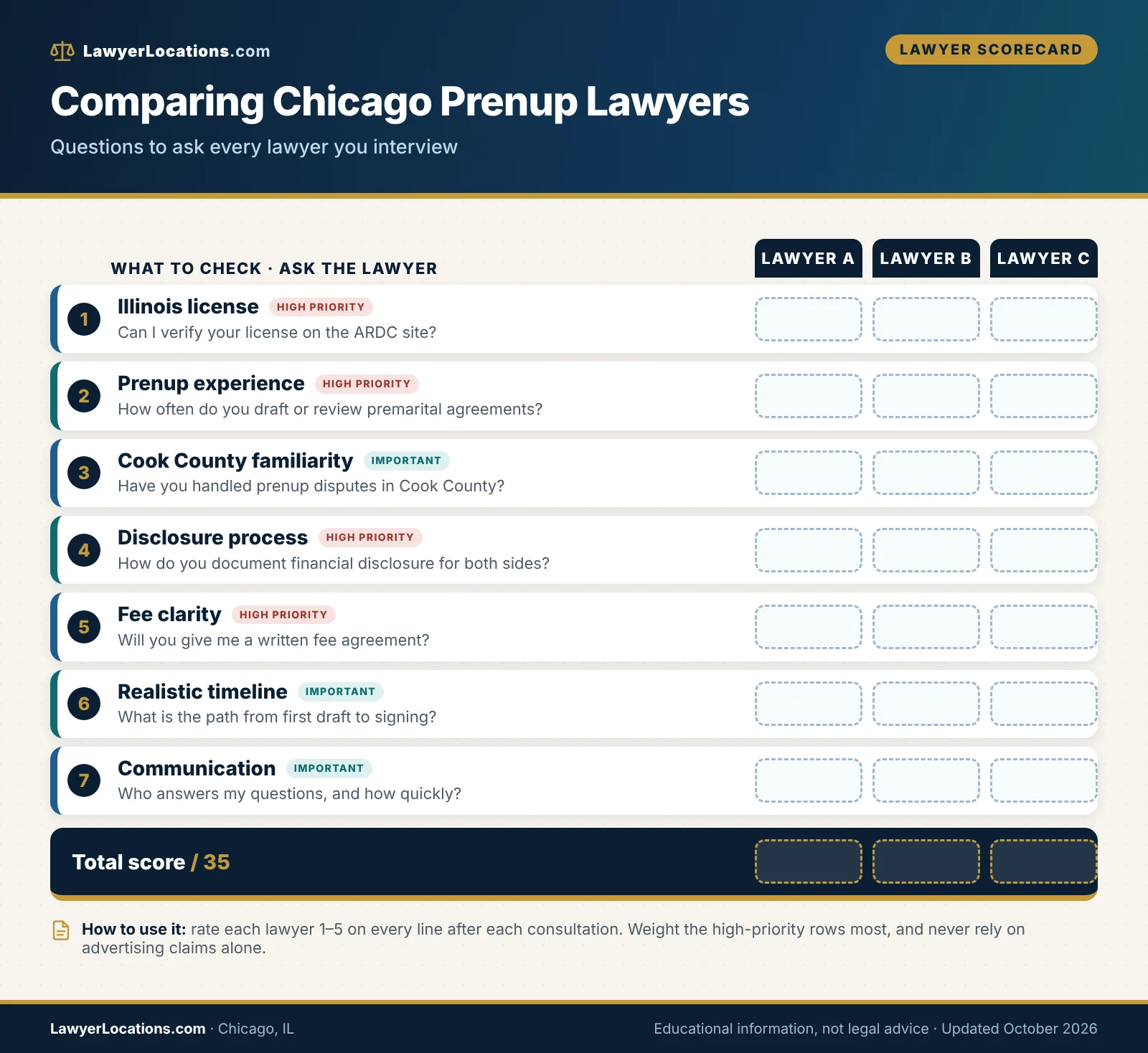
Text version of this graphic
| Criterion | Question to ask |
|---|---|
| Illinois license | Can I verify your license on the ARDC site? |
| Prenup experience | How often do you draft or review premarital agreements? |
| Cook County court familiarity | Have you handled disputes over prenups in the Domestic Relations Division? |
| Disclosure process | How do you document financial disclosure for both sides? |
| Fee clarity | Will you give me a written fee agreement? |
| Timeline | What is the realistic path from first draft to signing? |
| Communication | Who will answer my questions and how fast? |
Bring the same five questions to every consultation and take notes in the same order. Side-by-side notes make differences in clarity and candor easy to see, even when you meet the lawyers on different days.
Red flags when choosing a prenup lawyer
Most red flags are about pressure, shortcuts and promises. They are easier to spot early than after a retainer is paid.
Pressure and shortcuts
Be wary of anyone who suggests skipping financial disclosure, signing at the last minute or avoiding a second lawyer to save time. Shortcuts that look efficient now can make the agreement vulnerable to the very challenges Section 7 describes.
- Advice that you do not need to disclose assets because the other partner “already knows”
- A request to sign within days of the wedding with no chance to revise
- Reluctance to put fees and scope in writing
- Discouraging you from consulting your own lawyer
Outcome promises and conflicts of interest
No honest lawyer can promise that a prenup will be enforced in every circumstance, because the court makes that decision later on facts no one can fully predict. Treat statements like “this will never be challenged” as marketing, not legal analysis.
Also ask whether the lawyer or firm has any relationship with your partner or your partner’s family that could affect advice. If a conflict exists, a good lawyer will raise it first and explain what it means.
- Each partner has a separate Illinois lawyer
- Disclosure schedules are exchanged and acknowledged in writing
- The signing happens weeks before the wedding
- The fee agreement is written and clear
- One lawyer is asked to serve both partners
- Signing is scheduled for the week of the ceremony
- Disclosure is skipped to save time or avoid awkwardness
- The lawyer promises an outcome
Fees, consultations and timing
What a prenup lawyer in Chicago charges depends on the lawyer, the complexity of your finances and how much negotiation is needed, so this guide gives no price averages. What you can control is how clearly the fee structure is explained and how early you start.
Common fee structures and what they cover
Lawyers generally describe fees in three ways. Ask which one applies and what it includes before you sign a fee agreement.
Hourly, flat and limited-scope arrangements
Under an hourly arrangement, you pay for time spent, usually against an advance deposit called a retainer. Under a flat fee, the lawyer quotes one price for a defined package, such as drafting a first draft and one round of revisions. Under a limited-scope arrangement, the lawyer handles only specified tasks, such as reviewing a draft your partner’s lawyer sent you. Illinois ethics guidance states that a lawyer’s fee must be reasonable, and a written fee agreement helps both sides understand what was promised.
Each structure has trade-offs. Hourly billing can fit uncertain negotiations but makes the total harder to predict; flat fees are predictable but may exclude extra rounds; limited scope costs less but leaves you responsible for the rest.
| Structure | How it usually works | Questions to ask | Watch out for |
|---|---|---|---|
| Hourly with retainer | You deposit an advance; the lawyer bills time against it | What is the hourly rate, and who bills at which rate? How often will I get invoices? | Open-ended negotiation can raise the total |
| Flat fee | One price for a defined package of work | What revisions and meetings are included? What is billed separately? | Extras outside the package |
| Limited scope | Lawyer performs only listed tasks, such as reviewing a draft | What is not covered? Who handles negotiation? | Gaps in coverage you did not notice |
| Referral-service consultation | A small fee at the first meeting through a bar referral program | Does the lawyer charge for time beyond the program fee? | Assuming the first meeting is free |
Costs beyond the lawyer’s time
Ask whether the quote includes other expenses. Depending on your assets, you may need an appraisal for real estate or a business, an accountant’s help organizing financial statements, or copies and notary services for signing.
These costs are usually separate from attorney fees. A good fee agreement says who approves them and how they are billed, so you are not surprised by a line item you never discussed.
A prenup is a private contract. Nothing in the Act as described here requires you to file it with the Circuit Court of Cook County, so keeping your own signed copies safe is part of the job.
Consultations: what to expect and how to prepare
A first consultation is a chance for both sides to decide whether to work together. Treat it as an interview, not a commitment.
Referral-service fees versus direct calls
If you reach a lawyer through the Chicago Bar Association service, expect a $30 fee at the initial consultation, and ask the lawyer whether additional time is billed. If you contact a firm directly, ask at the start whether the first meeting is paid, how long it lasts and whether it is in person, by phone or by video.
LawyerLocations.com cannot promise that any lawyer offers a free or discounted consultation, and policies vary. The only reliable approach is to ask before the appointment is booked.
What to bring to a consultation
Bring a short written summary of your goals and a rough list of assets and debts. Add any draft agreement you have received, and a list of questions for the lawyer. If you have a business or trust, bring a basic description of its structure.
- A one-page list of assets, debts and expected inheritances
- Recent statements for retirement and investment accounts
- Business ownership documents, if any
- Any draft or term sheet from your partner
- Your wedding date and any hard deadlines
- Five questions about experience, process and fees
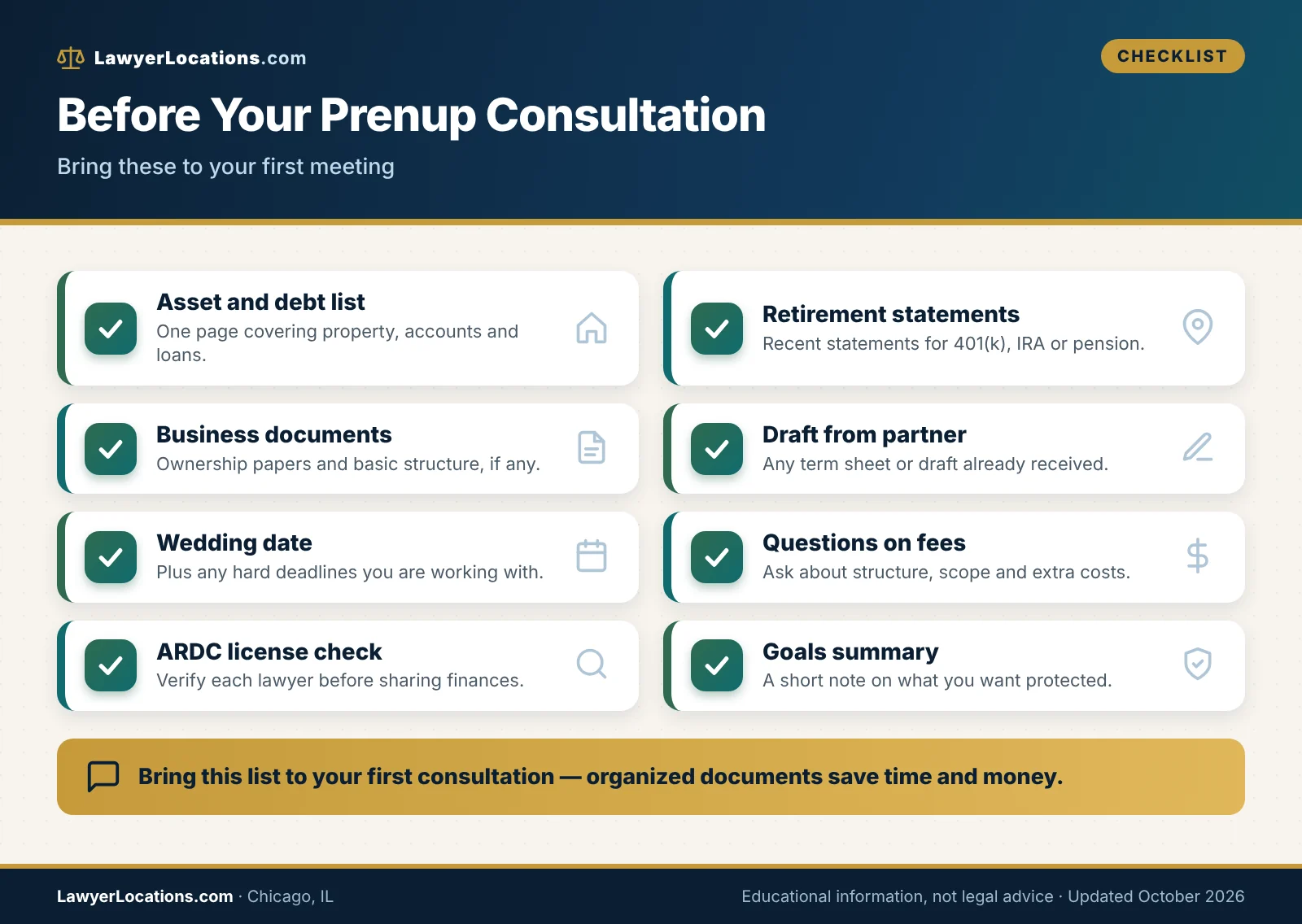
Text version of this graphic
- List assets, debts and expected inheritances.
- Gather retirement and investment statements.
- Collect business ownership documents.
- Bring any draft from your partner.
- Write down your wedding date.
- Prepare questions about experience and fees.
- Check the lawyer on the ARDC site.
- Ask for the fee agreement in writing.
Deadlines, decision points and the prenup timeline
The Act sets no fixed prenup deadline, but real-world constraints create a timeline. The sooner you start, the more options you keep.
Working backward from the wedding date
Pick your wedding date, then count back. Leave time for the Cook County license (valid 60 days from issuance, per the Clerk), time for the final review and signing, and time before that for negotiation and disclosure. Complex finances and holiday-season scheduling for both partners’ lawyers can stretch each stage.
As a rule of thumb that lawyers often share, start well before invitations go out, not after. Ask your lawyer for a timeline that fits your facts, and do not accept a plan that leaves the signing for the final week.
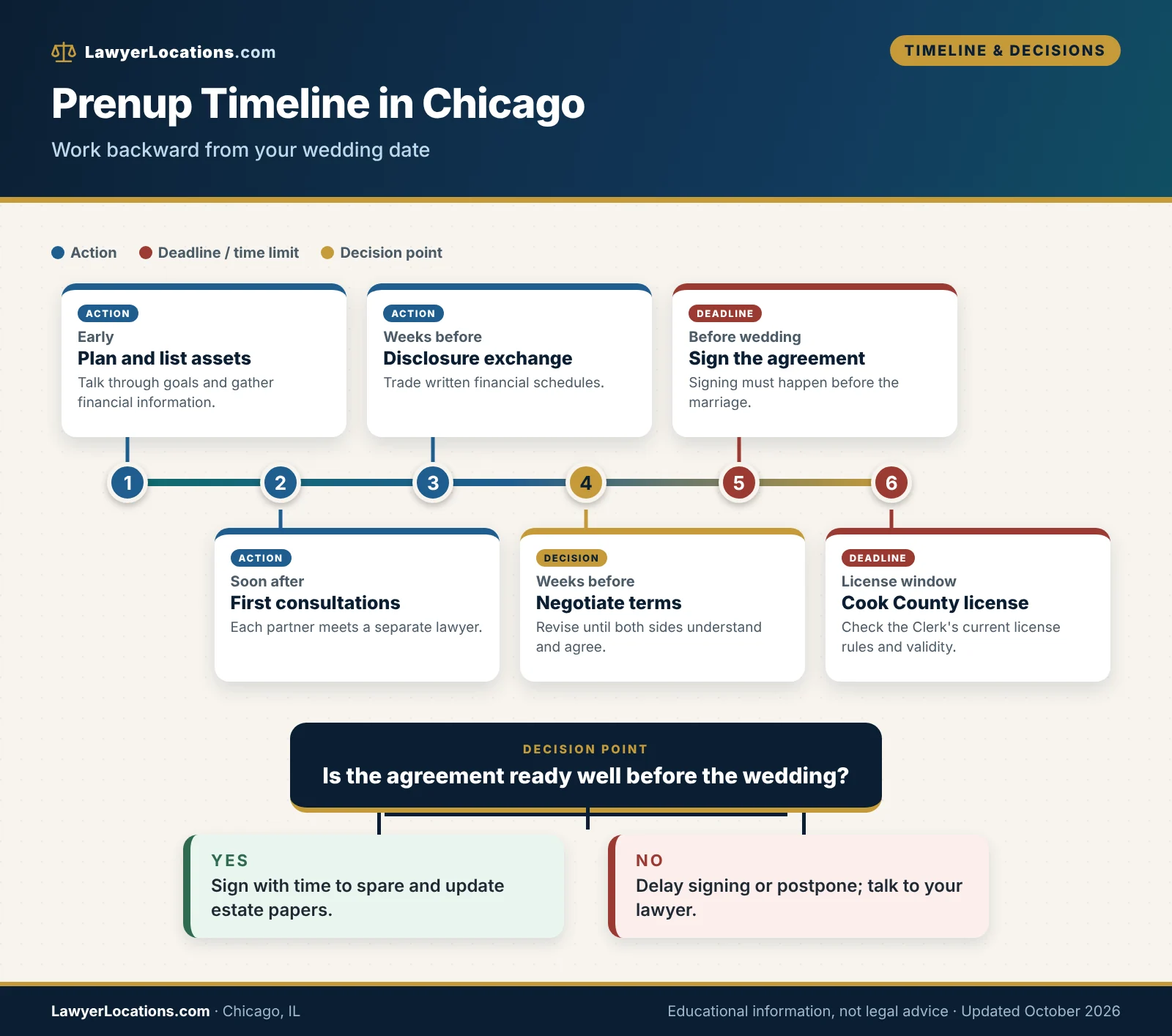
Text version of this graphic
- Early planning: talk through goals and list assets (action).
- First consultations: each partner meets a separate lawyer (action).
- Disclosure exchange: trade written financial schedules (action).
- Drafting and negotiation: revise until both sides agree (decision).
- Final review: read the final draft without pressure (action).
- Signing: both partners sign before the marriage (deadline).
- License and wedding: Cook County license is valid 60 days (deadline).
Decision point: If the agreement is not ready, do you delay signing or marry without one? Delaying signing keeps the prenup option open; marrying first means a prenup is no longer possible, though a written agreement between spouses may be.
Sign now, postpone or skip
If negotiations are unfinished near the wedding, you have three choices: finish and sign with enough time to avoid pressure, postpone the wedding date, or marry without a prenup. None of these is wrong in every case, but each carries different consequences for enforceability and for the Illinois default rules described above.
If you decide to marry without a prenup and later want an agreement, ask a lawyer about a written agreement between spouses. Its enforceability depends on Illinois law and the facts, which is a conversation for a licensed attorney.
Because a premarital agreement takes effect only upon marriage, the practical deadline is the day before the ceremony, and the safer deadline is several weeks earlier. Do not treat the final days as a negotiating window.
Special situations: business, retirement, children and estates
Some assets and family situations need extra care in a Chicago prenup. This section covers the ones couples ask about most and flags where a general guide stops and your lawyer’s advice begins.
Business interests and retirement accounts
These are two of the most common reasons couples seek a prenup, and each has its own wrinkle.
Owning or starting a business
If you own a business or expect to start one, the prenup can address whether the business and its growth are separate or marital property. Section 503(a) treats increases in the value of nonmarital property and income from it as nonmarital in many cases, but Section 503(c) says reimbursement may apply when a spouse’s personal effort significantly increases the value.
That interaction is why business owners often ask the lawyer to address personal effort, compensation and appreciation directly. If your business uses written contracts with partners or investors, a separate business lawyer may need to coordinate, and our guide to a Cook County contract lawyer explains what to ask in that setting.
Retirement plans and spousal consent
Some employer retirement plans give a spouse automatic survivor rights. The IRS explains that certain plans must provide a qualified pre-retirement survivor annuity to a surviving spouse unless the participant and spouse both consent in writing, and that the consent must be witnessed by a plan representative or notary. The IRS page does not discuss prenups.
The practical lesson is to ask your lawyer and your plan administrator how a waiver in a premarital agreement interacts with the plan’s own consent requirements. Do not assume that language in a prenup alone controls what a retirement plan will pay.
If you own a business or hold retirement accounts, ask your lawyer at the first meeting whether a plan administrator or co-owner must also sign anything. ask early, not at signing
Children, earlier relationships and estate planning
Families rarely begin with a blank slate. A prenup can help protect assets for children from an earlier relationship, but there are firm limits.
Children from earlier relationships
If either partner has children, the agreement can address how certain property will pass to them at death, within what Section 4 allows, such as through wills, trusts or life insurance provisions. It cannot adversely affect a child’s right to support.
It also cannot make decisions about parenting time or decision-making for the court. Those matters are decided by a judge in the Domestic Relations Division based on the circumstances when a case is filed, not by a clause drafted years earlier.
Coordinating with wills, trusts and beneficiary forms
A prenup should work with, not against, your estate documents. After you sign, update wills, trusts, retirement account beneficiaries and life insurance designations so they match the agreement, and ask your lawyer which updates are required.
If you are building an estate plan from scratch, our guide to a living trust lawyer explains how that tool differs from a prenup and where the two overlap.
Already married, or a prenup is being challenged
Not every reader is engaged. Some already have a signed agreement and wonder what it means, and others are married with no agreement at all.
Changing an existing prenup
If you already have a signed premarital agreement, Section 6 allows amendment or revocation after marriage only by a written agreement signed by both spouses. Ask a lawyer whether your circumstances justify an amendment, and keep the signed copy with the original.
Do not rely on emails, texts or verbal understandings to change a prenup. The statute asks for a signed writing.
If a prenup is challenged in a divorce
If your marriage ends and one spouse disputes the agreement, the grounds are those in Section 7, and the challenger carries the burden. A lawyer will gather evidence about the process: drafts, emails, who attended meetings, when disclosure was provided and when the agreement was signed relative to the wedding.
Keeping a clean paper trail from the beginning makes that later work easier. If you are wondering what a divorce case might involve, our guide on how long a divorce takes gives the broader picture.
Two partners in Chicago, one a business owner and one a salaried employee, decide on a prenup. Each hires a separate lawyer, they exchange written lists of assets and debts, and they sign about six weeks before the wedding. Years later, if one partner challenges the agreement, those steps document voluntariness and fair disclosure. This is an illustration of process, not a prediction of any result.
Prenups are also a topic in other cities, where local courts and resources differ. If you are comparing, our guides to a prenup lawyer in Miami-Dade County and a prenup lawyer in Los Angeles show how the same question plays out under different state law.
Common mistakes, quick answers and next steps
Most prenup problems come from process errors, not from the clauses themselves. Avoiding the mistakes below does more to protect enforceability than any clever drafting.
Mistakes that make a prenup vulnerable
These are patterns lawyers describe in general terms. They are not statements about any particular case.
Disclosure and representation mistakes
Leaving assets off a disclosure schedule, summarizing finances vaguely, or assuming the other partner knows your finances all weaken the document. Section 7 turns on whether fair and reasonable disclosure occurred, was waived in writing or was otherwise known.
Sharing a lawyer is the other common mistake. Separate lawyers are not a legal requirement under the Act, but they are a practical safeguard for both partners.
- Omitting or undervaluing an asset on a disclosure schedule
- Using one lawyer for both partners
- Relying on verbal side promises that are not in the signed document
Timing and drafting mistakes
Waiting until the last week, relying on an internet template that ignores Illinois law, and failing to update estate documents after signing are the timing and drafting mistakes people mention most. A template cannot account for your assets or for how Section 503 and Section 504 would otherwise apply.
Another frequent mistake is writing provisions about child-related matters that the Act does not allow to adversely affect a child’s right to support. Ask your lawyer to review any such clause with particular care.
Quick answers to common questions
These short answers reflect the Illinois statutes described in this guide as of October 2026. Confirm details with a licensed Illinois attorney before relying on them.
Questions about validity and process
The answers below cover the questions Chicago couples most often raise at the start. Each links back to the statute or office that governs the answer.
Do both of us need a lawyer for an Illinois prenup?
The Act does not require lawyers, but separate lawyers are a practical safeguard for voluntariness and fair disclosure. Ask each lawyer how representation will be documented.
Does a prenup have to be filed with a court?
The sections of the Act described here do not require filing. The agreement is a private contract that matters if the marriage ends or a dispute arises in the Circuit Court of Cook County.
Can a prenup waive child support?
No. Section 4 says a child’s right to support may not be adversely affected by a premarital agreement.
Can a prenup eliminate maintenance?
It can modify or eliminate spousal support, but under Section 7 a court may require support if enforcing the waiver would cause undue hardship from unforeseeable circumstances.
What if one of us did not see the other’s finances?
Lack of fair disclosure is part of one ground for non-enforcement, but it must be combined with unconscionability. Written disclosure and a signed acknowledgment reduce this risk.
Who decides whether a prenup is unconscionable?
Section 7 says the court decides unconscionability as a matter of law, so a judge rather than a jury makes that call.
Does a prenup need a notary?
The formalities section requires a signed writing and does not mention notarization. Many lawyers still use a notary for proof of identity, so ask what your lawyer recommends.
What happens if we call off the wedding?
The agreement takes effect only upon marriage under Section 5, so it has no effect if the marriage does not occur.
Can we change the prenup after the wedding?
Yes, but only by a written agreement signed by both spouses under Section 6.
Will my Cook County marriage license cover a wedding in another state?
The Clerk states that the license is valid only for ceremonies in Chicago and suburban Cook County. Check the rules where you plan to marry.
Questions about hiring and cost
Hiring questions tend to come down to verification and clarity. Check the ARDC record, ask for a written fee agreement and confirm whether the first meeting is paid.
For cost, no responsible guide can quote an average that fits your facts. Ask two or three lawyers for a written description of scope and fees and compare the structures described earlier in this guide.
Your next steps
If you are close to a decision, a short sequence keeps you moving without pressure.
This week
Write your asset and debt list and decide what you want the agreement to accomplish. Then contact two or three Chicago-area lawyers directly or through a bar referral service, and verify each on the ARDC site.
Set your target signing date several weeks before the wedding and ask each lawyer whether that timeline is realistic for your facts.
Before you sign
Read the final draft slowly, ask your lawyer to explain every clause in plain English, and confirm that disclosure schedules are attached and acknowledged. Confirm your fee agreement is in writing and that you know how to update estate documents afterward.
Keep signed copies in more than one safe place. If you are comparing cities or states, our Miami-Dade guide is a useful contrast.
Ready to compare prenup lawyers in Chicago?
Use the scorecard and questions above to interview two or three Illinois-licensed attorneys, verify each on the ARDC site and ask for a written fee agreement. LawyerLocations.com helps you prepare; it does not provide legal advice or recommend any firm.
General information only. This guide is educational content, not legal advice, and reading it does not create an attorney-client relationship. Laws, court procedures, fees and local rules change, and your facts matter. LawyerLocations.com is not a law firm and does not endorse or rate any lawyer. Consult a lawyer licensed in Illinois about your situation before you sign any agreement.
Sources & References
Show all 13 sources
- Illinois Uniform Premarital Agreement Act, Section 7 (750 ILCS 10/7) — Illinois General Assembly — ilga.gov — accessed October 2026
- Illinois Uniform Premarital Agreement Act, full text (750 ILCS 10/1 to 10/11) — Illinois General Assembly — ilga.gov — accessed October 2026
- Illinois Uniform Premarital Agreement Act (statute text mirror) — Justia — law.justia.com — accessed October 2026
- Property (750 ILCS 5/503) — Illinois General Assembly — ilga.gov — accessed October 2026
- Maintenance (750 ILCS 5/504) — Illinois General Assembly — ilga.gov — accessed October 2026
- Marriage Licenses — Cook County Clerk — cookcountyclerkil.gov — accessed October 2026
- Domestic Relations Division — Clerk of the Circuit Court of Cook County — cookcountyclerkofcourt.org — accessed October 2026
- Finding an Attorney — Clerk of the Circuit Court of Cook County — cookcountyclerkofcourt.org — accessed October 2026
- Lawyer Referral Service — The Chicago Bar Association — chicagobar.org — accessed October 2026
- FAQs for the Public — Attorney Registration and Disciplinary Commission of the Supreme Court of Illinois — iardc.org — accessed October 2026
- Illinois Rule of Professional Conduct 1.5 (Fees), opinions and annotations — Illinois State Bar Association — isba.org — accessed October 2026
- Illinois Legal Aid Online — Illinois Legal Aid Online — illinoislegalaid.org — accessed October 2026
- Retirement Topics: Qualified Pre-Retirement Survivor Annuity (QPSA) — Internal Revenue Service — irs.gov — accessed October 2026
Legal Disclaimer and Limitation of Liability
Informational and illustrative purposes only. This article was prepared by LawyerLocations.com solely on the basis of the information available to us at the time of writing. It is an illustrative, general overview. It is not a complete or authoritative statement of the law, and it has not been reviewed by a lawyer licensed in your state or county.
Not legal advice. Nothing in this article is legal, financial, tax or immigration advice, and reading it does not create an attorney-client relationship between you and LawyerLocations.com or any author, lawyer or firm mentioned. Laws, court rules, fees, filing deadlines and agency procedures differ by state, county and court, and they change often. Some details here may be simplified, incomplete or out of date, and time limits for legal claims can be short.
No warranty. We make no representation or warranty, express or implied, about the accuracy, completeness, timeliness or suitability of this content for your situation. Please do not rely on it to make, delay or skip any legal decision. Check the facts against official sources and speak with a licensed attorney in the relevant jurisdiction before you act.
Limitation of liability. To the fullest extent permitted by law, LawyerLocations.com and its owners, authors and contributors disclaim all liability for any loss, damage, cost or other consequence arising from the use of, or reliance on, this article, including any content on third-party websites we link to. Mentioning a lawyer, firm, organization or service is not an endorsement and is not a promise of any result. If you are in immediate danger, contact your local emergency number.