If you are comparing a motorcycle accident lawyer New York offers in your part of the state, start with the rules that apply to every rider’s claim. Most injury lawsuits must be filed within 3 years under CPLR 214(5), a wrongful death suit within 2 years of the death, and a claim against a city, county or the State can require written notice in as little as 90 days. Motorcyclists are generally outside New York’s no-fault system, and a major 2026 change to fault rules is still being sorted out by the courts.
This guide explains those rules, how a claim moves from crash to resolution, what lawyers’ fees look like under New York’s court rules, and how to compare lawyers before you sign anything. General information only, not legal advice.
How a Motorcycle Accident Claim Works in New York
A New York motorcycle injury claim is a civil case in which an injured rider (or a family) asks the person or entity at fault, usually through that party’s insurer, to pay for losses. Most claims settle without a trial, but the rules below shape what a claim is worth and how fast you must act.
Why motorcycle cases are handled differently from car cases
Riders carry less protection than drivers and often suffer more serious injuries, which raises the stakes of every legal and insurance decision. New York law also treats motorcycles differently from cars in the insurance code, and that difference changes where the money for early bills can come from.
The no-fault gap for riders
New York’s no-fault system lets people hurt in cars collect basic medical and wage benefits from an insurer no matter who caused the crash. Under Insurance Law § 5102, the definition of “motor vehicle” excludes motorcycles, and a separate definition describes a motorcycle as one defined in Vehicle and Traffic Law § 123 that must carry financial security. In practice, a rider generally cannot rely on a car’s no-fault coverage to pay early medical bills the way a car occupant can.
That gap makes health insurance, the rider’s own policy and the at-fault party’s liability coverage more important, and it is one reason riders often talk to a lawyer sooner than car-crash victims do. A court decision from 2024 (Sterling) put it plainly: motorcyclists are generally excluded from no-fault first-party benefits, though the outcome can turn on the exact class of vehicle, such as a low-speed limited use motorcycle.
Fault is the center of the case
Because there is usually no no-fault shortcut, a rider’s claim typically rises or falls on who was at fault and what the insurers can prove. Left turns across a rider’s path, doors opened into traffic, unsafe lane changes, road defects and speeding are the kinds of facts that get disputed. Insurers also look hard at the rider’s own conduct, including helmet use and lane position, which is why evidence from the first days matters.
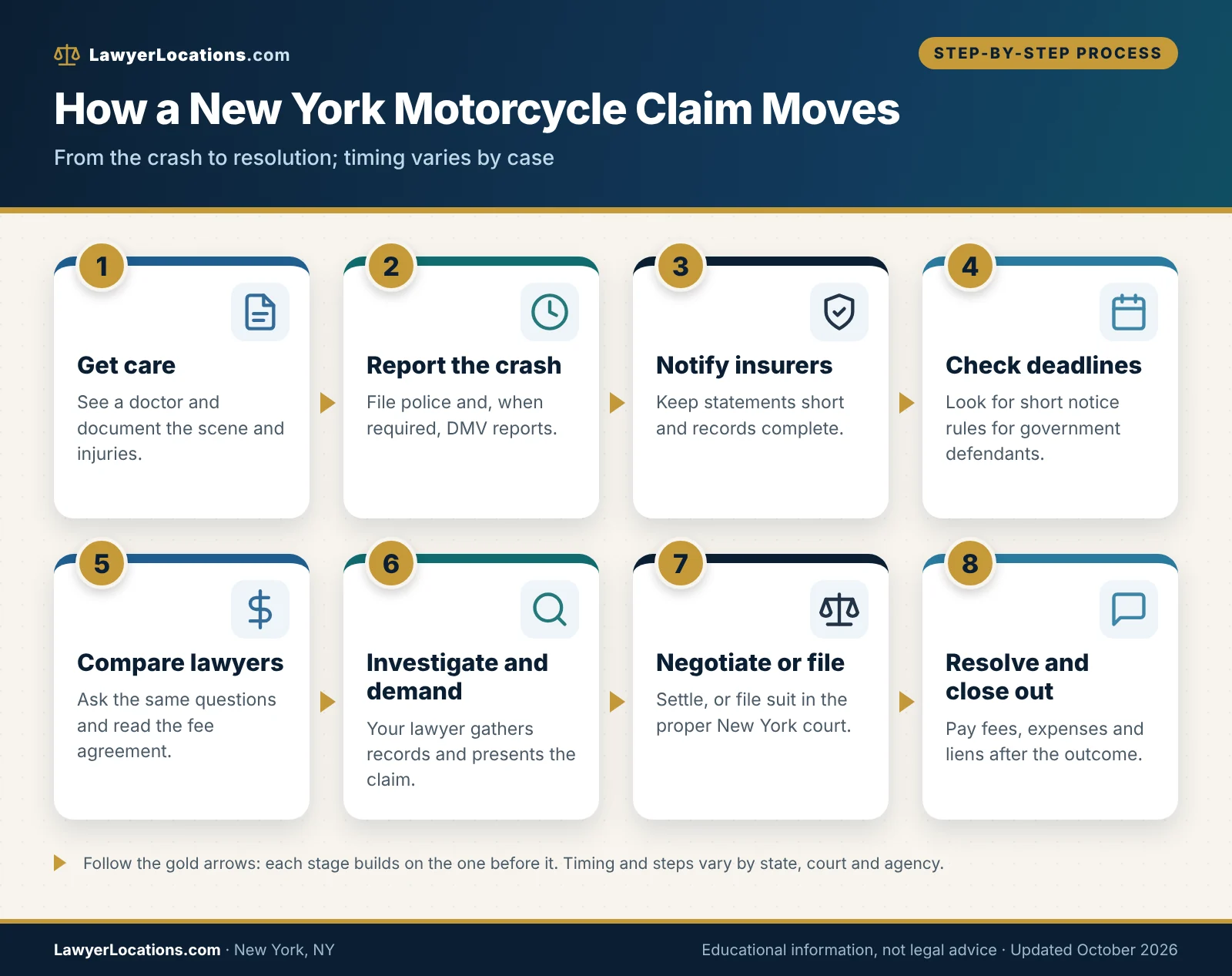
Text version of this graphic
- Get medical care and document the scene, the vehicles and your injuries.
- Report the crash to the police and, when required, to the DMV.
- Notify insurers carefully and keep records of every bill.
- Check deadlines, including any short notice rule for a government defendant.
- Compare lawyers and read the written fee agreement.
- Your lawyer investigates, gathers records and presents a demand to the insurer.
- Negotiate; if talks stall, file suit in the proper New York court.
- Resolve the case by settlement, trial verdict or dismissal, then close out liens and fees.
The clock on a motorcycle claim can be much shorter than three years when a city, county, town, village or State agency may share the blame, for example through a road defect. Ask about notice-of-claim rules in your first conversation with any lawyer.
Who can be responsible for a rider’s injuries
More than one party can share responsibility for a single crash, and each has its own insurer, deadlines and defenses. Sorting them out early prevents a missed notice deadline from ending a good claim.
Other drivers and their insurers
Most motorcycle claims are brought against another motorist whose negligence caused the crash. That driver’s liability policy is the usual source of payment, up to its limits, and the owner of the vehicle may also face liability depending on the facts. New York’s DMV lists baseline minimum liability limits for most vehicles of $25,000 for bodily injury to one person and $50,000 for a death, and says a motorcycle must be insured whenever it is operated on a public road. Those minimums can fall far short of a serious injury, so ask early whether other coverage exists.
Governments and road conditions
Potholes, missing signs, gravel, oil and poorly designed work zones can cause single-rider crashes. When a municipality or the State is a possible defendant, special notice rules apply, and many local governments also have their own written-notice requirements for road defects. Because these rules are technical and unforgiving, a rider who suspects a road problem should photograph the spot and speak with a lawyer quickly.
Manufacturers, repair shops and others
If a defective part, a recalled component or a faulty repair played a role, a product or negligent-repair claim may exist alongside the crash claim. These cases usually need the motorcycle itself, so keep the bike and its parts in their current condition until a lawyer or investigator has examined them. Do not repair, sell or scrap the bike while a claim is possible.
Which New York court hears the case
New York’s civil trial courts differ by the size of the claim and by where the crash or the defendant is located. Knowing the court structure helps you ask better questions about where a lawyer actually tries cases.
Supreme Court and the New York City Civil Court
In New York, the “Supreme Court” is the main trial court for civil cases and sits in every county; it is not the highest court in the state. The New York City Civil Court has monetary jurisdiction up to $50,000, so larger injury claims in the city are generally brought in Supreme Court. Outside New York City, local city, town and county courts also hear smaller civil matters, but serious injury claims are typically filed in Supreme Court in the county where a party lives or where the crash happened.
The four Appellate Division departments
Appeals from Supreme Court go to one of four Appellate Division departments, and each department adopts its own attorney-conduct rules, including the contingency fee rules discussed later. The First Department covers Manhattan and the Bronx; the Second covers Brooklyn, Queens, Staten Island, Long Island and the lower Hudson Valley; the Third covers the Capital Region and much of the northern and Southern Tier counties; and the Fourth covers western and central New York. Your lawyer should know the rules of the department where your case will be heard.
If the crash happened inside New York City, our guide to a motorcycle accident lawyer in New York City covers the borough-level details. This statewide page focuses on rules that apply everywhere in New York.
Deadlines and Notice Rules You Cannot Miss
Most New York injury suits must be filed within three years, but wrongful death claims, children’s claims and anything involving a government defendant follow different clocks. Missing a deadline can end a claim no matter how strong the facts are, so check every date that might apply. Our national guide, how long you have to file a personal injury claim, compares New York with other states.
The core time limits for riders and families
Two statutes cover most private-party motorcycle claims in the state. Which one applies depends on whether the rider survived.
Three years for most injury lawsuits
CPLR 214(5) sets a three-year limit for an action to recover damages for personal injury, subject to listed exceptions elsewhere in the CPLR (sections 214-b, 214-c, 214-i and 215). For a crash, that clock generally starts on the date of the accident. The deadline is for filing a lawsuit in court, not for settling with an insurer, and insurer negotiations do not stop the clock unless you have a written agreement that does.
Two years when a rider dies
Under EPTL 5-4.1, a wrongful death action in New York must be commenced within two years after the decedent’s death. The suit is brought by the estate’s personal representative, which means someone has to be formally appointed by a court before the case can proceed. The statute also gives the representative at least one year after a related criminal case ends in some situations, but families should not plan around that extension. Our guide to wrongful death lawyer costs explains the fee side of these cases.
Claims that involve a city, county, town or the State
Suing a public body is not the same as suing a private driver. The law requires early written notice, and the filing window after that notice is shorter.
Municipal defendants: notice of claim and the one-year-and-90-day rule
Under General Municipal Law § 50-e, a person with a tort claim against a public corporation generally must serve a sworn written notice of claim within 90 days after the claim arises. Under § 50-i, the lawsuit itself must then be started within one year and 90 days of the event, and at least 30 days must pass after the notice is served; wrongful death actions instead have two years from the death. A court can sometimes allow late notice, but it will not extend the notice beyond the time to sue, and it weighs factors such as whether the municipality learned the essential facts in time and whether it was prejudiced.
State defendants: the Court of Claims
Claims against the State of New York are heard in the Court of Claims. According to that court’s published guidance, a negligence claim must be served and filed within 90 days after it accrues, and serving a notice of intention within that period can extend the time to file the claim to two years from accrual. Because a state-owned road, a state worker or a state vehicle can be involved in a crash, a rider should not assume that the ordinary three-year rule governs.
If anyone tells you there is “plenty of time” without asking who owns the road, who employed the other driver and whether a government vehicle was involved, ask again. Notice deadlines for public bodies can pass long before the three-year mark.
Children, reports and housekeeping deadlines
Some deadlines are not about suing at all but still affect your claim. Report requirements, tolling rules for minors and insurance notice conditions all deserve a quick check.
Minors and people under a legal disability
CPLR 208 can extend a filing deadline when the injured person was under a disability because of infancy at the time the claim arose, so a passenger who was a minor may have more time than an adult rider. The same section caps some extensions at ten years, with an exception for infancy in non-malpractice cases. The extra time does not automatically apply to the 90-day notice rule for government defendants, where a court treats infancy as a factor in a late-notice request rather than an automatic extension.
Reporting the crash to the DMV and your insurer
Under Vehicle and Traffic Law § 605, a driver involved in an accident that kills or injures someone, or that causes more than $1,000 in property damage to any one person, must file a report with the DMV within ten days. Bicycle and e-scooter operators have a separate rule. Your own insurance policy may also require prompt notice of a crash, so read the notice conditions in your policy and send the notice in writing.
| Situation | Time limit or step | Where it comes from |
|---|---|---|
| Rider injured, private defendant | Lawsuit generally within 3 years | CPLR 214(5) |
| Rider dies from the crash | Wrongful death action within 2 years of death, brought by the personal representative | EPTL 5-4.1 |
| City, county, town or village may be liable | Sworn notice of claim within 90 days; lawsuit within 1 year and 90 days | General Municipal Law §§ 50-e, 50-i |
| State of New York may be liable | Claim filed within 90 days of accrual, or notice of intention to extend to 2 years | Court of Claims guidance |
| Injured minor | Extra time may apply for private defendants; notice rules for public bodies work differently | CPLR 208; GML § 50-e |
| Crash with injury or more than $1,000 in damage | Driver report to the DMV within 10 days | Vehicle and Traffic Law § 605 |
Write down three dates on day one: the crash date, 90 days later and three years later. Then ask each lawyer you consult which of those dates matters in your case and why.
Fault, Insurance and the 2026 Changes
New York changed its fault rules for many vehicle cases in May 2026, and the effect on motorcycle cases is not yet settled. Insurance coverage, helmet use and lane position also shape how insurers value a rider’s claim.
How fault is divided: the old rule and the 2026 bar
For decades New York followed pure comparative negligence. The 2026 budget legislation added a new rule for some auto cases, which makes this a topic to raise with any lawyer you interview.
Pure comparative negligence under CPLR 1411(a)
Under CPLR 1411(a), a claimant’s own culpable conduct does not bar recovery in a personal injury or wrongful death action. Instead, the damages are reduced in proportion to the claimant’s share of the fault. A rider found 30 percent at fault would, under that rule, recover 70 percent of the damages.
A jury finds that a driver’s unsafe left turn caused most of a crash but that the rider was also speeding. If the jury sets total damages at a round $100,000 and assigns the rider 30 percent of the fault, the recovery under CPLR 1411(a) would be reduced by that share. The numbers here are illustrative only.
The new CPLR 1411(b) bar for claims subject to Article 51
Chapter 58 of the Laws of 2026 (Part EE) added CPLR 1411(b). According to the Department of Financial Services, it took effect May 26, 2026 and applies to actions and proceedings commenced on or after that date. In a personal injury action “subject to article fifty-one of the insurance law” (the no-fault law), the claimant’s recovery is barred if the claimant’s culpable conduct is greater than the defendant’s, or greater than the combined culpable conduct of all the defendants. The same law removed the 90/180-day category from the definition of “serious injury” in Insurance Law § 5102(d), required fault to be decided before the serious-injury question under § 5104(a), and added a $100,000 cap on non-economic damages in § 5104(d) for certain at-fault claimants, such as those driving an uninsured vehicle, or those convicted of driving while impaired or of a felony tied to the vehicle.
Do the 2026 changes apply to motorcycle riders?
That is a fair question, and the honest answer is that it depends on how courts read the statute. Article 51 of the Insurance Law defines “motor vehicle” in a way that excludes motorcycles, which is the starting point for the debate.
What the statute’s wording suggests
CPLR 1411(b) applies only to actions “subject to article fifty-one.” Because Insurance Law § 5102 excludes motorcycles from the definition of motor vehicle, some commentators read the new bar as generally not reaching motorcycle operators and passengers. Others note that the question is open for riders, passengers and pedestrians struck by uninsured drivers, because courts have not yet decided how the phrase applies.
What to do about the uncertainty
Do not assume you are safe from the new rule, and do not assume you are covered by it. Ask each lawyer how they read CPLR 1411(b) for your facts, whether your lawsuit would be commenced after May 26, 2026, and how they would approach the fault evidence in either case. A lawyer who explains the uncertainty clearly is giving you better information than one who gives a flat answer.
Be cautious about any website or advertisement that states how the 2026 fault change affects riders as settled law. The statute is new and the courts are still working through it. Look for reasoning tied to the statute’s text, not a slogan.
No-fault, serious injury and the sources of payment
Because riders generally sit outside the no-fault system, money to cover bills usually comes from a mix of sources. Understanding each source helps you see why coverage questions come up in the first lawyer meeting.
Why riders are generally excluded from no-fault benefits
Insurance Law § 5102(j) defines a “covered person” as a pedestrian, or an owner, operator or occupant, of a motor vehicle with the required financial security, and § 5102(f) excludes motorcycles from “motor vehicle.” Basic economic loss under no-fault is defined in § 5102(a) as up to $50,000 per person for covered people. For motorcycles, the exclusion means the rider typically looks to other coverage for early bills. A trial-court decision in 2024 noted that the answer can differ for a class C limited use motorcycle, which is a low-speed vehicle, so the type of vehicle matters.
Health insurance, your own policy and uninsured-driver coverage
Many riders pay first-line medical bills through health insurance, then recover those costs through the injury claim. Your own motorcycle policy may include medical payments, uninsured motorist or supplementary coverage, and the declarations page shows what you bought. If the driver who hit you had no insurance or too little, read our guide to uninsured motorist claims and our overview of who pays medical bills after a crash.
Liability coverage and its limits
The at-fault driver’s liability policy is the most common source of compensation, and New York DMV’s published baseline minimums for most vehicles are $10,000 for property damage per crash, $25,000 for injury to one person, $50,000 for injury to two or more, $50,000 for a death of one person and $100,000 for deaths of two or more. Many drivers carry more than the minimum, and some have umbrella or employer coverage. Ask your lawyer how they will investigate every policy that could apply.
Rider conduct rules insurers will examine
Defense lawyers and adjusters read the Vehicle and Traffic Law for ways to argue a rider shares the blame. Knowing the rules lets you answer honestly and prepare calmly.
Helmets and eye protection
Vehicle and Traffic Law § 381(6) makes it unlawful to operate or ride on a motorcycle without a protective helmet that meets the federal motor vehicle safety standard in 49 C.F.R. § 571.218, and § 381(7) requires goggles or an approved face shield for the operator. If you wore a compliant helmet, keep it, because a damaged helmet can be evidence. If you did not, tell your lawyer before you talk with an adjuster so the issue is handled with a plan, not a surprise.
Lane position and lane splitting
Under Vehicle and Traffic Law § 1252, a motorcycle is entitled to the full width of its lane. The same section prohibits overtaking and passing in the same lane as the vehicle being passed, prohibits operating a motorcycle between lanes or between adjacent rows of vehicles, and bars riding more than two abreast in a single lane. Lane splitting is therefore not permitted in New York, which is a point insurers raise when a crash happened in slow or stopped traffic.
| Rule | What it says | Why it matters to your claim |
|---|---|---|
| CPLR 1411(a) | Claimant’s fault reduces damages in proportion and does not bar recovery | Sets the baseline fault rule for injury and wrongful death cases |
| CPLR 1411(b) (2026) | Bars recovery if the claimant is more at fault than the defendant, in actions subject to Insurance Law Article 51 | Application to riders is unsettled; ask your lawyer |
| Insurance Law § 5102(f), (m) | “Motor vehicle” excludes motorcycles that must carry financial security | Explains why riders are generally outside no-fault benefits |
| Vehicle and Traffic Law § 381(6), (7) | Protective helmet and eye protection requirements | Insurers may point to gear in a fault argument |
| Vehicle and Traffic Law § 1252 | Full-lane rights, no lane splitting, no more than two abreast | Lane position is a common fault dispute |
| Vehicle and Traffic Law § 605 | Driver must report injury or damage over $1,000 to the DMV within 10 days | Creates a record and a deadline |
How to Compare Motorcycle Accident Lawyers in New York
Compare at least two or three lawyers on the same questions, and compare the written fee agreements line by line. LawyerLocations.com is an education and discovery resource, not a law firm, so this section teaches you how to judge a lawyer instead of recommending one.
Where to find lawyers and how to check them
Search results, billboards and referrals from friends all produce names, but none of them tells you whether a lawyer is in good standing or suited to your type of case. A short vetting routine fixes that.
Referral services and free help
The New York State Bar Association runs a Lawyer Referral and Information Service that refers people to private attorneys in their area, and the New York City Bar runs a similar Legal Referral Service. According to the court system’s “Find a Lawyer” page, an initial meeting of up to 30 minutes through these services costs $35 or less, and it is free for personal injury matters. The same page points to LawHelpNY for free legal services by county and to court help centers in some courthouses. These services do not set attorney fees, and neither you nor the lawyer is obligated to work together after a referral.
Checking registration and discipline
Every attorney practicing in New York must be registered with the court system, and the Unified Court System publishes a public attorney search that shows registration status. Confirm that the lawyer’s status is current, that the name and firm match what you were told, and that the firm’s address is real. If you have questions about discipline, the Appellate Division departments’ grievance committees handle complaints and can tell you how to ask.
Questions to ask in the first meeting
Ask every lawyer the same set of questions in the same order, and take notes. The answers matter more than the sales pitch, and you can compare them later at your kitchen table.
Experience, trial readiness and local courts
Ask how many motorcycle injury cases the lawyer has handled in the last few years and how many reached a court filing, a mediation or a trial. Ask which counties the lawyer regularly appears in, whether the lawyer’s office will handle the case in the court where it would be filed, and who would try it if talks fail. Insurers often study a lawyer’s willingness to try a case, so a lawyer who refers every case to someone else may get different offers than one who prepares for court.
Who actually works on the file
At many firms the person who meets you at the intake is not the person who handles the case. Ask who your day-to-day contact will be, who signs the demand letter and who would attend a deposition or mediation with you. Ask how often you will get updates and whether you can reach the assigned lawyer, not only a case manager, when you have a real question.
Handling of early medical bills and coverage
Since riders are generally outside no-fault, ask how the lawyer approaches health insurance, medical payments coverage, liens and uninsured-driver coverage from the start. A good answer names the specific coverages that might apply to you and explains how they interact. A vague answer that covers only the at-fault driver’s policy suggests the lawyer has not thought about your whole financial picture.
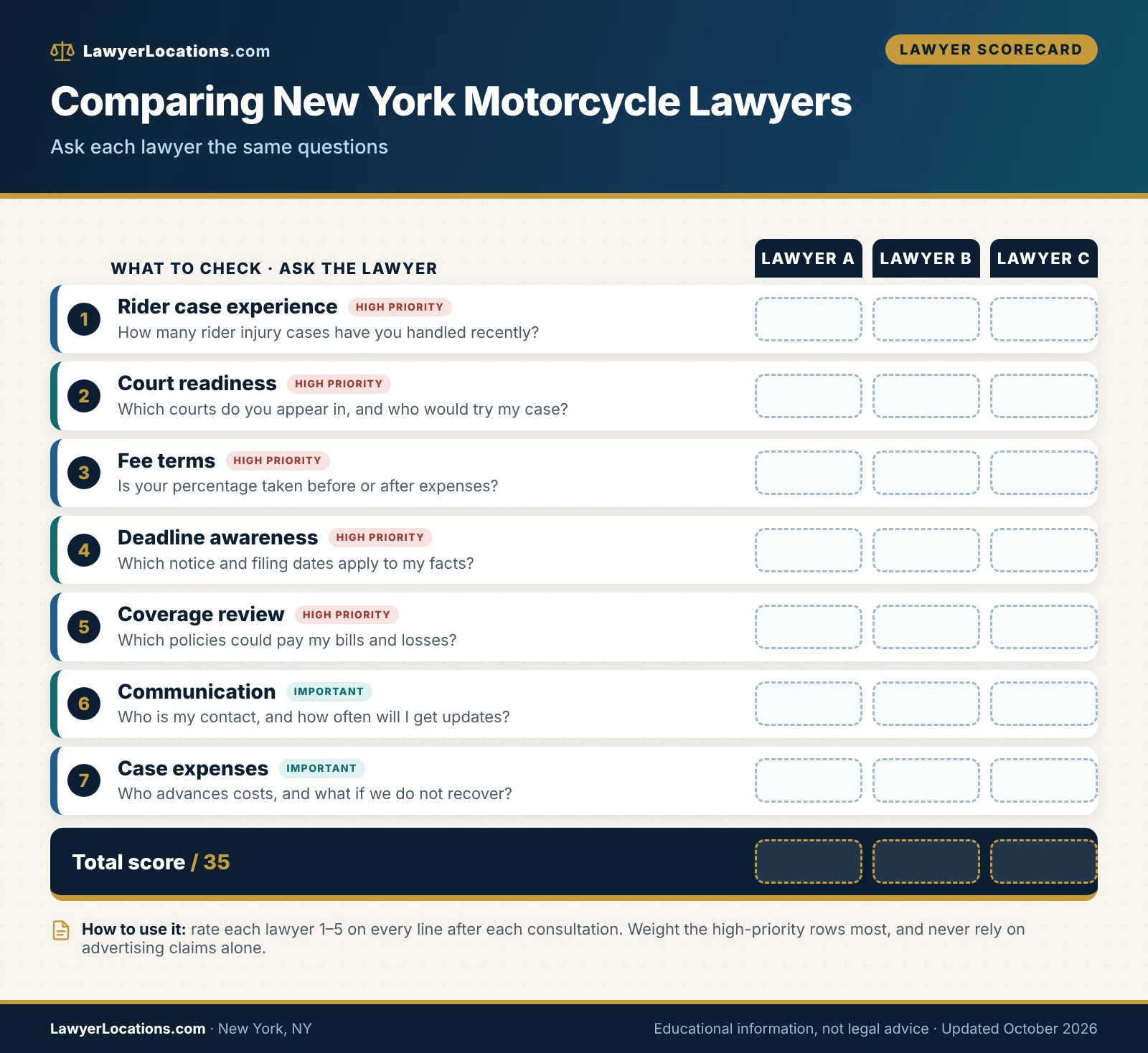
Text version of this graphic
| Criterion | Question to ask |
|---|---|
| Motorcycle case experience | How many rider injury cases have you handled recently? |
| Court readiness | Which courts do you appear in, and who would try my case? |
| Fee agreement | Is your percentage taken before or after expenses? |
| Deadline check | Which notice and filing dates apply to my facts? |
| Coverage review | Which policies could pay my medical bills and losses? |
| Communication | Who is my contact, and how often will I get updates? |
| Case costs | Who advances expenses, and what happens if we do not recover? |
Bring the same one-page summary to every consultation: the crash date, who was involved, your injuries, the insurers you have heard from and any letters you received. Identical information lets you compare answers fairly.
Red flags when choosing a lawyer
Most lawyers are honest and careful, but a few warning signs deserve attention. Treat any pressure to sign on the spot as a reason to slow down.
Pressure and unsolicited contact
Be wary of anyone who contacts you uninvited in the hospital or days after a crash, or who suggests you must hire them today. A lawyer who is confident in the value of their work will give you time to read the agreement, compare other options and ask questions. If a person calling or visiting you is not a licensed attorney, say no and do not sign anything.
Promises about results
No honest lawyer can promise a particular outcome or a settlement amount before reviewing the evidence, the policy limits and the medical records. Statements such as “we always win” or a stated dollar figure in the first call are red flags. Look for lawyers who explain the range of possible outcomes, the risks and the factors that move a result up or down.
- A fee agreement you are not allowed to take home and read before signing.
- No written explanation of how expenses are handled.
- Unwillingness to tell you which lawyer will actually handle your file.
- Any request that you not speak to other lawyers.
- Advice to repair or dispose of the motorcycle before it has been examined.
| Factor | Strong sign | Warning sign |
|---|---|---|
| Fee agreement | Clear written percentage, expense terms and what you owe if there is no recovery | Verbal terms or blank spaces |
| Communication | Named contact and an agreed update schedule | Hard to reach after signing |
| Deadline awareness | Identifies notice and filing dates unprompted | “Plenty of time” without questions |
| Coverage thinking | Looks beyond the at-fault driver’s policy | Ignores your own policy and health insurance |
| Courtroom approach | Explains what filing suit and trial would involve | Treats every case as a quick settlement |
Fees, Case Costs and Decision Points
Most injury lawyers work on contingency, meaning the fee is a percentage of the money recovered, and New York court rules limit what that percentage can be. Case expenses, liens and the timing of settlement decisions all affect what you take home.
How contingency fees work under New York rules
A contingency fee means the lawyer is paid from the recovery, not by the hour. New York adds rules about the size of the fee, the written agreement and your right to challenge a fee.
Percentage limits set by the Appellate Division
The four Appellate Division departments each have a rule on contingent fees in personal injury and wrongful death claims: 22 NYCRR 603.7(e) in the First Department, 691.20(e) in the Second, 806.13 in the Third and 1022.31 in the Fourth. The rules set maximum percentages, commonly described as one-third of the recovery, and they have historically applied the percentage to the recovery after expenses. A recent rule proposal has discussed allowing gross-recovery fees, so ask each lawyer in writing whether the percentage is calculated before or after expenses, and check your department’s current rule text.
Suppose a case recovers $300,000 and has $30,000 in expenses. At a one-third fee on the net recovery, the fee is $90,000 and the client receives $180,000 before liens. If the fee were computed on the gross recovery, the fee would be $100,000 and the client would receive $170,000. The arithmetic is illustrative, and the figures come from a public rule-comment example.
The written letter of engagement
Under 22 NYCRR Part 1215, a lawyer must give a client a written letter of engagement, or a signed retainer agreement, that explains the scope of the services, the fees, the expenses and billing practices, and, where it applies, the client’s right to arbitrate fee disputes under Part 137. The rule has exceptions, including matters where the expected fee is under $3,000. Read the whole document before signing and ask for a copy for your records.
Fee disputes and arbitration
Part 137 of the Chief Administrator’s rules gives clients a way to resolve certain fee disputes through arbitration, generally for amounts between $1,000 and $50,000. If the client requests it, arbitration is mandatory for the lawyer, and a client has 30 days after receiving the lawyer’s Notice of Client’s Right to Arbitrate to elect it. Fees set by statute, rule or court order are among the exclusions, so ask a bar association or the court system whether Part 137 fits your situation.
Case expenses, liens and what you may owe
The fee percentage is only part of the picture. The final amount you receive depends on expenses and on reimbursement claims that others may assert against the recovery.
Expenses the lawyer may advance
Case expenses can include court filing charges, medical record fees, investigator and accident-reconstruction costs, deposition transcripts and expert witness fees. Ask whether the lawyer advances these costs, whether they are repaid only from a recovery and whether any interest or markup is added. A transparent agreement lists the kinds of expenses and requires your approval for unusually large ones.
Liens and reimbursement claims
Health insurers, Medicare, Medicaid and others can claim repayment from a recovery for bills they paid, and the rules differ depending on who paid. Your lawyer should identify these claims early and negotiate them near the end of the case. Our guide on medical bills after a crash explains the main categories, and the factors that drive values appear in our overview of motorcycle accident settlements.
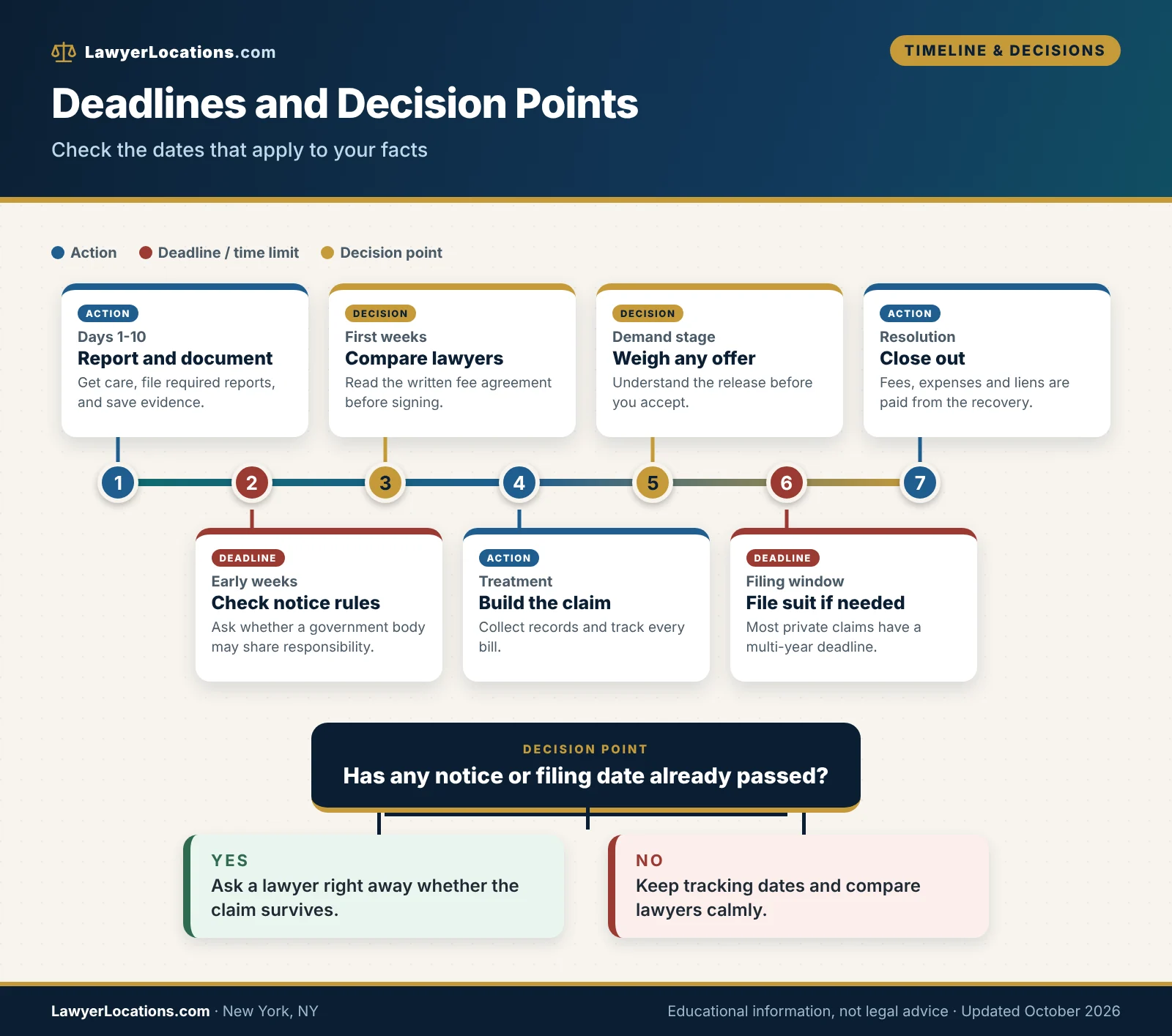
Text version of this graphic
- Days 1-10: get care, document the scene, report the crash and keep records.
- Within 90 days: serve any required notice of claim if a government body may be responsible.
- First weeks: compare lawyers and read the written fee agreement.
- Months of treatment: collect records and track bills while the lawyer investigates.
- Demand and talks: your lawyer presents the claim and negotiates with insurers.
- Before the filing deadline: decide whether to file suit; for most private claims, within three years.
- Resolution: settlement or verdict, then payment of fees, expenses and liens.
Decision point: has any deadline or notice date passed? If yes, ask a lawyer right away whether the claim can still be preserved.
Settlement or lawsuit: key decision points
Every claim reaches moments when you must choose between accepting an offer and moving forward. A calm process, built on a lawyer’s written advice, beats a rushed one.
Weighing an insurer’s offer
Early offers often arrive before the full extent of your injuries is known. Accepting one usually requires signing a release, which ends the claim even if later treatment costs more. Ask your lawyer to explain what is covered, what is not, and what medical opinion says about your recovery before you decide. Our overview of the settlement timeline shows how long the usual steps take.
Filing a lawsuit and what changes
Filing in the proper New York court starts formal discovery, in which each side exchanges records and questions witnesses under oath. Filing often increases pressure on an insurer, but it also adds cost and time. Settlements involving a child’s claim or a wrongful death estate often need court involvement, so ask your lawyer what approvals apply to your case.
| Item | What to ask | Source of rule |
|---|---|---|
| Contingency percentage | What is the percentage, and is it within the Appellate Division maximum? | 22 NYCRR 603.7(e), 691.20(e), 806.13, 1022.31 |
| Net or gross computation | Is the fee calculated before or after expenses? | Appellate Division rules; confirm current text |
| Written agreement | Does it explain scope, fees, expenses and arbitration rights? | 22 NYCRR Part 1215 |
| Fee disputes | Can I request arbitration if we disagree? | 22 NYCRR Part 137 |
| Case expenses | Who advances them, and who bears them if nothing is recovered? | Fee agreement terms |
| Liens | Which insurers or programs may seek repayment? | Depends on who paid the bills |
Evidence, Mistakes to Avoid and Next Steps
The first days after a crash decide how much evidence survives, and early missteps can make a claim harder to prove. This section turns the legal rules above into a practical checklist, a short list of mistakes and a plan for choosing your motorcycle accident lawyer in New York.
Evidence and documents to gather
Evidence fades quickly: skid marks wash away, witnesses move, and video systems overwrite recordings. Collect what you safely can, and ask a trusted person to help if you are hurt.
The scene, the vehicles and the people
If you are able, photograph the road, traffic signals, lane markings, debris, skid marks and the position of every vehicle. Get the other driver’s name, license, plate number and insurance details, and ask witnesses for contact information before they leave. Ask nearby businesses and homeowners whether a camera covered the spot, because recordings are often deleted within days.
Medical and financial records
Keep every medical record, bill, prescription receipt, mileage log and pay stub showing lost wages. Follow your treatment plan, because gaps in care give insurers an argument that your injuries were not serious. A simple journal of pain levels, missed activities and appointments can help you recall details months later.
The motorcycle and your gear
Do not repair or sell the motorcycle until an investigator has inspected it, and keep the helmet, jacket, boots, gloves and any damaged parts in a safe place. Photograph the damage before anything is moved. These items can show the force of impact and the condition of the equipment, and they can answer questions raised in a fault dispute.
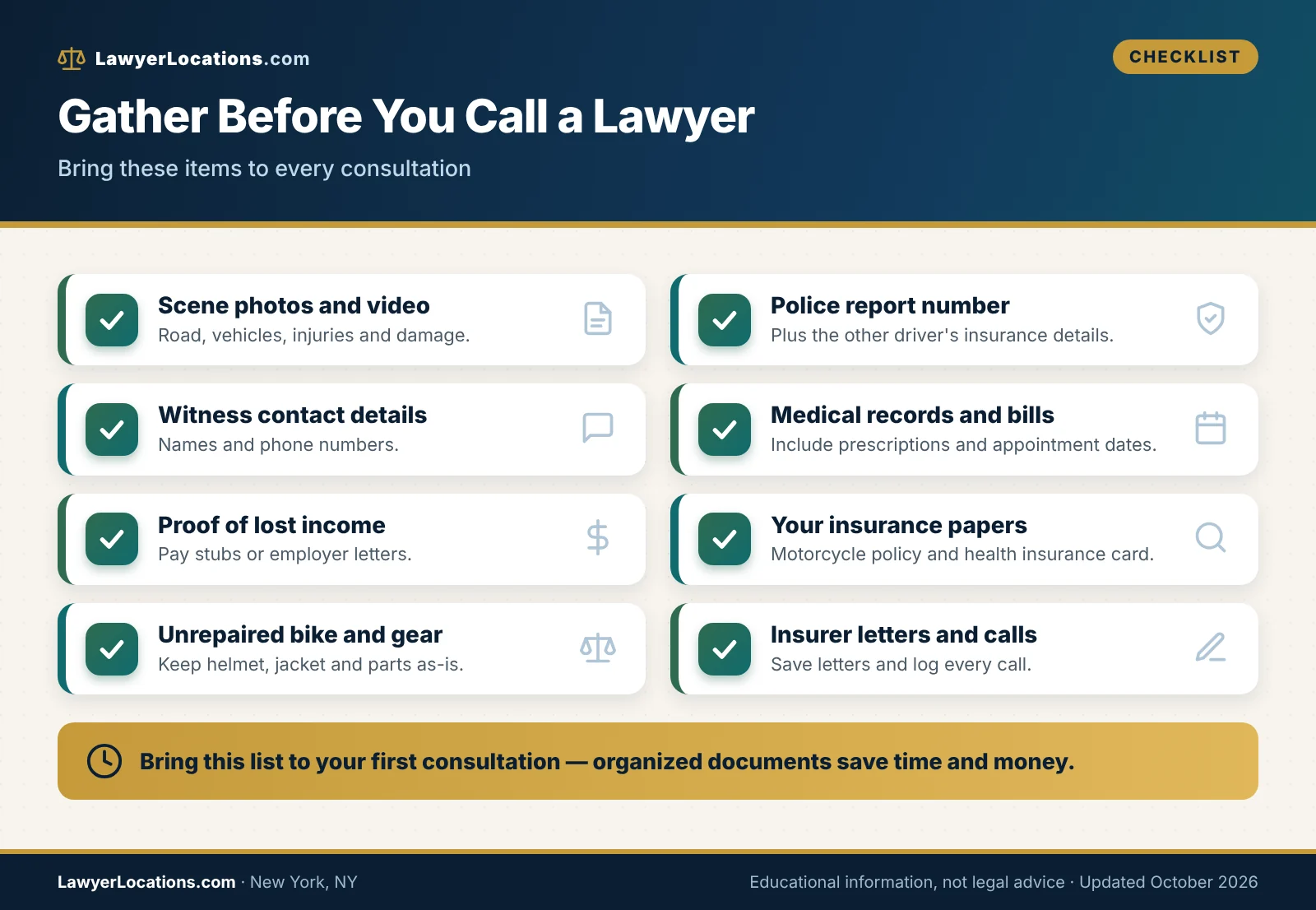
Text version of this graphic
- Photos of the scene, vehicles and your injuries
- Police report number and the other driver’s insurance details
- Witness names and phone numbers
- Medical records, bills and prescription receipts
- Proof of lost income, such as pay stubs
- Your own motorcycle policy and health insurance card
- The motorcycle, helmet and gear, kept unrepaired
- Any letters or calls from insurers, with dates
- Police report or incident number, and the DMV report if you were the driver required to file.
- Photos and video of the scene, the vehicles and your injuries.
- Names and contact details for the other driver, owner, insurers and witnesses.
- Your insurance declarations page and health insurance card.
- Medical records and bills, plus proof of lost income.
- The motorcycle and gear, unrepaired and stored safely.
Common mistakes that hurt a claim
Small choices in the first weeks can have big consequences. Avoiding these mistakes costs nothing and protects your options.
Talking to insurers without a plan
The other driver’s insurer will likely call quickly, sounding friendly and asking for a recorded statement. You are not required to give one, and an offhand comment about speed, lane position or how you feel can be used later. Keep early conversations short, stick to basic facts, and consider speaking with a lawyer before giving a recorded statement or signing any release or medical authorization.
Posting online and missing treatment
Insurers search social media, and photos of a weekend ride or a comment that you are “fine” can be taken out of context. Avoid posting about the crash, your injuries or your activities while the claim is open, and set your accounts to private. Do not skip appointments or stop treatment without telling your doctor, because gaps in treatment are often used to argue that an injury was minor.
- Giving a recorded statement before you know your injuries.
- Signing a release or a broad medical authorization too soon.
- Repairing the bike before it has been examined.
- Waiting on notice deadlines because the three-year date seems far away.
- Posting about the crash or your recovery online.
Next steps and quick answers
Move in a calm order: take care of your health, secure evidence, check the deadlines that apply to you and compare lawyers using the same questions. The answers below cover the points riders ask about most often.
Fees, money and coverage
How much does a motorcycle accident lawyer cost in New York?
Most injury lawyers work on contingency, so the fee is a percentage of the recovery and is capped by Appellate Division rules. Ask each lawyer for the percentage, whether it is calculated before or after expenses, and who pays case costs if there is no recovery.
Can I get a first meeting without paying?
That depends on the lawyer, so ask when you call. Bar referral services charge a small fee for many case types but, according to the court system’s guidance, waive it for personal injury matters.
Does New York no-fault insurance pay my medical bills after a motorcycle crash?
Generally not. New York’s no-fault law excludes motorcycles from its definition of motor vehicle, so riders usually look to health insurance, their own policy and the at-fault driver’s liability coverage. Some low-speed vehicle classes can be treated differently, so the exact vehicle matters.
What if the driver who hit me had no insurance?
Your own policy may include uninsured or underinsured motorist coverage, and other sources may exist. Read our guide to uninsured motorist claims and check the declarations page of your policy.
Do I need a lawyer for a minor motorcycle crash?
Not always, but injuries that seem minor on day one can grow, and the cost of a short consultation is small compared with a missed deadline or a release signed too soon. Our article on what to do after a crash covers the first steps in any vehicle collision.
Deadlines, courts and fault
How long do I have to sue after a motorcycle accident in New York?
Most private-party injury suits must be filed within three years under CPLR 214(5). Claims against local governments and the State can require notice within 90 days, so check early.
How long do families have to file a wrongful death claim?
Generally two years from the death, filed by the estate’s personal representative under EPTL 5-4.1. A court must appoint that representative first, which takes time.
What if I was partly at fault?
Under CPLR 1411(a), your share of fault reduces damages in proportion. A 2026 change, CPLR 1411(b), can bar recovery for claimants more at fault than the defendant in cases subject to Insurance Law Article 51, and how it applies to riders is unsettled.
Is lane splitting legal in New York?
No. Vehicle and Traffic Law § 1252 prohibits operating a motorcycle between lanes or between adjacent rows of vehicles, and it bars riding more than two abreast in one lane.
Does a rider have to wear a helmet in New York?
Yes. Vehicle and Traffic Law § 381(6) makes it unlawful to operate or ride on a motorcycle without a helmet that meets the federal standard, and § 381(7) requires eye protection for the operator.
Which court will hear my case?
Most serious injury cases are filed in the county Supreme Court. The New York City Civil Court handles claims up to $50,000, and claims against the State go to the Court of Claims.
Compare options in more than one way: read the fee agreement, check registration, and ask the same questions of each lawyer. If you were hurt in a city, our guides to New York City motorcycle accident lawyers and personal injury lawyers in New York City add local detail.
Ready to compare your options?
Gather the documents above, note your deadlines and ask each lawyer the same questions about experience, coverage, fees and communication. A thoughtful comparison now helps you choose a motorcycle accident lawyer in New York with a clear view of the costs, the risks and the process.
General information only. This article is for education and is not legal advice. Reading it does not create an attorney-client relationship, and LawyerLocations.com is not a law firm or a lawyer referral service. Laws, court rules, fees and deadlines change and depend on the facts of each case; consult a lawyer licensed in New York about your situation.
Sources & References
Show all 22 sources
- CPLR § 214, Actions to be commenced within three years — New York State Senate (Open Legislation) — nysenate.gov — accessed October 2026
- EPTL § 5-4.1, Action by personal representative for wrongful act, neglect or default causing death — New York State Senate (Open Legislation) — nysenate.gov — accessed October 2026
- CPLR § 208, Disability of infancy or insanity — New York State Senate (Open Legislation) — nysenate.gov — accessed October 2026
- CPLR § 1411, Damages recoverable when contributory negligence or assumption of risk is established — New York State Senate (Open Legislation) — nysenate.gov — accessed October 2026
- General Municipal Law § 50-e, Notice of claim — Public.Law — newyork.public.law — accessed October 2026
- General Municipal Law § 50-i, Presentation of tort claims; commencement of actions — New York State Senate (Open Legislation) — nysenate.gov — accessed October 2026
- Court of Claims frequently asked questions — New York State Unified Court System — nycourts.gov — accessed October 2026
- Insurance Law § 5102, Definitions (Article 51, comprehensive motor vehicle insurance reparations) — New York State Senate (Open Legislation) — nysenate.gov — accessed October 2026
- Circular Letter No. 3 (2026), Auto tort reform and flex rating changes — New York State Department of Financial Services — dfs.ny.gov — accessed October 2026
- Sterling decision, 2024 NY Slip Op 51506(U) (Article 51 defenses and motorcyclist status) — New York State Unified Court System, Official Reports — nycourts.gov — accessed October 2026
- New York State Law Digest: August 2026, CPLR 1411 amendment — New York State Bar Association — nysba.org — accessed October 2026
- Vehicle and Traffic Law § 381, Safety equipment (helmets and eye protection) — New York State Senate (Open Legislation) — nysenate.gov — accessed October 2026
- Vehicle and Traffic Law § 1252, Driving motorcycles on roadways laned for traffic — New York State Senate (Open Legislation) — nysenate.gov — accessed October 2026
- Vehicle and Traffic Law § 605, Reports of accidents — New York State Senate (Open Legislation) — nysenate.gov — accessed October 2026
- New York State insurance requirements — New York State Department of Motor Vehicles — dmv.ny.gov — accessed October 2026
- Letters of engagement (22 NYCRR Part 1215) — New York State Unified Court System — nycourts.gov — accessed October 2026
- Part 137, Fee Dispute Resolution Program — New York State Unified Court System — nycourts.gov — accessed October 2026
- Comments on contingent fee rules (22 NYCRR 603.7(e), 691.20(e), 806.13, 1022.31) — New York State Unified Court System — nycourts.gov — accessed October 2026
- NYSBA Ethics Opinion 669, computing contingent fees — New York State Bar Association — nysba.org — accessed October 2026
- New York City Civil Court: in general — New York State Unified Court System — nycourts.gov — accessed October 2026
- Find a Lawyer — New York State Unified Court System, Court Help — nycourts.gov — accessed October 2026
- Lawyer Referral and Information Service — New York State Bar Association — nysba.org — accessed October 2026
Legal Disclaimer and Limitation of Liability
Informational and illustrative purposes only. This article was prepared by LawyerLocations.com solely on the basis of the information available to us at the time of writing. It is an illustrative, general overview. It is not a complete or authoritative statement of the law, and it has not been reviewed by a lawyer licensed in your state or county.
Not legal advice. Nothing in this article is legal, financial, tax or immigration advice, and reading it does not create an attorney-client relationship between you and LawyerLocations.com or any author, lawyer or firm mentioned. Laws, court rules, fees, filing deadlines and agency procedures differ by state, county and court, and they change often. Some details here may be simplified, incomplete or out of date, and time limits for legal claims can be short.
No warranty. We make no representation or warranty, express or implied, about the accuracy, completeness, timeliness or suitability of this content for your situation. Please do not rely on it to make, delay or skip any legal decision. Check the facts against official sources and speak with a licensed attorney in the relevant jurisdiction before you act.
Limitation of liability. To the fullest extent permitted by law, LawyerLocations.com and its owners, authors and contributors disclaim all liability for any loss, damage, cost or other consequence arising from the use of, or reliance on, this article, including any content on third-party websites we link to. Mentioning a lawyer, firm, organization or service is not an endorsement and is not a promise of any result. If you are in immediate danger, contact your local emergency number.