Searching for a truck accident lawyer New Jersey residents can compare with confidence comes down to three things: knowing the state rules that shape your claim, checking whether a lawyer actually handles commercial-truck cases, and understanding how fees work before you sign. New Jersey generally gives you 2 years to sue for personal injury under N.J.S.A. 2A:14-2, and contingent fees in injury cases are capped by Court Rule 1:21-7.
This guide explains how a New Jersey truck crash case moves from first call to resolution, which federal trucking rules matter, how to compare lawyers, and what questions to ask at a first meeting. It is general legal information, not advice about your situation.
How a Truck Accident Lawyer Case Works in New Jersey
A truck accident case in New Jersey is a personal injury claim built on state negligence law, with federal motor carrier safety rules layered on top. A lawyer’s job is to identify every party who may share responsibility, preserve the evidence before it disappears, and pursue compensation through insurers or, if needed, the Superior Court.
What makes a truck crash claim different from a car crash claim
Most people searching for a truck accident lawyer in New Jersey have already figured out that this is not an ordinary fender-bender claim. The vehicles are bigger, the injuries tend to be more serious, and the companies behind the truck usually have insurers and risk managers who start working the same day. If you want a side-by-side look at how the two case types differ, our guide to truck accident lawyers versus car accident lawyers walks through it.
Federal safety rules sit on top of state tort law
Interstate trucking is regulated by the Federal Motor Carrier Safety Administration (FMCSA). Its rules cover how long a driver may be behind the wheel, what records a carrier must keep, and how much insurance a for-hire carrier must carry. A violation of those rules does not automatically win a case, but it can be powerful evidence that a driver or company did not act with reasonable care. New Jersey negligence law then decides how fault is measured and how damages are calculated.
More parties, more insurance policies, more moving parts
A single truck crash can involve the driver, the motor carrier that employs or contracts with the driver, the company that owns the trailer, a cargo loader, a maintenance contractor, or a parts manufacturer. Each may have a separate insurer, and each may point at the others. A lawyer who handles commercial-vehicle claims regularly will know how to sort out who is in the chain and which policies might respond.
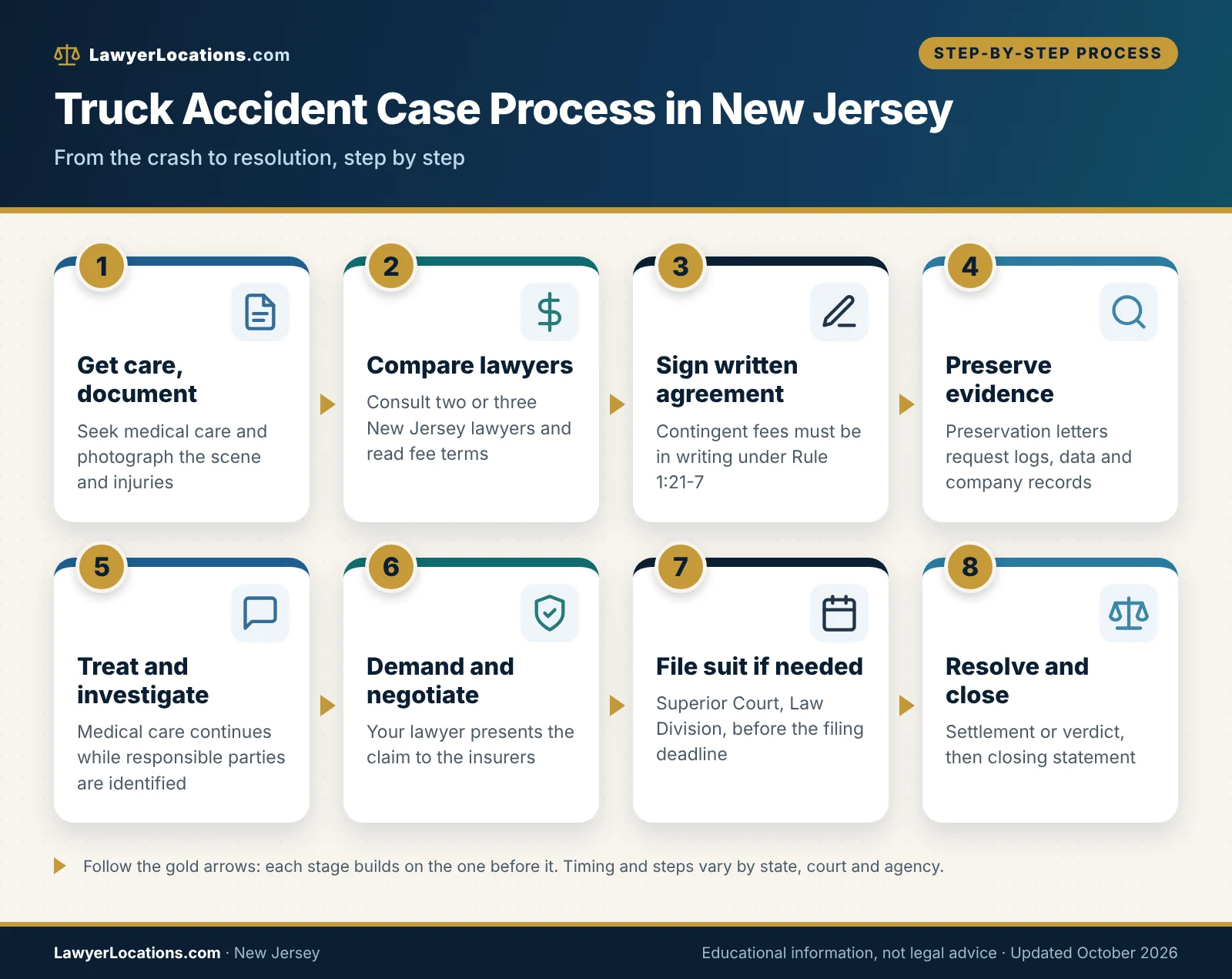
Text version of this graphic
- Get medical care and document the crash scene and your injuries.
- Consult one or more New Jersey truck accident lawyers and compare fee agreements.
- Sign a written agreement; your lawyer sends preservation requests and investigates.
- Treat and track medical care while the lawyer identifies every responsible party and insurer.
- Your lawyer presents a demand package and negotiates with the insurers.
- If talks fail before the deadline, a lawsuit is filed in the Superior Court, Law Division, Civil Part.
- Discovery, depositions, mediation or trial follow.
- Resolution, a closing statement, and payment of fees, expenses and any liens.
The New Jersey legal framework in plain English
Three state statutes do most of the early work in a New Jersey truck crash claim: the injury filing deadline, the wrongful death deadline, and the shared-fault rule. You do not need to memorize the section numbers, but knowing they exist helps you ask better questions when you interview lawyers.
The two-year filing deadline for injury claims
New Jersey’s general statute of limitations for injury to the person is found at N.J.S.A. 2A:14-2. It says an action for personal injury caused by another person’s wrongful act, neglect or default must be commenced within two years after the cause of action accrued. Accrual usually means the date of the crash, though a lawyer will look at whether any exception applies. For a broader state-by-state view, see our guide on how long you have to file a personal injury claim.
The two-year clock does not wait for you to finish treatment or for the insurer to make an offer. Do not rely on an adjuster’s timeline. If you are anywhere close to the two-year mark, speak with a New Jersey lawyer promptly so the deadline can be calendared and any exceptions evaluated.
How New Jersey measures shared fault
Under N.J.S.A. 2A:15-5.1, your own negligence does not bar recovery as long as it is not greater than the negligence of the person (or combined persons) you are suing. Your damages are then reduced by your percentage of fault. In practice, a person found 51% at fault generally cannot recover from a defendant found 49% at fault, while a person found 30% at fault can recover, but with the award reduced by 30%.
Suppose a jury values a plaintiff’s damages at $200,000 and finds the plaintiff 20% responsible for a lane-change collision with a tractor-trailer. Under the statute, the award is reduced by that 20%, to $160,000. This is a hypothetical for illustration only, not a prediction about any real case.
Where New Jersey truck accident cases are filed
Because truck crash injuries are often significant, most lawsuits belong in the state’s general trial court rather than a small-claims-style forum. Knowing the court structure helps you understand what your lawyer is describing at the first consultation.
Law Division, Civil Part versus Special Civil Part
The New Jersey Judiciary explains that the Special Civil Part is limited to cases where the demand is $20,000 or less, and that if you believe you are entitled to more, your case should be filed in the Law Division of the Superior Court. A serious truck crash claim will almost always exceed that figure, so the Civil Part of the Law Division is the usual venue. If a person sues in Special Civil for more than the limit, the court’s guidance warns that the amount above the limit is given up and cannot be claimed later in a separate suit.
Venue, federal court and why your lawyer’s choices matter
Which county’s Superior Court hears the case depends on venue rules, which generally look at where the crash happened and where the parties live or do business. Some truck cases involving out-of-state carriers may also be removed to federal court. Your lawyer should explain, in plain language, which court is likely and why, because the choice can affect timing, jury pool and procedure. Ask for this at the consultation rather than assuming it.
New Jersey Deadlines and Insurance Rules That Shape a Truck Crash Claim
Several New Jersey rules work together: the filing deadlines, the special notice rule for government vehicles, and the state’s no-fault insurance structure. Missing any one of them can limit or end a claim, so these are the first topics a careful lawyer will raise.
Filing deadlines that matter in truck crash cases
The two-year rule is the headline, but it is not the only clock. The table below collects the deadlines most likely to matter after a truck crash, with the source for each. Deadlines can change by amendment, so confirm the current text with the lawyer you hire.
| Situation | Time limit | Authority | What to do |
|---|---|---|---|
| Personal injury lawsuit against a private driver or company | Two years after the claim accrues | N.J.S.A. 2A:14-2 | Consult a lawyer early; do not wait for settlement talks to finish. |
| Wrongful death lawsuit after a fatal truck crash | Two years after the death; no time limit in certain cases where the death resulted from murder, aggravated manslaughter or manslaughter and the defendant was convicted, found not guilty by reason of insanity or adjudicated delinquent | N.J.S.A. 2A:31-3 | Ask a lawyer who is entitled to file and how the personal representative is appointed. |
| Claim involving a public entity (for example, a government-owned truck or a public road-condition issue) | Written notice of claim not later than the 90th day after accrual; suit barred once two years have elapsed | N.J.S.A. 59:8-8 | Act within weeks, not months; ask a lawyer whether the Tort Claims Act applies. |
| Physician certification under the lawsuit threshold | Within 60 days after the defendant answers the complaint, with one possible extension of up to 60 days for good cause | N.J.S.A. 39:6A-8(a) | Keep treating-doctor records current; your lawyer will coordinate the certification. |
Wrongful death after a fatal truck crash
If a loved one died in a truck collision, N.J.S.A. 2A:31-3 provides that an action under the Wrongful Death Act must be commenced within two years after the death. The statute carves out a narrow exception for certain homicide-related deaths where the defendant has been convicted, found not guilty by reason of insanity, or adjudicated delinquent. Families dealing with a fatal crash should also read our guide on wrongful death lawyer costs, since fee structures are an early concern.
Do not assume the exception applies to your situation. A fatal crash caused by a negligent driver is a civil negligence matter first, and the standard two-year clock is the safer working assumption until a lawyer tells you otherwise.
When a government vehicle or public entity is involved
Sometimes the truck belongs to a municipality, county, school district or state agency, or a public entity may share blame for a dangerous road. The New Jersey Tort Claims Act, at N.J.S.A. 59:8-8, requires that a claim for injury be presented to the public entity not later than the 90th day after accrual, and bars suit once two years have elapsed. Minors and legally incapacitated people have their own rules for suing after they reach majority or regain capacity.
A 90-day notice window is far shorter than the two-year lawsuit deadline. If there is any chance a government-owned vehicle or agency is involved, raise it on your very first call with a lawyer.
New Jersey’s no-fault insurance structure
New Jersey is a no-fault state for many automobile injuries, which means your own policy’s Personal Injury Protection (PIP) coverage usually pays your accident-related medical bills first, regardless of who caused the crash. That structure interacts with a truck claim in ways that surprise many people.
PIP pays first, then the liability claim begins
If you were hurt as a driver or passenger in a private passenger vehicle, your own auto policy’s PIP benefits typically respond to medical expenses up to the limit you purchased. The claim against the trucking company, which is a liability claim, then addresses losses PIP does not cover, such as pain and suffering and certain wage or property losses. Our guide to who pays medical bills after a car accident covers the order of payment and how liens come into play.
The limitation-on-lawsuit option and the physician certification
Some New Jersey drivers choose a policy with the limitation on lawsuit option, which is cheaper but restricts claims for non-economic loss (pain, suffering, loss of enjoyment of life). Under N.J.S.A. 39:6A-8(a), a person subject to that limit can pursue non-economic damages only if the injury falls into a listed category: death, dismemberment, significant disfigurement or scarring, displaced fractures, loss of a fetus, or a permanent injury established within a reasonable degree of medical probability.
The plaintiff must also serve a certification from a licensed treating physician, or a board-certified physician to whom the treating physician referred the plaintiff, within 60 days after the defendant answers the complaint. The certification must be based on objective clinical evidence. Check your own declarations page to see which option you chose; if you do not know, a lawyer can help you find out.
Bring your auto insurance declarations page to the consultation. It tells the lawyer your PIP limit and whether you chose the limitation on lawsuit option, two facts that change how the case is evaluated.
When the at-fault side is under-insured or you are
Federal rules set minimum insurance levels for many interstate carriers (see the evidence section below), but a catastrophic injury can exceed even those limits. In that situation, your own underinsured or uninsured motorist coverage may become relevant. For a primer on that coverage, see uninsured motorist claims and when a lawyer can help.
How shared fault plays out in truck cases
Trucking defendants and their insurers commonly argue that the other driver contributed to the crash: a sudden lane change, a stop in a travel lane, or speeding. Because New Jersey cuts off recovery when your fault is greater than the defendants’, this argument is rarely just a negotiating tactic.
The 51% bar in everyday terms
Think of the rule as a threshold with a sliding reduction. At or below the defendants’ combined fault, you recover a reduced award. Above it, recovery is barred. For that reason, the allocation of fault is often the most contested piece of a truck case, and the evidence in the next section is what moves it.
What you should not say to an insurer
Adjusters often ask for a recorded statement early. Casual remarks like “I didn’t see it coming” or “I’m fine” can be used later to argue shared fault or minimal injury. You are generally free to decline to give a recorded statement to the other side’s insurer until you have spoken with a lawyer, while still cooperating with your own insurer’s reasonable requests as your policy requires.
Truck Crash Evidence: What Lawyers Look For and What You Can Do
Truck cases are won or lost on evidence, and much of it sits with the trucking company rather than with you. The federal rules below explain why a lawyer will move fast to request records, and the checklist shows what you can gather yourself.
Federal rules that create evidence in truck cases
FMCSA regulations apply to many commercial vehicles in interstate commerce, and New Jersey crashes often involve trucks that cross state lines. Two sets of rules come up most often: driver hours and financial responsibility (minimum insurance).
Hours-of-service limits for property-carrying drivers
Under 49 CFR 395.3, a driver of a property-carrying commercial vehicle must start a shift after 10 consecutive hours off duty, may not drive after the 14th consecutive hour on duty, and may drive no more than 11 hours within that window. A 30-minute break is required once more than 8 hours of driving time have passed, and weekly limits of 60 hours in 7 days or 70 hours in 8 days apply, with a 34-hour restart option. Fatigue is a common theory in truck crashes, so logs and electronic records showing whether these limits were respected can be central.
| Rule | Limit | Why a lawyer asks about it |
|---|---|---|
| Start-of-shift rest | 10 consecutive hours off duty | Shows whether the driver began the shift rested. |
| Driving window | No driving after 14 consecutive hours on duty | Helps reconstruct how long the driver had been working at the time of the crash. |
| Daily driving cap | 11 hours of driving within the window | Tests for fatigue-related driving. |
| Break rule | 30-minute interruption after more than 8 hours of driving | Missing breaks can point to pressure to keep rolling. |
| Weekly cap | 60 hours in 7 days or 70 hours in 8 days | Reveals patterns across the week, not just the crash day. |
| Restart | 34 or more consecutive hours off duty | Shows whether the weekly count was legitimately reset. |
Minimum insurance for interstate for-hire carriers
Under 49 CFR 387.9, for-hire carriers operating vehicles of 10,001 pounds or more gross vehicle weight rating in interstate commerce must meet minimum levels of financial responsibility: $750,000 for general freight, $1,000,000 for certain oil and hazardous materials, and $5,000,000 for the bulk hazardous materials categories listed in the regulation. These are floors, not caps on what a claim may be worth, and many carriers carry more. A lawyer will want to see every policy, including excess and umbrella coverage.
The federal minimum depends on what the truck is hauling and whether the carrier is for-hire and interstate. A local delivery vehicle or an intrastate carrier may be governed by different requirements, so do not assume the $750,000 figure applies to your crash.
Evidence that can disappear quickly
Some of the most valuable evidence in a truck case is controlled by someone else and can be overwritten or discarded in the ordinary course of business. This is the main reason lawyers advise contacting counsel early rather than waiting for treatment to finish.
Driver logs, electronic data and company records
Typical records include hours-of-service logs, dispatch and trip records, maintenance and inspection files, driver qualification files, and data from the truck’s onboard electronics. Retention periods vary by record type, and some data can be overwritten when a vehicle returns to service. Ask any lawyer you interview how quickly they send preservation letters (written requests that a company keep specific records) and what they typically ask for.
Scene evidence, video and witnesses
Roadside cameras, nearby businesses, dash cameras and other drivers’ footage may be recorded over within days or weeks. Witnesses forget details or become hard to find. If you can safely do so, note names and phone numbers of witnesses at the scene, and write down what you remember while it is fresh. Our checklist in what to do after a car accident covers the basics that apply to truck crashes too.
What you can gather yourself
You are not expected to investigate the crash. But what you collect in the first days can save your lawyer time and strengthen the file. The list below is practical rather than exhaustive, and nothing on it should be done at the expense of your health or safety.
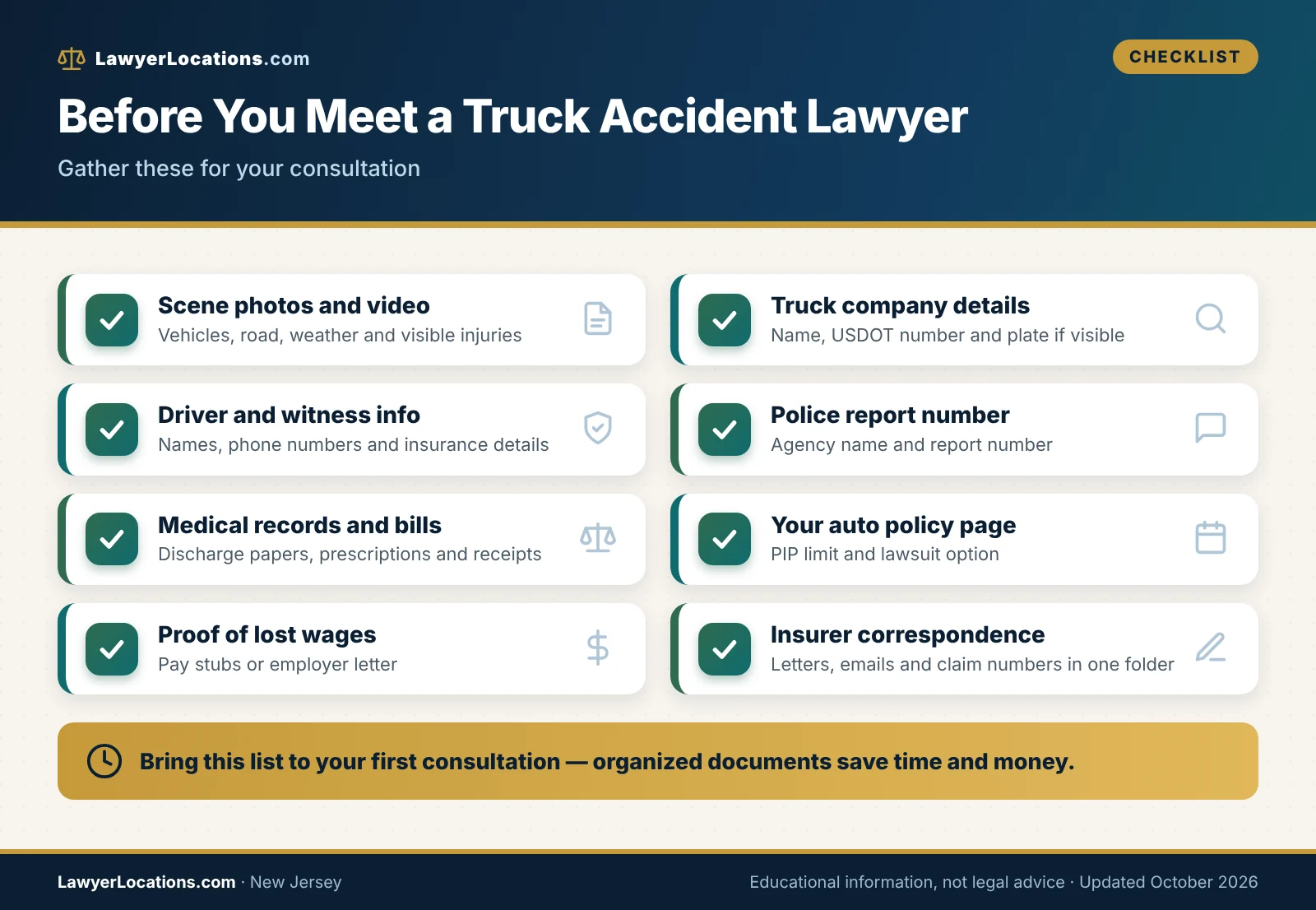
Text version of this graphic
- Photos of vehicles, the scene, road conditions and your injuries.
- The truck’s company name, USDOT number and license plate, if visible.
- Driver and witness names, phone numbers and insurance details.
- Police report number and the responding agency.
- Medical records, bills and a symptom diary.
- Your auto policy declarations page (PIP limit and lawsuit option).
- Pay stubs or proof of missed work.
- All letters, emails and texts from insurers, saved in one folder.
Documents and photos checklist
- Photos and video of all vehicles, damage, skid marks, signage and weather.
- The truck’s company name, any USDOT number on the cab door, and the license plate number.
- Names, contact information and insurance details for each driver, plus witness contact details.
- The police report number and the name of the responding department.
- Your own insurance declarations page and any claim number.
- Medical records, discharge papers, prescriptions and receipts for out-of-pocket costs.
- Proof of lost wages: pay stubs, a letter from your employer, or tax records for self-employed work.
Keep originals safe and give your lawyer copies. Store digital photos in more than one place, and do not edit or filter them.
A simple injury and symptom diary
Write a few lines each day about pain, sleep, mobility, missed activities and appointments. This record can later help show how the injury affected daily life, which matters in the non-economic portion of a claim. Keep entries factual and consistent with your medical records, and avoid posting about the crash or your recovery on social media, where statements and photos can be taken out of context.
keep every receipt Out-of-pocket costs such as prescriptions, mileage to appointments and medical equipment add up. A shoebox or a phone folder is enough, as long as it is complete.
How to Compare Truck Accident Lawyers in New Jersey
Compare at least two or three New Jersey lawyers on truck-case experience, communication, resources and fee terms, not on advertising. LawyerLocations.com is an educational resource and does not rank or recommend individual lawyers; the framework below helps you evaluate them yourself.
Where to look for a truck accident lawyer
The phrase “truck accident lawyer near me” returns a flood of ads, which says little about quality. These neutral starting points are more useful than a search results page.
County bar association lawyer referral services
The New Jersey State Bar Association’s lawyer referral page directs the public to county bar association referral services, with contacts for all 21 counties. You choose your county, then contact that county’s service directly. The NJSBA itself does not recommend specific attorneys. Referral services typically match you with a lawyer who handles your type of matter; ask each service how it screens participating lawyers and whether any initial consultation fee applies.
Checking a lawyer’s standing and credentials
Before you hire anyone, confirm the lawyer is licensed in New Jersey and in good standing through the New Jersey Judiciary’s attorney resources. The New Jersey Supreme Court also operates a Board on Attorney Certification that has run civil trial attorney certification; if a lawyer says they hold it, ask for the details and verify through the Judiciary rather than relying on an advertisement. Treat any credential as one data point alongside actual case experience.
Questions to ask at the consultation
A good consultation feels like an interview, not a sales pitch. Bring your documents and a short list of questions.
Questions about truck-case experience
- How many commercial-truck cases has your firm handled, and how do they differ from your car-crash cases?
- What is your process for sending preservation letters, and how soon after hiring do they go out?
- Have you worked with accident reconstruction, trucking-safety or medical experts, and who pays for them up front?
- Have you taken truck cases to trial, or do they mostly settle? What does that mean for my case?
- Who will actually handle my file day to day?
Avoid hiring based on a single dramatic number in an advertisement. Past results depend on the facts of each case and say little about yours.
Questions about communication and resources
Ask how often you will get updates, who answers your calls, and what happens if your primary lawyer is unavailable. Ask whether the firm can advance the costs of experts and records for a case that may run for years, and what happens to those costs if there is no recovery. A written answer to each question, in the fee agreement itself, is better than a verbal promise.
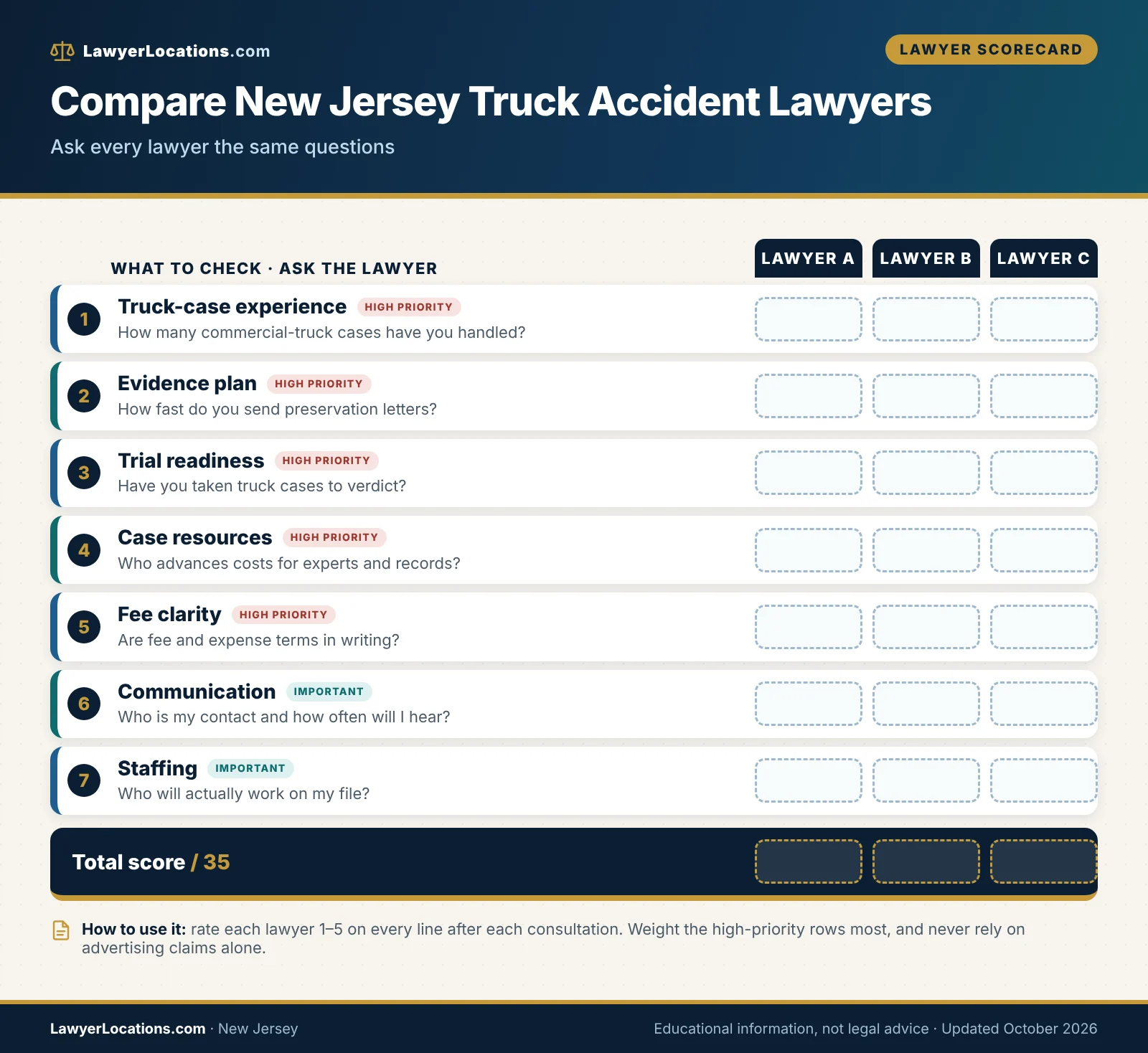
Text version of this graphic
| Criterion | Question to ask | Weight |
|---|---|---|
| Truck-case experience | How many commercial-truck cases have you handled? | High |
| Evidence plan | How fast do you send preservation letters? | High |
| Trial readiness | Have you taken truck cases to verdict? | High |
| Case resources | Who advances costs for experts and records? | High |
| Fee clarity | Is the percentage and cost handling in writing? | High |
| Communication | Who is my contact and how often will I hear? | Medium |
| Staffing | Who will actually work on my file? | Medium |
| Factor | What a strong answer sounds like | What should give you pause |
|---|---|---|
| Truck-case experience | Specific examples of commercial-vehicle issues the lawyer has handled, without breaching client confidentiality | Vague claims that all injury cases are alike |
| Evidence strategy | A clear plan for preservation letters, logs, electronic data and scene evidence | No mention of evidence until after treatment ends |
| Fee agreement | Written terms; percentage stated; expenses explained; Rule 1:21-7 acknowledged | Pressure to sign before you have read it |
| Case funding | Plain explanation of how expenses are advanced and repaid | Evasive answers about costs if the case loses |
| Communication | Named contact, realistic update schedule | Promises of constant availability that sound unrealistic |
| Realistic expectations | Discussion of risks, shared-fault issues and timelines | Predictions of a specific dollar result |
Red flags when hiring
Most lawyers are professional and straightforward. A few warning signs, however, deserve a second look before you sign anything.
Pressure tactics and outcome promises
Be cautious about anyone who promises a particular result, pushes you to sign on the spot, or tells you that you must act today. A real deadline exists, but a lawyer who invents urgency to close a deal is a red flag. No honest lawyer can promise a result, because the outcome depends on facts, evidence, insurers and sometimes a jury.
- Promised or “sure thing” outcomes, or claims about what your case is worth before reviewing records.
- Reluctance to put fee terms in writing, which New Jersey requires for contingent fees under the rule.
- Unsolicited contact from a lawyer or “case manager” soon after the crash.
- No clear answer about who will handle your case or what they charge for expenses.
Unclear fee terms and handoffs
Some firms handle intake and then refer the case to another firm for a referral fee. That can be perfectly ordinary, but you should know who is responsible for your case and how any fee-sharing affects what you pay. Ask that question directly and request the answer in writing.
If you are asked to sign something that waives your right to review fees or limits your ability to switch lawyers, stop and ask for time to read it. You can take an agreement home and review it before deciding.
Comparing two or three lawyers fairly
Treat the process like any other major purchase: gather comparable information, then decide with a clear head.
Use the same questions with each candidate
Ask every lawyer the same list, take notes right after each call, and score the answers while they are fresh. Compare the written fee agreements side by side. A lawyer who answers the hard questions plainly is usually a better fit than one who stays vague.
Trust, communication and fit
Your case may last a year or longer, so you should feel comfortable asking questions. If a lawyer talks over you at the first meeting or dodges follow-up, that is useful information. Fit matters as much as credentials. If you are still deciding whether a lawyer is needed at all, our guide on whether you need a lawyer after a car accident can help you think it through.
Truck Accident Lawyer Costs, Fee Rules and Decision Points in New Jersey
Most truck accident lawyers in New Jersey work on a contingent fee, meaning the fee is a percentage of what is recovered rather than an hourly bill. In New Jersey, the maximum percentage in most injury cases is set by Court Rule 1:21-7, and the agreement must be in writing.
The sliding-scale fee ceiling under Rule 1:21-7
Rule 1:21-7 governs contingent fees in tort cases, which includes personal injury and products liability claims. It sets a maximum, not a standard rate. A lawyer may charge less, and all contingent fees must still be reasonable under the Rules of Professional Conduct.
The percentage bands
The rule applies a descending scale to successive layers of the recovery, so the percentage drops as the recovery grows. The table summarizes the bands in the rule text for most adult clients.
| Portion of net recovery | Maximum fee |
|---|---|
| First $750,000 | 33 1/3% |
| Next $750,000 | 30% |
| Next $750,000 | 25% |
| Next $750,000 | 20% |
| Amounts above those bands | A reasonable fee set under the rule’s court-application procedure |
If the client was a minor or mentally incapacitated when the agreement was made, the rule caps the fee at 25% for a settlement reached before the jury is empaneled, with a different cutoff point in a bench trial. Cases that fall outside the rule, such as statutory discrimination claims, follow different guidance.
The fee is calculated on the net recovery
Under Rule 1:21-7(d), the percentage is applied to the net recovery, meaning the amount left after case disbursements are deducted. Disbursements include costs like investigation, expert and testimony costs, and transcripts, whether advanced by the lawyer or the client. The rule says no deduction is made for liens, hospital claims or medical provider claims when calculating the base.
Assume a hypothetical $150,000 settlement with $15,000 in case disbursements. The net recovery for fee purposes is $135,000, and a fee at the maximum 33 1/3% rate would be $45,000. Liens and outstanding medical bills are handled separately and may further reduce what the client receives. Numbers are illustrative only and are not an average or prediction.
Case expenses, liens and what you actually take home
The fee percentage is only one part of the math. Expenses and liens often decide how much reaches the client, and they are worth discussing before you sign.
Case expenses in truck cases
Truck cases can require accident reconstruction, trucking-safety analysis, medical experts and extensive records requests. Those costs are separate from the lawyer’s fee. Ask whether the firm advances them, whether they are repaid from the recovery, and what happens if there is no recovery. Because the percentage in New Jersey is applied after disbursements are deducted, the order of calculation matters, so ask the lawyer to show a sample calculation in writing.
Medical liens and reimbursement claims
Health insurers, government programs and medical providers may assert claims against a settlement. Our guide on who pays medical bills after a car accident explains how those claims work and why negotiating them can affect your net recovery. Ask your prospective lawyer whether they help with lien resolution and whether that is included in the fee.
ask for a sample closing statement Reviewing one before you sign shows you how fees, expenses and liens line up on paper at the end of a case.
Written agreements, closing statements and fee review
New Jersey adds consumer protections to the fee relationship. They are worth knowing because they give you leverage to ask questions at any stage.
Writing and closing statement requirements
Where the fee is subject to the caps, Rule 1:21-7(g) requires a written agreement signed by the lawyer and client, with a signed copy given to the client. At the end of a recovery, the lawyer must give the client a signed closing statement. Read both documents carefully and ask for an explanation of any line you do not understand.
Reviewing a fee you think is wrong
The rule preserves a client’s right to seek court review of a fee, and a lawyer who believes the capped fee is inadequate must apply on notice to the Assignment Judge or designee for a reasonable fee. If you have a fee concern, raise it with the lawyer in writing first, and consider seeking independent advice from another New Jersey lawyer about the dispute process.
Deadlines and decision points over the life of a case
Costs and timing are linked. The longer a case runs, the more expenses accumulate, and the more important it is to make decisions at the right time. The graphic and table below tie the fee and deadline rules together.
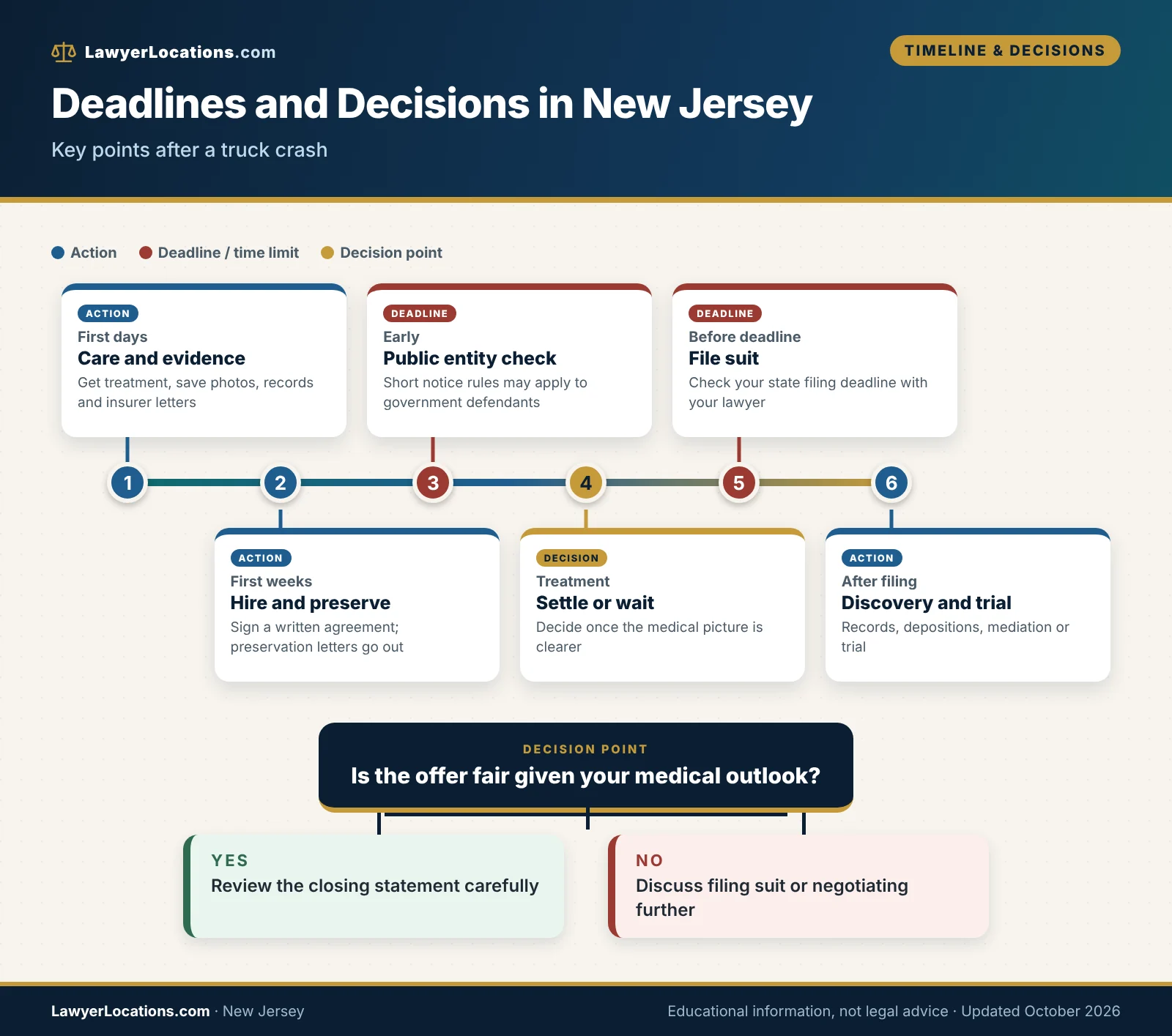
Text version of this graphic
- First days (action): Medical care, evidence, and consultations with New Jersey lawyers.
- First weeks (action): Sign a written fee agreement; preservation letters go out.
- Within 90 days (deadline): Notice of claim if a public entity may be involved.
- Treatment months (decision): Settle now or wait until the medical picture is clearer.
- Before 2 years (deadline): File suit in the Superior Court if the claim is unresolved.
- After filing (action): Discovery, physician certification if the lawsuit threshold applies, mediation or trial.
Decision point: Is the offer fair given your medical outlook? If yes, review the closing statement; if not, discuss next steps with your lawyer.
| Stage | Decision | Why it matters |
|---|---|---|
| Hiring | Which lawyer and which fee agreement | Sets the percentage, expense handling and who works the file. |
| Early investigation | What evidence to preserve and from whom | Driver logs, vehicle data and video can be lost if requests are late. |
| Treatment | Whether to settle before your condition stabilizes | An early settlement usually ends the claim, even if symptoms later worsen. |
| Pre-suit | Whether to file before talks conclude | The two-year deadline can pass while negotiations drag on. |
| Litigation | Whether to mediate, settle or try the case | Cost, risk and timing all change once discovery begins. |
| Closing | Whether to accept the final figure | The closing statement shows fees, costs and liens in black and white. |
Settle now or wait
Settlement offers often arrive before the full extent of an injury is known. Accepting one usually means giving up the right to ask for more later. For a closer look at how timing interacts with value, see our guide to the car accident settlement timeline.
Filing suit to protect the deadline
Filing a lawsuit does not mean you are headed to trial. Most cases that are filed still resolve before a verdict. Filing preserves your rights under N.J.S.A. 2A:14-2 and opens up formal discovery tools that can compel the production of records from the trucking company. Your lawyer will explain whether filing early or later fits your case.
Next Steps, Free Resources and Common Questions
After a serious truck crash, the sensible order is your health first, evidence second, and lawyer comparison third, all within the deadlines above. If money is the barrier to getting help, New Jersey has free and low-cost resources to explore.
What to do in the first weeks
The first few weeks set the foundation for the rest of the case. A short, calm routine beats a frantic scramble.
Health, documents and insurer contact
See a doctor and follow treatment advice, even if injuries seem minor at first, since some symptoms appear later. Report the crash to your own insurer as your policy requires, and keep a simple log of every call. Do not sign medical releases or settlement paperwork from the other side’s insurer before a lawyer has reviewed them. For a step-by-step list, see what to do after a car accident.
Schedule two or three consultations
Contact two or three New Jersey lawyers soon enough to leave time for evidence preservation and for the shorter deadlines that can apply. Bring the documents from the checklist, use the scorecard questions, and ask each lawyer to explain the fee terms in plain language. Take the agreements home and compare them side by side before signing.
Free and low-cost resources in New Jersey
Not everyone can afford to shop around, and some people need help understanding their options before they call a firm.
County bar lawyer referral services
The NJSBA directs people to county bar association referral services across all 21 counties. Examples on its page include the Bergen County Bar Association, the Essex County Bar Association, the Middlesex County Bar Association and the Union County Bar Association, each with its own phone number and website. Use the service for the county where you live, and ask how it screens its panel lawyers.
| Resource | What it offers | Best for |
|---|---|---|
| County bar association lawyer referral services (via the NJSBA) | Referrals to lawyers by county; the NJSBA does not recommend specific attorneys | Finding lawyers who take injury cases in your area |
| Legal Services of New Jersey (LSNJLAW) | Free civil legal help for low-income residents; hotline 1-888-LSNJ-LAW (1-888-576-5529) | People who meet income guidelines and need general civil legal help or referrals |
| New Jersey Judiciary | Court information, forms and procedural guidance | Understanding which court hears a claim and how filing works |
| FMCSA | Federal trucking rules, carrier safety and insurance information | Learning which federal rules may apply to the truck involved |
Legal Services of New Jersey and other nonprofit help
Legal Services of New Jersey describes itself as a nonprofit providing free civil legal assistance to low-income people in the state, with a hotline at 1-888-LSNJ-LAW. Its public materials do not promise help with injury cases, so treat it as a place to ask about your options and referrals, not as an assured source of representation.
Long-tail questions about hiring a truck accident lawyer in New Jersey
These are some of the questions we hear most often. Short answers are below; your own facts may change them.
Common questions, answered
How long do I have to sue after a truck accident in New Jersey?
For most personal injury claims, New Jersey allows two years from when the claim accrues under N.J.S.A. 2A:14-2. Special rules, such as the 90-day notice for public entities under N.J.S.A. 59:8-8, can shorten the window.
How much does a truck accident lawyer cost in New Jersey?
Many work on a contingent fee, meaning no fee unless there is a recovery, but expenses are handled separately and must be explained in the agreement. Court Rule 1:21-7 sets a sliding-scale ceiling, starting at 33 1/3% on the first $750,000 of net recovery in most cases.
What is the difference between a truck accident lawyer and a general car accident lawyer?
Truck cases often involve federal safety regulations, multiple defendants and larger insurance policies. Some car accident lawyers handle truck cases, so ask about specific experience. See our comparison of truck and car accident lawyers.
Can I still recover if I was partly at fault?
Under N.J.S.A. 2A:15-5.1, you can recover if your fault is not greater than the defendants’ combined fault, but your award is reduced by your percentage of fault.
Does my own insurance pay for medical bills after a truck crash?
In many cases, your own auto policy’s PIP coverage pays accident-related medical bills first up to your policy limit, regardless of fault. The liability claim against the trucking company addresses other losses.
What is the limitation on lawsuit option?
It is a cheaper coverage choice that limits claims for non-economic damages unless your injury falls into a category listed in N.J.S.A. 39:6A-8(a), supported by a physician certification.
What court handles a New Jersey truck accident lawsuit?
Usually the Superior Court, Law Division, Civil Part. The Special Civil Part is limited to claims of $20,000 or less.
How much insurance does a trucking company have to carry?
Federal minimums for interstate for-hire carriers start at $750,000 for general freight and are higher for certain hazardous materials under 49 CFR 387.9. These are minimums, not limits on what a claim may be worth.
What if my loved one died in a truck crash?
The Wrongful Death Act generally requires suit within two years of the death (N.J.S.A. 2A:31-3). See our guide on wrongful death lawyer costs for fee questions.
Should I talk to the trucking company’s insurer?
You may speak with them, but you are not required to give a recorded statement to the other side’s insurer. Many people wait until they have spoken to a lawyer.
Are there free ways to find a lawyer in New Jersey?
County bar lawyer referral services and Legal Services of New Jersey are good starting points. Ask each about eligibility and any consultation fee.
Can I switch lawyers if I am unhappy?
Generally yes, but the fee agreement may address what the first lawyer is owed. Read it carefully and ask a new lawyer to review it.
What if the trucking company’s insurance is not enough?
Your own underinsured motorist coverage may become relevant. See uninsured motorist claims for an overview.
Closing: your next step
If you are looking for a truck accident lawyer in New Jersey, start by writing down your deadlines, gathering the documents in the checklist, and booking two or three consultations. Ask the same questions each time, compare the written fee terms, and choose the lawyer whose answers are clearest and most realistic.
Ready to compare your options?
Use the scorecard questions above and the county bar referral services as a starting point. LawyerLocations.com does not provide legal advice or recommend individual lawyers, so make your decision on experience, communication and clear fee terms. If you are not sure whether you need a lawyer, begin with our guide on when hiring one makes sense.
General information only. This article is for educational purposes and is not legal advice. Reading it does not create an attorney-client relationship, and LawyerLocations.com is not a law firm. Laws, court rules, fees and deadlines change, and your facts matter. Consult a lawyer licensed in New Jersey about your situation, and confirm statutes and rules against official sources before relying on them.
Sources & References
Show all 12 sources
- N.J.S.A. 2A:14-2, Statute of limitations for injury to the person — Justia, New Jersey Statutes — justia.com — accessed October 2026
- N.J.S.A. 2A:15-5.1, Contributory negligence and comparative negligence — New Jersey Legislature, Legislative Information System — njleg.state.nj.us — accessed October 2026
- N.J.S.A. 2A:31-3, Wrongful Death Act limitation period — Justia, New Jersey Statutes — justia.com — accessed October 2026
- N.J.S.A. 59:8-8, Tort Claims Act time limits for notice of claim — Justia, New Jersey Statutes — justia.com — accessed October 2026
- N.J.S.A. 39:6A-8, Limitation on lawsuit option and physician certification — Justia, New Jersey Statutes — justia.com — accessed October 2026
- New Jersey Court Rule 1:21-7, Contingent Fees — CourtRules.net, New Jersey Rules of Court — courtrules.net — accessed October 2026
- 49 CFR 395.3, Maximum driving time for property-carrying vehicles — Electronic Code of Federal Regulations — ecfr.gov — accessed October 2026
- 49 CFR 387.9, Financial responsibility, minimum levels — Electronic Code of Federal Regulations — ecfr.gov — accessed October 2026
- What is the Special Civil Part? — New Jersey Courts — njcourts.gov — accessed October 2026
- Attorney certification notices — New Jersey Courts — njcourts.gov — accessed October 2026
- Lawyer Referral Service — New Jersey State Bar Association — njsba.com — accessed October 2026
- Legal Services of New Jersey (LSNJLAW) — Legal Services of New Jersey — lsnjlaw.org — accessed October 2026
Legal Disclaimer and Limitation of Liability
Informational and illustrative purposes only. This article was prepared by LawyerLocations.com solely on the basis of the information available to us at the time of writing. It is an illustrative, general overview. It is not a complete or authoritative statement of the law, and it has not been reviewed by a lawyer licensed in your state or county.
Not legal advice. Nothing in this article is legal, financial, tax or immigration advice, and reading it does not create an attorney-client relationship between you and LawyerLocations.com or any author, lawyer or firm mentioned. Laws, court rules, fees, filing deadlines and agency procedures differ by state, county and court, and they change often. Some details here may be simplified, incomplete or out of date, and time limits for legal claims can be short.
No warranty. We make no representation or warranty, express or implied, about the accuracy, completeness, timeliness or suitability of this content for your situation. Please do not rely on it to make, delay or skip any legal decision. Check the facts against official sources and speak with a licensed attorney in the relevant jurisdiction before you act.
Limitation of liability. To the fullest extent permitted by law, LawyerLocations.com and its owners, authors and contributors disclaim all liability for any loss, damage, cost or other consequence arising from the use of, or reliance on, this article, including any content on third-party websites we link to. Mentioning a lawyer, firm, organization or service is not an endorsement and is not a promise of any result. If you are in immediate danger, contact your local emergency number.