If you typed “citizenship lawyer san jose ca” into a search box, start with one fact: naturalization is governed by federal law, so California and Santa Clara County do not change who is eligible. The rules come from the Immigration and Nationality Act (8 U.S.C. 1427) and are applied by U.S. Citizenship and Immigration Services (USCIS) on Form N-400. What is local is the USCIS office that handles your case, the federal court that can review it, the county records you may need to pull, California’s rules for who may be paid to help with immigration paperwork, and the lawyers and nonprofits you can call.
This guide explains how a naturalization case moves through USCIS for San Jose residents, when a lawyer is useful and when another route may fit, what the government fee is as of October 2026, how California law treats “notario” fraud, and how to compare lawyers before you sign. It is general information, not advice about your case.
Citizenship Law Is Federal; San Jose Changes the Logistics
A green card holder in San Jose and one in Boise are measured against the same federal yardstick. This section separates what Congress and USCIS decide from what actually differs for someone living in Santa Clara County, so you know which parts of this guide are law and which are logistics.
What federal law decides
The eligibility rules for naturalization sit in the Immigration and Nationality Act (INA), a federal statute. USCIS applies them using its Policy Manual, where Volume 12 covers citizenship and naturalization. No California statute and no Santa Clara County or San Jose ordinance adds to or subtracts from those requirements.
The core requirements on the five-year path
USCIS lists the general requirements for people who have been lawful permanent residents (green card holders) for at least five years. As of October 2026, you generally must meet every item below when you file Form N-400 and keep meeting the ongoing ones until you take the oath:
- Be at least 18 years old when you file.
- Have been a lawful permanent resident for at least 5 years, with continuous residence in the United States during that time.
- Have been physically present in the United States for at least 30 months of the five years before filing.
- Have lived for at least three months in the state or USCIS district where you file.
- Be a person of good moral character who is attached to the principles of the Constitution.
- Read, write and speak basic English and pass a civics test, unless an exception applies.
- Take the Oath of Allegiance.
The statute, 8 U.S.C. 1427, describes the same building blocks: five years of residence, presence for at least half that time, three months in the filing state or district, and good moral character during the statutory period. The government is not limited to looking only at the five years before you file when it weighs character, which matters if you have an older record.
The three-year path for spouses of citizens
A shorter route exists under section 319(a) of the INA. USCIS says an applicant must have been a lawful permanent resident for at least three years, must have lived in marital union with a U.S. citizen spouse for those three years and while the application is pending, and must have been physically present in the United States for at least 18 months of the three years. The English, civics and good-moral-character requirements still apply.
One practical point comes up often. Because eligibility is tied to living in marital union with your citizen spouse both before filing and while the case is pending, a change in the marriage or in your spouse’s status mid-case needs professional advice before you answer any USCIS question about it.
USCIS Policy Manual guidance says an applicant under the general provision may file up to 90 days before reaching the five-year mark, although eligibility does not arise until the full period is met. A miscounted date is one of the simplest ways to lose a filing fee, so many applicants have a professional check the calendar before mailing.
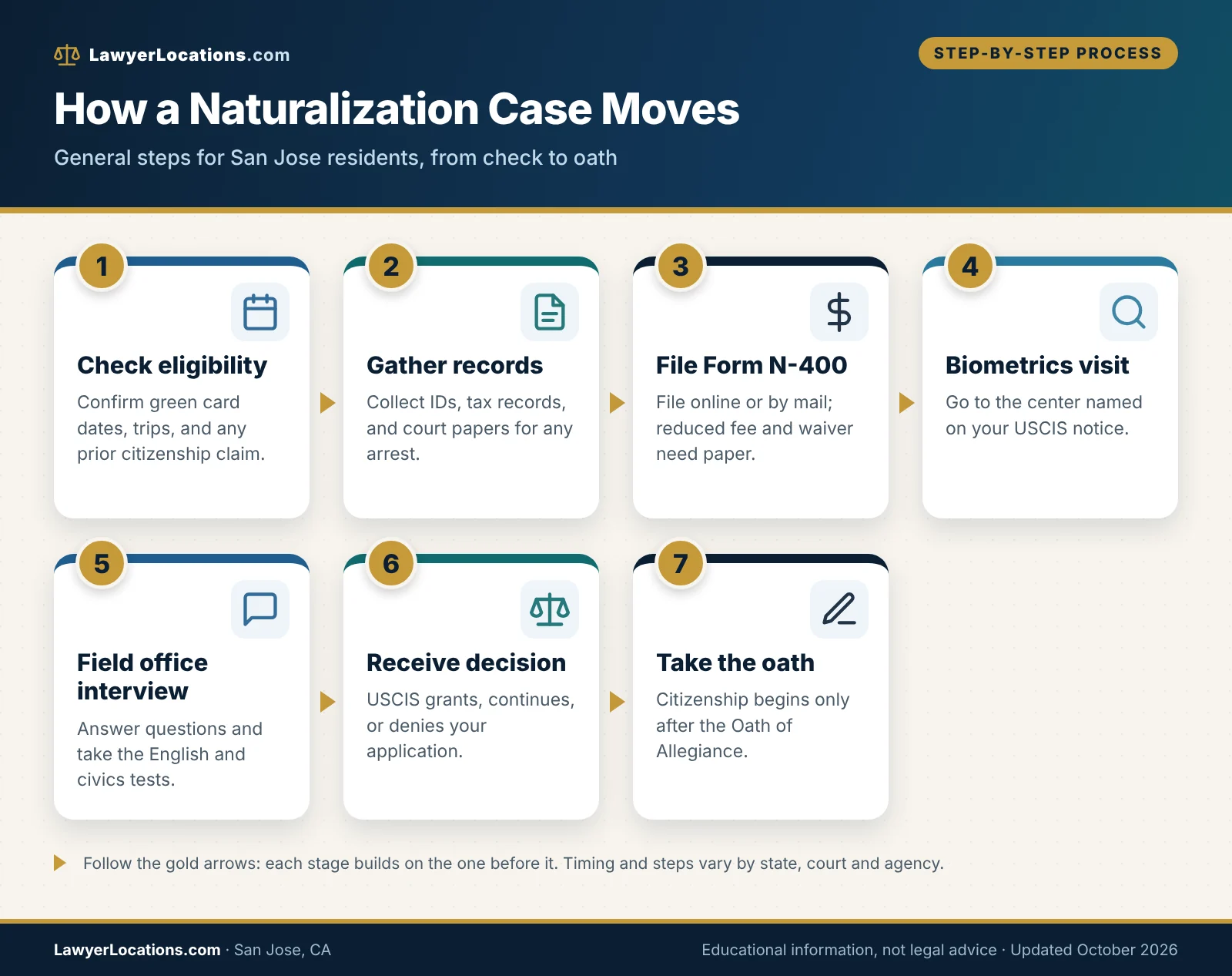
Text version of this graphic
- Check whether you are already a U.S. citizen or eligible to naturalize.
- Gather evidence and complete Form N-400.
- File online or by mail and pay the fee or file a fee request.
- Receive a receipt notice and go to the biometrics appointment if one is scheduled.
- Attend the interview and tests at the field office named on your notice.
- Receive a decision: granted, continued or denied.
- Attend the oath ceremony and return your green card.
- Receive the Certificate of Naturalization and check it for errors.
What is local to San Jose and Santa Clara County
For a San Jose resident, the local layer is practical. It covers which USCIS office you will visit, where fingerprints are taken, which federal court hears disputes, which county offices hold the records USCIS may ask for, and which California rules protect you when you hire help.
Your USCIS office and biometrics site
USCIS lists both a San Jose Field Office and a San Jose Application Support Center on its website. Which field office is assigned to your case depends on where you live, so use the USCIS office locator and, above all, the address printed on your appointment notice. USCIS says its field offices handle interviews and naturalization ceremonies, do not accept walk-ins, and ask you not to arrive more than 15 minutes before an appointment (30 minutes for a naturalization ceremony). To reschedule, USCIS lists its Contact Center at 800-375-5283.
| Place or office | Details we could verify | What it is used for |
|---|---|---|
| USCIS San Jose Field Office | Listed by USCIS; confirm the address on your notice; appointment required, no walk-ins | Naturalization interview and tests, and ceremonies, as your notice directs |
| USCIS Application Support Center, San Jose | Listed on uscis.gov; use the address on your biometrics notice | Fingerprints and photo, when USCIS schedules them |
| U.S. District Court, N.D. Cal., San Jose courthouse | Robert F. Peckham Federal Building, 280 South First Street, San Jose, CA 95113; Clerk’s Office open Monday to Friday, 9:00 a.m. to 4:00 p.m., excluding federal holidays | Federal court for naturalization lawsuits filed by Santa Clara County residents |
| Santa Clara County Bar Association Lawyer Referral Service | P.O. Box 26457, San Jose, CA 95159; 669-302-7803; listed by the State Bar as a certified referral service | Referrals to private lawyers |
| Santa Clara County Office of Immigrant Relations | Publishes a list of citizenship legal-help providers on the county’s Division of Equity and Social Justice website | Finding free or low-cost help |
Biometrics are the fingerprints and photograph USCIS uses for background checks. Not every applicant is called in for them, and your notice will say if you are.
Federal court and county records
Santa Clara County lies within the Northern District of California, and the district has a courthouse in San Jose, the Robert F. Peckham Federal Building at 280 South First Street. The Clerk’s Office there is open Monday through Friday from 9:00 a.m. to 4:00 p.m., excluding federal holidays, and the court lists a third-floor document drop box that is open from 7:30 a.m. to 5:00 p.m. This is the federal trial court a San Jose resident would use if USCIS fails to decide a case on time or denies an application after a hearing (see section 6).
County records are a separate system. If an arrest, citation or family-court order in your history came from a California state court in Santa Clara County, the file is generally held by the Superior Court of California, County of Santa Clara. USCIS may ask for certified court dispositions, so start requesting records early, before you gather the rest of your evidence.
Check first whether you are already a citizen
The Census Bureau’s QuickFacts reports that 42.0% of San Jose residents were born outside the United States and that 58.9% of residents age 5 and over speak a language other than English at home (2020-2024 American Community Survey estimates). With that many families rooted in other countries, some residents have U.S. citizen parents or grandparents without realizing it. Before paying for an N-400, make sure naturalization is the right form at all.
Citizenship through a U.S. citizen parent
USCIS describes two general ways to obtain citizenship through U.S. citizen parents: at birth, and after birth but before age 18. Which rule applies depends on the law in effect when the person was born, and in general it requires that at least one parent was a U.S. citizen who had lived in the United States for a certain period. USCIS’s page for children of citizens also covers children who live in the United States as permanent residents in the legal and physical custody of a citizen parent.
These cases turn on dates, adoption and parents’ residence histories, so a lawyer’s review of the family history can prevent spending money on the wrong application.
Why the answer changes which form you file
A person who is already a citizen by birth abroad or by derivation does not naturalize. Instead, USCIS offers Form N-600, Application for Certificate of Citizenship, which documents citizenship you already hold. The N-600 filing fee on the October 2026 fee schedule is $1,335 online or $1,385 on paper, which is higher than the N-400 fee.
If a parent, grandparent or adoptive parent was ever a U.S. citizen, say so at the very first conversation with a lawyer or accredited representative. That one fact can change the form, the fee and the strategy.
How a Naturalization Case Moves Through USCIS for San Jose Residents
USCIS describes naturalization in ten steps, from checking eligibility to understanding citizenship after the oath. For a San Jose applicant the working sequence is filing, a biometrics visit if one is scheduled, an interview and test at the field office that handles your case, a decision, and then an oath ceremony.
From filing to biometrics
The first stage is the paper trail. Most delays and rejections start here, with an unsigned form, a wrong fee or a missing record, so it is worth slowing down before you submit.
Filing online or on paper
USCIS says you can file Form N-400 online through a USCIS account or by mail. The current edition date of the form is 01/20/25, and USCIS may reject a form from the wrong edition. If you request a reduced fee or file a fee waiver, you cannot file online; you must file on paper with the request and its evidence.
Lawyers and accredited representatives can create an online representative account to file for clients, which is one reason the filing method is worth discussing during a consultation.
Biometrics at an Application Support Center
If USCIS needs fingerprints or a photo, it mails an appointment notice with the date, time and location, and you go to the center named on that notice. USCIS lists an Application Support Center in San Jose on its website. Bring the appointment notice and follow the instructions printed on it. USCIS says applicants can reschedule a biometrics appointment through a USCIS account.
The flow of the whole process is summarized in the graphic earlier in this guide, and the text version beneath it lists each step in order.
The interview
After the preliminary checks finish, USCIS schedules an interview. The notice states the date, time and place, and USCIS tells applicants to bring the notice with them.
Appointment rules and who may come with you
USCIS field offices do not allow walk-ins. A significant 2026 change affects applicants who hire help: USCIS states that, effective May 18, 2026, attorneys and accredited representatives may no longer attend field-office interviews remotely except in limited circumstances, and must be physically present. If you want your representative beside you in San Jose, confirm the in-person plan in writing before the date.
Your representative appears by filing Form G-28, Notice of Entry of Appearance as Attorney or Accredited Representative. USCIS’s legal-services page lists who may represent you: a lawyer in good standing who is eligible to practice, an accredited representative working for a Department of Justice (DOJ) recognized organization, or a supervised law student or graduate.
What the officer reviews
The officer will ask about your application and background, and you will take the English and civics tests unless an exception applies. USCIS’s N-400 instructions say it may also run a background check, including a check of FBI criminal history records, so answers that conflict with a record are a common problem.
Do not guess on the form. USCIS’s instructions say you must report all offenses, including offenses that were expunged or pardoned and offenses committed before age 18, and that failing to disclose them can lead to denial even when the underlying offense would not itself have barred you.
Tests, decision and the oath
The test version you take depends on when you filed, not when you are interviewed. That detail surprises many people with older pending cases.
The English and civics tests
USCIS says applicants who filed Form N-400 on or after October 20, 2025 take the 2025 civics test, while those who filed earlier take the 2008 test. The 2025 test is oral: the officer asks up to 20 questions from a list of 128, and you pass by answering 12 correctly. The English test checks speaking during the interview, reading one of three sentences aloud, and writing one of three sentences.
| Feature | 2008 civics test | 2025 civics test |
|---|---|---|
| Who takes it | N-400 filed before October 20, 2025 | N-400 filed on or after October 20, 2025 |
| Question bank | 100 questions | 128 questions |
| Questions asked | Up to 10 | Up to 20 |
| To pass | 6 correct | 12 correct |
| Test stops as failed | After 5 incorrect | After 9 incorrect |
| 65/20 special consideration | 10 questions from 20 marked questions | 10 questions from 20 marked questions |
If you fail part of the test at the first interview, USCIS says you get two attempts in total and will be retested on the failed portion between 60 and 90 days after the first interview, citing 8 CFR 312.5(a) and 335.3(b). Free study materials, including the 128 civics questions and a study guide, are on USCIS’s website. Some answers change with elections or appointments, so study the version USCIS currently publishes.
Decisions and the oath ceremony
USCIS says it will mail a decision. It may grant the application, continue it (for example, to request more evidence or to retest), or deny it. If approved, you may be able to take the oath the same day; otherwise USCIS mails Form N-445 with the date, time and location of the ceremony. Rely on your own notice, not a rumor or a website listing, for where to go.
At check-in you complete the N-445 questionnaire, return your green card, and take the oath. You are not a U.S. citizen until you take the Oath of Allegiance. Review your Certificate of Naturalization before you leave the ceremony and report errors right away, because replacing one later requires a new application.
When a Citizenship Lawyer Helps and When Another Route May Fit
Many straightforward naturalization applications are filed without a lawyer, and USCIS says plainly that you do not need a representative to file forms or to represent yourself. A lawyer becomes more valuable as the facts get more complicated, because the cost of a mistake can include a lost filing fee, a denial, or in rare cases a referral that puts your permanent resident status at risk.
Situations where legal advice often matters
The categories below are the ones immigration practitioners most often flag. None of them automatically means you cannot naturalize, but each one deserves a professional’s review before you file.
Arrests, charges and convictions
Good moral character is judged over the statutory period, and USCIS’s N-400 instructions require you to report every offense, including ones that were expunged, pardoned, or committed before age 18. Policy Manual Volume 12, Part F lists permanent bars (murder, and an aggravated felony conviction on or after November 29, 1990) and conditional bars for acts within the statutory period, such as certain crimes involving moral turpitude, controlled-substance violations, 180 days or more of imprisonment, false testimony, and driving-under-the-influence conduct in some circumstances.
USCIS’s N-400 instructions add that it will not approve an application while you are on probation, on parole or under a suspended sentence, and that you should supply court evidence showing the sentence ended. For a case that began in Santa Clara County, the court file is typically held by the Superior Court of California, County of Santa Clara, so ask the lawyer or representative which records to request and in what form. If a California court has dismissed, expunged or sealed a case, do not assume it disappears for immigration purposes. Our guides to expungement lawyers and DUI lawyer costs explain the criminal-side basics, and how to compare criminal defense lawyers covers the questions to ask when a charge is still open.
If you have an open charge, a past arrest you do not fully understand, or a conviction from another state or country, talk to a licensed lawyer before filing Form N-400. A naturalization interview is a background review, and the application itself is a sworn statement.
Policy changes in good moral character review
On August 15, 2025, USCIS issued Policy Memorandum PM-602-0188, which describes a more “holistic” good-moral-character review. It tells officers to weigh positive factors such as community involvement, family responsibilities, education, steady work and tax compliance alongside any disqualifying conduct, and to look closely at conduct that is technically lawful but may be contrary to community standards.
For applicants, the practical lesson is to bring evidence of good character, not just the absence of a record: proof of paid taxes, current child support, and completed probation.
In December 2025 and January 2026, USCIS issued internal memoranda (PM-602-0192 and PM-602-0194) directing holds and re-reviews of benefit applications for people from countries named in presidential proclamations. As of our October 2026 check, USCIS’s policy-memoranda page marks both memos “no longer in effect due to court orders” and points to web alerts about the related lawsuits. If your country of birth or citizenship appears in a travel-restriction proclamation, ask a lawyer or accredited representative about current processing before you rely on any timeline.
Long trips abroad and questions about where you live
Continuous residence is not just a count of days. USCIS’s Policy Manual says an absence of more than six months but less than one year is presumed to break continuous residence, an absence of one year or more automatically breaks it, and a lengthy or frequent absence can also raise an abandonment-of-residence problem. A person whose family, job and home stayed in the United States during a long trip may be able to rebut the presumption with documents.
Extended stays abroad are common among families with relatives overseas, so this is worth checking against your passport stamps and travel records before you file, not after USCIS asks.
| Length of a single absence | Presumption of a break? | What it means in practice |
|---|---|---|
| 6 months or less | No presumption | Generally not treated as a break, though many short trips can still prompt questions about where you actually live |
| More than 6 months, less than 1 year | Presumed to break continuity | You must show you kept your U.S. ties, such as the same job, family in the United States, and access to a home |
| 1 year or more | Breaks continuity | Application is generally denied unless Form N-470 was approved for qualifying work abroad; a new waiting period applies |
If you are planning a long stay abroad, ask a lawyer before you leave. Form N-470, Application to Preserve Residence for Naturalization Purposes, covers only certain types of work abroad, and it has its own fee of $420 on the October 2026 fee schedule.
Money, tax and past immigration problems
Not every issue involves a crime. Several financial and immigration-history problems can also surface in the interview.
Taxes, child support and Selective Service
USCIS’s instructions say a failure to pay taxes as required may lead to a finding that you lack good moral character, and that applicants with overdue taxes should provide IRS transcripts and a signed repayment agreement. A parent who has failed to support dependents during the statutory period, even without a court order, can be found to lack good moral character unless there are extenuating circumstances. Men who were required to register with the Selective Service between ages 18 and 26 and knowingly did not may be unable to show the required attachment to constitutional principles and good moral character.
Prior removal orders, false claims and voting
USCIS’s Policy Manual says an order of removal terminates lawful permanent resident status and therefore disrupts continuity of residence. It also lists false claims to U.S. citizenship, unlawful voter registration and unlawful voting among the conditional bars to good moral character, subject to a narrow exception in some cases. People who ticked a box for “citizen” on an old employment form or registered to vote by mistake should talk to a lawyer before filing, because an honest explanation must be paired with the right legal analysis.
This is also the point where a naturalization case can blur into a removal-defense case. If you have any criminal or immigration-court history, a lawyer who handles both naturalization and removal defense can be worth a conversation; our guide to deportation defense lawyers shows how those cases are compared.
Medical, age and family circumstances
Some applicants qualify for exceptions that change the English or civics requirement. Getting these right early avoids a failed test and a delayed case.
Disability exceptions and Form N-648
Federal law, 8 U.S.C. 1423(b), excuses the English and civics requirements for a person who cannot comply because of a physical or developmental disability or a mental impairment. USCIS’s N-400 instructions explain that the applicant answers “Yes” on the relevant item of the form and submits Form N-648, Medical Certification for Disability Exceptions, completed by a medical professional, with the N-400. A doctor’s visit and form completion may carry a cost of their own, so ask about it early.
Age-based exceptions
The same statute excuses the English requirement for an applicant over 50 who has lived in the United States as a permanent resident for at least 20 years (the “50/20” rule), or over 55 with at least 15 years (“55/15”). USCIS also provides a special civics procedure for applicants who are 65 or older and have been permanent residents for 20 or more years, who take a shorter test of 10 questions drawn from 20 marked questions and may take the test in the language of their choice.
When a lower-cost route may fit
A clean record and a simple timeline do not require a private lawyer. Several lower-cost options exist, and some are free.
Self-filing with a careful checklist
If you have been a permanent resident for more than five years, have no arrests, no long trips, have filed your taxes, and your documents match, you may be comfortable filing yourself. USCIS publishes a free N-400 checklist of required initial evidence, the full instructions, and free study materials. Print the checklist, tick off every item, and read the final form aloud before signing.
Self-filing has limits: if any answer is uncertain, get a consultation before you sign under penalty of perjury.
Accredited representatives, legal-aid groups and lawyers compared
USCIS lists accredited representatives of DOJ-recognized organizations as a category that can represent you. These are staff at nonprofit organizations that the Department of Justice has approved to provide immigration legal services at low cost. The table summarizes the trade-offs of each route.
| Route | Who it may suit | Main trade-offs |
|---|---|---|
| File it yourself | Clean record, steady residence, comfortable with forms | No cost beyond the USCIS fee, but no one reviews your answers before USCIS does |
| DOJ-accredited representative at a recognized organization | Moderate complexity, limited budget | Often low-cost or free, but capacity, eligibility rules and waiting lists vary; not every case type is accepted |
| Pro bono or legal-aid program | Low-income applicants who meet program rules | No fee, but an intake and eligibility screen applies and availability can be limited |
| Private immigration lawyer | Criminal history, long absences, tax issues, prior removal, derived-citizenship questions | Fees are paid by you; quality and communication vary, so verify the license and get the fee in writing |
How to Compare Citizenship Lawyers and Find Help in San Jose
To choose a citizenship lawyer in San Jose, verify the person’s license first, then compare experience with your specific facts, the written fee, and how they communicate. Price alone is a poor guide, because a very low quote can leave out the work you actually need.
Verify the person before you compare prices
Two checks take ten minutes and screen out most of the worst outcomes. Do them before you pay anyone, and do them again if a friend, a social media page or a community group refers you.
Check the California license and discipline history
The State Bar of California runs a lookup tool called Check Attorney Profile, and its “Before Selecting an Attorney” page tells the public to compare two or more lawyers in brief interviews. The State Bar also says that lawyer referral services it certifies refer only to attorneys who are State Bar licensees in good standing. USCIS adds that you should ask to see an attorney’s current licensing document and verify with the licensing agency that the attorney is eligible to practice.
The State Bar’s page also warns about attorneys who contact you unsolicited, in person, by phone or on social media, and cautions you to be wary of any lawyer who guarantees results. A good lawyer, the State Bar says, should be able to explain the strengths and weaknesses of your case.
The State Bar suggests asking whether the lawyer will handle your case personally or whether someone else at the firm will. If someone else will, consider meeting that person too. For a naturalization case, that person may be the one who prepares your N-400.
Understand who is allowed to represent you in a federal immigration matter
USCIS says a lawyer who files for you must be a member in good standing of the bar of a U.S. state or territory and must not be disbarred or otherwise restricted from practice. That means an immigration lawyer licensed in another state can generally represent you before USCIS, so a San Jose address is not a requirement, although local knowledge of the field office, the county court records and the nonprofit network can be useful.
Be careful with the name on the door. A “consultant,” “document preparer” or “immigration service” is not a lawyer, and under USCIS’s rules such people can offer only limited help with forms, cannot give legal advice, and may charge only a nominal fee for the clerical help they are allowed to give.
Questions that separate careful work from rushed work
A good first call is not a sales call. Ask each lawyer the same questions, write down the answers, and compare them side by side.
Questions about experience and process
Ask how many naturalization cases the lawyer or firm handles, and whether they have handled cases like yours, such as a past DUI, a long absence, or a derivative-citizenship question. Ask who will actually prepare the application and who will attend the interview. Ask what happens if USCIS issues a request for evidence or continues the case.
The in-person interview rule that began on May 18, 2026 makes one question newly important: will the lawyer physically attend your interview, and is that attendance included in the quoted fee?
Ask which languages the lawyer’s office works in, and whether you will speak with the lawyer or only with staff. If you need an interpreter at the interview, ask who arranges it. A clear answer on communication is as useful as an answer on experience.
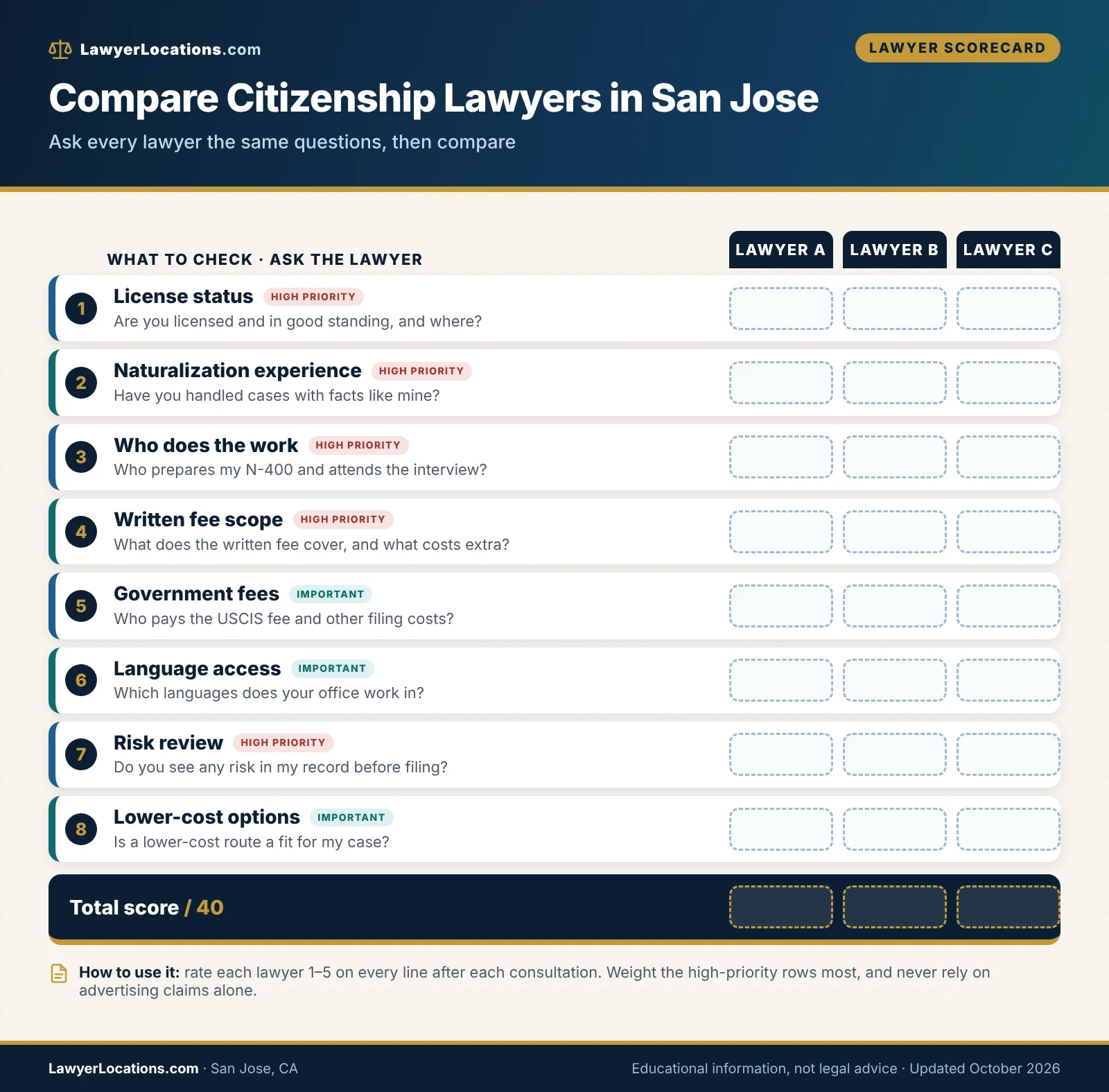
Text version of this graphic
| Criterion | Question to ask |
|---|---|
| License | Are you licensed and in good standing, and where? |
| Case fit | Have you handled naturalization cases with facts like mine? |
| Who does the work | Who prepares my N-400 and who attends the interview? |
| Written fee | What does the written fee cover and what is extra? |
| USCIS fees | Is the government fee separate from your fee? |
| Communication | How will you update me and how fast do you answer? |
| Risk review | Do you see any risk in my record before filing? |
| Alternatives | Is there a cheaper route that fits my case? |
Questions about fees and communication
Ask whether the fee is flat or hourly, what it includes, and what triggers extra charges. Ask who pays the government filing fee and the cost of translations, medical forms and certified records. Ask how the lawyer will communicate (portal, phone, email or text) and how quickly you should expect a reply.
A careful lawyer will tell you when you do not need one. If a consultation ends with an honest “this looks routine; here is how to file it yourself,” that is useful information, even if you hire no one.
Where to look in San Jose and Santa Clara County
The Bay Area has more referral and nonprofit options than most places, but each has limits. We list only what we could verify on official or organizational websites in October 2026, and we do not rank or endorse any of them.
Lawyer referral and legal-aid programs
The Santa Clara County Bar Association runs a Lawyer Referral Service, and the State Bar of California lists it among its certified referral services. The State Bar’s listing gives a mailing address of P.O. Box 26457, San Jose, CA 95159, a telephone number of 669-302-7803, and the website sccba.com/lawyer-referral-service, which includes an online referral request form. A referral service connects you with a private lawyer; it does not vouch for the outcome, and fees are set by the lawyer.
For free or low-cost help, the County of Santa Clara’s Office of Immigrant Relations (part of the Division of Equity and Social Justice) publishes a page of citizenship and naturalization providers for permanent residents. The county’s own legal-services page says that capacity for these organizations to take new clients varies and is not guaranteed, and it asks you to contact each organization to see if you are eligible.
| Organization | Phone listed by the county | Note |
|---|---|---|
| Amigos de Guadalupe Center for Justice and Empowerment (Legal Services) | (408) 341-6080 | Listed by the county |
| Asian Law Alliance | (408) 287-9710 | Listed by the county |
| Bay Area Legal Aid, San Jose office | (408) 283-3700 | San Jose office |
| Catholic Charities of Santa Clara County | San Jose (408) 468-0100; Gilroy (408) 842-4808 | Gilroy line listed for immigration legal services |
| Center for Employment Training (CET-ICP) | (408) 534-5451 | Listed by the county |
| Council on American-Islamic Relations (CAIR) | (408) 986-9874 | Listed by the county |
| International Rescue Committee, San Jose | (408) 277-0255 | San Jose office |
| Pars Equality Center | (408) 261-6405 | Listed by the county |
| Santa Clara University, Katharine and George Alexander Community Law Center | (408) 288-7030 | Listed by the county |
| Services, Immigrant Rights & Education Network (SIREN) | (408) 453-3003 | Listed by the county |
| Step Forward Foundation | (408) 915-8698 | Listed by the county |
| Immigration Institute of the Bay Area | Fremont (510) 894-3639; Redwood City (650) 780-7530 | Offices outside San Jose |
| Centro de Ayuda Legal para Inmigrantes (CALI) | (650) 938-4041 | Listed by the county |
| Community Legal Services in East Palo Alto | (650) 326-6440 | Listed by the county |
| Oasis Legal Services | (510) 666-6687 | Serves the LGBTQ+ community |
| LATINAN | (703) 839-5752 | Listed by the county |
Appearing on the county’s page tells you that the county lists the organization. It does not tell you that the group will take your case, what it charges, or whether the person you speak with is a lawyer or a DOJ-accredited representative. Ask all three questions on the first call, and confirm any phone number on the organization’s own website before you travel.
DOJ-recognized organizations
The Department of Justice’s Executive Office for Immigration Review (EOIR) publishes a roster of recognized organizations and accredited representatives, searchable by state and city. A roster listing shows that an organization is recognized. It does not tell you what services it offers this month, who is eligible, or whether it handles citizenship applications. Call first, ask whether an accredited representative handles N-400 cases, and ask whether there is a waiting list.
When you search the roster, filter for California and for the city you live in, then compare the results with what each organization says on its own website.
Prepare for the first conversation
Bring the right papers and a short list of questions, and the first conversation will be shorter, cheaper and more useful.
Documents to gather before you call
Your lawyer or representative will usually need your green card, passport, a list of trips abroad with dates, addresses for the last five years, employment history, and tax transcripts if you owe anything. Add marriage and divorce records, children’s birth certificates, and court records for any arrest, even a dismissed one. The checklist below shows the core items.
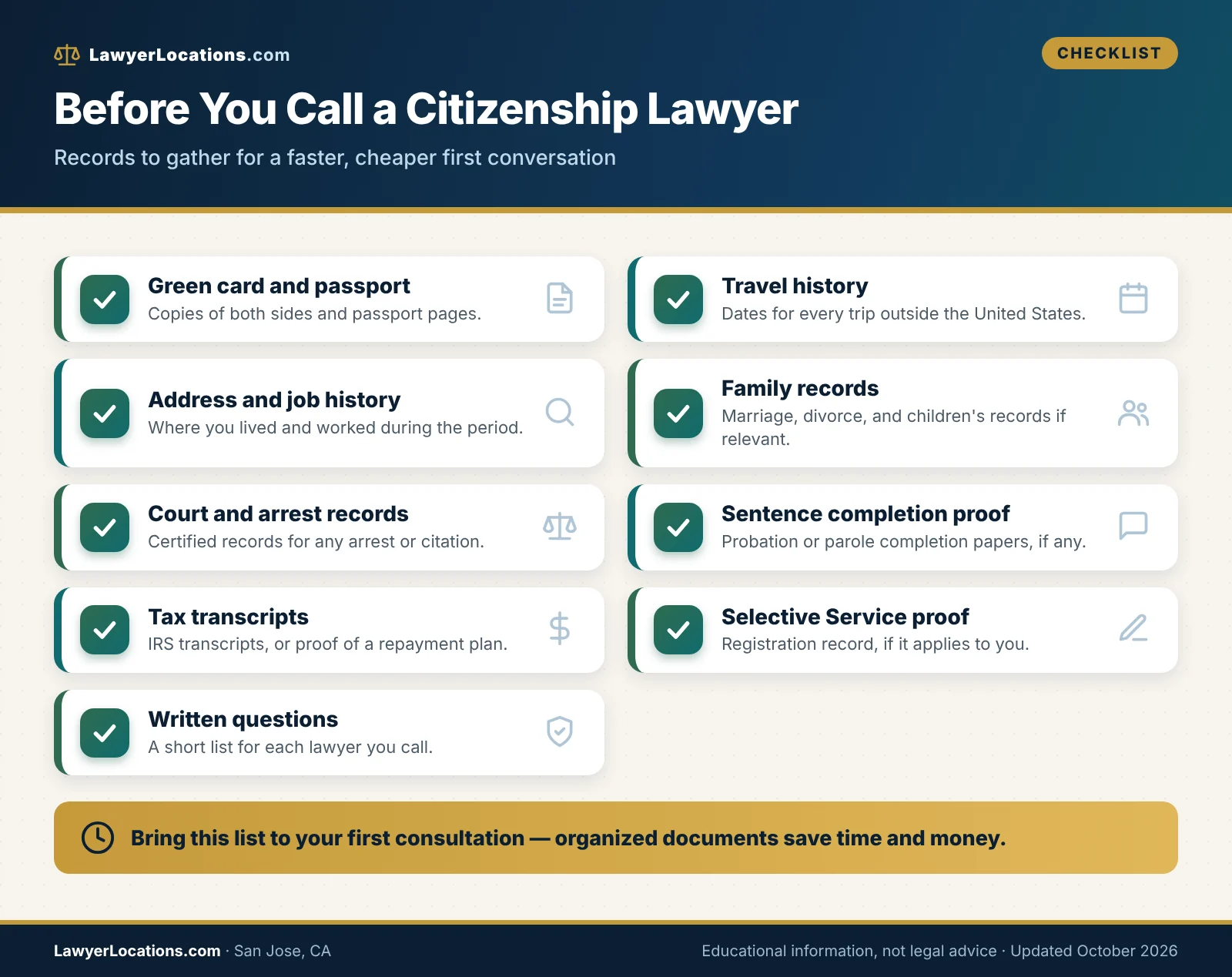
Text version of this graphic
- Green card (front and back) and passport pages
- Dates and lengths of every trip outside the United States
- Addresses and employers for the statutory period
- Marriage, divorce and children’s records, if relevant
- Court records for any arrest, citation or conviction
- Proof of probation or sentence completion
- Tax transcripts or proof of any repayment plan
- Selective Service registration, if it applies
- A written list of questions for the lawyer
Questions and facts to write down
Write a one-page timeline of when you became a permanent resident, where you lived, and any trips or legal events. Note anything you are unsure about. Share it honestly with whoever you consult, and ask each lawyer how they treat what you say in an initial conversation; reading this page does not create an attorney-client relationship.
Notario Fraud and California Protections
California has a dedicated statute for people who are paid to help with immigration paperwork but are not lawyers, and USCIS warns that “notario” offers are a common trap. Naturalization applicants are targeted because they are close to a valuable benefit and are often nervous about getting something wrong.
What California law says
The California Immigration Consultant Act sits in Chapter 19.5 of Division 8 of the Business and Professions Code, beginning at section 22440. It protects you whether the person is a storefront preparer, a travel agency, or someone who found you through social media.
The Immigration Consultant Act in plain language
The Act covers anyone who, for compensation, acts as an immigration consultant in California. Attorneys, and people authorized by federal law to represent clients before USCIS or the Board of Immigration Appeals, are exempt, as are certain nonprofit employees who help with forms for free or for a nominal fee. For everyone else, the Act limits the work to clerical tasks such as completing agency forms, translating a client’s answers, obtaining supporting documents and making referrals. A consultant may not advise you how to answer form questions or give legal advice.
Consultants covered by the Act must also meet several other requirements:
- File a $100,000 bond with the California Secretary of State and pass a background check.
- Give you a written contract before work begins, in English and in your native language, stating in boldface that the consultant is not an attorney and may not perform the legal services an attorney performs.
- Honor your right to cancel within 72 hours of signing.
- Give signed receipts, provide copies of completed forms and return your original documents.
- Avoid promising results without a factual basis or claiming special influence with government officials.
The Act expressly prohibits translating “notary public” into Spanish as “notario” with intent to mislead, and it requires advertisements to state clearly that the consultant is not an attorney. If an ad promises to “fix your papers” and calls the person a notario, treat that as a warning, not a credential.
Penalties and your remedies
The Act provides civil penalties that an injured person, the Attorney General, a district attorney or a city attorney can pursue, and it makes violations a misdemeanor with fines and possible jail time, with escalation for repeat violations. An injured client may also recover actual damages, or statutory damages if greater, plus attorney’s fees. The Act generally requires an action to be filed within four years of discovering the violation.
These are summaries, not a substitute for the statute. If you think you were harmed, a licensed lawyer or a consumer-protection office can tell you which remedy fits and how soon to act.
What a notary or consultant can and cannot do
The legal line between a licensed lawyer, an accredited representative, a consultant and a notary is easy to blur in a storefront. The comparison below shows the differences that matter to a naturalization applicant.
Who may do what with your N-400
| Type of helper | May give legal advice? | May appear for you at USCIS? | Key protection or check |
|---|---|---|---|
| Lawyer in good standing | Yes | Yes, by filing Form G-28 | Verify the license and discipline record with the licensing bar; get a written fee agreement |
| Accredited representative of a DOJ-recognized organization | Yes, within the organization’s recognition | Yes, by filing Form G-28 | Check the EOIR roster; ask about eligibility and waiting lists |
| Immigration consultant | No | No | Bond, written bilingual contract and 72-hour cancellation right under Bus. & Prof. Code 22440 et seq. |
| Notary public who is not a lawyer | No | No | A notary is not an attorney in the United States and cannot represent you in immigration matters |
USCIS makes the same point from the federal side: a notary public in the United States is not an attorney and cannot represent you in legal matters, including immigration cases.
What the federal side adds
Federal rules also limit who may charge for immigration help. USCIS’s legal-services page says that people who are not lawyers or accredited representatives may help with forms in only limited ways and may not give legal advice. A California consultant who follows the state Act is still not allowed to decide which immigration benefit you should seek or to review your answers for risk.
Notario público means a lawyer with special credentials in some Latin American countries. In the United States a notary public only verifies signatures and identity, and is not an attorney.
Warning signs and where to report
Fraud rarely looks like fraud on the first visit. It looks helpful, confident and cheap, which is exactly why a few specific questions can protect you.
Red flags to watch for
- The person calls themselves a “notario,” “immigration consultant” or “visa preparer” and cannot show a bar license or a DOJ accreditation.
- They promise approval, a fast result or a “special connection” at USCIS. USCIS warns about people who claim special connections to the government.
- They ask you to sign blank forms, or fill in answers you do not understand.
- They hold your original passport, green card or birth certificate.
- They want cash only, give no written agreement or give no receipt.
- They contact you through social media or a private message offering to “fix” your case.
Where to report a problem
USCIS says that if you suspect immigration fraud, you can report it to the Federal Trade Commission or your state consumer protection office. In California, the Immigration Consultant Act lets the Attorney General, a district attorney or a city attorney bring civil actions, so your county district attorney’s office is a natural place to ask about a local consultant. If the person is a lawyer, the State Bar of California handles complaints about lawyers.
Keep copies of every receipt, text message and form, and consider asking a licensed lawyer or accredited representative to review anything already filed.
Costs, Deadlines and Decision Points as of October 2026
As of October 2026, the USCIS fee for Form N-400 is $710 online or $760 on paper, with a $380 reduced fee and fee waivers available only on paper. A higher fee has been proposed but was not in effect when we last checked the official fee schedule, which was updated October 16, 2026. Lawyer fees are separate and vary, so we avoid quoting averages.
USCIS fees
The government fee is the one cost you cannot negotiate. It is also the one most likely to change, so check it again on the day you file.
Current fees
USCIS’s Fee Schedule (Form G-1055, edition 10/16/26) lists the fees currently in effect. The October 16, 2026 update added fiscal-year 2027 H.R. 1 fees for several other forms (Forms I-131, I-589, I-765, I-821 and I-941), but the N-400 entries show the amounts below.
| Form and purpose | Online | Paper | Notes |
|---|---|---|---|
| N-400, Application for Naturalization | $710 | $760 | Reduced fee and fee waiver cannot be filed online |
| N-400 reduced fee | Not available online | $380 | Household income not more than 400% of the Federal Poverty Guidelines, with documentation |
| N-400 fee waiver | Not available online | $0 | Certain applicants may qualify; see Form I-912 instructions |
| N-400, qualifying military service (INA 328/329) | $0 | $0 | Fee exemption for qualifying service |
| N-336, Request for a Hearing on a Denial | $780 | $830 | $0 for certain military applicants or with a fee waiver |
| N-600, Application for Certificate of Citizenship | $1,335 | $1,385 | Documents citizenship you already hold |
| N-565, Replacement Naturalization/Citizenship Document | $505 | $555 | $0 if the error was USCIS’s |
| N-470, Preserve Residence for Naturalization | $420 (general filing) | Only for certain work abroad | |
The fee schedule also says that if the fee is incorrect, the application will be rejected, and that cash can never be used to pay a filing fee, even at a USCIS office. For mailed filings it describes electronic payment options and an exemption process; check the current instructions on the day you mail.
A proposed increase that has not taken effect
On June 23, 2026, the Department of Homeland Security published a proposed rule, “Naturalization Application Fee Adjustments,” at 91 Fed. Reg. 37500 (docket USCIS-2026-0265). The proposal would raise the N-400 fee to $1,330 on paper or $1,280 online and would end the reduced fee and fee waivers for the N-400 and N-336, while keeping exemptions for current and former members of the armed forces. The comment period ended August 24, 2026, and a correction was published July 8, 2026.
A proposed rule is not law. When we checked in October 2026, the Federal Register listing showed the proposal and the correction but no final rule, and the USCIS fee schedule updated on October 16, 2026 still showed $710 and $760. A final rule could be published at any time, so confirm the fee on the USCIS fee page and in the Federal Register on the day you file.
Do not rush to file before you are eligible just to beat a possible fee change. USCIS’s early-filing rule allows filing only up to 90 days before the five-year mark, and an application filed too early can be denied with the money lost. Ask a lawyer or accredited representative to confirm your earliest filing date.
Reduced fee, fee waiver and other costs
Federal rules include two ways to pay less. Both require a paper filing and documents, and both are covered by the proposed rule above.
Reduced fee and fee waiver
The reduced fee is half of the paper fee for applicants whose household income is not more than 400 percent of the Federal Poverty Guidelines. You complete Part 10 of the N-400 and submit each household member’s most recent federal tax return, or pay stubs and similar income evidence if no return was filed. The fee waiver, requested on Form I-912 or in a written request, is available to applicants who show inability to pay by receiving a means-tested benefit, having household income at or below 150 percent of the guidelines, or facing extreme financial hardship. USCIS tells applicants at or below 150 percent not to request a reduced fee and to use the waiver instead, and not to file both requests.
USCIS says the evidence for a means-tested benefit must show that you, your spouse, your child living with you, or in some cases a parent or sibling currently receives that benefit. A document from the agency showing your name, the benefit and a current date is the kind of proof USCIS describes.
Other out-of-pocket costs
Beyond USCIS and attorney fees, applicants commonly pay for certified translations of foreign-language documents (USCIS requires a certified English translation), certified court records, IRS transcripts (which are free from the IRS), and a medical professional’s time for an N-648. Some applicants also pay for study materials, although USCIS offers free ones.
Ask every lawyer whether quoted fees include these items. A quote that looks cheap may add them later.
What lawyers charge for citizenship work
We did not find an official source for typical citizenship attorney fees in San Jose, so we do not quote averages. What can be said is how fees are commonly structured, what California requires in writing, and what to compare.
Common fee structures
Immigration lawyers often quote a flat fee for a defined scope, such as preparing and filing the N-400 and attending the interview. Others bill hourly, especially for complicated records problems, or offer a payment plan. A lawyer who promises a particular result in exchange for a fee deserves extra scrutiny, because no one can control a USCIS decision.
Get the arrangement in writing. A written agreement should name the services covered, the price, who pays USCIS and third-party costs, and what happens if USCIS requests more evidence, denies the case or reschedules.
California’s written fee agreement rule
California Business and Professions Code section 6148 requires a written fee agreement in cases not covered by the contingency-fee statute when it is reasonably foreseeable that the total expense to the client, including attorney fees, will exceed $1,000. The contract must state each basis for compensation (such as hourly rates or flat fees), the general type of legal work the attorney will perform, and each party’s responsibilities, and the attorney must give you a duplicate copy signed by both sides.
If a lawyer does not comply, the statute says the agreement is voidable at the client’s option, although the lawyer may still collect a reasonable fee. The statute lists exceptions, including emergency services, services of the same general kind previously rendered and paid for, and cases where the client knowingly waives the writing in writing after full disclosure. A naturalization case will often cross the $1,000 line once government and third-party costs are counted, so expect a written agreement and be cautious of a lawyer who offers none.
What a fee should cover
A clear scope usually includes an initial review of eligibility and records, preparing the application, assembling evidence, filing, tracking the case, and attending the interview. Ask separately about a request for evidence, an N-336 hearing request after a denial, and a federal lawsuit, which are usually outside a flat N-400 fee.
Ask each lawyer to list, in one sentence each, what is included, what is extra, and what would make the total change. Compare those sentences, not just the headline number.
Deadlines and decision points
Naturalization has fewer hard deadlines than many legal problems, but the ones it has are strict. The timeline below marks the points where a decision is most likely to matter.
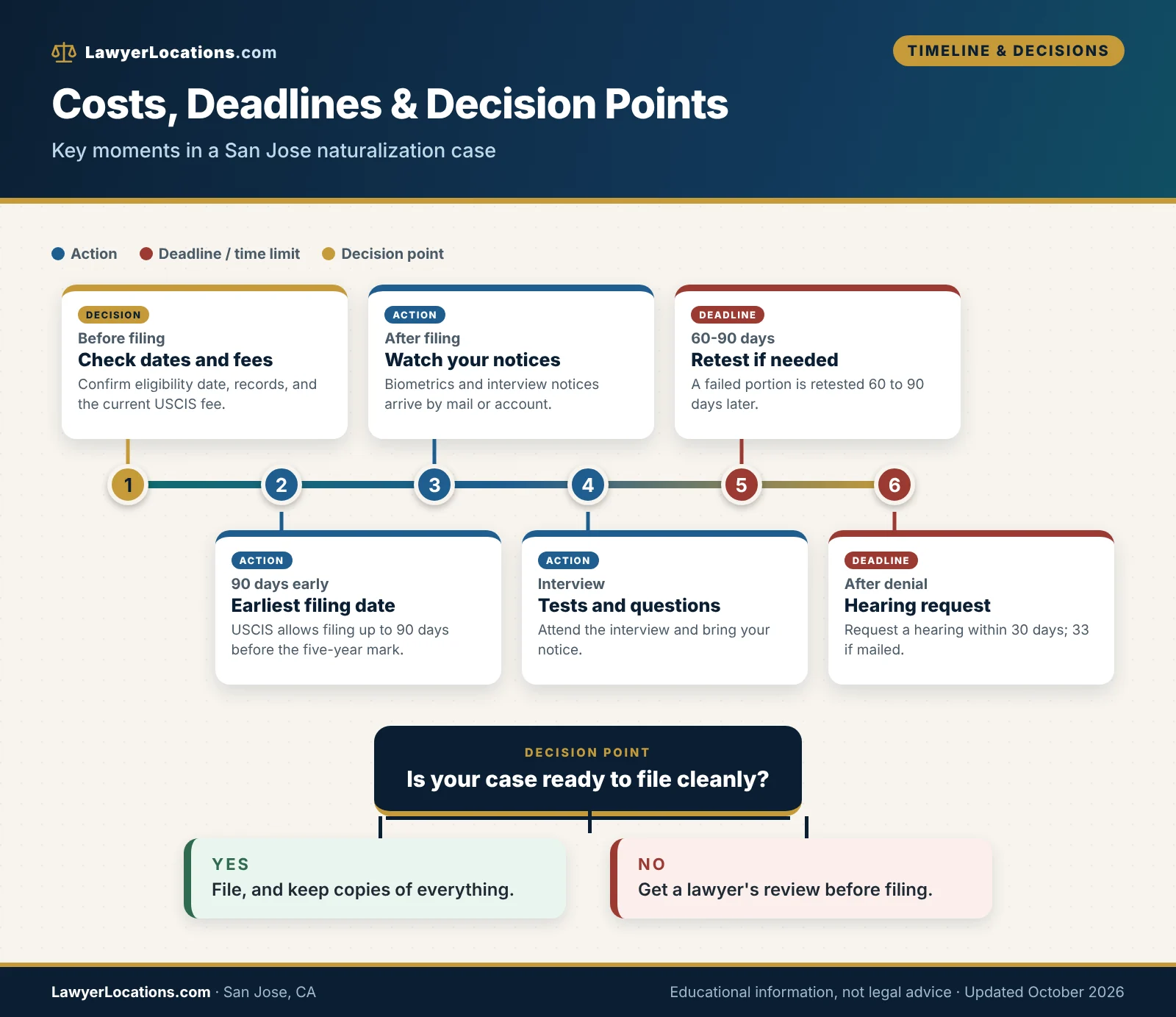
Text version of this graphic
- Before filing (decision): Check eligibility dates, records and the current USCIS fee.
- Up to 90 days before the five-year mark (action): Earliest allowed filing date.
- After filing (action): Receive a receipt notice, a biometrics notice and an interview notice.
- Interview (action): Take the tests and answer questions at the field office named on your notice.
- If a test portion is failed (deadline): Retest between 60 and 90 days after the first interview.
- If denied (deadline): Request a hearing within 30 calendar days, or 33 if the decision was mailed.
- Decision point: Ready to file cleanly? If yes, file and keep copies. If not, get a lawyer’s review first.
Dates that can change your options
USCIS says you should file Form N-336 within 30 calendar days of receiving a decision denying your N-400, or within 33 calendar days if the decision was mailed, and that a late request will generally be rejected without a refund. If USCIS does not decide an application within 120 days after the interview, 8 U.S.C. 1447(b) lets the applicant ask the U.S. district court for the district where they reside to decide the matter or send it back. For San Jose residents, that is the U.S. District Court for the Northern District of California, which sits in San Jose at the Peckham Federal Building. After a denial following an N-336 hearing, 8 U.S.C. 1421(c) allows review in the district court, where the court makes its own findings of fact and conclusions of law.
These are federal court options, so they usually call for a lawyer licensed to appear in federal court. If a denial arrives, ask questions immediately, because the 30-day clock starts when you receive the decision.
Deciding whether to file now or wait
The sensible question is not “how fast can I file?” but “am I ready to file a clean case?” If you are comfortably eligible, your record is simple and the USCIS fee is affordable, filing promptly is reasonable. If a trip, a tax problem, a pending charge or a family-history question could affect the case, waiting a few weeks for a professional review often costs less than losing a filing fee.
If the choice is hard, our guides to green card lawyers and visa lawyers explain how the earlier stages of the immigration journey are handled and may help you gather your older records. For a comparison with another large metro, see our guides for Harris County, TX and Atlanta, GA.
Next Steps for Choosing a Citizenship Lawyer in San Jose, CA
The shortest path to a good choice is to verify your eligibility dates, gather records, check licenses, and talk to at least two providers before you pay. That order protects your money and your application.
A practical order of operations
Use the lists below as a working plan. You can do the first four steps on your own, in a week or two, without paying anyone.
Before you pay anyone
- Confirm your dates. Write down your green card date, your trips abroad and your earliest possible filing date.
- Check whether you may already be a citizen. Review your parents’ citizenship and your own history.
- List any arrests, tax issues or support obligations. Collect the court and agency records.
- Verify the license. Use the State Bar of California’s attorney search, or the DOJ roster for an accredited representative.
- Escalate if the answers are complicated. If steps 2 or 3 turn up anything uncertain, move straight to a licensed lawyer rather than self-filing.
After you choose help
- Get the fee agreement in writing. Ask who pays the USCIS fee and other costs.
- Review every answer before it is filed. You sign the form under penalty of perjury, so you are responsible for it.
- Calendar the notices. Biometrics, interview and ceremony notices are time-sensitive and are mailed or posted to your USCIS account.
- Prepare for the tests. Study the civics questions for the version that applies to your filing date.
Quick answers to common questions
These short answers are for orientation. Your own facts may change the answer, and the cards below are in addition to the questions answered in the sections above.
Eligibility, tests and process
Do California or Santa Clara County rules change who can become a citizen?
No. Naturalization eligibility is set by federal law and applied by USCIS. San Jose and Santa Clara County change only the office, the federal court, the county records and the local help available to you.
Can I bring my lawyer to the interview?
Yes, if the lawyer files Form G-28. Since May 18, 2026, USCIS requires attorneys and accredited representatives to attend field-office interviews in person, with limited exceptions.
What happens if I fail the English or civics test?
USCIS gives two attempts. If you fail a portion at the first interview, you are retested on that portion between 60 and 90 days later.
Which civics test will I take?
It depends on your filing date. If you filed Form N-400 on or after October 20, 2025, you take the 2025 test (up to 20 questions, 12 correct to pass). Earlier filers take the 2008 test.
Can I file Form N-400 without a lawyer?
Yes. USCIS says you do not need a representative to file forms. A consultation is most valuable when you have an arrest, a long trip abroad, a tax problem or a family-history question.
Costs and getting help
How much does the N-400 cost in October 2026?
The fee schedule lists $710 online and $760 on paper, with a $380 reduced fee and a fee waiver available on paper only. A proposed increase had not taken effect when we checked.
Can I get free help with citizenship in San Jose?
Possibly. DOJ-recognized organizations and legal-aid groups in the Bay Area may help eligible applicants, but eligibility and capacity vary. Call first and ask whether an accredited representative handles N-400 cases.
Is an immigration consultant the same as a lawyer?
No. Under California’s Immigration Consultant Act, a consultant may do clerical work but may not give legal advice, and must follow bond, contract and advertising rules.
Does my lawyer have to be in San Jose?
Not necessarily. USCIS requires a lawyer in good standing with the bar of a U.S. state or territory. Local knowledge can help, but the license and the fit with your facts matter more.
What if USCIS denies my application?
You can request a hearing on Form N-336 within 30 calendar days of receiving the decision, or 33 if it was mailed. A lawyer can also explain whether reapplying or a federal court case makes sense.
Ready to compare your options?
Whether you are searching for a citizenship lawyer in San Jose, CA or weighing a free legal-aid route, start by confirming your dates and your license check, then ask two or three providers the same questions. LawyerLocations.com is a legal-education resource, not a law firm, and does not recommend a particular lawyer; use the scorecard and checklist above as your guide, and revisit our green card lawyer guide if your residence history needs a closer look.
General information only. This guide is general legal information, not legal advice, and reading it does not create an attorney-client relationship. LawyerLocations.com is a legal-education and lawyer-discovery resource, not a law firm, and does not recommend or rank any lawyer or organization. Immigration law, USCIS fees, policies and court rules change often. Confirm current requirements with USCIS and consult a lawyer licensed in the relevant jurisdiction, or a DOJ-accredited representative, about your own situation.
Sources & References
Show all 28 sources
- USCIS, “Form N-400, Application for Naturalization” (edition 01/20/25; filing options, reduced fee and fee waiver paper-only note) — U.S. Citizenship and Immigration Services — uscis.gov — accessed October 2026
- USCIS, “Additional Information on Filing a Reduced Fee Request” — U.S. Citizenship and Immigration Services — uscis.gov — accessed October 2026
- USCIS, “G-1055, Fee Schedule” (edition 10/16/26) — U.S. Citizenship and Immigration Services — uscis.gov — accessed October 2026
- Department of Homeland Security, “Naturalization Application Fee Adjustments,” 91 Fed. Reg. 37500 (June 23, 2026), proposed rule, docket USCIS-2026-0265 — Federal Register — federalregister.gov — accessed October 2026
- USCIS, “I-912, Request for Fee Waiver” — U.S. Citizenship and Immigration Services — uscis.gov — accessed October 2026
- USCIS, “I am a Lawful Permanent Resident of 5 Years” — U.S. Citizenship and Immigration Services — uscis.gov — accessed October 2026
- USCIS, “I am Married to a U.S. Citizen” — U.S. Citizenship and Immigration Services — uscis.gov — accessed October 2026
- USCIS, “I am the Child of a U.S. Citizen” — U.S. Citizenship and Immigration Services — uscis.gov — accessed October 2026
- USCIS, “10 Steps to Naturalization” — U.S. Citizenship and Immigration Services — uscis.gov — accessed October 2026
- USCIS, “The Naturalization Interview and Test” — U.S. Citizenship and Immigration Services — uscis.gov — accessed October 2026
- USCIS, “Study for the Test” (2008 and 2025 civics test details) — U.S. Citizenship and Immigration Services — uscis.gov — accessed October 2026
- USCIS, “Field Offices” (walk-in, arrival-time and rescheduling notes; in-person attorney requirement effective May 18, 2026) — U.S. Citizenship and Immigration Services — uscis.gov — accessed October 2026
- USCIS, “Application Support Center – San Jose, CA” — U.S. Citizenship and Immigration Services — uscis.gov — accessed October 2026
- USCIS Policy Manual, Vol. 12, Part D, Ch. 3, “Continuous Residence” — U.S. Citizenship and Immigration Services — uscis.gov — accessed October 2026
- USCIS Policy Manual, Vol. 12, Part D, Ch. 6, “Jurisdiction, Place of Residence, and Early Filing” — U.S. Citizenship and Immigration Services — uscis.gov — accessed October 2026
- USCIS Policy Manual, Vol. 12, Part F (good moral character; permanent and conditional bars) — U.S. Citizenship and Immigration Services — uscis.gov — accessed October 2026
- USCIS, Policy Memorandum PM-602-0188, “Restoring a Rigorous, Holistic, and Comprehensive Good Moral Character Evaluation Standard for Aliens Applying for Naturalization” (Aug. 15, 2025), and policy-memoranda status page — U.S. Citizenship and Immigration Services — uscis.gov — accessed October 2026
- USCIS, “N-336, Request for a Hearing on a Decision in Naturalization Proceedings” — U.S. Citizenship and Immigration Services — uscis.gov — accessed October 2026
- USCIS, “Legal Services” (who may represent you; notarios) — U.S. Citizenship and Immigration Services — uscis.gov — accessed October 2026
- 8 U.S.C. 1421, 1423, 1427 and 1447 (judicial review, English and civics, requirements of naturalization, hearings on denials) — Legal Information Institute, Cornell Law School — law.cornell.edu — accessed October 2026
- California Business and Professions Code, Division 8, Chapter 19.5, sections 22440-22448 (Immigration Consultants) — California Legislative Information — leginfo.legislature.ca.gov — accessed October 2026
- California Business and Professions Code section 6148 (written fee agreements) — Public.Law (California Codes) — california.public.law — accessed October 2026
- “Before Selecting an Attorney” (Check Attorney Profile; questions to ask) — State Bar of California — calbar.ca.gov — accessed October 2026
- “Find a San Francisco Bay Area Lawyer Referral Service” (certified referral services, including the Santa Clara County Bar Association LRS) — State Bar of California — calbar.ca.gov — accessed October 2026
- “Citizenship and Naturalization” legal-services providers and “OIR resources” — County of Santa Clara, Division of Equity and Social Justice, Office of Immigrant Relations — desj.santaclaracounty.gov — accessed October 2026
- Court Locations: San Jose (Robert F. Peckham Federal Building address; Clerk’s Office hours) — U.S. District Court, Northern District of California — canb.uscourts.gov — accessed October 2026
- QuickFacts: San Jose city, California (foreign-born persons; language other than English at home; 2020-2024 ACS) — U.S. Census Bureau — census.gov — accessed October 2026
- Recognition and Accreditation Rosters — U.S. Department of Justice, Executive Office for Immigration Review — justice.gov — accessed October 2026
Legal Disclaimer and Limitation of Liability
Informational and illustrative purposes only. This article was prepared by LawyerLocations.com solely on the basis of the information available to us at the time of writing. It is an illustrative, general overview. It is not a complete or authoritative statement of the law, and it has not been reviewed by a lawyer licensed in your state or county.
Not legal advice. Nothing in this article is legal, financial, tax or immigration advice, and reading it does not create an attorney-client relationship between you and LawyerLocations.com or any author, lawyer or firm mentioned. Laws, court rules, fees, filing deadlines and agency procedures differ by state, county and court, and they change often. Some details here may be simplified, incomplete or out of date, and time limits for legal claims can be short.
No warranty. We make no representation or warranty, express or implied, about the accuracy, completeness, timeliness or suitability of this content for your situation. Please do not rely on it to make, delay or skip any legal decision. Check the facts against official sources and speak with a licensed attorney in the relevant jurisdiction before you act.
Limitation of liability. To the fullest extent permitted by law, LawyerLocations.com and its owners, authors and contributors disclaim all liability for any loss, damage, cost or other consequence arising from the use of, or reliance on, this article, including any content on third-party websites we link to. Mentioning a lawyer, firm, organization or service is not an endorsement and is not a promise of any result. If you are in immediate danger, contact your local emergency number.