A prenup lawyer Arlington TX couples can hire helps you and your future spouse put in writing how property, debts, and support will be handled if the marriage ends or one of you dies. Texas treats these contracts as premarital agreements under Tex. Fam. Code ch. 4: they must be in writing, signed by both people before the wedding, and they only take effect once you marry.
This guide explains what Texas law lets a prenup do, what a court can refuse to enforce, how Tarrant County fits in, how Texas lawyers usually charge, and how to compare Arlington attorneys before you sign a fee agreement. It is general information, not advice about your situation.
How a Prenup Lawyer Case Works in Arlington, TX
A prenup lawyer drafts, negotiates, or reviews a written agreement between two people who plan to marry. The lawyer’s job is to make sure you understand what you are giving up and keeping, and to build the paper trail that helps the agreement hold up if it is ever challenged. In Arlington, the governing rules are Texas rules, and any later court dispute runs through Tarrant County.
Unlike a lawsuit, a prenup is a planning project with a wedding date attached. That deadline, not a court calendar, usually sets the pace. This section walks through what the work involves and how a typical engagement moves from first call to signing.
What a prenup lawyer does for you
People often picture a prenup as a form with blanks. In practice it is a custom contract, and the lawyer’s work is mostly conversation, financial sorting, and careful drafting. The two roles below cover most of what Arlington couples ask for.
Drafting and negotiating the agreement
If you are the person asking for the agreement, a lawyer turns your goals into enforceable language. That usually means listing what each person owns before marriage, deciding what will stay separate property, and spelling out what happens to income, homes, businesses, and debts during and after the marriage.
Drafting also covers the unglamorous details: how disputes will be resolved, which state’s law governs, and what happens if one person later wants to change the deal. A short, vague agreement can cause more fights than no agreement at all.
Reviewing an agreement your partner’s lawyer drafted
If your future spouse hands you a draft, you need your own lawyer, not a shared one. A reviewing attorney reads the agreement, explains it in plain language, points out what is missing, and proposes changes. You can sign without changes, but you should make that choice with full information.
A second lawyer also strengthens the agreement itself. As section 2 explains, Texas courts look at whether a person signed voluntarily and understood the other person’s finances. Independent advice is one of the clearest ways to show that.
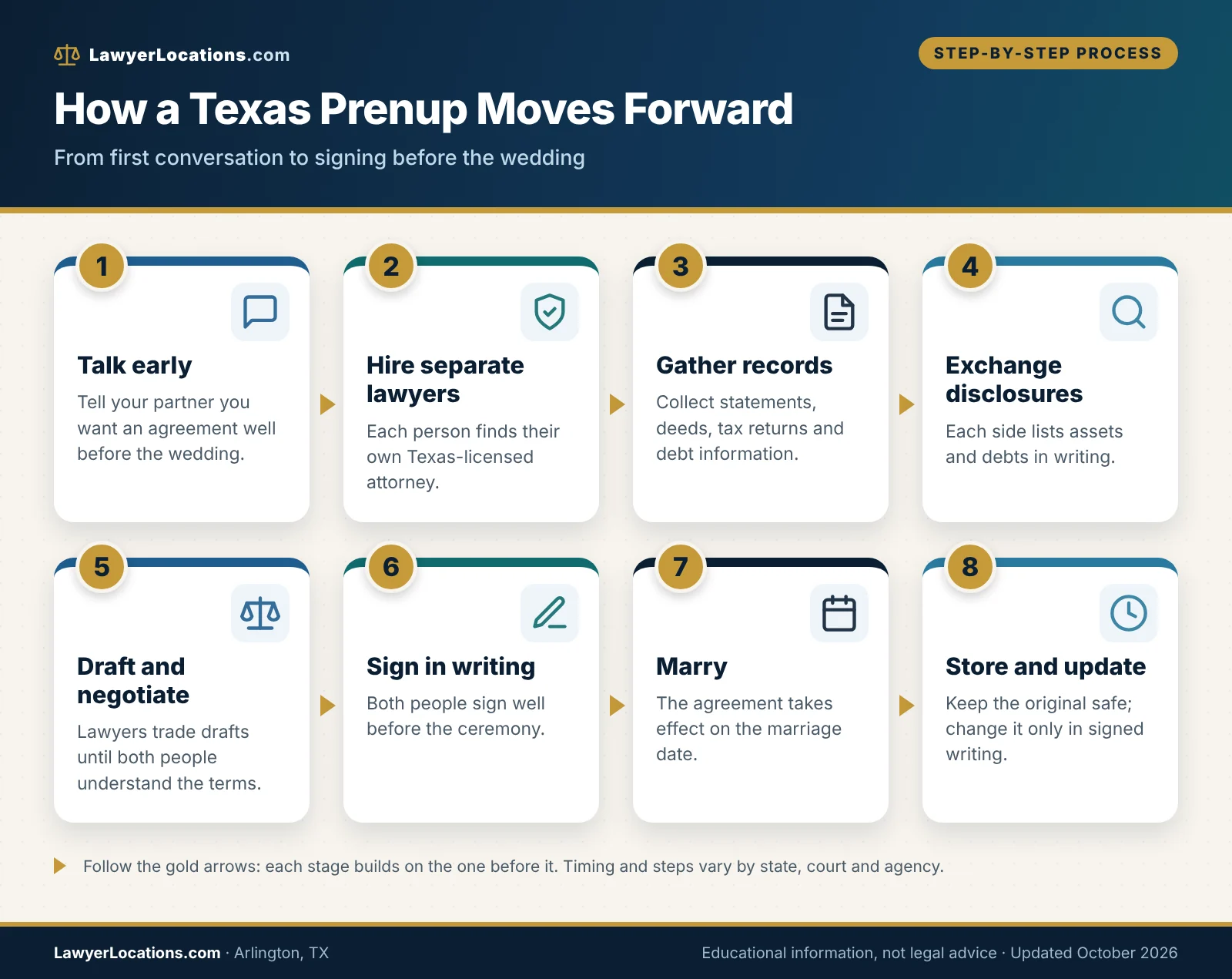
Text version of this graphic
- Decide you want an agreement and tell your partner early.
- Each person finds a separate lawyer licensed in Texas.
- Each person gathers financial records for a written disclosure.
- One lawyer drafts; the other reviews and proposes changes.
- Negotiate and revise until both people understand and accept the terms.
- Both people sign in writing, well before the wedding.
- Marry; the agreement takes effect on the marriage date.
- Store the signed original safely and update it only in writing.
From first call to signing: the usual steps
The order below is typical, not required. Some couples finish in a few weeks; complicated finances or a second marriage can stretch the process. The earlier you start, the more room you have to negotiate calmly.
Before the first meeting
Talk with your partner first. Surprising someone with a draft a few days before the wedding is the fastest way to create doubt about whether they signed freely. Agree on the basic idea of an agreement, who will hire which lawyer, and who is paying for what.
Then make a rough list of your assets, debts, income, business interests, expected inheritances, and any children from earlier relationships. You do not need exact numbers for a first consultation, but lawyers can give better guidance when they see the whole picture.
Disclosure, drafting, and negotiation
Each person typically prepares a written financial disclosure, often attached to the agreement as a schedule. Drafts then move back and forth between the two lawyers. Expect questions you have not thought about, such as what happens to a home one of you owns before marriage if the other helps pay the mortgage.
Do not rush the middle step. Negotiation is where misunderstandings get fixed. A signing that follows weeks of back-and-forth is far easier to defend than one that follows an all-night scramble.
Ask your lawyer for a written timeline that works backward from the wedding date. Mark the day the final draft should be in your hands, the day you sign, and a buffer in between. build in buffer days so a delayed document does not turn into a rushed signature.
Common situations that lead couples to a prenup
There is no single profile of a person who signs a prenup. Lawyers commonly hear the situations below, and each shapes the drafting differently.
Business owners, professionals, and people with inherited property
If one person owns a company or a share of one, the agreement can address how the business interest and its growth will be treated. Texas is a community property state, so income earned during marriage is presumptively shared, even if it comes from a business that started before the wedding. Careful drafting matters here because the line between separate and community property can blur over the years.
People expecting an inheritance or family land also ask for agreements. Property received by gift or inheritance is already separate under Texas law, but a prenup can add clarity about how it will be handled if it is mixed with marital funds.
Second marriages, children, and debt
When one or both people have children from earlier relationships, a prenup is often paired with updated wills and beneficiary designations so that property reaches the people each spouse intends. A prenup can also address who is responsible for pre-marriage debts such as student loans or business loans.
Keep in mind the limits discussed below: a prenup cannot reduce a child’s right to support, and it does not decide custody. Our guide to legal separation versus divorce explains how marital property questions look when a marriage actually ends.
Texas Law on Premarital Agreements
Texas premarital agreements are governed by chapter 4 of the Texas Family Code. The statute is short and practical: it says what form the agreement must take, what it may cover, and when a court can refuse to enforce it. Because this is state law, the same rules apply whether you live in Arlington, Houston, or El Paso.
The sections below follow the statute in the order most people need it. Statute numbers are given so you and your lawyer can read the current text on the Texas Legislature’s website.
What the statute requires to make a prenup valid
The formal requirements are simple, which is exactly why people trip over the unwritten ones. A signed piece of paper is necessary but does not by itself guarantee a court will enforce the deal.
Writing, signatures, and no need for “consideration”
Under Tex. Fam. Code § 4.002, a premarital agreement must be in writing and signed by both parties. The same section says the agreement is enforceable without consideration, which is the legal term for something of value exchanged. In everyday terms, the promise to marry and the mutual commitments are enough; you do not need to pay each other to make it binding.
An oral understanding, a text message exchange, or a promise made over dinner is not a premarital agreement in Texas. If you want protection, it needs to be a signed writing.
The agreement only works if the marriage happens
Section 4.001 describes a premarital agreement as an agreement between prospective spouses, made in contemplation of marriage, that is meant to be effective on marriage. Section 4.004 confirms that it becomes effective on marriage. If the wedding is called off, the agreement never takes effect.
That timing also tells you what a prenup is not. Once you are married, a new agreement about property is a different kind of document. Chapter 4 has separate provisions for agreements between spouses during the marriage, and a lawyer can explain which kind fits your situation.
A premarital agreement (prenup) is a contract between two people planning to marry that sets their property and financial rights in advance. A postmarital agreement is a contract between spouses already married. The two are governed by different parts of the Family Code.
What a Texas prenup can cover, and what it cannot
Texas law gives couples wide room to make their own financial rules. The limits are mostly about children and public policy.
Property, management, death, and support
§ 4.003 lists the subjects a premarital agreement may address. In summary, couples can contract about each person’s rights and obligations in any property; how property may be bought, sold, managed, and controlled; what happens to property on separation, divorce, or death; changing or eliminating spousal support; making wills or trusts to carry out the agreement; who receives life insurance death benefits; which state’s law governs the agreement; and other matters that do not violate public policy or a criminal statute.
In practice this means a Texas prenup can keep a business, a home, or an investment account as separate property, can set rules for how future earnings will be treated, and can limit or waive claims on the other person’s estate. Each of those choices has consequences, so ask your lawyer to walk through examples with real numbers from your situation.
Children: support is protected, custody is decided by the court
Section 4.003 states that a child’s right to support may not be adversely affected by a premarital agreement. A clause that tries to cap or waive child support is not a safe bet, and the court can disregard it when deciding support.
Custody and time with children are likewise decided by a judge based on the child’s best interest, not by agreement made before the wedding. A prenup that tries to fix custody ahead of time will not bind the court. Lawyers usually keep child-related terms out of the agreement for that reason.
If a lawyer or an online template promises that a prenup can “lock in” custody or waive child support, treat that as a warning sign. Texas protects a child’s right to support regardless of the prenup.
When a Texas court will not enforce a prenup
The most useful part of the statute for anyone about to sign is the part that explains how agreements fail. Section 4.006 puts the burden on the person trying to avoid the agreement. That person must prove one of the grounds below.
The agreement was not signed voluntarily
The first ground is that the person did not sign voluntarily. Courts look at the circumstances around signing: how much time the person had, whether they had their own lawyer, whether they understood what they were signing, and whether they felt pressured. Voluntariness is a fact question, which is why lawyers like a clear paper trail.
A signing the night before the wedding, with guests arriving and a deposit on the venue, invites a later argument that the pressure was too heavy. A calm schedule with documented review is much easier to defend.
Unconscionable terms combined with a lack of disclosure
The second ground has several parts that must be shown together. The person must prove the agreement was unconscionable when signed, meaning grossly one-sided, and also that before signing they were not given a fair and reasonable disclosure of the other person’s property and financial obligations, did not voluntarily and expressly waive that disclosure in writing, and did not have (and could not reasonably have had) adequate knowledge of the other person’s finances.
The practical lesson is that disclosure protects the agreement. An honest, reasonably complete schedule of assets and debts, attached to the signed agreement, makes the second ground much harder to prove.
Spousal support, public assistance, and who decides unconscionability
Section 4.006 also addresses a safety valve: if a provision limiting or eliminating spousal support would leave one spouse eligible for public assistance at separation or divorce, a court may require the other spouse to provide support to the extent needed to avoid that eligibility. It also says that whether an agreement is unconscionable is decided by the court as a matter of law, not by a jury.
Together, these points mean a prenup is strong but not absolute. Careful drafting and honest disclosure give it the best chance of being applied as written.
| Ground for challenge | What the challenger must show | What helps the agreement hold up |
|---|---|---|
| Not voluntary | The person did not sign the agreement voluntarily. | Early drafts, separate lawyers, adequate time, a record of questions asked and answered. |
| Unconscionable and no disclosure | Terms were unconscionable when signed, and the person had no fair disclosure, did not waive it in writing, and lacked adequate knowledge. | Written asset and debt schedules from both sides, attached to the agreement. |
| Spousal support causing public-assistance eligibility | A support limit would make a spouse eligible for public assistance. | Reasonable support terms; awareness that a court may step in on this narrow point. |
| Child support limits | A clause tries to reduce a child’s right to support. | Keeping child-related terms out of the agreement. |
Changing a prenup, and why Texas is a community property state
Two more pieces of Texas law shape how a prenup works over time: how it can be changed after the wedding, and what the default rules look like if there is no agreement.
Amending or revoking after the wedding
§ 4.005 says that after marriage a premarital agreement may be amended or revoked only by a written agreement signed by both spouses, and that the change needs no consideration either. Section 4.008 addresses time limits: the period for bringing an action to enforce the agreement is tolled, meaning paused, during the marriage, although equitable defenses based on delay may still apply.
The takeaway is practical. Keep the signed original and every amendment together, and revisit the agreement after major life events such as a business sale, an inheritance, or a child’s birth.
What happens without a prenup: community and separate property
Without an agreement, Texas applies its default marital property rules. § 3.001 defines separate property as what a spouse owned before marriage, plus property received during marriage as a gift or inheritance, plus certain personal injury recoveries. § 3.002 defines community property as everything else either spouse acquires during the marriage. Under § 3.003, property either spouse possesses when the marriage ends is presumed to be community property, and the spouse claiming something is separate must prove it by clear and convincing evidence.
If the marriage ends in divorce, a Texas court divides the community estate in a way the court considers just and right under § 7.001. That is not an automatic 50/50 split, and courts have discretion. A prenup replaces some of that uncertainty with rules you chose yourselves.
| Topic | Texas default without a prenup | What a prenup can do |
|---|---|---|
| Property owned before marriage | Separate property (§ 3.001). | Confirm it stays separate and address how growth and mixing with marital funds are treated. |
| Earnings during marriage | Community property (§ 3.002). | Agree that some or all earnings stay separate, within the limits of § 4.003. |
| Gifts and inheritances | Separate property (§ 3.001). | Add clarity about commingling and about how the property is managed. |
| Divorce division | Court makes a just and right division of the community estate (§ 7.001). | Set the division rules in advance, subject to enforcement limits. |
| Spousal support | Court-ordered maintenance is limited and governed by chapter 8. | Modify or eliminate support, subject to the public-assistance safety valve. |
| Child support | Set by the court under the child support guidelines. | Nothing that reduces the child’s right to support (§ 4.003). |
A prenup is the most common way couples opt out of the community property default, but it is not the only one. Texas also allows agreements between spouses during the marriage. A lawyer can explain which route fits your timing and goals.
Arlington and Tarrant County: Courts, Clerks and Local Help
Arlington sits in Tarrant County, so the courts and clerks that matter to an Arlington prenup are county offices, most of them in Fort Worth. The substantive Texas rules above are the same statewide. The points below are where an Arlington couple’s experience differs from one in Dallas or San Antonio: which court, which clerk, which local legal-help programs.
A prenup itself is a private contract and is not filed with a court when you sign it. Courts enter the picture in two situations: when a dispute arises later, usually inside a divorce, or when someone asks a judge to interpret or enforce the agreement.
Where prenup disputes are decided: Tarrant County courts
Texas divorces and most family cases are filed in district court. For Arlington residents, that means the Tarrant County district courts, with the court file kept by the Tarrant County District Clerk.
The Tarrant County District Clerk
The District Clerk’s website lists its address as 100 N. Calhoun St., Fort Worth, Texas 76196, general hours of Monday through Friday, 8 a.m. to 5 p.m., and a general phone number of 817-884-1574. The clerk also offers an online court document lookup for case records. Hours, locations, and online tools change, so confirm them on the clerk’s page before you travel.
Because the clerk’s office is in Fort Worth rather than Arlington, plan travel time if you need to inspect records in person. Most lawyers handle routine filings electronically, but you may still be asked to appear in court for key events.
Why the county matters for the agreement
If a divorce is later filed, the spouse who files must meet Texas residency rules under Tex. Fam. Code § 6.301: generally six months in Texas and 90 days in the county where the suit is filed. Section 6.702 adds a 60-day waiting period after filing before a divorce can be granted, with an exception for certain family-violence situations.
A prenup does not change these rules, but it can change what happens during the waiting period: the property terms may be settled by agreement instead of fought over. Our guide on how long a divorce takes covers the timing in more detail.
Getting married in Tarrant County: the marriage license and your signing date
Your prenup has to be signed before the wedding, and the wedding in turn requires a marriage license. Timing the two together prevents a last-minute squeeze.
The Tarrant County Clerk and marriage licenses
Marriage licenses in Texas are issued by the county clerk. The Tarrant County Clerk’s website has pages for marriage license requirements, fees, and office locations. Check those pages for current locations and hours, including whether an office near Arlington is available on the day you plan to go.
Texas law also builds a short waiting period between getting a license and holding the ceremony, with limited exceptions. Confirm the current rules with the county clerk when you apply, because exceptions and fees can change.
A sensible order of events
Lawyers who handle prenups generally want the agreement fully signed well before the license and ceremony, not squeezed between them. A calendar that finishes disclosure and drafting first, signing second, and license-and-wedding third leaves room for hiccups without raising the voluntariness issues discussed above.
There is no statutory deadline telling you when to start, but a prenup must be signed before the marriage takes place. After the wedding, the document is no longer a premarital agreement. Work backward from the date your marriage will happen, not from the date you sign the engagement paperwork. before the wedding
Free and low-cost help in Tarrant County
A private lawyer is not the only starting point. Several Tarrant County programs can answer first questions, point you to a referral, or tell you whether your situation fits a legal-aid program.
Legal aid, the law library, and bar association programs
The Tarrant County Law Library’s free and low-cost legal assistance page lists Legal Aid of NorthWest Texas (817-336-3943 for Fort Worth), which provides free civil legal help to eligible low-income residents. It also lists the Tarrant County Bar Association’s Lawyer Referral and Information Service and the association’s LegalLine, where volunteer attorneys answer questions by phone and slots are booked online for certain evenings.
Legal aid programs set priorities based on funding and need, and a premarital agreement may not fall within them. Calling to ask is free and can save you a wasted week.
Texas-wide self-help and the City of Arlington’s list
TexasLawHelp.org, a statewide self-help site run by legal aid organizations, publishes a directory that includes the Tarrant County Bar Association’s lawyer referral service and Legal Aid of NorthWest Texas. The City of Arlington’s City Attorney page titled “Useful Legal Services Contacts” also collects local referral numbers.
These resources are starting points. They do not replace a lawyer who is licensed in Texas and who is not also representing your future spouse.
| Resource | What it is | Useful for |
|---|---|---|
| Tarrant County District Clerk | Keeps district court files at 100 N. Calhoun St., Fort Worth; offers online document lookup. | Finding court records and learning how filings in a later divorce are handled. |
| Tarrant County Clerk | Issues marriage licenses and keeps vital records. | Marriage license requirements, fees, office locations. |
| Tarrant County Bar Association Lawyer Referral and Information Service | Bar-run referral program listed by the Tarrant County Law Library and TexasLawHelp. | Getting names of Texas-licensed lawyers who handle family matters. |
| Tarrant County Bar Association LegalLine | Volunteer attorneys answer questions by phone on scheduled evenings. | A short, general question before deciding whether to hire a lawyer. |
| Legal Aid of NorthWest Texas | Free civil legal help for eligible low-income residents; Fort Worth number 817-336-3943. | Asking whether your situation fits a program’s priorities. |
| Tarrant County Law Library | County library with a free and low-cost legal assistance page. | Finding forms, books, and referral information. |
How to Compare Prenup Lawyers in Arlington
Comparing prenup lawyers is mostly about three things: whether the lawyer is licensed and in good standing, whether they regularly handle marital property agreements, and whether you can work with them under a clear fee arrangement. Advertising slogans tell you very little. The questions below tell you much more.
LawyerLocations.com is a legal-education resource, not a law firm, and does not rate or recommend lawyers. The aim here is to give you a method you can use with any firm.
Verify the lawyer, then verify the fit
Start with the basics before you spend time on personality or price.
License, discipline history, and who will do the work
Confirm that the lawyer is licensed to practice in Texas and in good standing. The State Bar of Texas provides attorney profile pages that show license status and public disciplinary history. A lawyer licensed only in another state may not be authorized to advise you on Texas law or appear in Texas courts.
Ask who will actually draft and review your agreement. At many firms, a paralegal or associate prepares documents under a lawyer’s supervision, which is common and fine as long as you know it and the lawyer reviews the final product.
Experience with marital property agreements
A family lawyer who mostly handles divorces and custody may or may not draft prenups often. Ask how many premarital agreements the lawyer has handled recently and whether they regularly draft for the kind of assets you have, such as a closely held business, real estate, or inherited property. Do not ask for client names; ask about categories of work.
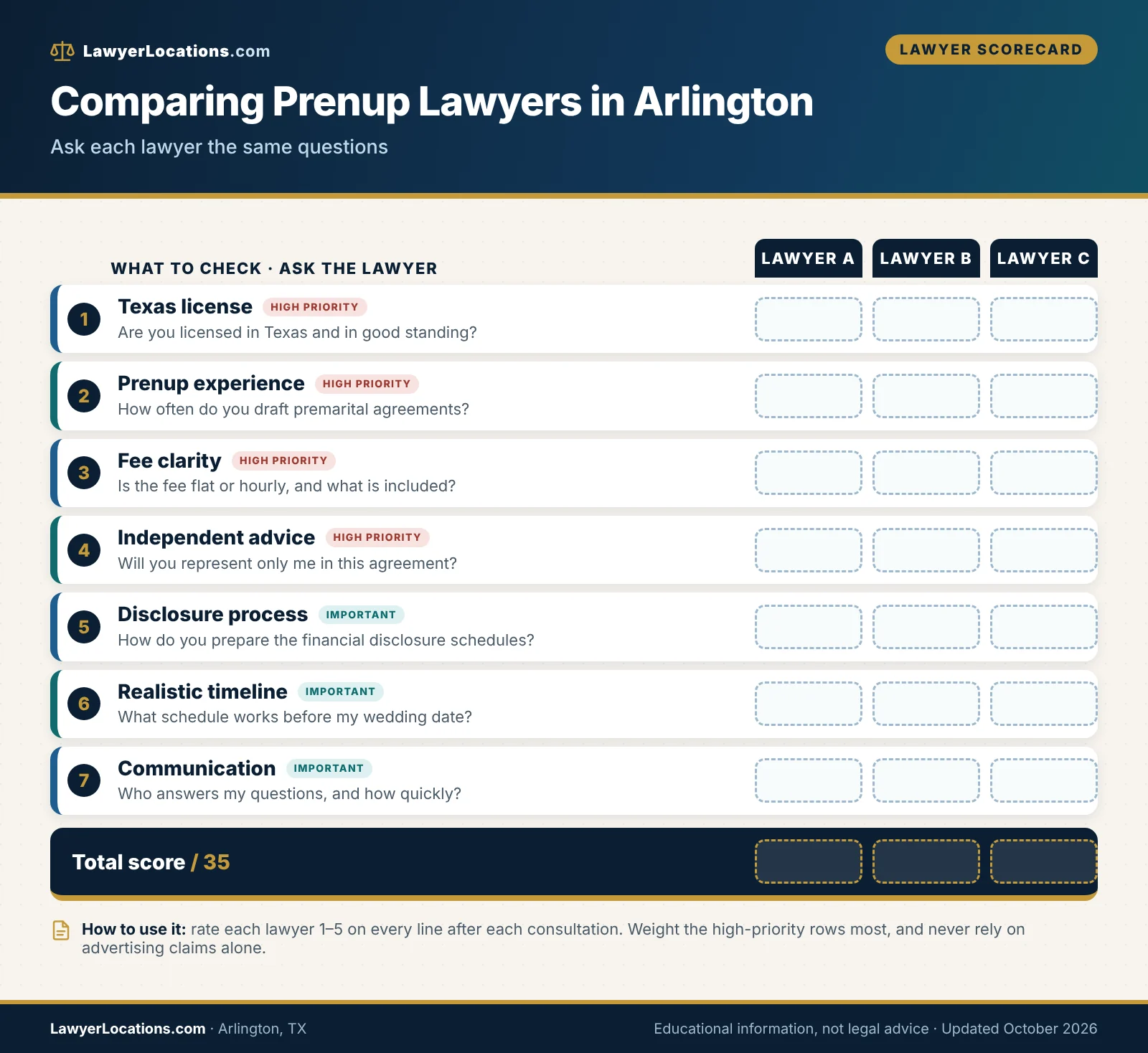
Text version of this graphic
| Criterion | Question to ask |
|---|---|
| Texas license | Are you licensed in Texas and in good standing? |
| Prenup experience | How often do you draft premarital agreements? |
| Fee clarity | Is the fee flat or hourly, and what is included? |
| Independence | Will you represent only me in this agreement? |
| Disclosure process | How do you handle the financial disclosure schedules? |
| Timeline | What is a realistic schedule before my wedding date? |
| Communication | Who answers my questions and how fast? |
One lawyer per person, and who pays the bill
This is the point most couples misunderstand. Many people assume they can save money by sharing one lawyer. For a prenup, that is a poor idea.
Why each person needs separate counsel
In a prenup the two people’s interests are, by nature, opposed: each is deciding what to give up. Lawyers are bound by conflict-of-interest rules that generally prevent one lawyer from representing both sides of a negotiation like this. Even where a lawyer might be allowed to act, a one-lawyer arrangement gives the weaker-informed spouse an obvious argument later that they were not properly advised.
Separate lawyers do more than satisfy the rules. They create evidence that each person received independent advice, which supports the voluntariness and disclosure points discussed in section 2.
When one partner pays for the other’s lawyer
Sometimes the higher-earning partner offers to pay the other’s legal fees. That can be a generous way to level the playing field, but the arrangement should be written down. The lawyer’s duty runs to the person they represent, not to whoever pays the invoice, and a good lawyer will say so up front.
If your partner is paying for your lawyer, ask the lawyer to explain in writing who the client is, who receives the advice, and whether the payer will have access to your communications. client = you
Questions to ask at the first consultation
Come with questions written down. A confident lawyer will welcome them. A lawyer who dodges basic questions about fees or process is telling you something about how the engagement will go.
Questions about process and timing
Ask what the lawyer needs from you, how disclosure schedules are prepared, how many drafts are typical, and how long the process usually takes. Ask what happens if the other side’s lawyer is slow and the wedding date is close. A lawyer with a realistic schedule is a better sign than one who promises everything by Friday.
Also ask how the lawyer would handle your top goal, whether that is protecting a business, preserving an inheritance, or keeping the agreement simple. You are testing for clear thinking, not for a guaranteed result.
Questions about fees and communication
Ask for the fee structure in writing: flat or hourly, retainer amount, what is included, what triggers extra charges, and how you will be billed. Ask how you reach the lawyer, who handles day-to-day questions, and what response time is realistic. Avoid anyone who will not put the basics on paper.
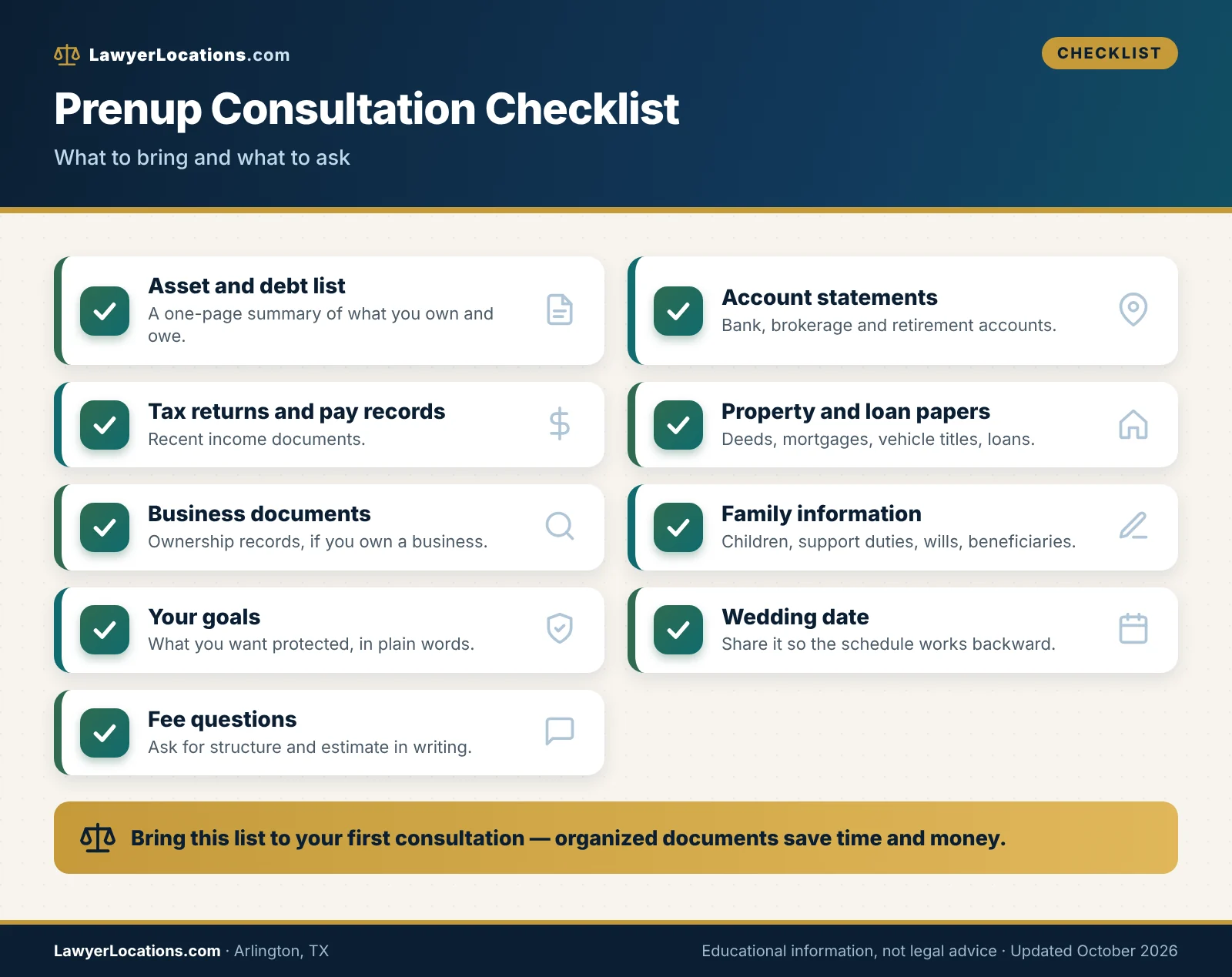
Text version of this graphic
- Your list of assets, debts, income, and business interests
- Recent tax returns and pay records
- Statements for bank, retirement, and investment accounts
- Property deeds, mortgage and loan statements
- Business ownership documents, if you own a business
- Information about children and support obligations
- Your goals and the points you will not compromise on
- Your wedding date and a rough timeline
- Questions about fees, communication, and next steps
Red flags when choosing a lawyer
Most prenup lawyers are careful professionals. These warning signs, though, are worth taking seriously.
Promises, pressure, and unclear fees
- A promise that the agreement is “airtight” or “guaranteed” to hold up. No lawyer can promise how a court will rule.
- Pressure to sign a fee agreement on the spot, or to skip separate counsel to save money.
- A refusal to explain the fee structure or to put it in writing.
- Advice that you do not need financial disclosure from your partner, or that you can leave out parts of your own finances.
A lawyer who raises these points is not looking out for the strength of your agreement.
Do-it-yourself templates and rushed timelines
Online forms can look cheaper, but a template does not know your assets, your children, or your plans, and it cannot give you the independent advice a court may look for. If you use a template as a starting point, have a Texas lawyer review it before signing.
Likewise, a lawyer willing to turn a draft around in two days before your wedding is a convenience for you but a risk for the agreement. Slow it down.
Be wary of any service that offers to match you with a lawyer but will not tell you who runs it, how it is paid, or which firms receive your details. Choose your lawyer yourself; do not let a lead-generation page choose for you.
Costs, Deadlines and Decision Points
What a prenup costs in Arlington depends on how complicated your finances are, how much negotiation is needed, and how the lawyer charges. This guide does not quote an average, because no official source publishes one for Arlington prenups, and any single number would mislead. What it can do is show you what drives the bill so you can ask the right questions.
Deadlines work differently here than in an injury or divorce case. The only hard calendar is the one you set: the agreement must be finished and signed before you marry.
How Texas prenup lawyers usually charge
Texas lawyers set their own fees, and several models are common for premarital work. Ask which one the lawyer uses and what it covers.
Flat fees, hourly rates, and limited-scope review
A flat fee covers a defined package, such as drafting an agreement from a client questionnaire and one round of revisions. An hourly arrangement bills for time spent, usually against a deposit. A limited-scope engagement covers only a specific task, such as reviewing a draft prepared by the other side’s lawyer.
Flat fees offer predictability but may exclude extra drafts or negotiation. Hourly billing fits uncertain or complex situations but can run up if the negotiation drags. Limited-scope review is often the practical choice for the person receiving a draft.
Retainers and the written fee agreement
Many lawyers ask for an upfront payment called a retainer, which is held and drawn against as work is done. Ask whether unused money is refunded and how often you will receive itemized statements.
The Texas Disciplinary Rules of Professional Conduct, Rule 1.04, require that fees not be unconscionable and that the basis or rate of the fee be communicated to a client, preferably in writing, when the lawyer has not regularly represented that client. Get the fee arrangement in writing, even if the lawyer does not insist.
| Fee structure | How it works | Best suited for | Question to ask |
|---|---|---|---|
| Flat fee | One price for a defined package of drafting and revisions. | Simple finances, cooperative couples, clear scope. | What is excluded, and what happens if we need more revisions? |
| Hourly with retainer | Lawyer bills time against a deposit. | Complex assets, businesses, or heavy negotiation. | What is the hourly rate, who bills time, and how often will I get statements? |
| Limited-scope review | Lawyer reviews and advises on a draft you received. | The person reviewing the other side’s draft. | Will you also negotiate changes, or only advise me? |
| Contingent fee | Fee depends on an outcome. | Rarely a fit for family or premarital matters. | Why is an outcome-based fee proposed for a contract I am signing? |
What drives the total cost
Two prenups for two couples can differ greatly in cost. The reasons are usually predictable.
Complexity of assets and the number of drafts
A couple with a few bank accounts and student loans needs a shorter schedule and less drafting than a couple with a business, rental property, and an expected inheritance. More assets mean more detail, more questions, and more time reviewing documents.
Each additional draft also adds to the cost. Clear instructions up front, and a willingness to decide quickly on open points, usually reduce the number of rounds.
Negotiation, a second lawyer, and unexpected add-ons
Two lawyers mean two sets of fees, even if one partner pays both. Budget for that. Heavy negotiation over a sticking point, such as how to treat the growth of a business, raises the bill for both sides.
Ask whether related work, such as updating your will or beneficiary designations, is included or billed separately. A prenup rarely stands alone.
Two Arlington couples both plan to marry in the spring. Couple A has modest savings and no business interests. Couple B includes one partner who co-owns a company and expects family land. Couple B’s lawyers will likely spend more time on disclosure schedules and on how business growth is treated, so the work and the bill will probably be larger. The legal rules are identical; the facts are different.
Timeline, deadlines, and decision points
Because there is no court calendar, the planning calendar is yours. The aim is to finish with room to spare and without pressure.
Working backward from the wedding date
Many couples benefit from starting months ahead of the ceremony. The earlier stages are conversation, finding lawyers, and gathering records. The middle stages are drafting and negotiation. The final stage is a signing that happens well before the license and ceremony.
There is no magic number of weeks that makes an agreement valid. The point is to leave enough time that both people can say truthfully they understood what they signed and had a fair chance to ask questions and request changes.
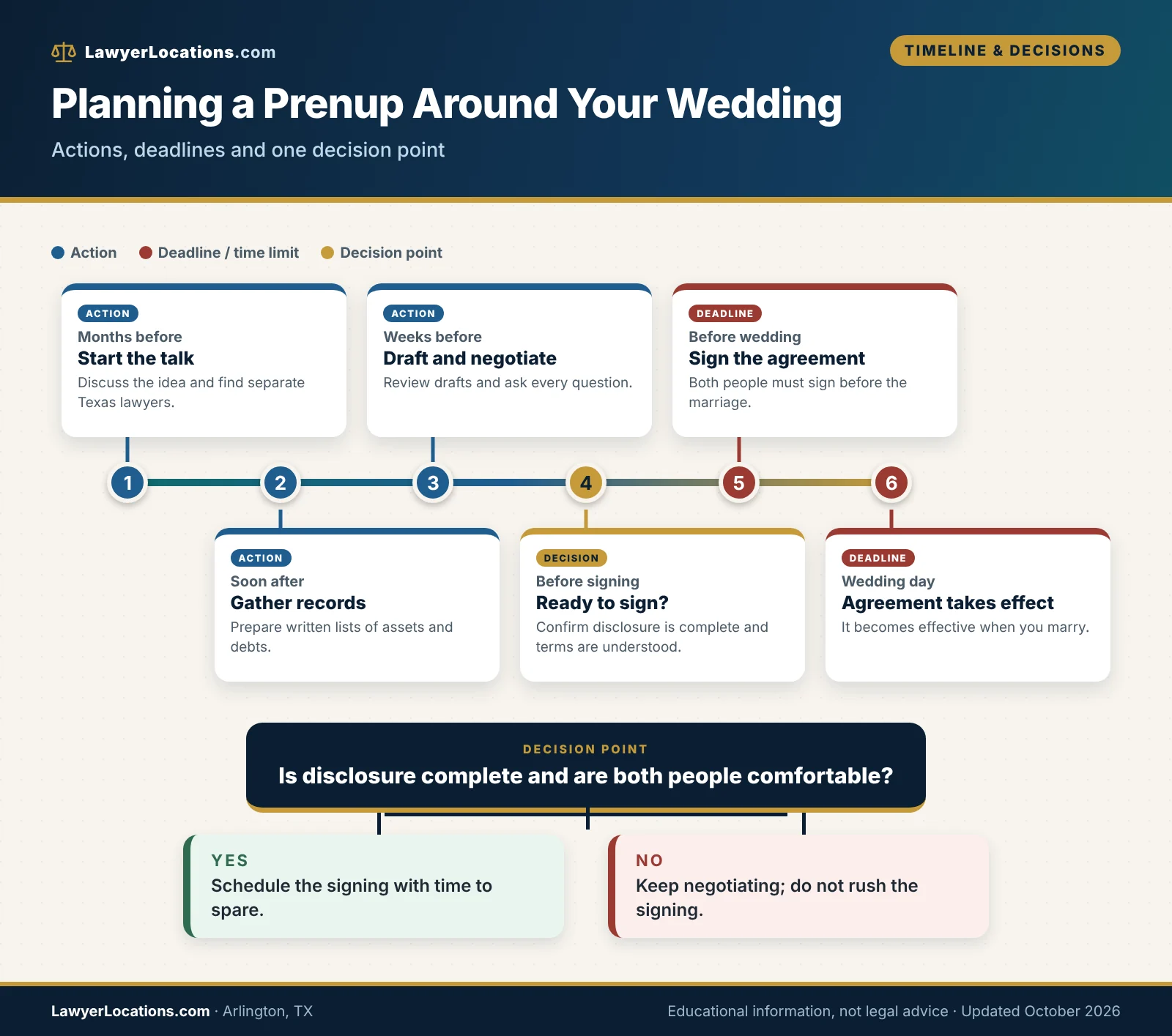
Text version of this graphic
- Months before the wedding (action): Talk with your partner; each person finds a Texas-licensed lawyer.
- Soon after (action): Gather records and prepare a written disclosure of assets and debts.
- Weeks before (action): Draft, review, and negotiate; ask every question you have.
- Decision point: Is the disclosure complete and does each person understand and accept the terms? If yes, schedule the signing. If no, keep negotiating or move the signing; do not rush.
- Well before the wedding (deadline): Both people sign; the agreement must be signed before the marriage.
- Wedding date (deadline): The agreement takes effect on marriage.
- After the wedding (action): Store the original safely; amend only in writing signed by both spouses.
The legal deadlines that do exist
The statute gives you no deadline to start, but a few time-related rules matter. The agreement must be signed before the marriage (§ 4.002, § 4.004). After the wedding, changes require a signed written agreement (§ 4.005). And the time to bring an action to enforce the agreement is tolled during the marriage (§ 4.008), though equitable defenses about delay may still be available.
If a divorce is ever filed, the residency and waiting-period rules under § 6.301 and § 6.702, discussed in section 3, set the earliest timing.
Costs after the wedding: updates and enforcement
Signing the agreement is not always the last time you will need a lawyer for it. Planning for later costs avoids surprises.
Updating the agreement as life changes
If your finances change substantially, you may want to amend the prenup. Amendments must be written and signed by both spouses under § 4.005. Ask your lawyer whether they charge for a review when major events occur.
When a prenup is challenged in court
Enforcing or contesting a prenup is part of a divorce case, and divorce litigation can be expensive. A thorough agreement with strong disclosure often reduces the chance of a fight and, if there is one, the cost of resolving it. That is the main financial argument for careful work up front.
You do not have to figure out all costs at the first call. Ask for a written estimate of the range for your situation, what could push it higher, and when you would be told if it is heading higher. ask for an estimate in writing
Documents, Mistakes, Next Steps and Common Questions
Most prenup problems come from the same few causes: too little time, incomplete disclosure, and unclear drafting. This section lists the documents to gather, the mistakes that cause trouble, and a simple plan for the first week.
Documents to gather before you meet a lawyer
You do not need everything for a first consultation, but the more complete your records, the faster the lawyer can give useful advice.
Financial records and a written asset list
- Recent bank, brokerage, and retirement account statements
- Recent pay records and tax returns
- Deeds, mortgage statements, and vehicle titles
- Loan, credit card, and student debt statements
- Business formation documents and ownership records, if applicable
- Information about any expected inheritance, trust interest, or family property
Prepare a one-page list of what you own and owe. This list becomes the starting point for the disclosure schedule that supports the agreement.
Personal and family information
Gather basic information about children from earlier relationships, any child support or alimony obligations, and existing wills or beneficiary designations. Also write down your goals in plain words, for example “keep my business separate” or “make sure my children inherit my house.”
Finally, note your wedding date and the date you want signing to be finished.
Mistakes that can weaken a prenup
None of these mistakes is rare. All are avoidable.
Rushing and pressure
Waiting until a few days before the wedding to raise the idea, or presenting a long draft with a “sign it or the wedding is off” ultimatum, invites a later argument that the signature was not voluntary. If you feel pressured, say so to your lawyer. If pressure comes with threats, intimidation, or controlling behavior, our guide to domestic violence lawyers explains where to look for help.
Slow, documented, respectful negotiation protects the agreement and the relationship.
Incomplete disclosure, vague drafting, and loose ends
Leaving assets or debts off the schedule undermines the disclosure that supports the agreement. Vague terms, such as “reasonable” payments with no definition, leave room for later disputes.
Also remember related documents. Wills, trusts, and beneficiary designations on life insurance and retirement accounts should line up with the prenup. Some employer retirement plans are governed by federal law and have their own spousal-consent forms, and a prenup signed before the wedding may not, by itself, waive a spouse’s rights under those plans. Ask your lawyer how to handle them.
Do not hide assets or debts. A prenup is only as strong as the honesty behind it, and gaps in disclosure are one of the main ways a Texas agreement gets attacked under § 4.006.
Next steps and short answers to common questions
You do not need to solve everything at once. A short plan for the first week gets the process moving.
A simple first-week plan
- Talk with your partner. Agree on the idea, the timeline, and that each of you will have your own lawyer.
- Check licenses. Look up each lawyer you are considering on the State Bar of Texas website.
- Request fee terms in writing. Ask for the structure, retainer, and what is included.
- Gather your records. Use the checklist above.
- Book consultations. Prepare your questions and bring your asset list.
- Set a calendar. Work backward from your wedding date and leave a buffer.
Answers to common questions about prenups in Arlington
The questions below come up often. Each answer is general; a Texas lawyer can apply them to your facts. If you or your partner are moving from another state, our guides to prenup lawyers in Chicago, Miami-Dade County, and Los Angeles show how other states handle the same questions, and our guide to family law attorneys in Dallas covers a neighboring market.
How much does a prenup lawyer cost in Arlington, TX?
There is no official average. Cost depends on the fee model, the complexity of your assets, and how many drafts and negotiation rounds are needed. Ask for the fee structure and a written estimate for your situation, and remember that each partner needs their own lawyer.
Do we each need our own lawyer?
Strongly yes. Conflict-of-interest rules generally keep one lawyer from representing both sides, and separate counsel helps show each person understood the agreement and signed voluntarily.
Can we sign a prenup after we are married?
Not as a premarital agreement. A prenup must be signed before the marriage and takes effect on marriage. Spouses who want to change their property rights during the marriage can ask a lawyer about agreements between spouses, which Texas law treats separately.
Does a Texas prenup have to be notarized?
Section 4.002 requires a writing signed by both parties and does not mention notarization. Many lawyers still have signatures notarized as a precaution, so ask your lawyer what they recommend.
Can a prenup decide child support or custody?
No. Section 4.003 says a child’s right to support may not be adversely affected by a premarital agreement, and custody is decided by a judge based on the child’s best interest.
What if my partner did not disclose all their assets?
Lack of fair disclosure is one of the grounds in § 4.006, combined with unconscionable terms and lack of knowledge. Whether it applies depends on the facts, so talk with a Texas lawyer promptly.
How early should we start?
As early as you can. There is no statutory minimum, but starting months before the wedding leaves room for disclosure, drafting, and negotiation without pressure.
Can we change the prenup after the wedding?
Yes, but only through a written agreement signed by both spouses under § 4.005. Informal understandings do not amend the document.
Is a prenup only for wealthy couples?
No. People with debt, business interests, children from earlier relationships, or expected inheritances all use them. The question is whether the Texas default rules fit your plans.
Where would a divorce involving our prenup be filed?
For Arlington residents, ordinarily in a Tarrant County district court, with records kept by the Tarrant County District Clerk in Fort Worth. Residency rules in § 6.301 apply.
What happens if we move out of Texas?
The agreement can choose which state’s law governs it (§ 4.003), but a court in another state may apply its own rules. If you expect to move, ask your lawyer about how the agreement should be drafted.
Can I get free help with a prenup in Tarrant County?
Possibly for first questions. The Tarrant County Bar Association’s LegalLine and Legal Aid of NorthWest Texas are listed by the Tarrant County Law Library, though legal aid priorities may not include premarital agreements.
Ready to compare your options?
Pick two Texas-licensed lawyers to interview, bring your asset list and your questions, and ask each for fee terms in writing. A calm first conversation now is worth more than a rushed signature later. Reading this guide does not create an attorney-client relationship, and LawyerLocations.com does not recommend any lawyer.
General information only. This article is provided for general educational purposes and is not legal advice. Reading it does not create an attorney-client relationship with LawyerLocations.com or any lawyer, and LawyerLocations.com is not a law firm. Laws, court rules, fees, and agency procedures change and depend on your facts; consult a lawyer licensed in Texas about your situation, and verify deadlines and procedures with the court or agency involved.
Sources & References
Show all 11 sources
- Texas Family Code, chapter 4 (Premarital and Marital Property Agreements) — Texas Legislature (Texas Constitution and Statutes) — tcss.legis.texas.gov — accessed October 2026
- Texas Family Code, chapter 4 (full text, Word version) — Texas Legislature — statutes.capitol.texas.gov — accessed October 2026
- Tex. Fam. Code § 4.006 (Enforcement of premarital agreement) — Public.Law (Texas statutes) — texas.public.law — accessed October 2026
- Texas Family Code, chapters 3, 6 and 7 (marital property, dissolution, division of property) — Texas Legislature — statutes.capitol.texas.gov — accessed October 2026
- Texas Disciplinary Rules of Professional Conduct, Rule 1.04 (Fees) — University of Houston Law Center ethics library — law.uh.edu — accessed October 2026
- District Clerk (civil and tax division, address, hours, document lookup) — Tarrant County — tarrantcountytx.gov — accessed October 2026
- Marriage Licenses: locations — Tarrant County Clerk — tarrantcountytx.gov — accessed October 2026
- Free/Low Cost Legal Assistance — Tarrant County Law Library — tarrantcountytx.gov — accessed October 2026
- Tarrant County Bar Association Lawyer Referral Service — TexasLawHelp.org — texaslawhelp.org — accessed October 2026
- Legal Aid of NorthWest Texas — TexasLawHelp.org — texaslawhelp.org — accessed October 2026
- Useful Legal Services Contacts — City of Arlington City Attorney — arlingtontx.gov — accessed October 2026
Legal Disclaimer and Limitation of Liability
Informational and illustrative purposes only. This article was prepared by LawyerLocations.com solely on the basis of the information available to us at the time of writing. It is an illustrative, general overview. It is not a complete or authoritative statement of the law, and it has not been reviewed by a lawyer licensed in your state or county.
Not legal advice. Nothing in this article is legal, financial, tax or immigration advice, and reading it does not create an attorney-client relationship between you and LawyerLocations.com or any author, lawyer or firm mentioned. Laws, court rules, fees, filing deadlines and agency procedures differ by state, county and court, and they change often. Some details here may be simplified, incomplete or out of date, and time limits for legal claims can be short.
No warranty. We make no representation or warranty, express or implied, about the accuracy, completeness, timeliness or suitability of this content for your situation. Please do not rely on it to make, delay or skip any legal decision. Check the facts against official sources and speak with a licensed attorney in the relevant jurisdiction before you act.
Limitation of liability. To the fullest extent permitted by law, LawyerLocations.com and its owners, authors and contributors disclaim all liability for any loss, damage, cost or other consequence arising from the use of, or reliance on, this article, including any content on third-party websites we link to. Mentioning a lawyer, firm, organization or service is not an endorsement and is not a promise of any result. If you are in immediate danger, contact your local emergency number.