
If you are searching for a drug crime lawyer Atlanta GA, start with two facts: the exact charge and the court that will hear it. Drug cases in Atlanta are governed by Georgia’s Controlled Substances Act, with felonies heard in Fulton County Superior Court, misdemeanors in the State Court of Fulton County, and small-amount marijuana tickets in Atlanta Municipal Court.
This guide explains possession, intent to distribute and trafficking charges, first-offender and diversion options, record relief under Georgia’s July 1, 2026 first-offender changes, and how to compare lawyers and fee structures. It is general legal information, not advice, and it does not rank or recommend any lawyer.
Which Law, Court and Prosecutor Handle a Drug Case in Atlanta
Atlanta drug cases are built on state law but can land in three different courts depending on the charge. The Georgia Controlled Substances Act sets the offenses and penalties, the Fulton County courts decide most cases, and a separate City of Atlanta ordinance covers small amounts of marijuana.
Georgia law sets the charges, and Atlanta adds one important layer
The Georgia Controlled Substances Act applies in Atlanta
Drug crimes in Georgia are defined in the state’s Controlled Substances Act, found in O.C.G.A. Title 16, Chapter 13. The core offense statutes are § 16-13-30 (possession, distribution and possession with intent to distribute) and § 16-13-31 (trafficking). The schedule, the type of drug and often the weight decide the penalty range. The same offense carries the same statutory range anywhere in Georgia; what differs locally is who prosecutes, which judge hears the case, and which programs are available.
Atlanta’s marijuana ordinance: what it does and does not do
In October 2017 the Atlanta City Council approved an ordinance reducing the penalty for possessing less than one ounce of marijuana inside the city limits, and the mayor signed it on October 10, 2017. As reported at the time, the municipal judge’s penalty became a $75 fine with no jail time, replacing a penalty of up to six months in jail and a fine of up to $1,000.
The ordinance did not legalize marijuana. News reports explained that it affects the Municipal Court of Atlanta, that Georgia’s state law still applies, and that officers can choose which law to enforce. State law treats possession of one ounce or less as a misdemeanor and more than one ounce as a felony. So the city’s fine may not be the whole story if an officer files a state charge or the amount is larger.
The ordinance covers possession inside Atlanta city limits only. It does not touch sales, larger amounts or other drugs. A city citation and a state charge go to different courts, so ask any lawyer which one you actually received.
Which court hears an Atlanta drug case
Fulton County Superior Court handles felony drug cases
Felony drug charges, including possession of more than an ounce of marijuana, possession of most hard drugs, intent to distribute and trafficking, are heard by the Fulton County Superior Court in the Atlanta Judicial Circuit. Fulton County’s website lists 20 judges elected by county voters and a courthouse at 136 Pryor Street SW, Suite C-640, Atlanta, GA 30303. The Fulton County District Attorney’s Office prosecutes felonies and has a division for pre-indictment diversion and records restriction.
State Court, Magistrate Court and the Atlanta Municipal Court
Lower-level cases go elsewhere. The State Court of Fulton County handles criminal cases below the grade of felony, such as misdemeanors and traffic citations. The Fulton County Solicitor General’s Office prosecutes them by filing a formal accusation with the clerk, and the county lists the court at 185 Central Avenue SW. The county’s page does not mention drug offenses specifically, so ask your lawyer where your misdemeanor will be heard.
The Municipal Court of Atlanta hears city ordinance violations and limited misdemeanors inside the city limits, which is where a $75 marijuana ordinance citation would go. A law-firm guide lists its address as 150 Garnett Street SW; confirm the location and clerk hours with the court. A small part of the city lies in DeKalb County, so an arrest there may be handled by DeKalb courts.
| Type of matter | Where it is typically heard | Who prosecutes |
|---|---|---|
| Felony drug charge (larger amounts, intent to distribute, trafficking) | Fulton County Superior Court | Fulton County District Attorney’s Office |
| Misdemeanor drug charge under state law | State Court of Fulton County (confirm for your charge) | Fulton County Solicitor General’s Office |
| Marijuana under one ounce charged under the city ordinance | Municipal Court of Atlanta | City of Atlanta prosecutor (confirm in your paperwork) |
| Drug court, mental health court or veterans court | Fulton County accountability courts | Referral involves the State and defense counsel |
Write down the case number, court name and next date from every paper you receive. court name + case number + date
How a Drug Case Moves Through Fulton County
A felony drug case in Atlanta usually moves from arrest and booking, to a first appearance and bond, to a charging document and arraignment in Fulton County Superior Court, then to discovery, motions, negotiation and either a plea or a trial. Misdemeanors follow a shorter version of the same path. The timing of each step varies, so treat the order below as a guide rather than a schedule.
From the stop to the first court appearance
The encounter: stop, search, arrest and booking
Most drug cases begin with a traffic stop, a patrol encounter, a search warrant or a controlled buy. After an arrest you are booked, which means fingerprinted, photographed and processed. Those initial charges are not final; the prosecutor later decides what to file.
You have the right to remain silent and the right to a lawyer, and you can say so politely. A lawyer involved early can begin preserving video and records.
First appearance, bond and release conditions
Georgia law requires that a person arrested on a warrant be brought before a judicial officer within 72 hours of arrest, under O.C.G.A. § 17-4-26. At a first appearance the judge explains the charges, discusses counsel and addresses bond, the conditions and amount for pretrial release. Bond terms in a drug case can include reporting, travel limits, no-contact orders or drug testing, and violating them can lead to revocation. This is also when you can ask for appointed counsel, as explained in the lawyer-selection section.
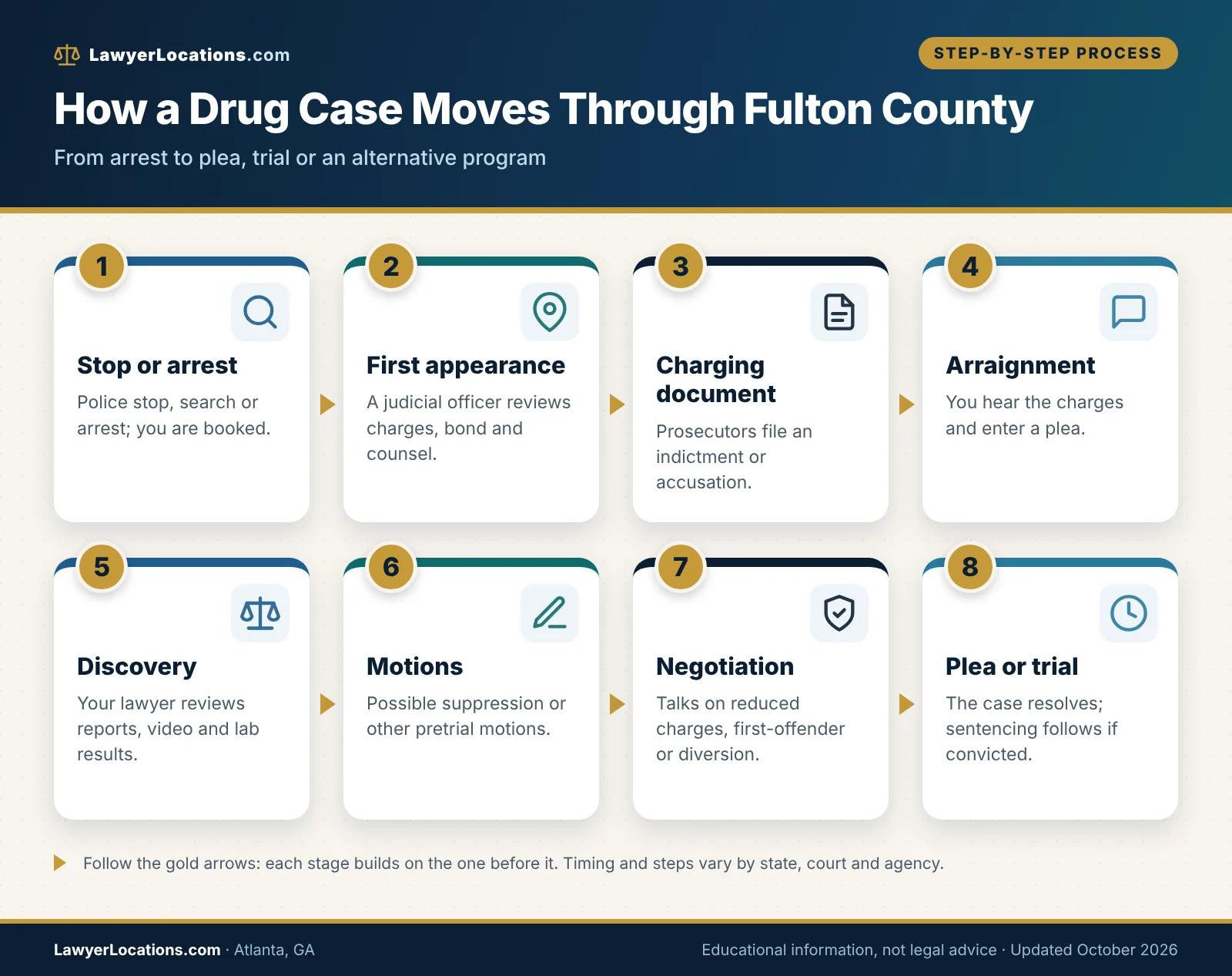
Text version of this graphic
- Stop or search. Police stop, search or arrest; you are booked.
- First appearance. A judicial officer reviews charges and bond.
- Charging document. Prosecutors file an indictment or accusation.
- Arraignment. You hear the charges and enter a plea.
- Discovery. Your lawyer reviews reports, video and lab results.
- Motions. Possible suppression or other pretrial motions.
- Negotiation. Talks on reduced charges, first-offender or diversion.
- Plea or trial. The case resolves; sentencing follows if convicted.
From the charging decision to resolution
Indictment or accusation, and arraignment
In Superior Court, a felony case typically proceeds on a grand jury indictment or on an accusation filed by the District Attorney, a charging document used when the defendant agrees to proceed without a grand jury. In State Court the Solicitor General files the accusation. Either way, the document states exactly what the State alleges, including the drug, the amount, the date and the location. Read every count, because those details are the starting point of your defense.
At arraignment you hear the charges and enter a plea. Pleading not guilty keeps every option open while your lawyer reviews the evidence, whereas a guilty plea before discovery can foreclose defenses and alternatives.
Discovery, motions and negotiation
After arraignment the lawyers exchange evidence, called discovery. In a drug case the defense typically looks for police reports, body-camera and dash-camera video, lab results, search warrant paperwork, phone extractions and informant information. Most cases then enter negotiation, where outcomes can include dismissal, a reduced charge, a first-offender or conditional-discharge disposition, diversion, or a negotiated plea. If talks fail, the State must prove every element beyond a reasonable doubt at trial.
After a plea or verdict: sentencing and consequences
Sentencing, probation and treatment conditions
If you are convicted, the judge sentences you within the statutory range. Many drug sentences involve probation, which can include drug testing, treatment, fines, fees and community service. A probation violation can lead to a revocation hearing, so compliance matters as much as the plea.
Consequences beyond the sentence
A drug conviction can reach beyond the courtroom. Employers, landlords, licensing boards and schools may ask about criminal history, and a felony conviction can affect firearm rights. For non-citizens, certain drug convictions can have serious immigration consequences that turn on the exact charge and plea wording. Ask “What happens to my record?” at your first consultation, alongside “What happens to my case?”
What Georgia Charges: Possession, Intent to Distribute and Trafficking
Georgia sorts drug cases into three buckets: simple possession, possession with intent to distribute (or actual sale), and trafficking. Which bucket the State picks, and which drug and weight it alleges, drives the court, the bond, the plea options and the sentencing range.
Possession charges and how the penalty ladder works
Controlled substances other than marijuana
Under O.C.G.A. § 16-13-30(a), it is unlawful to purchase, possess or control a controlled substance unless the Act authorizes it (a valid prescription is the everyday example). The penalty depends on the drug’s schedule and, for many drugs, the weight. The table summarizes the possession ranges in the 2025 Code of Georgia. These are statutory ranges, not predictions, and many cases resolve well below the ceiling or without a conviction.
| What was allegedly possessed | Weight or category | Statutory range |
|---|---|---|
| Schedule I substances and Schedule II narcotics | Under 1 gram / 1 to under 4 grams / 4 to under 28 grams | 1 to 3 / 1 to 8 / 1 to 15 years (heroin, morphine and opium at 4 grams or more are handled under § 16-13-31) |
| Schedule II non-narcotics | Under 2 grams / 2 to under 4 grams / 4 to under 28 grams | 1 to 3 / 1 to 8 / 1 to 15 years |
| Schedules III, IV and V | Any amount; third or later offense | 1 to 3 years; 1 to 5 years |
| Marijuana | One ounce or less | Misdemeanor: up to 12 months and a fine up to $1,000 (§ 16-13-2(b)) |
| Marijuana | More than one ounce | Felony: 1 to 10 years (§ 16-13-30(j)) |
Because penalty tiers turn on weight and schedule, lab results and weighing procedures become real issues in contested cases, and a fight over what substance was actually seized can change the charge itself.
Marijuana, hemp and low-THC products
Georgia has not legalized recreational marijuana. Possessing one ounce or less is a state misdemeanor, and more than an ounce is a state felony. Hemp complicates the picture: low-THC hemp is legal, yet hemp and marijuana can look and smell alike. Georgia’s Hemp Farming Act (Senate Bill 494, effective October 1, 2024) set licensing rules, requires buyers of hemp products to be 21 and limits THC-A, according to a news report; later changes are possible. That gap fuels two fights in marijuana cases: whether an officer’s detection of odor can support a search, and whether lab testing distinguishes illegal marijuana from legal hemp.
Intent to distribute: when “possession” becomes “distribution”
What prosecutors typically point to
Under O.C.G.A. § 16-13-30(b), it is unlawful to manufacture, deliver, distribute, dispense, administer, sell or possess with intent to distribute a controlled substance. Intent is rarely admitted, so the State infers it. Commonly argued circumstances include quantity, packaging, scales or baggies, cash, text or social media messages, statements to officers, and informant or controlled-buy information.
None of these is automatically conclusive, and your lawyer’s job is to test each inference and how the evidence was collected.
Penalty ranges and add-on exposure
The ranges jump once the charge moves from possession to distribution. For Schedule I and II drugs, distribution-type violations carry 5 to 30 years, and a second or later offense can carry 10 to 40 years or life. For Schedules III, IV and V the range is 1 to 10 years, and for marijuana it is 1 to 10 years under § 16-13-30(j). Using a person under 17 to help manufacture or distribute drugs carries 5 to 20 years and a fine up to $20,000 under § 16-13-30(k).
Other statutes can add exposure. Under O.C.G.A. § 16-13-32.5, making, distributing or possessing with intent to distribute drugs within 1,000 feet of a park, playground or recreation center, or of publicly owned housing, is a felony with up to 20 years for a first conviction and 5 to 40 years for a later one, and sentences must run consecutively to any other sentence. Civil forfeiture of cash, phones or vehicles can also arise.
Trafficking thresholds and mandatory minimums
The weight thresholds
“Trafficking” in Georgia is a weight-based charge, not a proof-of-sales charge. If the State proves a quantity at or above the statutory threshold, the person faces a mandatory minimum prison term and a mandatory fine under O.C.G.A. § 16-13-31, even without an alleged sale. The thresholds below are from the 2025 Code of Georgia as shown on Justia.
| Drug | Weight tier | Mandatory minimum prison term | Mandatory fine |
|---|---|---|---|
| Cocaine | 28 g to under 200 g / 200 g to under 400 g / 400 g or more | 10 / 15 / 25 years | $200,000 / $300,000 / $1,000,000 |
| Heroin, morphine, opium | 4 g to under 14 g / 14 g to under 28 g / 28 g or more | 5 / 10 / 25 years | $50,000 / $100,000 / $500,000 |
| Fentanyl and analogs | 4 g to under 8 g / 8 g to under 14 g / 14 g to under 28 g / 28 g or more | 10 / 15 / 25 / 35 years | $75,000 / $150,000 / $250,000 / $750,000 |
| Marijuana | More than 10 lbs to under 2,000 lbs | 5 years | $100,000 |
| Methamphetamine or amphetamine (sale or possession) | 28 g to under 200 g / 200 g to under 400 g / 400 g or more | 10 / 15 / 25 years | $200,000 / $300,000 / $1,000,000 |
For cocaine mixtures under 10 percent purity, the statute multiplies the total mixture weight by the cocaine percentage to decide whether a threshold is met, so the lab analysis, not the officer’s scale, may decide the tier. Georgia changed the fentanyl provisions in 2025 (Senate Bill 79) and again in 2026 (House Bill 535), so confirm the current tiers against the official Code for the date of the alleged offense.
Departures, cooperation and why the offense date matters
Mandatory minimums are not absolute, but the exceptions are narrow. Under § 16-13-31(g), a court may depart below the minimum only if all five conditions are met: the defendant was not a leader; no firearm, dangerous weapon or hazardous object was possessed or used; no one other than a party to the crime suffered death or serious bodily injury; the defendant has no prior felony conviction; and the interests of justice would not be served by the minimum. A prosecutor may also move for a reduced sentence when a defendant substantially assists in convicting others, or the parties may agree to a lower sentence.
Penalty laws change, and the version that applies generally tracks the date of the alleged offense, not the date of the plea.
If your paperwork says “trafficking” anywhere, treat the first consultation as urgent. The ways below the mandatory minimum are narrow: the statutory departure, cooperation, or an agreed charge.
Search and Seizure, Evidence Problems and Other Defense Issues
Most Atlanta drug cases begin with a stop, a search or a seizure, so a careful defense lawyer first examines how the drugs came into the State’s hands. If police violated the Fourth Amendment or the Georgia Constitution, a court may exclude the evidence, and without the drugs the State may have little left. That is an argument for a lawyer to make in court, not at the roadside.
Search-and-seizure questions lawyers look at first
Traffic stops, extended detentions and canine sniffs
An officer needs a lawful basis for the stop, such as a traffic violation or reasonable, articulable suspicion of a crime. The officer may handle the purpose of the stop (license, registration, insurance and a citation), but a stop generally cannot be stretched into a drug investigation without separate suspicion.
Defense lawyers therefore compare body-camera or dash-camera video with the officer’s report: when the stop began, when the traffic business ended, when a canine unit was called and when the dog alerted. Unexplained gaps are the raw material of a motion to suppress. ask about body-cam video
Consent, warrants and what an officer may search
Officers can search without a warrant in some situations: with valid consent, incident to a lawful arrest, in an inventory of a lawfully impounded vehicle, or when probable cause and a recognized exception apply. Consent is the most common route, and whether it was truly voluntary is a frequent issue. Your lawyer will ask what was said, how many officers were present, whether you were told you could refuse and whether you felt free to leave.
For homes, hotel rooms and phones, a warrant is usually the starting point, and it can be challenged if it relies on stale information or an unreliable informant. Because phones hold messages and location data, a lawyer will ask whether police had a warrant and stayed within it.
Do not physically resist, run or argue during a stop or search. You can calmly say that you do not consent to a search and that you want a lawyer, then let your lawyer challenge the search in court. Resisting can add new charges and weaken a good suppression argument.
The motion to suppress in a Georgia court
What a motion asks the judge to do
A motion to suppress asks the trial judge to rule that certain evidence was obtained unlawfully and cannot be used. Georgia addresses this in O.C.G.A. § 17-5-30. Under the 2025 Code as shown on Justia, a defendant aggrieved by an unlawful search and seizure may move to suppress on the ground that a warrantless search was illegal or that a warrant search was illegal, and the motion must be in writing and state facts showing the search was unlawful. The judge hears evidence outside the jury’s presence, and the State bears the burden of showing the search was lawful. If the motion succeeds on the key evidence, the State may dismiss, reduce the charge or improve a plea offer.
Timing and strategy
The statute does not set a specific filing deadline, but motions are filed in the court where the charge is pending, usually after discovery, and pretrial deadlines come from the trial judge’s scheduling orders.
Evidence and proof problems in drug cases
Possession, ownership and shared spaces
Drugs found in a shared car, apartment or backpack raise a basic question: whose were they? Georgia recognizes constructive possession, meaning a person can be treated as possessing drugs within their power and control even if not on their person. The State must still prove knowledge and control, and mere presence is typically not enough on its own. talk only to your lawyer
Lab analysis, chain of custody and informants
A drug charge depends on proof that the substance is what the State says it is. Crime-lab analysis, field tests, weighing and the chain of custody (the documented path of the evidence from seizure to courtroom) can all be examined. With an informant or controlled buy, your lawyer will look at the informant’s role and how the buy was documented.
- Why the stop began and how long it lasted
- Whether consent was truly voluntary
- Whether a phone search had a valid warrant
- Lab tests, weights and chain of custody
- Explaining your side to officers without a lawyer
- Texting or posting about the case
- Deleting messages or discarding items after an arrest
- Contacting witnesses on your own
Finding and Comparing a Drug Crime Lawyer in Atlanta
There are three routes to a drug crime lawyer in Atlanta: appointed counsel through the public defender, a referral through a bar association, or a private lawyer you research and hire yourself. Whichever route you take, compare the same questions in writing, confirm the lawyer is licensed in Georgia, and get fee terms in a signed agreement before you pay. LawyerLocations is not a law firm or referral service and does not endorse any lawyer.
Where to find a lawyer in Atlanta
Appointed counsel: the Office of the Public Defender, Atlanta Judicial Circuit
If you cannot afford a lawyer, you may qualify for a public defender. The Fulton County website describes the Office of the Public Defender, Atlanta Judicial Circuit (formerly the Fulton County Public Defender Office) as the office established in 1967 to represent people charged with crimes who cannot afford counsel. Its divisions cover Superior Court cases, probation revocation, appeals, accountability courts (including Drug Court) and a State and Magistrate Court division for misdemeanors and citations.
To use the office, you complete an application and must be found qualified; the county’s page lists separate application forms for Public Defender Services and State Court Services. The page lists the Adult Division at 404-612-5200 (100 Peachtree Street NW, Suite 1600) and the State and Magistrate Court Division at 404-612-5419 (160 Pryor Street SW, Suite J-210). Public defenders are licensed lawyers assigned through the office. If you are in custody, ask at your first appearance how to apply.
If you later hire a private lawyer, ask that lawyer how the handoff from appointed counsel will work. Whatever you decide, do not let a lawyer search cause you to miss a court date.
Bar referral services and private lawyers
The Atlanta Bar Association runs a Lawyer Referral and Information Service. Its page says the service began in 1955 and was renamed in 2003 after meeting American Bar Association standards for referral programs. Its page does not say whether consultations carry a fee, so ask when you call; the Association’s page lists 404-521-0781 in its footer, which you should confirm is the referral line. A referral service connects you with lawyers who signed up for the program, which is not a vetting of quality.
The State Bar of Georgia offers a Find a Lawyer page with a member directory and tips on hiring a lawyer, but notes that the State Bar cannot refer clients to lawyers directly. Use the directory to confirm a lawyer’s license and to look for public discipline, and use the Bar’s separate discipline pages for any history. verify the license first
How to compare drug crime lawyers in Atlanta
Questions that separate a good fit from a sales pitch
LawyerLocations does not rank or recommend individual lawyers, and no directory can tell you who is right for your case. What you can do is ask the same questions of every lawyer and compare the answers in writing. The scorecard below is built for drug cases: it covers the court that will hear your case, drug-specific issues and the plan for the first thirty days.
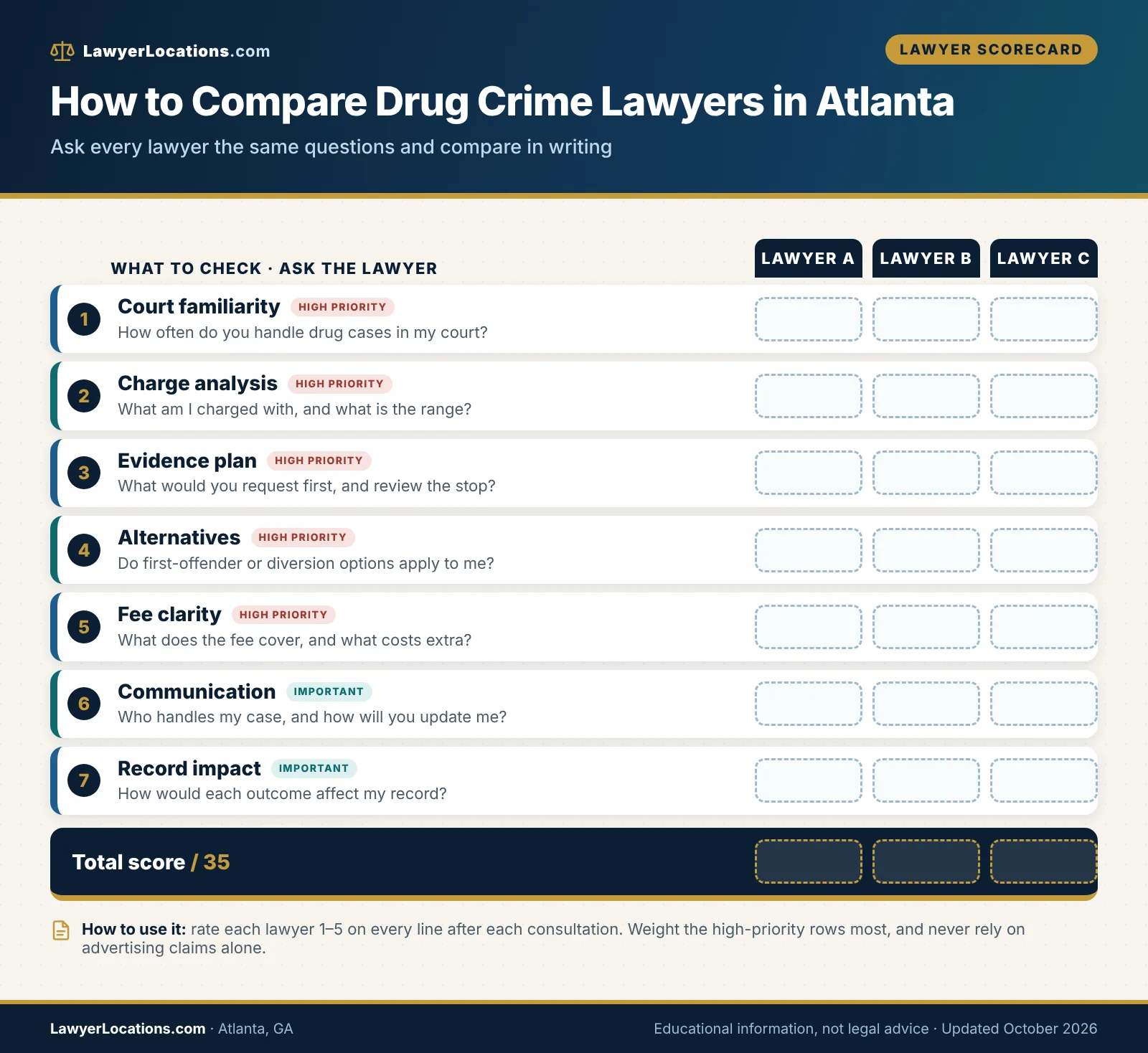
Text version of this graphic
- Court familiarity. How often do you handle drug cases in the court that has my case?
- Charge analysis. What exactly am I charged with, and what is the realistic range?
- Evidence plan. What would you request first, and would you review the stop or search?
- Alternatives. Do first-offender, diversion or accountability court options apply to me?
- Fee clarity. What does the fee cover, and what costs extra?
- Communication. Who will handle my case, and how will you update me?
- Record impact. How would each outcome affect my record, job, license or housing?
Pay attention to how specific the answers are: a lawyer who asks detailed questions and explains the process in plain language is giving you more useful information than one who leads with promises. compare answers in writing
Experience claims, advertising and what not to rely on
Use the State Bar of Georgia’s Find a Lawyer tools as a screening step: confirm that anyone you consider is licensed in Georgia through the member directory rather than relying on a website’s claims. Words like “specialist,” “expert” or “best” in an advertisement are marketing language, not a measure of quality, and no lawyer can ethically promise an outcome.
Walk away from any lawyer who promises a charge “will be dropped” or pressures you to sign and pay before you receive a written fee agreement.
Lawyer fees and what drives the price
Common fee structures in criminal defense
Criminal defense lawyers commonly charge a flat fee for a defined stage of the case, an hourly rate against a retainer, or a combination. Be cautious about any lawyer who ties the fee to the outcome of a criminal case, and ask how that fits professional conduct rules. Our guide to criminal defense fee structures in DUI cases explains the same basic models. We do not publish an “average” price for Atlanta drug cases because no official source tracks one. Use the factors below to understand why two quotes differ.
| Factor | Why it affects the work | Question to ask |
|---|---|---|
| Felony vs. misdemeanor | Felonies involve indictment, longer discovery and higher stakes | Does the fee cover all court stages? |
| Trafficking or intent to distribute | Mandatory minimums and more evidence to review | Do you review the weight and lab analysis? |
| Search-and-seizure issues | A suppression motion and hearing add time | Is a suppression hearing included? |
| Trial vs. plea | A trial requires far more preparation | Is trial covered or priced separately? |
| Experts and costs | Independent lab testing or investigators may be billed separately | Which costs are not in the fee? |
| Record cleanup | Post-case restriction may be separate work | Is record relief included or extra? |
Fee agreements, refunds and payment plans
Ask for the fee agreement in writing before paying. It should say what the fee covers, when it is earned, what happens if you change lawyers or the case ends early, and which costs you pay separately. If a fee dispute arises, the State Bar of Georgia runs a Fee Arbitration Program for attorney-client fee disputes; its website says filing is free for clients and the process is binding and confidential (404-527-8750). The page does not say whether criminal matters are covered, so confirm that first. If the quote is out of reach, ask about a payment plan and check whether you qualify for appointed counsel before going without legal help.
Preparing for a consultation
Documents and information to gather
You will get more from a first meeting if you bring the paperwork, and quotes based on your actual documents tend to be more accurate than quotes based on a phone description.
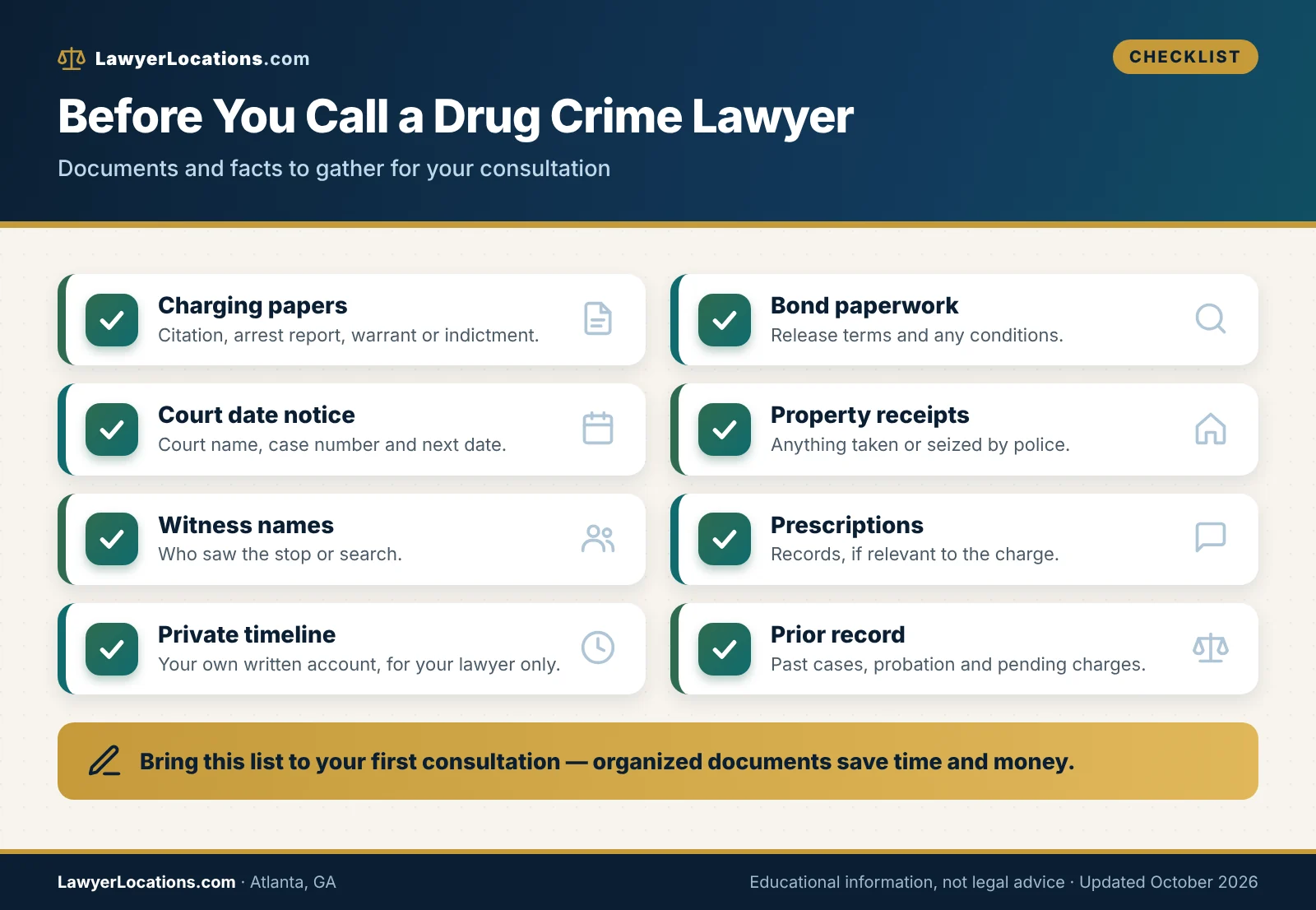
Text version of this graphic
- Citation, arrest report, warrant or charging document
- Bond paperwork and release conditions
- Court date notice and the court’s name
- Property or evidence receipts
- Names of anyone who saw the stop or search
- Prescription records, if relevant to the charge
- A private written timeline of events
- Your prior record, probation status and any pending cases
- Every document you were handed at arrest, booking or release
- Your employer’s drug-testing policy and any professional license rules, since a drug conviction can have consequences outside the criminal case
What to tell your lawyer, and what to avoid saying elsewhere
What you tell your lawyer to get legal advice is generally confidential, including unwelcome facts that a lawyer needs to plan around. Conversations with friends, family, co-defendants or people at the jail are generally not protected, and jail calls are typically recorded.
Write down your account while it is fresh, mark it “prepared for my attorney,” and give it only to your lawyer. If a drug conviction could affect your immigration status, say so at the first meeting, since consequences can turn on the exact wording of a plea.
First Offender, Diversion, Accountability Courts and Record Relief
For some people charged with a drug offense in Atlanta, the realistic goal is an outcome that ends without a lasting conviction: a first-offender sentence, a conditional discharge, a diversion program or an accountability court. Georgia law and Fulton County programs offer several such paths, each with its own eligibility rules and strings attached. Whether any fits depends on your record, the charge and the prosecutor’s position, so treat this section as a list of questions to ask, not a prediction.
Sentencing paths that can end without a conviction
The Georgia First Offender Act, O.C.G.A. § 42-8-60
Under O.C.G.A. § 42-8-60, a court may, with the defendant’s consent, place a person on probation or sentence them to confinement without first entering an adjudication of guilt, after a guilty verdict or a guilty or nolo contendere plea. The court may use it only if the defendant has no prior felony conviction, and a person can use the Act only once. If the person completes the sentence, they are discharged and exonerated, and the discharge is not a conviction. If the person violates probation or commits a new offense, the court can adjudicate guilt and sentence as in an ordinary case.
The Act excludes certain offenses, including serious violent felonies, certain sexual offenses and driving under the influence, and the judge has discretion even when it is requested.
You can use the First Offender Act only once. If a smaller case could be resolved another way, a lawyer may want to save first-offender status for a more serious future charge. Raise that strategy question before you plead.
Conditional discharge for first-time drug possession, O.C.G.A. § 16-13-2
Georgia also has a drug-specific path. Under O.C.G.A. § 16-13-2(a), a person with no prior drug convictions can consent to have proceedings deferred, without a judgment of guilt, and be placed on probation for up to three years, preferably with a rehabilitation program. If the person completes the terms, the court must discharge them and dismiss the case, and the discharge is not a conviction. It can be used only once. Subsection (c) extends similar treatment, with up to five years of probation, to some people eligible for a court-approved drug treatment program.
Diversion and accountability courts in Fulton County
Pre-trial, pre-indictment and pre-arrest diversion
The Fulton County Solicitor General’s Office runs a pre-trial diversion program for some first offenders and low-level offenders. Its website lists possession of marijuana of less than an ounce among eligible examples, and says referral comes through internal screening or the courtroom, where the assistant solicitor assigned to the courtroom makes the referral. Requirements can include courses, community service, restitution or fines, with a fee that takes indigence into account. Completion means dismissal and a restricted record; otherwise the case proceeds normally. The office lists [email protected] and 404-612-4000.
For felony-level cases, the District Attorney’s Office has a pre-indictment diversion division, but the public page we reviewed did not describe eligibility, so ask your lawyer how it treats your charge. Separately, the Atlanta nonprofit Policing Alternatives & Diversion Initiative (PAD) offers a pre-arrest alternative: City of Atlanta and Fulton County police can divert some people detained for substance-use, mental-health or extreme-poverty related law violations to PAD instead of arresting them. It is a program officers may choose to use, not a plan to count on.
Fulton County Drug Court and other accountability courts
Fulton County’s accountability courts are treatment-focused programs overseen by Superior Court. The county referral form lists Behavioral Health Treatment Court, Veterans Court and two Drug Court tracks (ATL Pathway and TLC Pathway), and says a defense attorney or the District Attorney may refer a person.
According to the Drug Court participant handbook (revised May 2023), the program has six phases of at least three months each and typically takes 18 to 24 months. It includes intensive outpatient treatment of at least nine hours a week, random drug testing at least twice a week, status hearings, curfews, employment from Phase 2, and total fees of $750. Termination for non-compliance leads to prosecution of the original charges or probation revocation. confirm current rules with your lawyer Drug court demands a lot, but it can make sense when a substance use disorder is driving the case.
Record relief after the case
Georgia’s first-offender record changes, effective July 1, 2026
House Bill 162, signed by Governor Kemp and effective July 1, 2026, requires first-offender records to be restricted and sealed at sentencing. According to the Georgia Justice Project, O.C.G.A. § 42-8-62.1 requires courts to restrict and seal records at sentencing, and § 42-8-62.2 lets people serving or who completed a first-offender sentence petition the sentencing court, which must rule within 90 days. Restriction hides arrest and case information from official checks such as the Georgia Crime Information Center; sealing hides online and court records from public view and private background-check companies.
The records are not erased: criminal justice agencies can still see them, as can some employers of people who work with vulnerable populations. A “retroactive first offender” path exists for some people who were never told about eligibility, and it requires the prosecutor’s consent.
Restricting other records under O.C.G.A. § 35-3-37
Georgia’s record restriction statute, O.C.G.A. § 35-3-37, covers more than first-offender cases. As shown in the 2025 Code, arrests never referred for prosecution, or dismissed or no-billed, can be restricted automatically after waiting periods from the arrest date: two years for misdemeanors, four years for most felonies and seven for serious violent felonies. It also allows restriction after certain drug or first-offender sentences, after completing drug, mental health or veterans court, and by petition for some misdemeanor convictions, limited to two over a lifetime.
| Situation | Relief path | Key point |
|---|---|---|
| First-offender sentence on or after July 1, 2026 | Court restricts and seals at sentencing (§ 42-8-62.1) | Ask for the order and keep a copy |
| First-offender sentence before July 1, 2026 | Petition the sentencing court (§ 42-8-62.2) | Court must rule within 90 days; status must not have been revoked |
| Charge dismissed, no-billed or never prosecuted | Restriction under § 35-3-37 | Automatic after waiting periods, or earlier on some dismissals |
| Misdemeanor conviction | Petition under § 35-3-37 | Two convictions per lifetime; many offenses excluded |
For help in Atlanta, the Georgia Justice Project lists an intake line at 404-827-0027 and a record clearing info session on first Fridays. Our guide to expungement lawyers and how record clearing works covers the national picture.
Deadlines, Decision Points, Mistakes to Avoid and Next Steps
The most time-sensitive moments in an Atlanta drug case are the first appearance, the court date on your paperwork, the arraignment and any plea offer deadline. Missing a court date is the most avoidable mistake, because it can lead to a warrant and new problems. Other choices, such as a speedy-trial demand, a suppression motion or a first-offender request, depend on timing rules a lawyer must track.
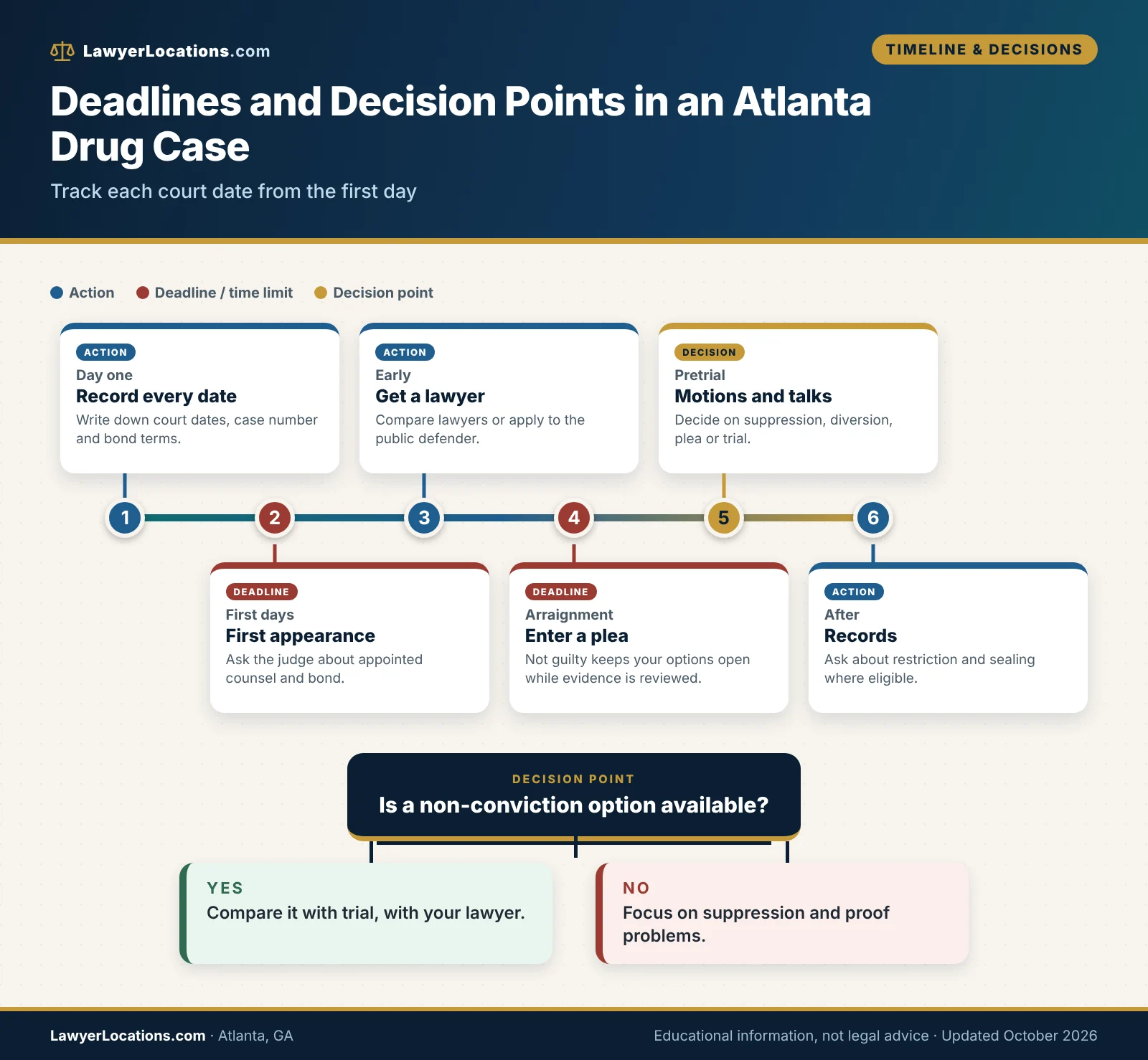
Text version of this graphic
- Arrest or citation. Record the court date, case number and bond conditions.
- First appearance (warrant arrests). A judicial officer should see you within 72 hours; ask about appointed counsel.
- Hire or apply for counsel. Compare lawyers or apply to the public defender.
- Arraignment. Hear the charges and enter a plea; not guilty keeps options open.
- Discovery and motions. Review evidence; decide on suppression and other motions.
- Plea decision point. Weigh first-offender, diversion, drug court, plea or trial.
- Sentence and records. Complete conditions; seek record restriction where eligible.
Decision point: Is a non-conviction or reduced-charge option available? If yes, compare it with trial; if no, focus on suppression and proof problems.
Deadlines and decision points to track
The first days after an arrest or citation
Write down every court date, case number and bond condition exactly as printed. If you were arrested on a warrant, the first appearance should occur within 72 hours of arrest (O.C.G.A. § 17-4-26), which is the time to ask about appointed counsel. If you received a citation instead of being held, treat its court date as mandatory.
If you think there may be an outstanding warrant, do not ignore it and do not try to avoid police. Talk to a lawyer about resolving it through the court.
Missing a court date can lead to a bench warrant and can disrupt bond, first-offender sentencing and diversion. If you cannot attend, have a lawyer contact the court before the date.
Once the case is formally charged
Under O.C.G.A. § 17-7-170, a defendant in a non-capital case may file a demand for speedy trial at the term of court in which the charging document is filed or the next regular term. It must be a separate, properly titled document, and if the State does not try the case in the statute’s time frame, the defendant can be discharged and acquitted. Courts require strict compliance, and the demand can force the pace before your lawyer has finished investigating, so it is a strategic decision.
Other timing points include the general limitation periods in O.C.G.A. § 17-3-1 (four years for most felonies and two years for misdemeanors, with exceptions), pretrial motion deadlines set by the judge and plea offer deadlines set by the prosecutor or court. A first-offender request must come before an adjudication of guilt, so it is a plea-stage decision.
Common mistakes and red flags
Mistakes that can hurt a drug defense
- Talking to officers or detectives about the facts before speaking with a lawyer
- Posting, texting or calling about the case, including on recorded jail phone lines
- Missing a court date or violating a bond or probation condition
- Pleading guilty at the first opportunity without seeing the evidence or asking about alternatives
Georgia protects some people who call for help during an overdose. Under O.C.G.A. § 16-13-5, a person who in good faith seeks medical help for someone overdosing, and the overdosing person, can be protected from arrest, charge or prosecution for certain drug violations (such as possessing under four grams of a solid substance or under an ounce of marijuana), if the evidence resulted solely from seeking help and the person provided care while waiting. It has conditions and is not a blanket shield.
Red flags when you are choosing a lawyer
- Guarantees about the result of your case
- No written fee agreement, or pressure to pay immediately
- Advice to ignore a court date, avoid police or discard evidence
Our guide on what to ask before hiring a criminal defense lawyer goes deeper on consultation questions.
Next steps and quick answers
A practical plan for the next seven days
- Collect your paperwork. Gather the citation, arrest report, bond papers and receipts, and note the court name and next date.
- Stop discussing the case. Keep details between you and your lawyer.
- Decide on counsel. Apply to the Office of the Public Defender, Atlanta Judicial Circuit if you cannot afford a lawyer; otherwise shortlist lawyers and use the scorecard.
- Verify licenses and read the agreement. Confirm each lawyer in the State Bar of Georgia directory and ask for a written fee agreement.
- Ask about alternatives. Raise first-offender, conditional discharge, diversion and accountability courts at the first meeting.
Quick answers to common questions
Can I still be charged for a small amount of marijuana in Atlanta?
Yes. The 2017 city ordinance lowered the city penalty for less than one ounce to a fine, but Georgia law still makes possession of one ounce or less a misdemeanor, and officers can choose which law to use. Check whether your paperwork is a city citation or a state charge.
Will I go to jail for a first drug possession charge?
It depends on the drug, the amount, your history and the court. Georgia has first-offender sentencing, conditional discharge for first-time drug possession, diversion and accountability courts, so some people finish a sentence without a conviction. No lawyer can promise a result.
How much does a drug crime lawyer cost in Atlanta?
Quotes vary with the charge, the stage of the case, whether a suppression hearing or trial is included and which costs are billed separately. Use the fee table above to compare written quotes.
Is there a drug crime lawyer near me who offers a free consultation?
Some lawyers offer free or low-cost first meetings and some do not. Ask in advance about any fee, how long the meeting lasts and what to bring.
Ready to compare your options?
If you are searching for a drug crime lawyer in Atlanta, GA, start with your charge and your court. Use the scorecard to compare attorneys, or apply for appointed counsel before your next date. This page cannot tell you what will happen in your case; a lawyer licensed in Georgia can.
Sources & References
Show all 28 sources
- O.C.G.A. § 16-13-30, Georgia Controlled Substances Act (2025 Code of Georgia) — Justia — law.justia.com — accessed October 2026
- O.C.G.A. § 16-13-31, trafficking (2025 Code of Georgia) — Justia — law.justia.com — accessed October 2026
- O.C.G.A. § 16-13-2, conditional discharge and marijuana of one ounce or less — Justia — law.justia.com — accessed October 2026
- O.C.G.A. § 16-13-32.5, drug offenses near parks and housing — Justia — law.justia.com — accessed October 2026
- O.C.G.A. § 16-13-5, medical amnesty for overdose help — Justia — law.justia.com — accessed October 2026
- O.C.G.A. § 42-8-60, First Offender Act — Justia — law.justia.com — accessed October 2026
- O.C.G.A. § 35-3-37, record restriction — Justia — law.justia.com — accessed October 2026
- O.C.G.A. § 17-5-30, motion to suppress — Justia — law.justia.com — accessed October 2026
- O.C.G.A. § 17-3-1, limitation periods for prosecution — Justia — law.justia.com — accessed October 2026
- O.C.G.A. § 17-4-26, presentment before a judicial officer — Justia — law.justia.com — accessed October 2026
- O.C.G.A. § 17-7-170, demand for speedy trial — Justia — law.justia.com — accessed October 2026
- Georgia HB 535 (2025-2026 Regular Session) bill status — Legiplex — app.azure.legiplex.com — accessed October 2026
- HB 162 first offender changes (one-pager and update page) — Georgia Justice Project — gjp.org and gjp.org/hb162firstoffenderupdates — accessed October 2026
- Retroactive First Offender one-pager — Georgia Justice Project — gjp.org — accessed October 2026
- Pre-Trial Diversion — Fulton County Office of the Solicitor General — fultoncountyga.gov — accessed October 2026
- Pre-Indictment Diversion, Records, and Records Restriction Division — Fulton County District Attorney’s Office — fultoncountyga.gov — accessed October 2026
- Office of the Public Defender, Atlanta Judicial Circuit — Fulton County — fultoncountyga.gov — accessed October 2026
- State Court of Fulton County — Fulton County — fultoncountyga.gov — accessed October 2026
- Fulton County Superior Court — Fulton County — fultoncountyga.gov — accessed October 2026
- Accountability Court Referral Form (June 2025) — Fulton County Superior Court — fultonsuperiorcourtga.gov — accessed October 2026
- Drug Court Participant Handbook (revised May 2023) — Fulton County Superior Court — fultonsuperiorcourtga.gov — accessed October 2026
- Policing Alternatives & Diversion Initiative (PAD) profile — GA Gives — gagives.org — accessed October 2026
- Lawyer Referral and Information Service — Atlanta Bar Association — atlantabar.org — accessed October 2026
- Find a Lawyer and Fee Arbitration Program — State Bar of Georgia — gabar.org/public/find-a-lawyer and gabar.org/programs/fee-arbitration — accessed October 2026
- Atlanta mayor signs marijuana ordinance into law (October 11, 2017) — WSB-TV — wsbtv.com — accessed October 2026
- What to know about Atlanta’s new marijuana law — Atlanta Magazine — atlantamagazine.com — accessed October 2026
- Here’s what you need to know about Georgia’s new hemp law (S.B. 494) — WABE — wabe.org — accessed October 2026
- Atlanta Municipal Court overview (secondary source; confirm with the court) — Georgia Criminal Defense (law-firm site) — georgiacriminaldefense.com — accessed October 2026
General information only. This guide is legal information, not legal advice, and reading it does not create an attorney-client relationship. LawyerLocations.com is a legal-education and lawyer-discovery resource, not a law firm, and it does not rank, endorse or guarantee any lawyer. Laws, penalties, court procedures, local programs and fees change, and this article reflects sources reviewed in October 2026. Your situation may differ. Consult a lawyer licensed in Georgia about your specific charge, and if you cannot afford one, ask the court about appointed counsel.
Legal Disclaimer and Limitation of Liability
Informational and illustrative purposes only. This article was prepared by LawyerLocations.com solely on the basis of the information available to us at the time of writing. It is an illustrative, general overview. It is not a complete or authoritative statement of the law, and it has not been reviewed by a lawyer licensed in your state or county.
Not legal advice. Nothing in this article is legal, financial, tax or immigration advice, and reading it does not create an attorney-client relationship between you and LawyerLocations.com or any author, lawyer or firm mentioned. Laws, court rules, fees, filing deadlines and agency procedures differ by state, county and court, and they change often. Some details here may be simplified, incomplete or out of date, and time limits for legal claims can be short.
No warranty. We make no representation or warranty, express or implied, about the accuracy, completeness, timeliness or suitability of this content for your situation. Please do not rely on it to make, delay or skip any legal decision. Check the facts against official sources and speak with a licensed attorney in the relevant jurisdiction before you act.
Limitation of liability. To the fullest extent permitted by law, LawyerLocations.com and its owners, authors and contributors disclaim all liability for any loss, damage, cost or other consequence arising from the use of, or reliance on, this article, including any content on third-party websites we link to. Mentioning a lawyer, firm, organization or service is not an endorsement and is not a promise of any result. If you are in immediate danger, contact your local emergency number.