If you are looking for a bicycle accident lawyer Idaho riders can compare, start with the rules that shape almost every Idaho bicycle claim. A personal injury lawsuit generally must be filed within two years under Idaho Code 5-219, and under Idaho Code 6-801 a rider can recover only if the rider’s share of fault is less than the share of the person being sued. If a state or local government is involved, a written claim may be due in as little as 180 days.
This guide explains those Idaho rules, how a bicycle claim moves from the crash report to an Idaho courtroom, how injury lawyers are usually paid, and how to compare lawyers before you sign anything. It is general information about Idaho law, not advice about your crash.
What a Bicycle Accident Lawyer Does in Idaho
A bicycle accident lawyer helps an injured rider prove who caused a crash, put a dollar value on the harm, and press an insurance company or a court for payment. In Idaho that work sits on top of a few state rules: a two-year filing deadline, a fault-sharing rule that can shut out a rider who is too much to blame, and special notice rules when a public agency may be responsible.
The sections below start with what the job involves, then move to the Idaho statutes, the insurance picture, and the practical steps of choosing and working with a lawyer. If you want the national deadline picture first, our guide on how long you have to file a personal injury claim compares states side by side.
What the job actually covers
Most bicycle claims are won or lost on three questions: who was at fault, how badly the rider was hurt, and where the money will come from. A lawyer’s work usually touches all three, from the first police report to the final settlement paperwork.
Proving fault
Fault means legal responsibility for the crash. In a typical Idaho bicycle case the other side argues that the rider was in the wrong place, ran a stop, rode without a light at night, or came out of nowhere. A lawyer gathers the crash report, photographs, witness names, and any camera footage, and lines them up against the rules of the road in Idaho Code Title 49, chapter 7.
Because Idaho lets a rider recover only when the rider’s fault is smaller than the defendant’s, small details about lane position or signaling can matter far more than they would in a state without that cutoff. That is one reason fault evidence gets collected early, while skid marks are visible and memories are fresh.
Valuing the claim
Value is built from bills and from harder-to-measure losses. Economic damages are the documented costs: medical care, lost pay, bike repair or replacement, and future care. Noneconomic damages are things like pain, loss of enjoyment, and scarring. A lawyer tracks both and watches for state limits, such as the cap on noneconomic damages in Idaho Code 6-1603, covered later in this guide.
No honest source can tell you what your claim is worth before the medical picture settles. Be wary of anyone who quotes a number on the first call. Valuation is a process that follows treatment, not a prediction made from the crash alone.
When a lawyer helps and when you may not need one
Not every bicycle crash needs a lawyer. Some do, and the dividing line is usually injury severity, disputed fault, and the number of parties involved. Weighing that honestly saves time and, in some cases, fees.
Situations that often call for legal help
Consider a consultation when the injury needed surgery, an emergency visit with follow-up care, or time off work. The same goes for crashes where the driver blames you, where the driver left the scene, or where the insurer is slow-walking or denying the claim. A cyclist hit by a driver with no insurance, or injured by a road defect on public property, also faces extra legal steps that are hard to handle alone.
- Injuries that required more than a single urgent-care visit
- A driver or insurer saying you were mostly or partly at fault
- A hit-and-run or an uninsured driver
- A fall tied to a pothole, a drainage grate, or a damaged path owned by a city, county, or state agency
- A crash that killed or seriously harmed a family member
Situations where you may manage on your own
If you had only minor scrapes, the damage is limited to a repairable bike, and the other driver’s insurer has accepted responsibility in writing, you may be able to handle the claim yourself. Idaho’s small claims department exists for smaller disputes, though under Idaho Code 1-2301 it cannot award pain-and-suffering damages, which narrows its usefulness after a real injury.
Even then, a one-time consultation can be worthwhile before you sign a release. A release usually ends the claim for good, including for injuries that show up later.
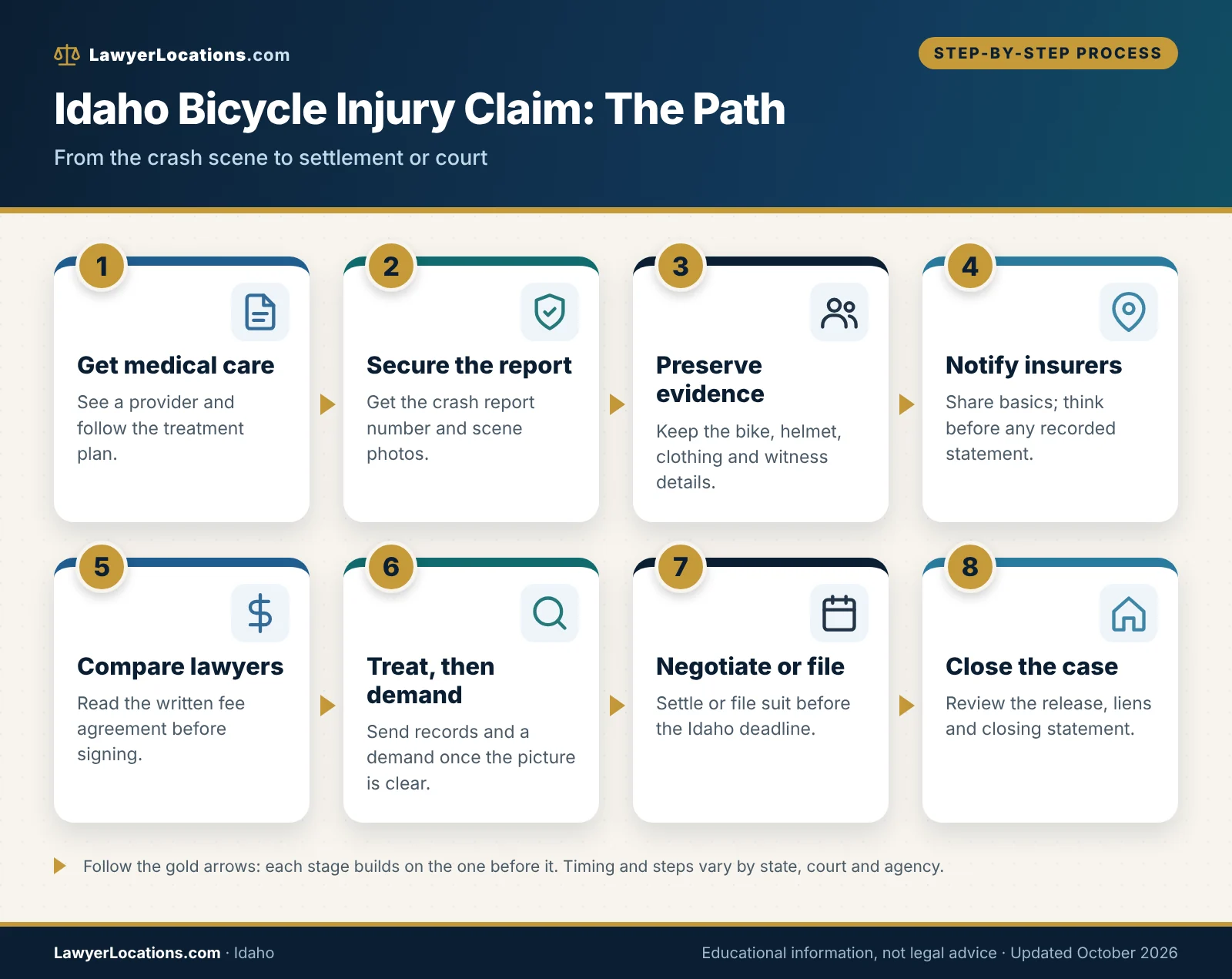
Text version of this graphic
- Get medical care and document injuries.
- Report the crash and obtain the official crash report.
- Preserve evidence: photos, bike, helmet, witness details.
- Notify insurers and avoid recorded statements without advice.
- Consult one or more Idaho lawyers and read the fee agreement.
- Complete treatment, then send a demand with records.
- Negotiate, or file suit before the Idaho deadline.
- Resolve by settlement or trial, then settle liens and fees.
Two years is the general rule for injury suits in Idaho, but a claim against a city, county, or state agency can require written notice in 180 days. Do not wait for treatment to end before finding out which clock applies to you.
How the Idaho picture differs from other states
Idaho is a mostly rural state with a handful of metro areas, and bicycle crashes happen in both settings: on shared roads with fast-moving traffic, on county roads with narrow shoulders, and on city streets and paths. The law is the same statewide, but the practical details change with the setting.
Same statutes, different roads
Idaho’s bicycle rules live in the state code, so a crash in Boise, Idaho Falls, Coeur d’Alene or a small county town is judged by the same chapter. What changes is who maintains the road (a city, a county highway district, or the Idaho Transportation Department) and which county court handles a lawsuit. Road ownership matters because it decides whether a government notice deadline applies.
If you are comparing how another state handles a similar crash, our guides for bicycle accident lawyers in Washington and New Orleans, Louisiana show how much deadlines and fault rules vary.
Why local knowledge matters in a lawyer
A lawyer who regularly works in Idaho courts knows the local judges’ procedures, the county clerk’s filing habits, and the insurers that commonly appear in the region. That familiarity is worth asking about, though it should never be confused with a promise of any result. Later sections give you the questions to use.
Idaho Law That Controls a Bicycle Injury Claim
Three bodies of Idaho law decide most bicycle claims: the filing deadline, the fault-sharing rule, and the rules of the road for people on bikes. Add a few rules about what damages can be recovered, and you have the legal frame a lawyer will use on day one.
The filing deadline and the fault-sharing rule
These two rules do the most work. One decides whether you can bring a claim at all; the other decides how much of the loss you can recover.
The two-year clock
Idaho Code 5-219(4) sets a two-year period for actions to recover damages for an injury to a person, or for a death, caused by the wrongful act or neglect of another. The statute also states that the period is not extended by continuing consequences of the injury, so ongoing pain does not restart the clock.
For most bicycle crashes the clock is tied to the date of the crash. The statute does contain special accrual rules for matters like a foreign object left in the body or fraudulent concealment, but those are rarely relevant to a crash on the road. Special rules can also change the timing for children and other people under legal disability, so a family dealing with an injured child should ask a lawyer how the deadline applies rather than assuming the standard two years.
Count two years from the crash date, then work backward. A lawsuit needs time for investigation, a demand, and negotiation. Starting a lawyer search in the final months leaves little room.
Comparative responsibility: the “less than” rule
Idaho Code 6-801 says that contributory negligence or comparative responsibility does not bar recovery in a negligence case involving injury if the claimant’s fault was not as great as the fault of the person against whom recovery is sought. Any damages are then reduced in proportion to the claimant’s share of fault. In plain terms, a rider found 20% at fault could recover 80% of the damages, but a rider whose fault equals or exceeds the defendant’s share is shut out.
Idaho Code 6-802 adds that the court may, and on any party’s request must, direct the jury to return separate special verdicts on damages and on each party’s share of responsibility. That is why lawyers pay close attention to how fault is framed. When more than one party is involved, such as a driver and a company that owned the vehicle or a public agency, how fault is compared can become technical, and your lawyer will explain how it applies.
Suppose a jury finds total damages of $100,000 and assigns 30% of the fault to the rider and 70% to the driver. The rider’s recovery would be reduced by the rider’s 30% share, to $70,000. If the jury instead assigned 50% to each, the rider’s fault would not be less than the driver’s, and the rider could not recover under the statute’s wording. The numbers are invented for arithmetic only.
The rules of the road for people on bikes
Idaho places bicycle rules in Title 49, chapter 7, which is headed “Pedestrians and Bicycles.” Reading the actual sections helps you see how the other side may try to assign fault to you, and how you may assign it to a driver.
Bicyclists are treated as drivers, with a duty of due care
Idaho Code 49-714 applies the traffic provisions of chapters 6 and 8 of Title 49 to people on bicycles, giving them the rights and duties of a driver of another vehicle, unless chapter 7 says otherwise or a rule cannot logically apply to a bike. The same section requires due care. The Legislature’s own page shows that this section was amended in 2026, a reminder to confirm the current text with your lawyer.
That framing cuts both ways. A cyclist is entitled to a lane and to a driver’s right of way where the law gives it, but is also expected to follow signs, signals and lane rules. Drivers who claim a rider “came out of nowhere” will point to those duties.
Position on the road, stops and lights
Idaho Code 49-717 tells a rider moving slower than normal traffic to stay as close as practicable to the right-hand curb or edge. It lists exceptions, including passing, preparing for a left turn, and avoiding hazards such as parked cars, pedestrians, animals, surface hazards or “substandard width lanes.” On a one-way road with two or more marked lanes, a rider may ride near the left edge where practical.
Idaho Code 49-720 governs stopping and signals. At a stop sign, a rider must slow and, if safety requires, stop, and must yield to vehicles in or approaching the intersection as an immediate hazard; after slowing and yielding, the rider may proceed with caution. At a steady red light, a rider must stop and yield and may then proceed with caution, with specific provisions for right turns on red and certain left turns. Turn signals are required during at least the last 100 feet before the turn, unless the hand is needed to control the bike. These provisions are often called the “Idaho stop,” although the statute does not use that phrase.
Idaho Code 49-723 requires a front light visible from at least 500 feet and a rear reflector for bicycles in use at the times set out in section 49-903. A missing light in a night crash is a common point of dispute.
Passing and driver duties
The general passing rule, Idaho Code 49-632, requires an overtaking driver to pass at a safe distance. The text of that section, as reviewed in October 2026, does not set a fixed number of feet for passing a bicycle, so “safe distance” becomes a fact question about speed, road width and conditions. Do not assume a specific minimum passing distance applies in Idaho; ask your lawyer which provisions are in force.
In practice, driver duties in a bicycle crash come from a mix of rules: safe passing, keeping a lookout, yielding at intersections and driveways, and checking before opening a car door or turning. A lawyer matches the facts to each one.
| Topic | Idaho Code | What it does in plain English |
|---|---|---|
| Injury filing deadline | 5-219(4) | Two-year period for injury and death actions; continuing consequences do not extend it. |
| Comparative responsibility | 6-801, 6-802 | Recovery allowed only if claimant’s fault is less than the defendant’s; damages reduced by claimant’s share; special verdicts on fault. |
| Bicyclists as drivers | 49-714 | Bike riders have a driver’s rights and duties and must use due care. |
| Road position | 49-717 | Stay as close as practicable to the right edge when slower than traffic, with listed exceptions. |
| Stops and signals | 49-720 | Slow and yield at stop signs and red lights, then proceed with caution; signal turns for the last 100 feet. |
| Night lighting | 49-723 | Front light visible from 500 feet and a rear reflector at the times in 49-903. |
| Passing | 49-632 | Pass at a safe distance; no fixed distance stated in the section. |
| Noneconomic damages | 6-1603 | Cap on noneconomic damages, adjusted each July 1, with exceptions for willful or reckless misconduct. |
| Collateral sources | 6-1606 | Awards may be reduced by certain payments from other sources, with listed exceptions. |
A government claim notice is not a lawsuit. It is a written claim that tells the public body about the injury so it can investigate, and filing one does not stop you from hiring a lawyer later.
What limits and reductions can apply to damages
Even a strong liability case can be shaped by state rules about what the final number may include. Two stand out in Idaho, and both are better understood before negotiations begin.
The noneconomic damages cap
Idaho Code 6-1603 caps noneconomic damages in personal injury and wrongful death cases at a base of $250,000 per claimant, adjusted each July 1 by the percentage change the Idaho Industrial Commission applies to the average annual wage under Idaho Code 72-409(2). The cap does not apply to causes of action arising from willful or reckless misconduct, or from acts a jury finds beyond a reasonable doubt would be a felony.
The section does not list the current adjusted figure, so ask your lawyer for the figure in force on your date of injury and check the Industrial Commission’s published schedule. Economic damages, such as medical bills and lost wages, are separate from this cap.
Collateral source reductions
Idaho Code 6-1606 allows a claimant to recover only the amount of damages that exceeds what the claimant has received from collateral sources, meaning private, group and governmental payments. The statute carves out exceptions, including benefits subject to subrogation or reimbursement rights, certain federal program benefits, and life insurance death benefits.
The practical effect is that health insurance payments, reimbursement rights, and the final amount you keep interact in ways that are easy to misread. Ask any lawyer you interview how they handle health insurer reimbursement claims and offsets in Idaho.
Insurance, Uninsured Drivers and Road-Defect Claims
Where the money comes from shapes the whole case. In Idaho a bicycle injury claim usually draws on the at-fault driver’s liability policy, the rider’s own coverage, and, in some cases, a government entity that owns the road or path.
Insurance that may pay after a bicycle crash
Many riders assume only the driver’s insurance matters. In reality, several policies may be in play, and the order in which you approach them can affect your options.
The driver’s liability policy
Under Idaho Code 49-117(20), the minimum liability limits in the state’s proof-of-financial-responsibility definition are $25,000 for bodily injury or death of one person in one accident, $50,000 for two or more people in one accident, and $15,000 for property damage. These are floors, not typical amounts, and a driver may carry more.
A serious bicycle injury can exceed a minimum policy quickly. That is why a lawyer will ask early whether the driver had higher limits, whether an employer, a rideshare or delivery company, or a vehicle owner may also be responsible, and whether you have coverage of your own that fills the gap.
Your own uninsured and underinsured motorist coverage
Idaho Code 41-2502 provides that motor vehicle liability policies for vehicles registered or principally garaged in Idaho must include uninsured motorist and underinsured motorist coverage unless the named insured rejects it. A rejection must be in writing or in a compliant electronic record. If you own a car, your own policy may be a source of recovery even when you were riding a bike at the time, and that depends on the policy language.
Because the policy wording controls, bring the full declarations page and policy to the consultation. Our guide on uninsured motorist claims walks through how those claims generally work, and our medical bills after a crash guide covers how bills are usually handled while a claim is pending.
Health insurance and medical payments coverage
Many riders pay for treatment with health insurance first and sort out reimbursement later. Health plans, and some government programs, often have reimbursement rights against a settlement. Idaho Code 6-1606 also adjusts how collateral payments affect an award, as noted above.
Ask your lawyer to explain in writing how bills, liens and reimbursement claims will be handled at settlement, because those items can change the amount that reaches you.
When a city, county or state agency may be responsible
Some bicycle crashes involve a road or path condition: a pothole, a deep crack, a broken drainage grate, missing signage, or a poorly maintained shared-use path. In Idaho, claims against government bodies follow the Idaho Tort Claims Act, which has its own deadlines and limits.
The notice deadline
Under Idaho Code 6-906, claims against a political subdivision, and claims against its employees for acts within the scope of employment, must be presented to and filed with the clerk or secretary of the political subdivision within 180 days of the date the claim arose or reasonably should have been discovered, whichever is later. Under Idaho Code 6-905, claims against the state must be submitted to the Secretary of State within the same 180-day window.
The earlier of the two clocks can be the one that matters. A claim can still be timely under the two-year rule and yet be barred for missing the 180-day notice. If there is any chance a government body is involved, talk to a lawyer promptly.
Do not assume the city or county is the owner just because a road is in town. Some roads belong to the state, some to a county or a highway district, and some to a private owner. Ownership decides who gets the written notice.
Limits and defenses that apply to government claims
Idaho Code 6-926 limits the combined liability of a governmental entity and its employees to $500,000 for damages, costs and attorney’s fees arising from one occurrence, subject to adjustments such as available insurance above that amount. Idaho Code 6-904 lists claims for which a governmental entity is not liable, including claims arising out of a plan or design for construction or improvement of highways, roads or streets under specified conditions, and claims based on discretionary functions.
These defenses make road-defect claims harder to evaluate than ordinary driver claims. A lawyer will look at whether the problem arose from design, from maintenance, or from a failure to repair after notice, because the answer can change whether a claim is viable at all.
| Possible source of recovery | Legal hook | First practical step |
|---|---|---|
| At-fault driver | Negligence; Idaho Code 49-714 and the rules of the road | Get the crash report number, driver and insurer information, and photos of the scene. |
| Driver’s employer or vehicle owner | Depends on facts and policy language | Note any company logo, plate or delivery app; tell your lawyer right away. |
| Your own uninsured/underinsured motorist coverage | Idaho Code 41-2502; your policy | Request the full policy and declarations page; notify your insurer as the policy requires. |
| City, county, highway district | Idaho Tort Claims Act; Idaho Code 6-906 | Identify the road owner and calendar the 180-day notice deadline. |
| State agency | Idaho Code 6-905 | Confirm whether the road is a state highway; written claim goes to the Secretary of State. |
How to Compare Bicycle Accident Lawyers in Idaho
Compare lawyers on the nuts and bolts: licensing and discipline history, relevant experience, how fees and costs work in writing, and how the office will communicate with you. LawyerLocations.com does not rate or recommend individual lawyers, so the framework below is meant to help you make your own comparison.
Where to look for a lawyer
Start with sources that have built-in checks. A directory listing is not an endorsement, and an advertisement is not proof of skill.
The Idaho State Bar Lawyer Referral Service
The Idaho State Bar’s Lawyer Referral Service is a public service of the bar. According to the bar’s page, participating attorneys are members in good standing with no pending public disciplinary complaints and carry professional liability insurance, and not every bar member participates. Participating lawyers agree to an initial consultation of up to a half-hour at no fee, and the bar lists a $35 referral fee that does not apply to personal injury, medical malpractice and workers’ compensation matters, which receive a free referral. Fees after the initial consultation are negotiated between you and the lawyer.
Referral requests start from the bar’s online referral link, and the bar’s page lists 208-334-4500 for follow-up help after you receive a referral. Check the bar’s current page before relying on any of these details, since programs change.
Confirming a license and checking discipline
Whatever route you use to find a lawyer, confirm that the lawyer is licensed in Idaho and check for public discipline through the Idaho State Bar. Licensing is the minimum bar, not a measure of quality. If a lawyer in another state offers to take your case, ask who will appear in the Idaho court and whether an Idaho-licensed lawyer will be on the file.
Be careful with unsolicited contact. Calls or messages from people claiming to “represent” you right after a crash may be from marketers or runners, not lawyers. You are free to hang up.
Court assistance offices and legal aid
Idaho’s Court Assistance Offices help people who represent themselves or cannot afford a lawyer. According to the court system’s page, they provide forms, document review and legal information, but cannot provide legal advice, and they refer people to the Lawyer Referral Service and to Idaho Legal Aid hotlines. Local offices are listed county by county on the court self-help site.
A court assistance office will not evaluate your injury claim, but it can explain how court works and what the risks of representing yourself are. It is a reasonable stop if cost is the main barrier to hiring a lawyer.
Questions that separate one lawyer from another
Good answers are specific. Vague reassurance is a signal to keep looking. The scorecard below turns the most useful questions into a quick comparison tool you can use across two or three consultations.
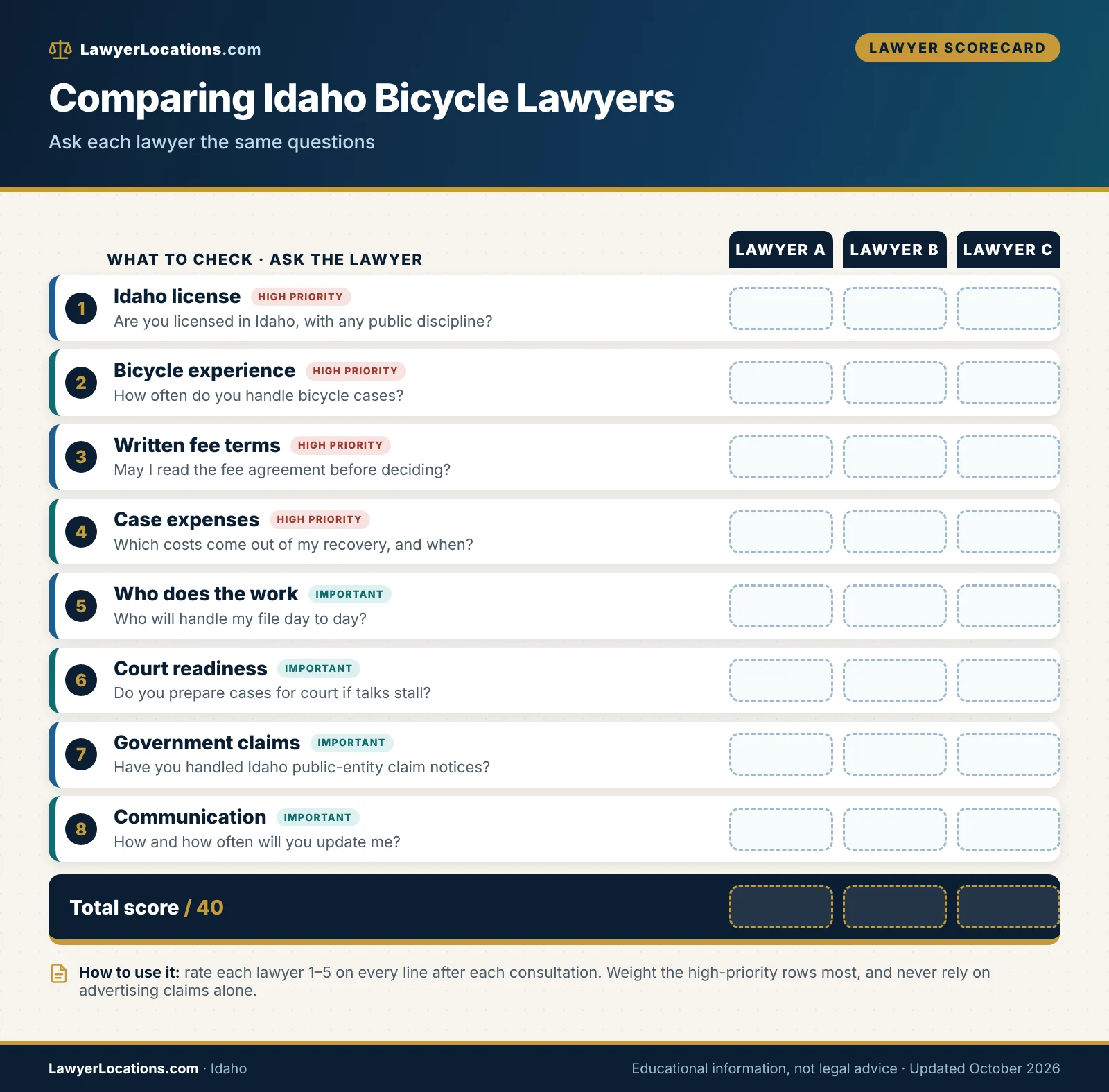
Text version of this graphic
| Criterion | Question to ask |
|---|---|
| Idaho license and discipline [high] | Are you licensed in Idaho, and any public discipline? |
| Bicycle case experience [high] | How often do you handle bicycle or cyclist cases? |
| Written fee terms [high] | Can I see the fee agreement before deciding? |
| Case costs [high] | Which expenses come out of my recovery, and when? |
| Who works on the file [medium] | Who will handle my case day to day? |
| Willingness to file suit [medium] | Do you prepare cases for court if talks stall? |
| Communication [medium] | How and how often will you update me? |
| Government claims [medium] | Have you handled Idaho Tort Claims Act notices? |
Experience and staffing
Ask how many bicycle or other vulnerable-road-user cases the lawyer has handled, whether those matters went to litigation, and whether the lawyer has dealt with Idaho Tort Claims Act notices when a road condition was involved. Experience claims should be explained in concrete terms rather than slogans.
Also ask who will do the day-to-day work. In many offices paralegals and associates carry much of the load. That is not a problem if the structure is clear and you know whom to call.
Fees and costs in writing
Idaho’s Rule of Professional Conduct 1.5(c) provides that a contingent fee agreement must be in a writing signed by the client. The writing must state how the fee is calculated, including the percentage for settlement, trial and appeal, which litigation and other expenses come out of the recovery, whether those expenses are deducted before or after the fee is calculated, and which expenses the client owes even if the case is lost. When the matter ends, the lawyer must give the client a written statement of the outcome showing how the amount sent to the client was determined.
Read the whole agreement before you sign, and ask for a sample closing statement. If any term is unclear, ask for it to be rewritten in plain language.
Communication and case handling
Ask how updates will be delivered, who returns calls, and how decisions on settlement offers are made. Ask who makes the final call on a settlement offer, and have the answer put in the fee agreement; a lawyer should explain each offer and its consequences in plain terms.
Notice how the first conversation feels. A lawyer who explains the weak points of your case, rather than only the strong ones, is giving you information you can use.
Preparing for the consultation
Walking in prepared makes a short meeting more useful and helps you compare lawyers on the same facts. The checklist graphic below lists documents to gather.
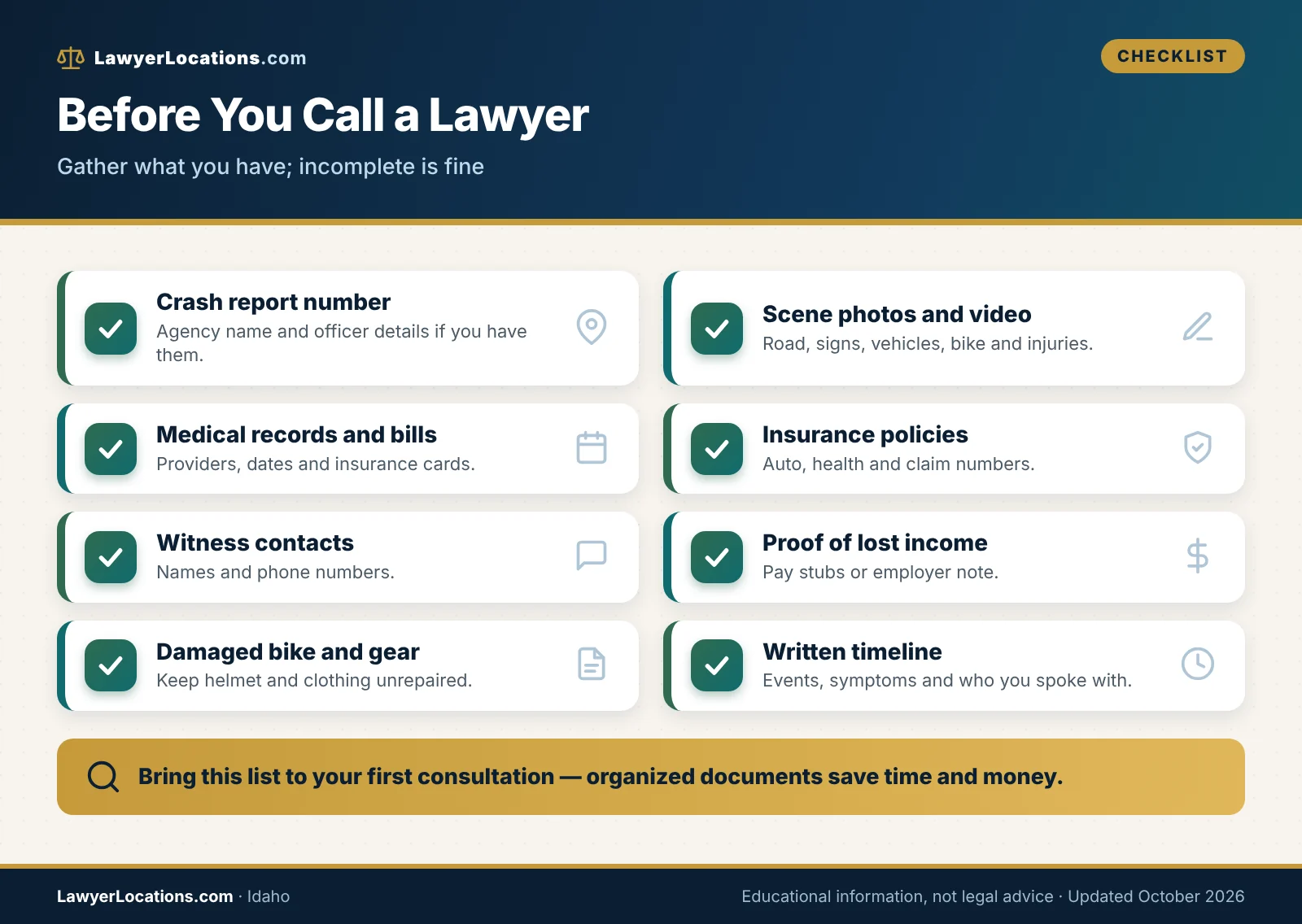
Text version of this graphic
- Crash report number and officer details
- Photos and video of the scene, injuries and bike
- Medical records, bills and insurance cards
- Insurance policy and claim numbers
- Witness names and contact details
- Proof of lost income
- The damaged bike, helmet and gear, kept as is
- A written timeline of events and symptoms
- Your questions for the lawyer
Documents and evidence to bring
Bring whatever you have, even if it is incomplete. Useful items include the crash report number, photos, medical records and bills, your insurance information, any correspondence from an insurer, and proof of missed work. Keep the damaged bike, helmet and clothing in their post-crash condition, because they can show impact points and force.
- Crash report number and the responding agency
- Photos of the scene, road surface, signs and injuries
- Names and phone numbers of witnesses
- Medical bills, records and a list of providers
- Your own auto, health and renter’s policies
- Pay stubs or other proof of lost earnings
What to expect from the first meeting
A first meeting is mainly an exchange of information. The lawyer asks about the crash, your injuries and your insurance, and explains whether and how the firm could help. You ask about experience, fees and process. Neither side should be making promises about outcome.
If you are comparing, take notes after each meeting and score each lawyer on the same criteria while the details are fresh. Our guide on whether you need a lawyer after a crash offers a second set of decision questions that translate well to bicycle injuries.
| Structure | How it generally works | What to ask |
|---|---|---|
| Contingent fee | Lawyer is paid a percentage of the recovery; no fee if there is no recovery, subject to the written agreement. | What percentage applies at settlement, trial and appeal? Are expenses taken before or after the fee? |
| Hourly | You pay for time spent, usually against a retainer. | What are the hourly rates, who bills, and how often will you get invoices? |
| Hybrid or limited scope | A mix, or help with a defined task such as reviewing an offer. | Exactly what is and is not included in the agreement? |
From the Crash Scene to an Idaho Courtroom
Most bicycle claims follow the same arc: treatment and evidence first, then an insurance claim, then negotiation, and only some cases end up in court. Knowing the stages helps you see where a lawyer adds value and where you control the pace.
The first days after a crash
The first few days set up the whole claim. What you do about your health, the official record, and the evidence will be hard to recreate later.
Medical care and the official record
Get medical attention even when you feel “mostly fine.” Adrenaline hides injuries, and a gap between the crash and the first appointment gives an insurer something to argue about. Tell every provider that your injuries came from a bicycle crash, and follow the treatment plan you are given.
For the official crash record, the Idaho Transportation Department’s Office of Highway Safety takes requests for crash reports through an online order form. According to the department’s page, the charge is $7 per copy plus a transaction fee, and the office can be reached at [email protected] or (208) 334-8000 with questions. Whether a report exists depends on whether a law enforcement agency responded and filed one, so ask the responding officer for the report number at the scene.
Photograph the scene from several angles before anything moves: the road surface, lane markings, signs, traffic signals, vehicle positions, your bike, and your injuries. Save originals; do not edit them
Preserving the bike, helmet and digital evidence
Do not repair or replace the bike until a lawyer or the insurer’s adjuster has had a chance to document it. Keep the helmet, clothing, lights and any bike computer or phone app data that logged speed or location. A cycling app can show where and how fast you were riding, which can help or hurt, so ask a lawyer before deleting anything.
Write down what you remember as soon as you can, including times, lighting, weather, and what you saw and heard. Collect witness names and phone numbers before people leave. If a doorbell camera or business camera may have recorded the crash, ask for the footage quickly, since many systems overwrite video on a short loop.
Talking to insurers
You will probably hear from the driver’s insurer soon. Give basic facts, such as your name and contact information, but think twice before giving a recorded statement or signing broad medical authorizations without advice. Adjusters are doing their job, which is to evaluate and limit what the company pays.
Report the crash to your own insurer as your policy requires. Notice requirements in your own policy can be strict, and missing them can complicate an uninsured or underinsured motorist claim. Our guide on what to do after a car accident has a general checklist that adapts well to bicycle crashes.
From claim to lawsuit
Most injury claims settle without a trial, but the lawyer and the insurer both negotiate with the court option in mind. A realistic path includes preparing to file even while talks continue.
Treatment, demand and negotiation
A lawyer typically waits until you have reached a stable point in treatment, or at least a clear prognosis, before sending a demand package to the insurer. The package pulls together records, bills, proof of lost income and a written explanation of fault and damages. The insurer then responds, and negotiation follows.
Early offers often arrive before the full medical picture is known. Accepting one usually requires signing a release, which ends the claim even if you later need more care. Our guides on how long settlements tend to take and how settlement offers are evaluated in a related vehicle-crash context explain why timing matters.
Choosing the right Idaho court
Idaho’s state courts form a unified system. According to the Idaho Supreme Court’s description of the courts, the magistrate division of the district court hears lower-value civil actions and small claims, while the district courts hear larger civil actions and felonies, and appeals from the magistrate division. The dollar thresholds are set by statute and court rule and can change, so ask your lawyer which court fits your claim.
The small claims department described in Idaho Code 1-2301 handles smaller money claims in the magistrate division, in the county where the defendant lives or where the cause of action arose, but it cannot award damages for pain and suffering. For a bicycle crash with real injuries, a regular civil case is usually the more complete route. Venue in a regular case is a legal question that your lawyer should confirm for your county.
Settlement, mediation or trial
If negotiation stalls, a lawyer may file a complaint in the right court before the deadline, then exchange information with the other side in a process called discovery. Many cases settle during or after discovery, sometimes with the help of a mediator, a neutral person who tries to help both sides reach agreement. A smaller share go to trial.
Ask a prospective lawyer whether the firm prepares each case as if it could be tried. That affects how seriously insurers treat the claim, though it never guarantees a particular result.
- Fault is clear and the injuries have a defined recovery path
- The insurer responds with documentation and a real evaluation
- You keep records and attend every appointment
- The insurer offers a quick payment before treatment is complete
- A release asks you to give up claims you do not yet understand
- A government entity may be involved and a notice deadline is running
Costs, Deadlines and Decision Points
Hiring a lawyer for a bicycle injury usually involves no upfront fee, but the full cost picture includes the fee percentage, case expenses, and liens. Deadlines in Idaho are short enough that decisions about hiring should be made in months, not years.
What a lawyer costs and how fees are handled
Fee structure varies by firm, so numbers in this guide stay general. The point is to understand what the agreement must say and how to compare it across offices.
Contingent fees
Under a contingent fee, the lawyer is paid a share of the recovery, and the Idaho professional conduct rule requires that the arrangement be set out in a writing signed by the client. Contingent fees are permitted in injury cases, but they remain subject to a general requirement that the fee be reasonable. Rule 1.5 lists factors for reasonableness, such as the work involved, the customary fee in the area, the amount at stake and the result obtained.
Percentages differ among firms and can change by stage (for example, one number before suit and a different number after filing or at trial). The agreement should state each one.
Case expenses and how they come out
Case expenses are the out-of-pocket costs of building the claim: records fees, filing fees, expert reviews, deposition costs and the like. The fee agreement should say which expenses come out of your recovery, whether they are deducted before or after the lawyer’s percentage is calculated, and whether you owe any of them if there is no recovery.
Say a case settles for $90,000, expenses are $6,000, and the fee is 30%. If the percentage is calculated after expenses are deducted, the fee is 30% of $84,000, or $25,200, and the client receives $58,800 before any lien. If the percentage is calculated on the full $90,000, the fee is $27,000 and the client receives $57,000 before any lien. The 30% figure is only for arithmetic and is not a typical rate.
Liens and reimbursement claims
A lien or reimbursement right is a claim by a health insurer, a government program, or a medical provider to be repaid from your recovery. These claims can be large, and their rules depend on the plan or program. Idaho Code 6-1606 treats benefits subject to subrogation or reimbursement rights differently from other collateral payments, so the details matter.
Ask the lawyer who will request lien amounts, who will negotiate them, and whether that work is covered by the fee. These are among the most overlooked parts of the closing statement, and they can change what you take home.
Deadlines and decision points to put on a calendar
Because Idaho has both a two-year suit deadline and a short government-claim deadline, a simple timeline helps. The graphic below shows how those dates and decisions fit together.
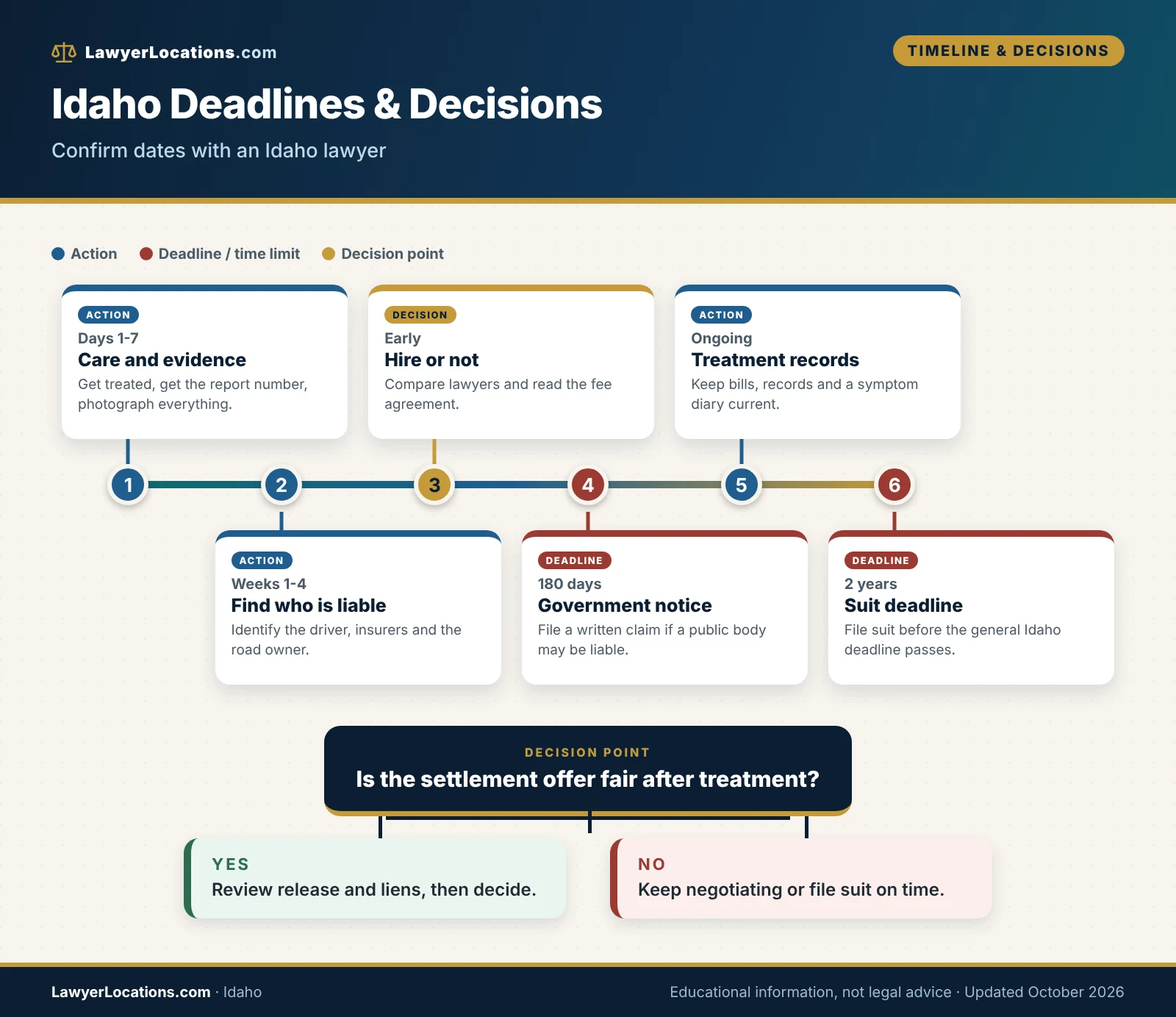
Text version of this graphic
- Days 1-7 (action): Get care; get the crash report number; photograph everything.
- Weeks 1-4 (action): Identify the driver, insurers and the road owner.
- Early (decision): Compare lawyers and read the fee agreement.
- Within 180 days (deadline): If a city, county or state body may be responsible, file the written claim.
- During treatment (action): Keep records, bills and a symptom diary current.
- Before two years (deadline): File suit unless the claim has settled.
- Decision point: Is a settlement offer fair after your treatment is complete? If yes, review the release and lien terms; if no, continue negotiation or file suit.
The 180-day and two-year dates
The government-claim notice period of 180 days in Idaho Code 6-905 and 6-906 and the two-year suit period in Idaho Code 5-219(4) can run at the same time. Missing the first can end a government claim even though the second has plenty of time left. If you are unsure who owns the road, treat the 180-day window as live until a lawyer tells you otherwise.
If a pothole, grate, path defect or other public-property condition may have contributed to your fall, ask about the 180-day notice in your first conversation, not your fifth.
Insurance policy deadlines
Your own insurance policy may have separate notice or claim requirements that differ from the statutes. Uninsured and underinsured motorist claims in particular depend on policy language, so read the notice provisions and report promptly. A lawyer can check whether your policy imposes time limits that are shorter than the statutory ones.
Keep a written log of every call and letter with an insurer, including the date, the name of the person you spoke with, and what was said.
When to accept an offer
A settlement offer is a decision point, not a deadline you must meet on the insurer’s schedule. Before accepting, you should know the full extent of your injuries, the total of medical bills and expected future care, the amount of any liens, and the fee and expense deductions. A lawyer can prepare a net-to-client estimate so you can compare the offer to what you actually keep.
If the offer expires while you are still deciding, ask the lawyer whether it can be extended in writing and what the filing deadline looks like if talks fail.
| Item | Timing | Source or note |
|---|---|---|
| Injury lawsuit against a private party | Two years under the general rule | Idaho Code 5-219(4); continuing consequences do not extend the period. |
| Written claim to a political subdivision | 180 days from when the claim arose or should have been discovered, whichever is later | Idaho Code 6-906; filed with the clerk or secretary of the entity. |
| Written claim to the State of Idaho | Same 180-day structure | Idaho Code 6-905; submitted to the Secretary of State. |
| Your own insurance notice | As your policy states | Read the policy; notice terms vary. |
| Settlement release | Before you sign | Get the release reviewed; it can end the claim permanently. |
| Noneconomic damages cap | Adjusted every July 1 | Idaho Code 6-1603; check the figure for your injury date. |
Mistakes, Red Flags and Next Steps
The most costly bicycle claim mistakes are quiet ones: waiting too long, saying too much too early, and signing paperwork without reading it. Most are avoidable with a little structure.
Common mistakes after an Idaho bicycle crash
These mistakes show up again and again in injury claims generally. They are easy to avoid once you know them.
Moving too fast with insurers
Accepting a quick payment, giving a long recorded statement, or signing medical authorizations that open your entire health history can all weaken a claim. Insurers may also ask early whether you were wearing a light or helmet or whether you stopped at a sign, because Idaho’s less-than rule makes your share of fault a central issue.
- Accepting a settlement before you know the full extent of your injuries
- Posting about the crash, your activity level or your recovery on social media
- Skipping appointments or leaving gaps in treatment without explanation
- Repairing or discarding the bike, helmet or clothing too soon
- Assuming the claim deadline is the same for every defendant
Waiting on deadlines
The statute does not reward delay. Memory fades, witnesses move, video is overwritten and the two-year and 180-day periods keep running. Even if you are not sure you want a lawyer, a short consultation to confirm which deadlines apply can protect your options.
If a family member was killed in a bicycle crash, the same urgency applies, and the filing period for a death claim is part of the same statute discussed earlier. Our guide to wrongful death lawyer costs explains how fees usually work in those cases.
Red flags when hiring
Most lawyers are professional and straightforward, but some marketing and some intake practices deserve caution. A few warning signs apply almost everywhere.
Promises and pressure
No lawyer can honestly promise a result or a dollar figure at the first call. Be cautious with anyone who assures you of a win, pressures you to sign on the spot, or discourages you from talking to other lawyers. A good lawyer explains the risks and lets you take the agreement home.
- Promises of a specific outcome or settlement amount
- Pressure to sign the same day with no time to read
- Unwillingness to put fee and expense terms in writing
- Vague answers about who will actually handle the case
Unclear fee or communication terms
If you cannot tell from the agreement what you would owe in each scenario, ask for a revised version. If calls and messages go unanswered during the intake stage, expect more of the same later. Ask in advance what happens to fees and expenses if you later change lawyers, and make sure the answer is in the agreement.
A written fee agreement that tracks the items in Idaho’s Rule 1.5(c) is a good starting point for comparison. If a lawyer’s draft leaves out items that the rule lists, ask why.
Your next steps
You do not have to settle every question at once. A short, ordered plan keeps you moving without pressure.
A short action plan
- Protect your health. Keep treatment appointments and save every bill and record.
- Secure the record. Get the crash report number, photos and witness details.
- Identify the deadlines. Find out who owns the road and calendar the earliest date.
- Compare lawyers. Use the scorecard and request the written fee agreement from each.
- Decide with the numbers. Ask for a net-to-client estimate before accepting any offer.
Ready to compare your options?
Use the scorecard and checklist in this guide to speak with more than one Idaho lawyer, ask for the fee agreement in writing, and calendar your earliest deadline. If you want the bigger picture on filing deadlines first, read our guide on how long you have to file a personal injury claim.
Quick answers to common Idaho bicycle questions
The short answers below cover questions people ask most often when they start looking for a bicycle accident lawyer in Idaho.
How long do I have to sue after a bicycle accident in Idaho?
The general rule for injury suits is two years under Idaho Code 5-219(4). Claims against a government body require a written claim within 180 days under Idaho Code 6-905 or 6-906.
Can I recover if I was partly at fault?
Under Idaho Code 6-801, you may recover if your fault is less than the fault of the person you are suing, and your damages are reduced by your share. If your share equals or exceeds theirs, recovery is barred under the statute’s wording.
Does Idaho require bicycle helmets?
The Title 49, chapter 7 section list reviewed for this guide includes no helmet section. A city may have its own ordinance, and an insurer may still raise helmet use when arguing about fault, so ask a lawyer how it could affect your claim.
Do I have to stop at a stop sign on a bike in Idaho?
Idaho Code 49-720 requires a rider to slow down and, if safety requires, stop, and to yield to vehicles in or approaching the intersection. After yielding, the rider may proceed with caution. Red lights have a separate rule.
What if the driver had no insurance?
Your own uninsured motorist coverage may apply if your policy includes it. Idaho Code 41-2502 requires insurers to include the coverage unless the named insured rejects it in writing.
What is the minimum insurance an Idaho driver must carry?
Under Idaho Code 49-117, the minimum liability limits are $25,000 for one person’s injury, $50,000 for two or more people, and $15,000 for property damage in one accident. Many drivers carry more, and some carry no valid coverage.
How is a bicycle accident lawyer paid in Idaho?
Many injury lawyers use contingent fees, which must be in a writing signed by the client under Rule 1.5(c). The writing must state the percentage and which expenses come out of the recovery.
Is there a cap on pain-and-suffering damages?
Idaho Code 6-1603 caps noneconomic damages, with a base of $250,000 adjusted each July 1 and exceptions for willful or reckless misconduct. Ask your lawyer for the current figure.
Where can I find a bicycle accident lawyer near me in Idaho?
The Idaho State Bar Lawyer Referral Service is one starting point, and Court Assistance Offices can refer you to it. Confirm any lawyer’s Idaho license and compare at least two before signing.
Can I get the crash report myself?
Crash reports are available through the Idaho Transportation Department’s Office of Highway Safety order form for a per-copy charge plus a transaction fee, according to the department’s page.
General information only. This guide is a legal-education resource from LawyerLocations.com, which is not a law firm and does not provide legal advice or lawyer recommendations. Reading it does not create an attorney-client relationship. Laws, court rules, fees and agency procedures change, and the facts of your crash matter. Consult a lawyer licensed in Idaho about your situation.
Sources & References
Show all 23 sources
- Idaho Code 5-219, Actions against officers, for penalties, on bonds, and for professional malpractice or for personal injuries — Idaho Legislature — legislature.idaho.gov — accessed October 2026
- Idaho Code 6-801, Comparative negligence or responsibility — Idaho Legislature — legislature.idaho.gov — accessed October 2026
- Idaho Code 6-802, Special verdicts on comparative responsibility — Idaho Legislature — legislature.idaho.gov — accessed October 2026
- Idaho Code 6-904, Exceptions to governmental liability — Idaho Legislature — legislature.idaho.gov — accessed October 2026
- Idaho Code 6-905, Filing claims against the state — Idaho Legislature — legislature.idaho.gov — accessed October 2026
- Idaho Code 6-906, Filing claims against political subdivision or employee; time — Idaho Legislature — legislature.idaho.gov — accessed October 2026
- Idaho Code 6-926, Limit on liability — Idaho Legislature — legislature.idaho.gov — accessed October 2026
- Idaho Code 6-1603, Limitation on noneconomic damages — Idaho Legislature — legislature.idaho.gov — accessed October 2026
- Idaho Code 6-1606, Collateral source offset — Idaho Legislature — legislature.idaho.gov — accessed October 2026
- Idaho Code Title 49, chapter 7, Pedestrians and Bicycles (section list) — Idaho Legislature — legislature.idaho.gov — accessed October 2026
- Idaho Code 49-714, Traffic laws apply to operators or riders of human-powered vehicles, bicycles, or electric-assisted bicycles — Idaho Legislature — legislature.idaho.gov — accessed October 2026
- Idaho Code 49-717, Position on highway — Idaho Legislature — legislature.idaho.gov — accessed October 2026
- Idaho Code 49-720, Stopping, turn and stop signals — Idaho Legislature — legislature.idaho.gov — accessed October 2026
- Idaho Code 49-723, Light and reflector required at night — Idaho Legislature — legislature.idaho.gov — accessed October 2026
- Idaho Code 49-632, Overtaking and passing — Idaho Legislature — legislature.idaho.gov — accessed October 2026
- Idaho Code 49-117, Definitions (proof of financial responsibility) — Idaho Legislature — legislature.idaho.gov — accessed October 2026
- Idaho Code 41-2502, Uninsured and underinsured motorist coverage — Idaho Legislature — legislature.idaho.gov — accessed October 2026
- Idaho Code 1-2301, Small claims department — Idaho Legislature — legislature.idaho.gov — accessed October 2026
- About the Courts (Idaho court structure) — Idaho Supreme Court — isc.idaho.gov — accessed October 2026
- Court Assistance Offices: About Us — Idaho Supreme Court — courtselfhelp.idaho.gov — accessed October 2026
- Lawyer Referral Service — Idaho State Bar — isb.idaho.gov — accessed October 2026
- Idaho Rule of Professional Conduct 1.5, Fees (PDF) — Idaho State Bar — isb.idaho.gov — accessed October 2026
- Submit a Crash Report Request — Idaho Transportation Department — itd.idaho.gov — accessed October 2026
Legal Disclaimer and Limitation of Liability
Informational and illustrative purposes only. This article was prepared by LawyerLocations.com solely on the basis of the information available to us at the time of writing. It is an illustrative, general overview. It is not a complete or authoritative statement of the law, and it has not been reviewed by a lawyer licensed in your state or county.
Not legal advice. Nothing in this article is legal, financial, tax or immigration advice, and reading it does not create an attorney-client relationship between you and LawyerLocations.com or any author, lawyer or firm mentioned. Laws, court rules, fees, filing deadlines and agency procedures differ by state, county and court, and they change often. Some details here may be simplified, incomplete or out of date, and time limits for legal claims can be short.
No warranty. We make no representation or warranty, express or implied, about the accuracy, completeness, timeliness or suitability of this content for your situation. Please do not rely on it to make, delay or skip any legal decision. Check the facts against official sources and speak with a licensed attorney in the relevant jurisdiction before you act.
Limitation of liability. To the fullest extent permitted by law, LawyerLocations.com and its owners, authors and contributors disclaim all liability for any loss, damage, cost or other consequence arising from the use of, or reliance on, this article, including any content on third-party websites we link to. Mentioning a lawyer, firm, organization or service is not an endorsement and is not a promise of any result. If you are in immediate danger, contact your local emergency number.