
Do I need a lawyer after a car accident? Not always, but a consultation is worth considering whenever someone was hurt, fault is disputed, or an insurer is pushing back. Minor fender-benders with no injuries and a cooperative insurer are often settled without counsel. Injury claims are different: the rules are set by state law, deadlines vary, and a signed release usually ends the claim for good.
This U.S. guide explains when handling a claim yourself is realistic, what a car accident lawyer does, how contingency fees work, which state rules change the answer, and how to compare lawyers before you commit.
When you can handle a claim yourself and when to talk to a lawyer
The honest answer to “do I need a lawyer after a car accident” is that it depends on three things: how badly anyone was hurt, how clear the fault is, and how the insurance company behaves once you file. This section gives you a simple way to sort your own situation before you spend time or money on anything.
The short answer: it depends on injury, fault and insurance
No law requires you to hire a lawyer after a crash. You are free to deal with insurers yourself, and many people with small, clear-cut claims do. The question is whether going alone costs you more than a lawyer would. That depends on what is at stake and how much the other side disputes.
Situations where handling it yourself is often reasonable
A do-it-yourself approach tends to fit when the facts are simple and the dollar amounts are modest. If nobody needed medical treatment, the other driver admits fault, and the repair estimate is the only real loss, a lawyer may add little. A good rule of thumb is that the more of the claim you can prove with a few documents, the easier it is to handle without help.
- No one reported pain, and no one saw a doctor, urgent care or an emergency room because of the crash.
- The other driver’s insurer has accepted fault in writing or through a clear police report.
- Your loss is limited to vehicle repair or replacement, plus perhaps a rental car.
- The insurer is returning calls, paying on time and not asking for broad medical releases.
Even then, keep your paper trail. Photos, the repair estimate and every email protect you if the insurer changes its position later.
Situations where a consultation is usually worth the time
A consultation is a conversation, not a commitment. Many lawyers who take injury cases offer an initial call or meeting at no charge, but that is each firm’s own policy, so ask when you schedule. You walk away knowing whether your claim is worth pursuing and what deadline applies in your state.
Treat the first call as a fact-finding step. You can ask what the lawyer thinks of your facts, how the fee agreement would work, and whether your situation looks simple enough to handle alone. no obligation to sign on the first call.
| Your situation | Handling it yourself | Consultation worth considering? |
|---|---|---|
| Minor property damage only, other driver clearly at fault | Often realistic; keep estimates and photos | Usually optional |
| Minor injury, treated once, fully recovered quickly | Possible, but do not sign a release until you are sure you have healed | Optional, but a quick call can confirm your deadline |
| Injury needing ongoing treatment, therapy or specialist care | Harder; the value of the claim depends on future care you cannot yet price | Yes, generally |
| Fault is disputed or you are blamed in part | Hard; state fault rules can reduce or even bar recovery | Yes |
| Other driver is uninsured or underinsured | Complex; your own policy may be the source of payment | Yes, generally |
| Insurer denies, delays or lowballs the claim | Possible, but escalation often requires legal leverage | Yes |
| A death, a child, a commercial truck or a government vehicle is involved | Not advisable alone | Yes, promptly |
Warning signs a claim has become more complicated than it looks
Claims often start simple and get harder. A sore neck on day one can turn into months of physical therapy, and an insurer that sounded friendly on day two can become difficult once the bills grow. These are the signals that tend to change the calculation.
Medical red flags
Injuries that appear slowly are the classic trap. Soft-tissue pain, headaches, dizziness and back or neck stiffness can surface hours or days after a crash, and some conditions only become clear after imaging or a specialist visit. If your doctor mentions possible surgery, injections, a referral to a specialist, time off work or a permanent limitation, the value of the claim is no longer easy to estimate on your own.
- Symptoms are getting worse or new ones are appearing weeks after the crash.
- Your doctor has not yet said you have reached maximum improvement, so you cannot know the final medical bills.
- You cannot work, or you can work only with restrictions.
- A child, an older adult or a passenger in your car was also injured.
Insurance and fault red flags
Insurance problems tend to cluster around a few moves. An adjuster who asks for a recorded statement early, offers a quick payment, suggests you were partly at fault, or sends a release before you have finished treatment is doing ordinary business, but each of those moments can narrow your options. Delays, silence, or a flat denial are separate signs that you may need help.
A release is a document that ends your right to claim more money for the crash. Once you sign and cash the check, you generally cannot reopen the claim if your injuries turn out to be worse. Do not sign one until your treatment picture is clear.

Text version of this graphic
- Get safe and get checked. Seek medical care and report the crash as your state requires.
- Document everything. Photos, names, insurance details, the police report number.
- Notify your own insurer. Report the crash promptly and read your policy’s reporting terms.
- Sort your situation. Injuries, fault and insurer behavior decide how complex the claim is.
- Decide: handle it or consult. A consultation is a low-pressure way to test the question.
- Treat and track. Follow medical advice and keep bills, records and a symptom log.
- Negotiate or file. Settle only after you understand your injuries, or file suit before your state’s deadline.
Why the question comes up so often
Car crashes are one of the most common reasons ordinary people deal with the legal system. Most people have never made an injury claim before, so the process feels unfamiliar, and insurance language is dense. That uncertainty is exactly why so many people search for this answer, and why it helps to understand the basic mechanics before deciding.
How an auto claim is actually paid
A car accident claim is usually a request for payment from an insurance company, not a courtroom battle. Depending on your state and the facts, money may come from the at-fault driver’s liability coverage, from your own policy (for example, personal injury protection, medical payments or uninsured motorist coverage), or from a mix. Many claims resolve through negotiation without a trial, but the possibility of filing suit is what gives a claim its leverage. For step-by-step guidance on the first hours after a crash, see our guide on what to do after a car accident.
Why lawyers get involved even in “simple” cases
Insurers employ trained adjusters whose job is to evaluate and limit what the company pays. That does not make them dishonest, but their interests differ from yours. A lawyer’s role is to put the claim in a form the insurer must take seriously, to track the deadline, and to press for the full value of the loss rather than the first number offered.
Hiring a lawyer does not mean going to court. In many injury matters the lawyer’s work is investigation, documentation and negotiation. Whether a case is ever filed is a decision you make with your lawyer based on the facts.
What a car accident lawyer does and how the fees work
A car accident lawyer investigates the crash, gathers and organizes proof of your losses, values the claim, negotiates with insurers and, if needed, files and litigates a lawsuit. Most injury lawyers are paid through a contingency fee, meaning a percentage of the recovery rather than an hourly bill. This section explains both the work and the money, using the ethics rule that governs how those fee agreements must be written.
The work a lawyer does on an injury claim
It helps to picture the claim as a project with several phases. A lawyer may do some or all of these tasks, and you can ask in a consultation which of them the firm would handle and which would fall to you.
Investigation and evidence
Early in a claim, the lawyer or staff typically request the crash report, identify every insurance policy that might apply, and send preservation letters so that records are not lost. In more serious matters, they may gather photos, vehicle data, witness contact details, nearby video, and medical records. Time matters here because surveillance footage and some vehicle data can be overwritten.
- Police or crash report and the report number
- Photos and video of vehicles, the scene, road conditions and visible injuries
- Names and contact details for drivers, passengers and witnesses
- Every insurance policy that might apply, including your own
- Medical records, bills and work-loss documentation
Valuing the claim and negotiating
Putting a number on a claim is not a formula. It generally involves past and future medical costs, lost income, property damage and the human impact of the injury, such as pain and limits on daily life. A lawyer packages that proof into a demand to the insurer and negotiates from there. If talks stall, the lawyer can advise on filing suit before the deadline.
A demand letter is a written request to the insurer that explains what happened, why the other driver is responsible, what your losses are, and what amount of compensation you are seeking.
How contingency fees work
With a contingency fee, the lawyer is paid only if there is a recovery, and the fee comes out of that recovery. That structure is why people without cash on hand can still obtain legal help after a crash. But the details matter, and they must be in writing.
What the written agreement must say
The American Bar Association’s Model Rule 1.5 is a model that states adopt in their own versions, so exact wording varies by state. The model rule says a contingent fee agreement should be in a writing signed by the client. It should state how the fee is determined, including the percentage that applies if the case settles, goes to trial or is appealed, which litigation expenses come out of the recovery, and whether those expenses are deducted before or after the fee is calculated. The rule also says the agreement must clearly notify you of any expenses you may owe whether or not you win, and that at the end the lawyer must give you a written statement showing the outcome and how any recovery was divided.
Two agreements can both say “one-third,” yet produce different take-home amounts. If the fee is calculated on the gross recovery and expenses are then subtracted from your share, you receive less than if expenses are deducted first. Ask the lawyer to walk through a numbers example using a round hypothetical, such as a $30,000 settlement, so you can see the difference. ask for a worked example
Some states also cap or regulate contingency percentages in injury cases, and the rules vary. Check your state bar’s guidance or ask the lawyer how your state’s rules apply. In every state, the fee must be reasonable; the ABA model rule lists factors such as the time and skill required, the customary local fee and the results obtained.
Costs, liens and what you take home
Your net recovery is not just the settlement minus the fee. Case expenses, such as records fees, filing fees, expert reports and depositions, are separate from the lawyer’s fee, and the agreement says who advances them and how they are repaid. Liens, which are legal claims on your recovery by those who paid your medical bills, may also reduce your share. Common lienholders include health insurers, hospitals and, for Medicare beneficiaries, the federal program.
- A fee agreement that is only oral, or that you are asked to sign without time to read it.
- No explanation of what you owe if the case does not succeed.
- Vague language about “costs” without saying who advances them or how they are repaid.
- Pressure to sign before you have had a chance to compare other lawyers.
Other ways lawyers charge
Contingency is common in injury work, but it is not the only model. Knowing the alternatives helps you recognize a fair arrangement and decide whether a limited form of help would meet your needs.
Hourly, flat-fee and limited-scope help
Some lawyers will review a settlement offer or a release for an hourly or flat fee, even if they will not take the whole claim. This is sometimes called limited-scope representation and can be a middle path for a modest claim. You keep control of the negotiation, while the lawyer checks the paper before you sign.
| Fee model | How it works | What to confirm in writing |
|---|---|---|
| Contingency fee | The lawyer is paid a percentage of any recovery; typically nothing is owed as a fee if there is no recovery | The percentage at each stage, which expenses are deducted and when, and what you owe if you lose |
| Hourly | You pay for time spent, whether or not you recover | Hourly rate, who bills time, retainer amount and billing frequency |
| Flat fee for a limited task | A set price for a defined service, such as reviewing a release or offer | Exactly what is and is not included, and what happens if the task grows |
| Hybrid | A mix, such as a reduced hourly component plus a percentage | How the pieces add up and whether any part is refundable |
Fees for a claim you could settle without a lawyer
If a claim is small, a percentage fee may take a noticeable bite out of a modest recovery, and the lawyer may be reluctant to take the case. That is not a reason to give up. Ask whether the lawyer would be willing to review the offer for a flat fee, or whether another route, such as your own insurer’s coverage or small claims court for property damage, fits better. For a deeper look at how the process unfolds over time, read our guide to the car accident settlement timeline.
Because LawyerLocations.com is a legal-education and lawyer-discovery resource and not a law firm, it does not quote fees or promise any specific lawyer will take a case. Ask each lawyer you speak with to explain their own fee terms in writing.
State rules that change the answer: deadlines, fault and no-fault
Car accident claims are governed mainly by state law, so the right answer in Texas can differ from the right answer in New York. Three rules matter most: how long you have to file suit, how your own share of fault affects your recovery, and whether your state uses a no-fault system for medical bills. Check your state’s current rule, because legislatures change them.
Filing deadlines differ from state to state
A statute of limitations is the legal deadline to file a lawsuit. If you miss it, a court will usually dismiss your case no matter how strong it was. The deadline for injuries from a crash is set by each state, and it is not the same as the deadline to report a claim to an insurer. For a full walkthrough, see our guide on how long you have to file a personal injury claim.
Examples from five large states
The table shows the personal injury deadlines in five states, as read from the state statute text. These are examples, not a substitute for checking your own state, and the start date of the clock (when the claim “accrues”) can raise its own questions.
| State | Deadline to file suit | Statute | Note |
|---|---|---|---|
| California | 2 years | Code of Civil Procedure 335.1 | Covers injury to, or death of, a person caused by another’s wrongful act or neglect |
| Texas | 2 years | Civ. Prac. & Rem. Code 16.003(a) | Runs from when the cause of action accrues |
| New York | 3 years | CPLR 214(5) | Personal injury damages, with listed exceptions in other sections |
| Florida | 2 years | Fla. Stat. 95.11(5)(a) | Negligence actions; reduced from four years for claims accruing on or after March 24, 2023 |
| Illinois | 2 years | 735 ILCS 5/13-202 | Actions for damages for injury to the person, “within 2 years next after the cause of action accrued,” subject to the statute’s carve-outs |
Do not wait for the deadline to decide. A lawyer needs time to gather records, and a lawsuit filed on the last day leaves no room for problems. If you are even close to your state’s deadline, speak with a lawyer licensed in your state right away.
Exceptions, government defendants and shorter notice periods
Deadlines are not always as simple as one number. Some situations pause or change the clock, such as injuries to children, claims where the injury was discovered later, or crashes involving a public employee or a government vehicle. Claims against cities, counties, states and other public bodies often come with special written-notice requirements that can be much shorter than the ordinary deadline, so ask a lawyer or the clerk of court how it works where you live.
If a city bus, a police car, a school vehicle or a government-owned truck was involved, treat the deadline as urgent and unclear until someone licensed in your state confirms it. Special notice rules may apply well before the ordinary filing deadline.
How fault rules affect what you can recover
Most states do not require the other driver to be 100 percent at fault for you to recover something. Instead they compare each person’s share of responsibility. How that comparison works is one of the biggest reasons lawyers matter when fault is disputed.
Comparative fault: reduce or bar
Under comparative fault, a court or insurer assigns each person a percentage of blame, and your recovery is reduced by your percentage. Some states stop there. Others add a cutoff, so that if you are more at fault than a certain threshold, you recover nothing. Some states apply stricter rules than most, so do not assume yours is lenient.
| State | Rule in brief | Source |
|---|---|---|
| Texas | A claimant may not recover if their percentage of responsibility is greater than 50 percent; otherwise recovery is reduced by their share | Civ. Prac. & Rem. Code 33.001 |
| Florida | Modified comparative negligence after the 2023 reform: a plaintiff found more than 50 percent at fault generally recovers nothing, applying to causes of action filed on or after March 24, 2023 | HB 837 (2023), as summarized by Cozen O’Connor |
| New York | The claimant’s own fault does not bar recovery; damages are reduced in proportion to it, subject to an exception for certain no-fault-related claims | CPLR 1411 |
Notice what this means in practice. In a state with a 50 percent bar, an argument over whether you were 45 or 55 percent responsible can decide whether you recover anything. That is a high-stakes disagreement to take on alone.
How insurers use shared-fault arguments
Adjusters often test for shared fault, asking whether you were looking at your phone, whether you braked in time, whether you were speeding. Statements made early, before you know the full picture, can be used later. Keep your account factual, avoid guessing about speeds or distances, and never apologize in a way that could be read as admitting fault.
- Saying “I’m fine” at the scene, then relying on that statement later when pain develops.
- Guessing at speeds, times or distances in a recorded statement.
- Posting about the crash, your activities or your injuries on social media.
- Skipping treatment gaps that an insurer can describe as proof your injuries were minor.
No-fault states and injury thresholds
Some states use no-fault auto insurance, in which your own policy pays certain medical bills and lost income regardless of who caused the crash. The ability to sue the at-fault driver is then limited to more serious injuries. If you live in or crashed in a no-fault state, the question “do I need a lawyer after a car accident” often turns on whether your injuries clear that threshold.
Florida: personal injury protection and the 14-day rule
Florida’s no-fault statute provides personal injury protection (PIP) benefits that pay 80 percent of reasonable medically necessary expenses and 60 percent of lost income, within a combined limit of $10,000, and the benefits depend on receiving initial services and care within 14 days after the crash. The statute also limits reimbursement to $2,500 if a qualified provider determines no emergency medical condition existed (Fla. Stat. 627.736). The practical lesson: see a medical provider promptly, because delay can cost you benefits that your own policy already pays for.
In Florida, the 14-day treatment window for PIP benefits is separate from the lawsuit deadline. Missing it can reduce what your own insurer pays, even if you have plenty of time to file a lawsuit.
New York: “serious injury” and basic economic loss
New York’s Insurance Law defines “basic economic loss” as covering up to $50,000 per person of medical costs, lost earnings (up to $2,000 per month for up to three years), and other reasonable expenses, within the limits of the statute. To sue for pain and suffering, an injured person generally must show a “serious injury,” defined in section 5102(d) to include death, dismemberment, significant disfigurement, a fracture, loss of a fetus, permanent loss of use of a body organ, member, function or system, permanent consequential limitation of use of a body organ or member, or significant limitation of use of a body function or system. Whether a particular injury meets those words is a fact-heavy question that is a common reason people consult a lawyer in no-fault states.
A threshold is the minimum level of injury your state requires before you can sue for pain and suffering. It does not stop you from collecting your medical bills and lost wages through no-fault benefits.
Not sure whether your state is a no-fault state? Check your own policy declarations and your state insurance department’s consumer page. If a crash involves an uninsured driver, see our guide on uninsured motorist claims and lawyers.
Handling the insurance claim yourself, step by step
If you decide to handle the claim without a lawyer, you can do it carefully. The goal is to protect your health, build a clean record, and avoid the three mistakes that cannot be undone: a premature release, a damaging statement, and a missed deadline. This section walks through the nuts and bolts.
Talking to adjusters without hurting your claim
You will probably deal with at least two insurers: your own and the other driver’s. Your duties to each are different, and mixing them up is a common trap.
Your own insurer versus the other driver’s insurer
Your policy usually requires you to report a crash promptly and cooperate with your insurer. Do that. The other driver’s insurer owes you no such duty; it represents its own policyholder. You can give it basic facts such as your name, the date and place of the crash and your vehicle details, but you are generally not required to give it a recorded statement or broad access to your medical history.
Keep communication with the other driver’s insurer in writing when you can, or follow up every call with a short email summarizing what was said. written beats verbal
Recorded statements, early offers and releases
An adjuster may ask to record your account. You can politely decline until you have thought it through, or until you have spoken to a lawyer. Early settlement offers can feel generous when you are juggling bills, but they are often made before the full medical picture is known. Before you sign any release, make sure it covers only what you intend and that your treatment is finished or your future care is accounted for.
- A release that says it covers “all claims, known and unknown.”
- A payment offered with a deadline that expires within days.
- A request for a blanket medical authorization instead of records tied to the crash.
- Pressure to settle before you have finished treatment.
Never sign something you have not read in full. If the language is unclear, take it to a lawyer for a flat-fee or hourly review before you sign, even if you plan to handle everything else yourself.
Medical bills, health insurance, Medicare and liens
Who pays your medical bills while the claim is pending is a practical question that shapes how you feel about the whole process. The answer depends on your coverage, your state and whether a program has to be repaid later.
Using health insurance, med-pay or no-fault coverage
You can often use your own health insurance for treatment and let the claim reimburse you later, although the health plan may have a right to be repaid from your recovery. Some auto policies include medical payments coverage, and no-fault states provide personal injury protection. Which source pays first depends on the policy and state law. Our guide to medical bills after a car accident explains the order in more detail.
Getting care is more important than worrying about who pays. Keep every bill, explanation of benefits and receipt, and tell each provider that the visit relates to a car accident so records are coded correctly.
Medicare and other repayment rights
If you are a Medicare beneficiary, federal rules matter. According to the Centers for Medicare & Medicaid Services, Medicare is a secondary payer when a liability insurer (including a self-insured entity), no-fault insurer or workers’ compensation entity is primarily responsible for the medical expenses. Medicare may pay first so you receive timely care, but those payments are “conditional” and must be repaid when you receive a settlement, judgment, award or other payment. Beneficiaries or their attorneys can contact Medicare’s Benefits Coordination & Recovery Center for conditional payment amounts, and a waiver of recovery can be requested only after a demand letter has been issued.
If you are on Medicare, tell the insurer and anyone helping you before you settle. A settlement that ignores Medicare’s repayment rights can create a bigger problem later. Medicare Secondary Payer
Private health plans, hospital liens and state Medicaid programs may have similar repayment rights, and the rules vary. Ask each one in writing for its claimed amount and how that amount was calculated.
Building the evidence file either way
Whether or not you ever hire a lawyer, a well-organized file strengthens your position. Good records make the difference between an adjuster guessing about your loss and an adjuster being shown your loss.
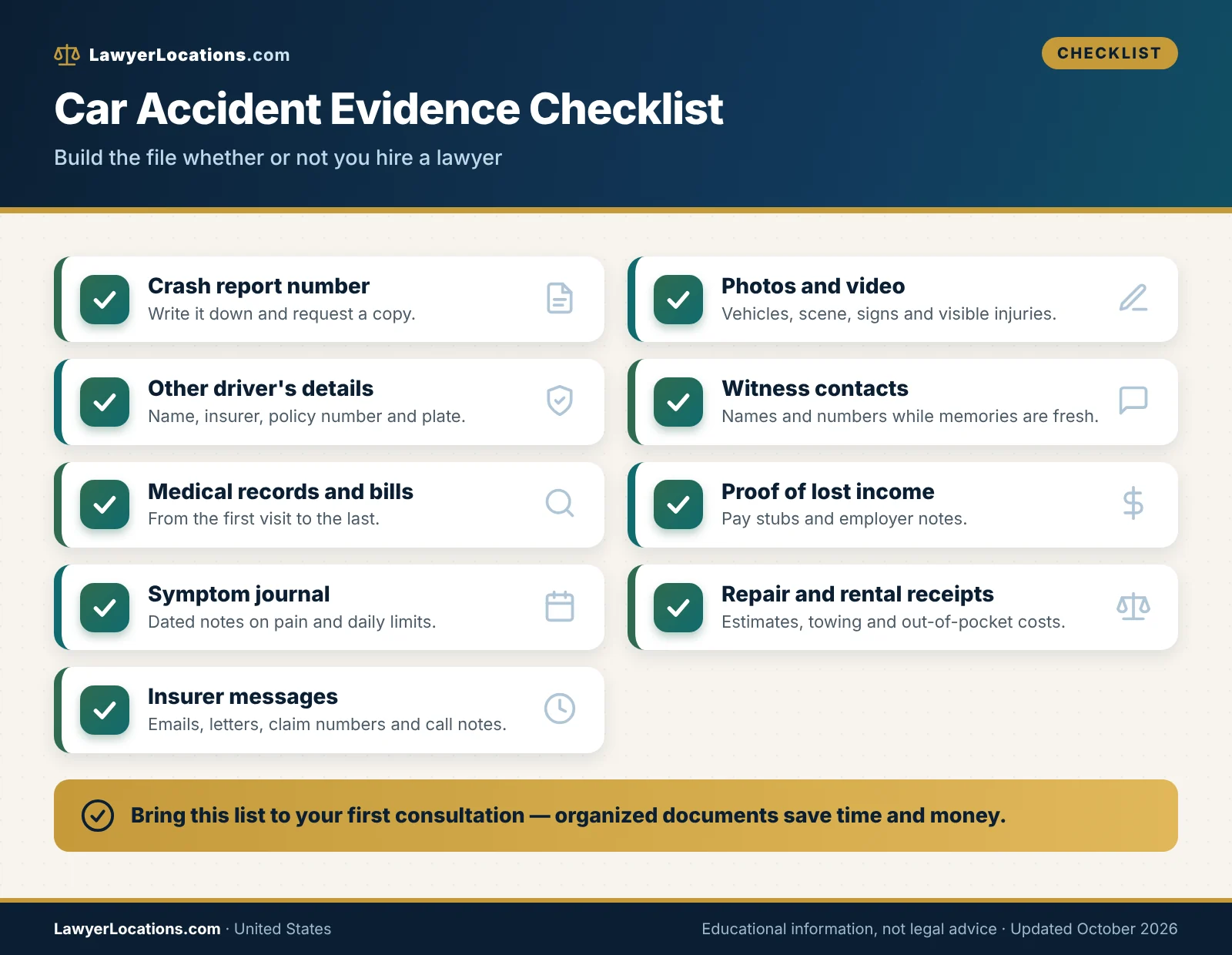
Text version of this graphic
- Crash report number. Write it down and request a copy.
- Photos and video. Vehicles, scene, signs, skid marks, injuries.
- Other driver’s details. Name, contact, insurer, policy number, plate.
- Witness contacts. Names and numbers while memories are fresh.
- Medical records and bills. From the first visit to the last.
- Proof of lost income. Pay stubs, employer notes, schedules.
- Symptom journal. Dated notes on pain, sleep and daily limits.
- Repair estimates and receipts. Vehicle, rental, towing, out-of-pocket costs.
- All insurer communications. Emails, letters, claim numbers, call notes.
The evidence checklist
Start the file on day one and add to it as you go. The checklist above covers what most claims need. Photos are the one item you cannot recreate later, so take more than you think you need, including the damage to every vehicle, the road, traffic signs and any visible injuries.
- Back up photos to a second location the same day.
- Ask the police department how to obtain the crash report and note the report number.
- Save every text and email with insurers; do not delete anything.
- Keep a running list of mileage to medical appointments.
Medical records and a symptom journal
Insurers weigh medical records heavily, and gaps in treatment are a common argument for paying less. Follow your provider’s treatment plan, keep your appointments, and tell your doctors about all symptoms, even ones that seem minor. A short daily note about pain levels, missed work and activities you cannot do gives you specific details to refer to later, rather than relying on memory.
“Day 12: Neck pain at 6 out of 10 after sitting through a work meeting. Could not lift my toddler. Skipped the gym.” Entries like this are short, dated and specific, which makes them more useful than a general statement later that you “had pain for a few weeks.”
How to find and compare a lawyer if you decide to hire one
If your situation points toward hiring a lawyer, the next step is finding a lawyer licensed in the state where the crash happened or where a case would be filed, then comparing more than one. Look for clear communication, a written fee agreement you understand, and experience with cases like yours. Avoid anyone who promises a result.
Where to look for a lawyer
You have more choices than a billboard or an ad. Checking a few different places gives you a fair picture of what is available in your area and prevents rushing into the first firm that calls.
Lawyer referral services and bar directories
The American Bar Association’s Find Legal Help page lists three ways to find a lawyer: lawyer referral services, which are public-service programs that help you find a lawyer; bar directories and lawyer finders offered by bar associations; and legal insurance or prepaid plans, for which subscribers pay a modest monthly cost. State and local bar associations typically run the referral services, and each has its own rules about fees and screening, so ask what the service does and does not check.
- Search your state bar’s website to confirm a lawyer is licensed and in good standing.
- Check the lawyer’s disciplinary record through the state bar, where the bar publishes it.
- Ask friends, family or coworkers who have been through an injury claim about their experience.
- If your crash was a rear-end collision, our rear-end accident lawyer guide covers the fault questions that come up most often.
Legal aid and low-cost options
If your income is limited, or if your claim is too small for a contingency lawyer, free and reduced-cost help may exist. LawHelp.org offers free legal rights information, court forms and referrals to nonprofit legal aid organizations in every state and territory, and you can find your state through its “Find Help by State” page. Legal aid programs often prioritize housing, family and benefits cases and may not take injury claims, but they can point you to other resources.
Many courts and bar associations run self-help centers that explain small claims procedures, which can be useful for a property-damage-only dispute. Search your county court’s website for “self-help.” check the clerk of court
Comparing lawyers on the things that matter
Two lawyers can say similar things in a consultation and run very different practices. A short list of questions, asked of every lawyer you talk to, makes the comparison fair.
Questions to ask at the consultation
Bring your evidence file, a short timeline of the crash and your treatment, and a list of questions. Ask the same questions of each lawyer so you can compare answers side by side. Pay attention to how clearly each person explains the process and whether they answer directly or deflect.
- Who will work on my case? Ask who handles daily communication and who makes decisions.
- How many injury cases like mine have you handled? Experience with similar crashes matters more than general claims.
- What is the fee, and what do I owe if I do not recover? Ask to see the written agreement before you decide.
- What case expenses should I expect? Ask who advances them and how they are repaid.
- What is my deadline, and when would you file suit? A good answer names the state rule and a plan.
- How will you keep me informed? Ask how often and by what method you will get updates.
- Who has authority to accept a settlement? The answer should be you, after advice.

Text version of this graphic
| Criterion | Question to ask | Weight |
|---|---|---|
| Licensing | Are you licensed in the state where my case would be filed? | High |
| Relevant experience | How many car accident injury claims have you handled? | High |
| Fee clarity | What percentage applies at each stage, and what expenses do I owe? | High |
| Written agreement | Can I take the fee agreement home to read? | High |
| Communication | Who will update me, and how often? | Medium |
| Case plan | What are the next steps and when would you file suit? | Medium |
| Willingness to try the case | Do you file suit when negotiations fail? | Medium |
| No guarantees | Do you avoid promising a result? | High |
Red flags when choosing a lawyer
A few warning signs are worth taking seriously. A lawyer who promises a specific outcome or settlement amount cannot know it yet, and rules of professional conduct generally restrict misleading claims about results. Pressure tactics, vague fee terms and unsolicited contact right after a crash deserve extra caution.
- Promises about the result or the dollar value of your case.
- A fee agreement you are not allowed to take home or review.
- Unsolicited calls, texts or visits shortly after the crash.
- Reluctance to explain who will actually handle your file.
- Asking you to sign a release or settle before you have finished treatment.
Be careful with anyone who contacts you first and asks for money up front to “process” an injury claim. Legitimate injury lawyers usually discuss the fee agreement openly and in writing.
A simple decision framework
If you are still unsure, run through a short framework. It will not tell you the right answer, but it will show you what drives your decision and where to focus your questions.
Weighing cost against risk
Consider what you could lose by handling the claim yourself, then compare that to what a lawyer might cost. A contingency fee reduces your share of a recovery, but a poorly handled claim can reduce it far more, or end it altogether through a missed deadline or a release signed too soon. The higher and less certain the stakes, the more a consultation is worth.
| If this is true | A reasonable next step |
|---|---|
| No injury, clear fault, cooperative insurer | Document, file the property claim, and keep records |
| Minor injury that has fully healed | Review any release carefully; consider a quick limited-scope review |
| Ongoing treatment or lost work | Book one or two consultations and compare fee terms |
| Fault disputed or shared | Consult a lawyer before giving a recorded statement |
| Insurer denies or stalls | Send written follow-up and consult a lawyer about escalation |
| Government vehicle, commercial truck or death involved | Consult a lawyer promptly; deadlines and rules may differ |
When the other vehicle is a truck or the claim is complex
Commercial vehicles bring additional parties, such as a driver, a trucking company and its insurers, and more evidence, such as logs and maintenance records. That added complexity is why many people treat these crashes differently. Our comparison of truck accident lawyers versus car accident lawyers explains what changes.
You can change your mind. If you hire a lawyer and later feel the relationship is not working, your state’s rules about changing lawyers and what happens to the fee apply. Ask about this in the fee agreement before you sign. ask about switching
Timeline, decision points, next steps and common questions
Whether you hire a lawyer or not, the same milestones apply: get care, protect evidence, track deadlines, and decide when a settlement offer is fair. This section lays out the sequence, gives you a short plan for the next week, and answers the questions people ask most when deciding if they need a lawyer after a car accident.
Costs, deadlines and decision points over time
Claims move in stages, and the right decision at each stage differs. Knowing the stages in advance keeps you from being rushed by an offer that arrives before you are ready to evaluate it.
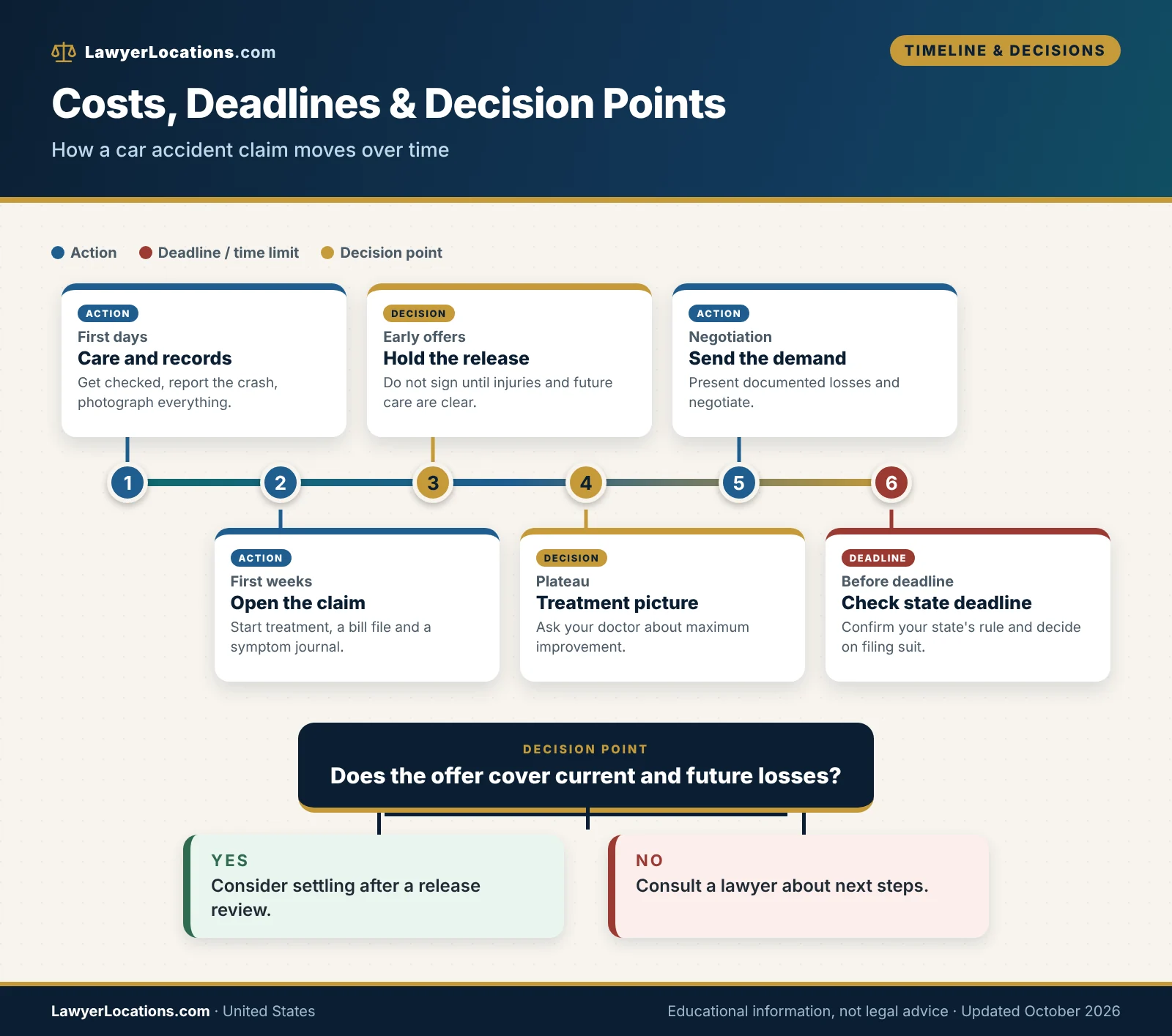
Text version of this graphic
- First days (action): Get medical care, report the crash, photograph everything, notify your insurer.
- First weeks (action): Start treatment, open the claim, keep a symptom journal and a bill file.
- Early offers (decision): Do not sign a release until your injuries and future care are clear.
- Treatment plateau (decision): Ask your doctor whether you have reached maximum improvement.
- Demand and negotiation (action): Send documented losses to the insurer and negotiate.
- Approaching deadline (deadline): Confirm your state’s filing deadline and decide whether to file suit.
- Decision question: Does the offer cover current and future losses? If yes, consider settling; if no, consult a lawyer about next steps.
The first days and weeks
In the first days, your main jobs are health and documentation. Get evaluated by a medical provider even if you feel fine, since some injuries show up late. Report the crash to your insurer, and keep notes on every call. In the first weeks, start the claim file described above and track any no-fault deadlines, such as Florida’s 14-day rule for PIP benefits.
Settlement offers and the filing deadline
The two moments that most often decide a claim are the first settlement offer and the filing deadline. Evaluate an offer only after you know what your treatment will involve, since a release usually ends the claim. As your state’s deadline approaches, either a settlement should be signed or a lawsuit should be filed, and a lawyer licensed in your state can tell you which fits. Our guide to the car accident settlement timeline shows how long each stage commonly takes.
Write your state’s filing deadline on a calendar today. Count from the date of the crash unless a lawyer tells you a different start date applies, and set reminders at least several months ahead. check your state’s rule
A simple next-steps plan
You do not need to solve everything this week. A few focused actions will put you in a stronger position whichever way you go.
This week
Get or keep medical care going, gather the documents on the evidence checklist, and write down your account of the crash while it is fresh. Notify your insurer, but hold off on recorded statements to the other side until you have thought it through.
- Schedule or keep every medical appointment.
- Save photos, bills and claim numbers in one folder.
- Write down your state’s filing deadline and any no-fault deadlines.
- Decline to sign any release for now.
If you decide to consult a lawyer
Pick two or three lawyers licensed in the relevant state, bring your file, and ask the same questions of each. Take the fee agreement home before you sign. If you also want to understand what a rear-end or truck crash changes, the related guides linked above go deeper.
Ready to compare your options?
Use the scorecard questions above to speak with a few lawyers licensed in your state, ask for the fee agreement in writing, and decide at your own pace. LawyerLocations.com is a legal-education and lawyer-discovery resource, not a law firm, and does not give legal advice.
Quick answers to common questions
These short answers address the questions people most often raise after a crash. They are general information, and the details depend on your state.
Questions people ask most
Do I need a lawyer if the accident was minor?
Not necessarily. If no one was hurt, fault is clear and the insurer is cooperating, many people handle the property claim themselves. If symptoms appear later, a short consultation can help you understand your options and deadline.
Do I need a lawyer if the accident was not my fault?
Being not at fault does not mean the claim will go smoothly. Insurers can still dispute fault, question your injuries or offer less than your losses. A lawyer is more useful when injuries are significant or when the insurer is disputing what happened.
How much does a car accident lawyer cost?
Most injury lawyers work on a contingency fee, which is a percentage of any recovery set out in a signed written agreement. The percentage and the treatment of case expenses vary by lawyer and sometimes by stage of the case, so ask to see the terms in writing.
Can I settle with the insurance company myself and still hire a lawyer later?
You can hire a lawyer at any time before your deadline, but once you sign a release and accept payment, the claim is generally over. If you are considering an offer, have a lawyer review the release before you sign.
How long do I have to file a car accident lawsuit?
It depends on your state. The examples above range from two to three years, and special rules apply to government defendants and some other situations. See our guide on filing deadlines for personal injury claims and confirm your own state’s rule.
Should I give the other driver’s insurer a recorded statement?
You are generally not required to. Many people decline until they have considered the risks or consulted a lawyer, especially when injuries are involved or fault is disputed.
What if the other driver has no insurance?
Your own policy may provide uninsured or underinsured motorist coverage, and the rules for those claims differ from ordinary liability claims. Read our guide on uninsured motorist claims and review your policy.
Who pays my medical bills while my claim is pending?
It depends on your coverage. Health insurance, medical payments coverage and, in no-fault states, personal injury protection may all be involved, and some payers have repayment rights from your recovery. See our guide to medical bills after a car accident.
What if I was partly at fault?
Most states reduce your recovery by your share of fault, and some bar recovery if your share is too high. For example, Texas bars recovery above 50 percent responsibility, while New York reduces damages in proportion to fault. Ask a lawyer how your state applies the rule.
Does hiring a lawyer mean I have to go to court?
No. Many injury matters are resolved through negotiation. Whether a lawsuit is filed is a decision you make with your lawyer based on the facts and the offers received.
Is a lawyer worth it for a small claim?
It can depend on the amount at stake and the fee terms. For modest claims, some people prefer a flat-fee or hourly review of an offer rather than a percentage arrangement. Ask the lawyer what makes sense for your numbers.
Questions to bring to your first call
Before you pick up the phone, write down your questions and your timeline. A prepared caller gets more useful answers and can compare lawyers more fairly.
- What is the filing deadline for my facts in this state?
- What fee percentage applies at each stage, and which expenses come out of my share?
- Who will handle my case day to day?
- Do you see any red flags in my situation, such as shared fault or a government vehicle?
- What would you want me to do, and not do, before we speak again?
If you decide a lawyer is not necessary, you have still made an informed choice. Keep your records for the length of the claim and at least until your state’s filing deadline has passed.
General information only. This guide is for general educational purposes and is not legal advice. Reading it does not create an attorney-client relationship, and LawyerLocations.com is not a law firm. Laws, deadlines, fees and court procedures change and differ by state and case; consult a lawyer licensed in the relevant jurisdiction about your situation.
Sources & References
Show all 14 sources
- Model Rules of Professional Conduct, Rule 1.5: Fees — American Bar Association — americanbar.org — accessed October 2026
- Find Legal Help: Hire a Lawyer — American Bar Association — americanbar.org — accessed October 2026
- California Code of Civil Procedure section 335.1 — Justia (state code mirror) — law.justia.com — accessed October 2026
- Texas Civil Practice and Remedies Code, Chapter 16, section 16.003 — Texas Legislature — tcss.legis.texas.gov — accessed October 2026
- Texas Civil Practice and Remedies Code section 33.001 — Public.Law (state code mirror) — texas.public.law — accessed October 2026
- New York CPLR section 214 — New York State Senate — nysenate.gov — accessed October 2026
- New York CPLR section 1411 — New York State Senate — nysenate.gov — accessed October 2026
- New York Insurance Law section 5102 — New York State Senate — nysenate.gov — accessed October 2026
- Florida Statutes section 95.11 — Florida Legislature — leg.state.fl.us — accessed October 2026
- Florida Statutes section 627.736 (personal injury protection) — Florida Legislature — leg.state.fl.us — accessed October 2026
- Fast and Furious: Tort Law Changes in Florida (HB 837 summary) — Cozen O’Connor — cozen.com — accessed October 2026
- 735 ILCS 5/13-202, Personal injury — Illinois General Assembly — ilga.gov — accessed October 2026
- Non-Group Health Plan Recovery — Centers for Medicare & Medicaid Services — cms.gov — accessed October 2026
- LawHelp.org: free legal information and legal aid referrals — LawHelp.org — lawhelp.org — accessed October 2026
Legal Disclaimer and Limitation of Liability
Informational and illustrative purposes only. This article was prepared by LawyerLocations.com solely on the basis of the information available to us at the time of writing. It is an illustrative, general overview. It is not a complete or authoritative statement of the law, and it has not been reviewed by a lawyer licensed in your state or county.
Not legal advice. Nothing in this article is legal, financial, tax or immigration advice, and reading it does not create an attorney-client relationship between you and LawyerLocations.com or any author, lawyer or firm mentioned. Laws, court rules, fees, filing deadlines and agency procedures differ by state, county and court, and they change often. Some details here may be simplified, incomplete or out of date, and time limits for legal claims can be short.
No warranty. We make no representation or warranty, express or implied, about the accuracy, completeness, timeliness or suitability of this content for your situation. Please do not rely on it to make, delay or skip any legal decision. Check the facts against official sources and speak with a licensed attorney in the relevant jurisdiction before you act.
Limitation of liability. To the fullest extent permitted by law, LawyerLocations.com and its owners, authors and contributors disclaim all liability for any loss, damage, cost or other consequence arising from the use of, or reliance on, this article, including any content on third-party websites we link to. Mentioning a lawyer, firm, organization or service is not an endorsement and is not a promise of any result. If you are in immediate danger, contact your local emergency number.