If you were hit on foot and are searching for a pedestrian accident lawyer San Antonio TX residents can compare with confidence, start with the clock. Texas generally gives you two years to file a personal injury lawsuit, and a claim against the City of San Antonio can require written notice in as little as 90 days. Texas also bars recovery if a jury finds you more than 50 percent responsible, so early evidence matters.
This guide explains the Texas pedestrian rules, the Bexar County courts and local agencies involved, how contingent fees and case expenses work, and how to compare lawyers before you sign anything.
How a Pedestrian Accident Lawyer Case Works in San Antonio, TX
A pedestrian injury claim in San Antonio is a Texas negligence case: you show that a driver (or another responsible party) failed to use reasonable care, that the failure caused your injuries, and that you suffered measurable losses. Most cases begin with an insurance claim and only some end up in a Bexar County courtroom. A lawyer’s job is to build the proof, deal with the insurers, and file suit before a deadline runs out if talks fail.
The first days after a crash in Bexar County
The first few days shape the whole claim because evidence disappears fast and early statements to insurers can be quoted back to you later. This section covers what matters before you ever speak with a lawyer.
Safety, medical care and 911
Move out of traffic if you can and call 911 so police and emergency medical crews are dispatched. Pedestrian injuries often look minor at the scene and turn out to involve fractures, head injuries or soft-tissue damage that surfaces hours later, so let paramedics evaluate you even if you feel “mostly fine.”
Medical records do double duty. They are how doctors treat you, and they are also the first proof that the crash caused your injuries. Follow your discharge instructions and keep every appointment, because gaps in treatment give an insurer room to argue that you were not really hurt.
The police report and who investigates
Depending on where the crash happened, the investigating agency may be the San Antonio Police Department, the Bexar County Sheriff’s Office or the Texas Department of Public Safety. Ask the officer for the report number before you leave the scene, and request a copy of the crash report from that agency once it is finished.
Read the report for mistakes. Check the spelling of names, the location, the lighting and weather notes, and the diagram. An officer’s fault finding is not binding on an insurer or a jury, but errors in basic facts are easier to correct early than months later.
Photograph the crosswalk, the signal heads, the road surface and the vehicle before the scene changes. If a nearby business has a camera, ask what its retention period is. Video is often overwritten within days, and a lawyer can send a preservation request quickly if you act fast.
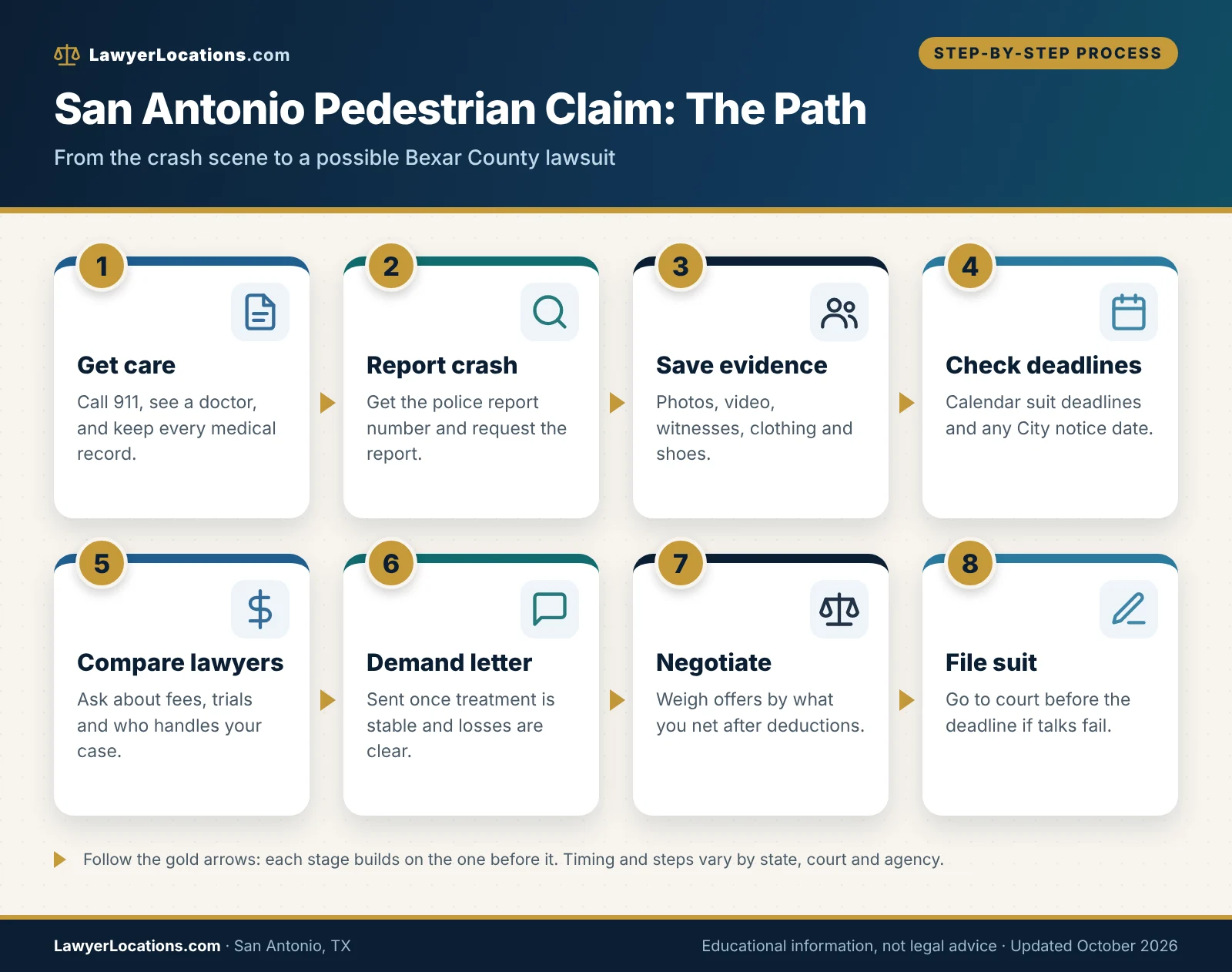
Text version of this graphic
- Get medical care and call 911; get the crash report number.
- Preserve evidence: photos, video, witness contacts, clothing, shoes and phone records.
- Calendar the deadlines, including any 90-day City notice.
- Talk with two or three lawyers and compare fee agreements.
- Your lawyer investigates, gathers records and identifies every insurance policy.
- Treatment reaches a stable point, then a demand letter goes to the insurer.
- Negotiate, and consider mediation if talks stall.
- File suit in a Bexar County court before the deadline if there is no fair resolution.
The Texas rules that decide fault
Fault in a pedestrian case is not a simple question of who had the walk signal. Texas law sets duties for both drivers and pedestrians, and the jury (or an adjuster) weighs how each person behaved.
What drivers must do for pedestrians
Under Tex. Transp. Code 552.003, a driver must stop and yield to a pedestrian crossing in a crosswalk when no traffic control signal is operating and the pedestrian is on the driver’s half of the road or approaching so closely from the other half as to be in danger. A driver who comes up behind a vehicle stopped for a pedestrian may not pass it.
A separate rule, Tex. Transp. Code 552.008, requires drivers to exercise due care to avoid colliding with a pedestrian on a roadway, to sound the horn when necessary, and to take proper precautions when they see a child or an obviously confused or incapacitated person on the road. This duty applies “notwithstanding” other provisions of the chapter, which is why a pedestrian who crossed in the wrong place can still have a claim.
When a pedestrian signal or traffic control signal is operating, a different section of the same chapter (552.002, “Pedestrian Right-of-way if Control Signal Present”) governs who goes first. Read the signal phase and timing in your lawyer’s investigation rather than relying on memory, because the details at a particular San Antonio intersection can decide the case.
What pedestrians must do
Pedestrians have duties too. Under Tex. Transp. Code 552.003(b), a pedestrian may not suddenly leave a curb or other place of safety and walk into the path of a vehicle that is so close the driver cannot yield.
Under Tex. Transp. Code 552.005, a pedestrian crossing outside a marked crosswalk, or outside an unmarked crosswalk at an intersection, must yield to vehicles on the roadway. Between two adjacent intersections that both have operating traffic signals, pedestrians may cross only in a marked crosswalk, and diagonal crossing at an intersection is allowed only when a traffic control device authorizes it.
None of this automatically ends a claim. Crossing mid-block, for example, makes you responsible for yielding, but the driver still owes the general duty of due care, and the jury decides how to divide responsibility.
Proportionate responsibility and the 50 percent bar
Texas uses a rule called proportionate responsibility. The jury assigns each person a percentage of fault, and under Tex. Civ. Prac. & Rem. Code 33.001 a claimant may not recover damages if his or her percentage of responsibility is greater than 50 percent. If you are 50 percent or less responsible, your damages are reduced by your share.
That 50 percent line is why insurers push hard on pedestrian “mistakes”: darting out, wearing dark clothing, looking at a phone, or crossing against a signal. Preserving objective evidence such as video, lighting conditions and vehicle speed data helps counter those arguments.
A jury finds a driver 70 percent at fault and a pedestrian 30 percent at fault, and total damages of $100,000. The pedestrian’s recovery would be reduced by his or her share, which is why your percentage is worth fighting over. If the same jury had found the pedestrian 51 percent at fault, the recovery would be barred entirely. This is a simplified illustration of how the rule works, not a prediction for any case.
| Rule | What it says in plain English | Why it matters to your claim |
|---|---|---|
| Tex. Transp. Code 552.003(a) | Drivers must stop and yield to a pedestrian in a crosswalk when no signal is operating and the pedestrian is on the driver’s half of the road or approaching closely. | Supports fault against a driver who failed to yield at a marked or unmarked crosswalk. |
| Tex. Transp. Code 552.003(b) | A pedestrian may not suddenly leave a curb or safe place and enter the path of a vehicle too close to yield. | An insurer may use this to assign you a share of the blame. |
| Tex. Transp. Code 552.005 | Pedestrians crossing outside a crosswalk must yield; between adjacent signalized intersections, cross only in a marked crosswalk. | Mid-block crossings raise a fault argument but do not erase the driver’s duties. |
| Tex. Transp. Code 552.008 | Drivers must use due care to avoid pedestrians on a roadway, sound the horn when necessary and take extra precaution around children or obviously confused or incapacitated people. | A general duty of care that applies even when other rules are in dispute. |
| Tex. Civ. Prac. & Rem. Code 33.001 | A claimant cannot recover if his or her responsibility is greater than 50 percent. | Your percentage of fault can reduce or bar recovery. |
Stages of a claim from demand to lawsuit
Most pedestrian claims follow the same arc: investigate, treat, demand, negotiate, and sue if needed. Knowing the sequence helps you judge whether a lawyer is moving the case along or letting it drift.
The insurance claim and demand letter
Your lawyer identifies every policy that might pay: the driver’s liability coverage, your own uninsured or underinsured motorist coverage if the driver has too little or no insurance, and any medical payments or personal injury protection coverage on a policy you hold. For more on that coverage, see our guide to uninsured motorist claim lawyers.
When your treatment has reached a stable point, the lawyer assembles medical records, bills, wage-loss proof and a narrative into a demand letter. Sending a demand too early can lock in a number before anyone knows the true cost of your recovery, so ask a prospective lawyer how they decide when a case is ready.
Filing suit in a Bexar County court
If the insurer will not make a fair offer, the next step is a lawsuit. The petition starts a formal process of written discovery, depositions and, if needed, trial. Many cases still settle after suit is filed, often at or after mediation, but filing before the deadline is what keeps your rights alive.
Which Bexar County court hears the case depends on the amount in controversy and strategy, and your lawyer will recommend one. Our car accident settlement timeline guide explains how long each stage commonly takes in practice.
Texas and San Antonio Deadlines That Can Decide a Pedestrian Claim
Most San Antonio pedestrian injury lawsuits must be filed within two years, but claims that involve a city, county or other government body can require written notice much sooner. Missing a deadline can end a strong claim, so confirm yours with a Texas lawyer as soon as possible.
If a City of San Antonio vehicle, employee, street or traffic signal may be involved, the City Charter asks for written notice within 90 days. That is far shorter than the two-year lawsuit deadline, so do not wait for treatment to finish before you act.
The two-year limitations period
A statute of limitations is a legal deadline for filing a lawsuit. A court will usually dismiss a case filed after it expires, no matter how strong the facts are.
Personal injury claims
Under Tex. Civ. Prac. & Rem. Code 16.003(a), a person must bring suit for personal injury not later than two years after the day the cause of action accrues. In a typical pedestrian crash, the claim accrues on the day of the collision. For a broader look at how these deadlines vary, read how long you have to file a personal injury claim.
Two years sounds generous, but investigation, treatment and negotiation eat time quickly. A lawyer who is hired in month 22 has little room to work, so treat the two-year date as a last resort and not a target.
Wrongful death claims
If a pedestrian dies from the injuries, Tex. Civ. Prac. & Rem. Code 16.003(b) also sets a two-year period for an action for injury resulting in death, and the cause of action accrues on the death of the injured person. Because the death can come days or months after the crash, the dates can differ from a pure injury claim.
Who may bring a wrongful death claim, and how any recovery is divided, are questions for a Texas lawyer. Our wrongful death lawyer cost guide explains what families should ask about fees in those cases.
Minors and other special situations
Texas law can pause or extend the clock in limited situations, including for children who are injured. Do not assume that a special rule applies to you; ask a lawyer to confirm in writing which date they are calendaring and why.
A parent should also remember that a child’s claim and the family’s claim for medical bills can follow different timing rules. Sort that out early so that neither is lost by accident.
Claims involving the City of San Antonio and other government bodies
Governments in Texas have governmental immunity, which means they can be sued only in situations the Legislature has allowed. The Texas Tort Claims Act (Chapter 101 of the Civil Practice and Remedies Code) is the main waiver, and it comes with notice rules and damage caps.
The 90-day City Charter notice
The City of San Antonio’s online Notice of Claim page cites City Charter Section 150, which calls for the claim to be made within ninety days after the injury or damage was sustained. The written notice goes to the City Manager or City Clerk and must state when, where and how the death, injury or destruction occurred, the apparent extent of the injury, and the amount of damages claimed.
The City’s online form also asks for the claimant’s contact details, the date, time and location of the loss, a description of what happened and, optionally, a police case number. Supporting documents are not required to submit it, but a lawyer will usually want the notice drafted carefully because it can be quoted back to you later.
The six-month state notice rule and actual notice
Under Tex. Civ. Prac. & Rem. Code 101.101, notice of a claim must be given to a governmental unit not later than six months after the incident, describing the damage or injury, the time and place, and the incident itself. Charter and ordinance provisions that require notice within a charter period permitted by law are ratified, which is why San Antonio’s shorter 90-day rule matters.
The statute also says these notice requirements do not apply if the governmental unit has actual notice that a death occurred, that the claimant was injured, or that property was damaged. Do not rely on that exception; send formal notice anyway, because whether the government had “actual notice” is a fact fight you would rather avoid.
Damage caps and sidewalk or street defect limits
Section 101.023 caps money damages against governments. For a municipality, the caps are $250,000 for each person and $500,000 for each single occurrence for bodily injury or death. For other units of local government, the caps are $100,000 per person and $300,000 per occurrence for bodily injury or death. A claim against a private driver is not subject to these caps.
The City’s claim page also notes that the Charter limits liability for sidewalk defects and, for street defects, requires proof that City officials had actual knowledge in time to fix or guard against the condition. If your fall or crash involved a broken sidewalk or road hazard, ask a lawyer early whether any claim is viable.
| Situation | Time limit | Source | Practical step |
|---|---|---|---|
| Lawsuit for personal injury against a driver | Two years from the day the claim accrues | Tex. Civ. Prac. & Rem. Code 16.003(a) | Calendar the date and aim to resolve or file well before it. |
| Lawsuit for injury resulting in death | Two years; accrues on the injured person’s death | Tex. Civ. Prac. & Rem. Code 16.003(b) | Ask a lawyer to confirm the date and who may sue. |
| Claim involving the City of San Antonio | Written claim within 90 days after the injury | City Charter Section 150, as cited on the City’s Notice of Claim page | Send written notice to the City Manager or City Clerk with required details. |
| Claim against a governmental unit generally | Notice within six months of the incident | Tex. Civ. Prac. & Rem. Code 101.101 | Give formal notice even if the agency may already know about the crash. |
| Hospital lien on your claim | Admission within 72 hours of the accident | Tex. Prop. Code 55.002 | Ask the hospital and your lawyer whether a lien was filed. |
Other time-sensitive steps
Besides filing deadlines, a few practical clocks tick during a pedestrian case. They rarely end a claim, but they can cost you money or evidence.
Hit-and-run and insurance notice
Under Tex. Transp. Code 550.021, a driver in a collision likely to cause injury or death must stop immediately, check whether anyone needs aid and remain at the scene until required information has been given. Leaving can be a felony when the crash causes death or serious bodily injury.
If the driver fled, report it to police right away and tell your own insurer promptly, because your uninsured motorist coverage may be the main source of recovery. Check your policy for notice requirements, and read our guide on medical bills after a car accident for how coverage and bills interact.
Hospital liens and billing deadlines
Texas Property Code 55.002 gives a hospital a lien on an injured person’s cause of action or claim when the person is admitted within 72 hours after an accident attributed to another person’s negligence. The section also extends the lien to a receiving hospital after a transfer for the same injury.
An emergency medical services lien under the same section applies only in counties with a population of 800,000 or less, so ask your lawyer whether it can apply in Bexar County. Liens affect how much you keep after a settlement, which is why our fee section later in this guide includes a net-to-client worksheet.
Bexar County Courts, Agencies and Local Resources for Pedestrian Cases
San Antonio is the county seat of Bexar County, so most lawsuits that start with a San Antonio crash are filed in Bexar County courts downtown. Local agencies create the crash report, the claim file and the records your lawyer will need. This section maps who does what.
Where pedestrian cases are filed
Texas civil cases are filed in the county where the legal rules on venue (the proper location for a lawsuit) place them, which for a San Antonio crash is usually Bexar County. Your lawyer chooses the court and files the petition electronically, but it helps to know the landscape.
The downtown courthouse complex
Bexar County’s official site lists the Bexar County Courthouse at 100 Dolorosa, San Antonio, TX 78205, and the Bexar County Justice Center at 300 Dolorosa Street, San Antonio, TX 78205-3006. The County Clerk’s Civil Central Filing Department is listed at 100 Dolorosa, Suite 104.
Courtroom assignments, security screening and parking change over time. Before you attend a hearing, mediation or deposition, confirm the building and room with your lawyer’s office or the clerk, and leave extra time to get through security.
District court, county court at law or justice court
Texas has several trial court levels, and the right one for a pedestrian case depends largely on how much is at stake and on legal strategy. Serious injury and wrongful death cases are commonly filed in district court, while smaller claims can land in a county court at law or a justice court. Ask your lawyer why they would choose a particular court and what that means for timing and cost.
Bexar County’s site notes that county court at law jury cases are set on Mondays or Tuesdays following a Monday holiday, a reminder that each court runs its own calendar. Court-specific procedures also vary from judge to judge, so a lawyer who regularly appears in Bexar County can save you surprises.
Searching court records
Bexar County provides a public court records search through its Justice Info Portal on the county website. You can use it to confirm that a case was filed, see the assigned court and review listed filings, which is one way to check a lawyer’s statements about their litigation activity.
A docket search shows filings, not quality or results, so use it as a reality check and not as a rating. Look for whether the lawyer’s name appears on cases like yours, and ask what happened if the answer is unclear.
Local agencies that create or hold evidence
A strong claim relies on records from the agencies that responded to your crash and manage the street where it happened. Each has its own request process, and some records are kept for limited periods.
Police, sheriff and state troopers
The investigating agency writes the crash report and may hold body-camera footage, 911 audio and witness statements. Ask your lawyer to request those records early, since retention schedules differ by agency and type of record. If the report blames you incorrectly, a lawyer can present contrary evidence to the insurer.
Do not assume the report settles fault. It reflects an officer’s observations and what people said at the scene, and an insurer or a jury will look at the rest of the evidence too.
City of San Antonio claims and records
The City operates an online Notice of Claim form. It asks for the claimant’s information and a description of the loss, and the City says that before any payment the claimant must provide a date of birth and Social Security number for federal Medicare reporting under MMSEA Section 111. Have a lawyer review what you submit, because it becomes part of the record.
Texas also has a Public Information Act that lets you request government records. Your lawyer may use it to ask for signal timing, maintenance or incident records tied to a specific intersection.
Street design, signals and lighting
Some pedestrian crashes involve more than driver behavior: missing crosswalk markings, poorly timed signals, broken streetlights or obstructed sight lines. These claims are harder because of governmental immunity, notice rules and the Charter’s limits on liability for street and sidewalk defects.
If you think the roadway played a role, say so to your lawyer in the first conversation and photograph the location from several angles. The 90-day City notice deadline makes this issue time-sensitive.
| Need | Who or where | What to know |
|---|---|---|
| Civil lawsuit filing | Bexar County district and county courts, downtown San Antonio | Lawyers file electronically; hearings are in the Dolorosa Street courthouse complex. |
| County Clerk civil filings | Civil Central Filing Department, 100 Dolorosa, Suite 104 | Address as listed on bexar.org; confirm before visiting. |
| Court record lookup | Bexar County Justice Info Portal | Confirm whether and where a case was filed. |
| Claim against the City of San Antonio | City Notice of Claim page (City Manager or City Clerk) | Charter asks for notice within 90 days; online form available. |
| Lawyer referral (statewide) | State Bar of Texas LRIS | Up to a 30-minute consultation for no more than $20; Bexar County callers are directed to a local certified referral service. |
| Lawyer referral (local) | San Antonio Bar Association Lawyer Referral Service | Listed by the St. Mary’s University law library; ask about consultation fees when you call. |
| Free or low-cost legal help | Texas RioGrande Legal Aid, St. Mary’s University clinics, TexasLawHelp.org | Eligibility rules apply, and many services do not take injury cases. |
Finding help: referral services and legal aid
You do not have to pick a name off a billboard. Referral services and legal aid organizations offer starting points, though none of them can promise that a lawyer will take your case.
State Bar of Texas referral service
The State Bar of Texas Lawyer Referral and Information Service helps callers find a lawyer or other resource. The State Bar says the lawyer it refers you to will provide up to a 30-minute consultation for no more than $20, that it has no participating attorneys who offer free or reduced-fee legal assistance, and that fees after that are set by agreement between you and the lawyer.
The State Bar page lists Bexar County among the counties directed to certified local lawyer referral services instead. You are responsible for calling the referred lawyer to schedule the appointment, and the service is not responsible for disputes between you and the lawyer.
Local bar and law school resources
The St. Mary’s University law library’s guide to finding a lawyer lists a San Antonio Bar Association lawyer referral service and the State Bar service, along with low-cost options including Texas RioGrande Legal Aid and clinics at St. Mary’s. Call to ask about eligibility, because many clinics and legal aid programs focus on other types of cases and have income limits.
TexasLawHelp.org, the State Bar’s pointer for free and low-cost help, offers plain-language guides. Use it to learn the vocabulary before you call, but remember that general information is not a substitute for a lawyer who reviews your facts.
A referral is an introduction, not an endorsement. Ask any referred lawyer the same questions you would ask a lawyer you found on your own, including who will actually work your case.
How to Compare Pedestrian Accident Lawyers in San Antonio, TX
Compare at least two or three lawyers on experience with pedestrian cases, trial readiness, communication and a written fee agreement. LawyerLocations.com does not rank, rate or recommend lawyers, so this section gives you the questions and checks to do it yourself.
What to look for in a pedestrian injury lawyer
Pedestrian cases can involve disputed signals, serious injuries, and insurers that argue the pedestrian was careless. These are the topics that separate a good fit from a mismatch.
Pedestrian-specific experience
Ask how often the lawyer’s office handles cases where the client was on foot, and how they investigate signal timing, lighting and sight lines. A lawyer who describes a concrete process is more reassuring than one who says only “we handle all accident cases.”
Ask for a description of the kinds of outcomes the office has handled without asking for promises. A responsible lawyer will not guarantee a result, and an answer that sounds too certain is a warning sign.
Trial readiness and resources
Insurers pay attention to whether a lawyer will actually try a case. Ask how many of their cases go to suit, whether they have gone before Bexar County juries, and how they pay for experts such as accident reconstructionists, medical specialists or life-care planners in a serious case.
Also ask how the office handles case expenses while the case is open and who decides whether to hire an expert. These choices affect both the strength of the case and what you net at the end.
Communication and staffing
Find out who your day-to-day contact will be, how often you will receive updates, and whether a lawyer or a case manager will answer questions. Many offices use paralegals and case managers, which is fine as long as a licensed lawyer supervises and you know whom to call.
Ask how decisions about settlement are made. You, not the lawyer, decide whether to accept an offer, and the lawyer should explain the risks and options clearly enough for you to make that call.
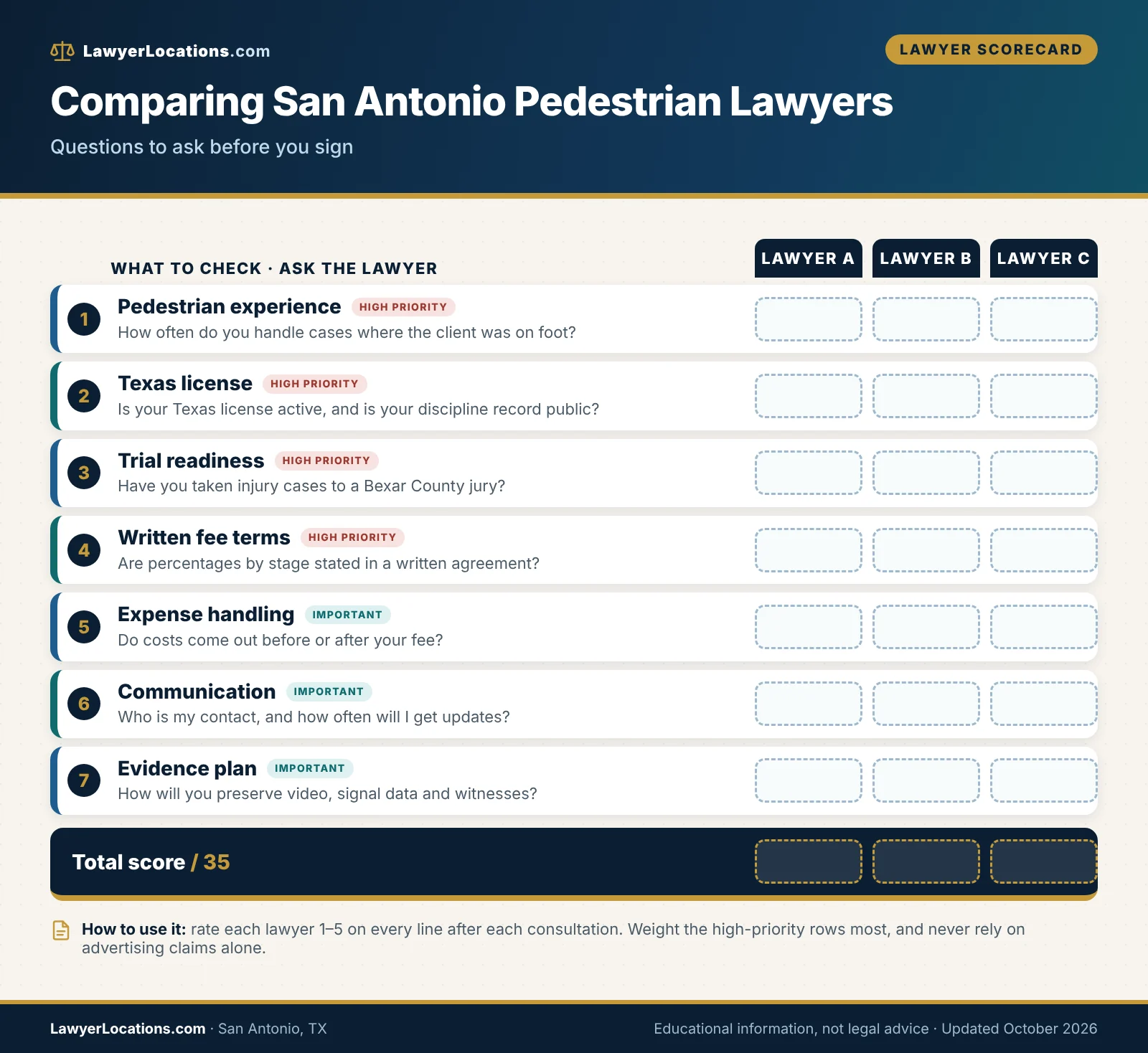
Text version of this graphic
| Criterion | Question to ask |
|---|---|
| Pedestrian experience | How often do you handle cases where the client was on foot? |
| Texas license status | Is your State Bar of Texas license active, and can I check discipline history? |
| Trial readiness | Have you taken injury cases to a Bexar County jury? |
| Fee clarity | Is the fee agreement in writing, with stage percentages stated? |
| Expenses | Which costs come out, and are they deducted before or after the fee? |
| Communication | Who is my contact, and how often will I get updates? |
| Evidence plan | How will you preserve video, signal data and witness statements? |
| Factor | Why it matters | Good sign | Caution sign |
|---|---|---|---|
| Experience with pedestrian crashes | Fault disputes are common and fact-heavy. | Explains a specific investigation plan. | Generic answers about “all injury cases.” |
| Written fee agreement | Texas requires contingent fees to be in writing. | Stage percentages and expenses spelled out. | Pressure to sign before you read it. |
| Trial readiness | Insurers weigh the threat of trial. | Open about trial experience and expert budget. | Promises of a quick, certain result. |
| Communication | Cases can last many months. | Named contact and update schedule. | Hard to reach during the consultation. |
| License and discipline | Only licensed Texas lawyers can practice here. | Active license, clean or explained record. | Cannot or will not state bar number. |
Checking credentials and spotting red flags
Advertising can look alike across firms. Independent checks tell you more than slogans do.
Verify the license and discipline history
Check that the lawyer holds an active Texas license and review any public disciplinary history through the State Bar of Texas lawyer directory. A lawyer may be licensed in another state without being licensed in Texas, so confirm the license that matters for a Bexar County case.
Ask who will be responsible for your case if the lawyer you meet is not the one who works on it. Written clarity about that point prevents misunderstandings later.
Marketing claims and red flags
Be careful with claims that a lawyer is the “best,” “top” or a “specialist” without explanation. A lawyer who claims a formal credential should be able to name the organization that issued it and the area it covers. Do not rely on awards or review stars alone.
- Promises about the outcome, the amount or how fast you will be paid.
- Someone contacting you at the hospital or at home out of the blue to sign you up.
- No written fee agreement, or a refusal to let you take it home to read.
- Vague answers about who will actually work on your case.
- Pressure to accept an early insurance offer or to stop treating.
Never sign a fee agreement or an insurer’s release without reading every page. A release can end your claim permanently, and a fee agreement controls what you owe. Ask for time and a copy to review.
Preparing for your consultation
You will get more from a short meeting if you arrive organized. Most lawyers want the same information, and having it ready shows the facts of your case clearly.
Documents and photos to bring
Gather what you have and bring copies, not originals. Do not delay a consultation just because something is missing; the lawyer can request the rest.
- Crash report number and any paperwork from police or EMS.
- Photos and video of the scene, your injuries, the vehicle and any damaged belongings.
- Names and contact details for witnesses, plus the driver’s insurance information if you have it.
- Medical records, bills, discharge papers and a list of providers.
- Pay stubs or employer letters showing missed work.
- Your own auto and health insurance information, plus any letters or calls from adjusters.
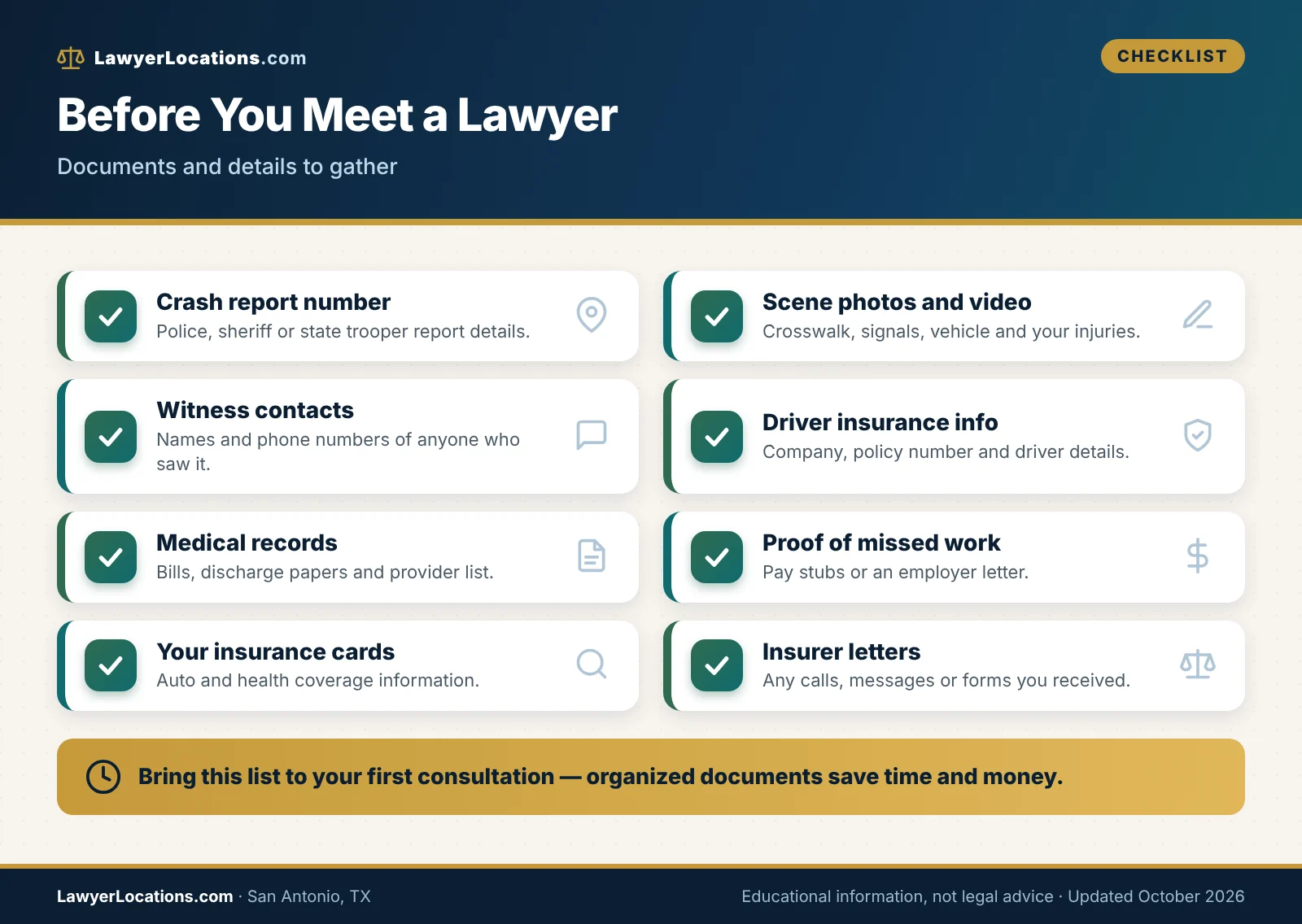
Text version of this graphic
- Crash report number and paperwork
- Scene, injury and vehicle photos or video
- Witness and driver insurance details
- Medical records and bills
- Proof of missed work
- Your own insurance information
- Letters or messages from insurers
- Written list of questions for the lawyer
Questions to ask in the first meeting
Write your questions down so you do not forget them in the room. Ask about fees, expenses, who works the case, how long similar cases take, and what the lawyer sees as the biggest risk in yours.
- Fee structure. What percentage applies before suit, after suit and at trial?
- Expenses. Are costs deducted before or after your fee is calculated?
- Deadlines. Which dates are you calendaring, including any City notice?
- Staffing. Who will I talk to, and how quickly are messages returned?
- Risks. What could weaken my case, and what will you do about it?
- Exit terms. What happens to fees and expenses if I change lawyers later?
Pedestrian Accident Lawyer Cost in San Antonio: Fees, Expenses and Liens
Most pedestrian injury lawyers in Texas work on a contingent fee, meaning the fee is a percentage of any recovery and is owed only if the case produces one. The exact percentage, and how expenses are handled, is set by your written agreement, so read it closely. This guide does not quote average percentages because no verified official source publishes them.
How lawyers charge for pedestrian cases
The fee structure shapes your incentives and your net recovery. Compare agreements side by side instead of focusing on one headline number.
Contingent fees
In a contingent fee arrangement, the lawyer is paid a percentage of the recovery, often with different percentages depending on the stage of the case. You typically pay no hourly fee, but you may still owe case expenses, depending on the agreement.
Texas Disciplinary Rule of Professional Conduct 1.04(d) says a contingent fee agreement must be in writing and must state the method by which the fee is determined. If the percentage differs for settlement, trial or appeal, the percentage for each must be stated. The agreement must also identify the expenses to be deducted from the recovery and say whether they come out before or after the contingent fee is calculated.
Hourly, hybrid and flat fees
Hourly billing is uncommon for injury plaintiffs, but you may see it for narrow tasks such as reviewing an insurance release or advising on a small claim. A hybrid arrangement mixes a reduced contingent percentage with an expense or hourly component. Flat fees are generally limited to discrete services.
Whichever structure you choose, ask for a plain-language example showing what you would receive on a hypothetical recovery. If the lawyer cannot walk through that math, keep shopping.
Fee division between lawyers
Sometimes a lawyer brings in another firm for a serious case. Under Rule 1.04(f), a division of a fee between lawyers who are not in the same firm is allowed only if listed conditions are met, including written client consent before the referral or association takes place. The consent must cover the identity of the lawyers or firms, the basis for dividing the fee and each party’s share or how it will be calculated.
Ask whether the firm ever refers cases to other offices and, if so, whether that changes your total fee. A proper arrangement does not add to what you pay without your informed written consent.
| Structure | How it works | Questions to ask |
|---|---|---|
| Contingent fee | Fee is a percentage of the recovery; written agreement required in Texas. | Does the percentage change if suit is filed or at trial? Which expenses come out? |
| Hybrid | Smaller percentage plus some hourly or flat component. | What do I owe if there is no recovery? |
| Hourly | You pay for time spent, win or lose. | What is the estimated total and how often will I get invoices? |
| Flat fee | One price for a defined service, such as reviewing a release. | What exactly is covered, and what costs extra? |
A closing statement is the written breakdown a lawyer gives you at the end of a contingent fee matter. It shows how the fee was determined and where the money went, and you should review it line by line before accepting funds.
Expenses, liens and what you keep
The percentage is only part of the story. What reaches your pocket depends on expenses, medical bills, liens and reimbursement claims taken from the recovery.
Case expenses and who advances them
Case expenses can include court filing fees, records fees, deposition costs, expert fees, mediation fees and investigator costs. Most contingent fee lawyers advance these costs and are repaid from the recovery, but your agreement should say so explicitly.
Ask whether you owe expenses if the case does not produce a recovery. Also ask for periodic expense reports, so a surprise is not waiting at settlement. Advertising lines such as “no fee unless we win” are no substitute for reading the contract.
Hospital liens, health insurers and other reimbursement claims
A Texas hospital lien under Tex. Prop. Code 55.002 attaches to your claim when you are admitted within 72 hours after an accident attributed to another person’s negligence. Health insurers, Medicare, Medicaid and other payers may also seek reimbursement from a settlement, depending on the plan.
A good lawyer will identify these claims early and try to negotiate them, because they reduce your net recovery. Our guide on medical bills after a car accident goes deeper on how bills, insurance and settlements fit together.
A net-to-client worksheet
Ask for a closing statement that shows each deduction. Texas Rule 1.04(d) requires a written report on the result at the end of a contingent fee matter, so you should see the gross settlement, fee, expenses and payments to lienholders before you accept funds.
| Line item | Where the figure comes from | What to confirm |
|---|---|---|
| Gross settlement or judgment | The agreed amount from the insurer or the court | Whether it includes all claims and all defendants. |
| Attorney fee | Your written fee agreement | The stage percentage that applies to your case. |
| Case expenses | Itemized expense report | Whether costs came out before or after the fee was calculated. |
| Medical bills and liens | Providers, hospital lien notices, health plan and government payers | Which amounts are final and which were negotiated. |
| Net to you | Gross less all deductions | That it matches the written closing statement. |
Ask each lawyer to run the worksheet above on the same hypothetical recovery. Numbers that look similar on the percentage line can produce different results once expenses are deducted before or after the fee. Compare the net, not the percentage.
Timeline, deadlines and decision points
No official source gives a standard duration for a San Antonio pedestrian case, so treat any promise of a precise timeline with suspicion. What you can do is understand the stages and the decisions you will face.
What drives how long a case takes
Severity of injury, the time needed to reach stable treatment, disputed fault, the number of insurers and parties, and court scheduling all affect the length. A case with a permanent injury usually takes longer because the full cost of care must be understood before a demand is sent. Our car accident settlement timeline guide goes through these factors in more detail.
Waiting is not always a bad sign, but silence is. Your lawyer should be able to tell you what stage the case is in and what is holding it up.
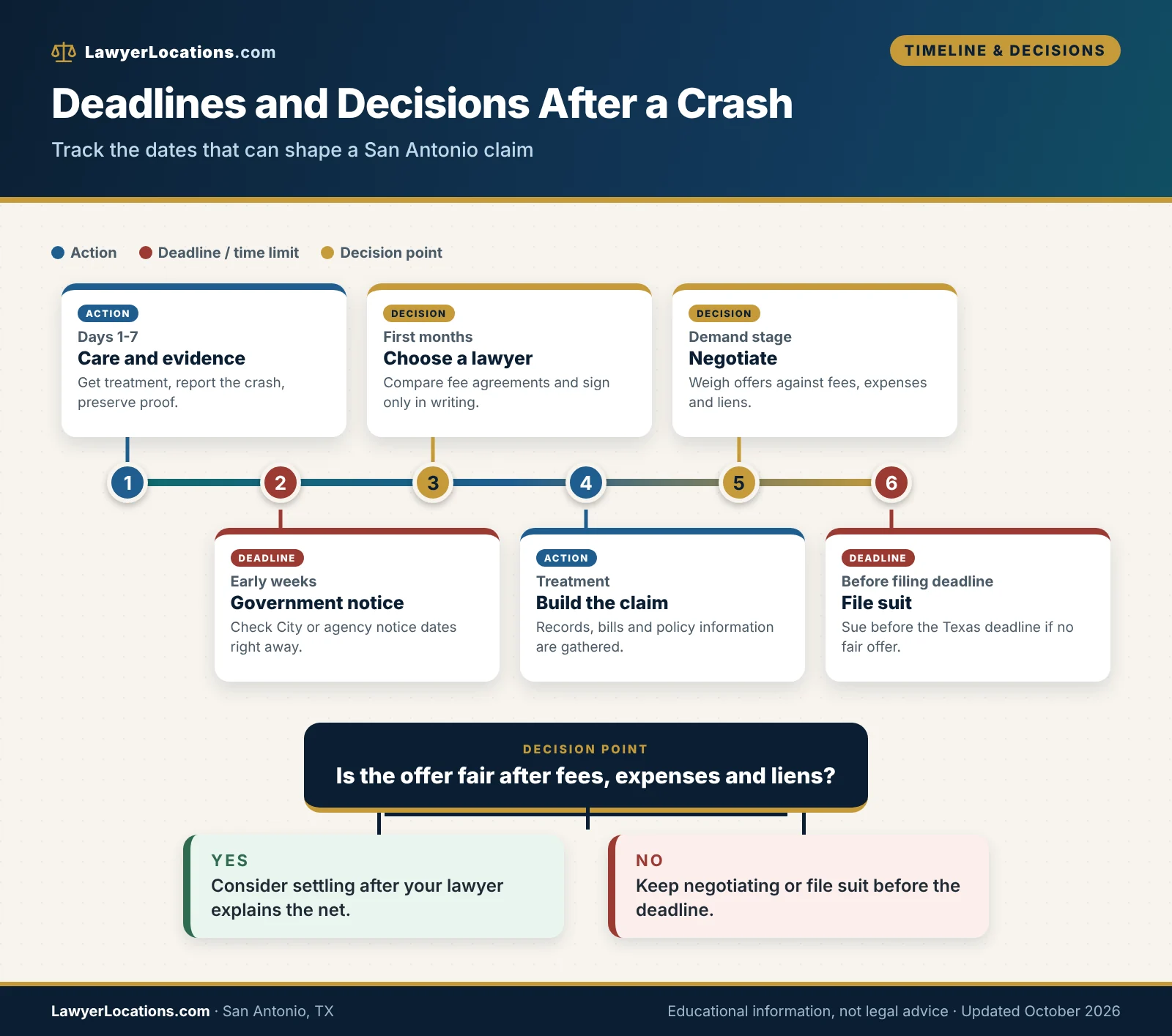
Text version of this graphic
- Days 1-7 (action): Get care, report the crash, preserve evidence.
- Early weeks (deadline): Send written notice if the City or another government body may be involved; the City Charter asks for 90 days.
- First months (decision): Choose a lawyer and sign a written fee agreement.
- Treatment period (action): Follow medical advice; the lawyer gathers records and policy information.
- Demand stage (decision): Send a demand once treatment is stable and losses are understood.
- Before two years (deadline): File suit if there is no fair resolution.
Decision point: Is the offer fair after fees, expenses and liens? If yes, consider settling; if no, continue to negotiate or file suit.
Key decision points along the way
You will face a few big choices: whether to hire a lawyer, whether to accept a settlement offer, and whether to file suit. Each choice deserves a clear explanation of the risks, the likely timeline and the net you can expect.
For a broader look at when legal help makes sense, read whether you need a lawyer after a car accident. Many of the same tests apply to a crash with a pedestrian.
| Stage | What happens | Money or deadline issue | Your decision |
|---|---|---|---|
| Right after the crash | Medical care, police report, evidence | City notice may be due in 90 days | Whether a government body could be involved |
| Hiring | Consultations and fee agreement | Contingent fee must be in writing | Which lawyer and which fee structure |
| Investigation and treatment | Records, policies, expert review | Expenses advanced and liens may accrue | How much treatment to pursue and when to stop |
| Demand and negotiation | Demand letter, offers, mediation | Compare net recovery after deductions | Accept, counter or sue |
| Lawsuit | Petition, discovery, possible trial | Two-year deadline for filing suit | Whether to try the case or settle |
Mistakes to Avoid, Quick Answers and Next Steps for San Antonio Pedestrians
The most costly mistakes are early ones: giving a recorded statement without advice, skipping treatment, posting about the crash online and missing a government notice date. Avoiding them keeps your options open.
Common mistakes after a pedestrian crash
These errors show up repeatedly in injury cases across Texas. Most are easy to avoid once you know about them.
Mistakes with insurers and statements
Adjusters may call within hours, sounding friendly. You are not required to give a recorded statement to the other driver’s insurer, and what you say can be used to assign you fault under the 50 percent rule. Keep any early contact short, stick to basic facts and consider speaking with a lawyer first.
Be wary of a quick check or a release form. Signing a release usually ends the claim for good, even if your injuries turn out to be worse than expected.
Mistakes with evidence and medical care
Do not throw away torn clothing, damaged shoes or a cracked phone, and do not post about the crash on social media. Defense lawyers do look at public posts, and an innocent photo can be spun against an injury claim.
Follow medical advice and tell every provider about all of your symptoms. Gaps in care and incomplete records make it harder to show the connection between the crash and your injuries.
Mistakes when hiring
Do not hire the first lawyer who calls you, and do not sign a fee agreement under pressure. Compare at least two options, ask the questions in this guide and check licenses. If you are told that a deadline is “about to expire” without specifics, ask which statute or notice rule they mean.
Also do not delay hiring because you worry about cost. A contingent arrangement is common, though the specifics vary, and a consultation will tell you what your options are.
If anyone tells you that the City of San Antonio claim deadline is not important because you have two years, ask for the source in writing. The City’s Charter sets a much shorter 90-day notice period for claims against it.
Quick answers to common questions
These short answers cover questions San Antonio pedestrians often ask. They are general information, not advice about your case.
Fees, insurance and fault
How much does a pedestrian accident lawyer in San Antonio cost?
Most work on a contingent fee, taking a percentage of the recovery, and Texas requires that fee agreement to be in writing. Percentages and expense rules vary by lawyer, so compare agreements and ask for a net-to-client example.
Is the first consultation free?
It depends on the lawyer. Some offices do not charge for an initial meeting, but you must ask. The State Bar’s referral service says its referred lawyers provide up to a 30-minute consultation for no more than $20.
What if I was crossing outside a crosswalk?
You may still have a claim. Texas law says pedestrians must yield when crossing outside a crosswalk, but drivers also owe a duty of due care, and a jury divides responsibility. You are barred only if you are found more than 50 percent responsible.
What if the driver had no insurance or drove away?
Your own uninsured motorist coverage, if you have it, may apply. Report a hit-and-run to police immediately and tell your insurer promptly. See our guide to uninsured motorist claims for more.
How long do I have to sue?
Generally two years from the injury, or from the death in a wrongful death case. Claims against a government body can require notice much sooner, including 90 days under the City of San Antonio Charter.
Can I sue the City of San Antonio?
Only in limited situations. Governments are immune unless the Legislature allows a claim, and the Tort Claims Act includes notice rules and damage caps. For municipalities, the caps are $250,000 per person and $500,000 per occurrence for bodily injury or death.
Courts, records and next steps
Where is a pedestrian lawsuit filed?
Usually in a Bexar County court downtown if the crash happened in San Antonio. Your lawyer picks the court and files electronically.
How do I get the crash report?
Ask the investigating agency, which may be the San Antonio Police Department, the Bexar County Sheriff’s Office or the Texas Department of Public Safety. Keep the report number from the scene.
What happens if a hospital treated me after the crash?
The hospital may have a lien on your claim if you were admitted within 72 hours. Ask your lawyer to review any lien and any health insurer reimbursement claim before you settle.
Do I need a lawyer for a minor injury?
Not always. If your injuries are minor and fault is clear, you may handle a claim yourself, but a short consultation can help you decide. Never sign a release without understanding what it ends.
What if I want to change lawyers?
You can, but fees and expenses may be owed to the first lawyer under the agreement. Ask about exit terms before you sign.
Can LawyerLocations.com recommend a lawyer?
No. We provide legal information and comparison tools, not lawyer ratings or referrals. Use the State Bar and local bar referral services if you want a starting list.
Write down two dates today: the 90-day City notice date and the two-year lawsuit date, both counted from the day of the crash. Share both with every lawyer you interview.
Your next steps
If you were hit on foot in San Antonio, a few steps will protect both your health and your claim. Take them in order and adjust with your lawyer’s advice.
The first seven days
- Get medical care. Follow every instruction and keep your records.
- Save evidence. Photos, video, clothing, witness names and the crash report number.
- Calendar the dates. Include the two-year suit deadline and any 90-day City notice.
- Limit insurer contact. Share basic facts only and sign nothing yet.
- Talk to two or three lawyers. Use the questions and scorecard in this guide.
Choosing with confidence
The right lawyer for you is the one who explains the Texas rules clearly, puts the fee in writing, and communicates in a way you trust. If a pedestrian crash is only one part of a broader problem, our guide on what to do after a car accident covers the first steps.
Ready to compare your options?
Use the checklist and scorecard above to speak with two or three Texas-licensed lawyers about your pedestrian accident, ask for a written fee agreement, and confirm your deadlines. LawyerLocations.com is an educational resource, not a law firm, and does not promise any outcome.
General information only. This article is legal information, not legal advice, and reading it does not create an attorney-client relationship. Laws, court rules, fees and agency procedures change, and the right answer depends on your facts. Consult a lawyer licensed in Texas about your situation, and check current rules with the court, clerk or agency involved.
Sources & References
Show all 12 sources
- Tex. Civ. Prac. & Rem. Code § 16.003, Two-year Limitations Period — Texas Legislature statutes (via Texas.Public.Law) — texas.public.law — accessed October 2026
- Tex. Civ. Prac. & Rem. Code § 33.001, Proportionate Responsibility — Texas Legislature statutes (via Texas.Public.Law) — texas.public.law — accessed October 2026
- Tex. Civ. Prac. & Rem. Code § 101.023, Limitation on Amount of Liability — Texas Legislature statutes (via Texas.Public.Law) — texas.public.law — accessed October 2026
- Tex. Civ. Prac. & Rem. Code § 101.101, Notice — Texas Legislature statutes (via Texas.Public.Law) — texas.public.law — accessed October 2026
- Tex. Transp. Code ch. 552 and §§ 552.003, 552.005, 552.008, Pedestrians — Texas Legislature statutes (via Texas.Public.Law) — texas.public.law — accessed October 2026
- Tex. Transp. Code § 550.021, Accident Involving Personal Injury or Death — Texas Legislature statutes (via Texas.Public.Law) — texas.public.law — accessed October 2026
- Tex. Prop. Code § 55.002, Hospital and EMS Liens — Texas Legislature statutes (via Texas.Public.Law) — texas.public.law — accessed October 2026
- Texas Disciplinary Rules of Professional Conduct, Rule 1.04 Fees — University of Houston Law Center, Legal Ethics Library — law.uh.edu — accessed October 2026
- Notice of Claim (City Charter Section 150) — City of San Antonio — sanantonio.gov — accessed October 2026
- Lawyer Referral & Information Service (LRIS) — State Bar of Texas — texasbar.com — accessed October 2026
- Bexar County Courts and Clerk FAQs — Bexar County, Texas — bexar.org — accessed October 2026
- Find a Lawyer (San Antonio referral and low-cost legal help) — St. Mary’s University School of Law Library — lawlib.stmarytx.edu — accessed October 2026
Legal Disclaimer and Limitation of Liability
Informational and illustrative purposes only. This article was prepared by LawyerLocations.com solely on the basis of the information available to us at the time of writing. It is an illustrative, general overview. It is not a complete or authoritative statement of the law, and it has not been reviewed by a lawyer licensed in your state or county.
Not legal advice. Nothing in this article is legal, financial, tax or immigration advice, and reading it does not create an attorney-client relationship between you and LawyerLocations.com or any author, lawyer or firm mentioned. Laws, court rules, fees, filing deadlines and agency procedures differ by state, county and court, and they change often. Some details here may be simplified, incomplete or out of date, and time limits for legal claims can be short.
No warranty. We make no representation or warranty, express or implied, about the accuracy, completeness, timeliness or suitability of this content for your situation. Please do not rely on it to make, delay or skip any legal decision. Check the facts against official sources and speak with a licensed attorney in the relevant jurisdiction before you act.
Limitation of liability. To the fullest extent permitted by law, LawyerLocations.com and its owners, authors and contributors disclaim all liability for any loss, damage, cost or other consequence arising from the use of, or reliance on, this article, including any content on third-party websites we link to. Mentioning a lawyer, firm, organization or service is not an endorsement and is not a promise of any result. If you are in immediate danger, contact your local emergency number.