Any personal injury lawyer Arizona residents hire will be working within three rules that shape almost every claim in the state: the general deadline to sue is two years under A.R.S. § 12-542, a claim against a city, county, school or other public body has a 180-day written notice rule under A.R.S. § 12-821.01, and Arizona reduces your recovery by your share of fault rather than barring it outright. Most injury lawyers are paid by a contingent fee, which Arizona’s ethics rules require to be in a signed writing.
This guide explains how Arizona injury claims work, where to look for a lawyer, what the fee paperwork should say, how to compare firms, and how a case moves through Arizona courts. It is general information for readers anywhere in the state, not advice about your own claim.
How Arizona Injury Law Works: Fault, Damages and Insurance
Arizona is a fault-based state. The person or business whose carelessness caused your injury, or the insurer standing behind them, is generally the one asked to pay. Three statutes and one constitutional clause do most of the work in setting how much that payment can be, and they apply the same way in Phoenix, Tucson, Flagstaff, Yuma and every town in between.
How fault is shared between you and the other side
Arizona does not treat fault as all-or-nothing. A jury is asked to decide how much each person involved contributed to the harm, and the money follows those percentages. That has a direct effect on what a lawyer will look for when evaluating your claim.
Pure comparative fault under A.R.S. § 12-2505
Under A.R.S. § 12-2505, if a jury finds that you were partly at fault, your damages are reduced in proportion to your share of fault instead of being thrown out. The system is called pure comparative fault: in theory, a person who is mostly responsible for their own injury can still recover the smaller share that belongs to someone else. The statute treats questions of contributory negligence and assumption of risk as questions of fact for the jury.
The statute carves out one exception. A claimant who intentionally, willfully or wantonly caused or contributed to the injury cannot use comparative negligence to protect a recovery in the same way. The practical point for you: a lawyer who tells you early that “you were partly at fault, so there is no case” is not describing Arizona law accurately, though the reduction can still be significant.
Several liability and fault assigned to people who are not in the lawsuit
Arizona also abolished the old rule that let an injured person collect the whole judgment from whichever defendant had the deepest pockets. Under A.R.S. § 12-2506, each defendant’s liability is generally several only, meaning each defendant answers for its own percentage of fault and not for anyone else’s share.
The same statute lets the jury assign fault to nonparties, including a person you settled with or someone a defendant properly names in a timely notice. That matters in multi-vehicle crashes, construction sites and property cases, because a share assigned to an empty chair can shrink the amount you collect. It is one reason lawyers ask early who else might have contributed. There are exceptions, such as when parties acted in concert or one party is legally responsible for the acts of its agent or employee.
A jury finds that a driver ran a red light (70% of the fault), a delivery company let an unsafe vehicle on the road (20%), and the injured pedestrian was looking at a phone while stepping off the curb (10%). Under the comparative-fault and several-liability rules, the pedestrian’s damages are reduced by 10%, and each of the other two defendants answers for its own percentage. The numbers are illustrative only, not a prediction.
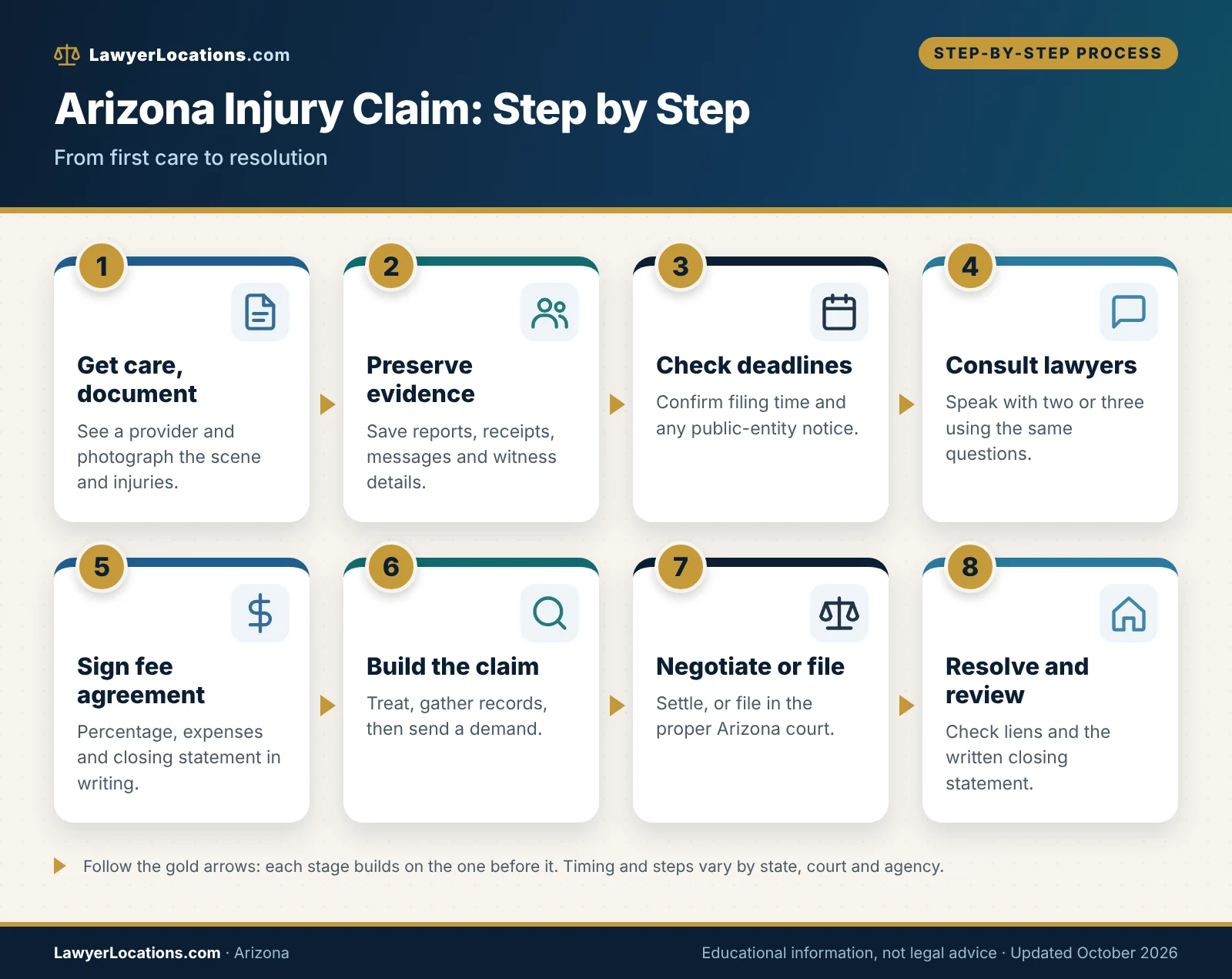
Text version of this graphic
- Get medical care and document the incident.
- Report to insurers and preserve evidence.
- Check deadlines, including any public-entity notice.
- Consult one or more Arizona lawyers.
- Sign a written fee agreement.
- Investigate, treat and send a demand.
- Negotiate, or file suit in the right Arizona court.
- Resolve the case and review the closing statement.
What an injured person can ask for, and what the state constitution says about limits
Injury law sorts losses into categories. Knowing the vocabulary helps you read a demand letter, a fee agreement and an insurer’s offer without being talked past.
The main categories of damages in plain English
Economic damages are losses with a paper trail: medical bills, future treatment, lost wages, lost earning ability and out-of-pocket costs. Non-economic damages cover harder-to-price harms such as pain, suffering, loss of enjoyment of life and scarring. In a death case, the claim is brought on behalf of surviving family members and looks at their losses, which is covered further below.
Insurers and lawyers value these categories differently, and the strength of the medical records often decides how much weight the non-economic part carries. Consistent treatment, honest descriptions of symptoms and gaps that you can explain are far more persuasive than a large number in a demand letter.
Arizona’s constitutional bar on damage caps
Article 2, Section 31 of the Arizona Constitution says no law may be enacted in the state limiting the amount of damages to be recovered for causing the death or injury of any person. In other words, Arizona has no statutory cap on compensatory damages in ordinary injury cases of the kind that some other states impose. That does not mean any particular case is worth a large amount; the evidence, the insurance available and the fault percentages still control the outcome.
The practical limit in many Arizona cases is not a legal cap but the insurance and assets available to pay. A lawyer should look for every policy that might apply, including the at-fault party’s coverage, your own uninsured and underinsured coverage, and any employer or property-owner policy.
The insurance that sits behind most Arizona claims
Most injury claims are really negotiations with an insurance company. Knowing what coverage exists, and how much, shapes the strategy before anyone files a lawsuit.
Minimum liability limits for Arizona drivers
Under A.R.S. § 28-4009, for policies issued or renewed on or after July 1, 2020, the minimum liability limits are $25,000 for injury or death of one person, $50,000 for two or more people in one accident, and $15,000 for property damage. Older policies carried lower minimums. These are floors, and many drivers buy more.
Because the minimums are modest compared with serious injuries, a crash with significant medical bills can exceed the at-fault driver’s coverage quickly. That is why your own policy matters.
Uninsured and underinsured motorist coverage
Under A.R.S. § 20-259.01, auto liability insurers in Arizona must offer uninsured (UM) and underinsured (UIM) motorist coverage and give the named insured written notice of the offer. Coverage can be set up to the policy’s bodily injury liability limits, and the declarations page is the final record of whether it was purchased or rejected.
If the other driver had no insurance, or too little, this coverage may become the main source of recovery. Claims against your own insurer can feel adversarial, and policy language matters. Our guide to uninsured motorist claims and when a lawyer can help walks through that process.
Deadlines and Notice Rules That Can End a Claim
In Arizona, most personal injury lawsuits must be filed within two years, and claims against public bodies follow much shorter rules. Missing a deadline usually ends the claim no matter how strong the evidence is, so this section deserves more attention than any other in this guide. For a national comparison, see our guide on how long you have to file a personal injury claim.
The two-year general rule
The default filing period is set by statute and covers the kinds of cases most readers are asking about.
What A.R.S. § 12-542 covers
A.R.S. § 12-542 requires certain civil actions to be commenced within two years after the cause of action accrues. The list includes personal injury, wrongful death (where the claim accrues at the injured person’s death), and several property-related claims such as trespass causing injury to property and conversion of personal property. Medical malpractice, as defined elsewhere in the code, is included in the personal injury category.
“Commenced” means the lawsuit is filed with the court, not that you have started talking to an insurer. Talking with an insurer does not stop the clock, so do not rely on ongoing negotiations to protect a deadline.
When the clock starts
A claim generally “accrues” when the injury happens and you know, or reasonably should know, that you were harmed and what caused it. For a car crash, that is typically the day of the crash. For some conditions, such as an injury whose cause is not discovered until later, the question of when the clock started can be argued, but a lawyer will not want to depend on that argument.
Treat the date of the incident as day one. If you are within a few months of the two-year mark, tell every lawyer you contact on the first call. Lawyers need time to investigate, gather records and prepare a filing, and some will decline a case that is too close to the deadline.
Claims against cities, counties, schools and other public bodies
If a public entity or public employee may share responsibility, such as a pothole on a city road, a school playground or a government vehicle, Arizona imposes two separate clocks that are much shorter than the general rule.
The 180-day notice of claim
A.R.S. § 12-821.01 requires a written claim to be filed with the person authorized to accept service for the entity or employee within 180 days after the cause of action accrues. The notice must explain the basis for the claim and include the facts that support a specific amount for which the claim can be settled. A claim that is filed late is barred.
The statute also says the claim accrues when you realize you were damaged and know or reasonably should know what caused the damage. If a required administrative or dispute-resolution process applies, the deadline does not begin until that process ends. Minors and legally incompetent persons are addressed separately and get 180 days after the disability ends.
The one-year suit deadline and the 60-day deemed denial
Separately, A.R.S. § 12-821 provides that actions against a public entity or public employee must be brought within one year. Under A.R.S. § 12-821.01, a notice of claim is treated as denied 60 days after it is filed unless you get written notice of denial sooner. That 60-day mark is a planning point because it is when many claimants can file suit.
Do not assume an ordinary insurance claim form satisfies the notice rule. The notice for a public entity has its own content requirements and must go to the right recipient. If any public agency or employee might be involved, say so in your first consultation.
Minors, deaths and other special situations
Some claims run on a different schedule. These are the situations where a short conversation with a lawyer is most likely to change the date on your calendar.
Injured minors
Under A.R.S. § 12-502, time during which a person is a minor or of unsound mind generally does not count toward the limitations period if the disability exists when the claim accrues. After the disability ends, the person gets the same period that others receive, not a longer one. A parent’s own claim, such as for a child’s medical expenses, can follow different timing, so ask a lawyer about it separately. The public-entity rules have their own minor provisions, so a child hurt at a public school should be treated carefully.
Wrongful death claims
A wrongful death action is also governed by the two-year period in A.R.S. § 12-542, with the claim accruing at the death. Under A.R.S. § 12-612, the action may be brought by a surviving spouse, child, parent or guardian, or by a personal representative of the deceased. It is brought for the benefit of the surviving spouse, children or parents, or for the estate if none survive. Families deciding how to hire counsel can read our wrongful death lawyer cost guide.
| Situation | Rule | Statute |
|---|---|---|
| Personal injury (general) | Two years from accrual | A.R.S. § 12-542 |
| Wrongful death | Two years; accrues at death | A.R.S. § 12-542; § 12-612 for who may sue |
| Notice to a public entity or employee | Written notice within 180 days, stating a specific settlement amount | A.R.S. § 12-821.01 |
| Lawsuit against a public entity or employee | One year | A.R.S. § 12-821 |
| Deemed denial of a notice of claim | 60 days after filing, unless denied sooner in writing | A.R.S. § 12-821.01 |
| Injured minor | Minority generally does not count toward the period for non-public claims | A.R.S. § 12-502 |
Common Arizona Injury Situations and Who May Be Responsible
Different accidents point to different defendants, different insurance and sometimes different deadlines. Identifying the likely category early helps you ask a lawyer the right questions and helps the lawyer decide whether the firm is a good fit for your type of claim.
Vehicle crashes on Arizona roads
Crashes are the largest source of injury claims in most states, and Arizona’s long highways, heavy commuter traffic and busy interstate corridors make them a frequent reason people search for a lawyer. The underlying rules are the fault and insurance statutes covered above.
Car and motorcycle collisions
In a typical collision claim, the question is who broke a traffic rule or failed to use reasonable care, and what the evidence shows: the police report, photographs, vehicle damage, witness statements and any camera footage. Comparative fault applies, so an insurer may argue you share some responsibility. Our checklist for what to do after a car accident covers the first steps, and the guide on whether you need a lawyer after a car accident helps you decide how much help the claim calls for.
Medical bills are a frequent worry. Our guide to who pays medical bills after a car accident explains how health insurance, medical payments coverage and liens interact with a claim.
Commercial trucks and company vehicles
When a commercial truck or a vehicle driven for work is involved, additional parties may share responsibility, such as an employer, a vehicle owner, a maintenance contractor or a freight broker. More defendants can mean more insurance, but also more disputes about who owes what under the several-liability rules. These cases tend to need quicker preservation of evidence, such as driver logs and electronic data. See truck accident lawyer vs. car accident lawyer for the differences.
Injuries on someone else’s property
Property owners and occupiers have a duty to take reasonable care. The detailed rules depend on the facts, including why you were on the property and whether the owner knew or should have known about a hazard.
Slip, trip and fall claims
A fall at a store, apartment complex, restaurant or parking lot usually turns on whether a dangerous condition existed, how long it was there, and whether the owner had a reasonable chance to fix it or warn visitors. Evidence disappears fast: spills are mopped up, stairs are repaired and video is overwritten. Photographing the exact spot, asking for an incident report and writing down the names of witnesses can matter more than anything said afterward.
Comparative fault is common in these cases because the defense often argues the injured person was not watching where they were walking. The reduction in damages follows A.R.S. § 12-2505, not an all-or-nothing bar.
Dog bites and animal attacks
Dog bite claims depend on specific Arizona statutes and on how the incident happened, including whether the animal was loose and where the injury took place. Homeowner’s and renter’s insurance are often the source of payment. Our guide to finding a dog bite lawyer in Tucson discusses the type of questions to bring to a consultation, and the same questions apply across Arizona.
Medical, workplace and government-related harm
Some injuries involve special systems that run alongside the general injury rules. A claim may be a different kind of case than it first appears.
Medical negligence
Medical malpractice is covered by the same two-year statute, which lists it within personal injury, but these cases also carry their own procedural requirements and usually need expert testimony. They are expensive to prepare, so many general injury firms refer them out or require a thorough review before agreeing to take one. If you suspect a medical error, ask any lawyer you speak with whether the firm handles that type of case or can point you to one that does.
Injuries at work and by public entities
If you were hurt on the job, workers’ compensation may be the primary route, and it operates under a separate administrative system with its own deadlines. At the same time, a third party such as a contractor or a negligent driver may be liable outside that system. If a government vehicle, building or employee caused the harm, return to the 180-day notice rule above and raise it immediately.
| Situation | Parties and coverage that may matter | Issue to raise early |
|---|---|---|
| Car or motorcycle crash | At-fault driver’s liability policy; your UM/UIM and medical payments coverage | Whether limits are enough; preservation of photos and vehicle data |
| Commercial vehicle crash | Driver, employer, owner, maintenance or freight companies | Records that can be overwritten; several-liability shares |
| Slip or fall on private property | Owner, tenant or property manager; premises liability policy | Incident report, photos of the hazard, video retention |
| Dog bite | Dog owner or keeper; homeowner’s or renter’s policy | Animal control report; where the incident occurred |
| Government road, building or vehicle | City, county, school district, state agency or employee | 180-day notice of claim and one-year suit deadline |
| Medical error | Provider, hospital, facility | Expert review; whether the firm takes these cases |
| Death of a family member | Same parties as the underlying event | Who can bring the claim; two-year clock from death |
How to Find and Compare Personal Injury Lawyers in Arizona
Use more than one source, check each lawyer’s standing with the State Bar of Arizona, and talk to at least two lawyers before you sign. There is no official ranking of Arizona injury lawyers, and LawyerLocations.com does not rank or recommend firms. What follows is a method for doing your own comparison.
Where to look for a lawyer in Arizona
No single directory is complete. The sources below serve different needs, and combining two or three gives a more reliable picture than relying on advertising alone.
The State Bar of Arizona directory and certified specialists
The State Bar of Arizona explains that it cannot make referrals or give legal advice, but its member directory lets you search by name, practice area or office location, and its lawyer listings include activity information you can check for discipline history. The State Bar also publishes a list of Certified Specialists in personal injury and wrongful death, organized by city, and describes certified specialists as lawyers who have demonstrated advanced knowledge and experience in complex injury and wrongful death litigation.
Certification is voluntary, and many experienced injury lawyers are not certified, so treat it as one data point and not a requirement. The reverse is also true: do not treat a polished website or a billboard slogan as evidence of experience.
County bar referral services
Two county bar associations run referral programs. According to the State Bar, the Maricopa County Bar Association service, at (602) 257-4434, charges $50 for a 30-minute consultation, and the Pima County Bar Association service, at (520) 623-4625, charges a $35 non-refundable fee at referral for a 30-minute consultation. The Maricopa County Bar describes its panel attorneys as licensed, insured and in good standing, and says each referral covers one legal matter.
Fees and procedures change, so confirm them when you call. Many injury lawyers offer their own initial consultations directly, so ask a firm whether a first meeting carries a charge before you book it, and do not assume a referral fee is required.
Legal aid and low-cost help
If your income is low, free civil legal aid is available through programs listed by the Arizona courts, including Community Legal Services (Maricopa, Mohave, La Paz, Yavapai and Yuma counties and several towns), Southern Arizona Legal Aid (Apache, Cochise, Gila, Graham, Greenlee, Pima, Pinal, Navajo and Santa Cruz counties and several Native American communities) and DNA People’s Legal Services (Coconino County and the Navajo and Hopi Nations). Legal aid programs set their own eligibility rules and often prioritize certain case types, and many do not handle fee-generating injury cases, so call to ask.
For people who earn too much for legal aid but cannot afford market rates, the Arizona courts also list a Modest Means program, and Pima County residents can look to QUILT. These programs are worth asking about if an insurer has denied a claim and you are unsure whether a contingent-fee lawyer will take it.
A scorecard for comparing the lawyers you speak with
Once you have two or three names, compare them on the same questions. A consistent scorecard keeps you from choosing based on who sounded most confident on the phone.
Experience with your type of claim
Ask how often the firm handles claims like yours, such as a rear-end crash, a premises fall or a claim against a city. Ask who will actually work on the file day to day and whether that person has handled similar cases in the county where the case would be filed. Experience with the exact type of problem matters more than a long list of unrelated case types.
Do not expect a lawyer to predict your result. A responsible lawyer will talk about what could help or hurt the claim and will not promise an outcome or a dollar figure.
Communication, staffing and who you will talk to
Many injury cases last a year or more, so how a firm communicates matters. Ask how updates are given, who returns calls, and whether you will be able to speak to the lawyer, not only a case manager. Written answers, such as an email recap of your consultation, are a good sign.
No firm can promise a response time with certainty, and you should be wary of any that advertises one. Ask for realistic expectations instead.
Trial readiness and willingness to file
Insurers generally pay more attention to a lawyer who is ready to file suit and try the case. Ask whether the firm files lawsuits when negotiations stall, how often its cases go to the court rather than settle, and how it handles the compulsory arbitration step that applies to smaller cases in Arizona superior court.
A firm that only settles can still be a fine choice for a modest claim. What matters is that the answer is honest and fits the value and complexity of your case.
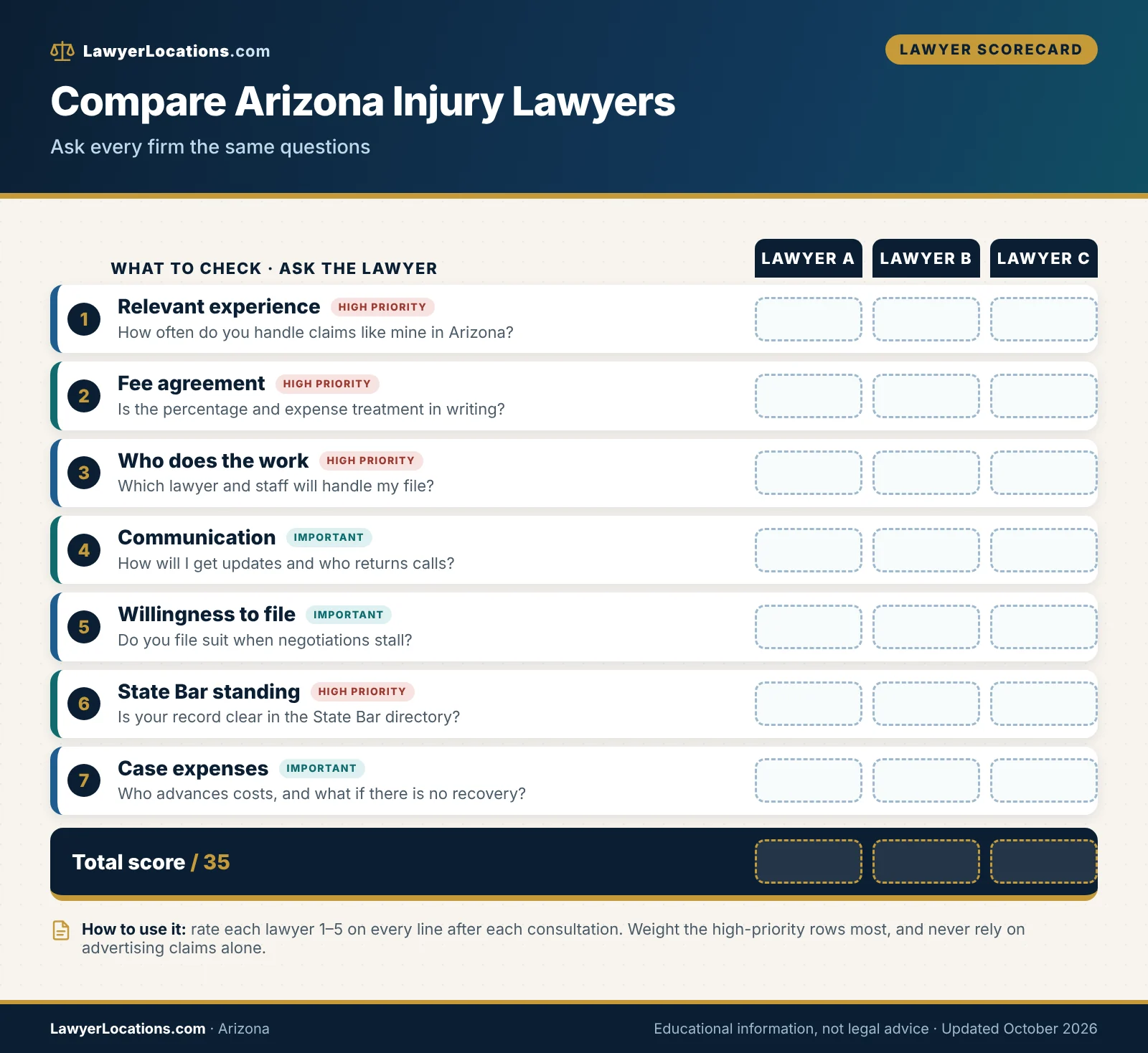
Text version of this graphic
- Experience: how often has the firm handled claims like yours in Arizona?
- Who works on the file: will a lawyer or a staff member handle day-to-day work?
- Fee agreement: is the percentage, expense treatment and closing statement written down?
- Communication: how will you get updates and who answers calls?
- Trial readiness: does the firm file suit when negotiations stall?
- Standing: is the lawyer in good standing with the State Bar of Arizona?
- Case expenses: who advances costs and what happens if there is no recovery?
Questions to ask in the consultation, and red flags
Prepare a short list of questions in advance. The goal is to leave with a clear sense of how the lawyer would handle your case and what it would cost you.
Questions about the case
Ask what issues the lawyer sees in your facts, what additional evidence is needed, what other insurance might apply, and what deadlines could affect the claim. Ask what the first 30 days would look like. If the lawyer asks you to fill gaps, such as medical records or a missing photo, that is normal.
- What deadlines apply to my situation, including any public-entity notice?
- What are the strengths and weaknesses of the claim as you see them?
- Who else might share responsibility, and could that affect what I collect?
- Will you need to hire experts, and who decides that?
Red flags to watch for
Some warning signs are easy to spot once you know them. Pressure to sign immediately, vague answers about money, and promises about results are the most common.
- A promise of a specific result or settlement amount before reviewing your records.
- No written fee agreement, or a reluctance to let you take it home and read it.
- Pressure to sign on the spot, or to refuse a call from an insurer without explaining why.
- Someone who contacts you uninvited at a hospital or at home to solicit your case.
- A refusal to explain how case expenses are handled.
Before you sign anything, look the lawyer up in the State Bar of Arizona member directory and check the activity information. If you later have a concern about a lawyer’s conduct, the State Bar’s Attorney/Client Assistance Program hotline is 602.340.7280.
What Arizona Injury Lawyers Charge and How Fee Agreements Work
Most Arizona injury lawyers are paid a percentage of what you recover, and the agreement must be in a signed writing. You generally do not pay an hourly fee while the case is pending, but case expenses are a separate question that your contract must answer. This guide gives no fee averages because percentages are negotiated and vary by firm and stage.
The contingent fee and what the ethics rule requires
A contingent fee means the lawyer’s payment depends on the result, usually as a share of the settlement or judgment. If there is no recovery, the lawyer generally receives no fee, though you may still owe expenses depending on the contract.
The signed writing and the percentage
Under ER 1.5(c) of the Arizona Rules of Professional Conduct, a contingent fee agreement must be in a writing signed by the client. It must state how the fee is determined, including the percentage that applies if the case settles, goes to trial or is appealed. That is why you may see a lower percentage for an early settlement and a higher one after a lawsuit is filed, if the firm uses a tiered structure.
Read the tiers carefully. Ask the lawyer to walk through what you would owe at each stage using a hypothetical amount, and ask what triggers a move from one tier to the next.
Expenses and the closing statement
The same rule requires the agreement to say what litigation and other expenses are deducted from a recovery and whether they come out before or after the fee is calculated. It must also give clear notice of any expenses you must pay whether or not you win. That detail changes your take-home amount more than most people expect.
When the matter ends, the lawyer must give you a written statement of the outcome. If there was a recovery, it must show the amount sent to you and how it was calculated. Ask to see it before you approve any disbursement.
If a fee agreement leaves expenses vague, or you cannot tell whether the percentage is calculated before or after costs are removed, ask for a corrected version. A contract you do not understand is not a contract you should sign.
Other ways to pay for legal help
The contingent fee is the norm for injury claims, but it is not the only option, and it is not always the best fit for smaller or unusual matters.
Hourly, flat-fee and limited-scope help
Some lawyers will work for an hourly rate or a flat fee on a narrow task, such as reviewing an insurer’s offer, drafting a demand letter or preparing you for a small claim. The Arizona courts describe several levels of representation, including limited scope, fixed rate, ghostwriting and full service, which vary in cost. This can make sense when the amount at stake is small enough that a contingent-fee firm would not take it.
Referral and consultation charges
As noted above, county bar referral services charge a flat fee for a 30-minute consultation, and some private firms charge for a first meeting while others do not. Ask about this when you book. A consultation fee is separate from a contingent fee and, in most cases, does not buy a commitment from the lawyer to take your case.
Liens, reimbursement and who gets paid from a recovery
Settlement money does not always go straight to you. Others may have a legal claim to part of it, and a careful lawyer will identify them before negotiating.
Hospital and provider liens under A.R.S. § 33-931
Under A.R.S. § 33-931, licensed health care institutions and providers, and ambulance providers, that treat or transport an injured person may have a lien on the injured person’s claim against a liable party. The lien does not reach health insurance, medical payments coverage or UM/UIM coverage, and one-third of any third-party judgment, settlement or award is exempt. For patients with health insurance, the statute adds conditions on when an in-network provider may use the lien, and it leaves cost-sharing such as copayments and deductibles enforceable.
These rules are technical. If you receive a notice of lien, give it to your lawyer instead of paying or ignoring it, because liens can sometimes be reviewed, reduced or compromised under the statutory process.
Health plans, government programs and other reimbursement claims
Besides provider liens, a health plan, an employer plan or a government program that paid your bills may claim reimbursement from your recovery under its own terms. The rules vary by plan type, and some federal programs have special rights. Ask the lawyer early who might have a reimbursement claim and how the firm handles negotiation of those amounts.
| Item | What to ask | Where the rule or source comes from |
|---|---|---|
| Contingent fee percentage | What percentage applies at settlement, trial and appeal? | Arizona ER 1.5(c) |
| Case expenses | Who advances them, and are they deducted before or after the fee? | Arizona ER 1.5(c) |
| Expenses if you lose | Do you owe any costs if there is no recovery? | Arizona ER 1.5(c) |
| Closing statement | Will you receive a written breakdown of the final distribution? | Arizona ER 1.5(c) |
| Referral or consultation charge | Is there a charge for the first meeting? | County bar referral programs; private firm policy |
| Provider liens | Which providers may assert a lien, and what share is exempt? | A.R.S. § 33-931 |
| Health plan reimbursement | Does any plan or program have a right to be repaid? | Plan terms and applicable law |
How an Arizona Injury Case Moves From Claim to Resolution
Many Arizona injury claims are resolved by negotiation, with or without a lawsuit, and a trial is only one possible ending. Even so, the case is built as if a court might decide it, because that is what gives an insurer a reason to take it seriously. For a closer look at the typical sequence after a crash, see our guide to the car accident settlement timeline.
The pre-lawsuit stage
Most of the work happens before anything is filed. This is the stage where your choices about treatment, records and communication matter most.
Treatment, investigation and documentation
The lawyer gathers the police report, photographs, medical records, billing statements, employer wage information and any available video. Insurers look hard at gaps in treatment and delays in seeking care, so following your medical provider’s plan is both good for your health and good for the claim. A claim is usually not valued until you reach a stable point in recovery, or until the doctors can describe what future care you will need.
The demand and negotiation
When the picture is clear, the lawyer typically sends the insurer a written demand with supporting records, and negotiation follows. The insurer may accept, counter or deny, and you decide whether to accept any offer. Do not accept a quick offer from an adjuster before you know the full extent of your injuries, because a signed release usually ends the claim.
Keep a short dated journal of symptoms, missed work and activities you could not do. It can fill gaps that medical records do not capture, and it helps you describe your experience accurately months later.
Filing a lawsuit in Arizona
If negotiations fail or the deadline is approaching, your lawyer files a complaint. Which court hears the case depends mostly on the amount at stake and the parties.
Superior court, justice court and federal court
Most injury cases of any size are filed in the Superior Court of the county where the incident happened or the defendant lives. Under A.R.S. § 22-201, justice courts hear civil cases where the amount in dispute is $10,000 or less, not counting interest, costs or attorney fees awarded where the law allows them. A federal court can hear an injury case in limited situations, such as when the parties are citizens of different states, so your lawyer will review that question before filing.
Maricopa County’s court website (superiorcourt.maricopa.gov) has a civil department page, a case lookup, court locations and a Law Library Resource Center with self-representation information. The Pima County Superior Court site (sc.pima.gov) lists a law library, forms, and case search through the Clerk of the Court. For other counties, use the Arizona Courts directory and the county clerk.
Compulsory arbitration for smaller cases
Arizona uses compulsory arbitration to move certain smaller superior court cases through a faster, less formal process. Under A.R.S. § 12-133, the court sets a jurisdictional limit by rule that may be as high as $65,000, and cases in superior court within that limit go to arbitration when the court finds, or the parties agree, that the amount in controversy falls within it. The court may waive arbitration for good cause if all parties file a written stipulation.
The limit in your county is set by court rule and may change, so ask your lawyer to confirm whether your case would be subject to it. Arbitration can be quicker and cheaper than a jury trial, but it changes how the case is prepared.
Settlement, trial and decision points
The final stage is where the practical consequences of your fee agreement and your risk tolerance come into focus. These are the decisions that belong to you, not your lawyer.
Deciding whether to settle
You decide whether to accept a settlement offer. A good lawyer explains the offer, what the claim might be worth under different outcomes, what liens must be paid and what you would net after fees and expenses. Ask for a written net-to-client calculation before you make the decision.
A settlement usually requires you to sign a release and give up the right to sue over the same injuries. If your condition may change, discuss that with your lawyer before signing.
Going to trial
If the case does not settle, it may go to a jury. A trial adds time, expense and uncertainty, and the fee percentage may change at that stage under your agreement. It also gives you the chance to have the facts decided by a jury of Arizonans instead of by an adjuster.
Ask your lawyer what a trial would cost, how long it would take in your county, and what the realistic alternatives are. Keep in mind that the answer can differ between counties and from year to year.
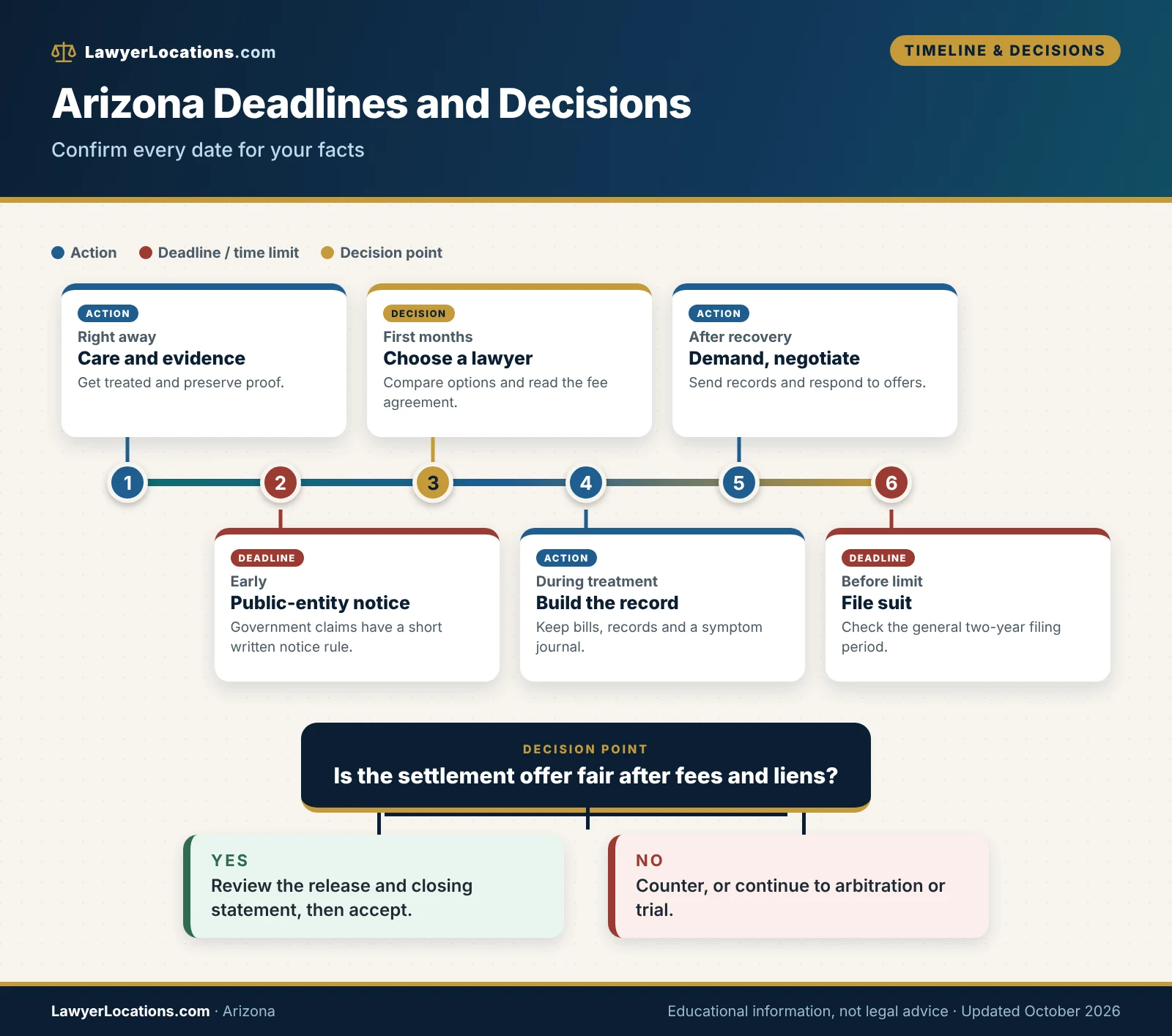
Text version of this graphic
- Right away: get medical care and preserve evidence (action).
- First weeks: check deadlines, including any 180-day public-entity notice (deadline).
- First months: consult lawyers and sign a written fee agreement (decision).
- During treatment: build the record and track losses (action).
- After recovery stabilizes: demand and negotiation (action).
- Before two years: file suit if the case has not resolved (deadline).
- Decision point: accept an offer or continue to arbitration or trial.
| Forum | Typical use | Rule or source |
|---|---|---|
| Justice court | Civil claims at or below the jurisdictional limit | A.R.S. § 22-201 ($10,000 or less) |
| Superior court | Most injury lawsuits; the county where the incident occurred or the defendant lives | County Superior Court; Maricopa and Pima sites |
| Compulsory arbitration | Smaller superior court cases within the court’s set limit | A.R.S. § 12-133 (limit may be up to $65,000) |
| Federal court | Limited situations, such as parties from different states | Federal jurisdiction rules; ask your lawyer |
| Public-entity claim | Notice first, then suit within the shorter period | A.R.S. §§ 12-821, 12-821.01 |
Evidence, Mistakes and Next Steps
The best thing you can do before calling a lawyer is protect your health, preserve evidence and write down the dates that matter. The checklist and the mistakes below are practical, not exhaustive, and they apply whether you are in Phoenix, Tucson, Flagstaff, Yuma or a small town.
Evidence and documents to gather
Good records make every part of the process easier: consultations are more productive, lawyers can evaluate the case faster, and insurers have less room to dispute the facts.
At the scene and in the first days
If you are able, photograph the scene, the hazard, your injuries and any vehicle damage before anything changes. Get contact details for witnesses and the other party, ask for the report number if police responded, and request an incident report if the injury happened at a business. Save any messages or notices you receive from an insurer.
Write down what happened while it is fresh. Stick to facts, not guesses about fault.
Medical, wage and financial records
Keep every medical record, bill, explanation of benefits, prescription receipt and mileage log. Gather pay stubs or an employer letter showing missed work. Your lawyer will usually request official records, but your own file helps confirm nothing is missing.
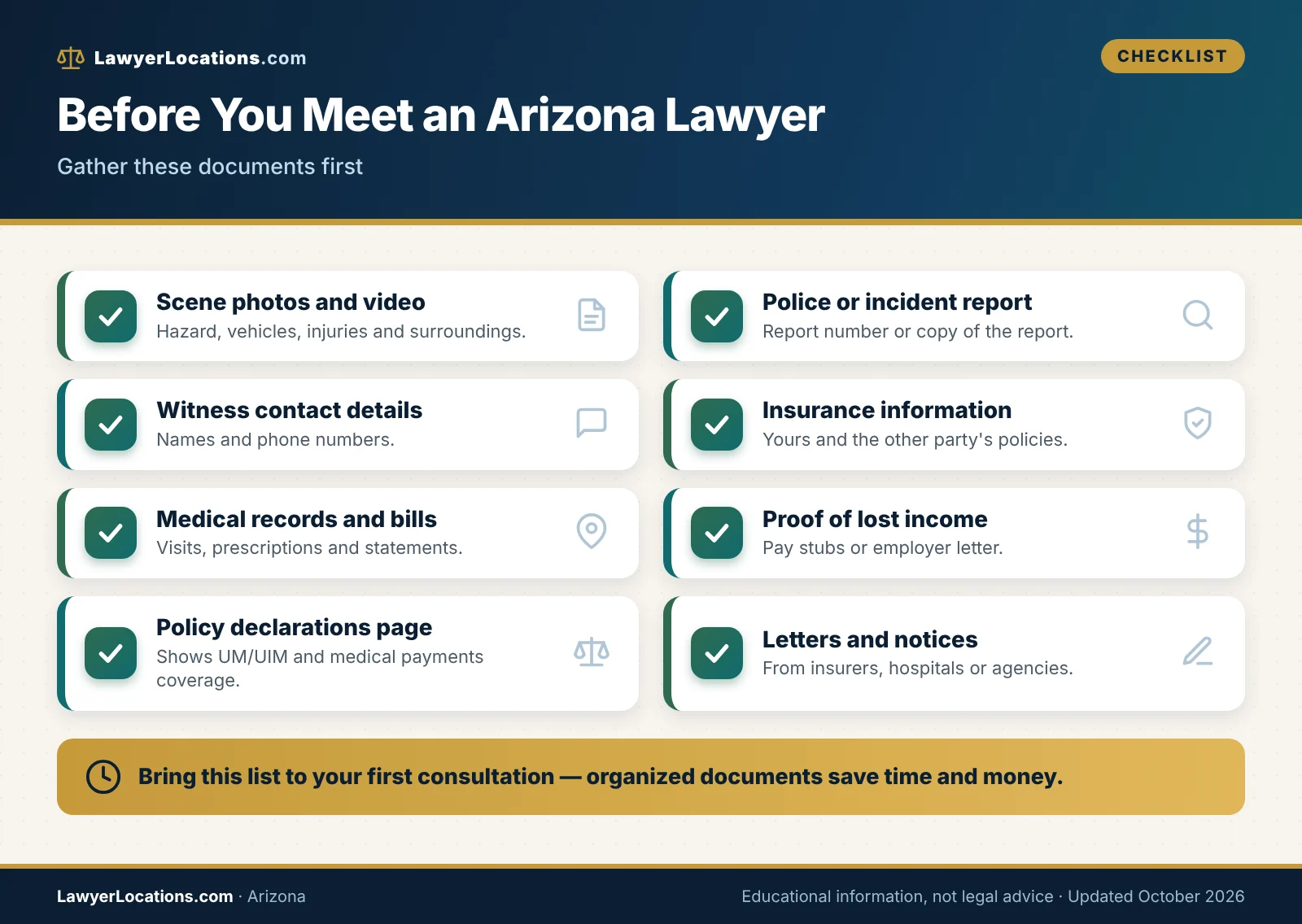
Text version of this graphic
- Photos of the scene, hazard and injuries
- Police or incident report number
- Witness names and contact details
- Insurance information for all parties
- Medical records, bills and receipts
- Proof of missed work and lost income
- Your own insurance policy declarations page
- Any notices or letters from insurers or public agencies
- Photos and videos of the scene, the hazard and your injuries
- Police report number or incident report
- Names and phone numbers of witnesses
- Your insurance declarations page, including UM/UIM and medical payments coverage
- All medical records, bills, receipts and explanation-of-benefits statements
- Pay stubs or employer letter showing missed time
- Any letters from insurers, hospitals or government agencies
Common mistakes that hurt Arizona injury claims
Many problems in injury claims come from understandable early choices. Knowing the pattern helps you avoid them.
Talking to the other side’s insurer without a plan
An adjuster for the at-fault party is not working for you. Give basic facts if you must, but avoid recorded statements, speculation about fault and statements about your recovery before you have talked to a lawyer. Offers made early in a claim often do not account for future treatment.
- Signing a release before you know the full extent of your injuries.
- Posting about the incident or your activities on social media.
- Skipping medical appointments or stopping treatment without telling your provider.
Missing a notice or filing deadline
The most costly mistake is letting a deadline pass. The 180-day notice rule for public bodies is shorter than most people expect, and the general two-year period can pass faster than a claim develops. Write the dates on a calendar the day you decide to look for help.
If a city, county, school district, state agency or public employee may be involved, do not wait for treatment to finish before consulting a lawyer. The 180-day notice period runs from accrual, not from the end of your recovery.
Signing a fee agreement you do not understand
Take the contract home. Compare it with the Arizona ER 1.5 requirements described above: a signed writing, a stated percentage for each stage, a clear treatment of expenses and a closing statement. If any piece is missing, ask for it to be added.
Your next steps, and help if money is tight
You do not need to resolve everything at once. A calm, step-by-step approach is more effective than a rush.
A practical order of operations
- Look after your health. Follow your provider’s advice and keep records of every visit.
- Write down your deadlines. Start with the two-year general rule and ask about any public-entity notice.
- Collect your documents. Use the checklist above.
- Contact two or three lawyers. Use the State Bar directory and a county bar referral service, and compare them with the scorecard.
- Read the fee agreement at home. Confirm percentages, expenses and the closing statement.
- Keep a simple file. Store every letter, bill and email in one place.
If you cannot afford a lawyer
Contingent-fee lawyers do not charge upfront fees, but they decide which cases to take. If you are turned down, ask whether the lawyer can explain why and whether the reason is the strength of the claim, the amount at stake or a deadline problem. Then consider the legal aid, Modest Means and limited-scope options described above, and the Arizona court self-help resources.
How long do I have to file a personal injury lawsuit in Arizona?
The general rule under A.R.S. § 12-542 is two years from when the claim accrues. Claims against public entities and employees follow separate notice and filing rules, so check those first if a government body may be involved.
Can I still recover if I was partly at fault?
Yes. Arizona uses pure comparative fault under A.R.S. § 12-2505, so your damages are reduced by your share of fault instead of being barred. An exception applies if you intentionally, willfully or wantonly contributed to the injury.
How much does a personal injury lawyer cost in Arizona?
Most are paid by a contingent fee, which must be in a signed writing that states the percentage for settlement, trial and appeal and how expenses are handled. Percentages and expense terms vary by firm, so compare agreements before signing.
Is there a cap on damages in Arizona injury cases?
The Arizona Constitution, Article 2, Section 31, says no law may limit the amount of damages recovered for causing the death or injury of any person. The practical limit is often the insurance and assets available.
What is the minimum car insurance a driver must carry in Arizona?
For policies issued or renewed on or after July 1, 2020, the minimums under A.R.S. § 28-4009 are $25,000 for one person, $50,000 for two or more people, and $15,000 for property damage. Many serious injuries exceed those amounts.
What if the other driver has no insurance?
Your own uninsured or underinsured motorist coverage may apply, depending on what you bought. Insurers must offer this coverage under A.R.S. § 20-259.01, and your declarations page shows whether you have it.
Do I have to use a lawyer referral service?
No. You can contact lawyers directly. Referral services such as the Maricopa and Pima county bar programs charge a flat fee for a short consultation, so ask what you are paying for before you book.
How do I check whether a lawyer is in good standing?
Use the State Bar of Arizona member directory and review the activity information. The State Bar’s Attorney/Client Assistance Program can be reached at 602.340.7280 if you have a concern about a lawyer’s conduct.
Who can bring a wrongful death claim in Arizona?
Under A.R.S. § 12-612, a surviving spouse, child, parent or guardian, or a personal representative of the deceased, may bring the action for the benefit of the surviving spouse, children or parents, or for the estate if none survive.
Do I owe a hospital if I settle?
Possibly. Under A.R.S. § 33-931, providers can hold a lien on your claim, with one-third of a third-party recovery exempt. Give any lien notice to your lawyer so it can be reviewed before money is distributed.
Which court would hear my case?
Most injury lawsuits go to the county superior court. Justice courts hear civil cases of $10,000 or less under A.R.S. § 22-201, and smaller superior court cases can be sent to compulsory arbitration under A.R.S. § 12-133.
Ready to compare your options?
Write down your deadlines, gather your documents and speak with two or three lawyers using the scorecard above. If you were in a crash, our guide on whether you need a lawyer after a car accident is a good next read. LawyerLocations.com does not rank or recommend individual lawyers, and nothing here promises a result.
General information only. This guide is provided by LawyerLocations.com for general educational purposes and is not legal advice. Reading it does not create an attorney-client relationship, and LawyerLocations.com is not a law firm and does not recommend or rank individual lawyers. Statutes, court rules, fees and agency procedures change, and the facts of each situation differ, so consult a lawyer licensed in Arizona about your own claim and verify current deadlines with the court, agency or statute itself.
Sources & References
Show all 20 sources
- A.R.S. § 12-542, Two year limitation — Arizona Legislature — azleg.gov — accessed October 2026
- A.R.S. § 12-821, General limitation; public employee — Arizona Legislature — azleg.gov — accessed October 2026
- A.R.S. § 12-821.01, Authorization of claims against public entities — Arizona Legislature — azleg.gov — accessed October 2026
- A.R.S. § 12-2505, Comparative negligence — Arizona Legislature — azleg.gov — accessed October 2026
- A.R.S. § 12-2506, Apportionment of fault; several liability — Arizona Legislature — azleg.gov — accessed October 2026
- A.R.S. § 12-612, Wrongful death; parties — Arizona Legislature — azleg.gov — accessed October 2026
- A.R.S. § 12-502, Effect of disability — Arizona Legislature — azleg.gov — accessed October 2026
- A.R.S. § 28-4009, Motor vehicle liability policy — Arizona Legislature — azleg.gov — accessed October 2026
- A.R.S. § 20-259.01, Uninsured and underinsured motorist coverage — Arizona Legislature — azleg.gov — accessed October 2026
- A.R.S. § 12-133, Compulsory arbitration — Arizona Legislature — azleg.gov — accessed October 2026
- A.R.S. § 22-201, Justice court jurisdiction — Arizona Legislature — azleg.gov — accessed October 2026
- A.R.S. § 33-931, Health care provider liens — Arizona Legislature — azleg.gov — accessed October 2026
- Arizona Constitution, Article 2, Section 31, Damages for death or personal injuries — Justia — law.justia.com — accessed October 2026
- Arizona Rules of Professional Conduct, ER 1.5 Fees — Arizona Supreme Court (rule text) — courtrules.net — accessed October 2026
- Personal Injury & Wrongful Death Certified Specialists — State Bar of Arizona — azbar.org — accessed October 2026
- Frequently Asked Questions — State Bar of Arizona — azbar.org — accessed October 2026
- Lawyer Referral Service — Maricopa County Bar Association — maricopabar.org — accessed October 2026
- Obtaining Legal Services — Arizona Judicial Branch Self-Service Center — azcourts.gov — accessed October 2026
- Superior Court in Maricopa County — Judicial Branch of Arizona in Maricopa County — superiorcourt.maricopa.gov — accessed October 2026
- Superior Court in Pima County — Arizona Superior Court in Pima County — sc.pima.gov — accessed October 2026
Legal Disclaimer and Limitation of Liability
Informational and illustrative purposes only. This article was prepared by LawyerLocations.com solely on the basis of the information available to us at the time of writing. It is an illustrative, general overview. It is not a complete or authoritative statement of the law, and it has not been reviewed by a lawyer licensed in your state or county.
Not legal advice. Nothing in this article is legal, financial, tax or immigration advice, and reading it does not create an attorney-client relationship between you and LawyerLocations.com or any author, lawyer or firm mentioned. Laws, court rules, fees, filing deadlines and agency procedures differ by state, county and court, and they change often. Some details here may be simplified, incomplete or out of date, and time limits for legal claims can be short.
No warranty. We make no representation or warranty, express or implied, about the accuracy, completeness, timeliness or suitability of this content for your situation. Please do not rely on it to make, delay or skip any legal decision. Check the facts against official sources and speak with a licensed attorney in the relevant jurisdiction before you act.
Limitation of liability. To the fullest extent permitted by law, LawyerLocations.com and its owners, authors and contributors disclaim all liability for any loss, damage, cost or other consequence arising from the use of, or reliance on, this article, including any content on third-party websites we link to. Mentioning a lawyer, firm, organization or service is not an endorsement and is not a promise of any result. If you are in immediate danger, contact your local emergency number.