
Searches for a family law attorney Dallas TX residents can compare usually come down to three things: knowing that Dallas County family cases are heard in a small group of dedicated family district courts, understanding the Texas rules that set the pace (such as the 60-day divorce waiting period and the 6-month / 90-day residency test), and comparing lawyers on fee structure, communication and courtroom familiarity rather than on advertising.
This guide explains how a Dallas family case moves, how Texas lawyers usually charge, what to ask in a first meeting, which local offices and legal-aid groups can help, and the mistakes that cost people time and money. It is general information, not legal advice.
What a family law attorney handles in Dallas and where cases are filed
A family law attorney in Dallas, TX handles the legal problems that arise inside households: ending a marriage, deciding where children live and how parents share time, setting child support, and enforcing or changing orders after the fact. Almost every one of those cases runs through a Dallas County family district court, which is why local familiarity matters as much as general legal knowledge.
What a Dallas family law attorney typically does
Family law is a bundle of related case types rather than a single service. Knowing the labels helps you describe your situation accurately when you call a law office, and it helps you screen out lawyers who rarely handle your kind of case.
Divorce and the division of property and debt
A divorce case asks the court to end the marriage and to divide what the spouses own and owe. Texas is a community property state, which means the starting point for property earned during the marriage is shared ownership. A lawyer’s job is to sort out what counts as shared and what counts as separate, gather the financial paper trail, and negotiate or try the division.
Many Dallas divorces settle before a trial. Even then, a lawyer drafts and reviews the agreement, because the final decree is a court order that is hard to undo once the judge signs it.
Children: conservatorship, possession and support
When children are involved, Texas courts decide who makes major decisions, when each parent has the children, and how much child support is paid. Texas uses its own vocabulary. Conservatorship is the Texas word for the rights and duties of a parent, and possession and access is the word for the schedule. A case about children without a divorce is called a suit affecting the parent-child relationship, often shortened to SAPCR.
Unmarried parents, grandparents seeking access and parents who moved to Dallas from another state all end up in this kind of case. A lawyer helps you present your child’s routine, your work schedule and your proposed plan in a form the court can adopt.
Enforcement, modification and related protective filings
Family law does not end when the decree is signed. Parents ask courts to enforce unpaid support or ignored schedules, and they ask to change orders when jobs, homes or children’s needs change. Some clients also need help with family-violence safety planning, which has its own rules and can interact with a divorce; our domestic violence lawyer guide explains how to compare lawyers for those situations.
When you speak with a lawyer, ask whether they regularly handle your exact task. Drafting a divorce decree and arguing a contested enforcement hearing are different skills.
Where Dallas family cases are filed and who runs the paperwork
In Texas, divorces and parent-child cases are filed in district court. Dallas County’s official court directory lists seven family district courts: the 254th, 255th, 256th, 301st, 302nd, 303rd and 330th District Courts. Which of those courts hears a particular case is decided by the court system, not by the lawyer or the client, so do not expect a law office to promise you a specific judge.
The seven Dallas County family district courts
Each family district court has its own judge and staff, and several publish their own procedures. For example, the county’s website hosts policies and procedures documents for individual courts. A good local lawyer reads the current procedures for the court assigned to your case and tells you what is different about them, such as how hearings are scheduled.
The county’s court pages link to the Frank Crowley Courts Building and the George Allen Courts Building. Because courtroom locations can change, confirm the building, floor and courtroom with the clerk’s office or your lawyer before you travel to a hearing.
The District Clerk, family records and filing
The Dallas County District Clerk keeps the court file. The clerk’s Civil & Family Records desk is in the George Allen Courts Building, 600 Commerce Street, Basement B Floor West, Dallas, TX 75202, with posted business hours of 8:00 a.m. to 4:30 p.m., Monday through Friday. The clerk’s website states that online access to records of the family courts is currently suspended, so copies of decrees and other filings are requested through the clerk’s records request process or in person.
Attorneys can search current records through the statewide re:SearchTX portal using their electronic filing credentials. If you are representing yourself, the District Clerk also publishes a page of forms for self-represented persons and a page of family court forms.
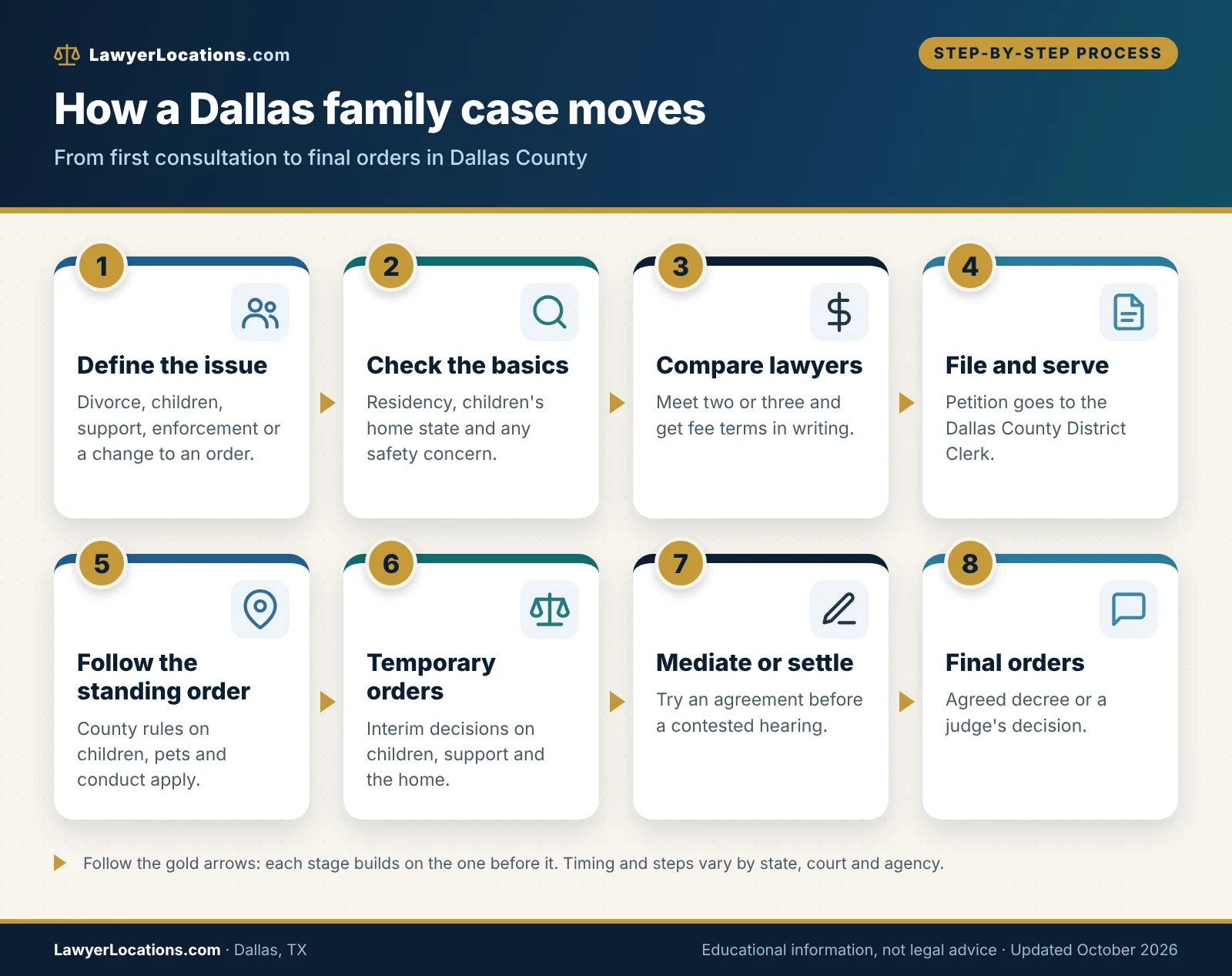
Text version of this graphic
- Describe the problem: divorce, children, support, enforcement or change of an existing order.
- Check the basics: residency, children’s current home state, and whether any safety issue exists.
- Consult one or more lawyers and compare fee agreements.
- File in the Dallas County family district court and have the other side formally served.
- Temporary orders, information exchange and the Dallas County standing order guide the case while it is pending.
- Mediation or negotiation attempts a settlement.
- Final orders: an agreed decree or a trial decision.
- After the decree: enforcement or modification when circumstances change.
Local versus statewide: what changes in Dallas
The substantive rules come from the Texas Family Code and apply statewide. What changes in Dallas is the practical layer: the courts that hear the case, the standing order those courts apply, local rules and court procedures, the clerk’s office, and the local legal-aid and bar resources. The rest of this guide separates those layers so you can tell which parts of your plan are fixed by statute and which are set by Dallas County practice.
What stays the same in every Texas county
Statewide statutes control who may file for divorce, how long a case must wait before a divorce can be granted, and how child support is calculated under the guidelines. A lawyer in Houston or Austin works from the same code. That is why you can often learn the basics from statewide resources before you ever speak with a Dallas lawyer.
It also means a lawyer who tells you “Dallas has its own divorce law” is overstating things. The local differences are procedural and practical, not a separate legal system.
What is genuinely local to Dallas County
The local layer includes the seven family courts, the Dallas County standing order, the county’s alternative dispute resolution program, the District Clerk’s records process, and Dallas-based nonprofits and bar services. It also includes habits: how a particular court sets hearings, what the court expects in a proposed order, and how local mediators work. Experienced Dallas family lawyers know these patterns, and that experience is a legitimate reason to prefer a lawyer who regularly appears in these courts.
Ask each lawyer you interview, “How often do you appear in the Dallas County family courts, and what is your usual approach to cases like mine?” You are not asking for a guarantee. You are listening for specific, local, plain-English answers.
Texas rules that shape every Dallas family case
Three sets of rules decide the early shape of most Dallas family cases: the residency and waiting-period rules for divorce, the guideline formula for child support, and the Dallas County standing order that governs behavior while a case is pending. Knowing them before your first consultation lets you ask better questions.
Divorce threshold rules: residency and the waiting period
Before a Texas court can grant a divorce, two timing rules must be met. One controls where and when you may file; the other controls how soon a divorce can be finalized.
Residency: six months in Texas, 90 days in the county
Under Tex. Fam. Code § 6.301, a divorce suit may not be maintained in Texas unless, when the suit is filed, either the person filing or the other spouse has been a domiciliary of Texas for the preceding six months and a resident of the county where the suit is filed for the preceding 90 days. Either spouse can satisfy the test, which matters if one spouse has recently moved.
For Dallas, that means the county-residency clock refers to Dallas County, not just the City of Dallas. People who live in suburbs such as Garland, Irving or Mesquite may live in Dallas County or in a neighboring county, so a lawyer will check the county line before anything is filed.
The 60-day waiting period and its family-violence exception
Under Tex. Fam. Code § 6.702, a court generally may not grant a divorce before the 60th day after the suit was filed. The waiting period does not apply if the court finds that the other spouse has a final conviction or deferred adjudication for a family-violence offense against the filing spouse or a member of the household, or that the filing spouse has an active protective order or magistrate’s emergency protection order based on family violence committed during the marriage.
The 60 days is a minimum, not a forecast. Complicated or contested cases take longer, and our guide on how long a divorce takes explains the factors that stretch the timeline.
The waiting period starts when the suit is filed, not when you first hire a lawyer. If your situation involves safety concerns, tell any lawyer you consult about them at the start, because the family-violence exception depends on specific court findings or orders.
Children and child support under the guidelines
Child-related orders in Texas turn on the child’s best interest, and child support starts from a statutory formula. Neither is a guess; each is a framework a lawyer should be able to explain in plain words.
Conservatorship and possession: what to expect from the conversation
A lawyer will usually begin by asking about each child’s school, health needs, daily routine, and each parent’s work schedule and home. The court focuses on the child’s best interest, and the details you bring shape how a proposed parenting plan looks. The Family Code’s possession-and-access rules provide default schedules that many Texas orders build on, and a lawyer can explain how those defaults would apply to your children’s ages and your travel distance.
If you and the other parent already agree on most points, say so at the first consultation. It may change the type of help you need, from full litigation to document drafting and review.
Guideline child support percentages
Under Tex. Fam. Code § 154.125, the court presumptively applies a percentage of the paying parent’s monthly net resources, up to a cap. The cap is the maximum amount of net resources to which the guidelines apply, as published by the state’s Title IV-D agency in the Texas Register, and it is adjusted every six years for inflation, with changes taking effect on September 1 of the adjustment year. Check the Attorney General’s current published figure instead of relying on a number you saw in an older article.
| Children before the court | Share of monthly net resources (standard schedule) | Share if net resources are under $1,000 per month |
|---|---|---|
| 1 | 20% | 15% |
| 2 | 25% | 20% |
| 3 | 30% | 25% |
| 4 | 35% | 30% |
| 5 | 40% | 35% |
| 6 or more | At least the five-child amount | At least the five-child amount |
These percentages are the starting presumption. A court can consider other factors, and the way “net resources” is calculated from income, benefits and deductions is where lawyers earn their fees. Treat the table as orientation, not as a prediction of what a judge will order in your case.
The Dallas County standing order and local procedures
Dallas County adds its own layer on top of the Family Code. Two items matter most at the start of a case: the standing order and the county’s dispute-resolution options.
What the standing order covers
The Dallas County Family District Courts publish a Standing Order Regarding Children, Pets, Property and Conduct of the Parties. The version posted on the District Clerk’s family forms page was revised on January 31, 2026, and it applies to every divorce suit and every suit affecting the parent-child relationship filed in Dallas County. As a standing order, it applies without anyone having to ask for it.
Among other things, the posted text tells parties not to remove the children from Texas to change their residence, withdraw them from school or day care, hide them or change their home without written agreement or a court order, make disparaging remarks about the other party near the children, or discuss the litigation in their presence. It also prohibits harming or threatening a family pet and using vulgar or offensive language, with intent to annoy or alarm, to communicate with the other party. Read the full current order, because it contains more than this summary.
Local rules and alternative dispute resolution
The county posts local rules and guidelines for its civil and family courts on the District Clerk’s website, along with an alternative dispute resolution (ADR) page. Mediation is a common step in contested family cases, and your lawyer can explain what the assigned court expects and when. Because local rules and individual-court procedures are revised from time to time, ask your lawyer to point to the current version rather than describing it from memory.
Texas also has statutes on mediation and on collaborative family law. Ask any lawyer you interview whether they offer those options and when they think they fit.
A standing order is a court order that applies automatically to a category of cases. You do not need a hearing to put it in place. Breaking it can lead to a motion asking the judge to enforce it.
| Checkpoint | Source | What it means in practice |
|---|---|---|
| Residency to file for divorce | Tex. Fam. Code § 6.301 | Six months in Texas and 90 days in the filing county for either spouse when the suit is filed. |
| Waiting period | Tex. Fam. Code § 6.702 | Divorce generally cannot be granted before the 60th day after filing; family-violence exceptions exist. |
| Child support formula | Tex. Fam. Code § 154.125 | Percentage of net resources by number of children, applied up to a published cap. |
| Conduct while the case is pending | Dallas County Family District Courts standing order | Rules on children, pets, property and communication apply to every divorce and parent-child case. |
| Court file and copies | Dallas County District Clerk | Request copies through the Civil & Family Records process; online family records access is suspended. |
| Dispute resolution | Dallas County ADR page and local rules | Ask the lawyer how mediation is handled in the court assigned to your case. |
Fees, retainers and consultations for a Dallas family law attorney
Most Dallas family lawyers charge by the hour against a deposit called a retainer, though flat fees and limited-scope arrangements exist for simpler tasks. The right fee model depends on how contested your case is, not on which lawyer sounds most confident. This guide does not publish rate “averages,” because no verified official source tracks them for Dallas; ask each office for its written fee terms instead.
How Texas family lawyers typically structure fees
Fee structures differ, and the same office may offer more than one. Understanding the labels lets you compare offers on equal footing.
Hourly billing and the retainer
In an hourly arrangement, the lawyer and staff record time in increments, and you pay for the time spent on your case. Most offices ask for an up-front deposit, often called an advance fee retainer or evergreen retainer, that is held in a trust account and drawn down as work is billed. When the deposit runs low, the office may ask you to replenish it.
Ask three questions: what hourly rates apply to the lawyer, associates and paralegals; what increments time is billed in; and what happens to any unused deposit at the end of the case. A fair office answers those in writing.
Flat fees and limited-scope help
A flat fee is a single price for a defined task, such as preparing paperwork in an agreed divorce where nothing is disputed. It works when the work is predictable. It works poorly when the other side contests everything, because a flat price rarely covers unexpected hearings, and an office may carve those out as extra.
Some lawyers also offer limited-scope representation, sometimes called unbundled help: you hire them for one piece, such as reviewing a settlement or preparing for a hearing, and handle the rest yourself. The Dallas Bar Association’s referral listing on Texas Law Help suggests asking whether a lawyer will do this; not every lawyer does.
Contingent fees are unusual in family cases
In personal injury work, a lawyer may take a percentage of a recovery. That model rarely fits family law. Comment 9 to Texas Disciplinary Rule of Professional Conduct 1.04 states that contingent fee arrangements in domestic relations cases are rarely justified, and a divorce or custody case usually has no money “recovery” to take a percentage of anyway. If a lawyer proposes a percentage of your property settlement or a bonus tied to custody time, treat it as a reason to ask hard questions. Our criminal defense fee guide shows how fee models are compared in another practice area.
Be cautious about any lawyer who promises a specific result, a specific judge, or a fixed total cost for a contested case before reviewing your facts. Nobody controls how the other side behaves.
Rules about fee agreements in Texas
Texas lawyers are bound by the Texas Disciplinary Rules of Professional Conduct. Those rules do not fix a price, but they set boundaries and expectations around fees.
What Rule 1.04 requires
Under Texas Disciplinary Rule 1.04, a lawyer may not enter into an arrangement for, charge or collect an illegal or unconscionable fee. A fee is unconscionable if a competent lawyer could not form a reasonable belief that the fee is reasonable. The rule lists factors for judging reasonableness, including the fee customarily charged in the locality for similar legal services. When a lawyer has not regularly represented the client, the basis or rate of the fee must be communicated to the client, preferably in writing, before or within a reasonable time after the representation begins.
In practice, that means you are entitled to know how you will be billed, and asking for the terms in writing is both reasonable and normal.
What a written fee agreement should spell out
Look for the items below before you sign, and ask about anything that is missing. Keep a copy, because it is your reference when a bill surprises you.
- Who will work on your case, and each person’s hourly rate.
- The size of the retainer, how it is held, and when you must replenish it.
- How billing increments, travel, copies and filing costs are charged.
- What the fee covers, such as temporary hearings, mediation and trial, and what is billed separately.
- How often you receive itemized statements.
- How either side can end the relationship and what happens to unused funds.
Consultations: free, reduced-fee or paid
First meetings are priced differently across Dallas offices. Some advertise no-charge consultations, others charge a set fee, and bar-sponsored referral services may offer a reduced-fee first meeting. Confirm the cost and the length before you book so there are no surprises, and remember that a consultation does not necessarily mean the lawyer has agreed to represent you.
Reduced-fee consultations through the bar referral service
The Dallas Bar Association operates a Lawyer Referral Service that connects people with attorneys in the Dallas area; you can use the service by phone or through an online client referral form on dallasbar.org. Texas Law Help notes that many Texas referral services charge a modest set fee for a short first consultation, but it also says to confirm the amount with the service. After the consultation, you negotiate fees directly with the lawyer you choose.
A referral is a starting point, not an endorsement. You still need to ask the questions in the next section.
Getting the most out of a first meeting
Arrive with a one-page timeline of the marriage or relationship, the children’s names and ages, and a short list of the outcomes you care about most. Bring the documents in the checklist below if you have them. A prepared client gets a more specific answer in a shorter meeting, and that saves money when the meeting is billed.
Take notes during the meeting and send a short follow-up email summarizing what you understood. If the lawyer’s answer differs from your summary, you will find out early.
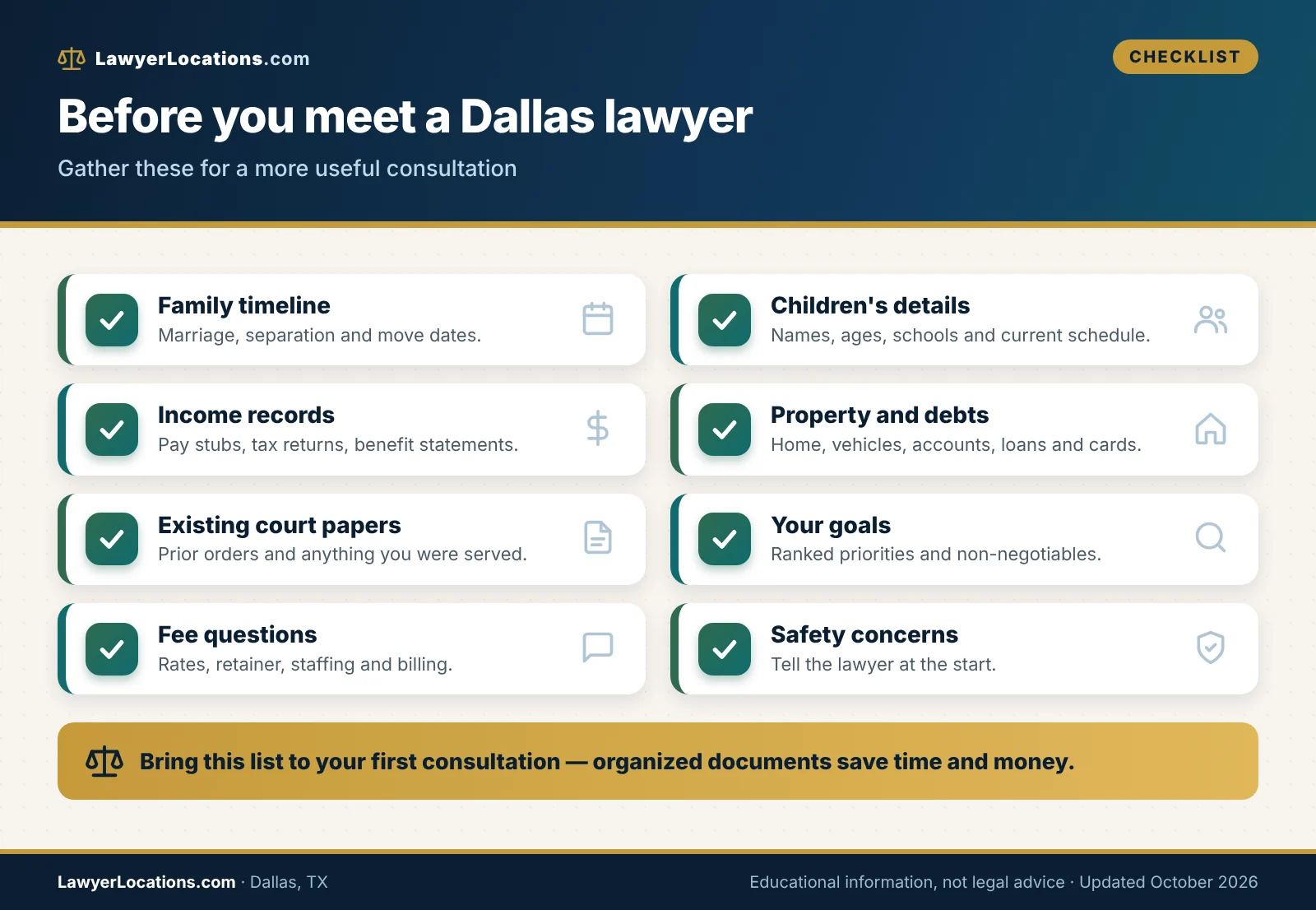
Text version of this graphic
- Marriage and family timeline: dates of marriage, separation, and moves.
- Children: names, birthdates, schools, medical needs and current schedule.
- Income records: pay stubs, tax returns, benefit statements.
- Property and debt list: home, vehicles, retirement accounts, loans, credit cards.
- Existing court papers: prior orders, protective orders, anything you were served with.
- Your goals ranked, plus what you will not compromise on.
- A list of questions about fees, staffing and communication.
A consultation is confidential only to the extent the law and the office’s practices provide, and you are not yet the lawyer’s client unless you both agree. Do not send sensitive documents until the office tells you how to share them securely.
| Fee structure | How it works | Often fits | What to check |
|---|---|---|---|
| Hourly with retainer | Deposit is drawn down as time is billed. | Contested or unpredictable cases. | Rates for each timekeeper, replenishment terms, refund of unused funds. |
| Flat fee | One price for a defined task. | Agreed, uncontested matters with complete paperwork. | Exactly what is included and what turns into an extra charge. |
| Limited scope | Lawyer handles an agreed piece of the case. | People who can handle part of the process themselves. | Who files, who appears at hearings, and what happens if the case changes. |
| Contingent percentage | Fee depends on an outcome. | Rarely used in family cases. | Why it is proposed at all; Texas rule commentary treats it as rarely justified in domestic relations. |
Costs include more than the lawyer’s fee. Court filing costs, process-server charges, mediator fees, expert or appraiser costs and the cost of copies all add up, and the amounts vary by case. Check the Dallas County District Clerk’s current fee information for filing costs instead of relying on a figure in an article, and ask the clerk about options if you cannot afford court costs.
How to compare Dallas family law attorneys
Compare lawyers on four checkable things: license and discipline record, relevant experience, how the office communicates and staffs your case, and whether the fee terms are clear. Advertising volume and slogans are not on that list. LawyerLocations is a legal-education and discovery resource, not a law firm, and nothing here ranks or endorses any lawyer.
Verify credentials and record before you hire
Credentials answer a narrow question: is this person allowed to practice, and have there been consequences for misconduct? They do not tell you whether the lawyer is a good fit.
Confirm the Texas license and any discipline
Every lawyer who represents you in a Dallas family court must be licensed to practice in Texas. The State Bar of Texas provides a public attorney search, and the bar also publishes information on disciplinary actions. Look up each lawyer you are considering, check that the name on the license matches the name on the engagement letter, and read any public discipline carefully instead of treating it as automatically disqualifying or irrelevant.
Also confirm that the person you are meeting is a lawyer rather than a paralegal or intake worker. Many offices have both, and both are useful, but legal advice should come from a licensed attorney.
Understand what board certification means and what it does not
The Texas Board of Legal Specialization recognizes family law as an area in which a Texas lawyer can earn board certification, a credential that requires meeting the board’s standards. If a lawyer advertises it, you can verify it with the board instead of taking the ad’s word for it. If a lawyer does not have it, that does not mean they are unqualified, and many capable family lawyers do not hold it.
Treat the credential as one verifiable data point. It is not a guarantee of results, and you should still ask about experience with your kind of case.
Questions that reveal fit
The first meeting is a two-way interview. The questions below are designed to produce concrete answers instead of sales language.
Experience in the Dallas County family courts
Ask how much of the lawyer’s practice is family law and how often they appear in Dallas County family courts. Ask what percentage of their cases settle in mediation versus go to hearing, and what that tells you about their approach. A direct, modest answer (“most of my cases settle, but I prepare every file as if it will be heard”) is better than a boast.
Ask who would handle hearings if your lawyer were unavailable, and whether you can meet that person. Courts expect lawyers to be prepared and punctual, and backup coverage is part of that.
Communication, staffing and billing habits
Ask who your day-to-day contact will be, how quickly the office typically returns messages, and whether you will receive copies of everything filed or sent. Avoid choosing a lawyer on the strength of a promised response time, because no outside source can verify it. Instead, ask how the office handles emergencies, such as a child-related problem on a weekend.
Finally, ask how the office handles billing disputes. A transparent office will explain its process without discomfort.
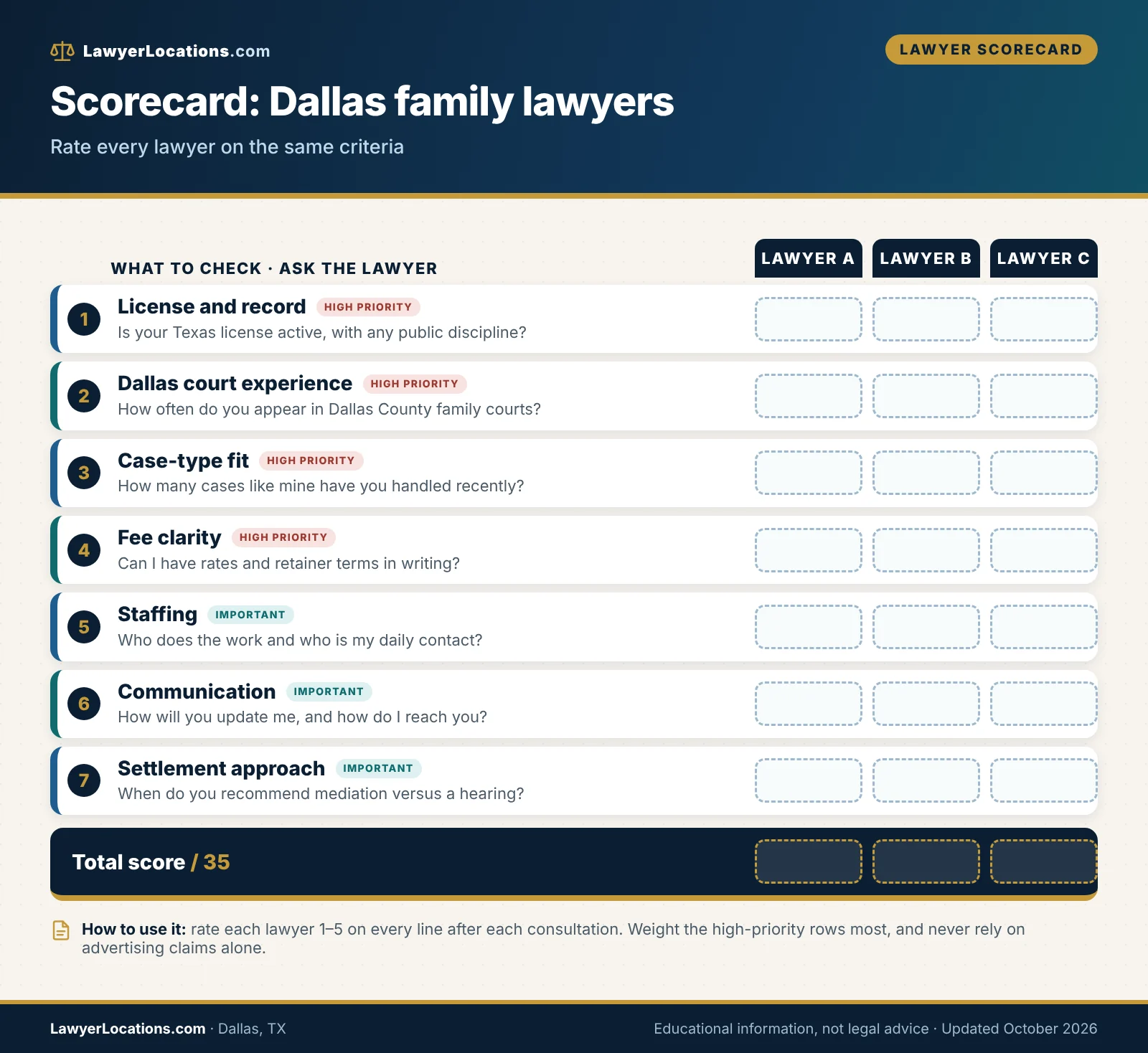
Text version of this graphic
| Criterion | Question to ask |
|---|---|
| License and record | Is your Texas license active, and is there any public discipline? |
| Dallas family court experience | How often do you appear in the Dallas County family courts? |
| Case-type fit | How many cases like mine have you handled recently? |
| Fee clarity | Can I have the fee terms and rates in writing? |
| Staffing | Who will do the work and who is my daily contact? |
| Communication | How will you update me and how do I reach you? |
| Settlement approach | When do you recommend mediation, and when a hearing? |
| Criterion | What to ask | Good sign | Warning sign |
|---|---|---|---|
| License and record | Is your Texas license active? Any public discipline? | Clear answers that match the State Bar record. | Evasive answers or a name that does not match the record. |
| Local courts | How often do you appear in Dallas County family courts? | Specific, modest description of recent work. | Promises about a particular judge or outcome. |
| Case-type fit | What share of your work is divorce, custody, support or enforcement? | Regular experience with your kind of case. | Family law is a side offering. |
| Fees | May I have the fee terms in writing? | Rates, retainer and billing practice are written down. | Vague terms or pressure to sign immediately. |
| Staffing | Who will work on my file? | Named team and a backup contact. | You meet one person and never hear from them again. |
| Communication | How will you update me? | A defined method and copies of filings. | Unwilling to explain strategy in plain language. |
Red flags and green flags
Some patterns should slow you down. Others suggest a healthy fit.
Red flags to take seriously
- A guarantee of an outcome, including promises about custody time or property.
- Pressure to hire the same day, or “limited time” fee offers.
- A refusal to provide fee terms in writing.
- Advice to ignore a court order, hide assets or coach a child, which can hurt you in front of the judge.
- Claims that your case is “easy” before the lawyer has read the file.
If any of these appear, it is reasonable to end the conversation and consult someone else.
Green flags that suggest a good working relationship
- The lawyer explains the process and risks plainly.
- The fee agreement is complete and unhurried.
- The office tells you what it does not know yet.
- The lawyer discusses settlement and trial as real options.
- Answers are all reassurance and no detail.
- You cannot find the lawyer on the State Bar’s public search.
- The office dismisses your safety or child-related concerns.
- Costs are described only as “reasonable.”
Pay attention to how the lawyer responds when you raise a worry. A good lawyer treats your questions as part of the job.
Meet at least two lawyers before you decide, even if the first one seems perfect. The comparison itself teaches you which questions matter. If you are thinking about a prenuptial agreement for a future marriage, our guide to a prenup lawyer in nearby Arlington covers a related Texas issue.
From filing to final orders: costs, deadlines and decision points
A Dallas family case moves through predictable stages: filing and service, temporary orders, information exchange and mediation, then final orders and afterward enforcement or modification. The decision points are mostly about whether to settle, and your lawyer should explain the trade-offs at each one. The stages below describe the general path; no court or lawyer can promise how long yours will take.
Filing, service and the early weeks
The first few weeks set the tone. Good preparation here usually prevents expensive fixes later.
Choosing the county and filing the case
Your lawyer first confirms that Dallas County is the right place to file by checking the residency rules in Tex. Fam. Code § 6.301 for a divorce and the child’s circumstances for a parent-child case. The petition is filed with the Dallas County District Clerk, and the case is assigned to one of the family district courts. Attorneys file electronically; if you are self-represented, use the District Clerk’s family forms and self-represented pages to learn the current filing steps.
Ask the office what it needs from you at this stage and how long the preparation will take. Rushing a filing because of an emotional moment is a common source of regret.
Service of the other party and the standing order
The other spouse or parent must be formally notified of the case, usually through service of the petition and citation or through a signed waiver or appearance when the case is agreed. Once the case is on file, the Dallas County standing order applies in every divorce and parent-child suit, so both sides should read it and adjust their behavior before any hearing.
Following the order protects you. Judges notice which side follows the rules, and a violation can become the other side’s best exhibit.
Temporary orders, mediation and settlement
Between filing and the final decree, the court can make temporary decisions about children, support and use of property, and the parties typically try to settle. Most family cases end by agreement, but a lawyer should prepare each file for a hearing in case talks fail.
Temporary orders hearings
If the parties cannot agree on interim arrangements, a lawyer may ask the court for temporary orders on issues such as who stays in the home, children’s schedules and support while the case is pending. Courts set these hearings according to their own calendars. Ask your lawyer how the assigned court usually schedules them, what evidence it expects and how much preparation time to budget.
Temporary orders are not final, but they can shape the case, because they establish a routine the court may be reluctant to change without a reason. Prepare accordingly.
Mediation and other dispute-resolution options
Dallas County has an alternative dispute resolution page, and Texas law recognizes mediation and collaborative family law. In mediation, a neutral third party helps the sides try to reach an agreement, and the mediator does not decide the case. A written settlement that meets legal requirements can become the basis of the final decree.
Ask your lawyer to explain what is binding, what is not, and how the signing process works before you attend. Do not sign anything at mediation that you do not understand. If you are weighing alternatives to a full divorce, our guide on legal separation versus divorce explains the differences and why they vary by state, so ask a Dallas lawyer which options Texas offers.
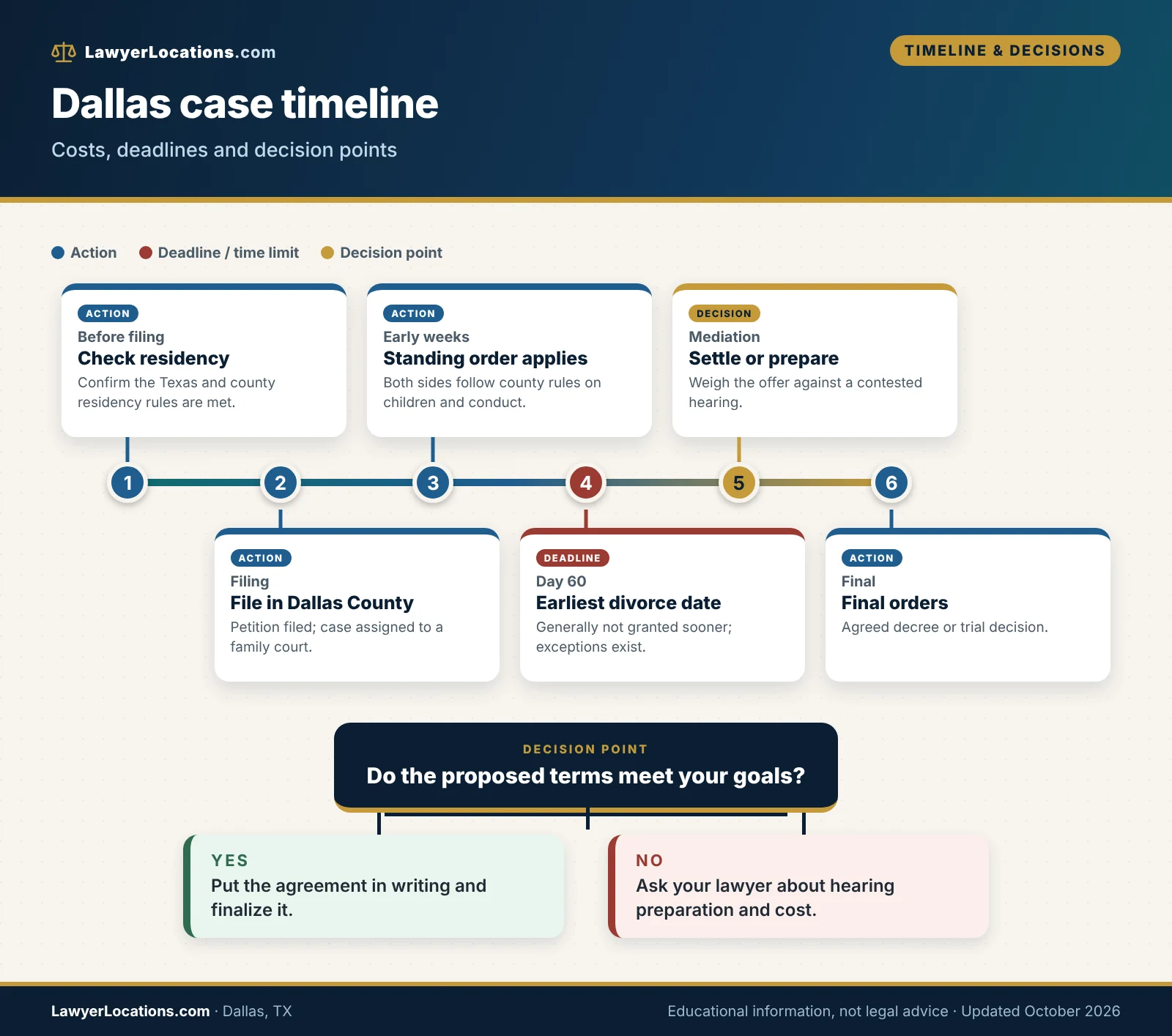
Text version of this graphic
- Before filing: confirm residency, gather documents, choose a lawyer (action).
- Filing: petition goes to the Dallas County District Clerk and the case is assigned to a family court (action).
- Early weeks: service, the standing order applies, temporary orders if needed (action).
- Day 60 after filing: earliest point a divorce can generally be granted, with exceptions (deadline).
- Mediation or settlement talks: decide whether to settle or prepare for hearing (decision).
- Final orders: agreed decree or trial decision (action).
- After the decree: enforce or modify when circumstances change (action).
Decision point: Do the terms on the table meet your goals well enough to settle? If yes, finalize the agreement in writing. If no, ask your lawyer about hearing preparation and its cost.
Final orders and life after the decree
The decree or final order is the document you will live by, so read it closely before you agree. A lawyer should walk you through every paragraph.
Getting copies of your decree and court file
Keep a certified copy in a safe place and a digital copy for easy reference. Request copies from the Dallas County District Clerk’s Civil & Family Records desk, either through the clerk’s records request form or in person at the George Allen Courts Building, 600 Commerce Street, Basement B Floor West. The clerk’s page states that staff will give a cost estimate after you submit a request and that sealed or confidential records generally require a court order.
Check the office’s current hours and payment options before you go. The clerk’s posted hours are 8:00 a.m. to 4:30 p.m., Monday through Friday, with requests after 4:00 p.m. handled the next business day.
Enforcing or changing orders later
If a parent stops paying support or ignores the schedule, a lawyer can ask the court to enforce the order. If circumstances change significantly, such as a job change, relocation or a child’s new needs, a lawyer can advise whether and how to ask for a modification. Keep a log of problems with dates and records, because courts expect evidence rather than summaries.
For child support specifically, the Office of the Attorney General of Texas, Child Support Division, offers services to parents to help with establishing and enforcing orders; you can apply through its website.
| Stage | What happens | Where it happens | Ask your lawyer |
|---|---|---|---|
| Pre-filing | Residency check, document gathering, choosing counsel. | Law office; Texas Family Code rules. | Does Dallas County meet the venue and residency rules? |
| Filing and service | Petition filed; other party served or waives service. | Dallas County District Clerk; assigned family district court. | Which court was assigned and what are its procedures? |
| Pending case | Standing order applies; temporary orders may be requested. | Family district court. | What should I do or avoid while the case is pending? |
| Waiting period | Divorce generally cannot be granted before day 60. | Statewide rule, Tex. Fam. Code § 6.702. | Does any exception apply to my situation? |
| Settlement | Negotiation, mediation or collaborative process. | Mediator’s office; Dallas County ADR resources. | What are the pros and cons of this offer? |
| Final orders | Agreed decree or a judge’s decision after trial. | Family district court. | What does each paragraph require me to do and by when? |
| After the decree | Copies, enforcement or modification. | District Clerk records; same family court system. | What would count as a significant change? |
A parent who recently moved from another state to Dallas County may find that a divorce cannot yet be filed here because the county-residency period has not run, while the other spouse could meet the test. A lawyer reviewing both spouses’ timelines would flag that early. The point is not who “wins” the race to the courthouse, but that the rule in § 6.301 looks at either spouse’s residency on the date of filing.
Free and low-cost help in Dallas County
If a private retainer is out of reach, Dallas has several routes to legal help: a bar referral service, legal-aid organizations, a volunteer attorney program, the county law library and the District Clerk’s self-help forms. Eligibility rules and services change, so contact each organization directly for current information.
Lawyer referral and legal aid
Some organizations connect you to a private lawyer, and others provide free help directly to people who qualify.
Dallas Bar Association Lawyer Referral Service
The referral service, listed through Texas Law Help, refers people to attorneys in the Dallas area, including family law matters such as divorce, custody, child support and paternity. You can request help by phone or through an online form at dallasbar.org. Ask about the consultation fee, whether reduced-fee options exist, and whether the lawyer will provide limited-scope help.
Using a referral service does not obligate you to hire the lawyer you are referred to. You can still compare.
Legal Aid of NorthWest Texas and the Dallas Volunteer Attorney Program
Legal Aid of NorthWest Texas is a nonprofit that provides civil legal help to eligible people in the region, and it is listed in the Texas Law Help directory. The Dallas Volunteer Attorney Program is a pro bono program that places volunteer lawyers with eligible clients and has hosted legal clinics. Eligibility depends on income and the type of case, and demand can be high, so apply early and keep your documents organized.
If you are not accepted, ask what other referrals the organization recommends. Those referrals are often worth following up.
Self-help and public resources
If you must handle some or all of the case on your own, use official materials first and be careful with generic downloaded forms that may not match Dallas County practice.
Dallas County Law Library and District Clerk forms
The Dallas County Law Library maintains a self-help catalog for members of the public, and the District Clerk posts family court forms and a page of forms for self-represented persons. Law library staff can generally help you find materials but cannot give legal advice. Review the standing order and local rules before you file anything, and check each form’s date.
If you file without a lawyer, consider paying for a limited-scope consultation to review your paperwork before you submit it.
Texas Law Help and the Attorney General’s Child Support Division
Texas Law Help (texaslawhelp.org) is a statewide legal-information site that hosts directories of legal-aid and referral services. The Office of the Attorney General of Texas runs the state’s Child Support Division, which helps parents establish, collect and enforce support, and it publishes guides and forms on its site. Use official government and nonprofit resources first, and treat commercial form sites cautiously.
Whichever resource you use, keep a record of what you submitted and when.
| Resource | What it offers | Best used for | Note |
|---|---|---|---|
| Dallas Bar Association Lawyer Referral Service | Referrals to Dallas-area attorneys. | Finding a private lawyer, possibly with a reduced-fee first meeting. | Confirm the fee and whether the lawyer handles your case type. |
| Legal Aid of NorthWest Texas | Civil legal help for eligible people. | Low-income households with qualifying family matters. | Eligibility is based on income and case type. |
| Dallas Volunteer Attorney Program | Volunteer lawyers and legal clinics. | Eligible people who need pro bono help. | Apply early; capacity varies. |
| Dallas County Law Library | Self-help materials and legal research tools. | Learning the process or preparing your own paperwork. | Staff cannot give legal advice. |
| Dallas County District Clerk | Family court forms, records requests and self-represented information. | Forms, copies of decrees and filing guidance. | Online access to family records is currently suspended. |
| Texas Attorney General Child Support Division | Child support establishment and enforcement services. | Support cases, paternity and collection. | Apply through the agency’s website. |
When you call any of these organizations, ask three things up front: whether you are likely to qualify, what documents they need, and how long applications usually take. Write down the answers so you can plan around them.
Mistakes to avoid, safety, quick answers and next steps
The most expensive mistakes in Dallas family cases are usually avoidable: ignoring the standing order, hiding financial information, posting about the case online and signing agreements you have not understood. A short, steady plan beats a dramatic first move.
Common mistakes and how to avoid them
The patterns below come up repeatedly in family courts nationwide. Each one is easy to prevent if you know about it.
Mistakes with children and conduct
- Moving children out of school or out of Texas without written agreement or a court order, which the Dallas County standing order specifically addresses.
- Talking about the case in front of your children or criticizing the other parent to them.
- Sending angry, offensive or threatening messages that can be shown to the judge.
- Posting about the case, the other parent or your finances on social media.
Treat every text and email as something a judge may read. Keep communication brief, polite and focused on the children.
Mistakes with money, paperwork and fees
- Leaving out accounts, debts or income when you gather information.
- Signing a retainer agreement without reading the billing and refund terms.
- Missing a hearing or a court-ordered deadline because mail went to an old address.
- Assuming an online template will work in Dallas County without checking local requirements.
Create a folder, paper or digital, for every document you receive or send. It will save time and money during the case.
Safety first: family violence and urgent situations
If you or your children are in danger, safety comes before strategy. Call 911 in an emergency.
When safety changes the legal plan
Safety concerns can affect how a case is filed and what protections are sought. As noted above, § 6.702 includes an exception to the divorce waiting period when specific family-violence findings or orders exist. Whether any of that applies to you is a question for a lawyer, and you should tell the lawyer about any safety concern at the beginning of the consultation.
Our domestic violence lawyer guide explains how to find and compare lawyers in these situations.
Planning for contact, devices and records
If the other person monitors your phone, email or location, ask a trusted advocate or lawyer about safer ways to communicate before you act. Keep copies of important documents somewhere the other person cannot reach. Plan how you will explain the situation briefly at each new contact so you do not need to repeat difficult details.
Local victim-service and legal-aid organizations can help you build a safety plan. The Texas Law Help site lists safety and legal resources by region.
Quick answers to common Dallas questions
The questions below are the ones people ask most often when they start looking for a family law attorney in Dallas, TX.
Short answers about hiring, fees and courts
How do I find a family law attorney in Dallas, TX?
Start with the State Bar of Texas attorney search, the Dallas Bar Association Lawyer Referral Service and legal-aid organizations if you may qualify. Then interview at least two lawyers using the scorecard in this guide.
How much does a family law attorney in Dallas cost?
It depends on the fee model, the lawyer and how contested your case is. Many offices charge hourly against a retainer, and some offer flat fees for simple agreed matters. Ask for the rates and terms in writing instead of relying on an average.
Can I get a free consultation?
Some offices offer one and others charge a fee, so confirm before you book. Bar-sponsored referral services may offer a reduced-fee first meeting. Our guide to free consultations with a criminal defense lawyer shows how to judge such offers in general.
How long must I live in Dallas County before filing for divorce?
Either spouse must have been a Texas domiciliary for the preceding six months and a resident of the filing county for the preceding 90 days when the suit is filed, under Tex. Fam. Code § 6.301.
What is the fastest a Texas divorce can be granted?
Generally not before the 60th day after the suit is filed, subject to the family-violence exceptions in § 6.702. Many cases take longer, especially if they are contested.
Which court hears a Dallas divorce or custody case?
One of the Dallas County family district courts: the 254th, 255th, 256th, 301st, 302nd, 303rd or 330th. The assignment is made by the court system.
What is the Dallas County standing order?
It is an order on children, pets, property and conduct of the parties that applies in every divorce and parent-child case filed in the county. Read the current version posted on the District Clerk’s website.
How do I get a copy of my divorce decree?
Submit the District Clerk’s Civil & Family Records request form by email or in person at the George Allen Courts Building. Online access to family court records is currently suspended.
How is child support calculated in Texas?
The guidelines in § 154.125 apply a percentage to the paying parent’s monthly net resources, up to a published cap, with a lower schedule if net resources are under $1,000 per month.
Can I get help if I cannot afford a lawyer?
Possibly. Contact Legal Aid of NorthWest Texas, the Dallas Volunteer Attorney Program, the Dallas Bar Association referral service or the Dallas County Law Library for current eligibility and services.
Do other states handle family law the same way?
No. Residency rules, waiting periods and local courts differ. For comparison, see our California family law attorney guide.
How to use these answers
Use the answers above to prepare questions, not to replace a consultation. The rules summarized here are accurate as of October 2026 but can change, and an attorney licensed in Texas can tell you how they apply to your facts.
Bring a printed copy of your questions to each consultation so you can compare lawyers on the same topics.
A simple next-steps plan
You do not need to solve everything at once. Work through the steps below at your own pace, and prioritize safety and children’s needs first.
Your first seven days
- Write a one-page timeline. Include dates of marriage, separation, moves and key events.
- Collect core documents. Gather income records, a list of property and debts, and any existing court papers.
- Read the standing order. Download the current Dallas County version and follow it.
- Shortlist two or three lawyers. Verify licenses with the State Bar of Texas.
- Attend consultations. Ask the same questions each time and take notes.
- Compare written fee terms. Choose on fit and clarity rather than speed.
If cost is the barrier, contact legal-aid and referral resources in the same week rather than waiting.
When you are ready to choose a Dallas family law attorney
After you have met your shortlist, compare answers on the scorecard, read each fee agreement in full, and choose the lawyer whose approach and communication style fit your situation. If you are still unsure, ask for a second meeting before you sign.
Ready to compare your options?
Use the checklist and scorecard in this guide to interview two or three Texas-licensed lawyers about your situation, and ask each for written fee terms. LawyerLocations is a legal-education and discovery resource, not a law firm, and reading this page does not create an attorney-client relationship.
General information only. This guide is legal education, not legal advice, and reading it does not create an attorney-client relationship. Laws, court rules, fees and procedures change, and facts differ from case to case. For advice about your situation, consult a lawyer licensed in Texas. LawyerLocations.com is not a law firm and does not endorse or rank any attorney.
Sources & References
Show all 15 sources
- Texas Family Code § 6.301, General Residency Rule for Divorce Suit — Texas Legislature (as reproduced by Public.Law) — texas.public.law — accessed October 2026
- Texas Family Code § 6.702, Waiting Period — Texas Legislature (as reproduced by Public.Law) — texas.public.law — accessed October 2026
- Texas Family Code § 154.125, Application of Guidelines to Net Resources — Texas Legislature (as reproduced by Public.Law) — texas.public.law — accessed October 2026
- Texas Disciplinary Rules of Professional Conduct, Rule 1.04 (Fees) — Supreme Court of Texas rules, as reproduced by the University of Houston Law Center — law.uh.edu — accessed October 2026
- Family District Courts — Dallas County, Texas — dallascounty.org — accessed October 2026
- Dallas County Standing Order Regarding Children, Pets, Property and Conduct of the Parties (revised January 31, 2026) — Dallas County Family District Courts, posted by the District Clerk — dallascounty.org — accessed October 2026
- Civil & Family Records Information — Dallas County District Clerk — dallascounty.org — accessed October 2026
- Family Court Forms — Dallas County District Clerk — dallascounty.org — accessed October 2026
- Forms for Self-Represented Persons — Dallas County District Clerk — dallascounty.org — accessed October 2026
- Law Library self-help catalog — Dallas County Consolidated Services — dallascounty.org — accessed October 2026
- Dallas Bar Association — Lawyer Referral Service — Texas Law Help directory — texaslawhelp.org — accessed October 2026
- Legal Aid of NorthWest Texas — Texas Law Help directory — texaslawhelp.org — accessed October 2026
- Dallas Volunteer Attorney Program — North Texas Giving Day listing — northtexasgivingday.org — accessed October 2026
- Dallas Volunteer Attorney Program hosts virtual legal clinics — State Bar of Texas blog — blog.texasbar.com — accessed October 2026
- Child Support Division publications — Office of the Attorney General of Texas — texasattorneygeneral.gov — accessed October 2026
Legal Disclaimer and Limitation of Liability
Informational and illustrative purposes only. This article was prepared by LawyerLocations.com solely on the basis of the information available to us at the time of writing. It is an illustrative, general overview. It is not a complete or authoritative statement of the law, and it has not been reviewed by a lawyer licensed in your state or county.
Not legal advice. Nothing in this article is legal, financial, tax or immigration advice, and reading it does not create an attorney-client relationship between you and LawyerLocations.com or any author, lawyer or firm mentioned. Laws, court rules, fees, filing deadlines and agency procedures differ by state, county and court, and they change often. Some details here may be simplified, incomplete or out of date, and time limits for legal claims can be short.
No warranty. We make no representation or warranty, express or implied, about the accuracy, completeness, timeliness or suitability of this content for your situation. Please do not rely on it to make, delay or skip any legal decision. Check the facts against official sources and speak with a licensed attorney in the relevant jurisdiction before you act.
Limitation of liability. To the fullest extent permitted by law, LawyerLocations.com and its owners, authors and contributors disclaim all liability for any loss, damage, cost or other consequence arising from the use of, or reliance on, this article, including any content on third-party websites we link to. Mentioning a lawyer, firm, organization or service is not an endorsement and is not a promise of any result. If you are in immediate danger, contact your local emergency number.