
If you are looking for a personal injury lawyer in Cook County, IL, you are choosing someone who will work in the Circuit Court of Cook County, under Illinois law, against insurers and defendants who know that courthouse well. Illinois generally gives you 2 years to file a bodily-injury lawsuit, and a jury can bar recovery if it finds you more than 50% at fault, so early steps matter.
A search for a personal injury lawyer Cook County IL turns up mostly ads; this guide explains which Cook County courts hear injury cases, how a claim moves from first call to resolution, what contingency-fee agreements should say, and how to compare attorneys fairly before you sign anything. LawyerLocations.com is an educational directory, not a law firm.
What hiring a personal injury lawyer in Cook County involves
A personal injury lawyer represents someone hurt because of another party’s carelessness or wrongdoing. In Cook County, that work usually plays out in one specific court system and under one state’s law, which is why a county-focused search is different from a generic national one.
What personal injury lawyers handle here
The label “personal injury” covers a broad family of civil claims. The common thread is that someone was physically hurt, and a person or company may be legally responsible for the harm.
Common types of injury claims
The Circuit Court of Cook County’s Law Division lists the kinds of cases it hears, and they give a useful map of this field: personal injury and wrongful death, motor vehicle injury, medical and legal malpractice, product liability, intentional tort, construction injuries, premises liability and more. Car, truck and motorcycle crashes, falls on unsafe property, defective products and dog bites all fall under this umbrella.
Some of these have their own specialists and their own wrinkles. If your situation is a crash involving a commercial vehicle, our comparison of a truck accident lawyer versus a car accident lawyer explains why the difference matters. Pedestrians hurt in the city may want to read about a pedestrian accident lawyer in Chicago, and dog-bite victims can start with our dog bite lawyer guide for Chicago.
What the lawyer actually does for you
In practical terms, an injury lawyer gathers evidence, communicates with insurers so you do not have to, values the claim (medical costs, lost income, pain and other harms), negotiates, and files and litigates a lawsuit if negotiation fails. The work is mostly paperwork, deadlines and persuasion. Very few cases end in a dramatic courtroom scene.
Negligence means failing to use reasonable care, and that failure causes harm. Most Illinois injury claims are negligence claims: the injured person must show a duty, a breach of that duty, causation and damages.
Why the county matters
Cook County is not just a place on a map for these claims. It determines which judges, which clerk, which court rules and which local procedures apply to your case.
One county, many courthouses
The Circuit Court of Cook County sits in the Richard J. Daley Center in downtown Chicago and also operates courthouses in the suburbs. The court’s own Law Division page describes different dollar thresholds for Chicago and for the suburban districts, which means that where your case belongs can depend on both the amount at stake and the location of the incident or the parties. A lawyer who files in the wrong place loses time, so ask any attorney you interview how they decide on venue.
This guide stays at the county level. If your case is centered in the city itself, the Chicago personal injury lawyer guide covers city-specific considerations, while this page concentrates on courts, procedures and resources that apply across the whole county.
Illinois law, applied locally
The substantive rules, such as deadlines and how fault is shared, come from the Illinois General Assembly and the Illinois courts, so they are the same in Cook County as in the rest of the state. What changes is the machinery: local calendars, arbitration programs, e-filing practices and the clerk’s office. We cover both layers below so you can tell which questions to ask a lawyer about the law and which to ask about the local courthouse.
When you interview a lawyer, ask a county-specific question such as “Would this case likely sit in the Law Division at the Daley Center or in a suburban district, and why?” A clear, reasoned answer tells you more than a confident slogan.
Cook County courts and how a case moves through them
Most injury lawsuits in Cook County are filed in the Law Division of the Circuit Court, and most claims never get that far because they settle first. Understanding both the pre-suit and in-court stages helps you judge what a lawyer is promising.
Before a lawsuit: claim, investigation and negotiation
The early months are about evidence and medical treatment, not courtrooms. Decisions you make here shape everything that follows.
Safety, evidence and insurance notice
After an injury, the first priorities are medical care and preserving proof: photographs, names of witnesses, medical records, and the other party’s insurance details. Our guide on what to do after a car accident walks through those first hours in detail. Report the incident to your own insurer as your policy requires, but think carefully before giving a recorded statement to the other side’s insurer.
The Illinois Department of Insurance points out that the other driver’s insurer has no contract with you and that its main duty is to its own policyholder. That is not an accusation. It is a reminder that the adjuster’s job is not to maximize your recovery.
Demand, negotiation and release
Once your treatment has progressed enough to understand the injury, your lawyer typically assembles a demand package and negotiates with the insurer. The Department of Insurance notes that insurers usually require a signed “release for damages” before paying, and that a release ends your right to further recovery from that driver and insurer. Do not sign a release until you know your injuries have stabilized and any liens are understood.
Our car accident settlement timeline shows how long these stages often take in general, and our guide to medical bills after a car accident explains how treatment costs and liens interact with a settlement.
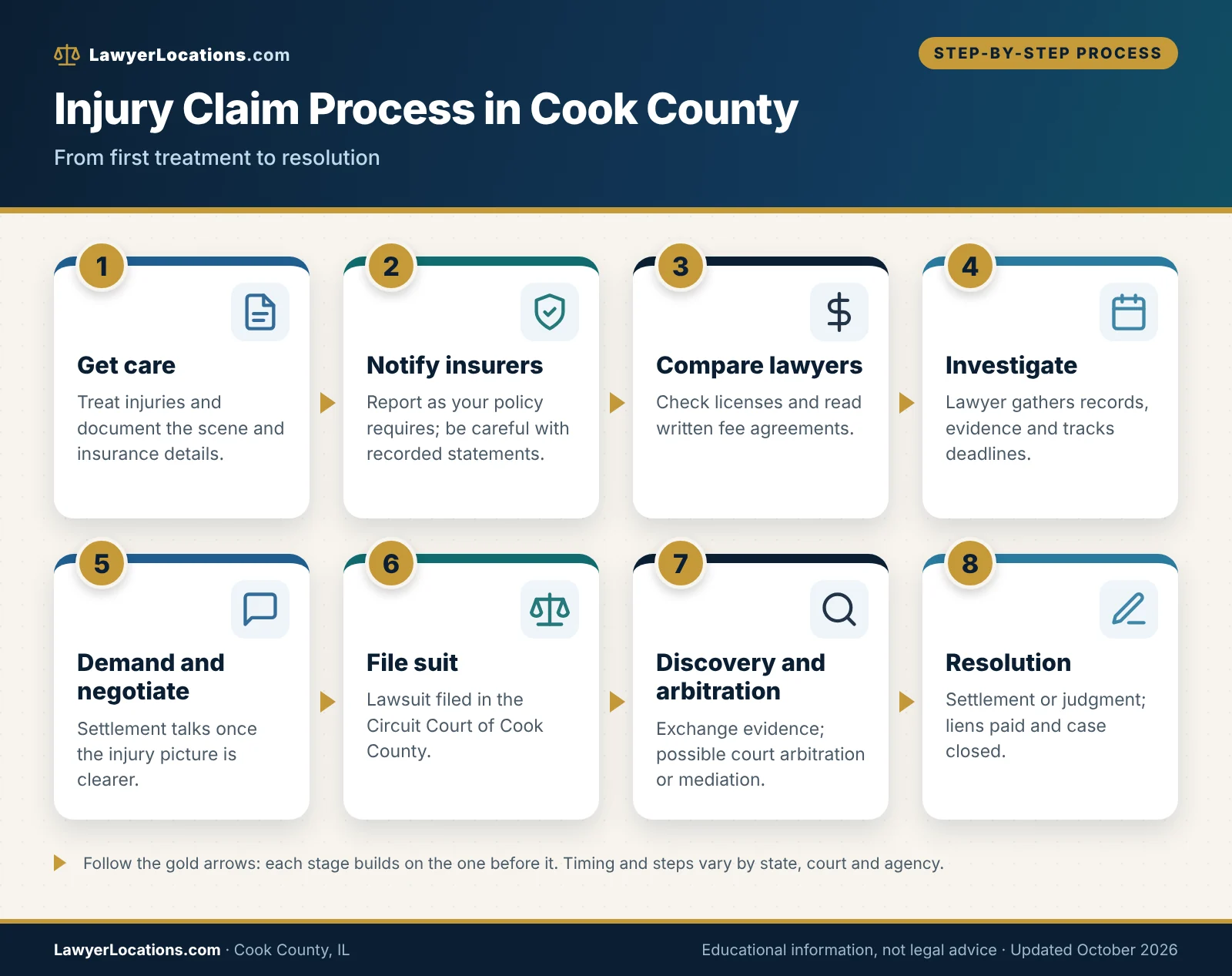
Text version of this graphic
- Get medical care and document the incident.
- Notify insurers as your policy requires; be cautious with recorded statements.
- Consult one or more Cook County personal injury lawyers and compare fee agreements.
- Your lawyer investigates, gathers records and tracks deadlines.
- Treatment progresses; your lawyer prepares a demand and negotiates.
- If there is no fair resolution, a lawsuit is filed in the Circuit Court of Cook County.
- Discovery, possible court-annexed arbitration, mediation or trial.
- Settlement, judgment or other resolution; liens are paid and the case closes.
In court: the Law Division and its neighbors
If negotiation does not resolve the claim, a lawsuit is filed. Cook County has a structure for sorting cases by size and location.
Which Cook County court hears the case
According to the court’s Law Division page, that division hears civil suits seeking money damages above $30,000 in Chicago and above $100,000 in the suburban districts. It sits at the Richard J. Daley Center, 50 W. Washington St., Chicago, IL 60602. Claims below those thresholds are generally handled elsewhere in the Circuit Court, in the Municipal Department.
| Where the case arises | Law Division range | Where to confirm |
|---|---|---|
| City of Chicago (First Municipal District) | Money damages above $30,000 | Law Division page, Circuit Court of Cook County |
| Suburban Cook County districts | Money damages above $100,000 | Law Division page, Circuit Court of Cook County |
| Smaller claims | Generally handled in the Municipal Department rather than the Law Division | Clerk of the Circuit Court of Cook County |
Your lawyer, not you, chooses where to file, but you should understand the logic. A modest-value claim from a suburban crash may sit in a different courthouse than a serious-injury claim from downtown Chicago.
E-filing, the clerk and court-annexed arbitration
Civil filings in Illinois are electronic. The Clerk of the Circuit Court of Cook County states that e-filing became mandatory for civil areas on July 1, 2018, and filers use an approved electronic filing service provider through the statewide eFileIL system. The Clerk’s office can be reached at (312) 603-5030, and the site offers live chat on weekdays.
Cook County has also expanded a mandatory arbitration program for personal injury cases. A June 2021 court announcement described judges referring cases valued at roughly $30,000 to $50,000 (higher-value cases at the judge’s discretion), with auto crash cases the most common. The parties get a short window for discovery, then present the case to an arbitrator. A party unhappy with the award can reject it by paying a $750 fee, and that party may owe the other side’s attorney fees for the arbitration work if they then lose at trial. Because that announcement dates from 2021, ask your lawyer how the program currently works and check the court’s current orders.
Arbitration in this setting is a stage within the court case, not a replacement for it. A rejected award still leads to a regular trial track.
Illinois law that shapes your Cook County claim
Three rules do most of the work in an Illinois injury case: the filing deadline, the fault-sharing rule and the insurance backdrop. They are statewide rules, but they decide whether a Cook County case is worth pursuing and how it should be valued.
The filing deadline
Illinois sets a time limit, called a statute of limitations, for starting a lawsuit. Miss it, and a court will usually dismiss the case no matter how strong the facts are.
The two-year general rule
Under 735 ILCS 5/13-202, actions for personal injury must generally be commenced within 2 years after the cause of action accrues, which usually means the date you were hurt. The statute lists narrow exceptions, including special treatment for damages arising from certain violent crimes when the offender is convicted. The Illinois Department of Insurance summarizes the practical side for consumers: bodily-injury claims generally carry a 2-year limit, and property damage claims a longer one.
Two years is the general rule, not a promise that every claim fits it. Claims against government bodies, claims involving children, and health-care claims can follow different clocks. If you are anywhere near the second anniversary of your injury, speak with a lawyer licensed in Illinois right away. For a wider look at this topic, see our national guide on how long you have to file a personal injury claim.
Shorter clocks and special situations
The Department of Insurance notes that when a government entity is involved, the time limit depends on that entity’s own statute. Illinois has a separate law, the Local Governmental and Governmental Employees Tort Immunity Act, for claims against local public bodies, and deadlines and notice steps under it can be much shorter than two years. In Cook County, where city, county, transit, park and school entities are everywhere, a fall on a public sidewalk or a crash involving a public vehicle can raise this issue.
The Department also says a minor generally has two years from their 18th birthday. Wrongful-death claims, medical-negligence claims and other special categories have their own rules; our wrongful death lawyer cost guide discusses how those cases are handled from a fee standpoint.
| Topic | General rule | Source to check |
|---|---|---|
| Bodily-injury lawsuit | Within 2 years after the claim accrues | 735 ILCS 5/13-202; Illinois Department of Insurance |
| Property damage | Longer than injury claims (the Department of Insurance lists 5 years) | Illinois Department of Insurance |
| Injured minor | Generally 2 years after the 18th birthday | Illinois Department of Insurance |
| Government defendant | Governed by that entity’s own statute; often shorter and with notice steps | Illinois Department of Insurance; the Tort Immunity Act |
| Plaintiff more than 50% at fault | Barred from recovering damages | 735 ILCS 5/2-1116 |
| Plaintiff 50% or less at fault | Damages reduced in proportion to your share of fault | 735 ILCS 5/2-1116 |
Shared fault and insurance
Fault in Illinois is rarely all-or-nothing. How a jury or an adjuster divides it can change a settlement more than the medical bills do.
The 50% bar
Illinois uses a form of modified comparative fault. Under 735 ILCS 5/2-1116, a plaintiff in a negligence case is barred from recovering damages if the trier of fact finds the plaintiff’s own fault is more than 50% of the proximate cause of the injury. If the plaintiff’s fault is 50% or less, recovery is allowed but reduced in proportion to that fault.
Suppose a jury values a case at $100,000 and finds the injured person 20% at fault. The award would be reduced by that 20%. If the same jury found the injured person 51% at fault, the plaintiff would receive nothing. The dollar figures here are illustrative, not predictions.
This is why insurers often look for any argument that you share blame, such as a late brake, a missed signal or a phone in the car. It is also why lawyers care about independent evidence like video, police reports and witness statements.
Insurance limits and what they mean for recovery
The Illinois Department of Insurance states that most drivers must carry liability limits of 25/50/20: $25,000 per person and $50,000 per accident for bodily injury, and $20,000 for property damage. Those are minimums. A seriously injured person can face medical costs that exceed what a minimum policy pays, which makes it important to look at your own coverage, including any underinsured or uninsured motorist protection.
If the at-fault driver has no insurance or too little, read our overview of an uninsured motorist claim lawyer. Ask any attorney you interview how they will investigate every possible source of recovery, not just the first policy that shows up.
Pull out your own auto policy declarations page before the consultation. Knowing your own limits helps a lawyer spot coverage you may not realize you have.
What a personal injury lawyer costs in Cook County
Most injury lawyers in this field are paid on contingency, which means a percentage of the recovery rather than an hourly bill. The percentage and the treatment of expenses vary from firm to firm, so the written agreement is what matters.
How contingency fees work
A contingency fee means the lawyer is paid only if the case produces money, and the fee comes out of that money. That structure opens the courthouse door for people who could not afford hourly rates, but it is not the same as “free.”
Fees versus costs
Two different things can come out of a recovery. The fee is the lawyer’s percentage. Case costs are the out-of-pocket expenses of building the case, such as filing fees, records, expert witnesses, depositions and medical-report charges. Agreements differ on whether costs are deducted before or after the fee is calculated, and that order can change your net amount significantly.
Illinois ethics guidance summarized by the Illinois State Bar Association treats contingent fees as permissible when the arrangement is written and reasonable in amount. Ask for the full written agreement before you commit, and read it at home rather than at the lawyer’s desk.
Be cautious if a lawyer refuses to put the percentage, the cost rules or the circumstances in which the fee changes into writing. A confident verbal promise is not a substitute for a signed agreement.
Fee tiers and what changes them
Some agreements use a single percentage; others step it up as the case advances, for example one rate if the case settles before a lawsuit and a higher rate once a complaint is filed or trial is near. Ask exactly which events trigger a change, and ask what you would owe if you ended the relationship partway through. We do not publish average percentages here because they vary by firm and case, and no official source sets one for Cook County.
Our related guide on wrongful death lawyer costs gives a good model of the kinds of fee questions to put to any injury attorney, even outside that specific category.
Other money questions
Fees are only one part of the financial picture. Liens, medical bills and the timing of payment can matter just as much to what you actually keep.
Medical bills, liens and net recovery
Hospitals, health insurers, Medicare, Medicaid and others may claim a right to be repaid out of a settlement. These claims are called liens or reimbursement rights, and they reduce your take-home amount unless they are negotiated. A careful lawyer will ask about them early and explain how they affect the numbers. Our guide on medical bills after a car accident explains how bills are handled while a claim is pending.
| Topic | What to ask | Why it matters |
|---|---|---|
| Fee percentage | What is the percentage, and does it change if a lawsuit is filed or trial begins? | Determines the lawyer’s share at each stage |
| Case costs | Who advances costs, and are they deducted before or after the fee is calculated? | Changes your net recovery |
| If you lose | Do I owe anything for fees or costs if there is no recovery? | Clarifies your downside risk |
| Liens | Who will identify and negotiate medical liens, and is there extra charge for that? | Liens reduce what you take home |
| Ending the relationship | What do I owe if I change lawyers? | Prevents surprises if the match is poor |
| Closing statement | Will I receive a written breakdown of fees, costs and payments at the end? | Lets you check every deduction |
Filing fees and what to expect
Courts charge fees to start a case and for certain motions, and Illinois courts allow people with limited means to ask for a fee waiver. Because those amounts are set by court schedules that change, we do not quote them here; check the Clerk of the Circuit Court of Cook County’s current fee schedule or ask your lawyer which charges will be advanced as case costs.
A lawyer’s willingness to explain these items in plain language is itself useful information. If you cannot get a straight answer about fees before you sign, you are unlikely to get one afterward.
How to compare personal injury lawyers in Cook County
Compare lawyers on verifiable facts and clear answers, not on advertising volume. Check each license, read each fee agreement, and see how each candidate talks about your specific facts.
What to verify before the first meeting
A few checks take minutes and filter out most of the avoidable problems. Do them before you spend a consultation slot on someone.
License status and discipline history
The Attorney Registration and Disciplinary Commission of Illinois (ARDC) runs a public Lawyer Search that shows license status, contact details, public disciplinary history, and whether the lawyer reports malpractice insurance. Run every candidate through it. If a lawyer is based elsewhere, make sure they are licensed in Illinois and ask who would actually appear in Cook County court.
The ARDC also takes complaints at no charge, though it says it does not settle fee disagreements, give legal advice or take over a case. Knowing what the agency can and cannot do helps you set realistic expectations if a problem arises later.
Experience that matches your case
“Experience” is only useful if it fits your facts. A lawyer who regularly handles crash claims may or may not be the right fit for a premises case, a product claim or a government-defendant claim. Ask how many cases of your type the lawyer has handled in Cook County courts, how many went to a jury, and who in the office does the day-to-day work.
Treat words like “best,” “top” or “sure win” as marketing, not evidence. No ethical lawyer can promise an outcome, and neither can this directory.
Questions that reveal fit
The consultation is a two-way interview. You are deciding whether to trust this person with a decision that affects your health, income and finances.
Strategy, staffing and communication
Ask the lawyer to describe how they would approach your case in plain language. Good answers cover liability evidence, the injuries and treatment, the likely venue, the insurance picture and the main risks. Then ask about communication: who answers your calls, how often you will get updates, and whether decisions to settle are always yours.
- Who will handle my case day to day, and who will appear in court?
- What is the biggest risk you see in my claim?
- How do you decide when to recommend settling versus filing suit?
- How will you keep me informed, and how fast do you usually return messages?
- Will you explain every settlement offer to me in writing?
Comparing two or three candidates side by side
Meeting more than one lawyer is reasonable and normal. Use the same questions with each so that the answers are comparable, and write notes immediately afterward while the impressions are fresh. Do not feel pressure to decide in the room.
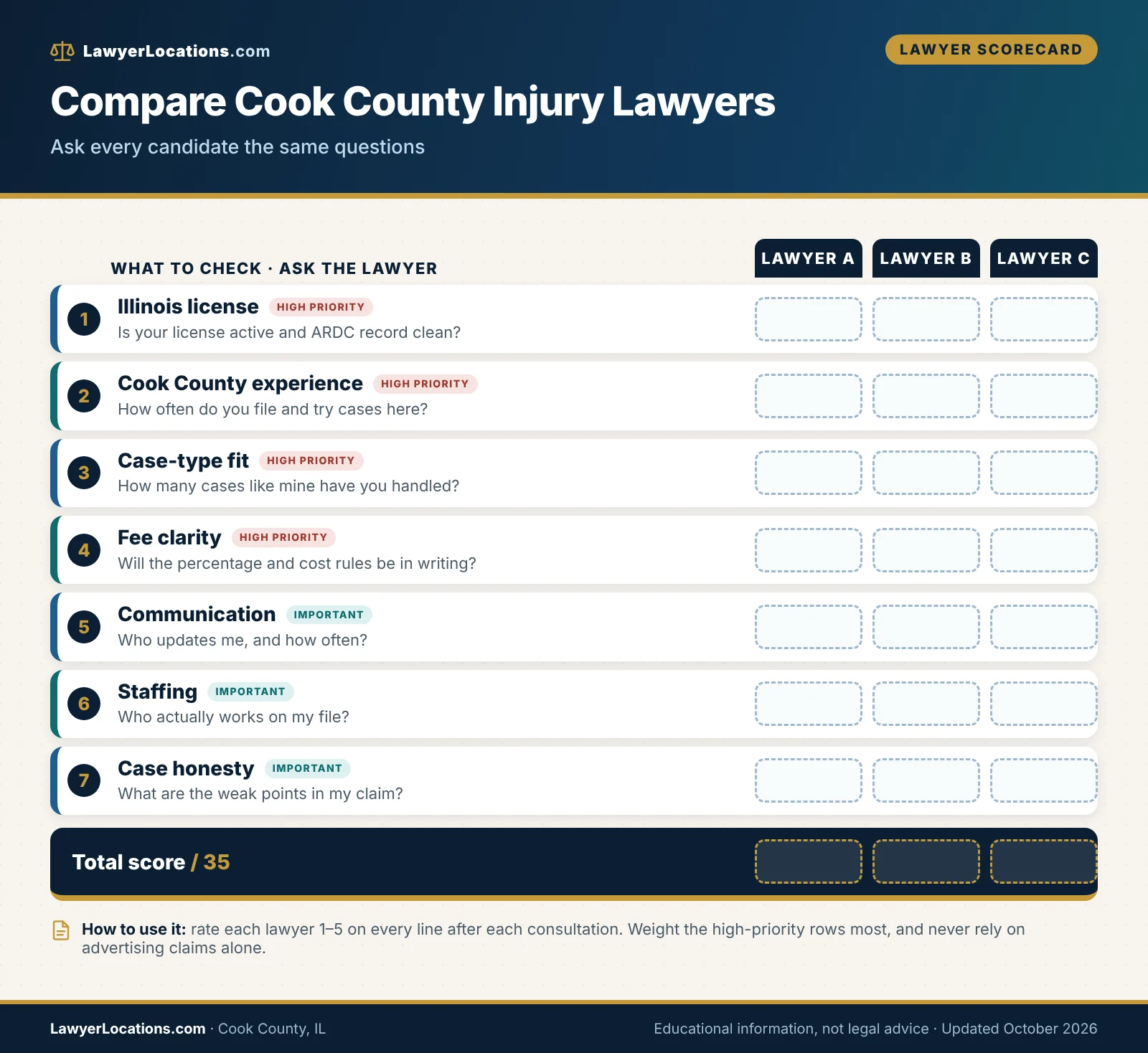
Text version of this graphic
| Criterion | Question to ask |
|---|---|
| Illinois license | Is your license active, and is your ARDC record clean? |
| Cook County experience | How often do you file and try cases in Cook County courts? |
| Case-type fit | How many cases like mine have you handled? |
| Fee clarity | Will the percentage and cost rules be in writing? |
| Communication | Who updates me, and how often? |
| Staffing | Who actually works on my file? |
| Case honesty | What are the weak points in my claim? |
| Factor | Lawyer A | Lawyer B | Lawyer C |
|---|---|---|---|
| Active Illinois license and clean ARDC record | |||
| Cook County court experience with my type of case | |||
| Written fee agreement is clear and complete | |||
| Honest about risks and weak points | |||
| Communication plan I can live with |
Deadlines, decision points and consultation prep
A Cook County injury case has a rhythm: a long stretch of treatment and negotiation, a few hard deadlines, and a handful of decisions that belong to you. Knowing where those fall helps you stay in control.
The timeline and the decisions inside it
Timing varies enormously with injury severity, insurance cooperation and court calendars, so treat any timeline as a rough outline rather than a forecast.
Stages and the clocks that run alongside them
The earliest stage is treatment and evidence gathering. Next comes negotiation, often after your doctors have a clearer view of recovery. If no fair resolution emerges, a lawsuit must be filed before the limitations period expires, which for most bodily-injury claims is two years from the injury. After filing, the case moves through discovery (the exchange of information and depositions), possible court-annexed arbitration or mediation, and, if still unresolved, trial.
Because each stage can take months, lawyers usually calendar the filing deadline with a margin and avoid waiting until the final weeks. Ask any attorney how they track that date and what internal reminders they use.
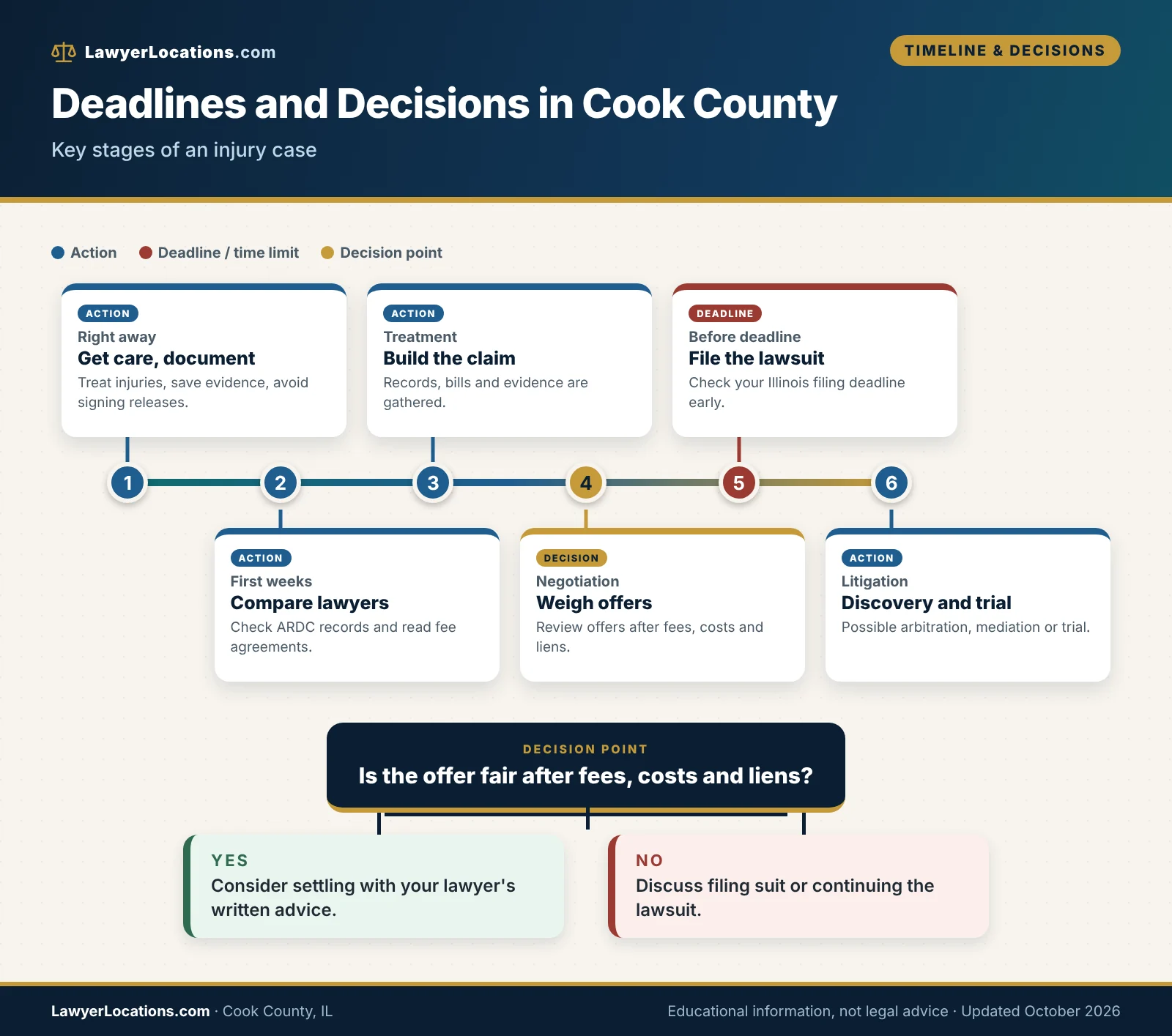
Text version of this graphic
- Right after the injury (action): Get care, document the scene, and avoid signing anything.
- First weeks (action): Consult lawyers and compare written fee agreements.
- Treatment period (action): Lawyer gathers records and evidence while you follow medical advice.
- Demand and negotiation (decision): Consider settlement offers with your lawyer’s advice.
- Before the filing deadline (deadline): A lawsuit must be filed within the statute of limitations.
- Litigation (action): Discovery, possible arbitration or mediation, then trial if needed.
- Decision point: Is the offer fair after fees, costs and liens? If yes, consider settling. If no, discuss filing or continuing the lawsuit.
Settle or sue: how to think about the decision
The choice to accept an offer is yours, not your lawyer’s. A sound recommendation weighs the strength of liability evidence, the extent and permanence of the injury, the insurance limits available, the risk that a jury finds you partly at fault, and what you would net after fees, costs and liens. Ask your lawyer to show you those numbers in writing for each offer.
A settlement negotiation does not stop the limitations clock. Unless a written agreement says otherwise, the filing deadline keeps running while an insurer “reviews” your claim.
Preparing for the consultation
Walking into a consultation with organized information lets a lawyer give a more useful answer in less time, and lets you compare candidates on the same facts.
Documents and information to bring
Gather what you have without worrying if it is incomplete. Missing pieces can be requested later. The point is to give the lawyer a clear picture of what happened and what it has cost you.
- Photos and video of the scene, vehicles, hazards and injuries
- Police report number or incident report, if one exists
- Names and contact information for witnesses
- Your insurance policy and the other party’s insurance details
- Medical records, bills and a list of providers you have seen
- Pay stubs or other proof of missed work
- Any letters, emails or messages from insurers
- A short written timeline of the incident while memories are fresh
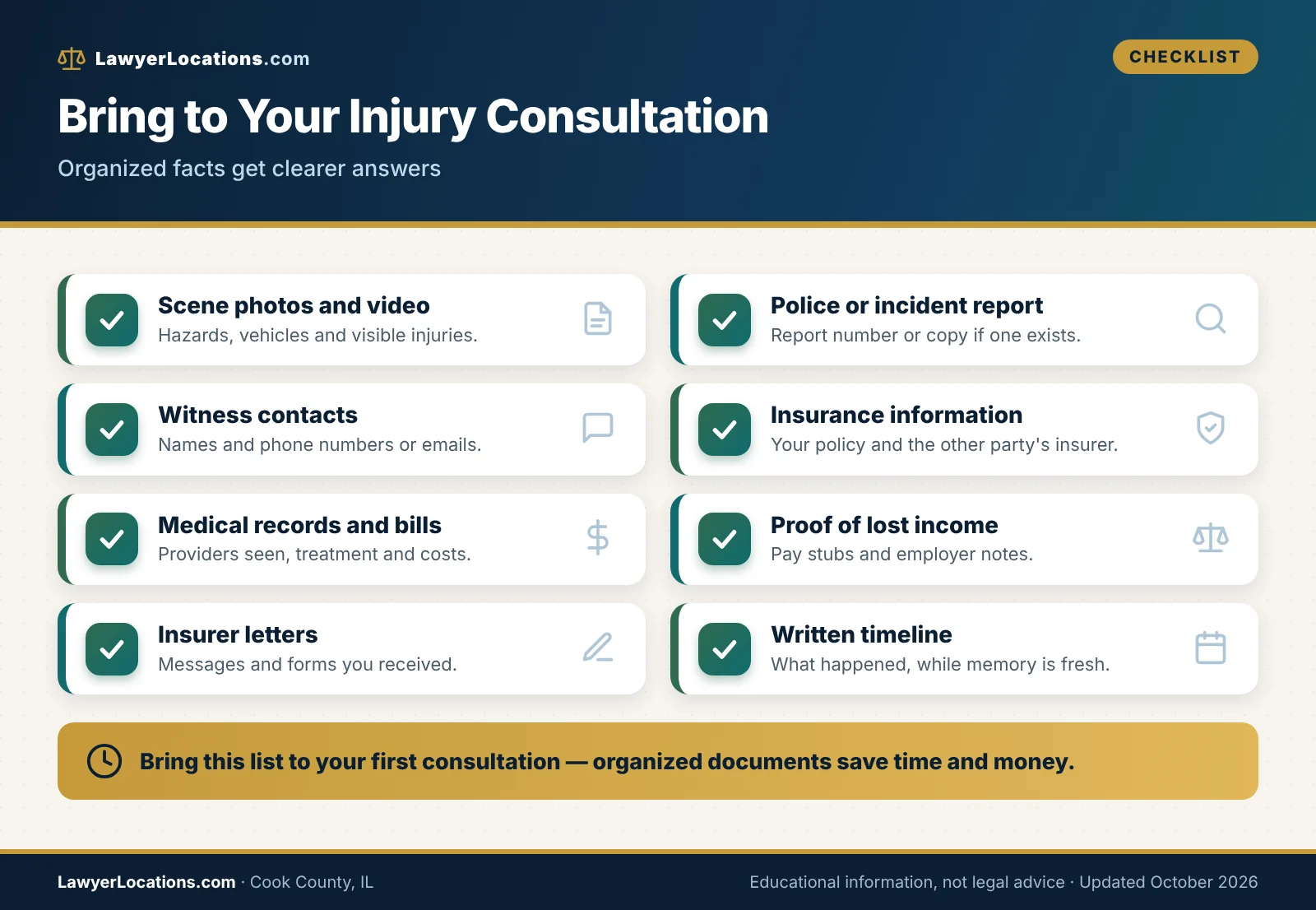
Text version of this graphic
- Photos and video of the scene and injuries
- Police or incident report details
- Witness names and contact information
- Your insurance policy and the other party’s insurer
- Medical records and bills
- Proof of missed work and lost income
- Insurer letters and messages
- A written timeline of what happened
Habits that protect your claim
A few everyday choices can quietly affect a claim. Keep following your doctor’s treatment plan, because gaps in care give insurers an argument that you were not hurt as badly as you say. Be careful about posting on social media, since photos and comments can be used out of context. And keep a simple journal of symptoms, missed activities and expenses.
keep every receipt Out-of-pocket costs such as parking at appointments, prescriptions and medical devices add up, and they are easy to forget without a paper trail. Our guide on whether you need a lawyer after a car accident can help you judge how far you need to take things.
Local resources, red flags and next steps
Cook County offers several public and nonprofit resources for finding a lawyer, checking one out, and understanding the court system. Combined with a few red-flag checks, they put you in a better position to choose.
Local resources worth knowing
These organizations are not endorsements. They are starting points for verification and information, and each has its own rules and limits.
Finding and checking a lawyer
The Chicago Bar Association’s Lawyer Referral Service has a personal injury referral program for injuries sustained in Cook County or nearby Illinois counties. According to the service, the referred lawyer collects a $30 fee at the initial consultation that supports the service’s operating costs, the lawyer may also charge for their time so you should ask in advance, and neither you nor the lawyer must continue after the first meeting. The service lists a phone number of (312) 554-2001, with staff available weekdays.
After you have a name, confirm it on the ARDC Lawyer Search. A referral service is a starting point; it does not replace your own due diligence or your own comparison of fee agreements.
Courts and insurance regulators
For questions about filing, the Clerk of the Circuit Court of Cook County can be reached at (312) 603-5030, and the court’s Law Division page lists the division’s address and main phone. For disputes with an insurance company’s handling of a claim, the Illinois Department of Insurance lists consumer offices, including one at 115 S. LaSalle Street in Chicago.
| Resource | What it offers | Contact detail listed by the organization |
|---|---|---|
| Chicago Bar Association Lawyer Referral Service | Personal injury lawyer referrals for Cook County and nearby counties | (312) 554-2001, weekdays |
| ARDC Lawyer Search | License status, public discipline, malpractice-insurance reporting | iardc.org |
| Clerk of the Circuit Court of Cook County | Civil filing information, e-filing guidance, live chat on weekdays | (312) 603-5030 |
| Circuit Court of Cook County, Law Division | Information on Law Division cases and sections | Daley Center, 50 W. Washington St., Chicago; (312) 603-6343 |
| Illinois Department of Insurance | Consumer guidance on auto claims and insurer duties | 115 S. LaSalle St., 13th Floor, Chicago; (312) 814-2420 |
Red flags and common mistakes
Most problems with injury representation start with a rushed decision or a vague agreement. A little skepticism early costs nothing.
Warning signs when choosing a lawyer
Pressure is the biggest signal. A legitimate lawyer will let you take an agreement home, read it and ask questions. Beware of anyone who contacts you unprompted right after an injury and pushes you to sign immediately.
- Promises of a specific result or dollar amount before reviewing your records
- Reluctance to put fee terms and cost rules in writing
- Pressure to sign on the spot or to avoid talking to other lawyers
- Vague answers about who will handle your file
- No clear plan for tracking the filing deadline
- Discouraging you from following your doctor’s advice
Mistakes that can weaken a claim
Common errors include giving a recorded statement to the other side’s insurer without advice, signing a release before treatment is complete, posting about the injury on social media, skipping medical appointments, and waiting too long to consult a lawyer. Each is avoidable once you know about it.
- You compare two or three lawyers with the same questions
- You read the fee agreement before signing
- You keep records and follow medical advice
- You rush because of pressure or fear
- You accept a quick offer before your injuries are understood
- You assume a verbal promise will be honored
Next steps and quick answers
You do not need to solve everything at once. A short sequence of steps is enough to move forward with confidence.
A short action plan
- Protect your health and your proof. Get treatment and save photos, records and receipts.
- Note your deadline. Mark two years from the injury on your calendar, and check sooner if a government body may be involved.
- Verify candidates. Use the ARDC Lawyer Search and, if helpful, a bar referral service.
- Compare fee agreements. Take them home and read them closely.
- Choose and confirm in writing. Keep a signed copy of the agreement.
Ready to compare your options?
Use the scorecard and questions above to line up two or three Cook County personal injury lawyers, check each one’s record, and choose based on clear answers rather than pressure. If your situation involves a crash, our guide to personal injury lawyers in Chicago adds city-level detail.
Quick answers to common Cook County questions
These short answers address questions people often ask when they search for a personal injury lawyer near them in Cook County. They are general information, not advice about your case.
Where do I file a personal injury lawsuit in Cook County?
Injury suits are filed in the Circuit Court of Cook County. Per the court’s Law Division page, that division hears suits seeking more than $30,000 in Chicago and more than $100,000 in the suburban districts. Your lawyer decides the proper venue.
How long do I have to sue after an injury in Illinois?
The general rule under 735 ILCS 5/13-202 is two years from when the claim accrues. Claims against government bodies and some other categories can have different or shorter deadlines.
Can I recover if I was partly at fault?
Yes, if your fault is 50% or less. Under 735 ILCS 5/2-1116 your damages are reduced by your share of fault, and you are barred if you are found more than 50% at fault.
Do I pay a personal injury lawyer upfront?
Many injury lawyers work on contingency, meaning the fee comes from any recovery. Case costs and the rules for them vary, so get the terms in writing before you sign.
What is the minimum auto insurance in Illinois?
The Illinois Department of Insurance lists 25/50/20 liability limits for most drivers: $25,000 per person, $50,000 per accident for bodily injury, and $20,000 for property damage.
Is there a way to find a lawyer through a local bar association?
The Chicago Bar Association operates a Lawyer Referral Service with a personal injury program. Ask about any consultation fee before the meeting, and verify the lawyer on the ARDC Lawyer Search.
Does arbitration replace a trial in Cook County?
Not necessarily. The court’s mandatory arbitration program for certain injury cases is a stage within the case, and a party can reject the award by paying a fee, as described in the court’s 2021 announcement. Ask your lawyer how it applies now.
Should I talk to the other driver’s insurance company?
The Illinois Department of Insurance notes that the other insurer’s main duty is to its own policyholder. Consider speaking with a lawyer before giving a recorded statement or signing a release.
Who can I contact if I have a problem with my lawyer?
The ARDC accepts complaints at no cost, though it says it does not resolve fee disputes or provide legal advice. Start by raising the concern with the lawyer in writing.
Sources & References
Show all 9 sources
- 735 ILCS 5/13-202 (Personal injury limitations period) — Illinois General Assembly — ilga.gov — accessed October 2026
- 735 ILCS 5/2-1116 (Modified comparative fault) — Illinois General Assembly — ilga.gov — accessed October 2026
- Law Division — Circuit Court of Cook County — cookcountycourtil.gov — accessed October 2026
- Expanded arbitration program will speed up outcomes for personal injury cases — Circuit Court of Cook County — cookcountycourtil.gov — accessed October 2026
- eFile — Clerk of the Circuit Court of Cook County — cookcountyclerkofcourt.org — accessed October 2026
- Filing a Claim with Another Driver’s Insurance Company — Illinois Department of Insurance — idoi.illinois.gov — accessed October 2026
- Personal Injury lawyer referral — Chicago Bar Association Lawyer Referral Service — lrs.chicagobar.org — accessed October 2026
- FAQs for the Public — Attorney Registration and Disciplinary Commission of Illinois — iardc.org — accessed October 2026
- Illinois Rule of Professional Conduct 1.5 (Fees) and related ethics opinions — Illinois State Bar Association — isba.org — accessed October 2026
General information only. This article is a general educational resource, not legal advice, and reading it does not create an attorney-client relationship. LawyerLocations.com is not a law firm and does not recommend or rate individual lawyers. Laws, court rules, fees and procedures change, and your facts matter. Consult a lawyer licensed in Illinois about your situation.
Legal Disclaimer and Limitation of Liability
Informational and illustrative purposes only. This article was prepared by LawyerLocations.com solely on the basis of the information available to us at the time of writing. It is an illustrative, general overview. It is not a complete or authoritative statement of the law, and it has not been reviewed by a lawyer licensed in your state or county.
Not legal advice. Nothing in this article is legal, financial, tax or immigration advice, and reading it does not create an attorney-client relationship between you and LawyerLocations.com or any author, lawyer or firm mentioned. Laws, court rules, fees, filing deadlines and agency procedures differ by state, county and court, and they change often. Some details here may be simplified, incomplete or out of date, and time limits for legal claims can be short.
No warranty. We make no representation or warranty, express or implied, about the accuracy, completeness, timeliness or suitability of this content for your situation. Please do not rely on it to make, delay or skip any legal decision. Check the facts against official sources and speak with a licensed attorney in the relevant jurisdiction before you act.
Limitation of liability. To the fullest extent permitted by law, LawyerLocations.com and its owners, authors and contributors disclaim all liability for any loss, damage, cost or other consequence arising from the use of, or reliance on, this article, including any content on third-party websites we link to. Mentioning a lawyer, firm, organization or service is not an endorsement and is not a promise of any result. If you are in immediate danger, contact your local emergency number.